Public transportation in Vienna is the city’s integrated network of U-Bahn subway lines, S-Bahn local trains, trams, and buses. Run mainly by Wiener Linien, it is known for being clean, frequent, efficient, and easy to use. One ticket or pass usually covers city train and subway services, plus nearly all tram and bus routes inside the city zone. The system works on an honor basis: there are no ticket barriers, but you still need a valid ticket because random checks do happen.
| Key | Information |
|---|---|
| Main operator | Wiener Linien operates the main city transport network. |
| Transport modes | U-Bahn, S-Bahn or Schnellbahn, Straßenbahn trams, and buses. |
| Ticket system | Tickets and passes generally work across city public transport, as long as the journey follows the fare rules. |
| Validation | Some tickets must be validated before boarding or at the start of the journey. |
| Airport zone | Vienna Airport is outside the city transport zone, so a Vienna-only pass may not cover the full airport route. |
| Best for visitors | Time-based passes such as 24-hour, 7-day, or longer network tickets are often the simplest option for frequent trips. |
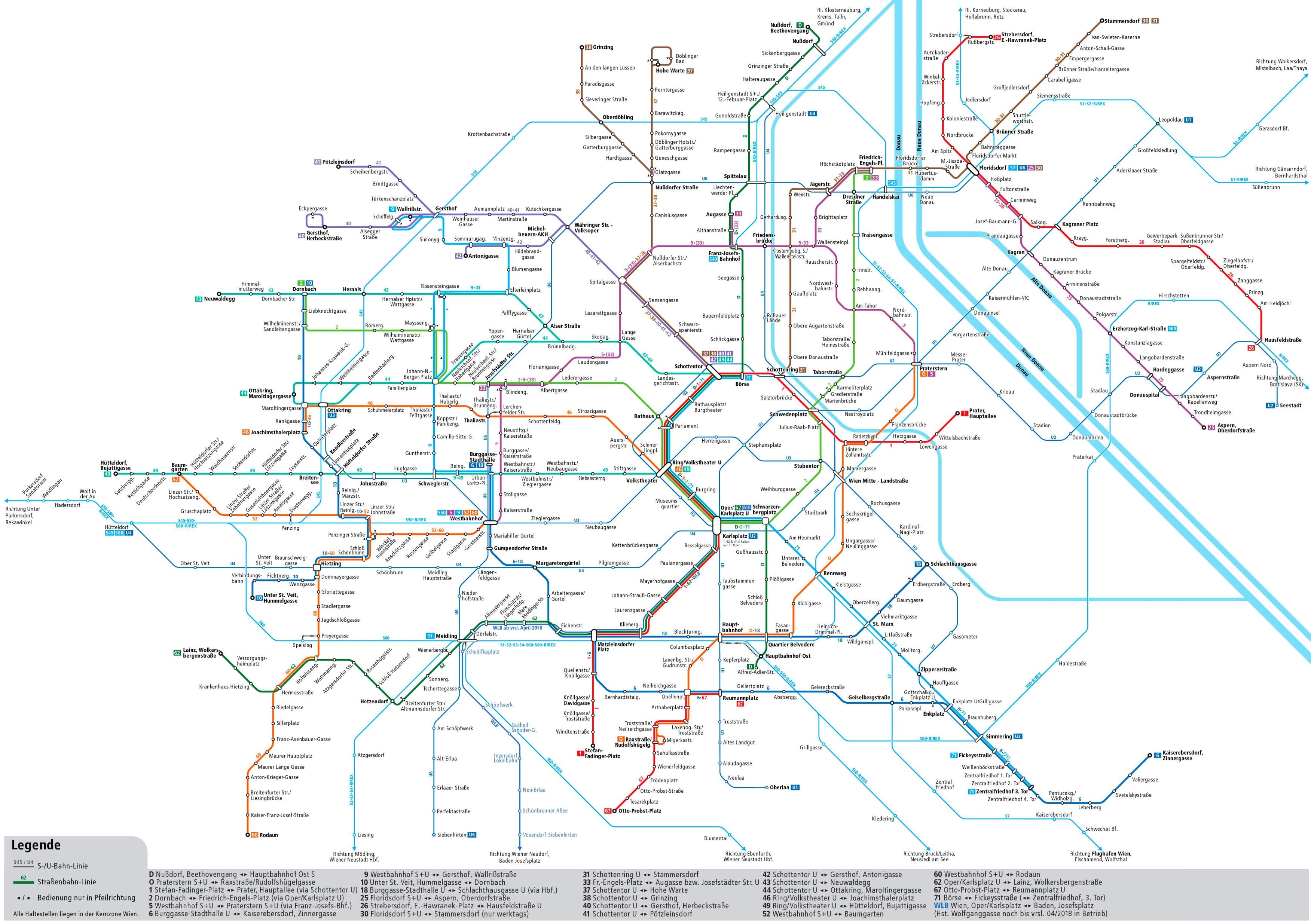
Map of Public Transportation in Vienna
Map of public transport system in Vienna showing different lines and stations. Click on the map to enlarge it or download the map in PDF format.
Buses and streetcars in Vienna
Buses and streetcars are a practical part of transportation in Vienna, especially for areas not directly served by the U-Bahn. They are integrated with the wider Wiener Linien system, so you normally do not need a separate ticket when changing between bus, tram, subway, and local train services within the city fare rules.
A single ticket is valid for one direct journey. You may change between public transport modes, but you should not interrupt the trip or use the ticket for a round trip. If your ticket needs validation, stamp it before boarding or at the start of travel. On buses and trams, validation can also be done on board.
For more than a couple of rides in one day, a pass is usually easier. Vienna offers 24-hour, 7-day, 31-day, and annual options, and tourist cards may combine transport with discounts. Tickets are available from station ticket offices, ticket machines, the Wiener Linien online store or app, selected Trafik newsagents, and sometimes directly on trams.
Children under six travel free. Children aged 6 to 15 have reduced-fare options and can travel free on Sundays, public holidays, and during official school vacation periods in Vienna.
Trams in Vienna
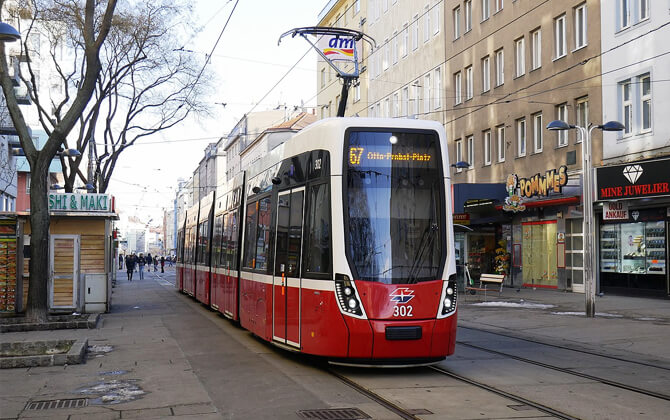
Vienna’s trams, also called streetcars, are one of the most recognizable parts of local transport. The tramway system dates back to the 1800s and remains a major everyday transport option. The available information describes the network as covering around 171 km, or about 106 miles, with just under thirty regular lines and a fleet of more than 500 tramcars.
Trams run on rails set into the road and use overhead electric cables. Most services operate from early morning until after midnight, with selected night services on some routes. During the day, frequency is often around every 3 to 8 minutes, so waiting times are usually short.
Tickets must be valid before you ride. Where validation is required, use the onboard stamping device or ticket machine. After validation, the ticket can be used for continuous travel within the network rules.
| Station | Details |
|---|---|
| Line 1 route | Runs between the Prater area and the south of the city, using much of the Ring route. |
| Line D route | Connects parts of the Ring with Hauptbahnhof, the Belvedere area, and northern Vienna. |
| Line 71 route | Travels from the center past Belvedere to the Zentralfriedhof. |
| Line 2 route | Runs from the Danube area through much of the city center and onward to the west. |
Modern low-floor trams, known as Niederflur trams, make boarding easier for passengers with prams, luggage, or wheelchairs. Newer Flexity trams are already in operation on selected lines, and many stops have raised platforms. Trams also provide stop announcements and route information on screens and through loudspeakers.
When leaving the tram, press the exit button before your stop. If you are boarding and the door does not open automatically, use the outside button. Drivers should be especially careful near tram tracks: trams have right of way and should not be blocked.
Vienna U-Bahn or Vienna subway system
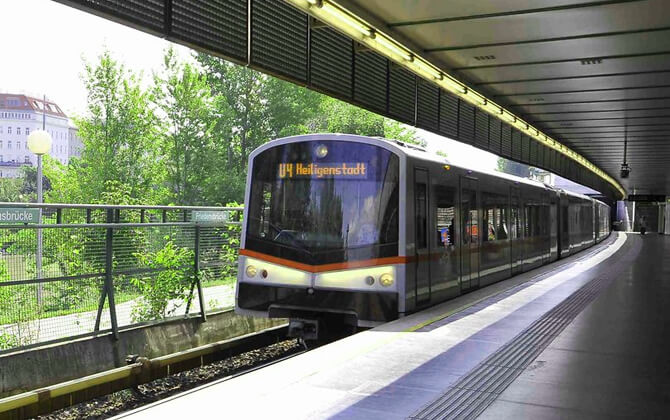
The Vienna U-Bahn is the fastest way to move around much of the city. The subway system has five main lines, U1, U2, U3, U4, and U6, with around 109 stations and about 84 km, or 52 miles, of track. Trains are generally clean, modern, and frequent, especially during working hours.
The U-Bahn uses the same integrated city transport ticketing approach as trams, buses, and many local train journeys. There are no ticket barriers at stations, but a valid ticket or pass is still required. For visitors, a network pass can make the route plan simpler because it removes the need to buy a new ticket for each short trip.
| Service detail | Timings |
|---|---|
| Usual starting time | First trains usually depart around 5:00 am. |
| Monday to Friday closing time | The subway generally runs until around midnight. |
| Weekend and public holiday service | On Fridays, Saturdays, Sundays, and before public holidays, the U-Bahn runs through the night about every 15 minutes. |
| Night alternatives | NightLine buses operate during overnight hours when the subway is not running on regular weekday nights. |
Accessibility is strong across the system. Stations have elevators and escalators, and trains and stations include tactile guidance for passengers with visual impairments. The network is also known for being safe and well maintained.
The U-Bahn connects easily with major sights such as St. Stephen’s Cathedral, Schönbrunn Palace, and the Prater. For a stations map, stations list, timetable, route timetable, or schedule today, use the official transport planning tools and station displays. Vienna is also planning an expansion: the new U5 line is expected to enter service in 2030.
Vienna S-Bahn
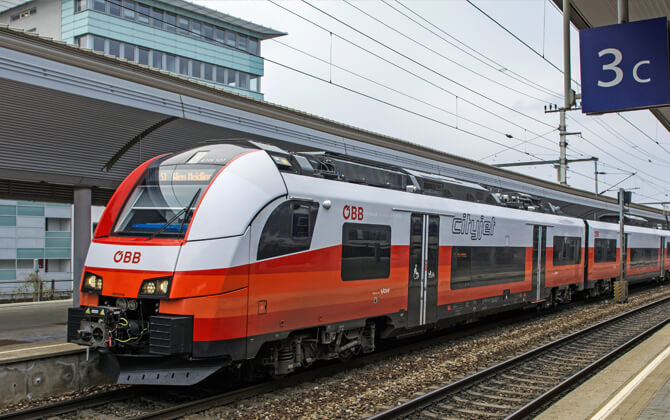
The Vienna S-Bahn, or Schnellbahn, is the local train network that works alongside the U-Bahn, trams, and buses. It is useful for longer cross-city trips and regional connections, while still forming part of the wider public transport system used for transportation in and around Vienna.
Tickets and passes are generally integrated with other city transport services, depending on the route and fare zone. Some tickets must be validated before boarding, and validation machines are available at S-Bahn stations and platforms where required.
For visitors who plan several trips, a time-based ticket or network pass can be more convenient than buying single tickets repeatedly. Timetables, route maps, train schedule information, and route planning tools cover S-Bahn services together with the rest of the network.
Airport Connections
Vienna Airport is well connected to the city by car, bus, and train, with services close to the arrivals area. The key point to remember is fare zone coverage: the airport is outside the Vienna city transport zone, so a Vienna-only public transport pass may not cover the full journey.
By car, taxi and transfer counters are in the arrivals hall. After customs, go left and the limousine and taxi counters are shortly on the right. Taxis usually leave from the road outside arrivals or nearby short-term parking. Uber also operates in Vienna. Car hire is available at the airport; the main rental center is reached by going left after customs, down the large ramp, then right at the bottom toward Deck 0 of the P4 multi-storey car park.
By train, look right after customs for the ramp down to the station under the terminal. The station has ticket offices, machines with English displays, and departure boards showing train timings to Vienna and beyond.
| Station | Details |
|---|---|
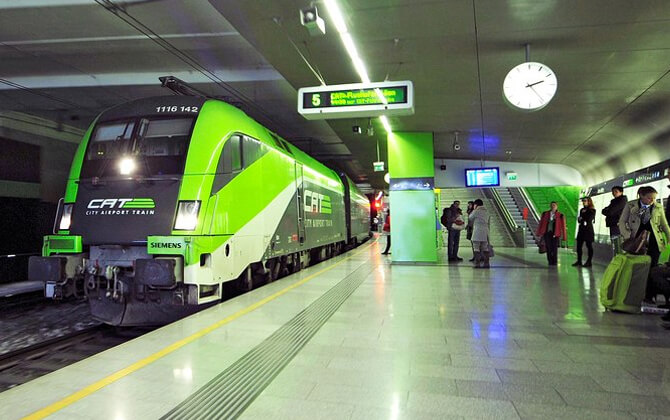
| Wien Mitte | Reached by the City Airport Train, or CAT, in 16 minutes. The station connects with U3 and U4 subway lines. |
| S7 city train route | Slower than the CAT but cheaper and useful for destinations along its route. |
| Wien Hauptbahnhof | Served by Railjet national trains from the airport. |
| Airport bus stops | Vienna Airport Lines buses stop immediately outside the terminal. |
| Morzinplatz/Schwedenplatz | One of the city areas served by airport bus services. |
| Westbahnhof | Connected to the airport by Vienna Airport Lines services. |
| VIECON / Messe Wien area | Served by airport bus connections. |
| UN / Austria Centre area | Airport bus services also connect to this area and nearby hotels. |
The CAT, S7, and Railjet services generally run at about 30-minute intervals during the day. If you prefer the bus, stops are immediately outside the terminal as you leave customs and enter arrivals. Tickets can be bought online in advance, from the driver, or from a machine inside the arrivals hall.
If you arrive late or want extra comfort before continuing, hotels are available near the airport, including options next to the arrivals area.
Getting around in Vienna
Getting around in Vienna is usually easiest by public transport. The city transport system covers most places visitors need, and changing between U-Bahn, S-Bahn, trams, and buses is straightforward when your ticket or pass is valid for the route.
Tickets are sold at station machines, ticket offices, the Wiener Linien online store or app, and selected Trafik newsagents. Some tickets need stamping before travel, while others already show their valid period. A single ticket suits a direct journey; a 24-hour network card, 7-day pass, or 31-day pass is often better if you expect frequent trips. Always check the fare rules and ticket price before you travel, especially when heading beyond the city zone.
| Service detail | Timings |
|---|---|
| General public transport operating hours | The Vienna Transport Authority operates nearly 20 hours per day. |
| Underground weekend opening hours | On weekends and public holidays, the underground runs throughout the night. |
| Planning timings today | Use the WienMobil app or station information for the current schedule, opening times, route timetable, and last train details. |
The WienMobil app is useful for a live route plan across public transport and other travel options in the city. You can also download a map showing subway lines and express connections, which helps when comparing routes before you ride.
- U-Bahn: the fastest option for many central and cross-city trips.
- Trams: a good choice for seeing more of Vienna at street level.
- Buses: useful where the subway or tram network does not reach directly.
- S-Bahn: practical for some longer city and regional journeys.
Vienna also has regulated taxis if you need a cab, but for most day-to-day travel, public transport is the most practical and economical choice.