Taipei Metro, also known as Taipei Mass Rapid Transit or MRT and branded as Metro Taipei, is the main rapid transit system for Taipei and New Taipei City in Taiwan. Operated by Taipei Rapid Transit Corporation, it is central to public transport, local transport, and daily transportation in Taipei. Service began on March 28, 1996, and the system has grown from the island’s first rapid transit network into a busy city transport system carrying more than two million trips a day.
| Key | Information |
|---|---|
| System name | Taipei Metro, Taipei MRT, Metro Taipei |
| Operator | Taipei Rapid Transit Corporation |
| Service area | Taipei and New Taipei City, Taiwan |
| Opening date | March 28, 1996 |
| Network role | Major public transport system for residents and visitors |
| Daily ridership | More than two million trips |
| Early growth | By 2000, 62 stations were operating across three main lines |
| Network impact | Widely credited with easing traffic congestion in Taipei and nearby satellite towns |
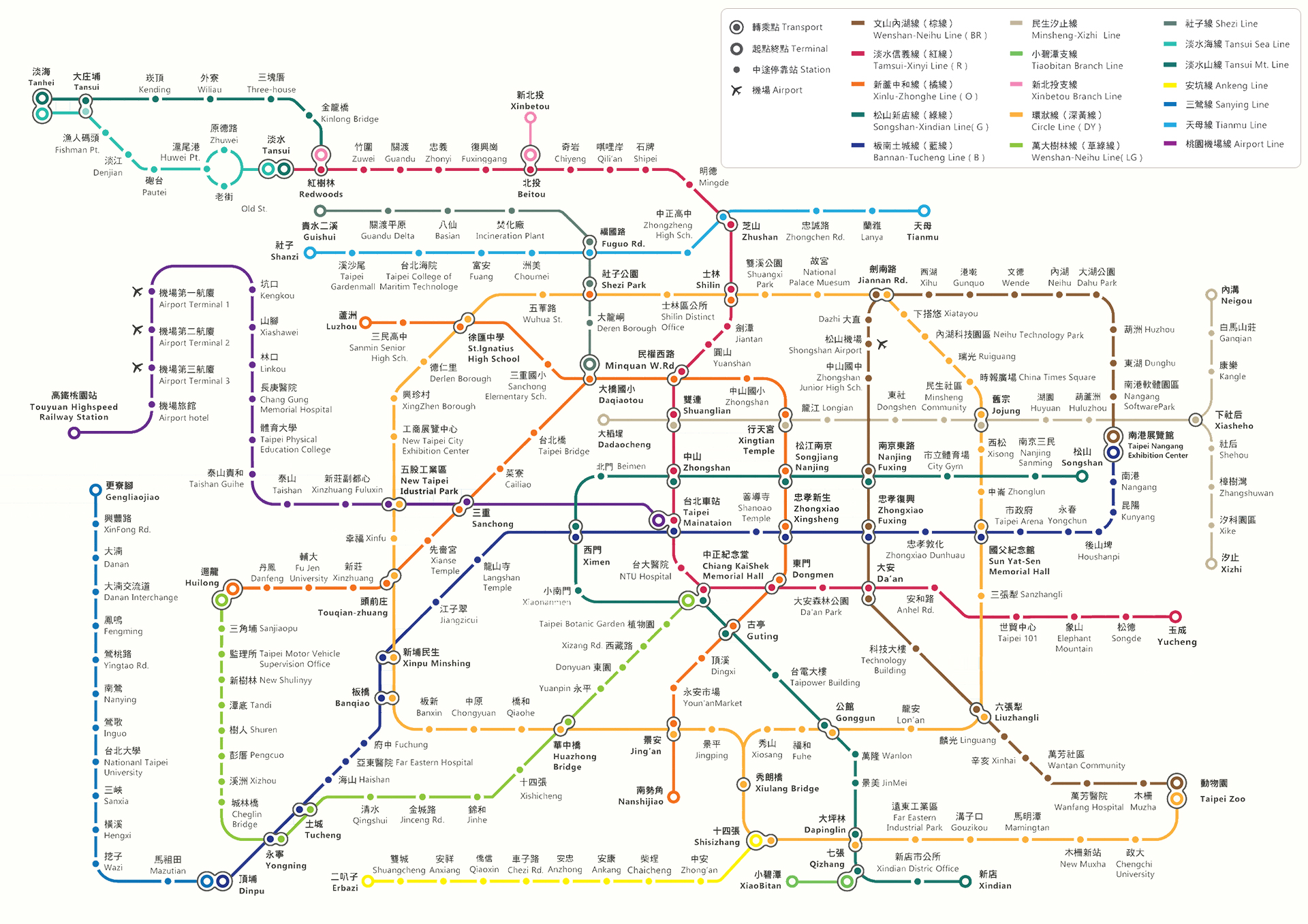
Taipei Metro Map
Map of Taipei Metro showing different lines and stations. Click on the map to enlarge it or download the Taipei Metro map in PDF format.
Taipei Metro Lines and Stations
Taipei Metro operates five main lines: the Wenhu line, Tamsui–Xinyi line, Songshan–Xindian line, Zhonghe–Xinlu line, and Bannan line. The Circular line is also part of the network. Together, these routes form the backbone of MRT travel across Taipei and New Taipei City, with most lines radiating from central Taipei in a spoke-hub pattern.
The system opened with the Wenhu line in 1996 and expanded through the 2000s and 2010s as new sections, transfer stations, and route options were added. For trip planning, the stations map and route plan are especially useful around major interchange points.
| Line | Route and details |
|---|---|
| Wenhu line | Taipei Zoo – Taipei Nangang Exhibition Center; 25.7 km (16.0 mi); 24 stations; rubber-tyred medium-capacity metro; opened March 28, 1996; last extended July 4, 2009 |
| Tamsui–Xinyi line | Xiangshan – Tamsui; 30.2 km (18.8 mi); 27 stations; high-capacity railway track; opened March 28, 1997; last extended November 24, 2013 |
| Xinbeitou branch line | Beitou – Xinbeitou; 1 station; high-capacity railway track; opened March 28, 1997 |
| Songshan–Xindian line | Xindian – Songshan; 19.7 km (12.2 mi); 19 stations; high-capacity railway track; opened December 24, 1998; last extended November 15, 2014 |
| Xiaobitan branch line | Qizhang – Xiaobitan; 1 station; high-capacity railway track; opened September 29, 2004 |
| Zhonghe–Xinlu line | Nanshijiao – Huilong/Luzhou; 31.5 km (19.6 mi); 26 stations; high-capacity railway track; opened December 24, 1998; last extended June 29, 2013 |
| Bannan line | Dingpu – Taipei Nangang Exhibition Center; 28.2 km (17.5 mi); 23 stations; high-capacity railway track; opened December 24, 1999; last extended July 6, 2015 |
| Circular line | Dapinglin – New Taipei Industrial Park; 15.4 km (9.6 mi); 14 stations; medium-capacity railway track; opened January 31, 2020 |
Most major transfer points get busy during rush hours, especially Taipei Main Station, Zhongxiao Fuxing, and Minquan West Road. Cross-platform interchanges are available at several stations, including Chiang Kai-shek Memorial Hall, Guting, Dongmen, and Ximen. Beimen station also includes a small archeological museum, while other stations feature public art and gallery spaces.
| Station | Details |
|---|---|
| Taipei Main Station | Major MRT, rail, high-speed rail, airport, and bus interchange |
| Zhongxiao Fuxing | Busy transfer station during peak travel periods |
| Minquan West Road | Important interchange station with heavy rush-hour use |
| Chiang Kai-shek Memorial Hall | Cross-platform interchange station |
| Guting | Cross-platform interchange station |
| Dongmen | Cross-platform interchange station |
| Ximen | Cross-platform interchange station and gateway to Ximending |
| Beimen | Station with a small archeological museum |
| Taipei Zoo | Connection to the Maokong Gondola |
| Banqiao | Rail connection point |
| Nangang | Rail connection point |
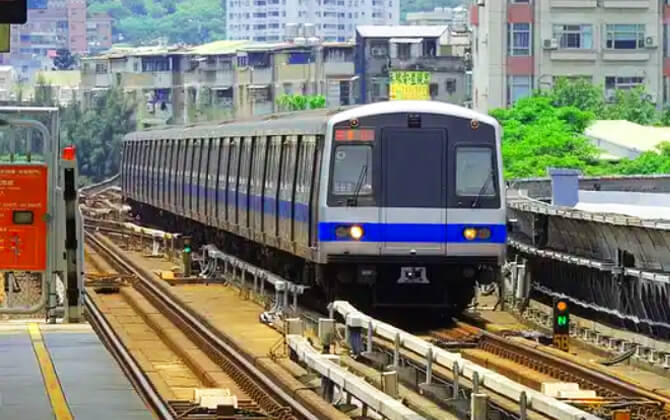
Station platforms vary by design. Most underground stations use island platforms, while many elevated and at-grade stations use side platforms. High-capacity stations have 150 m (492 ft) platforms for six-car trains, with Xiaobitan as an exception. As of September 2018, all stations had automatic platform gates.
Passengers can transfer to city buses at all metro stations. Rail connections are available at Taipei Main Station, Banqiao, and Nangang, while Taipei Main Station also connects with the Airport MRT. Around several stations, Taipei Metro operates underground malls and other public facilities, making the system more than a simple train route.
Tickets and Fares
Taipei Metro fare options are straightforward. A single-journey ticket price ranges from NT$20 to NT$65, about US$0.62 to US$2.02, depending on distance. Entry is by blue single-journey tokens or electronic stored-value cards such as EasyCard.
Single-journey tokens are sold from vending machines and station information counters. One-day EasyCard Passes, plus 24-hour, 48-hour, 72-hour, and All Pass tickets, are available at Metro station information counters. Each pass can be used by only one passenger at a time.
| Ticket or pass | Fare and details |
|---|---|
| Single Journey | NT$20–65, about US$0.62–US$2.02 |
| One-day EasyCard Pass | NT$150, about US$4.70 |
| 24-hour Taipei Metro Pass | NT$180, about US$5.60 |
| 48-hour Taipei Metro Pass | NT$280, about US$8.70 |
| 72-hour Taipei Metro Pass | NT$380, about US$11.80 |
| All Pass Ticket | NT$1,280, about US$39.80; includes unlimited rides for 30 days on Taipei Metro, Taipei buses, and YouBike bike share |
EasyCards and other rechargeable IC cards are common for everyday travel. Fare discounts are based on monthly ride counts, and rebate amounts vary by usage. Passengers with welfare cards issued by local governments may receive 60% off per ride. Children aged 6 and over pay adult fares.
Other fare products include joint tickets with other services and group tickets. YouBike discounts are also available at Taipei Main Station. A fare calculator or station fare chart is useful before choosing a ticket, especially if your route includes transfers or longer-distance travel.
Turnstiles are being replaced by the end of 2025 to support contactless card, QR code, and mobile wallet payments.
Taipei Metro Timing and Hours
Taipei Metro operating hours run daily from 6:00 a.m. to midnight. The starting time for first trains is around 6:00 a.m. from terminal stations, and the last train usually leaves around 12:00 a.m. These opening hours make the MRT available through most of the day, while late-night service ends after final departures.
The system does not close for long, but the overnight window is important. Tracks are inspected at 5:00 a.m., and the last train returns to the depot at 1:30 a.m. That leaves 3 hours and 30 minutes for maintenance and train cleaning. The non-service period is not expected to be reduced because it supports safe operations.
| Service detail | Timings |
|---|---|
| Opening times and first trains | Around 6:00 a.m. daily |
| Regular working hours | 6:00 a.m. to midnight |
| Closing time and last train | Around 12:00 a.m. midnight from terminal stations |
| Last train returns to depot | 1:30 a.m. |
| Track inspection | 5:00 a.m. |
| Maintenance window | 3 hours and 30 minutes |
| Train frequency | Generally every 1.5 to 15 minutes, depending on line and time of day |
There are currently no plans to change the metro service times. Frequency varies by line and period, and crowding can be heavier during peak hours at major interchange stations. For timings today, schedule today, or a specific train schedule, check the first and last train times for your line before traveling.
Useful contact information
- Citizen Hotline in Taipei City: 1999
- Callers outside Taipei City: 886-2-27208889
- Taipei Metro telephone: 886-2-2536-3001
- TRTC departmental address: 7, Lane 48, Sec. 2, Zhongshan N. Rd., 104216, Taipei City, Taiwan (R.O.C.)
Park’n Ride in Taipei
Taipei Rapid Transit Corporation provides park-and-ride facilities at selected MRT stations, making it easier to combine driving with metro travel. TRTC also provides GPS coordinates for parking locations, which can be entered into an onboard navigation system.
| Station | Details |
|---|---|
| MRT Tamsui Station | Park-and-ride parking available |
| MRT Hongshulin Station | Park-and-ride parking available |
| MRT Zhongyi Station | Park-and-ride parking available |
| MRT Xinbeitou Station | Park-and-ride parking available |
| MRT Beitou Station | Park-and-ride parking available |
| MRT Qilian Station | Park-and-ride parking available |
| MRT Shipai Station | Park-and-ride parking available |
| MRT Zhishan Station | Park-and-ride parking available |
| MRT Shilin Station | Park-and-ride parking available |
| MRT Jiantan Station | Park-and-ride parking available |
| MRT Xindian Station | Park-and-ride parking available |
| MRT Nanshijiao Station | Park-and-ride parking available |
| MRT Taipei Nangang Exhibition Center Station | Park-and-ride parking available |
| MRT Wende Station | Park-and-ride parking available |
| MRT Jiannan Rd. Station | Park-and-ride parking available |
| MRT Yongning Station | Park-and-ride parking available |
| MRT Haishan Station | Park-and-ride parking available |
| MRT Kunyang Station | Park-and-ride parking available |
| MRT Luzhou Station | Park-and-ride parking available |
| Neihu Depot | Parking open to the public during exhibition periods at Nangang Exhibition Center |
| Muzha Depot | Parking open on holidays |
For available spaces, GPS coordinates, parking charges, and fees, call TRTC’s 24-hour customer service hotline at (02) 218-12345 or the 1999 Citizen Hotline.
TRTC also operates an underground motorcycle park-and-ride facility at MRT Neihu Station. It has 319 parking spaces, a parking charge per day of NT$20, about US$0.62, and a monthly pass of NT$200, about US$6.20, during the first three months of operation instead of the standard NT$300, about US$9.30, before September 30. A NT$3 discount, about US$0.09, is available if the same EasyCard is used for entry, exit, and an MRT ride within 1 hour of parking.
Connections to Other Systems
Taipei Metro connects with several other transport networks across the city and region. Bus transfers are available at all metro stations, and in 2009 the daily transfer volume between the metro and bus systems reached 444,100 transfers, counting EasyCard users only.
Connections to Taiwan Railway Administration and Taiwan High Speed Rail services are available at Taipei Main Station, Banqiao, and Nangang. Taipei Main Station also provides access to Taipei Bus Station, while Taipei City Hall station connects with Taipei City Hall Bus Station.
| Station | Details |
|---|---|
| Taipei Main Station | Transfers to Taiwan Railway Administration, Taiwan High Speed Rail, Taipei Bus Station, and the Airport MRT |
| Banqiao | Transfers to Taiwan Railway Administration and Taiwan High Speed Rail services |
| Nangang | Transfers to Taiwan Railway Administration and Taiwan High Speed Rail services |
| Taipei City Hall | Connection to Taipei City Hall Bus Station |
| Taipei Zoo | Connection to the Maokong Gondola |
| Songshan Airport | Metro access to Taipei Songshan Airport |
For other major destinations, the MRT links to the Maokong Gondola from Taipei Zoo and serves Taipei Songshan Airport through Songshan Airport station. A metro system connecting Taipei to Taoyuan International Airport has been available since March 2017.
Connections with the New Taipei Metro are also available, specifically with the Circular line and Danhai LRT. Travelers looking for light rail or tramway-style service will find those links outside the core Taipei Metro network rather than on central MRT lines.
Airport Connections
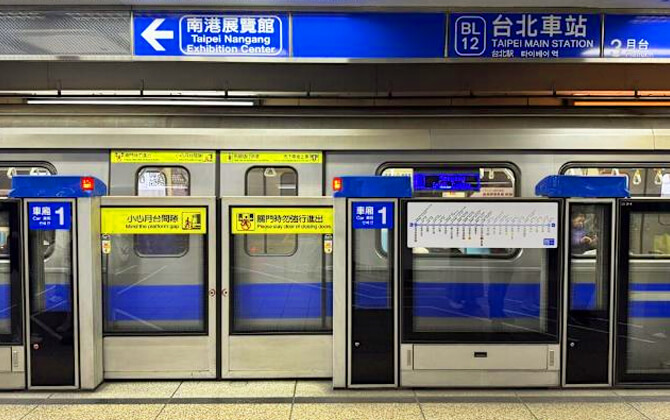
Taipei is connected to Taoyuan International Airport by the Taoyuan Airport MRT, a rapid transit route linking Taipei Main Station with the airport in northern Taiwan. The line began commercial service on March 2, 2017, and serves 22 stations along its route.
Two services operate on the line. Express trains are the faster option and focus on airport passengers, while Commuter trains stop at all stations. Both services offer free Wi-Fi. Express trains also provide luggage racks, wireless charging, and dedicated seating for air travelers.
The line provides in-town check-in and baggage check facilities at Taipei Main Station and New Taipei Industrial Park. That can make airport travel easier, especially if you want to check in before reaching the terminal and ride with less luggage.
| Station | Details |
|---|---|
| Taipei Main Station | Main city terminal for Taoyuan Airport MRT and in-town check-in |
| New Taipei Industrial Park | In-town check-in and baggage check facilities |
| Airport Terminal 1 | Direct MRT access to Taoyuan International Airport Terminal 1 |
| Airport Terminal 2 | Direct MRT access to Taoyuan International Airport Terminal 2 |
| Taoyuan HSR station | Connection between the airport line and Taiwan’s high-speed rail network |
| Laojie River | Current continuation of the line, opened in July 2023 |
| Zhongli railway station | Extension under construction, scheduled for completion in 2028 |
At the airport, station entrances are clearly signed, and passengers can board directly for Taipei Main Station without transferring. The line also connects with Taoyuan HSR station, creating a practical link between the airport, Taipei, and Taiwan’s high-speed rail network.
Curious Facts
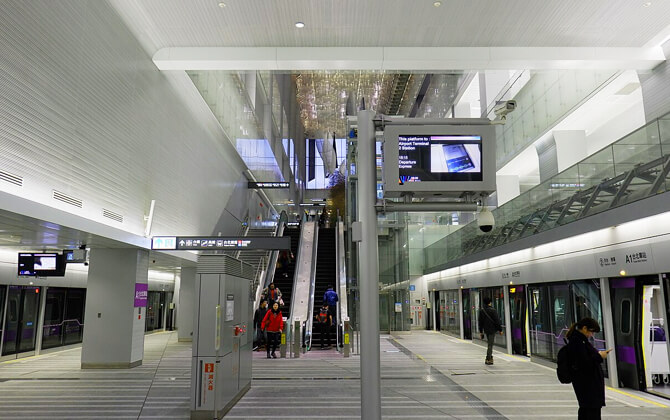
Taipei Metro was the first rapid transit system built on the island of Taiwan. The initial network was approved in 1986, and passenger service began on March 28, 1996.
By 2000, the system had 62 stations on three main lines. It later expanded to 131 stations while carrying more than two million trips a day.
The network follows a spoke-hub pattern, with many lines running outward from central Taipei. That layout helps explain why the MRT has been so effective at reducing traffic congestion in the capital and nearby New Taipei City.
The system is built for accessible travel. Stations and trains include ramps, elevators, tactile guide paths, extra-wide faregates, and designated wheelchair areas on trains.
Some stations are built to do more than move passengers. In public discussions about the system, broad platforms have also been described as air raid shelters, with extra space and supplies intended for emergencies.
Announcements are multilingual. They are recorded in Mandarin, English, Taiwanese, and Hakka, with Japanese at busy stations. Korean announcements were later added at stations with heavy tourist use.
Another distinctive touch is the station music. Different lines use different arrival melodies, so regular riders can often recognize a line by sound as well as by color.
The metro has also been recognized for performance. Data cited from Imperial College London and Nova/CoMET ranked Taipei Metro first in the world for reliability, safety, and quality standards for four consecutive years from 2004 to 2007.
The system has set major ridership records, including 2.17 million passengers over 42 consecutive hours during New Year celebrations in 2009–2010 and 2.75 million passengers on December 31, 2013.
Station rules are strict but practical. Smoking is forbidden throughout the system, and eating, drinking, chewing gum, and betel nuts are not allowed within the paid area.
History
Proposal and construction
The idea of building a rapid transit system on the island was first introduced at a press conference on June 28, 1968, when the Ministry of Transportation and Communications announced plans to study a network for the Taipei metropolitan area. The proposal was later shelved because of financial concerns and the view that such a system was not yet urgently needed.
As traffic congestion worsened during the 1970s, the need for rapid transit became more pressing. In February 1977, the Institute of Transportation of the Ministry of Transportation and Communications released a preliminary report outlining five lines: U1, U2, U3, S1, and S2. This became the first Taipei rapid transit plan, with some corridors intended to be converted from Taiwan Railways Administration branch lines.
Further studies followed in the early 1980s. In 1981, British Mass Transit Consultants and China Engineering Consultants, Inc. were invited to expand the research, and in 1982 Taipei City Government commissioned National Chiao Tung University to study medium-capacity rapid transit systems. In January 1984, the university proposed an initial design that included the Wenhu line and the Tamsui–Xinyi line. Early plans would have kept the 1,067 mm (3 ft 6 in) gauge used by TRA lines, with rolling stock aligned to TRA and Japanese narrow-gauge standards.
On March 1, 1985, the Executive Yuan Council for Economic Planning and Development signed an agreement with the Taipei Transit Council, a group of three American consultant firms, to conduct overall research on a rapid transit system in Taipei. The revised proposal shifted to standard gauge track, used wider and longer rolling stock for the high-capacity lines, and added the Wenhu line to the network.
In 1986, the initial network design was approved by the Executive Yuan, with a budget of NT$441.7 billion, about US$13.72 billion, allocated for the project. The Preparatory Office of Rapid Transit Systems was created on June 27, 1986, and formally established as the Department of Rapid Transit Systems on February 23, 1987, to handle planning, design, and construction. The initial network included six lines, totaling 79 stations and 76.8 km (47.7 mi) of route length, with elevated, ground-level, and underground sections. The Neihu Line corridor was approved in 1990, and the Taipei Rapid Transit Corporation was formed on June 27, 1994, to oversee operations.
Construction began on December 15, 1988. The period brought heavy traffic disruption, later described as the “dark age of Taipei traffic,” and the project became politically controversial because of computer malfunctions during storms, alleged structural problems in some elevated sections, budget overruns, and fare prices.
Opening and expansion
The system opened on March 28, 1996, with the 10.5 km (6.5 mi) elevated Wenhu line, a driverless medium-capacity line with twelve stations running from Zhongshan Junior High School to Taipei Zoo. The first high-capacity line, the Tamsui–Xinyi line, began service on March 28, 1997, from Tamsui to Zhongshan and was extended to Taipei Main Station later that year. On December 23, 1998, the system reached 100 million passengers.
Expansion continued with the opening of a section of the Bannan line between Longshan Temple and Taipei City Hall on December 24, 1999. This was the first east–west line across the city, linking the previously completed north–south routes. On May 31, 2006, the second stage of the Banqiao–Nangang section and the Tucheng section began operation, and the service was named Bannan after the districts it connects.
The Maokong Gondola opened to the public on July 4, 2007, connecting Taipei Zoo, Zhinan Temple, and Maokong. It was suspended on October 1, 2008, after erosion from mudslides beneath a support pillar following Typhoon Jangmi, then resumed service on March 31, 2010, after the pillar was relocated and safety inspections were completed.
On July 4, 2009, the opening of the Neihu segment of the Wenhu line completed the last of the six core segments. Construction had not started until 2002 because of debate over whether the line should be medium-capacity or high-capacity. The Zhonghe–Xinlu line was extended from Guting to Luzhou and Huilong in 2012, followed by the Xinyi section of the Tamsui–Xinyi line on November 24, 2013, and the Songshan section of the Songshan–Xindian line on November 15, 2014.
Before 2014, only physical lines had official names, while services did not. After the core network was completed, the naming scheme was formalized and “lines” began to refer to services. Between 2014 and 2016, the lines also received number-based names, later replaced by color names in 2016.
In June 2023, the metro added Korean announcements at stations with high numbers of tourists because of increasing South Korean visitor numbers. On April 3, 2024, following a magnitude 7 earthquake, all active MRT trains were suspended for safety checks, and all Taipei Metro routes resumed later that day.
Future Extensions
Taipei Metro continues to expand beyond its completed core network, with several projects under construction and others still in planning. These future extensions aim to improve links between Taipei, New Taipei City, and surrounding districts while strengthening transfers to other rail services.
Projects under construction
The Tamsui-Xinyi line is being extended east from Xiangshan to Guangci/Fengtian Temple. The extension is 1.4 km (0.9 mi) long, will add one station, and is scheduled to open in Q1 2026. A further extension to Academia Sinica will be studied.
The Circular line is also moving ahead in multiple phases. Phase 2, now under construction, is planned for completion in June 2031. It includes a northern section from New Taipei Industrial Park to Jiannan Road and a southern section from Dapinglin to Taipei Zoo. Phase 3 began construction in 2025 and is expected to finish in 2032, creating the eastern section that will connect Jiannan Road and Taipei Zoo into a complete loop.
The Wanda-Zhonghe-Shulin line is another major project. Phase 1 will run from CKS Memorial Hall to Juguang in Zhonghe and is expected to be completed in 2027. Phase 2 will extend the line from Zhonghe Senior High School to Huilong, making the segment between Zhonghe Senior High School and Juguang a branch line. The full line is expected to be completed in 2033.
The Xizhi-Donghu line, originally planned as the eastern section of the Minsheng-Xizhi proposal, received final approval in 2023 and broke ground on March 20, 2025. It is expected to open in 2032 and will interline with the Keelung Metro.
The Sanying line is also under construction. Its first section is 14.29 km (8.9 mi) long, includes twelve stations, and is due to open in Q1 2026. The line will serve Tucheng, Sanxia, and Yingge. It is also planned to extend to Bade District, with two additional stations and an expected completion date in 2034.
Planned and proposed routes
The Minsheng-Xizhi line remains a planned project. It would run 17.52 km (10.9 mi) from Dadaocheng Harbour to Xizhi District Office, partly underground and partly elevated. A possible extension to connect with the planned Keelung Light Rail has also been considered.
The Zhonghe-Guangfu line is a proposed 8 km (5.0 mi) medium-capacity line from Xiulang Bridge to Sun Yat-sen Memorial Hall station. It would provide additional cross-river access, serve NTU at Gongguan station, and connect with five existing metro lines. Its future remains uncertain, including which operator would build and run it.
Other planned projects include the Shenkeng light rail and the Wugu-Taishan light rail, both of which are in feasibility study stages. The Wugu-Taishan proposal also includes a planned infill station on the Taoyuan Airport MRT and a possible extension toward Banqiao.
Future vision materials show that completed, approved, and planned routes are expected to increase the size of the network significantly over time, though construction schedules still depend on government approval and financial resources.
Nearby Attractions
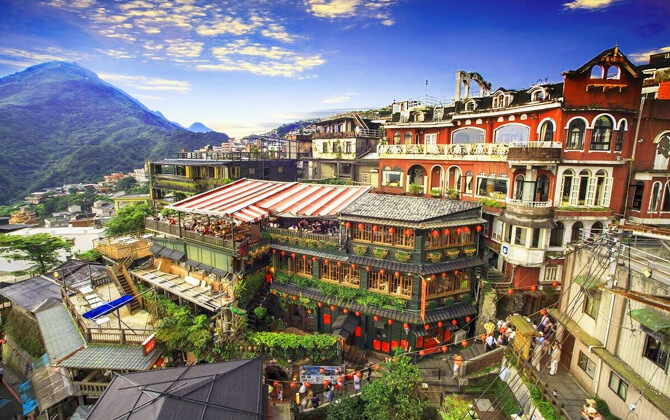
Taipei Metro makes it easy to reach many of the city’s best-known sights. Stations are clearly labeled in English, and maps are available at station exits. If you want a simple sightseeing route, several major attractions are within walking distance of MRT stops.
Popular stops and what you can visit nearby
| Station | Details |
|---|---|
| Taipei 101 / World Trade Center Station | Taipei 101 |
| Chiang Kai-shek Memorial Hall Station | Chiang Kai-shek Memorial Hall |
| Songshan Station | Songshan Ciyou Temple and Raohe Night Market |
| Longshan Station | Longshan Temple |
| Ximen Station | Ximending and the Red House |
| Xiangshan Station | Elephant Mountain, a well-known viewpoint for Taipei 101 and the city skyline |
| Shilin Station | National Palace Museum |
| Jiantan Station | Shilin Night Market |
| Taipei Zoo Station | Taipei Zoo and access to the Maokong Gondola |
| Xinbeitou Station | Beitou Hot Springs |
Other easy-to-reach places include Taipei Main Station, Zhongshan, Zhongxiao Fuxing, Sun Yat-sen Memorial Hall, and Taipower Building. These areas connect to neighborhoods, shopping streets, museums, temples, and night markets, which makes the MRT one of the most practical ways to explore Taipei without complicated transfers.
If you are short on time, combining one temple, one shopping district, and one night market in the same day is a simple way to experience the city by metro.
Media