Public transportation in Bangkok includes rail, river boats, buses, and taxis, giving the city a broad transport system for daily travel and visitor trips. In practice, most people combine the BTS Skytrain, MRT, and river services for the fastest route, then use taxis or buses for shorter links, late travel, or areas beyond the main rail network.
| Key | Information |
|---|---|
| Main public transport modes | BTS Skytrain, MRT, Chao Phraya Express Boat, public bus, taxi |
| Best mix for visitors | BTS, MRT, and boats, with taxis or buses as backup |
| Useful for avoiding traffic | Rail lines and river boat services |
| Good for direct door-to-door travel | Taxi service |
| Airport access | Suvarnabhumi and Don Mueang both have public transport connections |
Public Transportation System in Bangkok Map
Map of Public Transportation in Bangkok showing different lines and stations. Click on the map to enlarge it or download the map in PDF format.

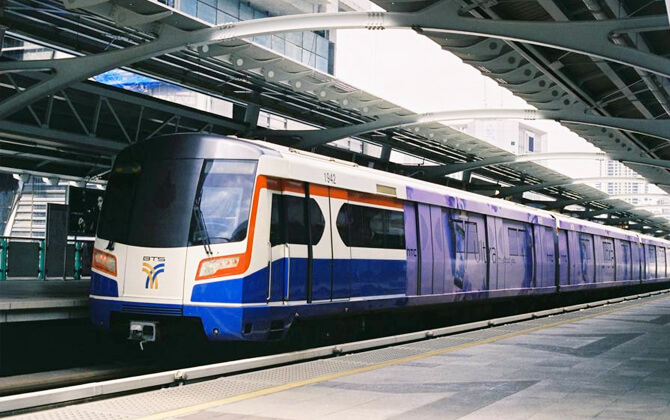
BTS Skytrain services in Bangkok
The BTS Skytrain is Bangkok’s elevated rapid transit system and a core part of city transport. It is operated by Bangkok Mass Transit System PCL under a concession from the Bangkok Metropolitan Administration.
The system has three lines: the Sukhumvit Line, the Silom Line, and the Gold Line people mover. Together they cover 70.05 km (43.53 miles) and serve 62 stations. The Sukhumvit Line runs to Khu Khot and Kheha, the Silom Line links the central business district and ends at National Stadium and Bang Wa, and the Gold Line runs between Krung Thon Buri and Klong San, serving ICONSIAM.
Important interchange stations include Siam and Krung Thon Buri. The BTS also connects into Bangkok’s wider public transport network, including the MRT, BRT, Airport Rail Link, and SRT Red Lines, so it is often the easiest route plan for getting across the city.
The system opened on 5 December 1999 and was Thailand’s first electric mass transit railway system. Since then, the network has seen major expansion, including the Sukhumvit extension to Bearing in 2011, the Silom extension to Bang Wa in 2013, and later additions reaching Khu Khot plus the Gold Line.
Today, the BTS is central to transportation in Bangkok, linking offices, shopping districts, and transfer points. Some trains finish early at Kasetsart University, Mo Chit, and Samrong to improve frequency on the busiest central sections.
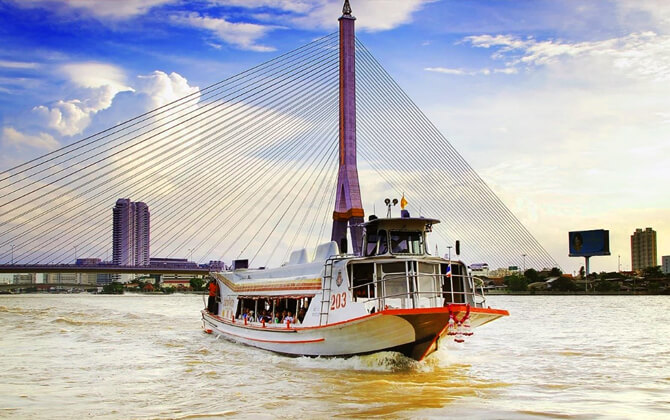
Chao Phraya Express Boat Ferry Service
The Chao Phraya Express Boat is one of the most practical ways to move through Bangkok without getting stuck in road traffic. It runs Monday to Sunday and on public holidays, connecting Bangkok and Nonthaburi along the river.
The service includes several regular lines with flat fare levels depending on the route.
- Orange Line: Nonthaburi-Rajsingkorn, Monday-Friday, fare 18 THB (about $0.49) flat rate.
- Yellow Line: Nonthaburi-Sathorn, Monday-Friday, fare 23 THB (about $0.63) flat rate.
- Green Yellow Line: Pakkret-Sathorn, Monday-Friday, fare 16 THB (about $0.44) from Pakkret to Nonthaburi, 23 THB (about $0.63) from Nonthaburi to Sathorn, and 35 THB (about $0.95) from Pakkret to Sathorn.
- Red Line: Nonthaburi-Sathorn, Monday-Friday, fare 32 THB (about $0.87) flat rate.
The company was established in 1971 by Khunying Supatra Singholaka and has long been part of Bangkok water transportation. Since 2020, four air-conditioned catamaran boats have operated between Nonthaburi and Sathorn, mainly improving connections with BTS and MRT services.
Regular boats call at many piers across the river route. For this stations list, the key stops mentioned in the source are shown below.
| Station | Details |
|---|---|
| Sathorn (Taksin Bridge) | Main river pier with connection to BTS Saphan Taksin Station |
| Oriental | Pier listed on the route, but Oriental Pier (N 1) is currently closed for renovation |
| ICONSIAM | Useful stop for access to the riverside shopping complex |
| Rajinee | Regular pier on the Chao Phraya route |
| Phra Arthit | Regular pier on the Chao Phraya route |
| Thewet | Regular pier on the Chao Phraya route |
| Bang Po | Regular pier on the Chao Phraya route |
For both commuting and sightseeing, this boat service is fast, affordable, and scenic. It is also a useful addition to any Bangkok stations map when you want an alternative to rail.
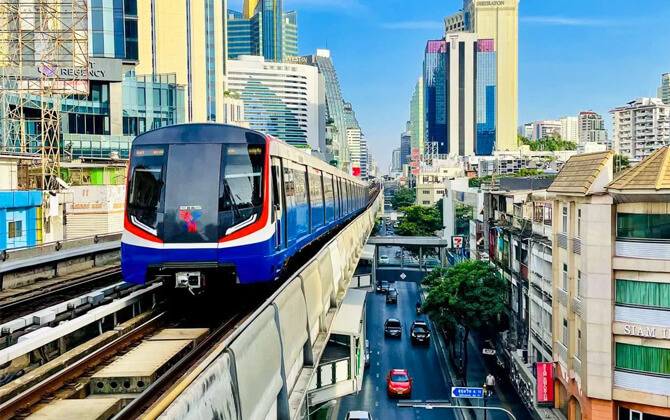
Bangkok Subway or Metro MRT service
The MRT is Bangkok’s metro system and an important part of the city’s rail network alongside the BTS Skytrain and the Airport Rail Link. It serves the Bangkok Metropolitan Region and covers both conventional metro lines and newer monorail services.
The MRT network includes the Blue Line and Purple Line, plus the Yellow and Pink monorail lines. The Orange Line is under construction, and more expansion is planned.
The Blue Line was the first MRT route to open, with its first section between Hua Lamphong and Bang Sue entering service in July 2004. The Purple Line opened in August 2016 and became the first mass transit line extending outside Bangkok.
Blue and Purple Line operations are handled by Bangkok Expressway and Metro Public Company Limited under concession from the Mass Rapid Transit Authority of Thailand. The Yellow and Pink lines are operated by subsidiaries of BTSC.
As of August 2024, the BEM-operated lines carry 526,000 passengers per day, with 54 operational stations across 71 km (44.12 miles) of route. After the Blue Line extension was completed in April 2020, the line became a quasi loop around central Bangkok, with an interchange at Tha Phra.
Stations usually have multiple exits, often four, and many connect with other public transport services including BTS, Airport Rail Link, and commuter rail. Platform screen doors, security staff, and cameras are in place across the system. The Blue Line uses Siemens Modular Metro trains.
For tickets and fare payment, the Blue and Purple Lines use RFID contactless technology. Single-trip round tokens are available, and frequent riders can use the MRT Plus card. Since January 2022, Blue and Purple Line fares have also accepted EMV contactless payment by credit, debit, and prepaid card.
The MRT continues to grow. The Orange Line and the southern extension of the Purple Line are under construction, while the Brown Line remains planned for the future.
Bangkok Taxi service
Taxis are one of the easiest ways to travel around Bangkok, especially for short trips or places not directly served by rail. They are widely available, and a metered taxi is the best option if you want the fare to stay clear and fair.
What to keep in mind
- Make sure the meter is running.
- The meter usually starts at 35 THB (about $0.95).
- If a driver offers a fixed price instead of using the meter, it is usually better to take another taxi.
- Taxis often queue at stations, so you may have several options.
- Using Google Maps during the ride can help you follow the route.
- Tipping is not standard, though rounding up the cost for good service is appreciated.
- Tolls are paid by the passenger.
When to choose a taxi
A taxi works well when you want a direct ride with no transfers. It is especially useful for nearby destinations, late-night trips, or any journey where comfort matters more than speed in traffic.
Helpful advice for riders
- Avoid picking up taxis in tourist-heavy parking lots when possible.
- Choose clean vehicles and reliable drivers when you can.
- If the driver refuses to use the meter, just move on to another taxi.
- Traffic can be heavy in peak periods, so timing makes a real difference.
For many travelers, taxis are best used as a flexible backup to Bangkok’s rail system rather than as the default option for every trip.
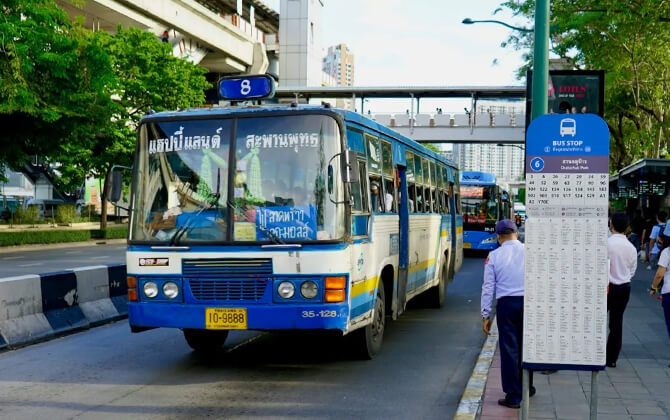
Public bus service in Bangkok
Bangkok’s public bus network is one of the city’s main everyday transport options. The Bangkok Mass Transit Authority is the primary operator in Greater Bangkok and serves both the capital and nearby suburban provinces.
The network covers Bangkok as well as neighboring areas in Nonthaburi, Samut Prakan, Pathum Thani, Nakhon Pathom, and Samut Sakhon. It serves around three million passengers per day and operates a large route network across the region.
Bus operating hours are generally 05:00 to 23:00, though some routes run 24 hours. That means opening hours, closing time, and timings today can vary by route. Services include ordinary and air-conditioned buses, while the broader system also includes private joint-service buses, minibuses, songthaews, and vans.
As of March 2021, BMTA operated 3,005 buses. With privately owned contract vehicles, the wider network covered 427 routes in eight zones and included many thousands of buses and vans. Reforms in the 2020s also shifted some routes to Thai Smile Bus, which operates electric buses.
Passengers can pay with cash or coupons when boarding. In 2017, a common ticket system for Bangkok mass transit was planned, including the Mangmoom Card.
Because the bus route network is extensive, checking the route timetable, schedule today, or train and bus connections in advance is a smart move. For areas beyond the rail lines, buses remain an important part of local transport.
Airport Connections
Bangkok has two international airports: Suvarnabhumi Airport (BKK), the main gateway about 30 km (18.64 miles) east of downtown, and Don Mueang Airport (DMK), the secondary airport, mainly used by low-cost domestic and international carriers.
Before heading out, check your terminal and leave extra time. Bangkok traffic can be heavy, especially during rush hour, so even a simple airport transfer can take longer than expected.
Suvarnabhumi Airport (BKK)
BKK connects to the city by taxi, shuttle bus, Airport Rail Link, private transfer, and car rental. The Airport Rail Link is the budget option, taking less than 30 minutes to Phaya Thai with a ticket price of 45 THB (about $1.22). From there, you can transfer to the BTS Sukhumvit Line.
Taxis are available from the official taxi counter on the first floor, with a typical fare of 350-500 THB (about $9.51-$13.59), plus airport fees and tolls. Private transfers are also available, and car rental is an option if you want more flexibility.
Don Mueang Airport (DMK)
DMK is about 25 km (15.53 miles) from downtown Bangkok. It is served by the Red Line train, airport buses, taxis, and car rental services. The Red Line connects the airport with Krung Thep Apiwat Station, where you can transfer to the MRT Blue Line. The trip takes about 17 minutes and costs 33 THB (about $0.90), though there is a short walk from the airport exit to the station.
Airport buses run regularly to central Bangkok, including routes A1, A2, A3, and A4. Taxis are available from dedicated pickup points at Terminals 1 and 2, with average fares of 300-400 THB (about $8.15-$10.87), plus airport charges and tolls.
Other Helpful Notes
The Airport Rail Link runs daily and offers a fast connection between Suvarnabhumi Airport and central Bangkok. Since 8 November 2025, passengers have been able to pay by tapping a contactless Visa, Mastercard, JCB, or UnionPay card at the fare gates.
If you have an early flight, arriving ahead of time or staying near the airport can make things easier. The source material mentions Amari Don Muang Airport Hotel near DMK and Top High Airport Link Hotel near Phaya Thai.