The Long Island Rail Road, or LIRR, is a commuter rail system in southeastern New York State. It runs from Manhattan to the eastern end of Suffolk County on Long Island and provides year-round public transport service 24/7. Publicly owned by the Metropolitan Transportation Authority, it is the busiest commuter railroad in North America and one of the few systems worldwide with continuous service. The network has 126 stations, more than 700 miles (1,127 km) of track, and 319 route miles (513 km). Founded in 1834, with its first section opening in 1836, it is the oldest railroad in the United States still operating under its original name and charter.
| Key | Information |
|---|---|
| Official name | Long Island Rail Road (LIRR) |
| Owner | Metropolitan Transportation Authority |
| Service type | Public commuter rail |
| Area served | Long Island, Manhattan, and Brooklyn |
| Operating hours | 24/7 year-round |
| Stations | 126 |
| Track length | More than 700 miles (1,127 km) |
| Route length | 319 miles (513 km) |
| Founded | 1834 |
| First section opened | April 18, 1836 |
| Average weekday ridership | 354,800 in 2016; about 336,300 in the fourth quarter of 2025 |
| Annual ridership | 103,474,900 in 2025 |
Long Island Rail Road Map & Fare Zone
Map of Long Island Rail Road showing different lines and stations. Click on the map to enlarge it or download the Long Island Rail Road map in PDF format.
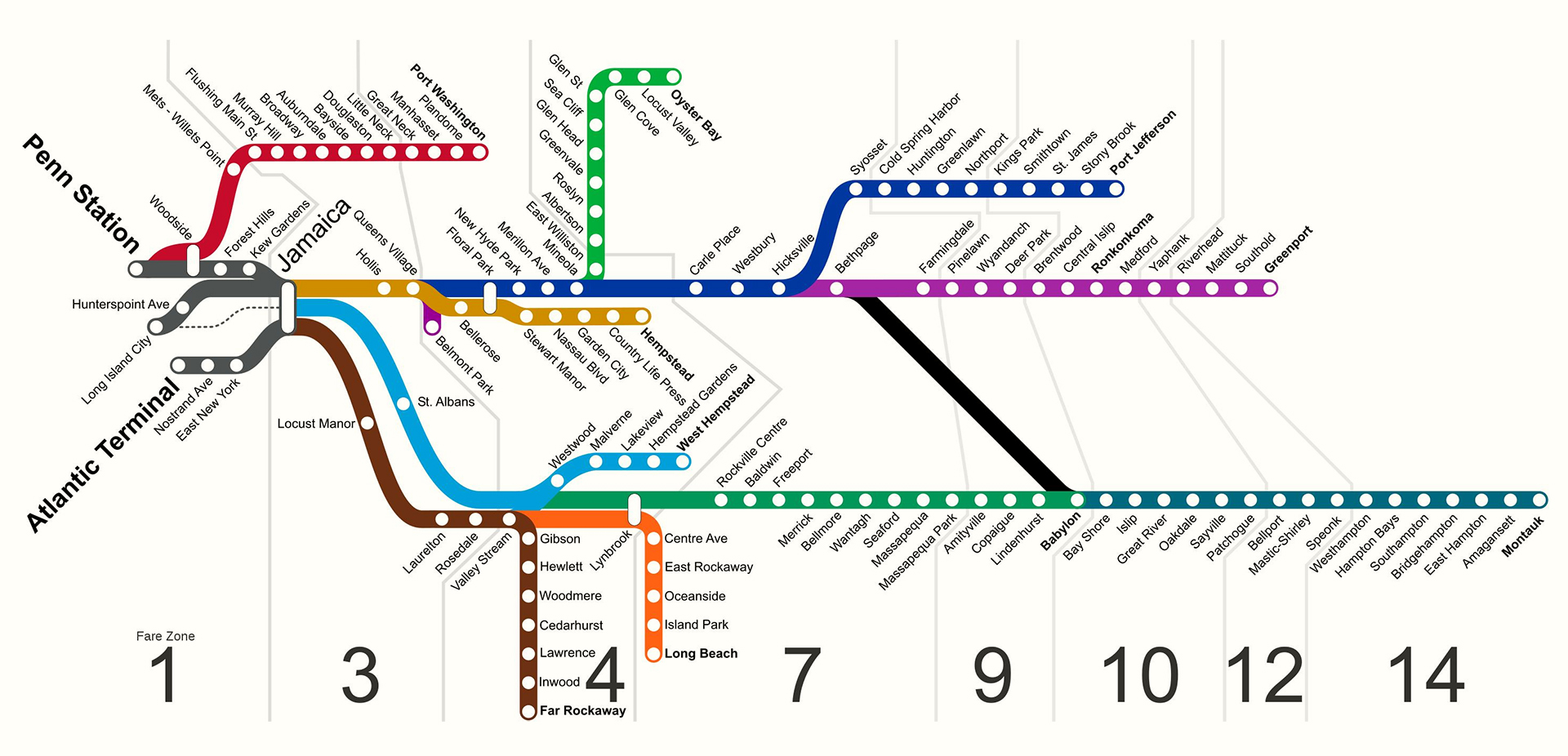
Long Island Road Lines and Stations
The Long Island Rail Road system serves all four counties of Long Island, plus stations in Manhattan and Brooklyn. It has 126 stations across eleven rail lines or branches. The route runs from Atlantic Terminal in Brooklyn to Montauk at the far eastern end of Long Island, while Penn Station is the busiest and westernmost station. If you are looking for a stations map or a practical stations list, the key thing to know is that Jamaica is the main transfer hub.
Several stations act as major interchange points. Jamaica is the central one, while Woodside, Mineola, Hicksville, Valley Stream, Lynbrook, and Babylon are also important for changing trains. Some stations, including Huntington, Ronkonkoma, and Babylon, connect electric and diesel service on the same branch.
Lines and terminals
The LIRR has 10 regular passenger services and the seasonal Belmont Park Branch. The City Terminal Zone groups the main New York City terminals.
| Station | Details |
|---|---|
| Babylon Branch | 13 stations; western terminal Rockville Centre; eastern terminal Babylon |
| Belmont Park Branch | 1 station; western and eastern terminal Belmont Park |
| City Terminal Zone | 12 stations; western terminals Penn Station, Long Island City, Atlantic Terminal, Grand Central Madison; eastern terminal Jamaica |
| Far Rockaway Branch | 11 stations; western terminal Locust Manor; eastern terminal Far Rockaway |
| Hempstead Branch | 9 stations; western terminal Hollis; eastern terminal Hempstead |
| Long Beach Branch | 6 stations; western terminal Lynbrook; eastern terminal Long Beach |
| Montauk Branch | 16 stations; western terminal Babylon; eastern terminal Patchogue / Montauk |
| Oyster Bay Branch | 10 stations; western terminal East Williston; eastern terminal Oyster Bay |
| Port Jefferson Branch | 16 stations; western terminal New Hyde Park; eastern terminal Huntington / Port Jefferson |
| Port Washington Branch | 13 stations; western terminal Woodside; eastern terminal Port Washington |
| Ronkonkoma Branch | 14 stations; western terminal Bethpage; eastern terminal Ronkonkoma / Greenport |
| West Hempstead Branch | 6 stations; western terminal St. Albans; eastern terminal West Hempstead |
Trunk lines
The network is built around three trunk lines. The Atlantic Branch connects Atlantic Terminal and Valley Stream, the Main Line runs between Penn Station or Grand Central Madison and Greenport, and the Montauk Branch runs from Long Island City to Montauk. Most eastbound services from New York City use one of these trunk lines as part of the route plan.
| Station | Details |
|---|---|
| Atlantic Branch | 8 stations; western terminal Atlantic Terminal; eastern terminal Valley Stream; branches served: City Terminal Zone, Far Rockaway Branch, Long Beach Branch |
| Main Line | 29 stations; western terminal Penn Station or Grand Central Madison; eastern terminal Greenport; branches served: City Terminal Zone, Belmont Park Branch, Hempstead Branch, Oyster Bay Branch, Port Jefferson Branch, Port Washington Branch, Ronkonkoma Branch |
| Montauk Branch | 33 stations; western terminal Long Island City; eastern terminal Montauk; branches served: West Hempstead Branch, Babylon Branch, Montauk Branch |
Station types and special service patterns
LIRR stations fall into four basic types: ground level, elevated, open-cut, and underground. Most are ground level. All Babylon Branch stations are elevated, while underground stations are limited to Penn Station, Atlantic Terminal, and Grand Central Terminal.
Some stations have limited or special service patterns. Belmont Park operates only on event days. Pinelawn serves cemetery traffic during off-peak daytime hours. Hunterspoint Avenue and Long Island City are western terminals for several diesel trains during rush hours. The six Main Line stations east of Ronkonkoma have very limited service during the week.
Platform lengths vary a lot across the system, from 1 1/2 cars to 14 cars. Most stations are built for 10 to 12 railcars.
- Glen Street: two side platforms, each 1 1/2 cars long.
- Pinelawn: two side platforms, each 2 cars long.
- Westwood: one side platform, 4 cars long.
- Hampton Bays: one side platform, 6 cars long.
- Hempstead: two sets of island platforms, each 8 cars long.
- Woodmere: two side platforms, each 10 cars long.
- Northport: one side platform, 12 cars long.
- Bellmore: one island platform, 14 cars long.
The route structure also shows the split between electric and diesel operation. The Main Line is electrified west of Ronkonkoma, with limited diesel service farther east. The Montauk Branch is electrified from Jamaica to Babylon, then diesel east of Babylon. The Port Jefferson and Ronkonkoma branches also mix electric and diesel service on their outer sections.
Major station points are simple enough: Jamaica is the main transfer hub, Penn Station is the busiest terminal, and Long Island City and Hunterspoint Avenue are important western terminals for selected peak-hour trains.
Timings and Schedule
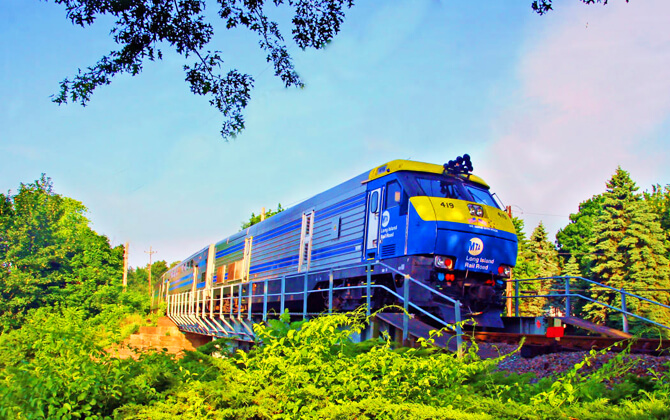
The Long Island Rail Road timetable and train schedule were updated in PDF form on April 6, 2026. On a typical weekday, the system carries about 250,000 customers on 947 daily trains. Schedule today details, route timetable information, and branch-specific timings can vary a lot depending on where you start and where you are heading.
Service runs from Penn Station and Grand Central to destinations including Port Washington, Great Neck, Babylon, Patchogue, Speonk, and Montauk. Some trains are direct, while others make local stops. In practice, opening hours, opening times, and working hours are not the main issue here because the LIRR operates around the clock. What matters more is your branch timetable, starting time, frequency, and the last train for your route.
| Service detail | Timings |
|---|---|
| System operating hours | 24/7 year-round |
| PDF timetables updated | April 6, 2026 |
| Weekday trains | 947 daily trains each weekday |
| Approximate weekday ridership | 250,000 customers |
| Peak arrival window at western terminals | 6 AM to 10 AM |
| Peak departure window from western terminals | 4 PM to 8 PM |
Peak travel periods
Peak fares apply on trains arriving at western terminals between 6 AM and 10 AM, and on trains departing from western terminals between 4 PM and 8 PM. If you use an off-peak ticket on a peak train, you need to pay a step-up fee.
Using the timetable
- Check the PDF timetable for your branch before you travel.
- Confirm your departure terminal, since Penn Station and Grand Central schedules are not the same.
- Double-check your destination because some branches serve the same stations at different times of day.
- Leave extra time for transfers or service changes outside the main commuter window.
For the latest schedule, timings today, running time, closing time for station areas, or last train information, riders are directed to the official PDF timetables or the agency at 718-217-5477.
Long Island Rail Road Fares, Tickets and Cards
LIRR fare rules are based on zones, with Zone 1 covering major terminals and stations such as Penn Station, Grand Central, Atlantic Terminal, Long Island City, Hunterspoint Avenue, Nostrand Avenue, East New York, Woodside, Forest Hills, Kew Gardens, and Mets-Willets Point. If you are comparing fare, ticket price, and travel cost, your origin and destination zones make the difference.
The MTA announced fare changes for 2026. Weekly and monthly ticket prices are set to rise by 4.5%, while other ticket types will increase by about 8%. The on-board surcharge for buying from a conductor or through the TrainTime app while already on the train will also go up.
- Weekly and monthly fares are increasing by 4.5%.
- Other ticket types are increasing by about 8%.
- A new unlimited Day Pass is replacing round-trip tickets under a pilot program.
- One-way paper and mobile tickets, plus Day Passes, stay valid until 4 a.m. the next day.
- The on-board surcharge is increasing to encourage pre-purchase through the MTA TrainTime app or ticket machines.
- The Family Fare program is expanding so children ages 5 to 17 can ride for $1 when traveling with a fare-paying adult.
For Zone 1, the fare calculator logic in MTA materials includes monthly, weekly, one-way peak, and one-way off-peak prices. The same materials also list reduced senior and disabled fares, CityTicket prices, and Far Rockaway Ticket prices.
| Zone | Monthly | Weekly | One-Way Peak | One-Way Off-Peak |
| 1 | $172.50 | $67.75 | $7.25 | $5.25 |
| 3 | $207.00 | $81.50 | $7.25 | $5.25 |
| 4 | $264.25 | $94.00 | $13.50 | $10.00 |
| 7 | $299.75 | $106.50 | $15.25 | $11.25 |
| 9 | $356.50 | $126.75 | $18.25 | $13.50 |
| 10 | $394.50 | $140.25 | $21.50 | $16.00 |
| 12 | $452.00 | $160.75 | $25.50 | $18.75 |
| 14 | $487.75 | $173.50 | $33.00 | $24.50 |
Reduced senior and disabled one-way fares are listed separately, along with CityTicket and Far Rockaway Ticket options. The agency also published proposed day pass prices for Zone 1, Zone 3, Zone 4, and higher zones.
Trips that do not involve Zone 1 use intermediate fare tables, with different prices based on origin and destination. Ten-trip tickets are available only to or from Zone 1. For trips within Zones 4 to 14, peak and off-peak fares are the same.
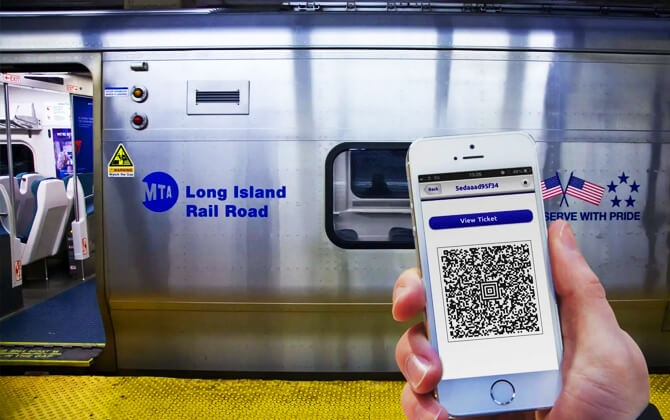
Tickets can be bought in the MTA TrainTime app, from ticket machines, or on board. Buying before boarding is usually the best way to avoid the extra charge and get the lowest price.
Connections to Other Systems
The Long Island Rail Road connects closely with other rail, subway, and bus networks at western terminals and at many stations across Long Island. Penn Station is the biggest interchange, with links to Amtrak, NJ Transit, PATH, the New York City Subway, and New York City Bus services.
At Grand Central Madison, riders can connect to Metro-North Railroad as well as subway and bus services. Atlantic Terminal in Brooklyn and Long Island City in Queens are also important access points for city transport and local transport connections.
Across New York City, several LIRR stations link directly to subway stations, and almost all stations in Brooklyn and Queens connect with New York City Bus routes. In Nassau and Suffolk counties, many stations also connect with Nassau Inter-County Express and Suffolk County Transit buses.
The railroad also has limited connections with other railroads on the western end of its freight network. These include interchange links at Fresh Pond Junction in Queens with CSX, Canadian Pacific Kansas City, and Providence and Worcester, plus service on freight-only or near freight-only routes such as the Bay Ridge Branch, Bushwick Branch, and Lower Montauk.
Airport Connections
The LIRR is one of the most practical public transport options for reaching JFK Airport from Manhattan or Brooklyn. Jamaica Station is the main transfer point, where passengers switch to the AirTrain for the final leg to the terminals.
Penn Station, Grand Central, and Atlantic Terminal all provide LIRR service to Jamaica. From there, travelers can follow signs to the AirTrain and continue to JFK. The AirTrain fare is separate from the rail ticket.
For LaGuardia Airport, one option is to take the train to Woodside and transfer to the LaGuardia Link Q70 bus. Another is to use the subway and the same bus connection. The Q70 serves Terminals C and B, while Terminal A requires the airport shuttle bus from Terminal B.
- Jamaica Station: transfer for JFK Airport via AirTrain.
- Woodside: transfer for LaGuardia Airport via Q70 bus.
- Penn Station, Grand Central, and Atlantic Terminal: major LIRR access points for airport trips.
LIRR tickets can be purchased before boarding or in the TrainTime app, which is usually the easier option when planning airport transportation in New York.
Tips and Rules
The Long Island Rail Road sets rules for the safe and proper use of its terminals, stations, and trains. These rules are meant to protect passengers, employees, and the public, while keeping transport service moving smoothly.
Public areas in stations and terminals are open only during the times set by the LIRR. Areas that are closed or not open to the public may be entered only by authorized persons or under a lease, license, operating agreement, or public safety authority.
Noncommercial activities may be allowed if they do not interfere with access, passenger flow, or transportation service. They are not allowed on platforms in Penn Station or on trains, and any such activity in Penn Station requires a permit from the superintendent.
Main prohibited uses include:
- blocking movement, lying on floors, platforms, stairs, or landings, or taking up more than one seat;
- making unreasonable noise, including using radios or sound devices on trains without headphones or earphones;
- throwing objects, vandalizing property, or tampering with equipment;
- drinking alcohol or carrying an open alcoholic beverage outside permitted areas;
- using controlled substances illegally or entering while impaired by alcohol or drugs;
- fighting, assault, threats, or any conduct that puts others in danger;
- entering locked or restricted areas, or using unauthorized entrances or exits;
- riding bicycles, scooters, skateboards, or similar devices in terminals, stations, or trains, except for physically disabled persons;
- using hand carts on escalators;
- conducting commercial activity without authorization;
- smoking on trains, in indoor areas not designated for smoking, or in outdoor ticketing, boarding, or platform areas.
Other rules cover littering, dumping, hygiene facilities, priority seating, ticket presentation, animals, firearms, dangerous substances, electrical connections, railroad crossings, and enforcement.
Priority seating must be given up when requested by a crew member or police officer. Riders must present a valid ticket, employee pass, dependent pass, or the required fare when asked.
Animals are generally not allowed in terminals, stations, or trains, except seeing-eye dogs, hearing-ear dogs, and animals properly confined for shipment. Firearms and other weapons are not permitted unless the person is licensed and carrying that license.
Violations may lead to an appearance ticket or ejectment from a terminal, station, or train. Police officers may issue appearance tickets or order removal. Penalties can include a fine of up to $50, imprisonment for up to 30 days, or both.
History
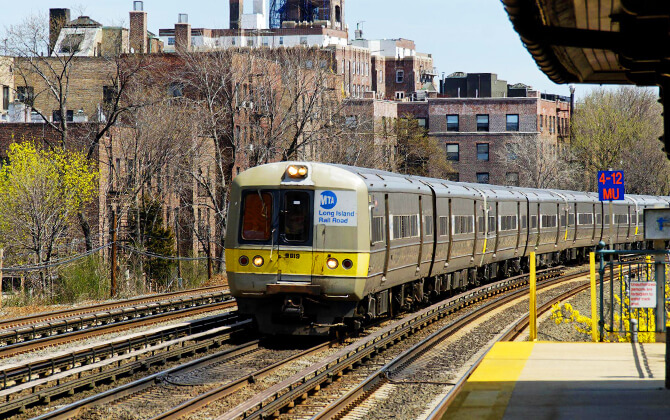
The Long Island Rail Road Company was chartered in 1834 to provide daily service between New York City and Boston by way of a ferry connection between Greenport on Long Island and Stonington, Connecticut. That original plan changed in 1849 when the land route through Connecticut took over as the main Boston connection.
Afterward, the railroad turned its attention to Long Island itself and competed with other railroads on the island. In the 1870s, president Conrad Poppenhusen and later Austin Corbin acquired and consolidated several railroads into the LIRR. The company struggled financially for much of its early history. In 1900, the Pennsylvania Railroad bought a controlling interest as part of its push for direct Manhattan access, which began on September 8, 1910.
Electric operation started in 1905, and the Pennsylvania Railroad supported expansion and modernization through the first half of the 20th century. After World War II, declining profits led to the end of those subsidies, and the LIRR entered receivership in 1949.
In the 1950s and 1960s, New York State began subsidizing the railroad because of its importance to Long Island. In June 1965, the state agreed to buy the LIRR from the Pennsylvania Railroad for $65 million. It then came under the Metropolitan Commuter Transit Authority, later renamed the Metropolitan Transportation Authority in 1968. With MTA backing, the railroad modernized further and officially became a subsidiary public benefit corporation in 1980.
In the 21st century, the system expanded again through major capital projects. East Side Access, first proposed in the 1968 Program for Action, opened with limited Jamaica-Grand Central shuttle service on January 25, 2023, followed by full service on February 27, 2023. The project created Grand Central Madison beneath Grand Central Terminal.
Other major work included the second track between Farmingdale and Ronkonkoma, completed in September 2018, and the Main Line third-track expansion between Floral Park and Hicksville, completed in 2022. The Belmont Park Redevelopment Project also led to the opening of Elmont station, the first new LIRR station in nearly 50 years.
Future Extensions
The Long Island Rail Road has already completed major upgrades, but more expansion and capacity improvements have been discussed or proposed. These projects focus on reliability, added capacity, and a more flexible system for riders across Long Island.
Planned electrification projects
In the 2020-2024 MTA Capital Program, the MTA proposed electrifying the Central Branch to improve service options and reduce the impact of disruptions. That project was later put on hold. There have also been long-standing calls to electrify the remaining portions of the Port Jefferson Branch and Oyster Bay Branch so more frequent direct Manhattan service could be offered.
Another possible system change is the introduction of OMNY, the contactless fare payment system planned for MTA commuter railroads, including the LIRR.
Capacity and network improvements
The 2025-2029 Capital Plan points to further capacity studies for commuter rail infrastructure. For the LIRR, the projects to be analyzed include Main Line electrification to Yaphank and improvements to the Port Jefferson and Montauk branches.
These ideas build on recent projects such as East Side Access, the second track to Ronkonkoma, and the Main Line third-track expansion between Floral Park and Hicksville. The next phase looks less about brand-new corridors and more about targeted upgrades that can support better frequency, stronger resilience, and more consistent service.
Stations and accessibility
Future capital plans also continue to focus on accessibility. The LIRR has said it will reach 98% accessibility, with at least four more stations expected to become accessible under the current plan, including Bellerose, Douglaston, and Cold Spring Harbor.
These upgrades are part of the wider effort to modernize the system while keeping it practical for a growing number of riders.
Nearby Attractions
The Long Island Rail Road gives easy car-free access to beaches, lighthouses, mansions, vineyards, downtown areas, golf courses, and other destinations around Long Island. It is also a convenient way to reach major sights in and around New York.
Long Island highlights
The train is a simple way to explore the Hamptons, including Westhampton, Hampton Bays, Southampton, Bridgehampton, East Hampton, and Amagansett. From Southampton Station, travelers can continue to Coopers Beach and the Parrish Art Museum. East Hampton Station connects to East Hampton Main Beach and Main Street shopping.
On the North Fork, the LIRR makes it easier to visit farm stands, vineyards, and craft beverage spots. The area is known for its wine country feel, and nearby stops can also lead to Port Jefferson and Patchogue, both known for dining, waterfront views, and walkable downtown streets.
For a classic seaside trip, Montauk offers white-sand beaches, the historic Montauk Point Lighthouse, and resort stays including Gurney’s Montauk Resort & Seawater Spa, Montauk Yacht Club, and Hero Beach Club.
Popular city sights
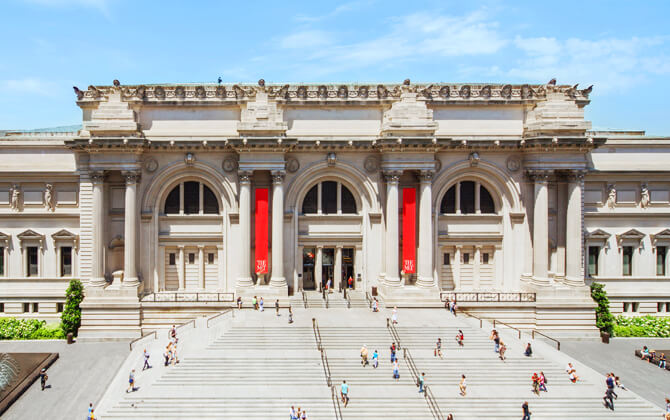
- The Metropolitan Museum of Art
- Statue of Liberty
- Empire State Building
- Central Park
- Times Square
- The Museum of Modern Art
- Top of the Rock
- Rockefeller Center
- One World Trade Center
Shopping and dining nearby
Near Jamaica, travelers will find quick dining options and shopping stops, plus easy connections into Manhattan. Nearby shopping destinations include Macy’s at Herald Square, Century 21 Downtown, and Woodbury Common Premium Outlets.
Useful nearby places to stay
- Residence Inn by Marriott New York JFK Airport
- Marriott New York JFK Airport
- Hampton Inn NY-JFK
- Comfort Inn JFK Airport