Public transportation in Taipei is a clean, efficient, and affordable city transport system built around the Taipei MRT, buses, airport rail, taxis, regional trains, and YouBike. The network is bilingual, air-conditioned, accessible, and easy to use, so visitors can move between major sights, airport terminals, rail stations, and local neighborhoods without much stress.
| Key | Information |
|---|---|
| Main transport modes | Taipei MRT, city bus, taxi, airport MRT, airport bus, Taiwan Railways, High-Speed Rail, YouBike |
| Main rapid transit system | Taipei Metro, also called Taipei MRT or Metro Taipei |
| MRT operating hours | Usually 06:00 to 00:00, with last train services finishing around 01:00 |
| Coverage | Taipei and New Taipei City, with connections to rail, bus, airport, and gondola services |
| Payment options | Single-journey tokens, EasyCard, iPASS, cash on buses, and selected card payments for taxis |
| Accessibility | Many services include elevators, ramps, tactile guide paths, accessible gates, and wheelchair spaces |
Map of Public Transportation In Taipei
Map of Public transportation in Taipei showing different lines. Click on the map to enlarge it or download the map of Public transportation in Taipei in PDF format.
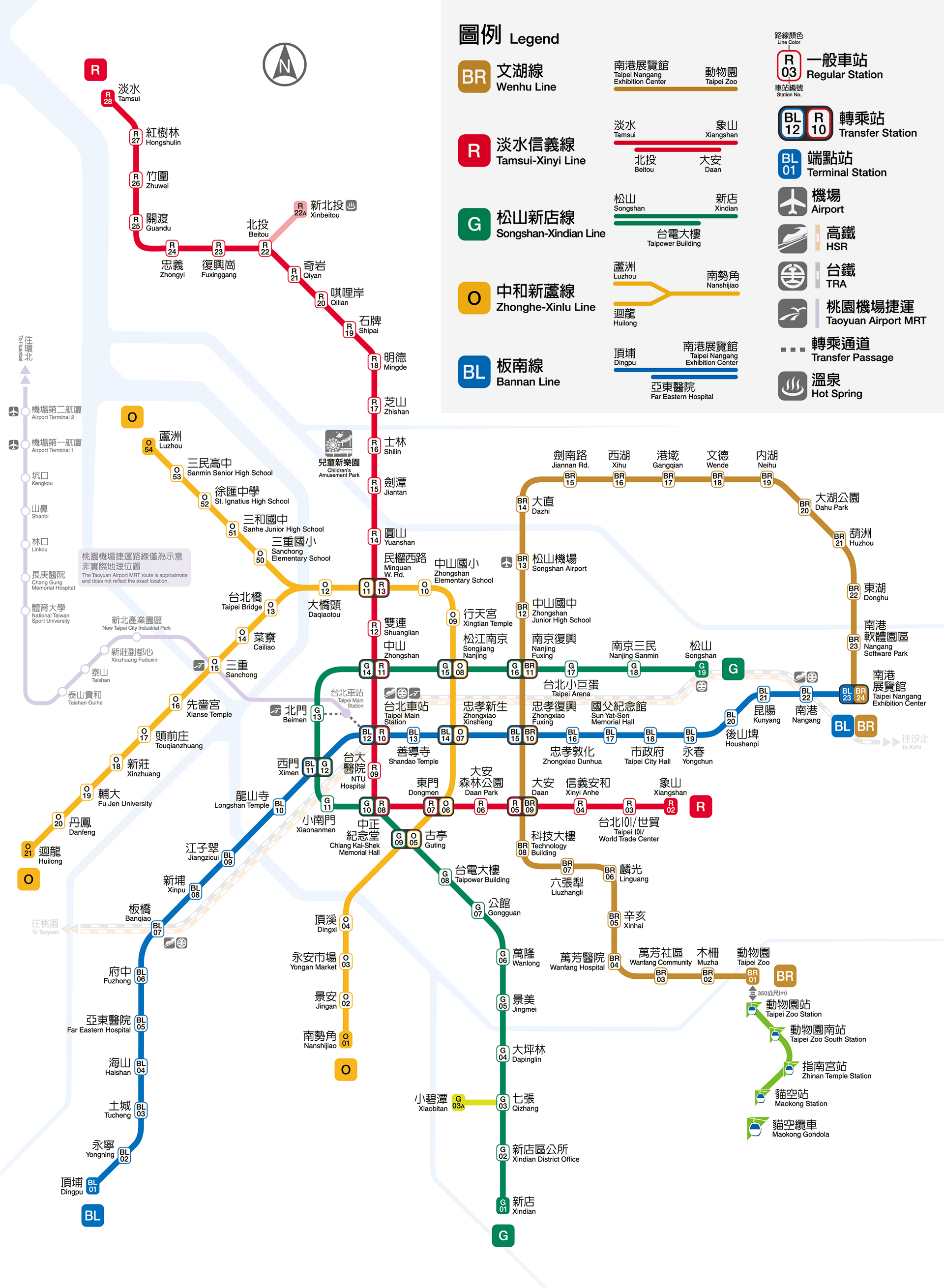
Rapid Transit System or Taipei MRT
Taipei Metro, also known as Taipei Mass Rapid Transit or Taipei MRT, is the rapid transit system serving Taipei and New Taipei City. It was the first rapid transit system built on Taiwan’s main island and remains the backbone of local transport in the capital area.
The system was approved in 1986, construction began in 1988, and the first line opened on 28 March 1996 with the Wenhu line. By 2000, the network had 62 stations across three main lines. Continued expansion has taken the system to 131 stations, and it now carries more than two million trips a day.
The MRT is operated by the Taipei Rapid Transit Corporation. Its route plan follows a spoke-hub pattern, with most lines running outward from central Taipei. Standard opening hours are usually 06:00 to 00:00, while the last train services finish around 01:00. Frequency depends on the line and time of day, and service can be extended during major events.
| Service detail | Timings |
|---|---|
| Typical starting time | 06:00 |
| Typical closing time | 00:00 |
| Last train running time | Final trains usually complete their trips around 01:00 |
| Frequency | Varies by route and time of day |
| Special event schedule | Extended operating hours may apply during major events |
The system is orderly and easy to understand. Smoking is banned throughout the metro, and eating, drinking, chewing gum, and betel nuts are not allowed inside the paid area. Announcements are made in Mandarin, English, Taiwanese, and Hakka, with Japanese at busy stations and Korean at selected stations.
Taipei MRT connects with city buses, Taiwan Railways, Taiwan High Speed Rail, the Maokong Gondola, Taipei Songshan Airport, the New Taipei Metro Circular line, and Danhai LRT. For first-time visitors, the stations map and route timetable are the easiest way to check where to transfer.
- Opened in 1996
- Serves Taipei and New Taipei City
- Includes 131 stations
- Carries more than two million daily trips
- Known for clean stations, clear rules, and reliable train schedule information
Accessibility is one of the system’s strengths. Stations and trains include obstacle-free routes, ramps, elevators, tactile guide paths, extra-wide faregates, and wheelchair spaces. Many stations also include public art, galleries, or other public facilities.
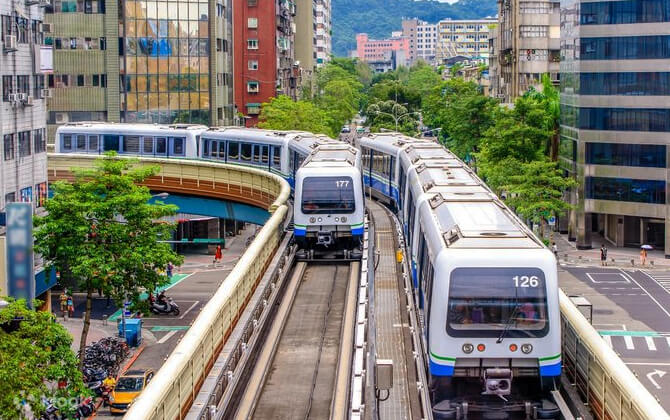
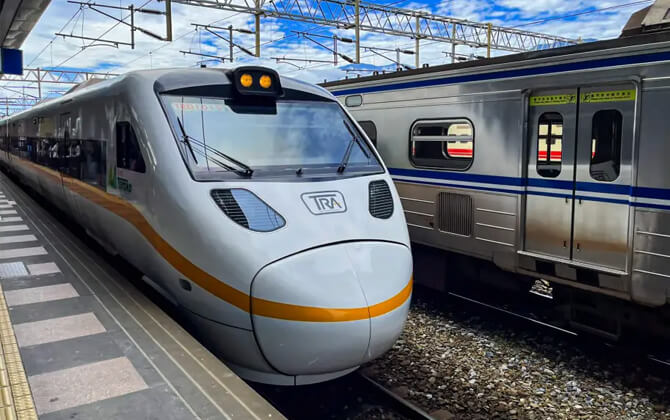
Train service in Taipei
Train service in Taipei is centered on the Taipei MRT, which handles most urban rail travel across Taipei and New Taipei City. For longer trips, the city also connects with Taiwan Railway Administration services and Taiwan High Speed Rail.
The MRT began operating on 28 March 1996 and has grown into the city’s main public transport system. Its daily working hours usually run from 06:00 to 00:00, with last train services completing by about 01:00. On special dates, such as New Year events, the train schedule may be extended to handle heavier demand.
Train frequency ranges from about 1 minute 30 seconds to 15 minutes, depending on the line and time of day. During New Year’s Eve 2009 and New Year’s Day 2010, Taipei Metro carried 2.17 million passengers over 42 consecutive hours of operation.
| Service detail | Timings |
|---|---|
| Opening times | Usually from 06:00 |
| Regular close | Around 00:00 |
| Last train | Services usually finish their runs by about 01:00 |
| Train frequency | About 1 minute 30 seconds to 15 minutes |
| Extended schedule today | May apply during major events; check current timings today before travel |
All stations and trains are accessible, with ramps, elevators, tactile guide paths, wide faregates, and wheelchair areas. The MRT is also known for being clean, punctual, and safe to use.
Several stations are especially useful for transfers between the MRT and other rail or local transport services.
| Station | Details |
|---|---|
| Taipei Main Station | Major interchange for Taipei MRT, Taiwan Railways, Taiwan High Speed Rail, buses, and airport connections |
| Banqiao | Connection point for metro and longer-distance rail services |
| Nangang | Rail and metro connection in eastern Taipei |
| Taipei Zoo | Connection for the Maokong Gondola |
When riding the MRT, do not smoke, eat, drink, chew gum, or bring betel nuts into the paid area. The rules are simple, but they are taken seriously.
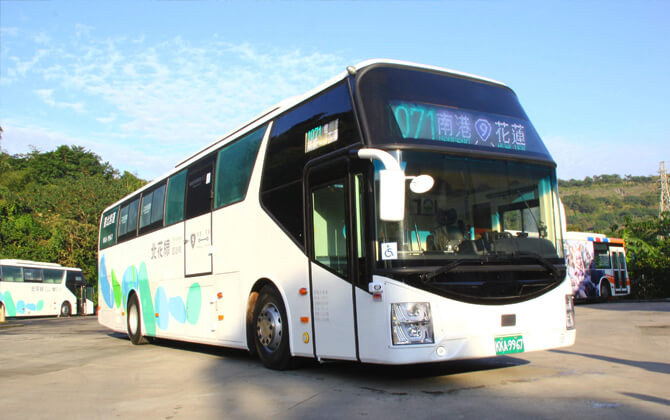
Bus service in Taipei
Taipei’s bus system is a useful and low-cost way to get around, especially for places not directly served by the MRT. The Taipei Joint Bus System includes general routes, trunk routes, MRT shuttle buses, mountain buses, recreational buses, and small buses.
Most bus stops have electronic signs showing the next arrival, and many display route information and timetables in English and Mandarin. Buses are generally clean, air-conditioned, and practical for relaxed sightseeing as well as daily commuting.
Bus fare in Taipei is based on sections, or fare zones. Most city trips need only a one-section ticket, but longer routes may require a two- or three-section fare. Cash is accepted, but buses do not give change.
- One section: NT$15, about US$0.50
- Two sections: NT$30, about US$1.00
- Three sections: NT$45, about US$1.45
You can also pay by EasyCard. Tap when boarding and again when alighting if required. EasyCard users may receive transfer discounts for MRT, bus, and YouBike trips within one hour after getting off the bus.
To ride smoothly, check the bus number and color before boarding because some routes do not follow the same path in both directions. Board at the front, follow the driver’s payment instructions, and watch the electronic sign or listen for stop announcements. For route planning, Google Maps and real-time bus tools are useful for checking schedule today, live arrivals, and route timetable details.
Bus connections are also handy for trips beyond central Taipei.
| Station | Details |
|---|---|
| Shilin | Useful starting point for buses to Yangmingshan |
| Xindian | Useful starting point for buses to Wulai |
| Taipei Main Station | Destination for the 1819 Kuo Kuang airport bus from Taoyuan International Airport |
For airport arrivals, the 1819 Kuo Kuang bus is the cheapest listed option from Taoyuan International Airport to Taipei Main Station. The Airport MRT is faster, while taxis cost more but offer direct door-to-door travel.
Taxis in Taipei
Taxis are easy to find in Taipei and work well when you want a direct ride across the city. Yellow taxis are usually the most expensive form of everyday public transportation, but the price is still reasonable compared with many international cities.
A ride across Taipei usually costs less than NT$250, about US$8.05. The starting fare is NT$70, about US$2.25, for the first 1.25 km, or 0.78 miles. After that, NT$5, about US$0.16, is added for every 250 meters, or 0.16 miles. Late-night rides and special holidays add NT$20, about US$0.65, and highway tolls may apply outside the city.
Most drivers use the meter and take a direct route. Taxi service in Taipei is generally well regarded, with fewer scams than in many cities. Still, have your destination written in Chinese if possible, because many drivers do not speak English.
Cash is the most common payment method. Some taxis accept credit cards or EasyCard, but not all. Tipping is not required or expected.
You can also request a licensed taxi through the Uber app in Taipei. Enter your pickup and drop-off points, choose Uber Taxi, and pay with supported cashless options such as card, Apple Pay, or Google Pay. Uber Taxi in Taipei supports up to 4 passengers and is available 24/7 when vehicles are nearby.
For airport travel, a taxi from Taoyuan International Airport to Taipei city center takes about one hour and costs around NT$1,300, about US$42.00. It is the most expensive transfer option listed here, but it can be very convenient after a long flight.
To book an International Taxi by phone, call 02-2799-7977. In that case, the driver will speak English.
Airport Connections
Travel from Taipei Taoyuan International Airport into the city is straightforward. The main options are Airport MRT, taxi, airport bus, and private transfer. Your best choice depends on arrival time, budget, luggage, and how close your hotel is to a station.
| Transport Option | Best For | Travel Time | Cost Range |
|---|---|---|---|
| Airport MRT | Fast and reliable travel | About 35–50 minutes | NT$160, about US$5.15 |
| Taxi | Door-to-door convenience | About 40–60 minutes | NT$1,200–1,600, about US$38.70–51.60 |
| Airport Bus | Budget travel | About 50–90 minutes | NT$90–150, about US$2.90–4.85 |
| Private Transfer | Groups and hassle-free arrival | About 40–60 minutes | NT$1,500–2,500, about US$48.40–80.60 |
The Taoyuan Airport MRT is the fastest and most predictable option. It runs to Taipei Main Station, with express and commuter services available. The express train takes about 35 minutes, while the commuter train takes about 50 minutes.
A one-way ticket from the airport to Taipei Main Station costs around NT$160, about US$5.15. You can buy tickets from machines or service counters, or pay with an EasyCard or iPASS. English signage is available, which makes this route easy if you are traveling light.
Taxis operate 24/7 outside the arrivals hall. A trip to Taipei city center usually costs NT$1,200–1,600, about US$38.70–51.60, depending on traffic and luggage fees. In clear traffic, the running time is usually 40–50 minutes, though rush hour or heavy rain can make it longer.
Airport buses are the cheapest option and serve major districts, transport hubs, and some hotels. They are slower than the MRT but useful if your accommodation is not near a station. Tickets are sold at official airport bus counters, selected machines, convenience stores inside the airport, and some online booking platforms.
Private transfers are best if you want the arrival arranged in advance. A driver meets you at the airport and takes you straight to your destination. Typical travel time is 40–60 minutes, depending on traffic and where you are staying in Taipei.
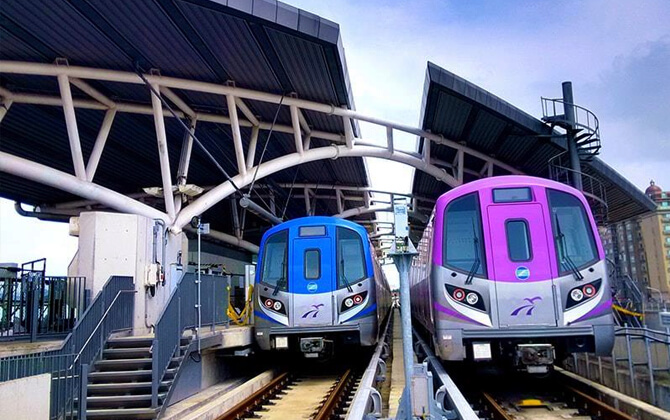
Getting around in city of Taipei
Getting around Taipei is simple because the city combines metro, bus, taxi, rail, and cycling into one practical transportation system. Public services are bilingual and air-conditioned, and the main routes are easy to check before you travel.
For a city of its size, Taipei is easy to cross. The city center can be traveled from Xiangshan to Ximen in about 40 minutes by bike, bus, or MRT. New Taipei City is larger, and an MRT trip from Tamsui to Xindian takes about 1 hour 30 minutes.
Taipei public transport is affordable, clean, punctual, and convenient. Google Maps is useful for route planning, transfer details, and timetable checks, especially when you want the latest timings today.
The EasyCard is the most practical card for most visitors. It can reduce regular bus and metro fares by 10–30%, and it also offers discounts for multiple journeys in one day. You can buy an EasyCard for NT$100, about US$3.20, plus your top-up amount at metro stations or 7-Eleven stores. It can also be used on TRA rail services.
The unlimited Fun Pass is widely advertised, but it usually makes sense only if you plan to visit several major attractions, such as the National Palace Museum and Taipei 101.
On the Taipei subway, avoid eating, drinking, and chewing gum. Try not to travel during weekday rush hours from 7–9 a.m. and 5–7 p.m. if you can. On escalators, stand on the right unless you are walking, keep conversations quiet, and leave dark blue priority seats for passengers who need them.
From Taoyuan International Airport, the cheapest listed transfer to Taipei Main Station is the 1819 Kuo Kuang bus, which costs NT$135, about US$4.35, and takes about one hour. The Airport MRT is faster at around 35 minutes and costs NT$160, about US$5.15. A taxi to the city center takes about one hour and costs around NT$1,300, about US$42.00.
Walking is a good way to explore Taipei at street level. It is not always the fastest option, but it gives you time to notice alleyways, small temples, and local shops. In summer, especially from June to August, use high SPF sunscreen and drink plenty of water.
Traffic can be busy around scooters and mopeds. Pedestrian crossings, traffic lights, and one-way streets help organize movement, but stay alert. If you rent a scooter, services such as WeMo and SKRT are available depending on whether you read Chinese.
Day trips by rail are easy from Taipei. Taiwan Railway Administration services can take you to Keelung, Yilan, and Jiufen, with a transfer at Ruifang for the shuttle bus to Jiufen. For farther destinations such as Tainan and Kending, High-Speed Rail is faster. Where rail does not reach, buses and taxi pooling can fill the gap.
Cycling is also popular. YouBike offers the first 30 minutes free, then charges NT$10, about US$0.32, every 30 minutes after that. Docking stations are commonly found outside MRT stations and around the city. YouBike can be rented with an EasyCard, and in some cases with a credit card. Taipei has YouBike 1.0 and YouBike 2.0, so return the bike to the correct dock type.
The MRT is the best option for accessible travel. Its 131 stations provide accessible routes, elevators, toilets, snack stores, and, in some places, underground malls. On hot or rainy days, that comfort matters.
Nearby Attractions
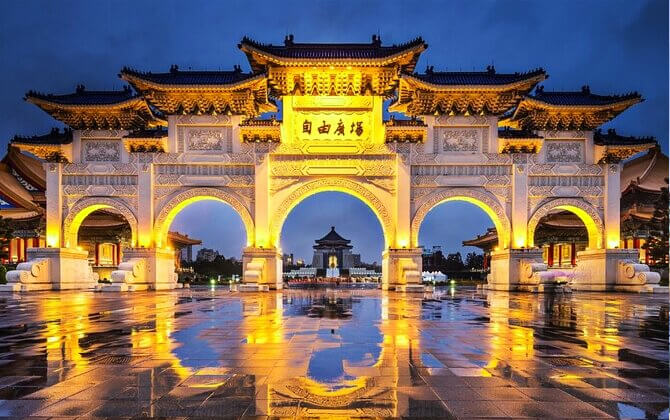
Taipei Main Station is a practical starting point for sightseeing because the Taipei Metro, buses, and Taiwan Railways are all close together. From here, you can reach many of the city’s best-known attractions without a car.
| Station | Details |
|---|---|
| Taipei Main Station | Main hub for MRT, buses, Taiwan Railways, and day-trip connections |
| Taipei 101 area | Reached by MRT for one of Taipei’s most famous landmarks |
| Chiang Kai-shek Memorial Hall | Major city sight accessible by MRT |
| Shilin Night Market area | Popular night market area reachable by MRT and bus |
| Ximending | Busy shopping and entertainment district connected by the metro network |
| Beitou | Hot spring area accessible by MRT |
| Xiangshan | Good area for city views |
For day trips, Taiwan Railway services can take you to Keelung, Yilan, and Jiufen. High-Speed Rail is useful for faster travel to other cities on Taiwan’s west coast.
For a full day of sightseeing, an EasyCard is the simplest ticket option for most journeys across Taipei’s local transport network.
Tips and Rules
Taipei’s public transportation is easy to use, but a few rules make every trip smoother. The Taipei Metro runs daily from 6 a.m. to midnight, with last train services finishing later. Tickets and passes are sold at station information counters, and single-journey tokens are available from vending machines in all stations.
Metro admission uses blue plastic single-journey tokens or EasyCards. Single-journey fares range from NT$20 to NT$65, about US$0.65–2.10. A One-day EasyCard Pass costs NT$150, about US$4.85. Other passes include the 24-hour pass at NT$180, about US$5.80, the 48-hour pass at NT$280, about US$9.05, the 72-hour pass at NT$380, about US$12.25, and the All Pass Ticket at NT$1,280, about US$41.30. Each pass can be used by only one passenger at a time.
When riding the MRT, do not eat, drink, chew gum, or smoke. Line up before boarding, and do not sit in priority seats reserved for elderly passengers, disabled passengers, pregnant passengers, and passengers traveling with young children. On escalators, stand on the right and walk on the left.
The Taoyuan Airport MRT has express and commuter trains. Free 4G Wi-Fi is available at all stations, and express trains include wireless charging and luggage racks. Before boarding, check whether the train is a purple express train or a blue commuter train. The express service takes 35 minutes from Taoyuan Airport Terminal 1 to Taipei Main Station and 38 minutes from Terminal 2 to Taipei Main Station.
Bus fares are section-based and can be paid in cash or with contactless smart cards. If you pay with coins, use the exact fare because buses do not give change. With smart cards, swipe when boarding and alighting. Most riders need only a one-section ticket, but the driver will tell you if a two- or three-section fare applies.
Check the bus number and color before boarding, because some buses do not follow the same route in both directions. Most stops show electronic arrival information, and route details are usually posted at the stop. If a bus crosses another fare zone, you may need to pay again. In some cases, drivers hand out a paper ticket near zone boundaries; keep it and return it when you get off.
On YouBike, riders can use MRT EasyCards, credit cards, or cellphones to rent a bicycle. Taipei has more than 5,000 bicycles at 163 stations. Fare rates are NT$10, about US$0.32, per half-hour up to four hours; NT$20, about US$0.65, per half-hour from four to eight hours; and NT$40, about US$1.30, per half-hour after eight hours.
Parking charges and station parking rules are not part of the standard MRT, bus, taxi, or YouBike fare system described here, so check the specific facility if you plan to drive to a station.