Kaohsiung Mass Rapid Transit is the main rapid transit and light rail system in Kaohsiung, Taiwan, serving the wider metropolitan area through the Red Line, Orange Line, and Circular Light Rail. The MRT opened in 2008, the circular tramway-style light rail began service in 2015, and the system is operated by the Kaohsiung Rapid Transit Corporation under a BOT contract with the city government.
| Key | Information |
|---|---|
| System name | Kaohsiung Mass Rapid Transit System |
| Also known as | Kaohsiung Metro, Kaohsiung Rapid Transit, KRT |
| Location | Kaohsiung, Taiwan |
| Modes | Rapid transit and light rail |
| Main lines | Red Line, Orange Line, Circular Light Rail |
| MRT opening | 2008 |
| Light rail opening | 2015 |
| Operator | Kaohsiung Rapid Transit Corporation (KRTC) |
| Romanization | Derived from Tongyong Pinyin |
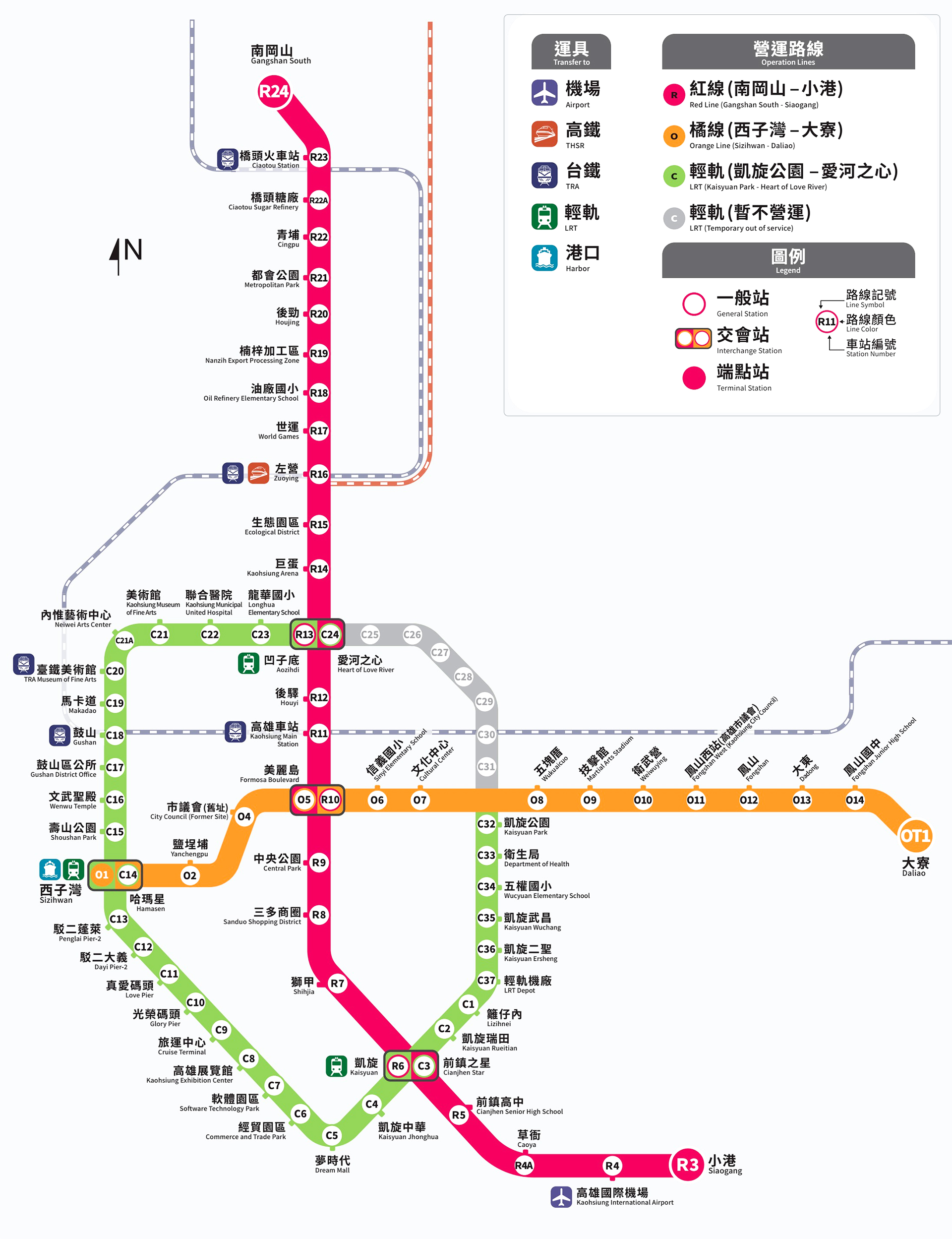
Kaohsiung Mass Rapid Transit Map
Map of Kaohsiung Mass Rapid Transit showing different lines. Click on the map to enlarge it or download the Kaohsiung Mass Rapid Transit map in PDF format.
Lines and Stations
Kaohsiung MRT is a compact but useful city transport system. It currently has two heavy rail lines, the Red Line and the Orange Line, plus the Circular Light Rail. Together they form the core route network for transportation in Kaohsiung and connect major districts, transfer points, shopping areas, and the airport.
| Station | Details |
|---|---|
| Red Line | Heavy rail line opened in 2008, 28.3 km (17.6 mi) long, 24 stations, running from Gangshan South to Xiaogang. |
| Orange Line | Heavy rail line opened in 2008, 14.4 km (8.9 mi) long, 14 stations, running from Sizihwan to Daliao. |
| Circular Light Rail | Light rail line opened in 2015, 12.8 km (8.0 mi) long, 23 stations, running from Lizihnei to Kaixuan Park. |
Red Line
The Red Line is the north-south main route of the system. It runs between Gangshan South and Xiaogang, covering 28.3 km (17.6 mi) with 24 stations. Stations mentioned in the source include Gangshan South, Ciaotou Station, Qingpu, and Xiaogang.
Orange Line
The Orange Line runs east-west through central Kaohsiung. It connects with the Red Line at Formosa Boulevard Station and stretches from Sizihwan to Daliao across 14.4 km (8.9 mi), with 14 stations. Stations listed in the source include Sizihwan, Yanchengpu, City Council, and Daliao.
Circular Light Rail
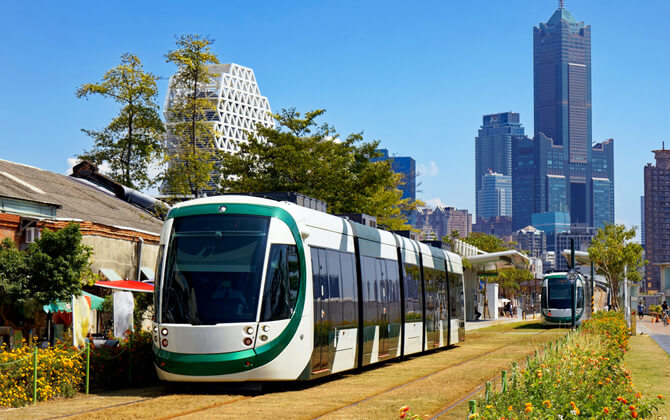
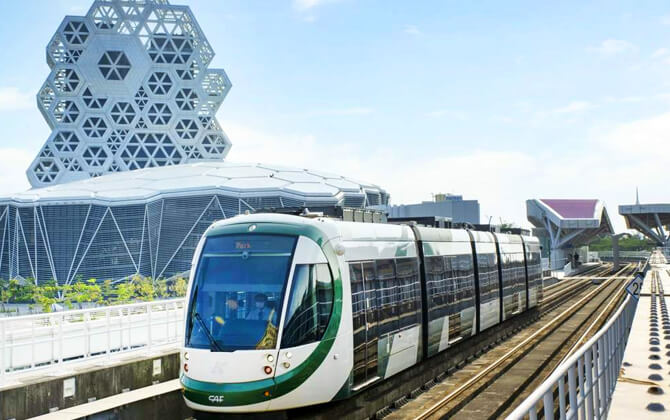
The Circular Light Rail is Kaohsiung’s tramway-style service, running at ground level around the downtown area. It links Lizihnei and Kaixuan Park and has 23 stations. Its operating hours are shorter than those of the heavy rail MRT lines.
For route planning, station-specific opening times, closing time, and last train information vary by line, direction, and station. Weekend and holiday timetable details may also differ, so checking the latest train schedule before travel is a smart move.
Schedule
Kaohsiung MRT operating hours generally start at 6:00 AM and run until 12:00 AM. Some source material also describes service as continuing until 1:00 AM, so if you need the exact opening hours, timings today, or the last train, check the latest official timetable before you travel.
| Service detail | Timings |
|---|---|
| General starting time | 6:00 AM |
| General closing time | 12:00 AM |
| Alternative late closing time mentioned in source | 1:00 AM |
| Peak frequency | Every 4 to 6 minutes |
| Off-peak frequency | Less than 8 minutes |
| After 11:00 PM | Less than 20 minutes |
| Recommended arrival before departure | 2 to 3 minutes early |
On the Red Line, first and last train timings depend on station and direction. At Central Park (R9), for example, the first train toward Gangshan Station leaves at 05:56 and the last train at 24:18. Toward Siaogang, the first train leaves at 06:14 and the last train at 24:34.
At Central Park, the schedule today for the last transfer toward the Orange Line is listed as 06:14 on workdays, the day before holidays, Saturday, and holidays, and 23:59 on Sunday.
The Red Line, Orange Line, and Circular Light Rail all have station-by-station working hours and route timetable details, with small changes possible on weekends and holidays. If you want the exact route plan for a specific trip, it is best to confirm the current schedule before setting out.
| Service detail | Timings |
|---|---|
| Red Line route | Gangshan South to Xiaogang |
| Orange Line route | Sizihwan to Daliao |
| Circular Light Rail route | Lizihnei to Kaixuan Park |
Fares
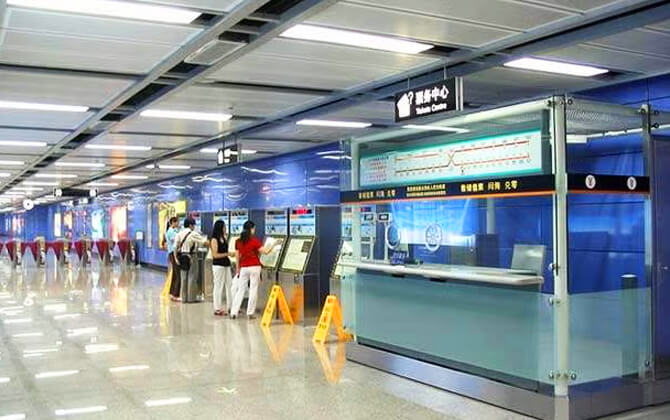
You can check the fare, ticket price, and travel cost by entering your starting point and destination in the Trip Planner, which works as a basic fare calculator for the system.
- Adult Single Journey Ticket fare
- Concessionary Single Journey Ticket fare for child and senior passengers
- Light Rail fare
- MTR Bus and feeder bus fare information
The source also mentions single journey ticket comparisons with Octopus fares, but it does not provide enough local detail to expand on that here.
Light Rail
The Kaohsiung Circular Light Rail began trial operation on January 1, 2024, and mileage-based fares have been charged since February 26, 2024.
Passengers need to swipe their card when entering and exiting. There is no difference between inbound and outbound directions at the platform ticket barriers, so you need to tap correctly or the card may be blocked.
Passengers using e-tickets or QR codes get a 15% discount off the e-fare. If you do not have an e-ticket, you can buy a ticket from a station machine, choose your destination, and the machine will calculate the price.
The approved fare starts at NT$20 (about US$0.63) for the first 5 km (3.1 mi), then adds NT$5 (about US$0.16) for each additional 2 km (1.2 mi), up to a maximum of NT$35 (about US$1.10) for one ride.
Holders of a Bao Ai Card or Senior Citizen Card can ride the Kaohsiung Light Rail free by swiping the card on entry or exit.
If you stay in the fare zone for more than 2 hours after entry, an extra NT$20 (about US$0.63) is charged. If you fail to swipe out on the same day, the system charges the highest fare from the previous ride plus the overtime fare, for a total of NT$55 (about US$1.73).
Connections
The Kaohsiung Mass Rapid Transit system ties together key parts of the city through the Red Line, Orange Line, and Circular Light Rail. The Red Line runs from Siaogang to Gangshan Station, the Orange Line runs from Hamasen to Daliao, and the light rail serves stops around the downtown area.
In-service rail routes include the Red Line, Orange Line, the R24 Kaohsiung Medical University Gangshan Hospital to RK1 Gangshan Station extension, and the Circular Light Rail. The network also has expansion projects under construction, including the Gangshan-Lujhu Extension Line Phase II and the Yellow Line, which is planned to serve Niaosong, Sinsing, Lingya, Cianjhen, Fongshan, and Sanmin districts.
Transfers between the Red and Orange Lines are available at Formosa Boulevard Station. For the light rail, transfer points include Kaixuan Station and Qianzhen Star Station, where passengers need to exit and walk. A separate fare is charged when transferring between the light rail and the MRT.
The Red Line provides direct public transport access to Kaohsiung International Airport at R4 Xiaogang Station. The system also connects places such as Kaohsiung Main Station, Kaohsiung Arena, Zuoying, Kaohsiung Exhibition Center, and several waterfront stops on the Circular Light Rail.
Connection to the Airport
Kaohsiung International Airport is directly connected to the Kaohsiung MRT Red Line at Kaohsiung International Airport Station (R4). For many travelers, this is the easiest way to get between the airport and the city.
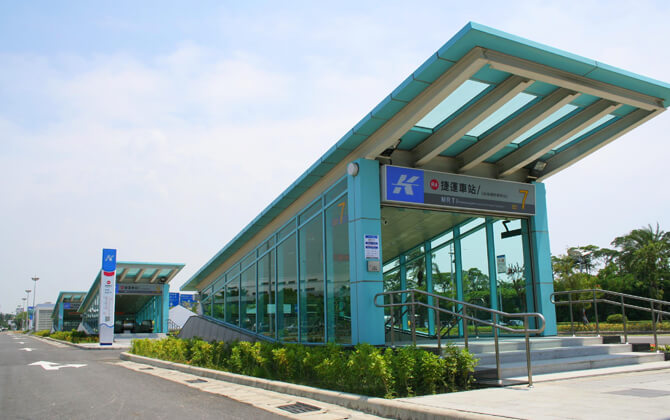
The airport station is underground, has an island platform, and includes seven exits. Exit 2 connects to the Domestic Terminal, while Exit 6 connects to the International Terminal. Other exits are located in the station parking area.
The Red Line links the airport with major city stations such as Kaohsiung Main Station and Formosa Boulevard, where you can transfer to the Orange Line. Train frequency is every 4 to 6 minutes in peak hours and no more than every 8 minutes off-peak.
This was the first airport link by subway in Taiwan, which makes the station an important part of local transport and city transport in Kaohsiung.
- Station: Kaohsiung International Airport Station (R4)
- Line: Red Line
- Terminal access: Exit 2 for Domestic Terminal, Exit 6 for International Terminal
- Service pattern: Every 4 to 6 minutes at peak times, no more than every 8 minutes off-peak
- Station parking: Other exits are located within the parking area
Rules
The Kaohsiung Light Rail Notice to Travelers sets out the main rules for using the system. Passengers are expected to follow staff instructions and posted notices at all times to keep transport safe and orderly.
General provisions
- Passengers must not enter track areas or any place not open to the public unless directed by staff during an accident or disaster.
- A valid ticket is required to enter and leave the paid area. The normal stay limit is 2 hours unless the operator is responsible for a delay.
- Passengers must not occupy, damage, interfere with, or move equipment and facilities in the system.
- Outside operating hours, staying in a station area or on a train is not allowed unless approved by the operator.
Tickets, purchase, and use
- Ticket types include single journey tickets, electronic tickets, ride-code multi-payment, and other ticket options announced by the operator.
- One-way tickets are sold at ticket machines or other designated locations.
- Children under 6 may travel free when accompanied by a fare-paying passenger, subject to the stated conditions.
- Each ticket is generally for one person and one trip, except group tickets.
- An electronic card must have at least NT$1 (about US$0.03) in stored value.
- Forged, altered, dirty, torn, expired, or otherwise invalid tickets may be treated as travel without a ticket.
- If a passenger fails to complete the correct exit sensing action, the electronic ticket transaction may become abnormal and the card may be locked.
- If a ticket is lost, the passenger should inform an inspector or buy another ticket at a machine.
- Except where the operator is responsible, one-way tickets are not refundable after entry sensing.
Service interruption and lost property
- If service is interrupted because of an accident, disaster, strike, or another approved reason, the company will make announcements and provide alternative transportation during the disruption.
- Passengers affected by an interruption may request a full refund within 7 calendar days, following the stated procedure.
- Lost items may be reported at the Service Desk or Lost Property Processing Center.
- To claim lost property, the owner must prove ownership. A non-owner must present both personal and owner identification.
- The operator handles lost property under relevant laws and is not liable for damage to lost items.
Items, conduct, and refusal of transport
- Baggage must not obstruct other passengers and must remain under the passenger’s care.
- Oversized baggage is restricted, except for approved items such as wheelchairs, strollers, and folding bicycles.
- Inflatable balloons are limited to five, and no single balloon may exceed 50 cm (0.5 m, 1.6 ft) on its longest side.
- Dangerous goods and flammable materials may not be brought into the system without permission.
- Passengers may be asked to cooperate with inspections if they carry suspected dangerous or flammable materials.
- The operator may refuse transport in cases involving rule violations, harassment, unsanitary conditions, unsafe behavior, prohibited items, or other conduct that threatens passenger safety or system operation.
Penalties and other rules
- Travel without a ticket, use of an invalid ticket, or use of a ticket that does not match the holder’s identity may result in the fare plus a penalty of 50 times the original price.
- Violations of Articles 50 and 50-1 of the Mass Rapid Transit Law may be handled by the operator according to law, and criminal cases may be referred to the proper authority.
- Unsafe or disruptive actions in stations or on trains may bring fines from NT$1,500 to NT$7,500 (about US$47.31 to US$236.54).
- Unauthorized carrying of declared dangerous or flammable materials, or interference with station, train, power, or safety equipment, may lead to fines from NT$10,000 to NT$1,000,000 (about US$315.39 to US$31,539.32).
- Passengers who feel unwell during the trip should notify staff immediately and request medical help.
- Electronic ticket purchase, refund, value-added service, registration, lost report, renewal, and dispute issues should be handled through the issuer’s customer service.
Fun Facts
Kaohsiung Metro blends transport, technology, accessibility, and public art in a way that gives the system a distinctive identity. The rapid transit network is operated by KRTC under a BOT contract with the Kaohsiung City Government.
The system uses romanization based on Tongyong Pinyin, and its trains are based on the Siemens Modular Metro design. Trains run in three-car sets, while platforms were built to handle up to six cars.
Passenger information is designed with both locals and visitors in mind. LED displays show the current and next station in Chinese and English, while announcements are made in Mandarin, Taiwanese, Hakka, and English, with Japanese at major stations.
Public art is a big part of the experience. Kaohsiung Arena Station, Formosa Boulevard Station, and Kaohsiung International Airport Station all include integrated artworks by international artists.
Accessibility is another standout point. All underground stations have full-height platform screen doors, and all stations are wheelchair accessible.
A few less obvious details are interesting too. The Red Line opened on March 9, 2008, the Orange Line on September 14, 2008, and the Circular Light Rail began operations in 2015. Some planned stations were never built: R1 and R2 were canceled before construction, while O3 was canceled after a fire at the original station site.
The network also has mascots, most notably the K.R.T. Girls, four anime-styled characters associated with the system.
History
The idea of a rapid transit system for Kaohsiung dates back to 1987, when the city government began a feasibility study. After favorable results, the government sought central approval and funding, and in 1990 approval was granted to establish the Kaohsiung City Mass Rapid Transit Bureau.
The first phase, covering the Red and Orange Lines, was approved in 1991. Funding disputes between Kaohsiung City and County Governments slowed progress, and the bureau was officially established in 1994 as the project moved into final scoping and detailed design.
In 1996, the central government instructed the project team to examine construction through a Build-Operate-Transfer model. In 1999, the city government invited bids for the BOT contract, and in 2000 Kaohsiung Rapid Transit Corporation was selected from three bidding groups and gained priority negotiating rights.
KRTC received its company license and was registered in December 2000. In January 2001, it signed the Construction and Operation Agreement and the Development Agreement with the city government, clearing the way for construction. Main participants included China Steel Corporation, Southeast Cement Corporation, RSEA Engineering Corporation, China Development Industrial Bank, and the Industrial Bank of Taiwan.
The system was built at a cost of NT$181.3 billion (about US$5.46 billion) and includes a 30-year operation and maintenance contract. Funding shares were 79% from the central government, 19% from Kaohsiung City Government, and 2% from Kaohsiung County Government.
Construction began in October 2001. By May 2006, 66 shield tunnels totaling 45.3 km (28.1 mi) had been completed, using both cut-and-cover and bored tunnel methods. Trial runs on the Red Line began in November 2006, and by January 2007 the last concrete slabs had been laid for the 37 planned stations.
The project was also affected by the Kaohsiung MRT Foreign Workers Scandal in 2005, which involved alleged inhumane treatment of Thai migrant workers. Investigations found kickbacks to politicians by the contractor. The scandal damaged public confidence and triggered a diplomatic response from Thailand. Chen Chu, then Chairperson of the Council of Labor Affairs of the Executive Yuan, resigned afterward.
Construction accidents pushed the opening well past the original December 2006 target. The Sanduo-Siaogang section of the Red Line opened for free test rides from February 8 to 11, 2008. The Red Line, except for two stations, opened on March 9, 2008, and the Orange Line fully opened on September 14, 2008. A temporary demonstration light rail using Melbourne D2 Tram cars from Siemens was also built in Central Park in 2004, but it closed soon afterward.
Future Expansions
Kaohsiung Metro expansion is ongoing, with several approved or active projects aimed at improving public transport coverage and strengthening the wider system. Key projects include the Yellow Line, the Gangshan-Lujhu Extension, and the Siaogang-Linyuan Extension.
The Gangshan-Lujhu Extension is being built in phases. Phase 2B was approved with a total budget of NT$14.6 billion (about US$460.47 million) and is expected to open by the end of 2029. It will extend service to Hunei District and improve transport access in the northern corridor of the metropolitan area.
The Siaogang-Linyuan Extension was approved on September 23, 2022, with a total budget of NT$53.311 billion (about US$1.68 billion). It will run through industrial parks and is planned to open in 2030. According to the source, the project is meant to support balanced regional development, improve transit access, and connect important industrial areas to the wider MRT network.
Another piece of the route plan for future growth is the Kaohsiung Commuter Pass NT$399 Program. Introduced in 2023 and promoted through 2024, it helped increase MRT and light rail use significantly. The Transportation Bureau also plans to keep improving transfers between MRT, light rail, city buses, intercity coaches, ferries, and YouBike.
Tourist Attractions
Kaohsiung’s MRT and LRT make sightseeing straightforward, especially if you are getting around by public transport. The network links waterfront districts, shopping streets, cultural venues, and major transport hubs, so moving between attractions is usually simple.
For a scenic trip, the light rail is especially useful around the harbor and pier areas. It can be combined with a riverside boat trip or a sunset harbor cruise. Popular stops and nearby attractions mentioned in the source include Pier 2 Art Center, Hamasen Railway Cultural Park, Hamasen Museum of Taiwan Railway, Kaohsiung Port Warehouse No. 2, and Jinzhan Harbor Cruise.
Several major sights are also close to MRT stations. The Dome of Light at Formosa Boulevard Station is one of the city’s best-known landmarks. Central Park, Liuhe Night Market, and Sanduo Shopping District are easy MRT trips, while Dream Mall and the Kaohsiung Eye Ferris wheel are connected by the light rail in the southern part of the city.
Beyond the center, the transport network helps visitors reach Lotus Pond, Shoushan Zoo, Shoushan Love Observatory, the Martyr’s Shrine, the National Science and Technology Museum, Fo Guang Shan Buddha Museum, and E-Da Theme Park. With MRT, LRT, bus, ferries, and sightseeing boats all in the mix, local transport in Kaohsiung works well for a flexible day out.
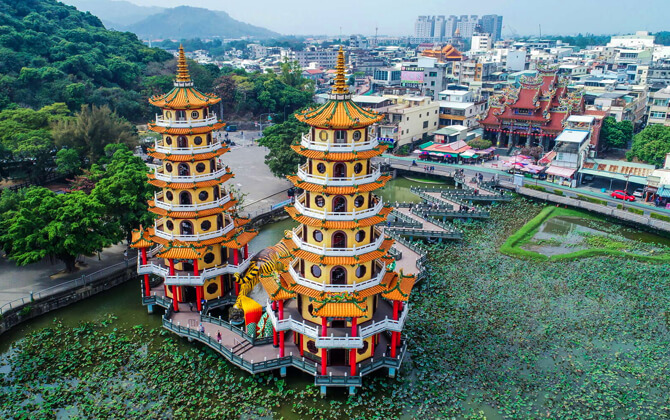
Popular places to visit by MRT and LRT
- Dome of Light at Formosa Boulevard Station
- Pier 2 Art Center and the surrounding warehouse districts
- Hamasen Railway Cultural Park
- Hamasen Museum of Taiwan Railway
- Kaohsiung Port Warehouse No. 2 (KW2)
- Love River, including the Love Boat and Love Gondola
- Dream Mall and the Kaohsiung Eye Ferris Wheel
- Central Park and nearby shopping streets
- Lotus Pond
- Fo Guang Shan Buddha Museum
If you plan to visit several places in one or two days, an MRT pass can be a practical way to save money and keep travel easy between attractions.