The Porto Metro is a light rail system in Porto, Portugal, and a core part of city transport and public transport across the wider metropolitan area. It opened in 2002, runs underground in central Porto and mostly at ground level or on elevated sections in the suburbs, and uses low-floor tram-style vehicles. The network has 6 lines, 85 stations, and 70 kilometres (43.5 miles) of double-track line serving Porto, Gondomar, Maia, Matosinhos, Póvoa de Varzim, Vila do Conde, and Vila Nova de Gaia.
| Key | Information |
|---|---|
| System type | Light rail network |
| Opening | First sections opened in 2002 |
| Operator | ViaPORTO |
| Lines | 6 |
| Stations | 85 operational stations |
| Network length | 70 kilometres (43.5 miles) of double-track commercial line |
| Underground section | 8.3 kilometres (5.2 miles) |
| Main interchange | Trindade |
| Coverage | 7 municipalities in Greater Porto |
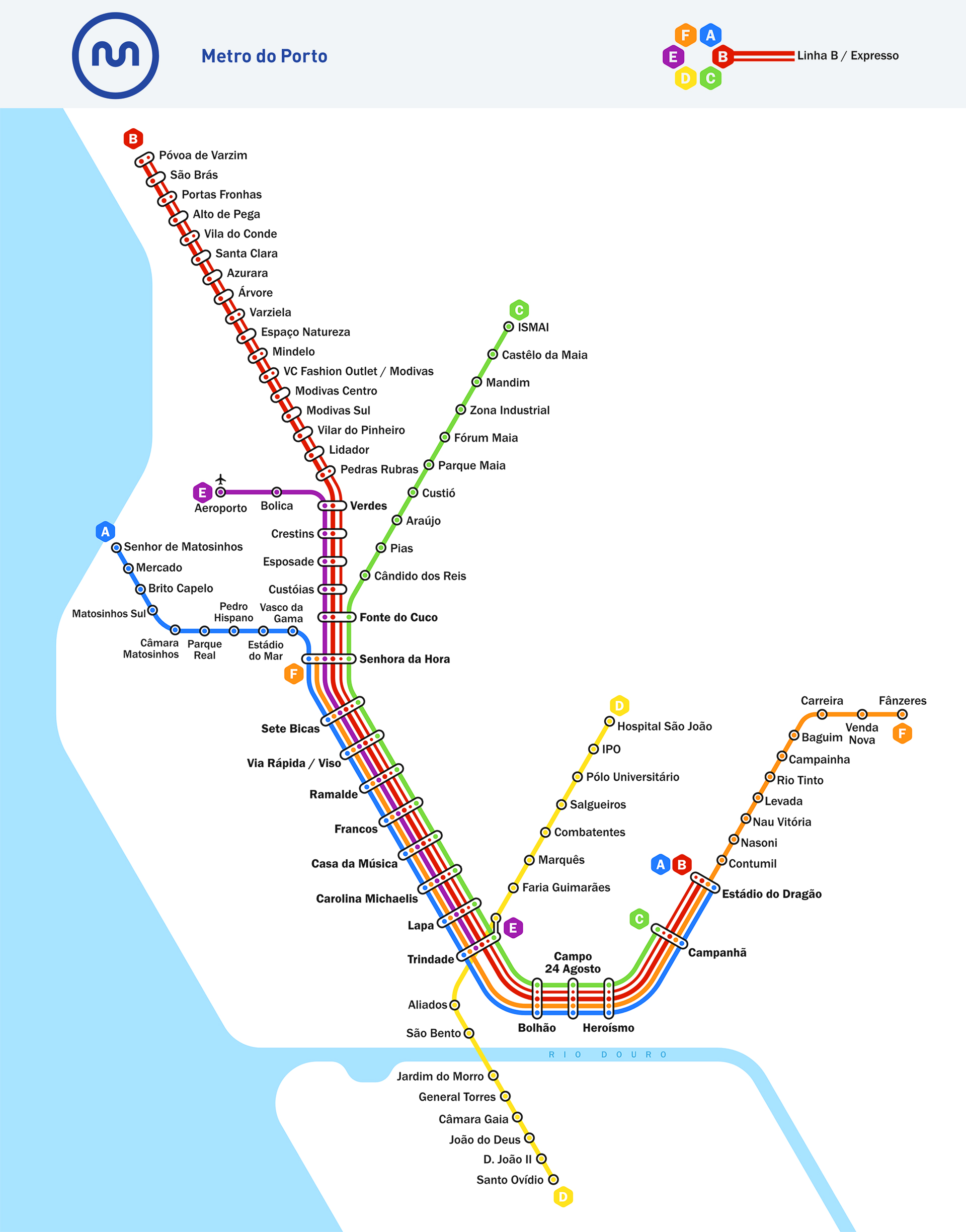
Porto Metro Map
Map of Porto Metro showing different lines. Click on the map to enlarge it or download the Porto Metro map in PDF format.
Lines and Stations
The Porto Metro route plan is built around six lines, with direct links to central Porto, suburbs, the airport, and major rail connections. Trindade is the main hub, where all lines pass, so it is the key point on most stations map searches and route planning.
Each line is identified by a letter and color. If you are checking the stations list or comparing running time by route, these are the main details.
| Station | Details |
|---|---|
| Line A | Blue Line: Estádio do Dragão to Senhor de Matosinhos, 23 stations, 15.6 kilometres (9.7 miles), about 40 minutes. |
| Line B | Red Line: Estádio do Dragão to Póvoa de Varzim, 35 stations, 33.6 kilometres (20.9 miles), about 61 minutes. |
| Line C | Green Line: Campanhã to ISMAI, 24 stations, 19.6 kilometres (12.2 miles), about 41 minutes. |
| Line D | Yellow Line: Hospital São João to Santo Ovídio, 16 stations, 9.2 kilometres (5.7 miles), about 25 minutes. This line crosses the River Douro. |
| Line E | Violet Line: Estádio do Dragão to Aeroporto, 21 stations, 16.7 kilometres (10.4 miles), about 35 minutes. |
| Line F | Orange Line: Fânzeres to Senhora da Hora, 24 stations, 17.4 kilometres (10.8 miles), about 39 minutes. |
| Trindade | Main interchange where all lines connect. |
| Campanhã, São Bento, General Torres | Connections with Comboios de Portugal rail services. |
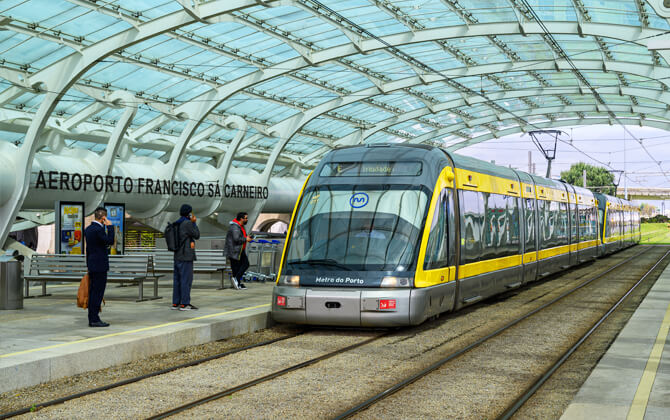
| Aeroporto | Direct airport access on Line E. |
Planning materials also mention future Line G from Casa da Música to São Bento and Line H from Casa da Música to Santo Ovídio.
Schedule and Frequency
The Porto Metro operating hours are generally 6:00 a.m. to 1:00 a.m. every day. If you are checking opening hours, opening times, working hours, or timings today, that is the standard service window across the system.
| Service detail | Timings |
|---|---|
| General operating hours | 6:00 a.m. to 1:00 a.m. daily |
| General frequency | Every 4 to 15 minutes, depending on time of day and demand |
| Friday and Saturday service | Lines A and D run 24 hours as part of the Move Porto program |
| Line A frequency | About every 12 to 15 minutes |
| Line C frequency | Four trams per hour |
| Line F frequency | As often as every 12 minutes on weekdays, up to every 30 minutes in the evening |
| Line E frequency | About every 15 minutes to Trindade, with some trains continuing beyond depending on the day and time |
| Airport line first train | 5:57 a.m. from Aeroporto |
| Airport line last train | 12:42 a.m. from Aeroporto |
The timetable and schedule can vary by line, day, and demand. In practice, train schedule gaps are shorter in busy periods and longer in quieter periods. If you need the closing time or last train for a specific route, especially on the airport line, check the current timetable before travel.
Trindade remains the main interchange for the route timetable, with all lines meeting there.
Prices, Tickets, and Passes
Porto Metro uses the Andante ticket system. Your fare, price, and ticket price depend mainly on the number of zones crossed, so it helps to check your route before you buy. This is the basic fare calculator logic used across much of local transport in Porto.
Occasional Trips
For occasional travel, the standard option is the reusable Andante Card. It is not personalized, but it can only be used by one person at a time. If several people are traveling together, each person needs a separate card.
You must validate your ticket before boarding and again whenever you change line or transport. On metro and train services, use the station validators. On buses, trams, and the Funicular dos Guindais, validate on board or at the entrance.
The card itself costs €0.60 (about US$0.65). Single-trip ticket cost depends on zones. The draft gives examples of a Z2 fare at €1.40 (about US$1.52) and a Z4 fare at €2.30 (about US$2.50). If you buy 10 identical single trips, you get 1 free.
For short stays, Andante Tour cards are another option. Andante Tour 1 is valid for 24 consecutive hours after first validation and costs €7.75 (about US$8.42). Andante Tour 3 is valid for 72 consecutive hours after first validation and costs €16.55 (about US$17.99). These cards are not personalized and cannot be topped up.
Children up to 4 years old travel free. After that, free travel applies only to resident children with a special pass.
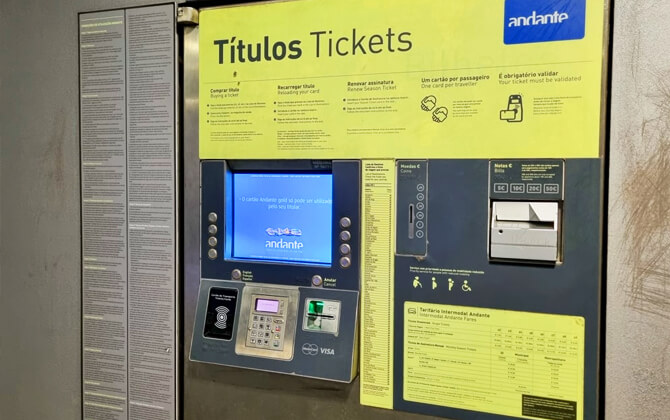
You can buy Andante cards from vending machines in metro stations, at Porto São Bento and Porto Campanhã train stations, and at Andante shops including Trindade, Campanhã, Hospital São João, and Casa da Música.
| Service detail | Timings |
|---|---|
| Andante Tour 1 validity | 24 consecutive hours after first validation |
| Andante Tour 3 validity | 72 consecutive hours after first validation |
Frequent Trips
For frequent travel, Porto Metro offers several rechargeable ticket and pass options. The blue Andante Azul paper ticket is non-personalized, rechargeable, and commonly used for regular trips. The ticket itself costs €0.60 (about US$0.65).
Regular fares by zone are listed below. These prices were updated on 1 January 2024.
| Zone | 1 ride | 10+1 rides |
| Z2 | €1.40 (about US$1.52) | €14.00 (about US$15.22) |
| Z3 | €1.80 (about US$1.96) | €18.00 (about US$19.57) |
| Z4 | €2.25 (about US$2.45) | €22.50 (about US$24.46) |
| Z5 | €2.75 (about US$2.99) | €27.50 (about US$29.90) |
| Z6 | €3.20 (about US$3.48) | €32.00 (about US$34.78) |
| Z7 | €3.65 (about US$3.97) | €36.50 (about US$39.67) |
| Z8 | €4.10 (about US$4.46) | €41.00 (about US$44.57) |
| Z9 | €4.55 (about US$4.95) | €45.50 (about US$49.46) |
Andante 24 works like a day pass, giving unlimited travel for 24 hours from first validation in the selected zones.
| Zone | Andante 24 price |
| Z2 | €5.15 (about US$5.60) |
| Z3 | €6.65 (about US$7.23) |
| Z4 | €8.30 (about US$9.02) |
| Z5 | €9.90 (about US$10.76) |
| Z6 | €11.80 (about US$12.83) |
| Z7 | €13.45 (about US$14.62) |
| Z8 | €15.10 (about US$16.41) |
| Z9 | €16.70 (about US$18.15) |
Andante Tour 3 is also sold as a 72-hour option at €16.00 (about US$17.39) in the general ticket section of the draft, while the occasional-trips section lists €16.55. The Monthly Pass is mainly used with the Andante Gold card and is valid for the chosen zones for one month. The card price is €6.00 (about US$6.52).
You can recharge monthly passes at Portugal ATMs. The Porto.CARD city pass includes unlimited public transport and is available for 1, 2, 3, or 4 days.
| Validity | Price |
| 1 day | €15.00 (about US$16.30) |
| 2 days | €27.00 (about US$29.35) |
| 3 days | €32.00 (about US$34.78) |
| 4 days | €41.50 (about US$45.11) |
The Porto.CARD Walker version, without public transport, costs €7.50 (about US$8.15) for 1 day, €12.00 (about US$13.04) for 2 days, €16.00 (about US$17.39) for 3 days, and €18.00 (about US$19.57) for 4 days.
You can buy tickets online before arrival, at the airport Tourist Office shop, through Payshop agents, and from machines at metro or train stations. Cash and credit card payments are accepted.
Connections
The Porto Metro is well integrated with the wider transport system. Trindade is the main interchange, and Senhora da Hora is another major transfer point. Other important stations for changing lines or moving to other public transport services include Estádio do Dragão, Campanhã, Fonte do Cuco, Verdes, São Bento, and General Torres.
Connections Between Lines
For changing routes, Trindade is the easiest place to switch trains because all six lines meet there. Campanhã and Senhora da Hora are also key interchanges.
| Station | Details |
|---|---|
| Line A | Estádio do Dragão connects with Lines B, E, and F; Campanhã with Line C and CP rail; Trindade with Line D; Senhora da Hora with Lines B, C, E, and F. |
| Line B | Estádio do Dragão connects with Lines A, E, and F; Campanhã with Line C and CP rail; Trindade with Line D; Senhora da Hora with Lines A and F; Fonte do Cuco with Line C; Verdes with Line E. |
| Line C | Campanhã connects with Lines A, B, E, and F and CP rail; Trindade with Line D; Senhora da Hora with Lines A and F; Fonte do Cuco with Lines B and E. |
| Line D | Trindade connects with Lines A, B, C, E, and F; São Bento and General Torres connect with CP rail. |
| Line E | Estádio do Dragão connects with Lines A, B, and F; Campanhã with Line C and CP rail; Trindade with Line D; Senhora da Hora with Lines A and F; Fonte do Cuco with Line C; Verdes with Line B; Aeroporto gives direct airport access. |
| Line F | Campainha and Contumil connect with CP rail; Estádio do Dragão connects with Lines A, B, and E; Campanhã with Line C and CP rail; Trindade with Line D; Senhora da Hora with Lines A, B, C, and E. |
Connections to Other Systems
The Andante card system covers Porto Metro, STCP buses, some train services, and regional buses included in the system. It is designed to make transfers across city transport and local transport easier within the selected fare zones.
Andante tickets are not valid on the Guindais Funicular or on trams. Tickets must be validated before travel and again when changing lines. The system is based on the station where the ticket is first validated, so choose the correct zone for your journey.
For wider transportation in Porto, key rail links are at Campanhã, São Bento, General Torres, Campainha, and Contumil. Line E provides the direct airport connection, and there is also a bus link between ISMAI and Trofa where rail service was not extended.
Funicular dos Guindais
The Funicular dos Guindais links the Ribeira area on the riverfront with Batalha at the top of the hill. It is practical, saves a steep uphill walk, and offers good views of the Dom Luís I Bridge, the medieval walls, and the wine cellars along the waterfront.
The funicular first opened in 1891 and was later renovated in 1994. A one-way ticket costs €3.50 (US$4.11).
| Station | Details |
|---|---|
| Route | Ribeira to Batalha |
| Fare | €3.50 (US$4.11) one way |
| Location | R. da Ribeira Negra 314 |
| Andante validity | Not valid |
Airport Connection
Francisco Sá Carneiro Airport is about 11 kilometres (6.8 miles) northwest of central Porto, in Maia. For most travelers, the metro is the easiest airport transport option.
Line E, the Violet Line, connects the airport directly with the city. The route to central Porto takes about 35 to 40 minutes, and Trindade is usually the most useful station for downtown access.
| Service detail | Timings |
|---|---|
| Distance from city center | 11 kilometres (6.8 miles) |
| Metro route | Line E from Aeroporto |
| Running time to central Porto | About 35 to 40 minutes |
| Starting time from airport | 5:57 a.m. |
| Last train | 12:42 a.m. |
| Frequency | Every 30 minutes |
For a trip from the airport to Trindade, you need a Z4 ticket. The ticket price is €2.30 (about US$2.50), plus €0.60 (about US$0.65) for the reusable card if you are buying it for the first time.
Other transport options are available too. Private transfers usually take 20 to 25 minutes and cost about €32.00 (about US$34.78) for up to 4 people. Public bus routes 601, 602, and 604 also connect the airport with the city, but they are slower and can take more than 50 minutes. Taxis usually cost around €25.00 (about US$27.17), while ride apps such as Uber and Bolt often start from about €20.00 (about US$21.74).
Metro Parking
Metro do Porto has Park & Ride facilities at selected stations, letting you combine station parking with metro travel. There are 32 parking areas in total, 30 of them free, across the Blue, Red, Green, Violet, and Orange lines.
If you use Park & Ride, the same Andante card can be used for parking access and your metro trip. The system is available for up to 12 hours a day.
| Station | Details |
|---|---|
| Occasional Park & Ride | €0.95 (about US$1.03) for up to 12 hours |
| Park & Ride Monthly Pass | €17.00 (about US$18.48) per month, up to 12 hours a day |
| Parking without public transport | €0.30 (about US$0.33) per 15 minutes |
| Extra parking time over 12 hours | €0.30 (about US$0.33) per 15 minutes |
| Current Park & Ride locations mentioned | Dragão and Botica |
| Estádio do Dragão opening hours | Open from 5:30 to 22:00; exits allowed during Metro do Porto service hours |
| Card purchase at park entrance | €0.50 (about US$0.54) |
These are the parking charges and parking charges per day structure mentioned in the draft, although the practical rate is shown for up to 12 hours rather than a full day. Metro do Porto states it is not responsible for vehicles or contents left in the car park, so lock the vehicle and remove valuables.
Notable Facts
Porto Metro is one of the largest light rail systems in Europe. It serves Porto and seven municipalities, has been operating since 2002, and is run by ViaPORTO.
The system has 6 lines, 85 stations, and 70 kilometres (43.5 miles) of double track. Most of the network runs at ground level or elevated, while 8.3 kilometres (5.2 miles) are underground. In the center, trains run underground; farther out, the network looks more like a modern tramway.
One of the most distinctive sections is the crossing of the River Douro on the upper deck of the Dom Luís I Bridge on Line D. Metro do Porto also managed the Funicular dos Guindais from 2004 to 2019.
The network grew in stages after 2002, with Line A opening first, followed by Lines B, C, D, E, and F. A southward extension of Line D opened in 2024.
Recent usage figures in the draft show 79 million passengers in 2023 and 89.8 million validations in 2024. The fleet includes 72 Eurotram low-floor articulated trams, Flexity Swift LRVs on Lines B, Bx, and C, and CRRC Tangshan LRVs on Lines C and E since 2023.
Rules, Tips, and Warnings
Porto Metro is generally straightforward to use, but a few rules matter for safe travel. They apply to passengers, pedestrians, cyclists, and drivers near the tracks.
- Never walk along the metro line.
- Cross only at designated pedestrian crossings and check carefully before crossing.
- If a train is stopped near a crossing, pass behind it, never in front.
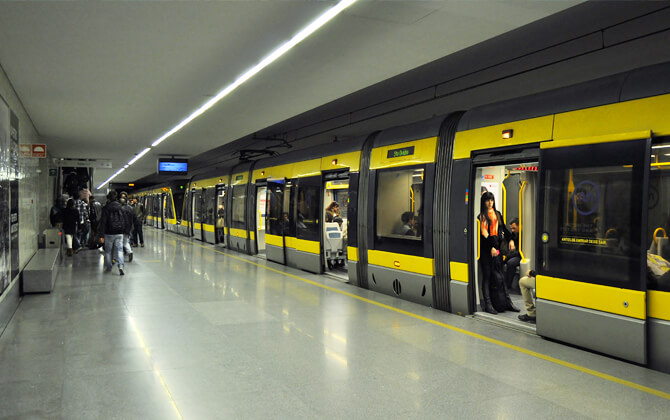
- Stay behind the yellow line in stations.
- Use emergency buttons and intercoms if you witness an accident.
- Trains are very quiet, so do not rely on sound alone.
- Trains always have priority over road traffic.
- Never drive or park on the tracks.
- Only passengers with a valid ticket may use Metro do Porto vehicles.
- Children under 4 travel free when accompanied by someone with a valid ticket.
- Let passengers exit before boarding.
- Do not block the doors.
- Preferential seats are reserved for disabled passengers, pregnant women, elderly passengers, and children.
- Bicycles may only enter through the rear door.
- Only small household pets in a basket are allowed, unless special written authorization has been granted.
- Guide dogs are allowed.
- Lost items should be handed to staff and can be claimed for up to one week at Lost and Found.
- All stations have video surveillance.
If you are unsure about anything, ask at a larger station. It is the easiest way to stay safe and avoid a ticketing mistake.
Milestones of the Porto Metro Construction
The history of Porto Metro starts in the 1990s, when plans for a partly underground electrified railway gained support. Metro do Porto S.A. was founded in 1993, and the first expansion phase was then prepared for the wider metropolitan area.
Construction officially began on 15 March 1999 in Campanhã. Early work included the Campanhã-Trindade tunnel and the conversion of former narrow-gauge railway sections. Test runs started in December 2001, and passenger service began on 29 June 2002 on Line A between Câmara de Matosinhos and Viso.
The first underground section to Trindade opened later in 2002, and the system was officially inaugurated on 7 December 2002. Tunnelling for the first phase was completed in 2003, and work on Line D began the same year.
- 1993: Metro do Porto S.A. founded
- 1998: financing and development contract signed
- 15 March 1999: construction begins in Campanhã
- December 2001: test runs begin
- 29 June 2002: first passenger service on Line A
- 7 December 2002: official inauguration
- 2003: first-phase tunnelling completed
- 2004 to 2006: Lines A, B, C, D, and E open in quick succession
- 2 January 2011: Line F opens
- 2020: Line G construction begins
- 2021: Line D extension work begins
- May 2024: Line H construction starts
Future Expansions
Expansion remains a big part of the Porto Metro story. Several projects are already under construction or planned, aimed at improving cross-city transport and strengthening links between major interchanges.
Line G, the Pink Line, is planned as a fully underground 2.7-kilometre (1.7-mile) route with four stations between Casa da Música and São Bento via Cordoaria. Expected opening is early 2027.
Line H, the Ruby Line, is a 6.74-kilometre (4.2-mile) route with eight stations from Casa da Música to Santo Ovídio. Construction began in May 2024, with partial opening planned for late 2026.
The MetroBus system is also being expanded. A second MetroBus line is expected by August 2026, connecting Casa da Música and Anémona in Matosinhos using hydrogen cell buses.
To support the expansion, Metro do Porto has ordered 22 additional CRRC units, with deliveries expected to begin in late 2026. The operator is also upgrading mobile coverage, with full 5G coverage expected in 2025.
| Project | Details | Expected timing |
| Line G | 2.7 kilometres (1.7 miles), 4 stations, Casa da Música to São Bento via Cordoaria | Early 2027 |
| Line H | 6.74 kilometres (4.2 miles), 8 stations, Casa da Música to Santo Ovídio | Late 2026, partial opening |
| MetroBus line 2 | Casa da Música to Anémona, Matosinhos | By August 2026 |
Sightseeing via the Porto Metro
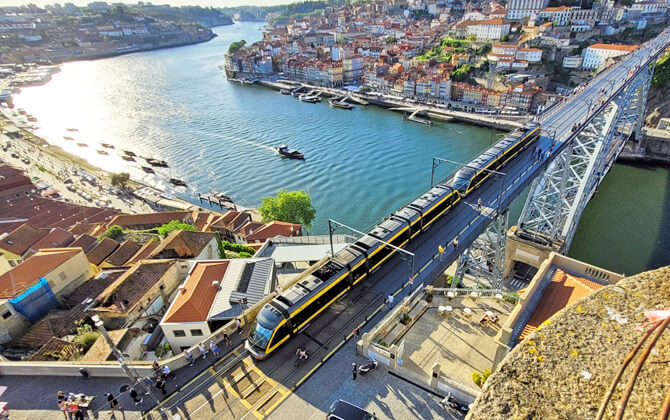
The Porto Metro is one of the easiest ways to explore the city. It connects the airport, downtown areas, the coast, and several major sights without the hassle of driving or parking in the center.
For first-time visitors, the system is fairly simple. You need an Andante card or the Andante app, and you should validate before travel. The zone list on ticket machines helps you choose the right fare without overthinking it.
Popular routes include Line E from the airport to Trindade, a Z2 ticket for central areas such as Aliados, São Bento, Mercado do Bolhão, Casa da Música, and Estádio do Dragão, and trips toward Matosinhos Sul or Brito Capelo for the beach and Parque da Cidade.
The metro is especially useful during major city events such as São João and Queima das Fitas, when road traffic gets heavier and public transport becomes the easiest way to move around. If you want a practical guide to transportation in Porto, this system does a lot of the heavy lifting.