The Incheon Subway is the rapid transit system serving Incheon, South Korea. Operated by Incheon Transit Corporation, it is part of the wider Seoul Metropolitan Subway system and plays a central role in local transport, city transport, and daily public transport across the capital area. The network includes two main Incheon lines, plus connections to Seoul Subway Line 7 and other rail services, with integrated fares that also work on bus routes.
| Key | Information |
|---|---|
| System | Incheon Subway |
| Operator | Incheon Transit Corporation |
| Main lines in Incheon | Line 1 and Line 2 |
| Regional connection | Linked to the Seoul Metropolitan Subway network, including Seoul Subway Line 7 |
| Fare system | Integrated with the Seoul system; transportation card and single journey fare card accepted |
| Basic adult fare | ₩1,250 by card or ₩1,300 in cash |
| City context | Incheon is South Korea’s third-largest city, west of Seoul on the coast |
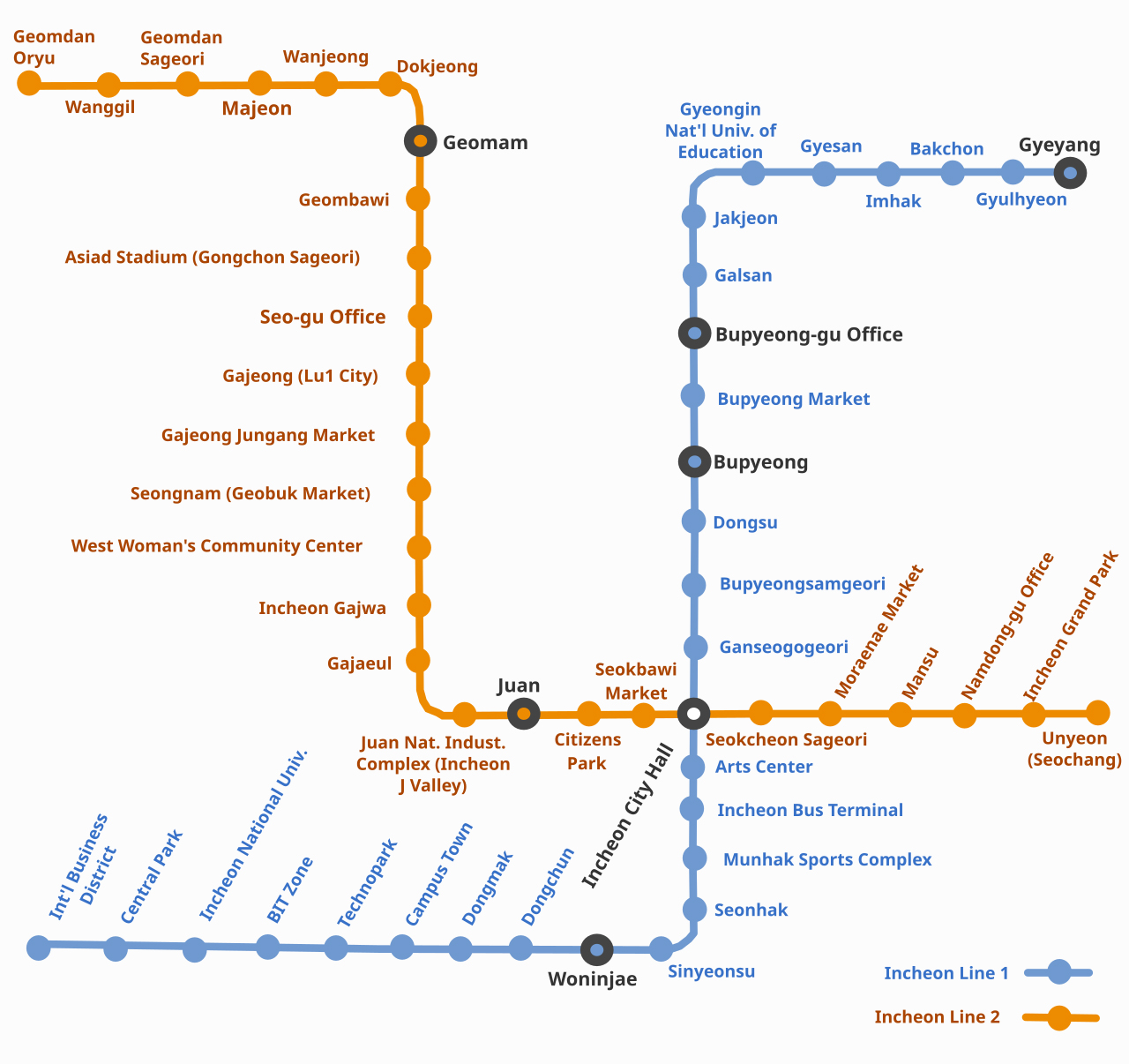
Incheon Subway Map
Map of Incheon Subway showing different lines and stations. Click on the map to enlarge it or download the Incheon Subway map in PDF format.
Lines and Stations
The Incheon Subway system has two main lines within the city, plus the Incheon section of Seoul Subway Line 7. Together, they form the core route plan for transportation in Incheon and connect key residential, business, and transfer points.
| Station | Details |
|---|---|
| Line 1 | Runs from Geomdan Lake Park to Songdo Moonlight Festival Park, with 33 stations over 37.1 km (23.1 miles). |
| Line 2 | Runs from Geomdan Oryu to Unyeon, with 27 stations over 29.1 km (18.1 miles). |
| Seoul Subway Line 7 | Incheon section runs from Onsu Station to Seongnam Station in Incheon, with 11 stations over 14.1 km (8.8 miles). |
Line 1
Line 1 is a north-south route. It opened for regular service on October 6, 1999, after six years of construction. Transfers are available at Bupyeong Station to Seoul Subway Line 1, at Woninjae Station to the Suin Line, and at Gyeyang Station to AREX.
The full running time from Gyeyang in the north to International Business District in the south is about 57 minutes. The line color is light blue, and it uses 34 eight-car trains.
Line 2
Line 2 is a north-south light metro route that opened on July 30, 2016. It connects with AREX at Geomam, Seoul Subway Line 1 at Juan, and Incheon Line 1 at Incheon City Hall.
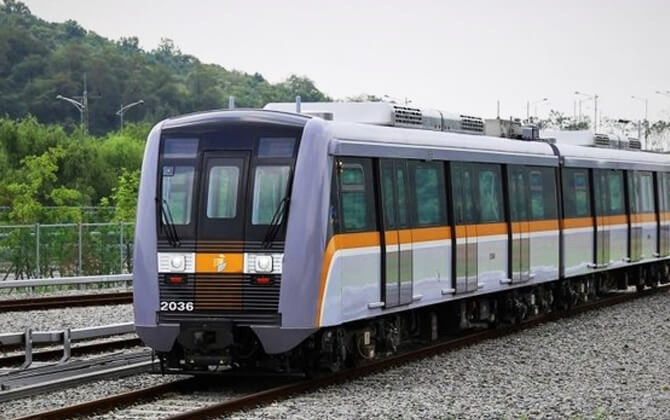
North of Asiad Stadium, part of the line runs above ground. Its color is orange, and it uses 37 two-car trains built by Hyundai Rotem in 2013.
Seoul Metro Line 7
Seoul Subway Line 7 was extended from Onsu into Incheon on October 27, 2012. The first extension ended at Bupyeong-gu Office Station, where it connected with Incheon Subway Line 1. On May 22, 2021, the line was extended again to Seongnam Station.
In Incheon and Bucheon, this section is operated by Incheon Transit Corporation, with through service between the two operators’ fleets.
Station notes
| Station | Details |
|---|---|
| Line 1 stations | All Line 1 stations are located in Incheon. |
| Line 1 stations list | Includes Geomdan Lake Park, Gyeyang, Bupyeong, Incheon City Hall, Woninjae, Incheon National University, and Songdo Moonlight Festival Park. |
| Line 2 stations list | Includes Geomam, Juan, Incheon City Hall, Asiad Stadium, and Unyeon. |
| Line 7 in Incheon | Adds more interchange options for passengers using the western extension. |
Operating Hours
The Incheon Subway operating hours begin early in the morning and continue past midnight. If you are checking opening hours, opening times, working hours, or timings today, the service pattern below gives the standard timetable by line.
| Service detail | Timings |
|---|---|
| Line 1 | 05:30 to 01:01 overnight |
| Line 2 | 05:30 to 01:06 overnight |
| Line 7 | 05:28 to 01:03 overnight |
| Line 7 on holidays | 05:28 to 00:10 overnight |
The starting time is around 5:30 a.m. on most lines. The closing time is after midnight, though Line 7 will close earlier on holidays. If you need the last train or schedule today for a specific route, check the official operator timetable before travel.
Frequency changes by line and time of day. During rush hour, Line 1 runs about every 4.5 minutes, Line 2 about every 3.3 minutes, and Line 7 every 4.0 minutes in the morning and 6.0 minutes in the evening. Outside peak periods, the train schedule becomes less frequent and holiday timings differ from weekday service.
For the latest route timetable, schedule, and train schedule information, Incheon Transit Corporation provides details for Lines 1 and 2, while Seoul Metro provides information for Lines 1 to 8.
Incheon Subway Ticket and Pricing
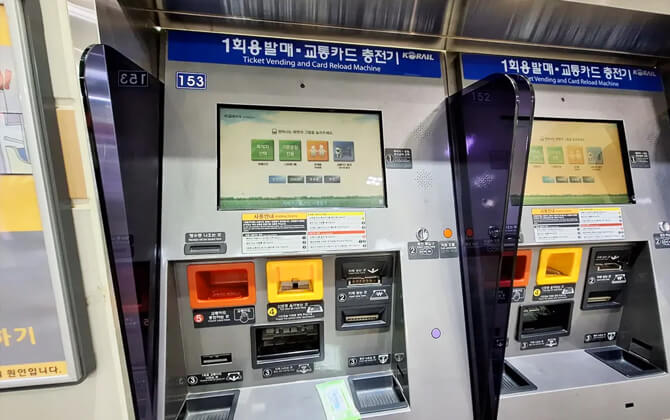
Incheon Subway fare is distance-based. You can pay with a transportation card or a single journey fare card. A transportation card works across the subway and bus network, including transfers, while a single journey fare card is for subway use only.
The single journey fare card includes a ₩500 deposit, about $0.37, which can be refunded at a deposit refund machine in subway stations after use.
Basic Subway Fare
| Category | Transportation Card | Single Journey Fare Card |
|---|---|---|
| General Public | ₩1,400 (about $1.04) | ₩1,500 (about $1.11) |
| Youth | ₩800 (about $0.59) | ₩1,500 (about $1.11) |
| Elementary School Students | ₩500 (about $0.37) | ₩500 (about $0.37) |
The exact ticket price rises with travel distance, so the total cost depends on how far you go.
How to Buy a Single Journey Fare Card
- Choose your destination and pay the fare, including the ₩500 deposit.
The deposit system is used so the cards can be reused.
Useful Fare Notes
- Fare increases with travel range.
- The fare system is integrated with the wider capital-area public transport network.
- Integrated transfer fares apply across Incheon, Seoul, and Gyeonggi when using a transportation card.
- The transfer discount applies up to 5 transfers.
- Continuous transfers between subway lines are not eligible for a transfer discount.
If you need a fare calculator, route fare, or the latest price information, check the official Incheon Transit Corporation and Seoul Metro services.
Connections to Other Systems
The Incheon Subway is closely connected to the greater Seoul Metropolitan Subway, making it a practical part of the region’s transport system rather than a stand-alone network. These links matter for everyday transportation in Incheon as well as longer trips across the capital area.
Direct Interchanges
| Station | Details |
|---|---|
| Bupyeong Station | Incheon Subway Line 1 connects to Seoul Subway Line 1. |
| Woninjae Station | Incheon Subway Line 1 connects to the Suin Line. |
| Geomam Station | Incheon Subway Line 2 connects to AREX. |
| Juan Station | Incheon Subway Line 2 connects to Seoul Subway Line 1. |
| Incheon City Hall | Incheon Subway Line 2 connects to Incheon Subway Line 1. |
Seoul Subway Line 7 in Incheon
Seoul Subway Line 7 extends into Incheon and meets Incheon Subway Line 1 at Bupyeong-gu Office Station. Within Incheon and Bucheon, the line is operated in part by Incheon Transit Corporation, with through service across the different operating sections.
The line was extended further with the Seongnam extension on May 22, 2021. Future expansion plans call for an extension to Cheongna International City Station, where a transfer to AREX would be available.
Planned and Proposed Links
Future Incheon Subway Line 3 is planned as a circular line. Based on the available route plan, it will connect with Seoul Subway Line 1 at Dowon Station and with Incheon Subway Line 1 at Dongmak Station.
The proposed Juan-Songdo Line is also expected to add transfer points at Juan, Citizens Park, Songdo, and Incheon National University, linking into existing Incheon and Seoul-area lines.
Airport Connections
Incheon International Airport has strong public transport connections to Seoul and beyond. Travelers can use AREX, Seoul subway links, airport limousine bus services, city buses, and taxis.
The airport is about 60 km (37.3 miles) from Seoul Station. The journey takes around 43 minutes on the AREX Express. By car, it takes about 1 hour 30 minutes, depending on traffic.
AREX Express and All-stop Trains
AREX is the fastest rail option between Incheon International Airport and Seoul Station. The Express train runs non-stop, while the all-stop train serves all 14 stations on the route, which can be more convenient if your destination is near an intermediate station.
On the all-stop service, you can use a single-journey card, a commuter ticket, or a transportation card such as T-money. AREX also connects with Gimpo International Airport Station for domestic flight transfers.
Connections Beyond Seoul
At Seoul Station, passengers can continue by rail to many parts of the country. Buses also run directly from the airport terminal to major cities nationwide, giving travelers another long-distance transport option.
For route details, fare information, timetable updates, and schedule details, contact the airport railroad hotline at 1599-7788 or check the official airport railroad service.
Luggage Services
Seoul Metro also offers luggage delivery and storage services through the subway system. T-Luggage provides same-day delivery between subway stations and the airport, while T-Locker offers unmanned locker storage at stations.
That can be handy if you want to travel light after landing.
Regulations
Incheon Subway ticket rules are tied to distance-based fares and the wider metropolitan transfer system. Passengers can use a transportation card, either post-paid or pre-paid, or a single journey fare card. Transportation cards work on both subway and bus services and allow transfer benefits where applicable.
Single journey fare cards include a ₩500 deposit, about $0.37, refundable at a deposit refund machine in subway stations. To buy one, select your destination and pay the fare plus the deposit.
| Category | Transportation Card | Single Journey Fare Card |
|---|---|---|
| General Public | ₩1,400 (about $1.04) | ₩1,500 (about $1.11) |
| Youth | ₩800 (about $0.59) | ₩1,500 (about $1.11) |
| Elementary School Students | ₩500 (about $0.37) | ₩500 (about $0.37) |
Before boarding, check your destination carefully and make sure you are on the correct train. Some parts of the wider network use express services that do not stop at every station.
Express sections mentioned in the available information include Subway Line 1 between Bupyeong Station and Yongsan Station, Dongincheon Station and Yongsan Station; Subway Line 9 between Gimpo Airport and Seoul Sports Complex; and the Airport Railway between Incheon International Airport Station and Seoul Station.
Types of Subway
Seoul Metro operates Lines 1 to 9 on routes connecting Incheon, Seoul, and Gyeonggi. In Incheon, Line 1 is connected to Bucheon and Seoul.
Incheon Subway serves the city directly, with transfers available to Seoul Metro Line 1 at Bupyeong Station and Juan Station, Line 7 at Bupyeong-gu Office Station, the Suin Line at Woninjae Station, and the Airport Railway at Gyeyang Station and Geomam Station.
Airport Railway connects Incheon International Airport, Incheon, and Seoul. General trains stop at all stations, while express trains stop only at Incheon International Airport Station and Seoul Station. General trains take 66 minutes and stop at 13 stations. Express trains take 51 minutes and run every 30 minutes. General trains run every 12 minutes.
The Suin Line connects Incheon to Suwon and also provides access to Ansan and Oido Island in Gyeonggi.
When transferring between metropolitan buses and the subway in Incheon, Gyeonggi, and Seoul, the fare is based on total distance traveled. To receive a transfer discount, you must use a transportation card and tag it correctly when boarding and alighting.
The transfer time window is within 30 minutes after exiting the gate between 07:00 and 21:00, and within 1 hour after exiting the gate between 21:00 and 07:00.
Transfer discounts do not apply when using the same route bus continuously, are limited to 5 transfers, and do not apply to continuous transfers between subway lines.
History
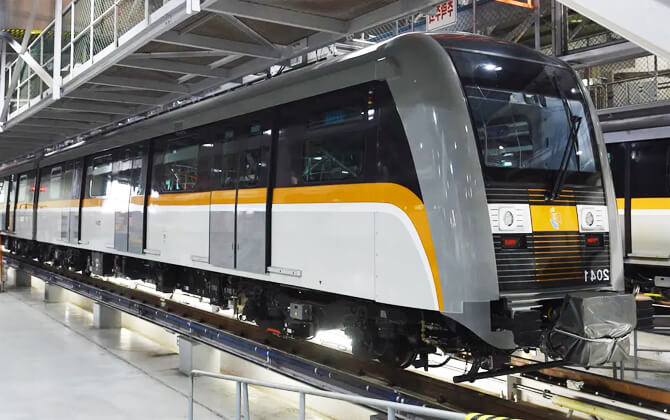
Incheon Subway Line 1 began trial runs in March 1999 and opened for regular service on October 6, 1999, after six years of construction. It became South Korea’s fourth subway system, after Seoul, Busan, and Daegu.
The line opened in stages. The first section ran from Bakchon to Dongmak, followed by a northern extension from Bakchon to Gyulhyeon on December 7, 1999. Another extension from Gyulhyeon to Gyeyang opened on March 16, 2007, adding a connection to the Airport Railroad. On June 1, 2009, the line was extended south from Dongmak to the International Business District. A one-station extension to Songdo Moonlight Festival Park opened on December 12, 2020, and the northern extension from Gyeyang to Geomdan Lake Park opened on June 28, 2025.
This history also reflects Incheon’s growing role within the wider metropolitan rail system, with transfer links added over time at Gyeyang, Bupyeong Station, Bupyeong-gu Office, and Woninjae.
Future Extensions
Incheon’s rail expansion plan reflects eight routes with a total length of 87.79 km (54.55 miles) and investment of ₩2.862 trillion, about $2.12 billion. The goal is to improve rail access and increase the city’s transit share.
The projects listed in the plan are Incheon Subway Line 2 Geomdan Extension, Bupyeong Coastal Pier Line, Songdo Tram, Incheon Subway Line 2 Nonhyeon Extension, Juan Songdo Line, Yeongjong Tram, Incheon Subway Line 1 Songdo Section 8 Extension, and Jemulpo Coastal Pier Line.
The plan was prepared as a periodic review under the Urban Railroad Act and reflects updated social and economic conditions. It also focuses on extending the benefits of GTX Line B and supporting regeneration in the city center.
Among the eight projects, three are moving first into preliminary feasibility study services within the year: the Incheon Subway Line 2 Geomdan Extension, the Bupyeong Coastal Pier Line, and the Songdo Tram. The Geomdan extension was already included in earlier railway planning, and the other two projects are also advancing through review processes.
In addition, Incheon Subway Line 3 is planned as a future circular line that would connect with Seoul Subway Line 1 at Dowon Station and Incheon Subway Line 1 at Dongmak Station. Another proposed route, the Juan Songdo Line, is planned as a 14.1 km (8.8 miles) tramway linking Juan and Songdo, with construction targeted for 2028 and operation aimed for 2033.
Nearby Attractions
Incheon Station is a convenient starting point for exploring the city’s historic core. Several attractions are within a short walk, so you can easily combine culture, food, and waterfront sightseeing in one outing.
- Songwol-dong Fairytale Village is about 8 minutes away on foot and is known for colorful murals and photo spots.
- Jjajangmyeon Museum is around 5 minutes away and looks at the history of one of Incheon’s signature dishes.
- Chinatown is also roughly 5 minutes from the station, with street food, shops, and a lively atmosphere.
- Incheon Jayu Park can be reached in about 8 minutes and is a good place for a relaxed walk above Chinatown.
- Incheon Art Platform is about 10 minutes away and combines creative spaces, exhibitions, and restored warehouse buildings.
- Wolmido and Wolmi Theme Park are nearby options if you want a livelier seaside stop.
Tourist Attractions
Incheon has several tourist attractions that pair well with a subway trip, especially around Incheon Station and nearby stops. For a short visit, these places offer a good mix of history, food, and coastal views.
Chinatown
Chinatown was established after Incheon Port opened in 1883 and became home to Chinese settlers and their culture. Today it is known for its red and gold architecture, long history, and food scene. It is also considered the birthplace of jajangmyeon, the black soybean sauce noodle dish shaped by both Chinese and Korean tastes.
Open Port Area
The Open Port Area is one of Incheon’s most important historic districts. After Jemulpo Port opened in 1883, Japanese-style streets, trade shops, hotels, and other buildings appeared near the settlements. Many of these buildings are now around 130 years old and have been converted into museums and exhibition halls.
Songwol-dong Fairy Tale Village
Songwol-dong Fairy Tale Village, near Chinatown, is a popular photo stop. Its alleys feature murals and life-like sculptures inspired by famous fairy tales such as Little Red Riding Hood and Thumbelina. The area is compact and can be explored in about an hour.
Wolmi Observatory
Wolmi Observatory offers wide views of the Incheon coast, Palmido Island, Incheon Port, the Lock Gate, and city areas including Songdo, Yeongjong, and Cheongna.
Exhibition Center for the Lock Gate of Incheon Port
This exhibition center explains the early days, present role, and future of Incheon Port in a straightforward way. It also covers the Lock Gate, one of the key features of the port system.
Wolmi Sea Train and Wolmido Island
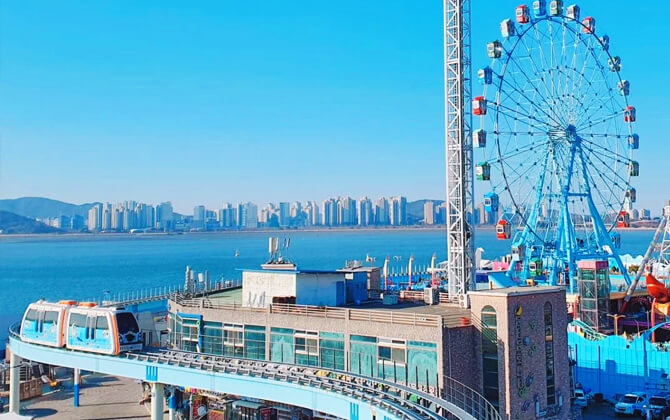
From Incheon Subway Station, you can take the Wolmi Sea Train to Wolmido Island. The ride offers views of the area, including the world’s largest mural, before reaching a coastal zone with a traditional garden, deer, and an observatory with sea views. Wolmido Island is also home to Wolmi Theme Park.
Dongincheon Samchi Street
Dongincheon Samchi Street, near Dongincheon Station, is known for grilled seerfish. It grew in popularity after a home-style restaurant made grilled seerfish a signature dish, and it was later designated as a grilled seerfish street. Today, several restaurants serve it with different grilling styles and sauces.
Songdo Central Park
Songdo Central Park is a modern green space in Songdo built around a seawater-fed canal. Visitors can rent canoes, kayaks, paddle boats, or use a water taxi. The park also has walking paths, small animals, and the Tri Bowl, a striking architectural landmark set in a shallow pond.