Daejeon Metro is the rapid transit system in Daejeon, South Korea, operated by the Daejeon Metropolitan Express Transit Corporation. The system currently has one operating line, Line 1, with 22 stations on a route of about 22.6 km (14.0 miles). It opened in 2006 and expanded in 2007, linking major city areas such as Daejeon Station, City Hall, Government Complex Daejeon, and Yuseong Spa. As part of the city transport network, it works closely with local bus services, while Line 2 and other expansion projects remain in development.
| Key | Information |
|---|---|
| System | Daejeon Metro |
| City | Daejeon, South Korea |
| Operator | Daejeon Metropolitan Express Transit Corporation |
| Current route | Line 1 from Panam to Banseok |
| Stations | 22 |
| Route length | 22.6 km (14.0 miles) |
| Opening | First section opened in 2006; expanded in 2007 |
| Operating hours | Generally 5:30 AM to midnight |
| Fare system | Sectional fare based on trips under or over 10 km |
| Connections | Bus services and rail transfers at key stations |
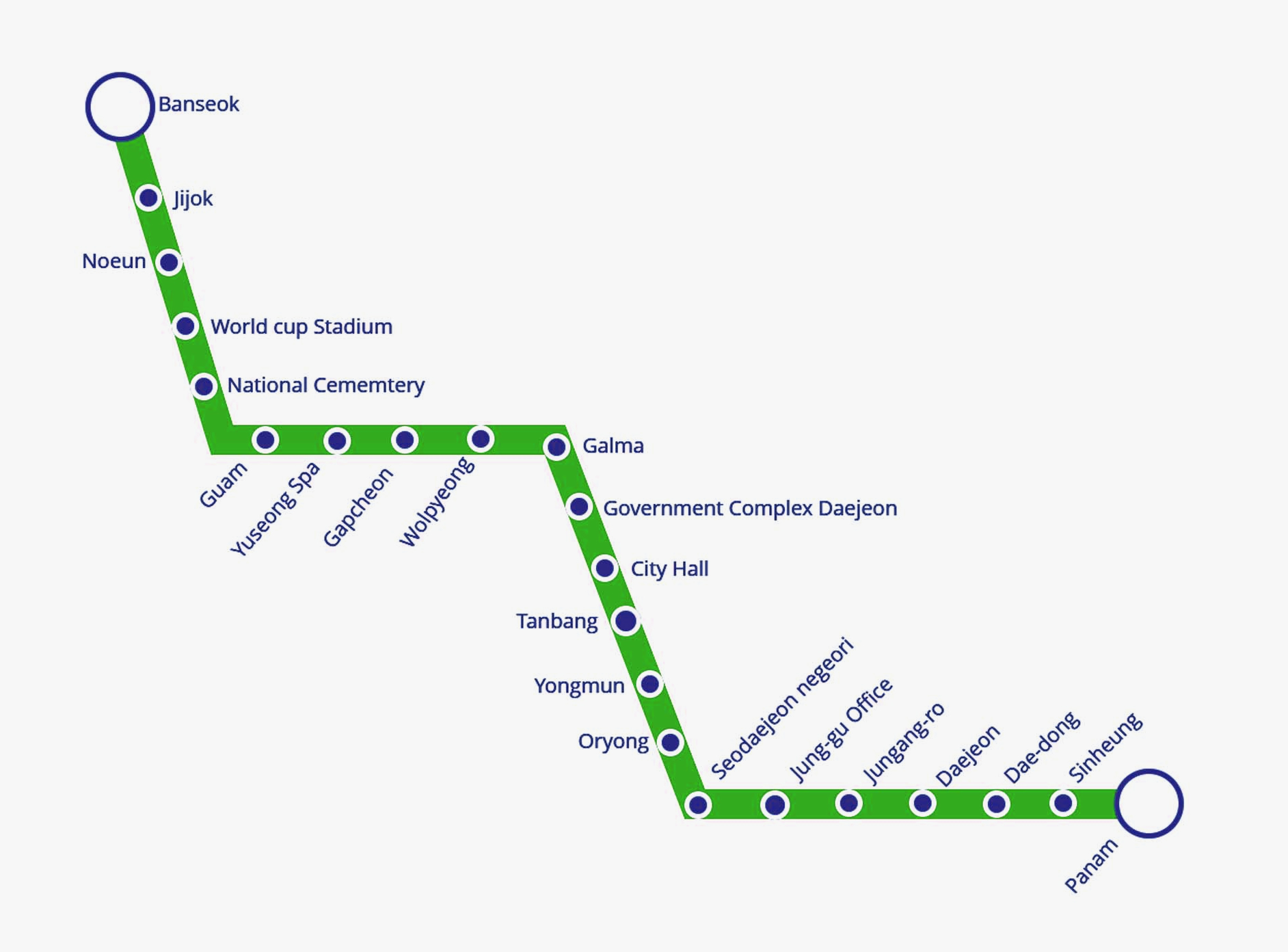
Daejeon Metro Map
Map of Daejeon Metro showing different lines and stations. Click on the map to enlarge it or download the Daejeon Metro map in PDF format.
Lines and Stations
Daejeon Metro currently operates one line: Line 1. This route runs from Panam Station in Dong-gu to Banseok Station in Yuseong-gu, covering 22.6 km (14.0 miles) with 22 stations. Service began in two stages, first on March 16, 2006, and then on April 17, 2007.
Line 1 connects several important parts of the city, including Daejeon Station, Jungangno, City Hall, Government Complex Daejeon, Yuseong Spa, and World Cup Stadium. In practical terms, it is the backbone of the current Daejeon Metro stations map and route plan.
A future extension from Banseok to Government Complex Sejong is also planned. If completed as scheduled, it would add five stations and extend the path train route further toward Sejong City, with a tentative opening in 2029.
| Station | Details |
|---|---|
| Line 1 | Panam to Banseok, 22 stations, 22.6 km (14.0 miles) |
| Major stations | Daejeon Station, Jungangno, City Hall, Government Complex Daejeon, Yuseong Spa, World Cup Stadium |
| Opening stages | First section opened March 16, 2006; second section opened April 17, 2007 |
| Future extension | Banseok to Government Complex Sejong, tentatively planned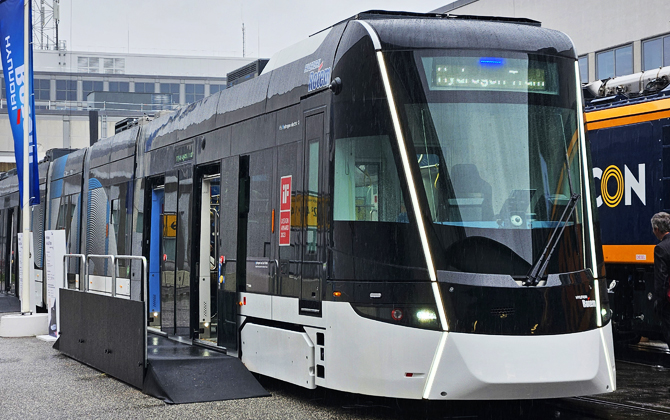 for 2029 for 2029 |
Schedule
Daejeon Metro runs every day. Regular operating hours are generally from 5:30 AM to midnight, so the opening hours, working hours, and closing time stay fairly simple for most travelers. Even so, timings today can change because of maintenance or other service issues, so checking the latest timetable is a smart move.
The train schedule varies by time of day. On weekdays, frequency is usually every 4 minutes in off-peak periods and every 2 minutes during peak hours. After 10:00 PM, trains typically run every 6 to 8 minutes. On weekends and public holidays, the schedule is generally every 4 minutes through the day.
First and last train times depend on the station and direction. For Line 1, Panam Station has a starting time of 05:30 on weekdays and 05:40 on weekends and holidays. The draft also states that Cheongnyangni Station has a last train at 23:50 on weekdays and 00:00 on weekends and holidays.
The source materials also mention Line 2 timetable details, including World Cup Stadium Station starting at 05:35 on weekdays and 05:45 on weekends and holidays, and Sinan Station showing a last train at 23:44 on weekdays and 23:54 on weekends and holidays.
If you are traveling late, check the route timetable for your boarding station in advance. The last train, opening times, and running time can vary by station and direction.
| Service detail | Timings |
|---|---|
| Regular operating hours | 5:30 AM to midnight |
| Weekday off-peak frequency | Every 4 minutes |
| Weekday peak frequency | Every 2 minutes |
| After 10:00 PM | Every 6 to 8 minutes |
| Weekends and public holidays | Generally every 4 minutes |
| Panam Station first train | 05:30 weekdays; 05:40 weekends and holidays |
| Cheongnyangni Station last train | 23:50 weekdays; 00:00 weekends and holidays |
| World Cup Stadium Station first train | 05:35 weekdays; 05:45 weekends and holidays |
| Sinan Station last train | 23:44 weekdays; 23:54 weekends and holidays |
Fares
Daejeon Metro uses a sectional fare system based on a 10 km boarding distance. In short, the fare and ticket price depend on whether your trip is under or over 10 km. That makes the cost easy to follow, even without a fare calculator.
The standard one-way price is split into Section 1 and Section 2. Using a transportation card is cheaper than paying cash, and free transfers to city buses are available within 30 minutes.
The main card is T-money, while Cashbee, Hanpay, and Rail Plus are also accepted.
| Ticket type | Section 1 | Section 2 |
|---|---|---|
| Cash | KRW 1,700 (about $1.27) | KRW 1,800 (about $1.34) |
| Transportation card | KRW 1,550 (about $1.16) | KRW 1,650 (about $1.23) |
| Fare type | Section 1 | Section 2 |
|---|---|---|
| Adult, card | KRW 1,550 (about $1.16) | KRW 1,650 (about $1.23) |
| Teenager, card | KRW 880 (about $0.66) | KRW 960 (about $0.72) |
| Child, card | KRW 550 (about $0.41) | KRW 600 (about $0.45) |
| Adult, cash | KRW 1,700 (about $1.27) | KRW 1,800 (about $1.34) |
| Teenager, cash | KRW 1,700 (about $1.27) | KRW 1,800 (about $1.34) |
| Child, cash | KRW 600 (about $0.45) | KRW 650 (about $0.49) |
The current fare levels have applied since January 1, 2024.
Ticket Prices
Ticket prices are also described in the source materials by passenger age and ticket type. As noted there, the system uses two distance sections: under 10 km and over 10 km.
The listed ticket options are Traffic Card, Token, and 3S Card. A Traffic Card is shown as the cheapest option, and free transfers to city buses are available. This section presents a separate fare table from the draft, so it is best read as an additional price reference.
| Passenger | Ticket Type | Section 1 | Section 2 |
|---|---|---|---|
| Adults | Traffic Card | KRW 1,250 (about $0.93) | KRW 1,350 (about $1.01) |
| Adults | Token | KRW 1,400 (about $1.04) | KRW 1,500 (about $1.12) |
| Adults | 3S Card | KRW 1,400 (about $1.04) | KRW 1,500 (about $1.12) |
| Teenagers | Traffic Card | KRW 880 (about $0.66) | KRW 960 (about $0.72) |
| Teenagers | Token | KRW 1,400 (about $1.04) | KRW 1,500 (about $1.12) |
| Children | Traffic Card | KRW 550 (about $0.41) | KRW 600 (about $0.45) |
| Children | Discounted Ticket | KRW 600 (about $0.45) | KRW 650 (about $0.49) |
| The elderly, disabled passengers, veterans, and wounded soldiers | Complimentary | No charge | No charge |
Adults are defined here as ages 19 to 64, teenagers as 13 to 18, and children as 6 to 12. Passengers aged 65 and above can ride free with valid ID, along with eligible disabled passengers, veterans, and wounded soldiers.
For children traveling in a group of more than 20 with an adult guardian, the Traffic Card rate applies.
Connection to the Airport
Daejeon does not have its own international airport. The nearest airport mentioned in the source materials is Cheongju International Airport, about 61 km (37.9 miles) from downtown Daejeon.
There is no direct metro route to the airport. Instead, travelers can start from Daejeon Station, then continue by rail using a separate airport-linked service. The trip is described as taking about 50 to 60 minutes, and it may require checking train availability in advance.
The materials also note that there is no direct Daejeon Metro connection to Seoul Gimpo Airport. Typical journeys involve a mix of train, bus, and subway transfers via Seoul.
| Station | Details |
|---|---|
| Cheongju International Airport | Nearest airport to Daejeon, about 61 km (37.9 miles) away |
| Daejeon Station | Main rail transfer point for airport travel |
| Direct metro-to-airport link | None |
| Estimated journey time | About 50 to 60 minutes |
Connections
Daejeon Metro is closely tied to the wider public transport system. Most stations connect with local bus routes, which makes it easier to continue across the city using city transport and local transport options beyond the rail line itself.
| Station | Details |
|---|---|
| Daejeon Station | Transfer to the Gyeongbu, Gyeongjeon, and Gyeongbu HSR lines, plus Saemaul-ho and Mugunghwa-ho services |
| Seodaejeon Negeori Station | Transfer to the Seodaejeon, Honam, and Jeolla bullet train lines, plus Saemaul-ho and Mugunghwa-ho services |
| Government Complex Daejeon | Listed in line data as a station with future or proposed metro connections |
| Yuseong Spa | Listed in line data as a station with future or proposed metro connections |
| Oryong | Listed as a proposed connection point for future lines |
| Yongmun | Listed as a proposed connection point for future lines |
| Government Complex Sejong | Planned end point for the Line 1 extension from Banseok |
| Namdaejeon Station | Shown in the Line 2 station list as a transfer point with KTX Namdaejeon Station |
These links make the metro useful for daily commuting and for longer regional trips as well.
Rules
To keep the system safe, orderly, and comfortable, passengers are expected to follow basic metro rules while traveling.
- Do not let your belongings block or inconvenience other passengers.
- Children over the age of six should pay for their metro ticket.
- Smoking is not allowed on the Daejeon Metro.
- Do not lean on the glass separating the platform from the tracks while waiting for the train.
- Persons under the influence of alcohol may be refused entry at the discretion of metro authorities.
- Flammable objects and fireworks are not allowed.
- Prams should be placed at the back or front of the train, in the first or last car.
- Running is not allowed in stations.
- All passengers should behave respectfully toward others.
- When walking, keep to the right to allow faster pedestrians to pass.
- Do not attempt to enter or leave the train after the doors have closed and the beep has sounded.
- Do not try to open the doors.
- Use headphones when playing multimedia content on your device.
- Do not distract metro staff from their duties with unnecessary conversation.
- Begging and hawking are prohibited in stations and on trains.
- Firearms are not allowed. Police officers must carry their badge.
- Eating is not allowed while waiting at stations.
- Do not enter staff-only areas.
- Promotion or advertising of any kind requires prior authorization.
Fun Facts
A full end-to-end trip on Line 1 takes about 40 minutes, which gives the system a fairly short running time from one terminus to the other.
Daejeon Metro carries around 110,000 passengers a day on average, making it a central part of local public transport.
Construction was originally expected to finish in 2003, but delays connected to the 1997 Asian financial crisis pushed the opening back to 2006.
Before the system opened, the mayor wanted 15,000 citizens to test the metro for free. That plan was rejected by an election committee, and water tanks were used instead to simulate train capacity. A bit unusual, honestly.
History
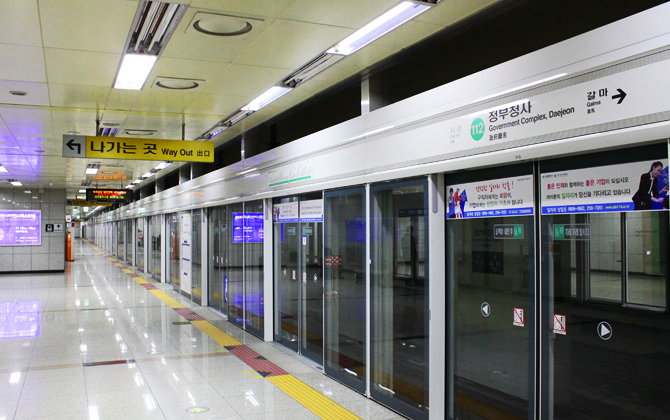
The history of Daejeon Metro starts in 1991, when a five-line urban rail system was included in the city’s construction plan. In February 1996, after Daejeon’s administrative district expanded, officials announced a metro plan totaling 102.3 km (63.6 miles). Construction of Line 1 began in October 1996, though right-of-way issues and financial pressure after the 1997 Asian financial crisis slowed progress.
Line 1 had originally been expected to open by 2003, but the launch was delayed. The first section, from Panam to Government Complex, opened on March 16, 2006. The second section, from Government Complex to Banseok, followed on April 17, 2007. Once the full route opened, city bus services were reorganized to feed into the subway, strengthening the overall transport system.
Since 2011, T-money has improved fare payment compatibility with other metropolitan cities. In March 2015, cumulative ridership passed 300 million. Usage peaked in 2014, then gradually declined at many stations as Daejeon’s population fell, although Banseok Station saw stronger demand because of its link toward Sejong City.
Line 2 has had a long and winding development path, including earlier maglev ideas before a tramway concept took hold. A basic plan was established in 2015, a tram-style route was announced in 2016, the maglev feasibility plan expired in 2017, and the tram proposal passed review in 2019. The line is now under construction and is expected to open in 2028.
Other rail projects have also been discussed. In 2015, a feasibility study passed for the Chungcheong region metropolitan railway, and Daejeon decided to fund Yongdu Station as a transfer point on Line 1. In 2021, a national rail plan separated the route toward Cheongju Airport into the Daejeon-Sejong-Chungbuk Metropolitan Railway, with the section from Government Complex to Cheongju Airport scheduled for 2034. Lines 3 to 5 remain under review.
Line 1
Line 1 was designed to connect Daejeon’s old and new city centers. It opened in two stages, in 2006 and 2007, and a further extension from Banseok to Government Complex Sejong is planned with a tentative opening date of 2029.
Line 2
Line 2 shifted through several concepts, from maglev to a street-level tram. A basic plan was set in 2015, the route was announced in 2016, and the project later moved forward as a tram. It is under construction and expected to open in 2028.
Chungcheong Metropolitan Railroad
The Chungcheong Metropolitan Railroad is planned to connect Chungcheongnam-do, Chungcheongbuk-do, and Sejong Special Self-Governing City, with Daejeon as the central hub. It will use existing railway corridors operated by Korail.
Daejeon-Sejong-Chungbuk Metropolitan Railway (CTX)
The Daejeon-Sejong-Chungbuk Metropolitan Railway was first intended as an extension of Line 1 toward Cheongju Airport. In January 2024, the plan was changed and separated into CTX, a new line linking Government Complex station on Line 1 to Cheongju Airport. It is scheduled to open in 2034.
Future Expansions
Daejeon’s main expansion project is Urban Railroad Line 2, now under full-scale construction after many years of debate. The new tram line is planned as a 38.8 km (24.1 miles) circular route with 45 stations and one vehicle base, linking all five Daejeon districts.
The project is being built as a hydrogen tram system, the first of its kind in Korea, with sequential completion expected by 2028. The route will connect major parts of the city around Daejeon Station, Government Complex, and Yuseong Hot Springs, with branch lines between Jung-ri and Yeon-axis and between Gwanjeo and Jinjam.
Five stations are planned as landmark stations. These include Government Complex Station, Expo Science Park Station, Bomunsan Park Station, and Daejeon Station Central Market Station.
Beyond Line 2, the city has also presented a broader urban railway plan covering future Lines 3, 4, and 5. Together, these projects are meant to strengthen rail-based city transport as the system continues to grow.
Tourist Attractions
Daejeon has a mix of city landmarks, green spaces, cultural spots, and easy day-trip options. It feels more relaxed than some of South Korea’s biggest destinations, which makes it pleasant to explore at a slower pace. With Daejeon Metro and local bus connections, several attractions are fairly easy to combine in one day.
For a practical route plan, it helps to focus on a few areas rather than trying to do everything at once. The city center and Expo Park area are especially convenient for visitors using public transport.
- Gyejoksan Mountain Red Clay Trail and Gyejoksan Fortress for scenic walks and open views.
- Daejeon Skyroad for nightlife, shopping, cafes, and LED displays in the city center.
- Yuseong Foot Spa and the nearby gardens for a free, relaxing stop.
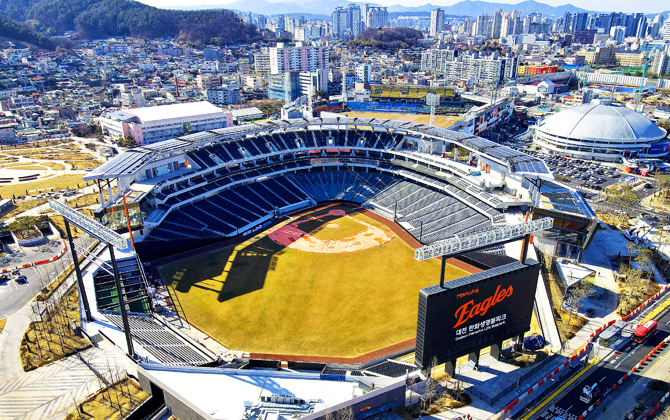
- Hanwha Life Eagles Baseball Stadium for atmosphere, food, and a classic local sports outing.
- Daecheong Lake for a quieter half-day trip with walking paths and viewpoints.
- Cheongnamdae Mansion for history, interiors, and landscaped grounds.
- Sungsimdang Bakery for one of Daejeon’s best-known local food stops.
- Jangtaesan Recreational Forest for evergreen scenery, wooden bridges, and a suspension bridge.
- Jungang Market and Jungangno Underground Shopping Mall for local shopping and affordable fashion.
- Expo Park, Expo Bridge, Expo Hanbit Tower, the fountain show, Hanbat Arboretum, and the National Science Museum for a strong cluster of attractions in one area.
- Daejeon O World and Ppuri Park for theme-park fun and an evening walk.
- Daedong Sky Park and Uam Historical Park for sunset views and a quieter historic setting.
If time is limited, a simple plan works best: pair one nature stop, one city-center attraction, and one Expo Park sight. It gives you a solid feel for the city without rushing.