Gwangju Metro is the rapid transit system in Gwangju, South Korea, operated by the Gwangju Metropolitan Rapid Transit Corporation. The system opened in 2004 and currently has one line, Line 1, with 20 operational stations along a 20.1 km (12.5 mi) route. It links the east and west sides of the city, serves the central business district, Gwangju Airport, and Gwangju Songjeong Station, and forms an important part of local public transport and city transport in Gwangju. Most of the route is underground, with above-ground sections between Sotae-Nokdong and Pyeongdong-Dosan, and the line is shown in turquoise on the stations map.
| Key | Information |
|---|---|
| System | Gwangju Metro |
| Operator | Gwangju Metropolitan Rapid Transit Corporation |
| Opening | 2004 |
| Current network | 1 line, 20 stations |
| Route length | 20.1 km (12.5 mi) |
| Main route | Line 1 from Nokdong to Pyeongdong |
| Service pattern | Most trains run between Pyeongdong and Sotae, with about one train per hour continuing to Nokdong |
| Airport access | Airport Station serves Gwangju Airport |
| Notable feature | The route crosses the Yeongsan River and the Hwangryong River |
Gwangju Metro Map
Map of Gwangju Metro showing different lines. Click on the map to enlarge it or download the Gwangju Metro map in PDF format.
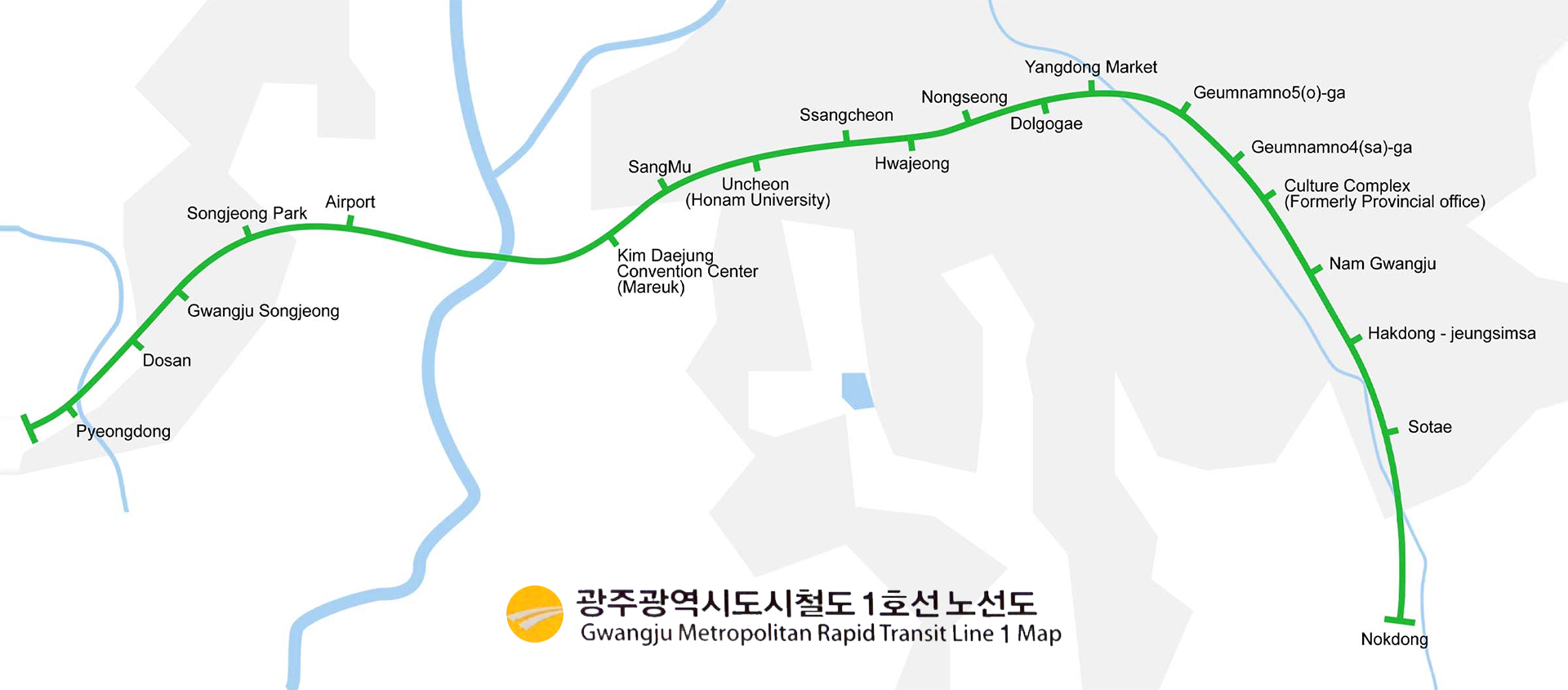
Lines and Stations
Gwangju Metro currently has one operational line. Line 1 runs across the city on a 20.1 km (12.5 mi) route and is the core of transportation in Gwangju. The system opened in 2004 and is mostly underground, apart from the sections between Sotae-Nokdong and Pyeongdong-Dosan.
Line 1
Line 1 connects eastern and western Gwangju and runs from Nokdong to Pyeongdong. Most trains operate between Pyeongdong and Sotae, while roughly one train per hour continues toward Nokdong. The route crosses both of Gwangju’s major rivers, the Yeongsan River and the Hwangryong River. As of 2021, the line has 20 stations.
| Station | Details |
|---|---|
| Nokdong | Eastern end of the route; limited through service compared with the main operating section |
| Sotae | Key operating point; most trains run between Sotae and Pyeongdong |
| Culture Complex | Station on Line 1 |
| Geumnamno 4(sa)-ga | Station on Line 1 |
| Geumnamno 5(o)-ga | Useful for airport trips mentioned in the airport connection section |
| Yangdong Market | Station on Line 1 |
| Nongseong | Near a bus connection |
| Uncheon | Station on Line 1 |
| Sangmu | Western terminus of the first opening stage in 2004 |
| Kim Daejung Convention Center | Station on Line 1 |
| Airport | Serves Gwangju Airport |
| Songjeong Park | Station on Line 1 |
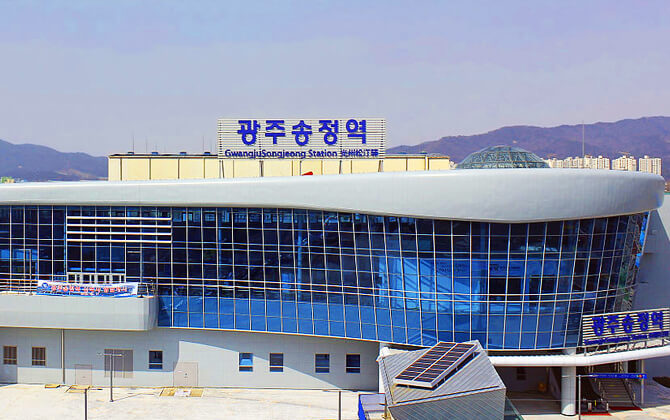
| Gwangju Songjeong Station | Transfer point for KTX and Korail services |
| Pyeongdong | Western end of the full Line 1 route |
The line opened in two stages: the first section began service on April 28, 2004, between Nokdong and Sangmu, and the full route opened on April 11, 2008, with the extension to Pyeongdong.
Expansion Plans
The Gwangju City Government plans to extend Line 1 eastward to Hwasun and westward to Naju. In 2009, the Presidential Committee on Balanced National Development said the Line 1 extension would be included in its 5+2 extensive economic zone project.
Line 2 was originally planned as a circle line, though a south-north option was also considered. After a public hearing in 2019, construction started on the original route plan. Phase 1, a 20-station route of 17 km (10.6 mi) in the south of the city, has been pushed back to 2026. Phase 2 is scheduled for 2029 and will complete the loop, while Phase 3 will add a 4.8 km (3.0 mi) branch serving the southeastern suburbs of Gwangju.
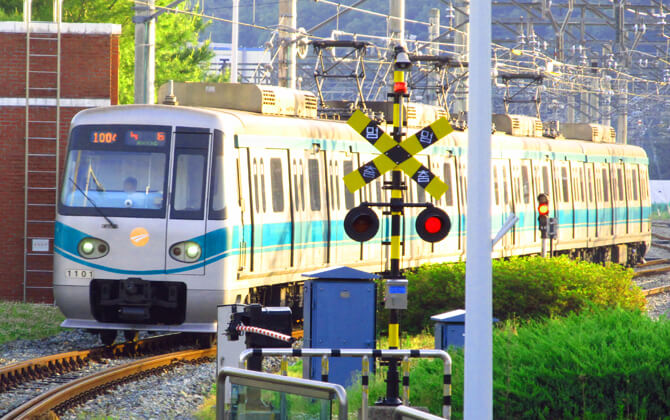
Operating Hours
Gwangju Metro operating hours are from 5:30 AM to midnight every day, so it does not run 24 hours. If you need the first train, last train, or timings today for an early or late trip, it is smart to check the latest timetable before you travel.
| Service detail | Timings |
|---|---|
| Daily opening hours | 5:30 AM to midnight |
| Regular frequency | Every 8 to 10 minutes |
| Morning rush hour frequency | About every 5 minutes |
| Evening rush hour frequency | About every 7 minutes |
| Full Line 1 running time | Around 37 minutes |
| Nokdong-Sotae shuttle frequency | Every 30 to 60 minutes |
In practice, opening times, working hours, and train schedule details vary by section. The Nokdong-Sotae section works more like a shuttle, with a much lower frequency than the main part of the line. If you are checking the schedule today, pay special attention to that part of the route.
For many riders, the key things to know are the starting time, the closing time, and the last train. A full end-to-end trip on Line 1 takes about 37 minutes, which makes the metro a straightforward option for getting across the city.
Fares and Tickets
Gwangju Metro uses a flat fare system, so the ticket price does not depend on distance. There are two main ticket options: a single journey ticket and a traffic card.
A single journey ticket costs ₩1,200 (about $0.89) for adults, ₩1,000 (about $0.74) for teenagers, and ₩400 (about $0.30) for children. With a traffic card, the fare drops to ₩1,100 (about $0.81) for adults and ₩800 (about $0.59) for teenagers, while the child price stays at ₩400 (about $0.30).
Passengers aged 65 and over, infants aged 0-5, disabled passengers, and veterans can travel free with the proper identification. Discounts are also available for groups of 20 or more. Depending on the conditions, a traffic card may also give reduced fare or free travel on city buses and other public transport.
Tickets can be bought from ticket machines at stations. Prepaid traffic cards are sold at metro station centers and convenience stores.
If you are comparing fare, cost, or price options, the card is the cheaper choice for most regular trips. The available information does not mention a day pass or fare calculator.
Connections to Other Systems
Even as a one-line system, Gwangju Metro provides an important transport link across the city. Line 1 runs through central areas and connects the eastern and western parts of Gwangju. At Gwangju Songjeong Station, passengers can transfer to KTX and Korail services for longer-distance travel.
The metro also connects with the wider public transport network. A bus route operates near Nongseong Station, and city bus services are expected to be reorganized further as the metro network develops. That gives Line 1 a useful role within local transport and city transport, especially for riders combining metro and bus trips.
Future expansion should strengthen those links. The planned Line 2 is expected to improve access between residential districts, commercial areas, universities, and major transfer points such as Namgwangju Station and Gwangju Station. It will also cross the Yeongsan River and the Hwangryong River.
Available plans also suggest that Line 2 will support better transfers from nearby city buses and improve transportation in parts of Gwangju that are harder to reach by urban rail today, including areas around Sangmu, Suwan, and Cheomdan.
Airport Connections
Airport Station is on Gwangju Metro Line 1 in Sinchon-dong, Gwangsan District, and it serves Gwangju Airport. The station is about 300 m (0.3 km / 0.2 mi) from the airport. It connects to Kim Daejung Convention Center Station via the Gukrak Bridge Haje Tunnel.
Airport Station lies on the Line 1 route between Pyeongdong and Nokdong. Trains run daily from 5:30 AM to 12:00 AM, matching the system’s operating hours, with regular service throughout the day.
Subway access to the airport is available from Geumnamno 5-ga Station to Airport Station, with hourly departures and a running time of about 19 minutes. The fare is ₩1,400 (about $1.03).
Although the station is very close to the airport, ridership has been relatively low. After the opening of Gwangju Songjeong Station on the Honam High-Speed Rail, some passenger demand shifted there, and Airport Station usage declined.
Bus connections from the airport area include the following routes:
| Station | Details |
|---|---|
| Songjeong 97 | Airport ↔ Gwangju Songjeong Station ↔ Daesan ↔ Chilseong ↔ Gwangam |
| Seonun 101 | Airport ↔ Songjeong Park Station ↔ Gwangsan Police Station ↔ Honam University Gwangsan Campus |
| 1000 | Airport ↔ Gwangju Songjeong Station ↔ Kim Daejung Convention Center ↔ City Hall ↔ U Square (Gwangju Bus Terminal) ↔ Geumnam-ro ↔ Chosun University ↔ Gwangju Court ↔ Jisan Yuwonji |
| 1160 (Naju) | Airport ↔ Naju ↔ Yeongsanpo Bus Terminal |
Tips and Rules
Gwangju Metro is generally easy to use, safe, and comfortable. A few simple rules make the ride smoother for everyone.
- Keep your voice low on the train. The system is usually quiet, so loud conversations stand out.
- If you watch videos or listen to audio, use headphones.
- Let passengers get off before boarding.
- Stand behind the waiting lines and queue in order.
- Give priority seats to elderly passengers, people with disabilities, and pregnant women. Leave these seats available even if they are empty.
- Do not eat or drink on the subway.
- Try not to block space with bags or bulky items.
- Before leaving the train, check your seat and the area around you for personal belongings.
These basic habits help keep public transport orderly and safe.
Fun Facts
Gwangju Metro opened in 2004 with 14 stations. Today, the system has one line with 20 operational stations over 20.1 km (12.5 mi) of route.
Most of the metro is underground, but some sections run above ground between Sotae-Nokdong and Pyeongdong-Dosan.
The route crosses both of Gwangju’s major rivers, the Yeongsan River and the Hwangryong River.
Line 1 opened in two stages: first between Nokdong and Sangmu on April 28, 2004, then fully between Nokdong and Pyeongdong on April 11, 2008.
Most trains run between Pyeongdong and Sotae, while only about one train per hour continues toward Nokdong. That operating pattern is one of the more unusual details of the system.
Expansion plans include extending Line 1 to Hwasun and Naju, while Line 2 is being built in phases after originally being planned as a circle line.
History
Gwangju Metro Line 1 opened in stages. The first section began service on April 28, 2004, between Nokdong and Sangmu. The full line opened on April 11, 2008, when the extension to Pyeongdong entered service.
Since then, Gwangju Metro has remained a single-line system, with Line 1 acting as the backbone of urban transport in the city. As of 2021, it had 20 stations in operation.
The system’s history also includes long-running expansion plans. The Gwangju City Government has proposed extending Line 1 eastward to Hwasun and westward to Naju, and in 2009 the Presidential Committee on Balanced National Development said the project would be included in its 5+2 extensive economic zone plan.
Line 2 is another major part of that story. It was first planned as a circle line, though a south-north option was also considered. After a public hearing in 2019, construction began on the original plan, but the opening schedule was revised. Phase 1 is now planned for 2026, Phase 2 for 2029, and Phase 3 will add a branch to the southeastern suburbs.
Extensions
Gwangju Metro is still a single-line system, but expansion is a major part of its future. The city government has proposed Line 1 extensions eastward to Hwasun and westward to Naju. In 2009, the Presidential Committee on Balanced National Development said the Line 1 extension would be included in its 5+2 extensive economic zone project.
Line 2 is the main construction project now shaping the network. It was originally designed as a circular route, although a north-south alignment was also considered. After a public hearing in 2019, construction began on the original route plan. Phase 1, once expected earlier, is now scheduled for 2026.
The current expansion plan for Line 2 is divided into three phases. Phase 1 will be a 20-station route of 17 km (10.6 mi) in the southern part of the city. Phase 2 is scheduled for 2029 and will extend the line to 38 km (23.6 mi), completing the loop. Phase 3 will add a 4.8 km (3.0 mi) branch serving the southeastern suburbs of Gwangju.
- Line 1: planned extensions to Hwasun and Naju
- Line 2: under construction in three phases
- Phase 1: 20 stations, 17 km (10.6 mi), planned opening in 2026
- Phase 2: 38 km (23.6 mi) loop completion, scheduled for 2029
- Phase 3: 4.8 km (3.0 mi) branch to the southeastern suburbs
These projects are intended to strengthen the rail system and improve connections between existing districts and newer development areas.
Nearby Attractions
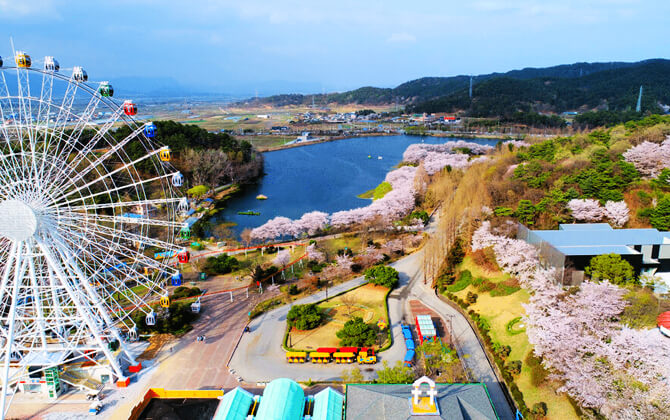
Gwangju has a good mix of culture, history, nature, and family attractions near the metro route. If you are planning a simple route or day trip by public transport, these places are worth considering.
- Asia Culture Center (ACC) — A large cultural complex focused on Asian culture, with exhibitions, performances, festivals, lectures, and educational programs throughout the year.
- 1913 Songjeong Station Market — A long-running local market with retro-style shops, younger businesses, and well-known street food.
- Penguin Village — A neighborhood known for decorations made from recycled materials, plus a J-Hope mural and a BTS fan photo zone.
- Mudeungsan Monorail at Jisan Amusement Park — A scenic ride with forest views and an overlook from Palgakjeong Observatory if you get off at the middle station.
- Songsan Amusement Park — A riverside park with an ecological pond, open squares, and walking paths lined with herbs and flowers.
- Gwangju Family Land — The city’s largest theme park, with more than 20 rides and the Big Eye Ferris Wheel.
These stops can be combined into an easy sightseeing plan, especially if you want to mix cultural sights with outdoor time.