Daegu Metro is the main urban rail system in Daegu, South Korea, and a key part of city transport. It includes three metro lines operated by Daegu Transportation Corporation—Lines 1, 2, and 3—plus the Daegu–Gyeongbuk Line, a regional commuter rail service operated by Korail. First launched on November 26, 1997, the system supports daily travel across the city, with Lines 1 and 2 running as rapid transit and Line 3 operating as a monorail. It also plays a growing role in transportation in Daegu and the surrounding Gyeongsangbuk-do region through ongoing expansion and regional rail integration.
| Key | Information |
|---|---|
| System | Daegu Metro (Daegu Urban Railway) |
| Location | Daegu, South Korea |
| Operator | Daegu Transportation Corporation; Daegu–Gyeongbuk Line operated by Korail |
| Lines | Line 1, Line 2, Line 3, Daegu–Gyeongbuk Line |
| Opening date | November 26, 1997 |
| Technology | Lines 1 and 2 are rapid transit; Line 3 is a monorail |
| Role in public transport | Backbone of local transport and city transport in Daegu |
| Regional integration | Daegu–Gyeongbuk Line added regional rail integration from 2023 |
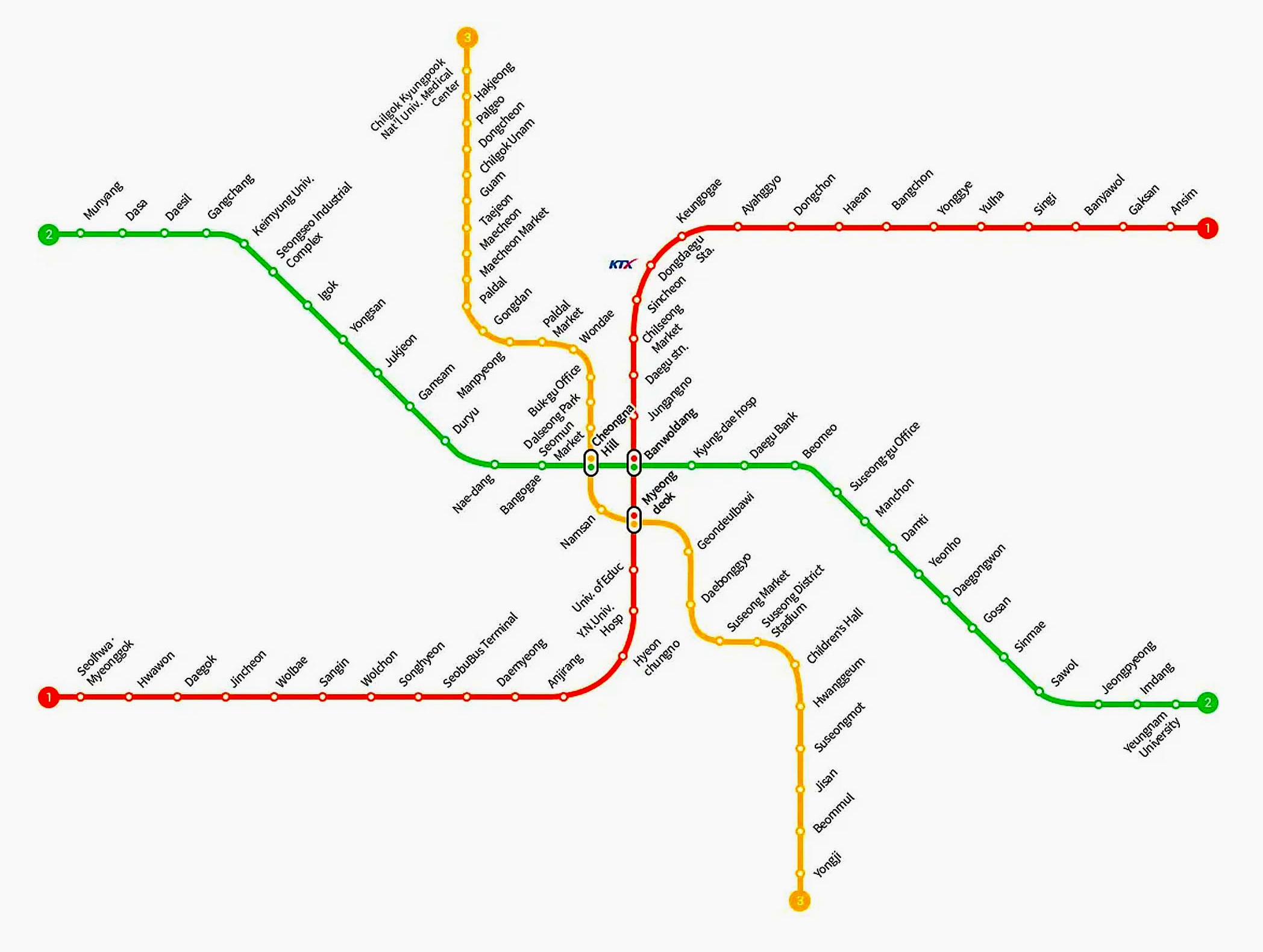
Daegu Metro Map
The Daejeon Metro Map shows different lines, stations, and interchanging possibilities. Line 1, 2, and 3 are marked with red, green, and orange colors, respectively.
Map of Daegu Metro showing different lines and stations. Click on the map to enlarge it or download the Daegu Metro map in PDF format.
Lines and Stations
Daegu Metro has three active metro lines, plus the Daegu–Gyeongbuk Line. Together, they form the core route network for public transport in the city and extend service into nearby parts of Gyeongsangbuk-do.
| Station | Details |
|---|---|
| Line 1 | Seolhwa-Myeonggok to Hayang; 35 stations; 37.1 km / 23.1 miles |
| Line 2 | Munyang to Yeungnam Univ.; 29 stations; 31.4 km / 19.5 miles |
| Line 3 | Chilgok Kyungpook Nat’l Univ. Medical Center to Yongji; 30 stations; 23.9 km / 14.9 miles |
| Daegyeong Line | Gumi Station to Gyeongsan Station; 8 stations; 61.85 km / 38.4 miles |
| Banwoldang | Main transfer station for Lines 1 and 2 |
| Myeongdeok | Transfer station for Lines 1 and 3 |
| Sinnam | Transfer station for Lines 2 and 3 |
| Key Line 1 stations | Seolhwa-Myeonggok, Banwoldang, Jungangno, Daegu Station, Dongdaegu Station, Ansim, Hayang |
| Key Line 2 stations | Munyang, Banwoldang, Daegu Bank, Beomeo, Sawol, Yeungnam Univ. |
| Key Line 3 stations | Chilgok Kyungpook Nat’l Univ. Medical Center, Dalseong Park, Myeongdeok, Yongji |
| Key Daegyeong Line stations | Gumi Station, Gyeongsan Station |
Line 1 runs from Seolhwa-Myeonggok to Hayang. It opened in stages starting in 1997, with the most recent extension from Ansim to Hayang opening in December 2024.
Line 2 links Munyang and Yeungnam Univ. It opened in 2005 and was later extended into Gyeongsan.
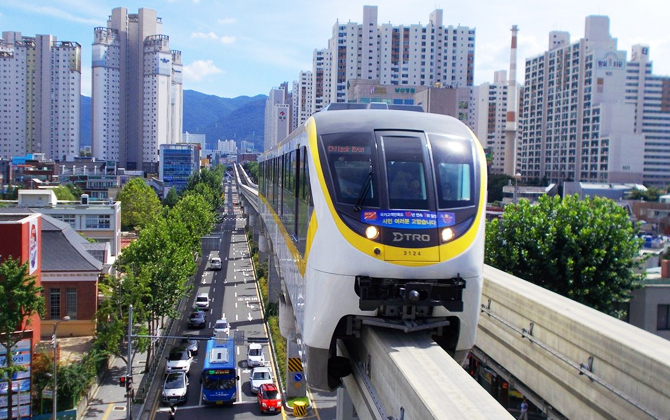
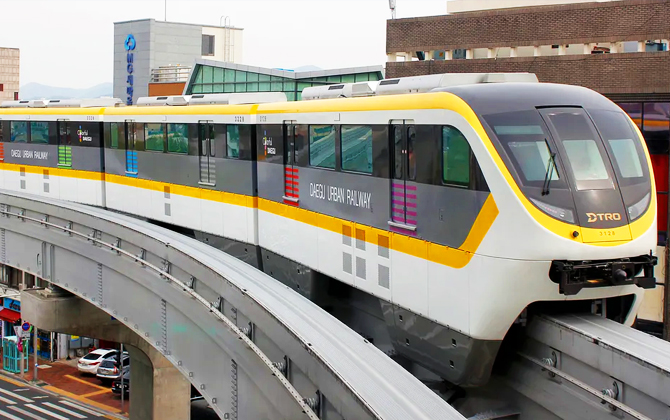
Line 3, also called Sky Rail, is the city’s monorail line. It connects Chilgok Kyungpook Nat’l Univ. Medical Center and Yongji.
The Daegyeong Line adds regional commuter service between Gumi and Gyeongsan through central Daegu. For anyone checking a stations map or stations list, the main interchange points are especially useful for planning a route.
Across the system, Lines 1 and 2 use rapid transit technology, while Line 3 uses a separate monorail system.
Hours of Operation
Daegu Metro operating hours are generally 05:30 AM to 12:00 AM daily. In other words, the opening hours and working hours are the same from Monday through Sunday, and the system does not run 24 hours.
| Service detail | Timings |
|---|---|
| Starting time | 05:30 AM |
| Closing time | 12:00 AM |
| Last train | Usually between 23:30 and 23:55 |
| Typical frequency | Around 12 minutes |
| Peak-hour frequency | About every 4 to 5 minutes |
If you are checking opening times, timings today, or the train schedule for an evening trip, keep an eye on the last train. Services usually close a little before midnight, so it is smart to get to the platform early.
The exact timetable can vary slightly by line, but the general running time pattern is consistent across the network. For most riders, the key things to know are the starting time, average frequency, and last departures.
Fares and Tickets
Daegu Metro uses a simple fare system based on ticket type and age, not distance. That keeps the fare calculator question pretty straightforward: the cost does not change with trip length.
Transportation card fare: adults pay ₩1,500 (about $1.02), teens ₩850 (about $0.58), and children ₩450 (about $0.31).
Pre-paid token fare: adults and teens pay ₩1,700 (about $1.15), and children pay ₩500 (about $0.34).
Older fare information in the source material also lists a one-time ticket price of ₩1,700 (about $1.15) for adults, ₩1,400 (about $0.95) for youths, and ₩500 (about $0.34) for children.
In practice, the main choice is simple: use a transportation card or buy a token ticket. If you ride often, a card is the more practical option. The source material does not mention a day pass or metro pass, so only card and token options can be confirmed here.
Connections to Other Systems
Daegu Metro is the backbone of public transport in Daegu, but it also connects with other rail services for longer trips. That makes it an important part of both local transport and wider transportation in the region.
Within the metro system, key interchange stations include Banwoldang for Lines 1 and 2 and Cheongna Hill for Lines 2 and 3. These transfer points help passengers move between major parts of the city.
Regional links became more important with the opening of the Daegyeong Line. On December 14, 2024, Daegu Station and Dongdaegu Station were added as transfer points, expanding the area transfer system.
One detail matters: mutual transfer is not possible with a token-type ticket on the Daegyeong Line because it uses a different standard from the Daegu Urban Railway.
Dongdaegu Station is also a major KTX station, so it serves as a key connection between the metro and South Korea’s national rail network. Because many transfer stations sit in central Daegu, some trips between outer districts still require passing through downtown interchange stations.
Airport Connections
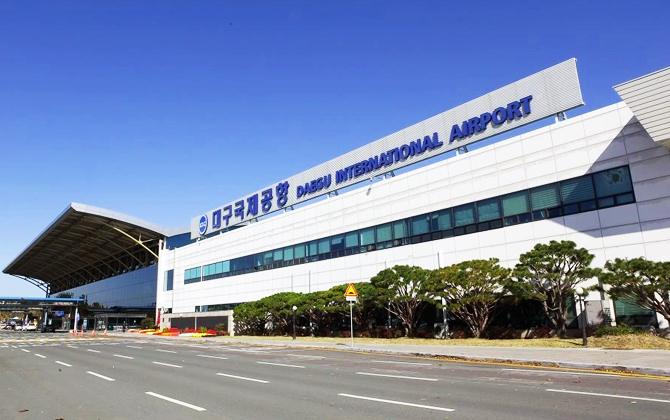
There are three ways to travel between Daegu and Daegu Airport (TAE): subway, taxi, or walking. For most travelers, the subway is the most practical route because it balances price and convenience well.
The direct subway trip between Jungangno Station and Ayanggyo Station takes about 11 minutes, with service every 10 minutes. The fare is ₩1,200–1,400, or about $0.81–$0.95.
A taxi takes about 8 minutes and costs roughly ₩12,000–15,000, or about $8.15–$10.19.
Walking is possible, but it takes about 1 hour 25 minutes for 7.2 km / 4.5 miles, so it is only really practical if you have lots of time and light luggage.
- Subway: 11 minutes, ₩1,200–1,400 ($0.81–$0.95), direct service every 10 minutes
- Taxi: 8 minutes, ₩12,000–15,000 ($8.15–$10.19)
- Walk: about 1 hour 25 minutes for 7.2 km / 4.5 miles
For the return trip, the same subway connection links Daegu Airport back to the city through Ayanggyo Station and Jungangno Station.
Facilities and Services
Daegu Metro is designed to make everyday public transport practical and comfortable. The system runs daily from 05:30 to midnight, with more frequent service during busy periods.
Ticketing is available through transit cards and prepaid tokens, with different prices for adults, teens, and children. Tickets can be bought from ticket machines or customer centers, and some machines are reserved for specific card users.
Stations include accessibility features for passengers with disabilities, including wheelchair lifts and elevators. Announcements are made in Korean and English.
The system also provides lost and found services, waiting rooms, and rest rooms at stations. In terms of safety, Lines 1 and 2 have platform screen doors, and emergency measures were strengthened after the 2003 Daegu subway fire. These upgrades included more flame-retardant materials and emergency gas masks and respirators in subway cars.
Transfers are generally well marked. In some stations, passengers need to follow signed routes between platforms or use escalators and elevators where platforms are at different heights.
Rules
The guidelines for Daegu Metro construction and operation were approved in January 1991. They were intended to address traffic problems linked to downtown overpopulation and to support a more efficient transport system with shorter commutes, less auto traffic, lower energy use, wider service coverage, and greater transportation capacity.
For passengers, the most relevant operating rules in the source material are the fare structure and service hours. The system runs from 05:30 to 00:00 rather than all day and all night.
| Station | Details |
|---|---|
| Transit card | Adult ₩1,500 ($1.02); Teen ₩850 ($0.58); Child ₩450 ($0.31) |
| Pre-paid token | Adult ₩1,700 ($1.15); Teen ₩1,700 ($1.15); Child ₩500 ($0.34) |
| Line 1 | 35 stations; 37.1 km / 23.1 miles; Seolhwa-Myeonggok to Hayang |
| Line 2 | 29 stations; 31.4 km / 19.5 miles; Munyang to Yeungnam Univ. |
| Line 3 | 30 stations; 23.9 km / 14.9 miles; Chilgok Kyungpook Nat’l Univ. Medical Center to Yongji |
Each line is segregated and uses its own vehicles. Lines 1 and 2 are rapid transit lines, while Line 3 is a monorail. Planning materials also mention additional future routes, but the active metro system remains the three-line network described here.
Tips
If you are using Daegu Metro for sightseeing or daily travel, it is one of the easiest city transport options to figure out. Most stations have stairs, escalators, and elevators, so access is usually straightforward.
Before you travel, it helps to keep a Daegu Metro stations map on your phone so you can check the route plan and stations list quickly. Waze can help with city streets, while Google is less useful for navigation in South Korea.
You can choose between an RF Card and a single-use token ticket. If you expect to ride more than once, the card is usually the better option. Single-use tickets are also easy to buy from machines by selecting English and following the steps.
On the platform, check signs, station numbers, and route directions carefully. Transfers are clearly marked, and colored arrows on the floor can guide you between lines. On board, stops are announced in Korean and English, and the next stations appear on overhead LED panels.
For a safe trip, stand behind the marked areas and follow platform guidance. If you have trouble with a ticket machine or need help finding your way, you can use the call button for assistance.
When leaving the station, double-check the exit number that matches your destination. It saves time and makes the trip much smoother.
History
The history of Daegu Metro goes back to 1985, when the City of Daegu carried out research on how to improve urban transit. In September 1989, a committee was established for the new metro project, and a feasibility study followed from 1989 to 1990. Construction and operation guidelines were approved in January 1991.
These plans focused on easing downtown congestion while improving commuting times, environmental conditions, service reach, and transportation capacity. Regional rail integration later expanded with the opening of the Daegyeong Line in 2023.
Line 1
Construction of Line 1 began in December 1991. The first 10.3 km / 6.4 miles section, between Jincheon and Jungang-ro, opened on November 26, 1997. A second 24.9 km / 15.5 miles section between Jincheon and Ansim opened on May 2, 1998.
The line was later extended south from Daegok in May 2002, then from Daegok to Seolhwa in 2016. The most recent expansion opened in December 2024, when the line was extended from Ansim to Hayang.
Line 2
Construction of Line 2 began in December 1996 and was completed on October 18, 2005 with the opening of the 28.0 km / 17.4 miles section between Munyang and Sawol.
In June 2007, the line was extended with three new stations in Gyeongsan. Another 3.3 km / 2.1 miles extension from Sawol to Yeungnam University of Gyeongsan was completed in September 2012.
Line 3
Line 3 was completed on May 17, 2009 between Gyeongbook University Hospital’s Chilgok campus and Yongji. The most recent extension opened on April 23, 2015. It operates as a light rail monorail and is widely known as Sky Rail.
Line 4 (Future Plan)
Daegu Metro Line 4 was approved and is planned to begin construction by 2026. Originally called the Expo Line, it was renamed Daegu Metro Line 4 during planning in 2023. The line is planned as automated guideway transit and is intended to connect Dong-gu with central Suseong District. Its planned color is sky blue.
Line 5 (Future Plan)
Daegu Metro Line 5 is planned to begin operation by 2032. It was originally proposed as a tramway line, but the current plan is to build it as a monorail. Its planned color is green.
Daegyeong Line
The Daegu–Gyeongbuk Line is a metropolitan rail service connecting Gumi to Gyeongsan through central Daegu. Operated by Korail, it opened in 2023 as part of the wider integration of regional rail into the Daegu transport system.
Future Plans
Daegu Metro expansion is focused on new lines and stronger regional connectivity. The city continues to build on Lines 1, 2, and 3 while linking more closely with the surrounding region through the Daegu–Gyeongbuk Line.
Line 4
Line 4 was approved and is expected to begin construction by 2026. It was first known as the Expo Line before being renamed in 2023. The planned route will connect Dong-gu with the heart of Suseong District, using automated guideway transit. Its planned color is sky blue.
Earlier planning documents also describe the project as a 12.6 km / 7.8 miles steel-wheeled automated guideway transit line with stations including Suseong District Stadium, Beomeo, Dongdaegu, Kyungpook National University, and Exco. The route was later refined during master planning, including one added station and a relocated depot site.
Line 5
Line 5 is planned as a future circular line and is currently expected to begin operation by 2032. The route has been revised several times. While it was originally proposed as a tram, the latest plan is for a monorail line. Its planned color is green.
Available planning information indicates that Line 5 should improve access to Seodaegu Station and strengthen connections across the urban rail network, especially in western Daegu.
2040 Daegu Basic Plan
Daegu Metropolitan City is also preparing the 2040 Daegu Basic Plan, a long-term framework for urban development over the next 20 years. The plan is expected to be finalized in early 2026 after administrative procedures including a public hearing and review by the Daegu Metropolitan Council.
It supports major projects such as the New Daegu-Gyeongbuk Airport, relocation of K-2 Brownfield and military units, and infrastructure for future industries. It also sets out a transportation vision based on a “5+1 Spokes” network with stronger regional links.
Regional Rail Expansion
Beyond the metro itself, future regional rail plans include the Daegu Metropolitan Area Phase 1 Railway connecting Gumi, Daegu, and Gyeongsan. The project is intended to reduce travel time and improve frequency with electric trains running at shorter intervals.
Nearby Attractions
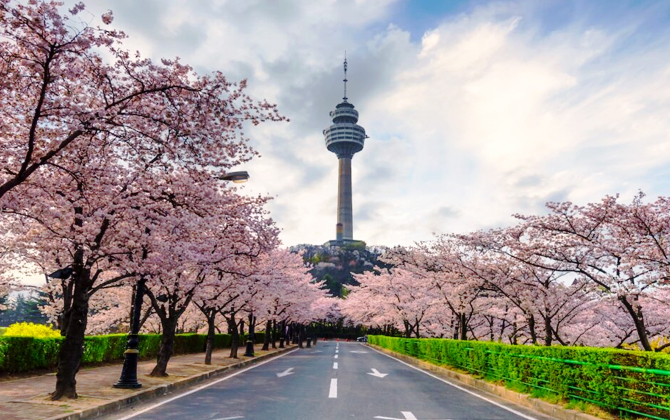
Daegu Metro makes it easy to get around the city and reach many of its best-known attractions by public transport. It is a practical way to combine sightseeing with everyday travel.
Popular places to visit
- E-World and 83 Tower are among Daegu’s best-known attractions, with amusement rides and skyline views.
- Seomun Market is one of South Korea’s largest traditional markets and is known for street food, fabric, crafts, and everyday shopping.
- Daegu Heritage Trail includes landmarks such as Gyesan Cathedral, Cheongna Hill, and the March 1st Independence Movement Road.
- Kim Gwang-Seok Street is a mural-filled pedestrian street dedicated to the late folk singer Kim Gwang-Seok.
- Suseong Lake is a relaxing spot for walking and a quieter city break.
Nature and city views
- Apsan Mountain Park offers hiking trails, wide views, and a cable car to the observatory.
- Palgongsan Mountain is popular for hiking, seasonal scenery, and its cable car ride above the forest.
- Donghwasa Temple, on the southern slopes of Palgongsan Mountain, combines history, culture, and peaceful surroundings.
- Duryu Park is a green space next to E-World and Daegu Tower.
With the metro, it is easy to move between markets, parks, cultural sites, and entertainment areas without long travel times between stops.