Kobe Rapid Transit Railway is a rail infrastructure company in central Kobe, Japan, and an important part of transportation in the city. It is a Category-3 Operator under Japan’s Railway Business Act, owning the Tozai Line, the Namboku Line, and later the Hokushin Line, while through-running services are operated by other rail companies. In practice, the system helps connect central Kobe with surrounding rail networks and key interchange stations, making local transport and wider city transport much easier.
| Key | Information |
|---|---|
| Company | Kōbe Rapid Transit Railway Company, Limited |
| Location | Central Kobe, Japan |
| Operator type | Category-3 Operator under Japan’s 1986 Railway Business Act |
| Main lines | Tozai Line and Namboku Line |
| Additional line | Hokushin Line |
| Service model | Owns infrastructure; trains are operated through the network by other railway companies |
| Main role | Links central Kobe with surrounding rail systems and interchange stations |
Kobe Rapid Transit Railway Map
Map of Kobe Rapid Transit Railway showing different lines. Click on the map to enlarge it or download the Kobe Rapid Transit Railway map in PDF format.
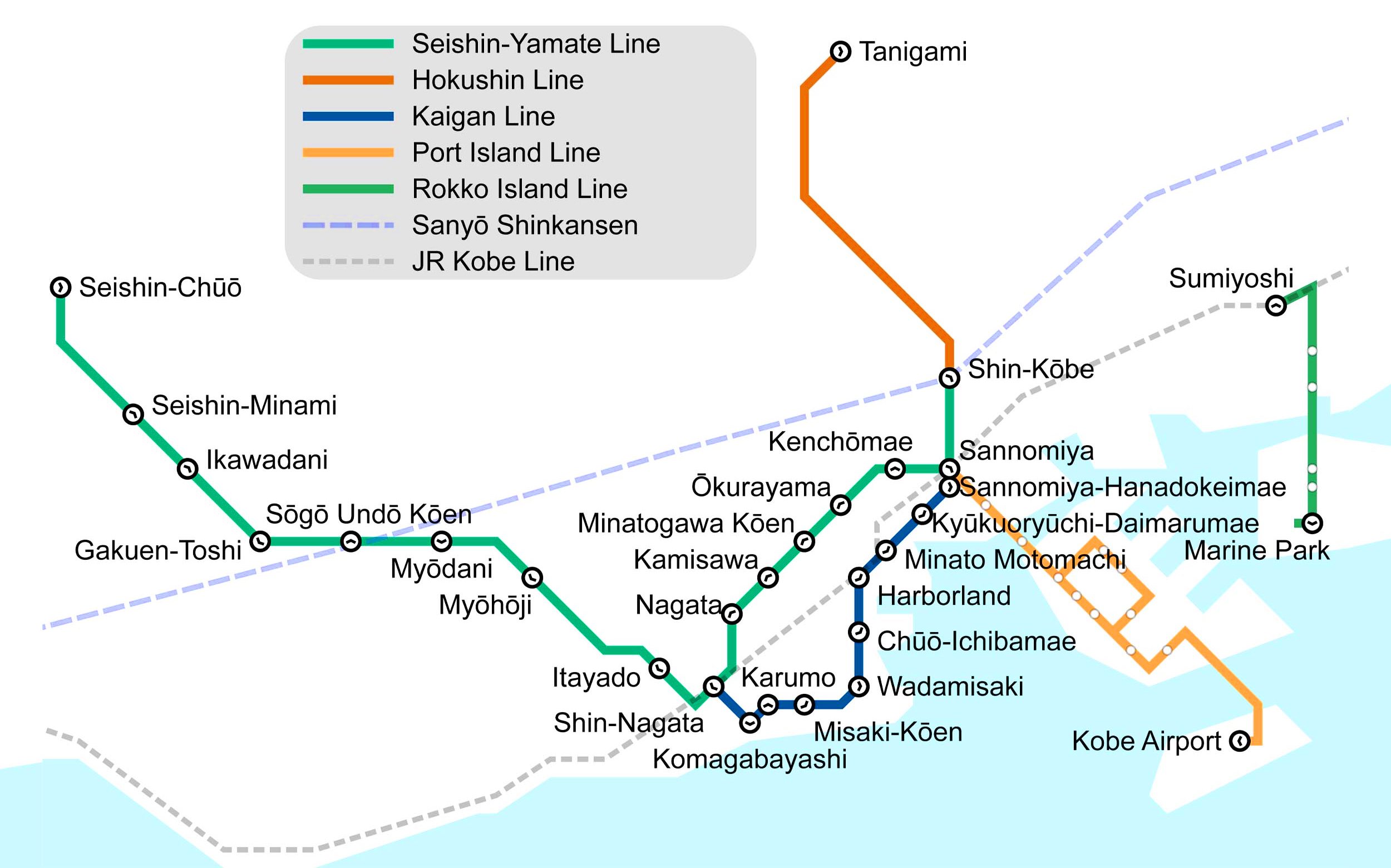
Lines and stations
Kobe Rapid Transit Railway includes the Tozai Line, the Namboku Line, and the Hokushin Line. The Tozai and Namboku lines have been part of the system since its founding, while the Hokushin Line was added later. Rather than running all trains itself, the company provides the infrastructure that supports through services across Kobe.
Tozai Line
The Tozai Line runs east-west and forms the most complex route in the network. It connects with several private railway systems and has three termini: Nishidai in the west, plus Hankyu Sannomiya and Motomachi in the east. At Kōsoku Kōbe, the route splits toward the Hankyu and Hanshin networks, with through services linking to the Hankyu Kobe Line, Hanshin Main Line, and Sanyo Electric Railway Main Line.
| Station | Details |
|---|---|
| Nishidai | Western terminus of the Tozai Line |
| Kōsoku Nagata | Intermediate station on the Tozai Line |
| Daikai | Intermediate station on the Tozai Line |
| Shinkaichi | Interchange station with the Namboku Line |
| Kōsoku Kōbe | Key junction where the line splits toward the Hankyu and Hanshin networks |
| Hanakuma | Intermediate station on the Tozai Line |
| Nishi-Motomachi | Intermediate station on the Tozai Line |
| Motomachi | Eastern terminus and connection toward the Hanshin network |
| Kobe Sannomiya | Eastern terminus and connection toward the Hankyu network |
Namboku Line
The Namboku Line is the shortest route in the network. It links Shinkaichi with Minatogawa and provides a connection to the Shintetsu Arima Line.
| Station | Details |
|---|---|
| Shinkaichi | Southern end of the Namboku Line and interchange with the Tozai Line |
| Minatogawa | Northern end of the line and connection to the Shintetsu network |
Hokushin Line
The Hokushin Line was originally owned by Hokushin Kyuko Electric Railway. Kobe Rapid Transit Railway bought the track assets after financial difficulties at Hokushin Kyuko in 2002. Since 1 June 2020, operation of the line has been transferred to Kobe Municipal Subway. Tanigami Station is operated by Hokushin Kyuko, while Shin-Kobe Station is operated by Kobe Municipal Subway.
| Station | Details |
|---|---|
| Tanigami | Station on the Hokushin Line operated by Hokushin Kyuko |
| Shin-Kobe | Station on the Hokushin Line operated by Kobe Municipal Subway |
| Line | Terminals | Notes |
|---|---|---|
| Tozai Line | Nishidai — Hankyu Sannomiya / Motomachi | Through-running with Hankyu, Hanshin, and Sanyo services |
| Namboku Line | Shinkaichi — Minatogawa | Connects with the Shintetsu network |
| Hokushin Line | Tanigami — Shin-Kobe | Transferred to Kobe Municipal Subway in 2020 |
Prices and tickets
The available fare and ticket information in the source material is published separately for the Port Liner and Rokko Liner. The official fare tables were revised on October 1, 2019, and the details below reflect the listed ticket price, pass, and day pass options in those materials.
Normal passenger fares
Normal passenger fare tables are shown as adult prices, with child fares listed separately. The tables are organized by travel sections and station groups, including Sannomiya, Boeki Center, Port Terminal, Naka Koen, Minatojima, Shimin Hiroba, Minami Koen, Naka Futo, Kita Futo, Iryo Center, Keisan Kagaku Center, Kobe Airport, and Rokko Island area stations from Sumiyoshi to Marine Park.
Examples include a fare of ¥210 ($1.40) for adults and ¥100 ($0.67) for children on shorter trips, with higher prices such as ¥250 ($1.67), ¥290 ($1.93), and ¥340 ($2.27) for longer Port Liner sections. The Rokko Liner table also lists adult and child fare by section.
Commuter and student passes
Monthly, 3-month, and 6-month pass options are available by section. Student passes cost less than commuter passes.
| Pass type | Section | 1 month | 3 months | 6 months |
|---|---|---|---|---|
| Commuter | Section 1 | ¥8,040 ($53.60) | ¥22,920 ($152.80) | ¥41,010 ($273.40) |
| Commuter | Section 2 | ¥9,650 ($64.33) | ¥27,510 ($183.40) | ¥49,220 ($328.13) |
| Commuter | Section 3 | ¥11,250 ($75.00) | ¥32,070 ($213.80) | ¥57,380 ($382.53) |
| Commuter | Section 4 | ¥12,850 ($85.67) | ¥36,630 ($244.20) | ¥65,540 ($436.93) |
| Student | Section 1 | ¥4,020 ($26.80) | ¥11,460 ($76.40) | ¥20,510 ($136.73) |
| Student | Section 2 | ¥4,830 ($32.20) | ¥13,770 ($91.80) | ¥24,640 ($164.27) |
| Student | Section 3 | ¥5,630 ($37.53) | ¥16,050 ($107.00) | ¥28,720 ($191.47) |
| Student | Section 4 | ¥6,440 ($42.93) | ¥18,360 ($122.40) | ¥32,850 ($219.00) |
Passes for both lines
Combined passes for the Port Liner and Rokko Liner are also available for 1 month, 3 months, and 6 months, with cost depending on the section combination.
| Type | Port Liner section | Rokko Liner section | 1 month | 3 months | 6 months |
|---|---|---|---|---|---|
| Commuter | Section 1 | Section 1 | ¥12,870 ($85.80) | ¥36,680 ($244.53) | ¥65,620 ($437.47) |
| Commuter | Section 2 | Section 2 | ¥15,440 ($102.93) | ¥44,020 ($293.47) | ¥78,760 ($525.07) |
| Commuter | Section 4 | Section 2 | ¥18,000 ($120.00) | ¥51,320 ($342.13) | ¥91,810 ($612.07) |
| Student | Section 1 | Section 1 | ¥6,440 ($42.93) | ¥18,340 ($122.27) | ¥32,820 ($218.80) |
| Student | Section 2 | Section 2 | ¥7,730 ($51.53) | ¥22,040 ($146.93) | ¥39,430 ($262.87) |
| Student | Section 4 | Section 2 | ¥9,020 ($60.13) | ¥25,710 ($171.40) | ¥46,000 ($306.67) |
Ticket books
Ticket books include 11 tickets for adult or child passengers.
| Section | Adult | Child |
|---|---|---|
| Section 1 | ¥2,000 ($13.33) | ¥1,000 ($6.67) |
| Section 2 | ¥2,400 ($16.00) | ¥1,200 ($8.00) |
| Section 3 | ¥2,800 ($18.67) | ¥1,400 ($9.33) |
| Section 4 | ¥3,300 ($22.00) | ¥1,600 ($10.67) |
All-day passes
Day pass products are sold for the Port Liner only, the Rokko Liner only, or both lines together.
| Pass | Adult | Child |
|---|---|---|
| Port Liner Only | ¥710 ($4.73) | ¥360 ($2.40) |
| Rokko Liner Only | ¥550 ($3.67) | ¥280 ($1.87) |
| Port Liner and Rokko Liner | ¥1,220 ($8.13) | ¥610 ($4.07) |
Special discount fares and tickets
The source also lists special discount fare tables and discounted ticket books. These 11-ticket books range from ¥1,000 to ¥1,650 ($6.67 to $11.00) for adults and from ¥500 to ¥800 ($3.33 to $5.33) for children, depending on the section.
Kobe also publishes collaborative discount tickets with nearby facilities, businesses, and other transport operators.
Related Kobe area day passes
Other day pass options mentioned in the source include the Kobe Meguri 1 Day Coupon, the City Loop Day Pass, and the Subway and Bus Day Pass.
- Kobe Meguri 1 Day Coupon: ¥1,000 ($6.67), with unlimited use of subways, non-JR trains, and some bus services for one calendar day, plus an ¥800 ($5.33) coupon for selected tourist sites.
- City Loop Day Pass: ¥800 ($5.33), with a 2-day version for ¥1,200 ($8.00).
- Subway and Bus Day Pass: ¥1,040 ($6.93), covering Kobe’s two subway lines and city buses for one day.
Ticket eligibility
Adult ticket prices apply from age 12 and up. Child fare applies from age 1 to under 12. Children aged 1 to 6 can travel free when accompanied by a person of elementary school age or older, up to two infants per accompanying person. Infants under 1 year old also ride free.
Timings and Frequency
Kobe Rapid Transit Railway operating hours generally run from early morning to late evening, though exact opening hours, opening times, working hours, and closing time vary by line and station. First departures, last train information, and timings today depend on the operator running the service over the infrastructure, so passengers should check the latest timetable or train schedule for the specific route.
As a general schedule, trains on the network usually arrive every 5 to 10 minutes during peak periods, with lower frequency off-peak. That makes the system practical for everyday public transport in central Kobe, especially on busy interchange corridors.
| Service detail | Timings |
|---|---|
| Operating hours | Early morning to late evening |
| Peak frequency | About every 5 to 10 minutes |
| Off-peak frequency | Less frequent than peak periods |
| First and last train | Varies by line and station |
The network includes the Tozai Line, the Namboku Line, and the Hokushin Line. The Tozai Line and Namboku Line opened in 1968, while the Hokushin Line opened in 1976.
Approximate running time for the airport shuttle service is listed as follows:
| Service detail | Timings |
|---|---|
| Kobe Sannomiya to Kansai Airport Terminal 1 | About 1 hour 5 minutes nonstop |
| Kobe Sannomiya to Kansai Airport Terminal 1 via Rokko | About 1 hour 15 minutes |
| Terminal 1 to Terminal 2 | About 11 minutes |
| Terminal 2 to Terminal 1 | About 15 minutes |
Real-time service updates are available for delays, disruptions, and other changes. If you are checking the route timetable or schedule today, using the station name directly from the stations map can help avoid spelling issues.
Connections to Other Systems
Kobe Rapid Transit Railway is a key link within Kobe public transport, tying central Kobe to several major private rail networks. Its infrastructure allows direct or through-running connections with Hankyu, Hanshin, Sanyo, and Shintetsu, so passengers can continue across the wider area without changing at every network boundary.
The most important interchange points are around Sannomiya and Shin-Kobe. Sannomiya is Kobe’s main transport hub, while Shin-Kobe connects with the Sanyō Shinkansen for longer trips. These links make the system useful for local transport, regional travel, and day-to-day city transport.
- Hankyu Railway: connected through the Tozai Line branch to Hankyu Kobe-Sannomiya Station.
- Hanshin Railway: connected through the Tozai Line branch to Motomachi Station.
- Sanyo Electric Railway: connected at the western end of the Tozai Line.
- Shintetsu (Kobe Electric Railway): connected through the Namboku Line at Minatogawa Station.
Fare payment is also integrated with nationwide IC card systems such as ICOCA and Suica, which makes transfers between rail operators simpler.
Facilities and Features
Kobe Rapid Transit Railway works mainly as an urban interchange system in central Kobe, supporting convenient transfers and through services rather than acting as a fully independent train operator. Its lines connect major districts with the wider regional rail network.
The network is designed around accessibility. Stations include elevators, escalators, tactile paving, and step-free routes, reflecting a universal design approach that helps keep travel safe and practical for a wide range of passengers.
For longer multimodal trips, the railway connects with JR lines, bus routes, and the Sanyō Shinkansen at Shin-Kobe. That gives it an important role in Kobe transport overall, linking residential, business, and central travel corridors.
History
Kobe Rapid Transit Railway Company, Limited was established in 1958 as a public-private company by the Kobe municipal government. The goal was to improve urban rail connections in a city where Hanshin, Hankyu, Sanyo Electric Railway, and Kobe Electric Railway had separate terminals connected largely by congested tramway services.
In 1968, the company began operating lines intended to connect suburban railways more efficiently through central Kobe. This shift came as Kobe’s trams were being reduced, and the municipal tram system had been fully abandoned by 1971. Under the 1986 Railway Business Act, the company later became a Category-3 Operator for its lines.
Development of the network
The Tozai Line and Namboku Line have been part of the network since the company’s early years. Kobe Rapid Transit Railway does not operate its own regular train services on these lines; instead, it provides the infrastructure used by private railway operators for through services.
The Hokushin Line was originally owned by Hokushin Kyuko Electric Railway. After financial difficulties in 2002, Kobe Rapid Transit Railway purchased the trackage. On 1 June 2020, operation of the line was transferred to Kobe Municipal Subway.
Stations and operations
Until September 2010, Kobe Rapid Transit Railway operated and administered stations on the Tozai Line and Namboku Line, with some exceptions. Station operations on the Tozai Line were then transferred to Hanshin and Hankyu, while Shinkaichi Station on the Namboku Line was transferred to Shintetsu.
On the Hokushin Line, station operations stayed separate from infrastructure ownership. Tanigami Station is operated by Hokushin Kyuko, while Shin-Kobe Station is operated by Kobe Municipal Subway.
Future Extensions
The available source material does not mention any confirmed expansion plans, new branches, or future extensions for Kobe Rapid Transit Railway.
What it does show is a broader focus on redevelopment around major stations, especially in Sannomiya. Planning documents emphasize better station-front spaces, smoother movement between rail and bus services, and stronger pedestrian access within a more integrated transport setting.
So for now, future change appears more closely tied to station access, transfers, and urban design than to any announced route expansion.
Nearby Attractions
Sannomiya Station is Kobe’s busiest rail hub and a practical base for sightseeing in central Kobe. Many well-known places are easy to reach from here, and some are close enough to combine on foot. Shin-Kobe Station is another useful gateway, especially for access to attractions north of the city center.
For sightseeing, Kobe also has a tourist loop bus linking major destinations including Kitano-cho, Nankinmachi, Meriken Park, Harborland, Shin-Kobe Station, and Sannomiya Station. A single ride costs ¥300 ($2.00), and a day pass costs ¥800 ($5.33).
- Nankinmachi — Kobe’s Chinatown, known for food and shopping.
- Meriken Park — a waterfront park with harbor views.
- Kobe Harborland — a waterside area with shops, restaurants, and entertainment.
- Kitano-cho — a district known for preserved Western-style houses.
- Nunobiki Falls — a scenic natural spot near Shin-Kobe Station.
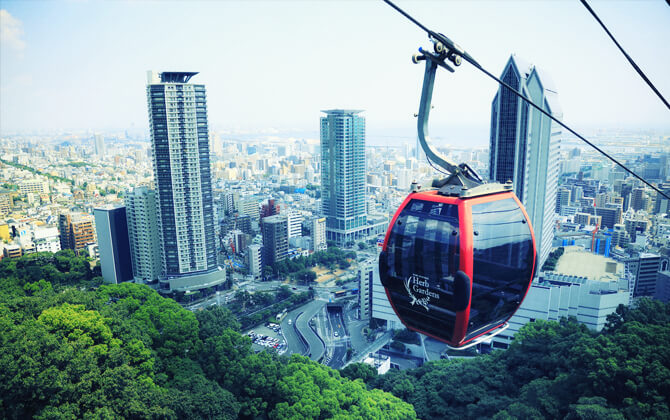
- Shin-Kobe Ropeway and Nunobiki Herb Garden — a popular area for views and relaxed sightseeing.
- Sorakuen Garden — a traditional Japanese garden in the city.
- Kobe City Hall Observation Deck — a free viewpoint with city and mountain views.
These attractions are spread across central Kobe, but they are still easy to combine in one day using the loop bus and nearby rail connections.