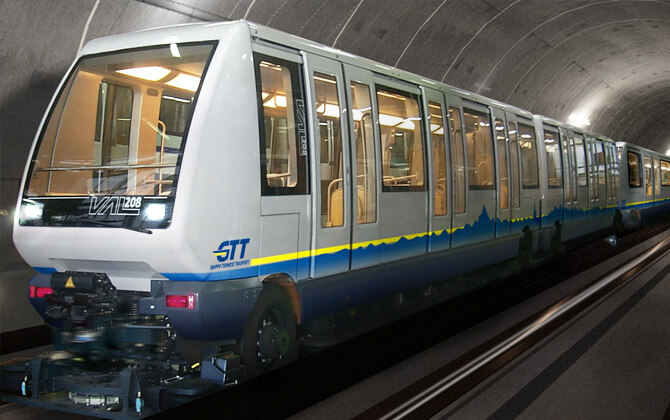
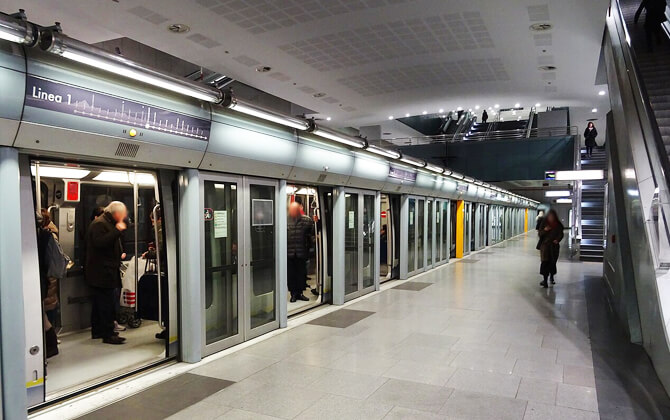
The Turin Metro, or Metropolitana di Torino, is a modern driverless VAL rapid transit system serving Turin, Italy. Operated by Gruppo Torinese Trasporti, the city-controlled public transport company, it currently has one active metro route: Line 1. The line runs 15.1 kilometers (9.4 miles) between Fermi in Collegno and Piazza Bengasi near the Moncalieri border, serving 23 stations and linking with Turin buses, trams, and wider city transport.
| Key | Information |
|---|---|
| System | Turin Metro, a driverless rapid transit system in Turin, Italy |
| Operator | Gruppo Torinese Trasporti, known as GTT |
| Active line | Line 1 |
| Route | Fermi in Collegno to Piazza Bengasi in Turin |
| Length | 15.1 kilometers (9.4 miles) |
| Stations | 23 stations |
| Opening period | Opened in stages from 2006 to 2021 |
| Transport integration | Integrated with GTT buses, trams, and local transport tickets |
Turin Metro Map
Map of Turin Metro showing different stations. Click on the map to enlarge it or download the Turin Metro map in PDF format.
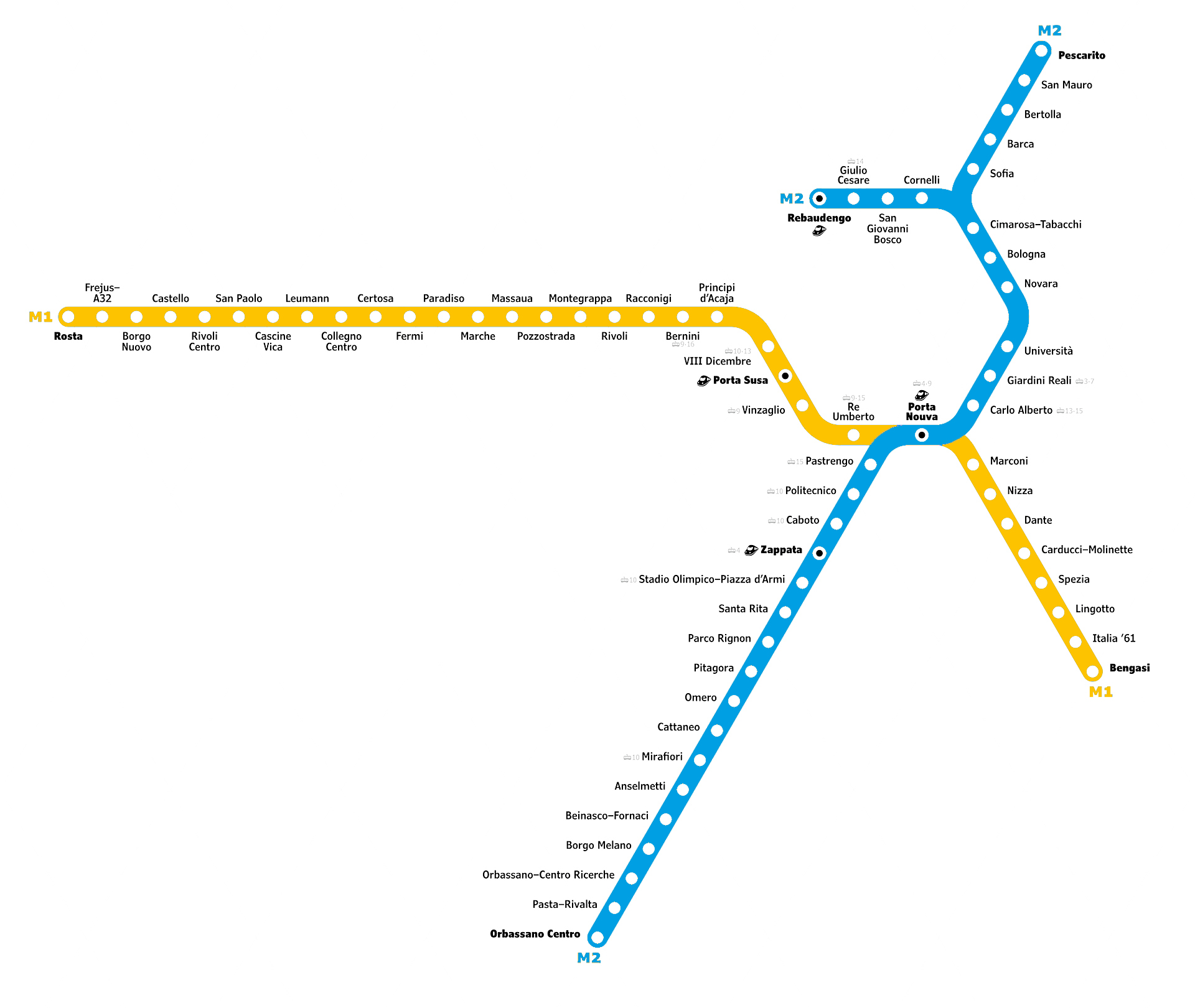
Overview of Lines and Stations
The Turin Metro is compact, automated, and easy to understand. Linea 1 forms the backbone of the system, running west to south through important urban areas and major transport hubs. Future Line 2 plans are covered later in this article, but the current metro service is centered on Line 1.
For trip planning, the main route plan is straightforward: follow Line 1 between Fermi and Piazza Bengasi, then transfer to buses, trams, railway services, or other public transport where needed. A stations map is useful before travel, especially if you are connecting at Porta Susa, Porta Nuova, or XVIII Dicembre.
| Line | Opening period | Type | Length | Stations | Terminals |
|---|---|---|---|---|---|
| Linea 1 | From 2006, with later extensions to 2021 | Fully automated VAL metro | 15.1 kilometers (9.4 miles) | 23 | Fermi – Piazza Bengasi |
| Linea 2 | Planned future line | Traditional metro project described in planning materials | Up to 27 kilometers (16.8 miles) in later design updates | Up to 32 planned stations in later design updates | Plans include Rebaudengo, Politecnico, and possible extensions |
This stations list covers the main stops and interchange points mentioned in the Turin Metro route information.
| Station | Details |
|---|---|
| Fermi | Western terminal of Line 1 in Collegno and a useful connection point for local commuter services. |
| XVIII Dicembre | Important interchange area with bus and tram connections; also noted for contemporary art pieces. |
| Porta Susa | Major rail interchange linked to Stazione di Torino Porta Susa, with connections to other Italian cities. |
| Porta Nuova | Key central transfer point for railway services, buses, and trams. |
| Lingotto | Station associated with the former Fiat factory area and later southern metro extensions. |
| Italia ’61 | Station opened in 2021, serving the new Piedmont Region Headquarters area. |
| Piazza Bengasi | Southern terminal area of Line 1 near the border with Moncalieri. |
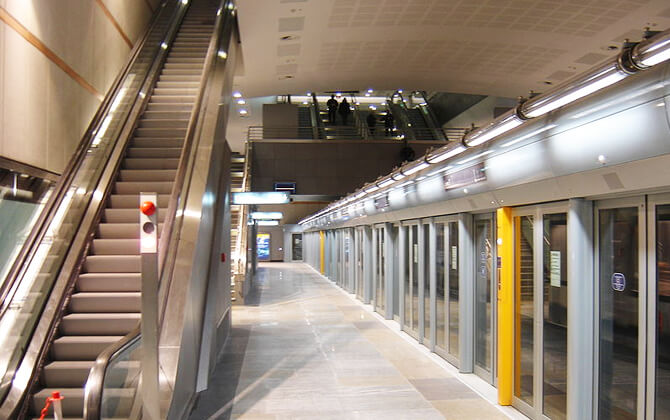
Stations are designed for accessible travel, with features such as elevators, ramps, tactile guidance, visual and audio announcements, priority seating, and wide passages. That makes the system practical for many passengers, including travelers with luggage, families, and people with reduced mobility.
Ticketing Types and discounts
Turin Metro fares are part of the GTT urban and suburban transport system, so many tickets also work on buses and trams. Depending on the product, tickets may be available on paper, through the ToMove app, on a BIP smartcard, or by contactless bank card at enabled metro turnstiles.
For a simple fare calculator approach, match the ticket price to your travel pattern: one short trip, a day of unlimited transport, several rides, or a longer pass.
Urban and suburban tickets
| Ticket | Details |
|---|---|
| City ticket | Costs €1.90 digital (about $2.05) or €2.00 on paper (about $2.15). Valid for 100 minutes from first validation and includes one metro ride. |
| MultiCity | Costs €11.80 (about $12.75). This is a 6-ride electronic carnet on chip-on-paper medium, with each ticket valid for 100 minutes and one metro journey. |
| Daily | Costs €3.70 digital (about $4.00), €4.50 on paper (about $4.85), or €3.00 in the ToMove app (about $3.25). It allows unlimited travel for one day on the GTT urban and suburban network from first validation until the end of service. |
| MultiDaily 7 | Costs €21.00 (about $22.70). It includes 7 daily tickets in electronic form through the ToMove app and can be used on non-consecutive days. |
| Daily x4 | Costs €12.00 digital (about $12.95) or €14.80 on paper (about $16.00). Valid for up to 4 people traveling together for unlimited journeys in one day. |
| Special Tour ticket | Valid for 48 or 72 hours and costs €9.50 (about $10.25) or €12.50 (about $13.50). It is valid on urban and suburban lines, including the metro, and must be used by one person only. |
City tickets, carnets, and day pass products must be validated as required by the ticket type. Digital tickets bought through ToMove can be used within 365 days of purchase when that condition applies.
Under 26 passes
The Under 26 pass is available to young adults up to 26 years old and is valid on urban and suburban lines, including the metro. It also covers SFM train services within the urban area.
These passes are loaded onto a BIP card. First-time purchases can be made through GTT e-commerce together with an annual or monthly pass, or at Customer Service Centres. When issued at a service centre, the BIP card has an extra cost of €5.00 (about $5.40). Renewals are available online, at authorized outlets, at ticket vending machines in metro stations, and at Sanpaolo and Unicredit ATMs.
| Pass | Details |
|---|---|
| Under 26 annual pass | Costs €258.00 (about $278.65). It is a personal pass loaded onto a BIP smartcard and can be purchased in any month. |
| Under 26 monthly pass | Costs €25.00 (about $27.00). It is valid for a calendar month and can be activated and used no later than the month in which the passholder turns 26. |
Train and public transport integration
Integrato B costs €4.50 (about $4.85) and is valid for 120 minutes from validation. It covers the GTT urban and suburban network, including one metro journey, plus one journey on GTT and TRENITALIA railway networks within the outer boundary of the second suburban ring. It is also valid on selected EXTRA.TO routes connecting Turin with nearby stations.
Where to buy and discount options
GTT tickets can be bought at metro stations, tobacconists, and shops or bars displaying the GTT logo. The ToMove app is the most convenient digital option for many visitors, and some tickets cost less in the app. Contactless payment is also available on enabled metro turnstiles and selected bus routes.
A discounted Tour ticket may be available at the Tourist Office in Piazza Castello if you use the Turismo Torino discounts leaflet and present your conference badge or ticket purchase email. In that case, the 48-hour ticket costs €7.00 (about $7.55), while the 72-hour ticket costs €9.00 (about $9.70).
Buy your ticket before travel and validate it when boarding a bus or tram, or when entering the metro. It is a small step, but it matters during inspections.
Operating Hours
Turin Metro operating hours vary by day. If you are checking the schedule today, pay attention to the starting time, closing time, and last train, especially late at night or on public holidays.
| Service detail | Timings |
|---|---|
| Monday opening hours | 5:30 to 22:00 |
| Tuesday to Thursday working hours | 5:30 to 00:30 |
| Friday and Saturday opening times | 5:30 to 01:30 |
| Sundays and public holidays | 7:00 to 01:00 |
| Typical first train on Line 1 | From 5:30 on regular weekdays |
| Typical last train information | Last trains are listed around midnight in station-by-station schedules, with later closing on some nights |
| Busy periods | Weekdays around 7:30-9:00 and 17:30-19:00 |
Weekend and holiday timings may be adjusted. Some services can start about 30 minutes later or close about 30 minutes earlier, so check the route timetable before relying on the final train schedule.
During rush hours, trains can feel noticeably busier. If your trip is flexible, traveling outside the morning and evening peaks usually makes the ride easier.
Interconnectivity
Turin Metro stations connect well with the city bus network, trams, rail services, and suburban transport. Inside stations, passengers can find maps showing nearby bus routes and available transfers.
| Station | Details |
|---|---|
| Fermi | Connects with local commuter trains operated by GTT. |
| XVIII Dicembre | Served by bus lines 10N, 29, 46, 49, 51, 55, 56, 57, 59, 59/, 60, 71, 72, tram lines 10 and 13, and the Dora Express intercity bus service. |
| Porta Susa | Surrounded by bus stops and connected to Stazione di Torino Porta Susa for rail links to major Italian cities. |
| Re Umberto | Connects with bus lines 7, 9, 14, 15, 33, 52, 63, 64, 67, 68, STAR 1, and several tram lines. |
| Porta Nuova | Major junction with tram lines 4, 7, and 9, bus lines 6, 11, 12, 33, 58, 58/, 61, 64, 67, 68, and 101, plus commuter trains. |
The metro is part of Turin’s wider public transport system, so many tickets purchased for the metro are also valid on buses and trams. That integration makes local transport simpler, particularly if your path train journey continues by surface transport.
Airport Connections
Turin Caselle Airport, also known as TRN, is connected to the city by train, with direct services to Torino Porta Susa station.
Trains run every 30 minutes, roughly from 5:00 am to 10:30 pm, and the running time is about 30 minutes.
A single adult airport train ticket costs €3.60 to €3.70 (about $3.90 to $4.00), depending on the purchase channel. Tickets can be bought at Trenitalia ticket machines, ticket offices, through the Trenitalia app or website, and in some cases by contactless Tap&Tap payment.
At the airport, follow the railway station signs after leaving arrivals, cross the road, and enter the car park building to reach the station area. If you want to avoid queues, buying in advance through the Trenitalia app is often easier.
From Torino Porta Susa, continue into the city by metro, bus, tram, or other local transport. Some materials also describe the airport as indirectly linked to the metro through other city stations and bus connections.
Rules and Regulations
When traveling on the Turin Metro and other GTT urban and suburban services, passengers may be asked by authorized staff to show the ticket, pass, card, or contactless payment method used for travel.
Smart tickets must be validated every time you board a service before reaching the next stop. On buses and trams, use the contactless reader on board. At metro stations, turnstiles control access to the platforms and accept smartcards, chip-on-paper tickets, magnetic-stripe tickets, and enabled contactless payment cards.
When using a smartcard, hold it against the validator until you hear a beep. A green signal confirms entry; a red cross means passage is not allowed.
Integrated paper tickets with a magnetic stripe must be kept in good condition. Do not bend, fold, erase, abrade, heat, or expose them to magnetic fields.
Passengers must board and alight only at stops, use the correct entrance and exit doors, and never get on or off while a vehicle is moving.
Keep doorways, gangways, and the space in front of ticket punching machines clear. Passengers must also follow the regulations displayed inside vehicles.
Passengers may speak to the driver only to request service information or in case of difficulty, such as sudden illness, mugging, harassment, or malfunctioning.
Violations can lead to fines. These may apply in addition to criminal sanctions and compensation for damage suffered by GTT.
- Smoking and alcohol consumption are prohibited in the underground.
- Baby buggies, baggage, pets, and bicycles are allowed only under the conditions stated in the transport rules.
- Passengers are responsible for making sure luggage and animals do not cause obstruction or damage.
Trivia
- The Turin Metro is fully automated, so there are no drivers in the carriages.
- It carries around 155,000 passengers a day and about 41 million passengers a year.
- The first underground tunnel was dug in the 1920s for an earlier metro plan, but that project was abandoned and the tunnel is now used as a parking area.
- Line 2 is planned, but no start date has been set in the available information.
History
The history of the Turin Metro began with early underground railway ideas in the 1920s and 1930s. Only part of the first tunnel was built before the plan was dropped, and that tunnel later became part of an underground parking system.
A new company dedicated to developing a metro system in Turin was founded in the 1960s. Several projects and feasibility studies followed, including a 7-kilometer (4.3-mile) underground line under the city center and another line linking FIAT factories with nearby neighborhoods, but the proposals were rejected.
In the mid-1980s, a new plan for five at-grade fast tram lines was approved. Only the planned Line 3 was built according to the original concept; the others were eventually implemented as regular tramway lines without dedicated lanes or as bus routes.
A new metro project was approved in 1995 for a route from Campo Volo on the western edge of the city to Porta Nuova, Turin’s main railway station. Funding problems put the project on hold. In April 1999, it resumed with a longer route to Lingotto and with VAL technology.
Construction began on 19 December 2000 as part of the works for the Turin 2006 Winter Olympics. The first section, from Fermi to XVIII Dicembre, opened on 4 February 2006. The line extended south to Porta Nuova on 5 October 2007, the southern extension to Lingotto opened on 6 March 2011, and Porta Susa station opened on 9 September 2011.
Lingotto – Bengasi southern extension
Between 2012 and 2021, two more stations were built to reach the southern boundary of the city: Italia ’61, serving the new Piedmont Region Headquarters, and Bengasi, named after the piazza below it. Both stations opened on 23 April 2021.
Timeline
| Section | Date | Route |
|---|---|---|
| 1 | 4 February 2006 | Fermi – XVIII Dicembre |
| 2 | 5 October 2007 | XVIII Dicembre – Porta Nuova |
| 3 | 6 March 2011 | Porta Nuova – Lingotto |
| 4 | 23 April 2021 | Lingotto – Bengasi |
Future Extensions
Turin Metro has one completed line, but several extensions and new routes have been discussed or planned over time. These projects are central to the system’s long-term expansion.
Line 1 extensions
The southern extension to Bengasi added Italia ’61 and Bengasi, opening on 23 April 2021. On the western side, a further extension toward Collegno and Rivoli is planned, with stations such as Certosa and Collegno Centro, plus additional stops toward Leumann Village and Cascine Vica.
There have also been funding requests for more trains, reflecting the need for additional rolling stock as Line 1 grows.
Line 2
Line 2 is the most advanced future project. It is planned to connect the south-western suburbs with northern Turin, crossing the city center and interchanging with Line 1 at Porta Nuova. The line has been described with 23 planned stations, while later design updates expanded the project to 27 kilometers (16.8 miles), 32 stations, and two depots.
Published plans show a route from Rebaudengo to Politecnico in the first phase, with possible extensions north toward Pescarito and south toward Orbassano Centro. The project has public funding support and is intended to be built in sections.
Possibility for Line 3
A third metro line has also appeared in public discussion. Earlier ideas suggested using part of the former Torino-Ceres railway corridor, with stations serving Venaria Reale, Juventus Stadium, and Turin International Airport.
Later proposals focused on the western part of the city and included locations such as Torino Dora, Amedeo di Savoia Hospital, Maria Vittoria Hospital, San Donato, Campidoglio, Parella, Cenisia, San Paolo, Mirafiori Nord, and Caio Maio Square. In the available materials, Line 3 remains a concept rather than an approved project.
Tourist Attractions

Turin’s metro is a practical way to reach several of the city’s best-known sights. Porta Nuova station is a few blocks from the Egyptian Museum, one of the oldest museums in Italy and home to one of the world’s largest collections of ancient Egyptian artifacts, second only to Cairo. The same area is also close to Piazza San Carlo and the Cathedral of St John the Baptist, where the Holy Shroud of Turin is housed.
For central sightseeing, the metro helps you move quickly between historic areas. From the network, you can access Piazza Castello, where major landmarks include the Royal Palace and Palazzo Madama, then continue on foot through nearby streets in the historic center.
Other attractions linked to Turin’s transport network include the Mole Antonelliana, home to the National Museum of Cinema, and the Palatine Gate, described in the draft material as the best-preserved 1st-century Roman gate in the world.
Turin public transport also helps with destinations farther from the center, including Parco del Valentino, the Basilica di Superga, and the Royal Residence of Venaria Reale through combinations of metro, bus, tram, or shuttle services.