The Milan Metro, or Metropolitana di Milano, is the rapid transit system serving Milan and is operated by ATM. It has five lines, 125 stations, and a network length of 111.8 kilometres (69.5 miles), with two additional stations under construction. Most of the system runs underground, and weekday ridership is about 1.4 million passengers. It is the largest metro system in Italy by length, stations, and ridership, with the first line opening in 1964 and the newest driverless line entering service in 2022.
| Key | Information |
|---|---|
| Operator | ATM |
| Lines | 5 |
| Stations | 125 |
| Network length | 111.8 kilometres (69.5 miles) |
| Daily weekday ridership | About 1.4 million passengers |
| First line opening | 1964 |
| Latest line opening | Line 4 in 2022 |
| System type | Rapid transit, mostly underground |
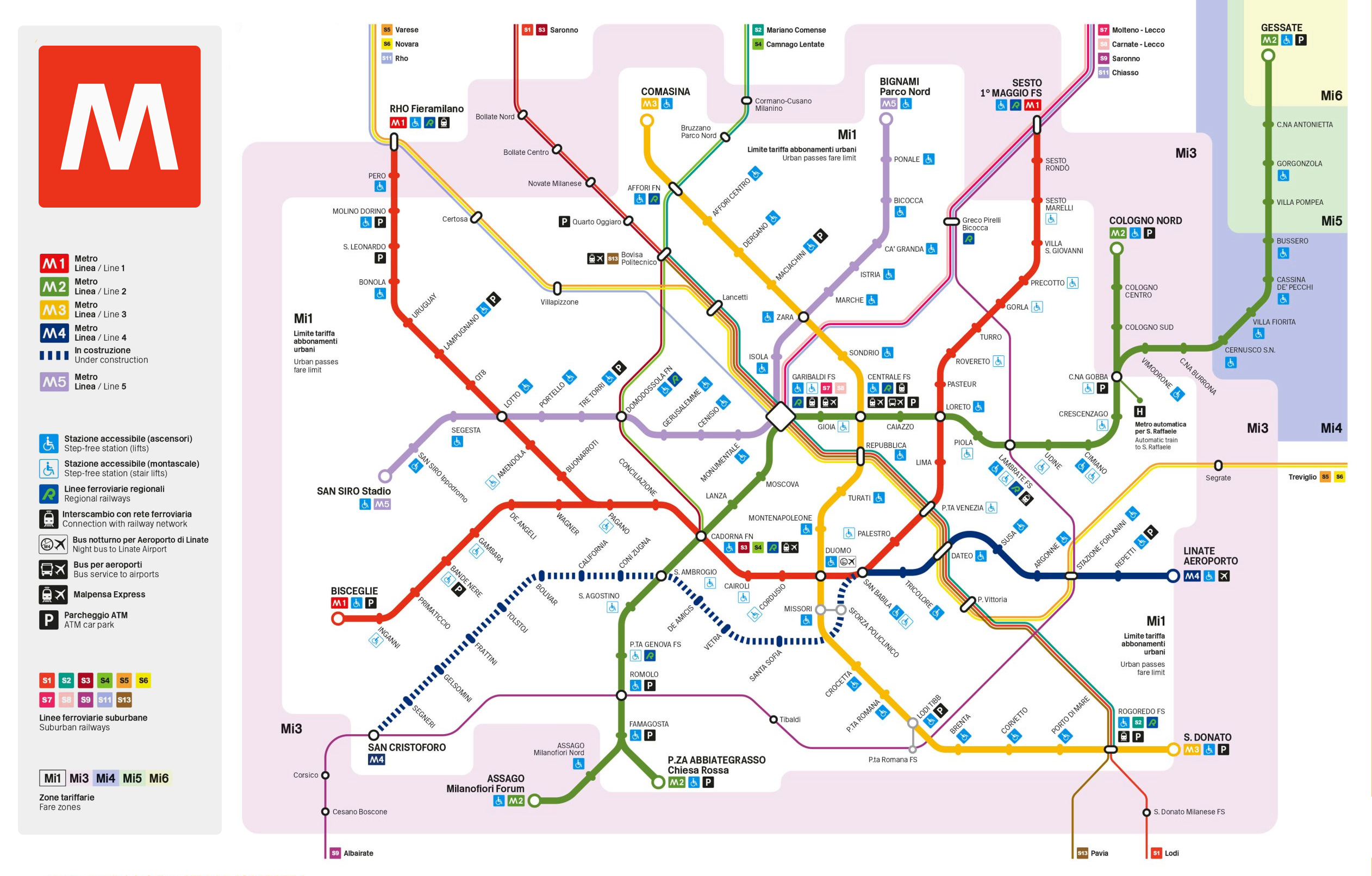
Milan Metro map
Map of Milan Metro showing different lines. Click on the map to enlarge it or download the Milan Metro map in PDF format.
Lines and Stations
The Milan Metro system has five lines and 125 stations, with two more stations under construction. Most of the network is underground, though some parts of Line 2 run above ground, including the Assago branch and the northern section.
The lines are identified by numbers and colors, which makes the stations map and route plan easier to follow. The metro also connects the city center with major railway stations, surrounding districts, and Linate Airport.
| Station | Details |
|---|---|
| Line 1 | Opened in 1964 and serves key central and western areas including Duomo, San Babila, Cadorna, and Lotto. |
| Line 2 | Opened in 1969 and connects stations such as Centrale, Loreto, and Garibaldi. |
| Line 3 | Opened in 1990 and links Duomo, Centrale, Zara, and San Donato. |
| Line 4 | Opened in 2022 as a driverless line and runs from Linate Aeroporto to San Cristoforo FS. |
| Line 5 | Opened in 2013 as a driverless line and runs between Bignami and San Siro Stadio. |
| Loreto | Interchange station where two metro lines meet. |
| Cadorna | Interchange station and link to suburban rail. |
| Centrale | Interchange station and major railway connection. |
| Duomo | Interchange station in central Milan. |
| Zara | Interchange station where two metro lines meet. |
| Garibaldi | Interchange station and suburban rail connection. |
| Lotto | Interchange station where two metro lines meet. |
| San Babila | Interchange station where two metro lines meet. |
| Sant’Ambrogio | Interchange station where two metro lines meet. |
There are nine line-to-line interchange stations: Loreto, Cadorna, Centrale, Duomo, Zara, Garibaldi, Lotto, San Babila, and Sant’Ambrogio. The metro also links with suburban rail at stations including Cadorna FN, Centrale, Garibaldi FS, Dateo, Romolo, and Rho Fiera.
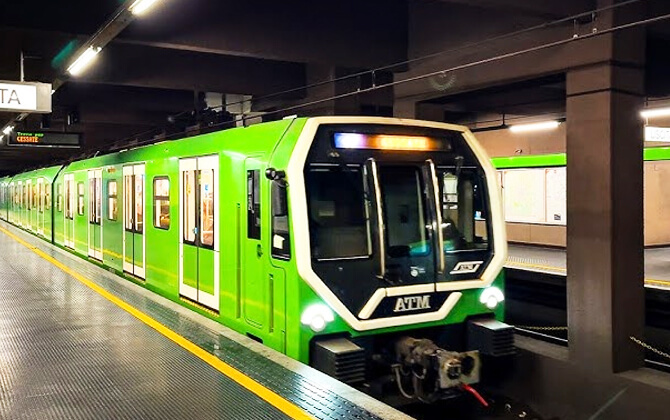
Lines 1, 2, and 3 are heavy metro lines, while Lines 4 and 5 are light metro lines. The first three use six-car trains, and Lines 4 and 5 use four-car trains.
Schedule, timetables, and calendar
The Milan Metro runs every day of the year. In general, operating hours are 5:30 a.m. to 12:30 a.m. from Monday to Saturday, and 6:00 a.m. to 12:30 a.m. on Sundays and public holidays. Line M5 has slightly different opening times, with service from 5:40 a.m. to 12:00 a.m. on weekdays and from 6:00 a.m. to 12:00 a.m. on Sundays and holidays.
On 25 December and 1 May, working hours are reduced to 7:00 a.m. to 7:30 p.m. If strike action affects the system, service is available from 5:00 a.m. to 8:45 a.m. and from 3:00 p.m. to 6:00 p.m.
Winter and summer timetable calendars apply across Milan public transport. For the metro, the winter timetable for M1, M2, and M3 runs from 4 September to 20 July, while the summer timetable applies from 21 July to 3 September. For M5, the summer timetable is valid from 6 August to 2 September.
| Service detail | Timings |
|---|---|
| Metro opening hours, Monday to Saturday | 5:30 a.m. to 12:30 a.m. |
| Metro opening hours, Sundays and public holidays | 6:00 a.m. to 12:30 a.m. |
| Line M5 weekdays | 5:40 a.m. to 12:00 a.m. |
| Line M5 Sundays and holidays | 6:00 a.m. to 12:00 a.m. |
| 25 December and 1 May | 7:00 a.m. to 7:30 p.m. |
| Strike timetable | 5:00 a.m. to 8:45 a.m. and 3:00 p.m. to 6:00 p.m. |
| Typical winter frequency | Every 2.5 minutes |
| Typical summer frequency | Every 5 minutes |
Train frequency changes by season, line, and time of day. In winter, trains usually run every 2.5 minutes; in summer, every 5 minutes.
Overground transport also helps fill the gap before closing time and after the metro close. Line 90 and 91 run 24 hours a day, Line 9 runs from 4:00 a.m. to 2:00 a.m., trams run from 4:30 a.m. to 2:30 a.m., and buses run from 5:30 a.m. to 1:45 a.m.
Timetables for weekdays
On weekdays, the metro normally runs from 5:30 a.m. to 12:30 a.m. The M5 path train service has a slightly shorter running time window, from 5:40 a.m. to 12:00 a.m. Monday to Saturday.
Frequency depends on the line, the area of the network, and the time of day. In central Milan, trains generally arrive every 2.5 minutes in winter and every 5 minutes in summer. At outer stations, such as the ends of Line 2, the timetable can be less frequent.
| Service detail | Timings |
|---|---|
| Weekday metro service | 5:30 a.m. to 12:30 a.m. |
| Weekday M5 service | 5:40 a.m. to 12:00 a.m. |
| Sundays and holidays | 6:00 a.m. to 12:30 a.m. |
| M5 on Sundays and holidays | 6:00 a.m. to 12:00 a.m. |
| 25 December and 1 May | 7:00 a.m. to 7:30 p.m. |
| Typical winter frequency | Every 2.5 minutes |
| Typical summer frequency | Every 5 minutes |
Prices, cards, and tickets
Milan has phased out paper tickets in favor of the rechargeable RicaricaMi card. You can buy it and top it up at metro station newsstands, automatic machines, and authorized retailers.
If you plan to visit major attractions and use public transport during your stay, the Milan Pass may also be worth a look. It includes access to selected attractions and unlimited public transport.
Here are the common ticket and pass options mentioned for the Milan Metro fare system.
- Single ticket: €2 ($2.17). Valid for 90 minutes from validation in zones Mi1, Mi2, and Mi3.
- 24-hour travel card: €7 ($7.60). Valid for 24 hours after validation in zones Mi1, Mi2, and Mi3.
- 48-hour travel card: €12 ($13.03). Unlimited travel for 48 hours from first validation.
- 10-ticket card: €18 ($19.55). Includes 10 journeys, each valid for 90 minutes from first validation.
Children under 14 travel free on Milan public transport, though they may need to show valid ID. There are also weekly, monthly, and annual travel cards for regular users.
You can buy tickets at metro machines, tobacconists, kiosks, and other authorized retailers. In another part of the draft, single ticket price is listed as €2.20 ($2.39), a day pass as €7.60 ($8.25), and a three-day ticket as €13 ($14.12), with ATM app and contactless payment also available at turnstiles.
Keep your ticket or card with you for the whole trip, since you may need it to exit the station or transfer to a bus or tram. No fare calculator is provided in the source material.
Connections to Other Systems
The Milan Metro is closely integrated with the wider public transport network, so transfers around the city and suburbs are usually straightforward. Beyond the five metro lines, the system connects with suburban rail, major railway stations, airport links, trams, buses, and trolleybuses.
Key railway interchanges include Cadorna FN, Centrale FS, Garibaldi FS, Lambrate FS, Rogoredo FS, and Sesto 1º Maggio FS. Some of these are also major hubs for regional, intercity, and high-speed trains.
The metro also has important line-to-line interchange stations: Loreto, Cadorna, Centrale, Duomo, Zara, Garibaldi, Lotto, San Babila, and Sant’Ambrogio.
For airport transport, Line 4 provides direct service to Linate Airport, while Malpensa Express trains can be reached via Cadorna for Malpensa Airport. The network also links with city transport services, station parking areas, and fare-zone boundaries, making it easier to combine different types of transportation in Milan.
| Station | Details |
|---|---|
| Metro interchanges | Loreto, Cadorna, Centrale, Duomo, Zara, Garibaldi, Lotto, San Babila, Sant’Ambrogio |
| Suburban rail links | Affori FN, Cadorna FN, Dateo, Domodossola, Stazione Forlanini, Garibaldi FS, Lambrate FS, San Cristoforo FS, Lodi T.I.B.B., Porta Venezia, Repubblica, Rho Fiera, Rogoredo FS, Romolo, Sesto 1º Maggio |
| Airport connections | Linate Airport via M4; Malpensa Express via Cadorna |
Connection to the airport
Linate Airport has the clearest metro connection, with direct service on Line M4 to Linate Aeroporto. For Malpensa Airport, the main rail link is the Malpensa Express, which is a practical option from central Milan and avoids city traffic.
From Milano Centrale to MXP T1-T2, the Malpensa Express runs from 5:25 a.m. to 11:25 p.m. every 30 minutes. Stops include Milano Porta Garibaldi, Milano Bovisa Politecnico, Saronno, Rescaldina, Castellanza, Busto Arsizio, and Ferno/Lonate Pozzolo.
From MXP T1-T2 to Milano Centrale, trains run from 5:09 a.m. to 10:09 p.m. every 30 minutes, with the same stops in reverse order.
You can also pay directly with a credit or debit card, which helps avoid queues at ticket machines.
Malpensa is also linked to Canton Ticino by the Tilo S50 train. This route connects the airport with Biasca, Bellinzona, Lugano, Mendrisio, Varese, and Gallarate.
| Service detail | Timings |
|---|---|
| Malpensa Express, Milano Centrale to MXP T1-T2 | 5:25 a.m. to 11:25 p.m., every 30 minutes |
| Malpensa Express, MXP T1-T2 to Milano Centrale | 5:09 a.m. to 10:09 p.m., every 30 minutes |
| Tilo S50, Malpensa T1-T2 to Switzerland | 6:13 a.m. to 11:13 p.m., one train every hour |
| Tilo S50, Switzerland to Malpensa T1-T2 | 4:33 a.m. to 9:33 p.m., one train every hour |
Rules
Milan’s metro is easy to use once you get used to the system. You do not need to speak Italian to ride it, but a few basic phrases can help.
When to Use the Metro
The metro is best for longer cross-city trips and for reaching places quickly from major stations such as Centrale. In the city center, though, walking is often simpler. Many key sights around the Duomo are only 10 to 20 minutes apart on foot.
If your route is only one or two stops, or if you would need to change lines, walking may be faster. At busy central stations, especially near Duomo, some entrances lead to long underground walks before you even reach the platform.
Metro Tickets
You can buy tickets in the ATM app, use contactless payment at the turnstiles, or purchase tickets at machines, tabaccherie, and edicole near stations.
One part of the source lists a single ticket fare as €2.20 ($2.39), valid for 90 minutes after first validation, with use allowed on trams and buses during that time. The same section lists a day pass at €7.60 ($8.25) and a three-day ticket at €13 ($14.12). Children under 14 travel free.
Keep your ticket with you during the whole journey, because you may need it to exit the station and transfer to a tram or bus.
Hours and Lines
According to this section, M1, M2, and M3 run from 5:30 a.m. until 12:30 at night, while M5 runs from 5:30 a.m. until midnight. On Christmas Day and 1 May, service is reduced.
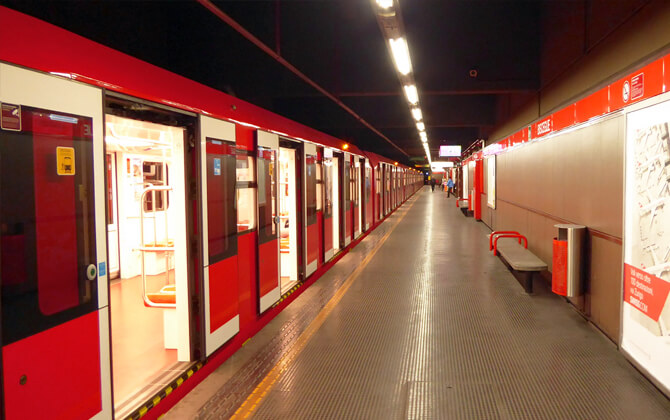
Milan has five metro lines in service. Line M1 is red, M2 is green, M3 is yellow, M4 is dark blue, and M5 is light purple. M1 and M2 split into branches, so always check the final destination before boarding.
How to Find Your Train
Look for the metro logo, a white M in a red square. Inside the station, follow the signs for your line and use the line color as your guide. To choose the right train, follow signs for the direction of the last stop on that line.
Accessibility
ATM is working to make the system more accessible, and most stations have either an elevator or a stairlift. In practice, these services are often broken, so it is best not to rely on them completely. Only one wheelchair is allowed per train car at a time.
Bathrooms
Some metro stations have bathrooms, but the official stations map does not show which ones do. Most bathrooms require payment.
What to Expect on the Metro
Metro cars generally have handrails and standing space, line maps are displayed inside, and stops are announced in Italian and English. Keep your ticket, stay alert in crowded areas, and watch your belongings as you would on any busy city transport system.
Let passengers get off before you board, and move toward the center of the carriage if the train is crowded. Locals often stand near the doors before their stop so they can get off quickly. It is polite to say prego and make space for people exiting.
How to Get to Milan Airports by Metro
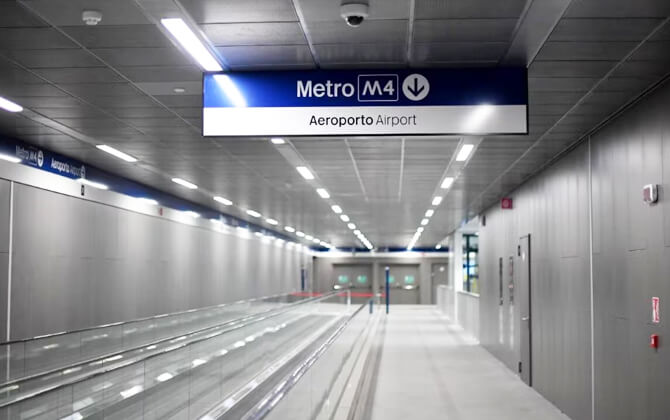
Milan has three international airports: Malpensa, Bergamo, and Linate. The only airport with direct metro service is Linate, reached on M4 to Linate Aeroporto.
For the other airports, take the metro for part of the route and continue by train or bus. Centrale is the main connection point, while Garibaldi and Cadorna also have airport links.
Helpful Italian Phrase
Dov’è la metropolitana più vicina? — Where is the nearest metro station?
Due biglietti per la metropolitana per favore. — Two tickets for the subway please.
Tips
- Use the metro for longer trips across Milan, but in the historic center it is often quicker to walk.
- Always check the final destination on the train display before boarding, especially on M1 and M2, where the route splits into branches.
- Keep your ticket or contactless card until the end of the journey. You may need it to exit the station and for transfers.
- If you use a paper ticket on trams or buses, validate it as soon as you board. On the metro, tap in and tap out with the same card or phone.
- Try to avoid peak periods if you can. Rush hour on weekdays, and match days in particular, can make stations and trains very crowded.
- On busy platforms, move promptly and let people exit first. Once inside, step away from the doors if there is space.
- Stay alert in major hubs such as Duomo and Centrale. Like in any big city, it pays to keep an eye on your belongings.
- For simple orientation, remember a few useful stations: Duomo for the cathedral area, Centrale FS for the main railway station, and Cadorna for Castello Sforzesco.
- If you are heading to Linate Airport, M4 is the direct connection. For other airports, you will need to combine the metro with a train or shuttle bus.
- Contactless payment is accepted on Milan metro, trams, and buses, which makes short trips especially convenient.
History of Milan Metro
The idea of a Milan subway dates back to 1914 and came up again in 1925, inspired by systems in cities such as London and Paris. In 1938, a seven-line network was planned, but World War II and lack of funding stopped the project.
The modern system was approved on 3 July 1952, and Metropolitana Milanese was created in 1955 to manage construction. Work on the first line started on 4 May 1957 at Viale Monte Rosa. Stations were designed by Franco Albini and Franca Helg, while Bob Noorda created the signage. Their work received the Compasso d’Oro award in 1964.
The first section of Line 1, from Lotto to Sesto Marelli, opened on 1 November 1964 after seven years of work. It had 21 stations and a length of 12.5 kilometres (7.8 miles). Ridership grew quickly, from 37,092,315 passengers in 1965 to 61,937,192 in 1969.
Line 2 opened in 1969, and the network expanded through the 1960s and 1970s. Line 3 opened on 3 May 1990, just before the World Cup, and was later extended in 1991 and 2004. More expansion followed in the 2000s and early 2010s on Lines 1, 2, and 3.
Line 5, the first automated line, opened in stages between 2013 and 2015. Line 4, also driverless, opened in November 2022 from Linate Airport to Dateo, then extended to San Babila in 2023 and to San Cristoforo FS in 2024. The metro also replaced several former interurban tramway routes, including the Line 2 corridor to Gessate.
Today, the Milan Metro is Italy’s largest rapid transit system by length, number of stations, and ridership. It has five lines, 125 stations, and a total length of 111.8 kilometres (69.5 miles), with about 1.4 million weekday passengers.
Future expansions
Milan Metro is still growing, with several expansion projects under construction, approved, or at the design stage.
Line 1 is under construction from Sesto 1° Maggio to Cinisello/Monza. This section is about 2 kilometres (1.2 miles) long and includes an intermediate station at Sesto Restellone. It is scheduled to open in 2027. There is also a project for a further 3-kilometre (1.9-mile) extension westward to Baggio.
Line 2 has a planned extension from Cologno Nord to Vimercate. The text describes it as 10.8 kilometres (6.7 miles) long with six stations, while the table below lists 9.7 kilometres (6.0 miles) and five stations.
Line 3 is planned to extend south-east from San Donato to Paullo. This route would cover 14.8 kilometres (9.2 miles) and include six stations, but the project is currently on hold.
Line 4 reached San Cristoforo railway station in October 2024, completing its last phase. Further extensions to Segrate train station and Buccinasco are planned, though work has not started yet.
Line 5 is planned to extend to Cinisello/Monza, where it would meet Line 1 again at Monza Bettola before continuing toward Monza city center and the west side.
| Line | Route or station | Phase | Scheduled opening | Length | New stations |
|---|---|---|---|---|---|
| Line 1 | Sesto 1° Maggio – Cinisello/Monza | Under construction | 2027 | 1.9 kilometres (1.2 miles) | 2 |
| Line 1 | Bisceglie – Baggio | Approved | – | 3 kilometres (1.9 miles) | 3 |
| Line 2 | Cologno Nord – Vimercate | Design | – | 9.7 kilometres (6.0 miles) | 5 |
| Line 2 | Gessate – Trezzo sull’Adda | Design | – | 8 kilometres (5.0 miles) | 4 |
| Line 3 | San Donato – Paullo Est | Design | – | 14.8 kilometres (9.2 miles) | 6 |
| Line 4 | Linate Airport – Segrate | Design | – | 2.5 kilometres (1.6 miles) | 2 |
| Line 5 | Bignami – Cinisello/Monza | Approved | 2031 | 13.2 kilometres (8.2 miles) | 12 |
| Line 5 | San Siro Stadio – Settimo Milanese | Design | – | 4.5 kilometres (2.8 miles) | 4 |
Fun facts
The Milan Metro is the largest rapid transit system in Italy by length, number of stations, and ridership.
It has five lines, 125 stations, and a network length of 111.8 kilometres (69.5 miles), with two more stations under construction.
On weekdays, the system carries about 1.4 million passengers.
The first line opened in 1964, while Lines 2, 3, 5, and 4 followed in 1969, 1990, 2013, and 2022.
Line 5 was the first automated line in the network, and Line 4 is driverless too.
The metro’s station design by Franco Albini and Franca Helg, together with Bob Noorda’s signage, received the Compasso d’Oro award in 1964.
Major interchange stations include Duomo, Centrale, Cadorna, Loreto, Garibaldi, Zara, Lotto, San Babila, and Sant’Ambrogio.
Nearby attractions
Milano Centrale is a handy starting point for exploring the city. From here, you can reach major sights by metro, or simply spend time around the station, where there are shops, cafés, and impressive architecture.
Nearby on foot, Piazza Gae Aulenti stands out for its modern design, while Corso Buenos Aires is one of Milan’s best-known shopping streets. For a quieter stop, Giardini Indro Montanelli and Giardini di Porta Venezia offer green space to relax.
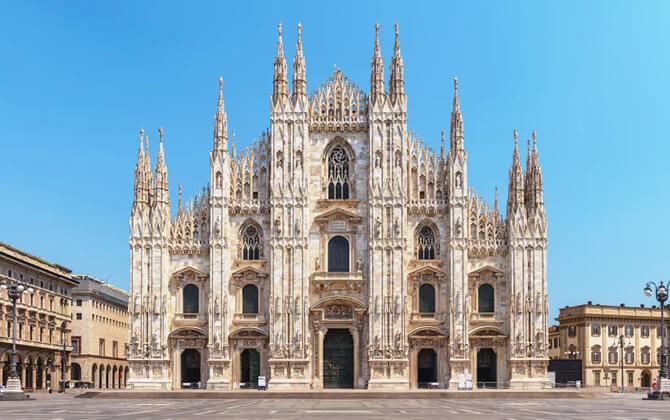
For classic sightseeing, Duomo di Milano is easy to reach by metro. Nearby, you can also visit Galleria Vittorio Emanuele II. Art lovers may want to continue to Pinacoteca di Brera, while Sempione Park is a good pick for a scenic walk near Castello Sforzesco.
Inside Milano Centrale, Mercato Centrale Milano on the ground floor is a convenient place to eat without leaving the station.
| Attraction | Approx. distance from Milano Centrale | Approx. travel time |
|---|---|---|
| Gae Aulenti Square | 1.0 kilometre (0.6 miles) | 5 minutes |
| Piazza della Repubblica | 1.5 kilometres (0.9 miles) | 10 minutes |
| Corso Buenos Aires | 1.5 kilometres (0.9 miles) | 10 minutes |
| Giardini Indro Montanelli | 2.0 kilometres (1.2 miles) | 15 minutes |
| Palazzo Dugnani | 2.5 kilometres (1.6 miles) | 10 minutes |
| Duomo di Milano | 3.0 kilometres (1.9 miles) | 15 minutes |
| Galleria Vittorio Emanuele II | 3.0 kilometres (1.9 miles) | 15 minutes |
| Pinacoteca di Brera | 3.0 kilometres (1.9 miles) | 20 minutes |
| Sempione Park | 3.5 kilometres (2.2 miles) | 25 minutes |