Rome public transport includes the metro, bus, tramway, and urban rail services that connect the city across a wide area. The system is practical, fairly easy to use once you know the basics, and usually the most cost-effective way to travel farther than you want to walk. Tickets are shared across most services, which makes moving between metro lines, buses, trams, and some trains much simpler.
| Key | Information |
|---|---|
| System | Integrated public transport network with metro, buses, trams, and urban trains |
| Main operator context | Shared ticketing across most forms of city transport |
| Metro lines | 3 lines: A, B, and C |
| Tram lines | 6 tram lines |
| Single ticket validity | 100 minutes from validation |
| Pass options | 24-hour, 48-hour, 72-hour, weekly, and monthly tickets; Roma Pass also available |
| Best for visitors | Metro for major sights, buses for broader coverage, trams and urban trains for selected routes |
| Airport links | Connections available to Fiumicino and Ciampino by train, bus, taxi, private transfer, and rental car |
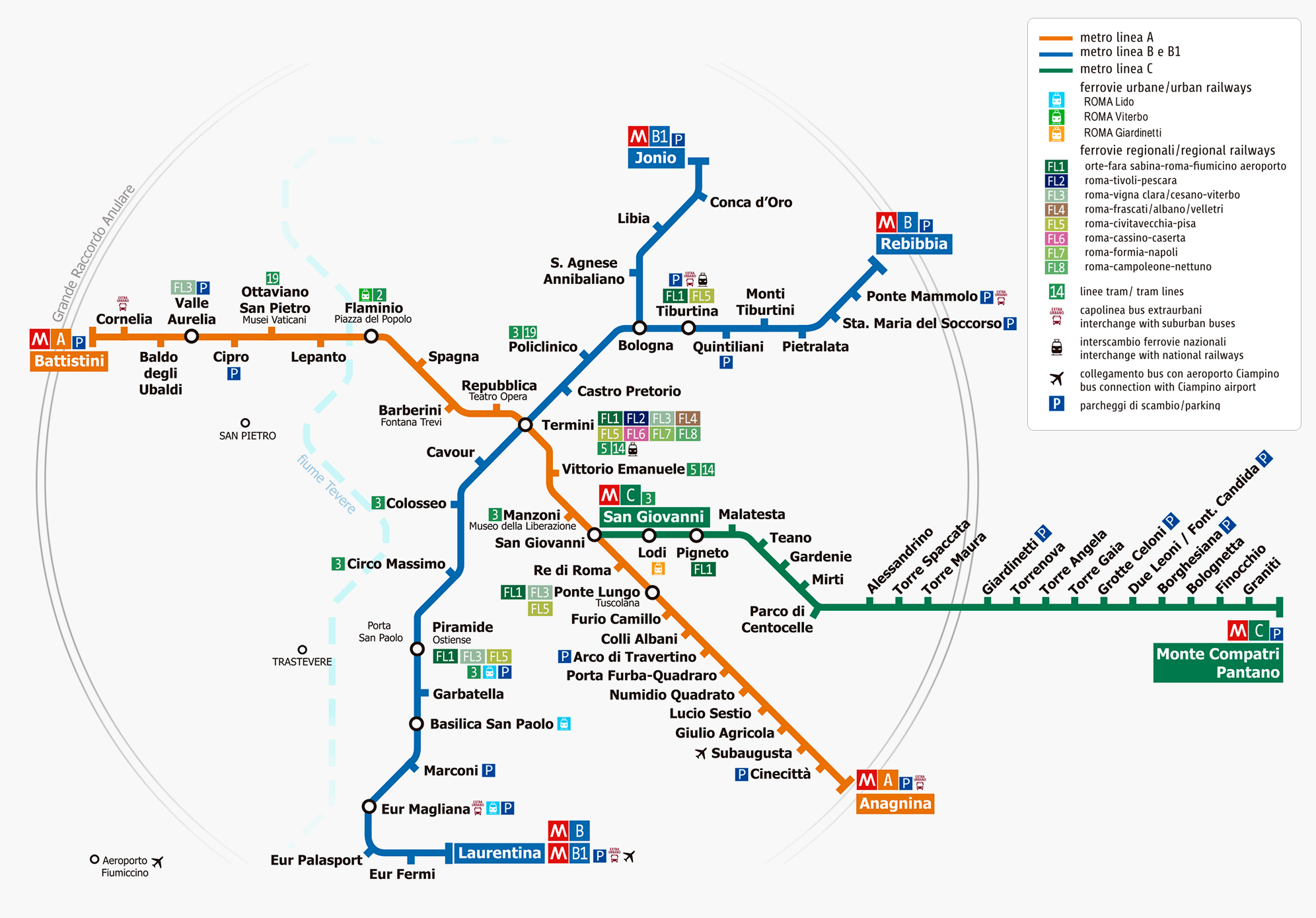
Rome Metro Map
Map of Rome Metro showing different lines. Click on the map to enlarge it or download the Rome Metro map in PDF format.
Travelling around Rome
Rome’s public transport system is varied, affordable, and generally user friendly. If you need a break from walking or want to cross the city faster, it is a practical part of local transport in Rome.
Types of public transport in Rome
The main transport options are the metro, buses, trams, and urban trains.
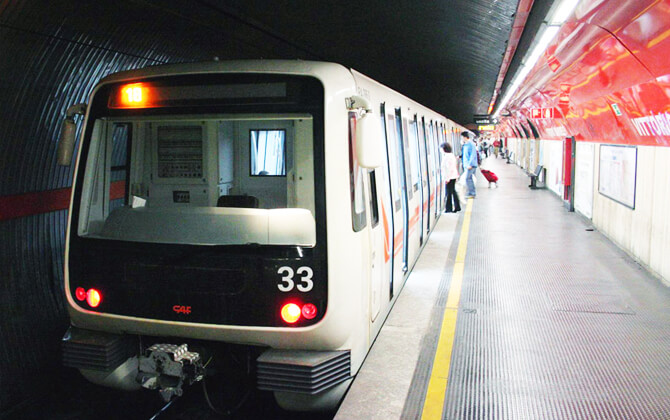
- Metro: Rome has three lines, A, B, and C. Lines A and B are the most useful for visitors, with stops near major sights such as the Vatican, the Spanish Steps, and the Colosseum. The system is not extensive, but trains run regularly.
- Buses: Buses are the most widespread form of city transport and often fill the gaps left by the metro. They reach almost every part of Rome.
- Trams: Rome has six tram lines. They are comfortable, but they do not reach the center, so they are less useful for many tourists.
- Urban trains: These complement the metro and use the same fare system and ticket rules.

Tickets and travel cards
Rome uses an integrated ticket system, so the same ticket can be used on buses, trams, the metro, and some urban trains. Options include a single ticket, 24-hour, 48-hour, and 72-hour passes, plus a weekly pass. If you are staying for two or three days, the Roma Pass may be worth a look because it includes unlimited public transport and access to selected attractions.
For buses and trams, you usually need to buy your ticket in advance and validate it on board. On the metro, the gate validates the ticket as you enter. Contactless card payment is also available on the metro.
Getting around efficiently
Rome is very walkable, so in the historic center it can be faster to walk than to wait for transport. For route planning, apps such as Google Maps, Moovit, and Probus Rome can help with the route timetable, live delays, and schedule today updates.
Public transport is especially useful for major sights. The Colosseum, the Vatican, and other popular areas are accessible by a mix of metro and bus routes. There is also a tourist-friendly 40 Express bus that passes many famous spots.
Best times to travel
If you can, avoid rush hour. Morning and evening services can be crowded, while outside commuter periods the system is usually much easier to use.
Why use public transport in Rome?
- Cost-effective: one of the cheapest ways to get around the city.
- Convenient: buses, metro, trams, and trains connect most areas.
- Time-saving: the metro avoids road traffic.
- Greener: a better choice than private transport.
Metro System in Rome
Rome’s metro system is one of the fastest ways to move around the city. It opened in 1955 and, while compact, still serves many of the main attractions visitors want to reach.
The network has three lines: A, B, and C. For most travelers, Lines A and B are the most useful because they serve the city center and major landmarks including the Colosseum, the Spanish Steps, and the Vatican. Line C mainly passes through residential areas.
How the Metro Lines Work
On the stations map, Line A is orange, Line B is blue, and Line C is green. Line A and Line B meet at Termini, the main rail hub. Line A and Line C connect at San Giovanni.
If you are planning a short stay, it helps to sort out tickets in advance. Some people use regular transport tickets, while others choose a pass that also includes attractions.
Tickets and Fares
Tickets are sold for a single trip of 100 minutes, or as passes for 1, 2, 3, or 7 days. Monthly tickets are available for longer stays. The same fare can be used on buses, the underground, trams, and some trains within the city.
You can buy tickets at station machines, tobacconists, newspaper stands, and through Tap&Go with a contactless VISA or Mastercard card or an NFC wearable device. If you buy at least €7 worth of tickets from the red vending machines, you automatically receive a rechargeable electronic card.
Children under 10 travel free with a paying adult. There are no student or senior discounts on tickets valid for less than one month.
Operating Times
The usual metro operating hours start at 5:30 am, with a closing time of 11:30 pm. On Fridays and Saturdays, opening times extend later and the last train runs until 1:30 am. Line A has a replacement bus service when it closes early from Monday to Thursday evenings for maintenance.
When the metro is closed, night buses follow the same route. On the front, they are marked MA for Line A and MB for Line B instead of a route number.
| Service detail | Timings |
|---|---|
| Metro starting time | 5:30 am |
| Regular closing time | 11:30 pm |
| Friday and Saturday last train | 1:30 am |
| Line A evening changes | Replacement bus service on some Monday to Thursday evenings |
Using the Metro
Stations are easy to spot thanks to the large M signs at street level. Inside, you pass through the barrier using your ticket, card, or phone QR code. Single tickets go into the machine, while multiday passes are held to the yellow circle.
When you travel, follow the direction shown by the final destination. For example, from Termini to the Vatican, look for Battistini. Most exits are simple turnstiles, though on the B1 line you currently need a ticket to exit.
Popular Stops for Visitors
| Station | Details |
|---|---|
| Ottaviano | Line A; useful for St. Peter’s Basilica |
| Cipro | Line A; useful for the Vatican Museums |
| Spagna | Line A; useful for the Spanish Steps |
| Barberini | Line A; useful for the Trevi Fountain |
| San Giovanni | Line A; useful for the Cathedral and Holy Stairs; interchange with Line C |
| Colosseo | Line B; useful for the Colosseum and Roman Forum |
| Circo Massimo | Line B; useful for Circus Maximus |
| Piramide | Line B; useful for Roma-Lido train connections |
| Termini | Line B; main interchange and central station |
Changing lines can take time because there are only a few interchange points. In some cases, walking or taking a bus is quicker than changing trains.
Accessibility and Travel Tips
Accessibility varies by station. Some stops have elevators or stairlifts, but not all, and equipment may not always be working. For wheelchair users, Line B is generally better than Line A. Visually impaired passengers can use tactile paths through stations.
Rush hour is usually 7:30 to 9:00 am and 6:00 to 8:00 pm, when trains can be packed. If possible, travel outside those working hours peaks. It also helps to keep a downloaded stations map on your phone.
Inspectors do spot checks, so always carry a valid ticket. If you are fined, card payment is possible, but not cash.
Bus system in Rome
Buses are the most widespread form of public transportation in Rome, and often the best option where the metro does not go. They are useful for short trips, for reaching neighborhoods beyond the historic center, and for linking with metro and train stations.
Bus operating hours usually run from 5:30 am to midnight, with night buses after that on a more limited network. Rome also has a small electric bus service in the center, handy on narrow streets where larger vehicles cannot pass.
How Rome’s bus network works
The bus network is extensive, with hundreds of lines and thousands of stops, so it covers nearly every part of the city. In the center, many routes are concentrated on a few main roads because the surrounding streets are too narrow for standard buses.
Main bus hubs include Termini, Piazza Venezia, Largo Argentina, and several major train stations. They are useful starting points if you are planning a route across Rome.
Tickets and validation
Bus tickets usually need to be bought before boarding. You can get them from tobacconists, newsagents, metro station machines, ticket offices, and some apps. Once on board, validate the ticket right away.
A standard single ticket is valid for 100 minutes and allows transfers during that running time. Multi-day pass options include 24-hour, 48-hour, 72-hour, and weekly tickets. Contactless payment is accepted on the ATAC network, so in some cases you can simply tap your card or device on board.
Useful bus lines for visitors
Several routes are especially useful for sightseeing. They reach places such as the Colosseum, the Vatican, Piazza Venezia, the Pantheon, and Trastevere. Among the more practical lines for visitors are 40X, 64, 70, 75, 81, 87, 118, 218, 492, and H. Lines 100, 117, and 119 are smaller electric buses serving central areas.
Bus 40X is particularly useful, linking Termini with the Vatican and passing many major sights. Other lines connect the Colosseum with the Trevi Fountain, Trastevere, the Vatican, and the Appia Antica area.
Tips for using buses in Rome
Buses can be crowded and are not always punctual, so leave a little extra time. Apps such as Google Maps and Moovit help with the timetable, schedule, and delays.
In the city center, keep in mind that many places are still close enough to walk. For short distances between famous landmarks, walking is often faster.
Public buses are relatively accessible, and many have boarding platforms and wheelchair spaces. For travelers with strollers or reduced mobility, the bus can be a better choice than the metro.
Commuter Rail and tram services in Rome
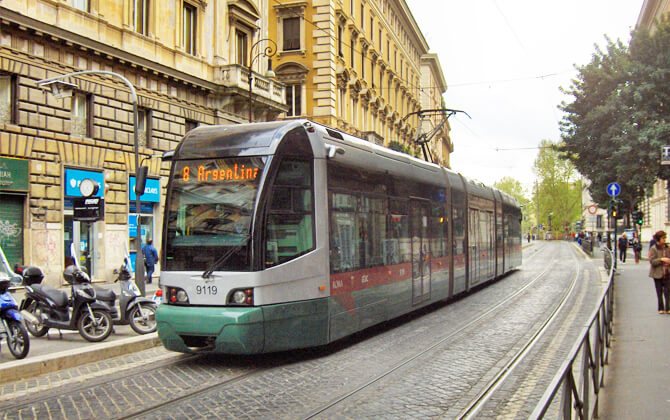
Rome’s public transport system also includes tram services and urban rail, both of which add useful coverage beyond the metro and bus network. The city has six tram lines, and tram routes mainly serve suburban areas rather than the historic center.
One of the best-known tram routes is no. 8, an express tram linking Largo Argentina with Trastevere and the western suburbs. Its first stop is at Via delle Botteghe Oscure, on the corner with Piazza Venezia.
Rome also has urban and commuter rail connections that extend beyond the center. These include Rome-Lido, also called Metromare, Roma-Nord, and the Rome–Giardinetti tram-train line. The Lazio regional rail network, known as the FL lines, links suburban districts and the wider region.
For travelers, commuter rail can also be useful for airport access and for reaching coastal or suburban destinations. Some urban train services connect to Fiumicino Airport and Ciampino Airport, while others reach places that are not easy to access by metro.
Trams and urban rail are part of the same wider system, so tickets are generally shared across services within their validity period. Standard tickets are valid for 100 minutes across public transportation, and children under 10 travel free.
These services can be very practical, but it is smart to keep a flexible schedule, as delays are common across Rome transport.
Taxi Service in Rome
Taxi service in Rome is usually provided by official white taxis, easy to recognize by the TAXI sign on the roof and the visible taximeter. You can find them at taxi stands, call a company, or book through an app. In busy periods, waiting can take time, so planning ahead is often the safer option for airport runs or early departures.
Rates and fares
Taxi fares in Rome are regulated and depend on the time of day, the day of the week, and the distance traveled. The minimum fare on weekdays from 6 am to 10 pm is €3 ($3.25), while the minimum fare on public holidays from 6 am to 10 pm is €5 ($5.41). At night, the minimum fare is €6.50 ($7.03).
Per-kilometer charges are split into three tariffs: Tariff 1 is €1.10 ($1.19), Tariff 2 is €1.30 ($1.41), and Tariff 3 is €1.60 ($1.73). Extra costs may apply for each additional suitcase after the first included in the price, telephone reservations, and waiting time. One hour of waiting time costs €27 ($29.21).
Based on official rates, an average journey in central Rome should cost between €7 and €10 ($7.57 to $10.81).
Airport and station journeys
Official fixed fares apply for trips to and from both Rome airports. A journey between Fiumicino Airport and the city costs €50 ($54.08), while Ciampino Airport costs €35 ($37.86). These prices are valid for up to four passengers and their suitcases, so you should question any extra charge above that. From Termini railway station to the city center, the fare generally falls between €8 and €15 ($8.65 to $16.22).
If possible, check the route on a map app before getting in. It gives you a rough sense of distance and helps you spot anything unusual.
How to avoid problems
To reduce the risk of overcharging, use only official taxis. In Rome, licensed taxis are white, have a roof sign, and show a meter at the front of the car. It is also wise to choose taxis with a phone number written on the side, as these usually work with a taxi company.
Before the ride starts, make sure the taximeter is on. If there is a problem, note the license plate and contact the taxi company. If you think you are being swindled, call the Carabinieri. Asking for a receipt is also a good idea.
Taxi companies
If you prefer to book by phone, Rome has several taxi companies. Radio Taxi can be reached at 06-3570, Pronto Taxi at 06-6645, and other companies include 06-5551, 06-4994, and 06-4157. You can also contact taxi service vehicles through the Numero Unico 060609 or use the Roma Capitale Chiama Taxi Utente app.
When booking through 060609, clearly pronounce the pickup address, since the system uses voice recognition to direct the request.
Useful tips
Tipping is not mandatory. If you want to leave something, rounding up to the nearest euro or giving a small tip is normal enough. Most taxis are supposed to accept card payments, though carrying cash as a backup is still sensible.
For accessibility needs, some taxis are adapted for wheelchairs, but not all. If you need one, it is best to book ahead.
Taxis can be a practical and comfortable alternative to public transport, especially when you have luggage or need to reach a place that is awkward by bus or metro.
Airport Connections
Rome has two airports: Fiumicino, the main international airport, and Ciampino, which is smaller but closer to the city center. There are several transport options for each, depending on your budget, luggage, and timetable.
Fiumicino Airport Transfers
Fiumicino is about 30 km (18.6 miles) from central Rome and offers the widest range of connections, including trains, buses, taxis, private transfers, and rental cars.
Trains
If you are traveling during the day with light luggage, the train is often the fastest option. The airport station is about a ten-minute walk from Arrivals and has two services to Rome.
- Leonardo Express is a direct non-stop train to Termini Station, with departures every 15 minutes and a journey time of around 32 minutes.
- Regional FL1 trains are a cheaper option and useful if you are staying near Trastevere, Ostiense, Tuscolana, or Tiburtina.
Tickets can be bought at airport vending machines, at the station, or online in advance. Remember to validate your ticket before boarding.
Buses
Buses are usually the lowest-cost option, though the trip takes longer than the train and depends on traffic. Several private shuttle services connect Fiumicino with Termini Station, and some stop in other parts of the city as well.
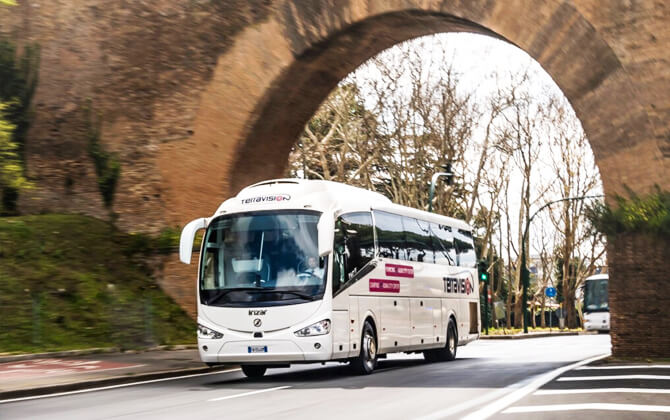
- Terravision, Rome Airport Bus, T.A.M., SIT Bus Shuttle, and Cotral all operate from the airport with different routes and stop patterns.
- Depending on the company, stops may include Termini, Vatican City, Ostiense, Tiburtina, or other central locations.
Bus tickets can usually be booked online, bought at the airport, or purchased on board, depending on the operator.
Taxis
Taxis are one of the simplest and most reliable ways to reach the center. There is a flat fixed fare for journeys within the Aurelian Walls, which covers most central areas. Official taxis are white and wait outside Arrivals.
Ignore unofficial drivers inside the terminal and use only licensed taxis.
Private Transfers
If you are traveling with a group, carrying lots of luggage, or simply want an easier arrival, a private transfer can work well. These should be booked in advance so the driver can meet you in Arrivals.
Private transfers generally cost more than taxis, but they offer a fixed price and door-to-door service.
Rental Cars
Rental car companies are available at the airport for travelers who want more independence. This is more useful if you plan to explore outside Rome than if you are staying only in the city.
Ciampino Airport Transfers
Ciampino is closer to central Rome, but it has fewer transport options than Fiumicino. The most common choices are buses, taxis, private transfers, and rental cars.
Buses
Private shuttle buses are the easiest and cheapest option for many travelers going from Ciampino to Rome. They usually take about 45 minutes and go to Termini Station.
- Terravision, SIT Bus Shuttle, and Rome Airport Bus all run Ciampino services.
- Tickets are usually available online, at the airport, or on board, depending on the company.
Taxis
Taxis are a quick and simple option from Ciampino, with a fixed fare to destinations within the Aurelian Walls. Outside that area, the ride is metered.
Private Transfers
Private transfers are also available from Ciampino and can be arranged before your flight. They are especially convenient if you want a driver waiting after baggage claim.
Rental Cars
Ciampino also has rental car services near the airport, with a free shuttle to and from the terminal. As with Fiumicino, a rental car makes more sense if you plan to travel beyond Rome.
If you want the simplest airport transfer, taxis and private transfers are the most comfortable choices. If price matters most, airport buses are usually the cheapest, while trains are best for daytime arrivals with light luggage.
Tips and Rules
If you want to use public transport in Rome smoothly, a few simple habits help a lot. First, avoid rush hour when possible, since mornings and evenings can be crowded. Second, download a route-planning app such as Moovit so you can check live arrivals, timings today, and delays, especially for buses.
When using the bus, remember to signal to the driver at the stop if needed. Once on board, validate your ticket right away. On the metro, keep your ticket with you until you fully exit the station. If you use Tap & Go, remember it is available at most metro stations, but not on every bus.
It also helps to know that Rome uses integrated ticketing, so the same ticket can be used across buses, trams, and the metro within its validity period. Single tickets stay valid for 100 minutes from the first stamp, while longer passes are useful if you expect to travel often.
Stay alert for service disruptions. Strikes happen often enough that checking ATAC updates is a smart move. And, as in any big city, keep an eye on your belongings, especially in crowded stations and vehicles.
- Avoid peak commuter times if you can.
- Validate paper tickets on buses and trams as soon as you board.
- Keep your ticket until you leave the metro system.
- Use a transport app to check routes, delays, and arrivals.
- Watch for service updates, especially during strikes.