The Rome Metro is Rome’s rapid transit system and the oldest metro network in Italy, operating since 1955. It has three lines — A, B, and C — covering 62 km (38.5 miles) of route with 74 stations. The system carries about 820,000 passengers a day and is part of the city’s wider public transport network, which also includes buses, trams, suburban rail, airport trains, and commuter services.
| Key | Information |
|---|---|
| System name | Rome Metro, or Metropolitana di Roma |
| Opened | 1955 |
| Lines | Line A orange, Line B blue, Line C green |
| Route length | 62 km, about 38.5 miles |
| Stations | 74 stations across the current network |
| Daily ridership | About 820,000 passengers |
| Annual ridership | About 320 million passengers |
| Fare system | Metrebus integrated tariff within the Municipality of Rome and the urban fare area |
| Connected transport | Metro, bus, trams, FL rail lines, commuter urban lines, Leonardo Express, and Civitavecchia Express |
Rome Metro Map
Map of Rome Metro showing different lines and stations. Click on the map to enlarge it or download the Rome Metro map in PDF format.
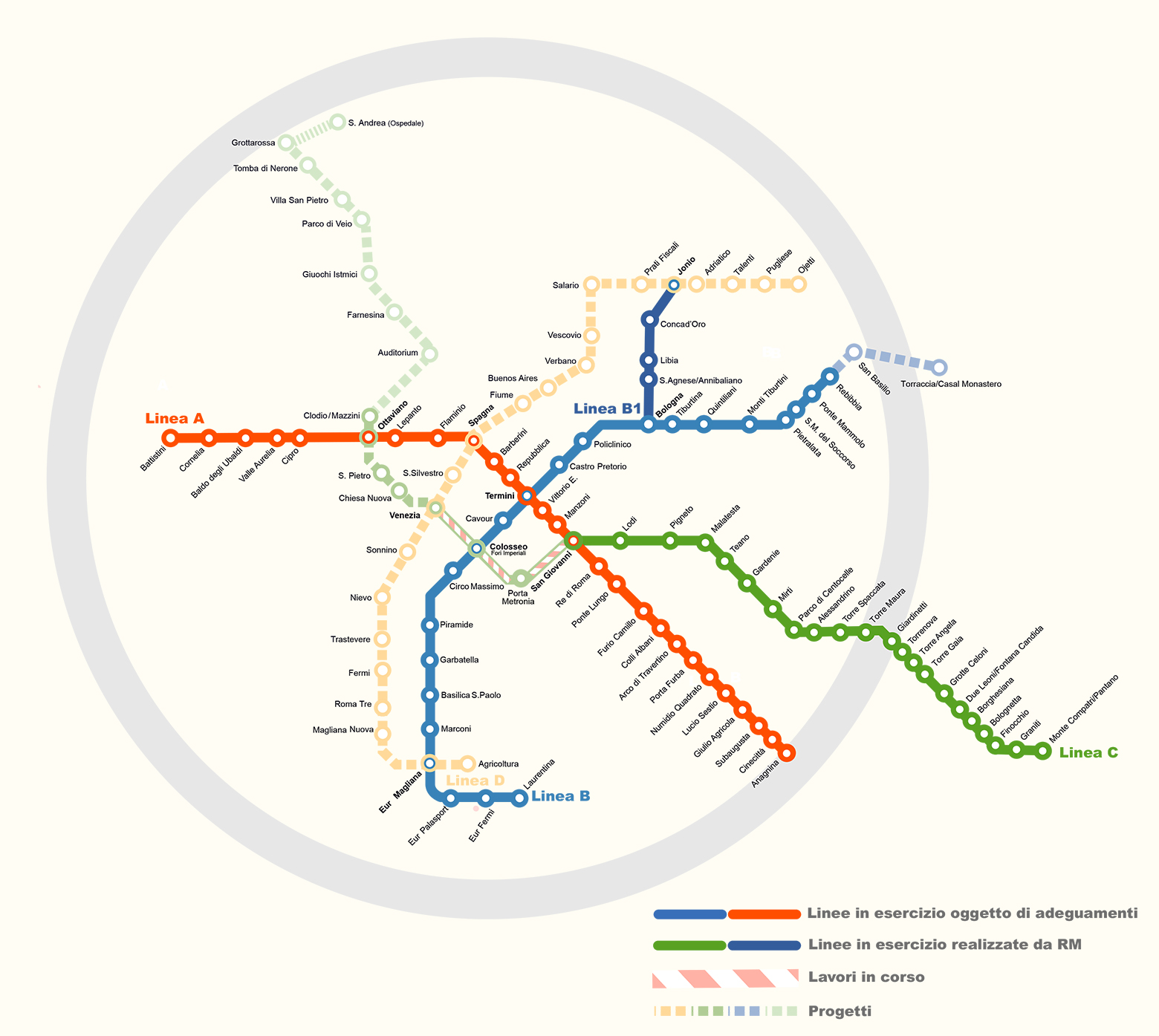
Rome Metro Lines and Stations
The Rome Metro is compact compared with many European metro systems, but its route plan still covers key transport hubs and several major sights. A stations map is especially useful for first-time visitors because Lines A and B handle most central sightseeing trips, while Line C mainly serves the eastern side of the city and continues to expand.
Line A, shown in orange, runs from Battistini to Anagnina with 27 stations. It is the most used line by both locals and visitors, linking the northwest and southeast of Rome. Useful stops include Cipro for the Vatican Museums, Ottaviano for St. Peter’s, Spagna for the Spanish Steps, Barberini for the Trevi Fountain area, and Termini for interchange with Line B and Roma Termini railway station.
Line B, shown in blue, runs from Laurentina to Rebibbia or Jonio and splits into two branches. It has 22 stations plus the B1 extension. Key stops include Termini for Line A and the Leonardo Express, Colosseo for the Colosseum and Roman Forum, and Piramide for connections with regional rail services from Fiumicino.
Line C, shown in green, opened in 2014 and runs from San Giovanni to Monte Compatri-Pantano. It is less central for most tourist routes, though it plays an important role in the eastern districts. Trains on Line C run every 12 minutes every day.
| Station | Details |
|---|---|
| Line A stations list | Battistini, Cornelia, Baldo degli Ubaldi, Valle Aurelia, Cipro, Ottaviano, Lepanto, Flaminio, Spagna, Barberini, Repubblica, Termini, Vittorio Emanuele, Manzoni, San Giovanni, Re di Roma, Ponte Lungo, Furio Camillo, Colli Albani, Arco di Travertino, Porta Furba, Numidio Quadrato, Lucio Sestio, Giulio Agricola, Subaugusta, Cinecittà, Anagnina |
| Line B and B1 stations list | Laurentina, EUR Fermi, EUR Palasport, EUR Magliana, Marconi, Basilica S. Paolo, Garbatella, Piramide, Circo Massimo, Colosseo, Cavour, Termini, Castro Pretorio, Policlinico, Bologna, Tiburtina FS, Quintiliani, Monti Tiburtini, Pietralata, Santa Maria del Soccorso, Ponte Mammolo, Rebibbia, Sant’Agnese/Annibaliano, Libia, Conca d’Oro, Jonio |
| Line C stations list | Monte Compatri-Pantano, Graniti, Finocchio, Bolognetta, Borghesiana, Due Leoni – Fontana Candida, Grotte Celoni, Torre Gaia, Torre Angela, Torrenova, Giardinetti, Torre Maura, Torre Spaccata, Alessandrino, Parco di Centocelle, Mirti, Gardenie, Teano, Malatesta, Pigneto, Lodi, San Giovanni, Amba Aradam – Ipponio, Fori Imperiali – Colosseo, Venezia, Chiesa Nuova, San Pietro, Risorgimento, Ottaviano, Clodio/Mazzini |
Some Line C stations listed for the city-center extension are still under construction.
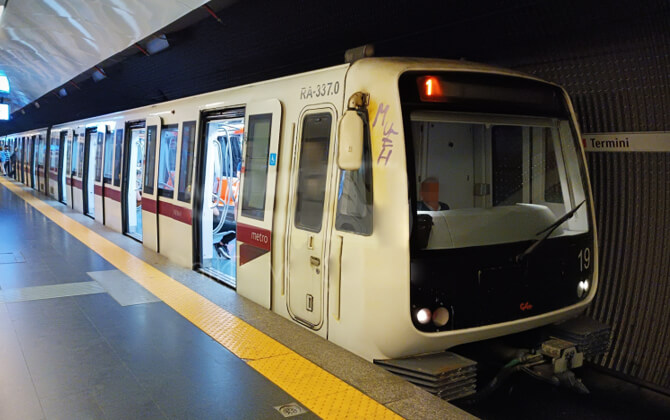
Timetable & Operating Hours
The Rome Metro has clear daily operating hours. Standard opening hours are from 5:30 am to 11:30 pm, with later opening times on Friday and Saturday nights, when service runs until 1:30 am the next day.
| Service detail | Timings |
|---|---|
| Starting time on Lines A, B, B1, and C | 5:30 am from the terminus stations |
| Weekday closing time | Last train around 11:30 pm |
| Friday and Saturday closing time | Last train around 1:30 am the next day |
| Line A frequency | Usually every 3 to 5 minutes |
| Line B frequency | About every 5 minutes on weekdays and about every 9 minutes on weekends |
| Line C frequency | About every 12 minutes |
| Typical running time between trains | At some times, trains may arrive every 10 to 15 minutes, with shorter gaps during peak hours |
If you are checking the train schedule today, remember that rush hour can be crowded in the morning and evening. The route timetable is usually straightforward, but service can change during maintenance, events, or strikes. After the metro lines close, night buses may replace underground service on some routes.
Fares and tickets
Rome uses an integrated public transport fare system, so the same ticket can usually be used on the Metro, buses, trams, and some urban and regional rail services inside the city. The Metro has a flat fare, which means the ticket price is the same whether you travel one stop or ride to the end of the line. You do not need a fare calculator for a standard metro trip.
| Ticket type | Validity | Price |
|---|---|---|
| BIT standard ticket | 1 metro ride or 100 minutes on buses, with transfers allowed | €1.50, about $1.60 |
| 24-hour ticket | Unlimited travel for 24 hours from validation | €8.50, about $9.10 |
| 48-hour ticket | Unlimited travel for 48 hours from validation | €15.00, about $16.10 |
| 72-hour ticket | Unlimited travel for 72 hours from validation | €22.00, about $23.50 |
| Weekly Pass CIS | 7 calendar days | €29.00, about $31.00 |
Children under 10 travel free with an accompanying adult and do not need a ticket. Tickets must be bought before boarding and validated on first use. If you use a pass or day pass, the date and time are recorded when it is first validated.
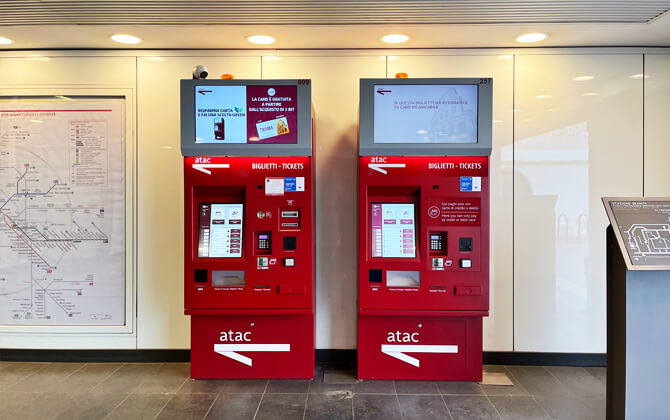
You can buy tickets from tobacconists, bars, vending machines at Metro stations, and major bus stops. At metro stations, enter and exit through the ticket barriers. On buses and trams, validate your ticket in the machines near the doors.
At Termini, you can change between Metro lines without passing through the ticket barriers, so one journey can include travel on both lines.
Connections
The Rome Metro works as part of the city transport network rather than as a stand-alone system. It connects with FL suburban rail lines, commuter urban lines, buses, trams, airport rail, and port rail services, making transportation in Rome easier to combine across different modes.
- Termini is the main interchange between Lines A and B and also connects with major rail and bus services.
- San Giovanni connects Lines A and C.
- Colosseo is the current interchange for Line C and Line B.
Beyond the metro, the Leonardo Express links Roma Termini with Fiumicino Airport, while the Civitavecchia Express connects the city with the Port of Civitavecchia. The wider local transport system also includes the Roma-Lido line, the Roma–Giardinetti line, and the Roma–Viterbo line.
Useful interchange stations include Piramide for the Roma-Lido service, Flaminio for Roma–Viterbo, and Termini for long-distance trains, airport rail, and buses. Future expansion should add more connections across the city.
Airport Connections
Rome’s two airports connect to the city in different ways. Fiumicino Airport has the Leonardo Express, a non-stop train to Termini Station. The journey takes about 32 minutes, and trains run every 15 minutes. It is the fastest and most comfortable public transport option mentioned here, though it costs more than the bus and local train alternatives.
From Fiumicino, you can also use the FL1 local train. It does not go directly to central Rome or Termini, but it connects with other rail and Metro services and can be useful for Trastevere, Ostiense, and Tiburtina.
Airport buses from Fiumicino terminate at Termini Station. Terravision is the lowest-cost bus option mentioned, while SIT, TAM, and Rome Airport Bus also operate services. Buses are cheaper than the Leonardo Express, but the journey takes longer.
Ciampino Airport has no direct rail link. The main options are airport buses to Termini Station or the ATRAL bus to Anagnina, the southern terminus of Metro Line A. From Anagnina, you can continue on the Rome Metro.
Rome public transport passes cannot be used to or from either airport on these airport services. For most travelers, Termini remains the key interchange because rail, Metro, and bus links are all in one place.
Rules and regulations
The Rome Metro is part of the ATAC transport network, so ticket rules are similar across the metro, buses, trams, and some urban trains. To keep your trip smooth and safe, travel with a valid ticket and keep it until the end of the journey.
Tickets must be validated when you enter the system. On the metro, validation happens at the gates: single-use tickets are inserted into the machine, while multi-day tickets and QR codes are read electronically. On buses and trams, stamp the ticket after boarding.
Ticket inspectors carry out spot checks, especially around metro turnstiles. If asked, you may need to show both your ticket and ID. Fines apply if you do not have a valid ticket or if you fail to validate it.
Children under 10 travel free with a paying adult. There are no student or senior discounts on tickets valid for less than one month.
If you use Tap&Go with a contactless card or NFC device, each traveler needs a separate payment method. The system charges the ticket price on the first tap. If you change bus, tram, or metro within 100 minutes, tap again and you should not be charged a second time.
Metro stations are marked with large M signs. Some stations and lines have limited accessibility, and escalators or elevators may be out of service, so check ahead if you rely on step-free access.
Maintenance, special events, and strikes can affect the schedule today. During announced strikes, service may be reduced or suspended, and details can change on the day.
History
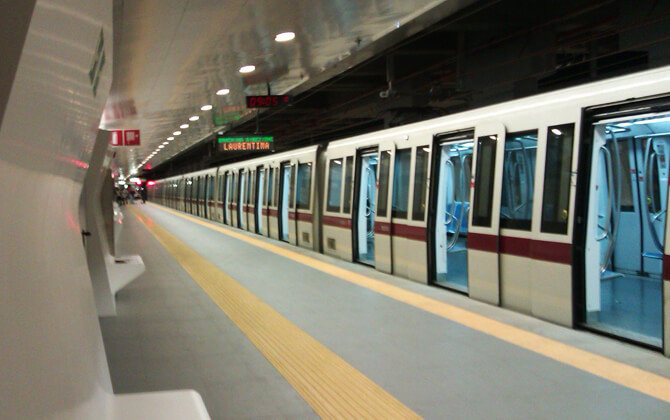
The Rome Metro, or Metropolitana di Roma, began service in 1955, making it the oldest metro system in Italy. Its first line was Line B, opened during the post-war reconstruction period and just before the Italian economic miracle.
Line B was planned in the 1930s to link Termini with the planned E42 district, which was intended for the 1942 universal exhibition. The Second World War interrupted the project, and some unfinished tunnels were used as air raid shelters. Work resumed in 1948, when the E42 area was being developed as EUR, and the line officially opened on 9 February 1955.
Line A became the second line. Approval came in 1959, construction began in 1964, and the line entered service in February 1980. It was later extended west from Ottaviano to Battistini in the late 1990s, while Valle Aurelia was connected with the reactivated Vigna Clara railway station in June 2022.
Line B was extended from Termini to Rebibbia in 1990. The B1 branch opened in stages between 2012 and 2015, reaching Jonio as the new terminus. Line C, Rome’s first driverless metro line, opened in 2014 and reached San Giovanni in 2018.
Building underground in Rome is difficult because excavation often uncovers archaeological remains. One clear example is San Giovanni, the city’s first archeostation, where work revealed about 21 layers of history down to virgin soil. The station now includes archaeological displays along the passenger route.
Future expansions
The Rome Metro network now covers 62 km, about 38.5 miles, with 74 stations, and several expansion projects are planned or under construction. The biggest focus is Line C, which is being extended deeper into the historic center.
The section of Line C from San Giovanni to Venezia is under construction, and Venezia station is expected to open in 2033. From there, the route is planned to continue toward Clodio/Mazzini, with a further possible extension to Farnesina. The aim is to strengthen interchange with Line A at San Giovanni and Ottaviano, with Line B at Colosseo, and with the future Line D at Piazza Venezia.
- Line A: planned extension from Battistini to Torrevecchia.
- Line B: planned extension from Rebibbia to Torraccia/Casal Monastero.
- Line B1: planned extension from Jonio to Bufalotta.
- Line C: under construction from San Giovanni to Venezia, with further planned extensions toward Clodio/Mazzini and Farnesina.
- Other projects: Line D, Line E, Rome–Giardinetti, and suburban rail improvements.
These projects are intended to improve connections between the city center and outer districts while adding capacity to the broader transport network.
Curious facts
The Rome Metro is one of the smaller metro systems in Europe, despite serving one of the continent’s most visited cities. It has grown slowly because building tunnels in Rome often means finding archaeological remains along the way.
Line A is the busiest and most useful line for many visitors. Line B is essential for Ancient Rome landmarks, while Line C is less central for sightseeing but important for the eastern districts.
San Giovanni is one of the most unusual stations in the system. During Line C construction, excavations revealed about 21 layers of history, from the Contemporary Age down to the Prehistoric Age.
The network is still developing, with major Line C work and other future expansions planned. For a city with such deep history under its streets, even a simple path train project can become complex.
Nearby attractions
The Rome Metro is handy for many of the city’s best-known sights. Lines A and B are the most useful for sightseeing, and Termini is the main interchange between them. Line A is best for the Vatican and Spanish Steps area, while Line B is better for the Colosseum and Ancient Rome landmarks.
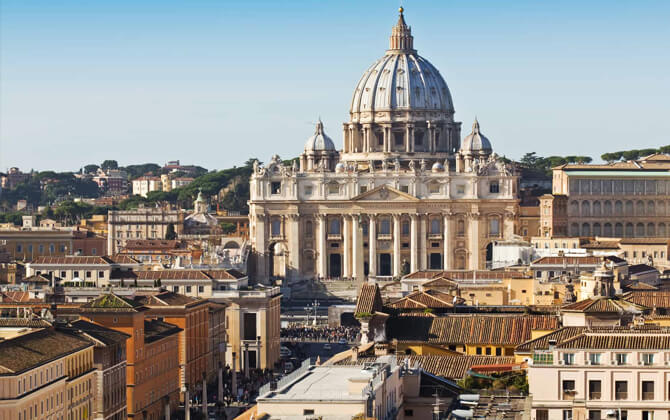
| Station | Details |
|---|---|
| Ottaviano | Use this stop for St. Peter’s Basilica, less than a 10-minute walk away. |
| Cipro | Useful for the Vatican Museums, especially if you already have skip-the-line tickets. |
| Flaminio | Close to an entrance to Villa Borghese, Pincio Hill, and Santa Maria del Popolo. |
| Spagna | Best for the Spanish Steps, Via dei Condotti, and Via del Corso. |
| Barberini | Good for the Trevi Fountain, Palazzo Barberini, the Crypt of the Capuchin Friars, and Via Veneto. |
| San Giovanni | Close to Rome’s cathedral, the Holy Stairs, and the Baptistery. |
| Vittorio Emanuele | Near Piazza Vittorio and its food market. |
| Colosseo | The best stop for the Colosseum, Arch of Constantine, Roman Forum, Domus Aurea, and Trajan’s Market. |
| Circo Massimo | Useful for Circus Maximus, Aventine Hill, and the Baths of Caracalla. |
| Piramide | Near the pyramid-shaped ancient tomb, Eataly, Testaccio market, and the Porta Portese flea market on Sunday mornings. |
For a simple sightseeing route, start at Termini and switch between Lines A and B as needed. It keeps the journey easy and avoids unnecessary transfers.