The Naples Metro, or Metropolitana di Napoli, is the rapid transit system serving Naples in Campania, Italy. It currently has three underground lines: Line 1, Line 6, and Line 11. ANM operates Lines 1 and 6, while EAV runs Line 11. The network covers 34.5 km (21.4 miles), includes 30 stations, and is one of the largest metro systems in Italy. It plays a central role in public transport and city transport in Naples, with stations known not just for transportation in the city but also for art and archaeology.
| Key | Information |
|---|---|
| System | Naples Metro / Metropolitana di Napoli |
| Lines | 3 underground lines: Line 1, Line 6, Line 11 |
| Route length | 34.5 km (21.4 miles) |
| Stations | 30 |
| Operators | ANM (Lines 1 and 6), EAV (Line 11) |
| Line colors | Line 1 yellow, Line 6 blue, Line 11 rainbow/orange |
| Ridership | About 115,000 passengers per day and around 45 million per year |
| Wider transport network | Also connected with Line 2, Circumvesuviana, Cumana, and Circumflegrea railways |
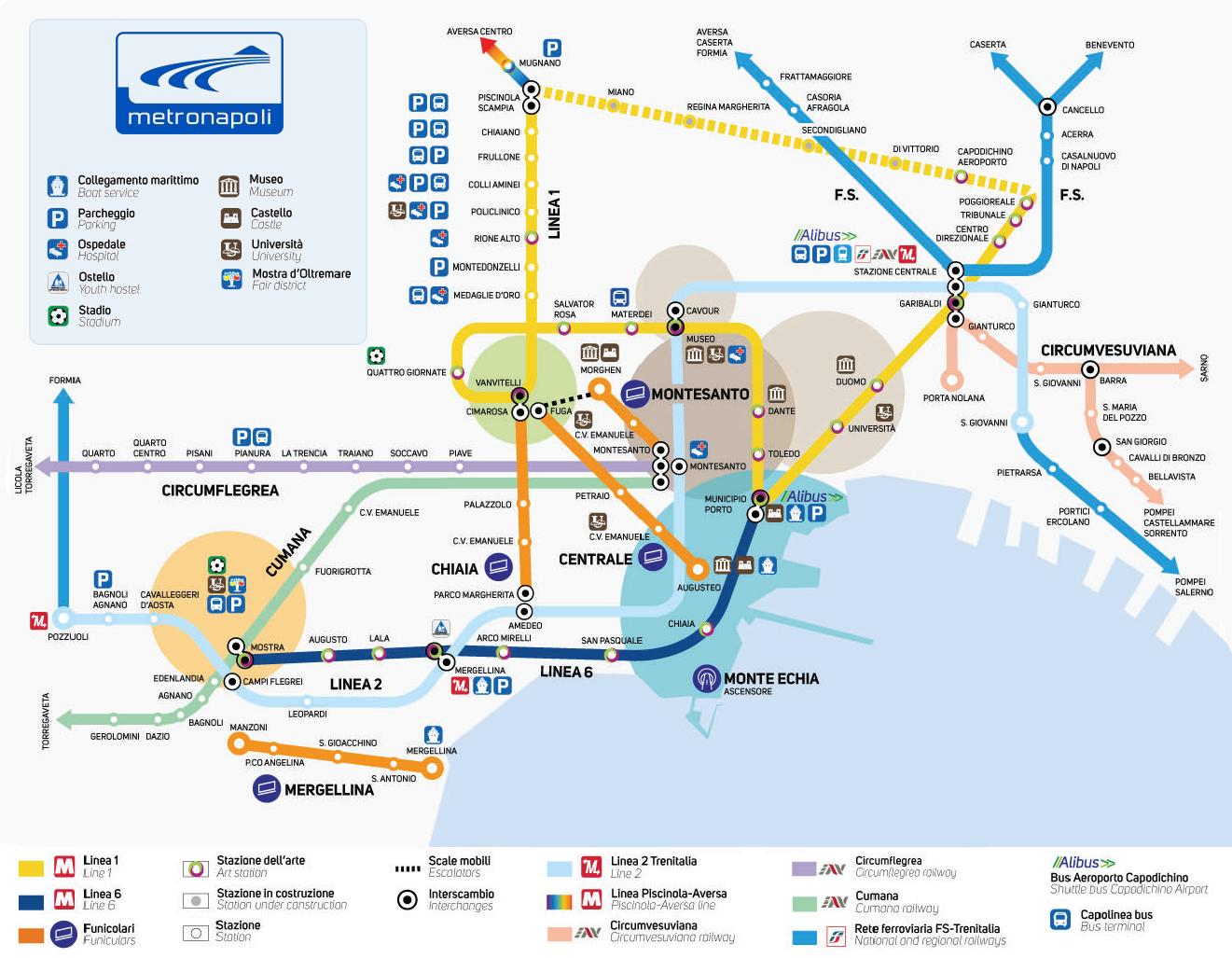
Naples Metro Map
Map of Naples Metro showing different lines. Click on the map to enlarge it or download the Naples Metro map in PDF format.
Lines and Stations
The Naples Metro system operates three underground lines: Line 1, Line 6, and Line 11. Together they form the core metro route through the city and parts of the wider metropolitan area. Line 1 is the main corridor, while Lines 6 and 11 add useful links for local transport and connections across the network.
Line overview
- Line 1: the main line, running from Piscinola Scampia to Centro Direzionale.
- Line 6: a light metro line that opened in 2007 and was extended to Municipio in 2024.
- Line 11: the Rainbow Line, opened in 2005 and extended to Aversa Centro in 2009.
Beyond the metro itself, Naples has a broader public transport system that includes Line 2, the Circumvesuviana lines, the Cumana railway, and the Circumflegrea railway. That wider network matters a lot when planning a route, especially for suburban trips and day travel outside the center.
Main stations and interchanges
| Station | Details |
|---|---|
| Piscinola Scampia | Interchange with Line 11. |
| Museo | Interchange with Line 2. |
| Municipio Porto | Interchange with Line 6. |
| Garibaldi | Connection with the central railway station, Circumvesuviana, and Line 2. |
| Vanvitelli | Connection with the Central, Chiaia, and Montesanto funiculars. |
Several Line 1 stations stand out for their design and archaeological features. Toledo, Università, Duomo, and Salvator Rosa are among the best-known stops, and they are a big reason the Naples stations map is so often searched by visitors.
Line 1 remains the busiest part of the network. Line 6 and Line 11 are smaller, but they still play an important role in the overall route plan and stations list.
Timetable & Operating Hours
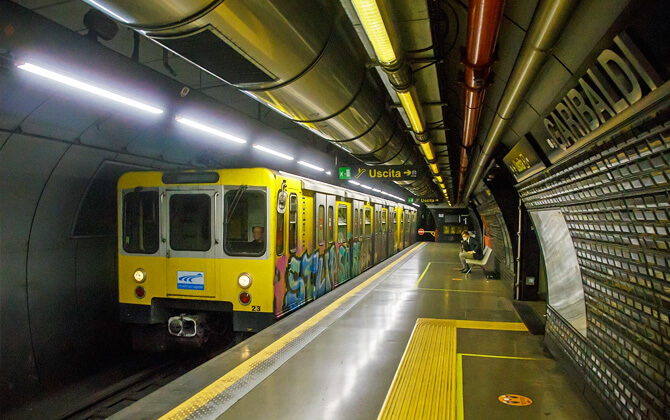
The Naples Metro timetable varies by line, but most services run daily from about 6:00 am to 11:00 pm. Depending on the line and time of day, train frequency is generally every 6 to 15 minutes. If you are checking operating hours, opening hours, opening times, or schedule today, it is worth remembering that Line 1, Line 6, and Line 11 do not all follow the same timings.
Line 1 has a starting time of 6:00 am. From Sunday to Thursday, the closing time is around 11:00 pm, while on Friday and Saturday the last train runs much later, at about 1:30 am. Typical Line 1 frequency is every 7 to 10 minutes.
Line 6 begins daily at 7:30 am and, as of August 2024, ends around 3:00 pm. There are plans to extend its working hours into the late evening once the line is fully operational. Line 11 starts daily at 6:00 am and closes at 10:00 pm.
For Line 1, the published route timetable shows a regular operating window of 06:04-22:52 on most days, with extended late-night service on Friday and Saturday until 00:58. Here is the standard train schedule for Line 1.
| Service detail | Timings |
|---|---|
| Line 1 Monday | 06:04-22:52, frequency 9 minutes |
| Line 1 Tuesday | 06:04-22:52, frequency 9 minutes |
| Line 1 Wednesday | 06:04-22:52, frequency 9 minutes |
| Line 1 Thursday | 06:04-22:52, frequency 9 minutes |
| Line 1 Friday | 06:04-00:58, frequency 9 minutes |
| Line 1 Saturday | 06:04-00:58, frequency 9 minutes |
| Line 1 Sunday | 06:04-22:52, frequency 9 minutes |
If you are looking up timings today, the last train, or opening times for a specific trip, check the latest service information before you travel. That matters even more on weekends or when using Line 6, whose running time and service window are still limited.
Fares and discounts in Naples Metro
Naples public transport uses the Unico Campania ticketing system. In practice, you need a valid ticket to use transport in the city, the province, and the region. There are no general age-based discounts, apart from children under 6, who can travel free when accompanied by an adult with a valid ticket. One child per adult is allowed, and the child cannot occupy a separate seat.
Within the City of Naples, TIC tickets cover ANM buses, the four funicular lines, regional EAV buses, Metro Lines 1, 2, and 6, plus the Circumvesuviana, Circumflegrea, and Cumana lines within city limits. Available ticket and pass options include 90-minute, day pass, weekly, monthly, and annual products.
| Ticket | Price | Details |
|---|---|---|
| Biglietto Orario | €1.50 (about $1.64) | Valid for 90 minutes from validation |
| Biglietto Giornaliero | €4.50 (about $4.91) | Valid until midnight on the day of validation |
| Biglietto Settimanale | €15.80 (about $17.24) | Valid until midnight on the last day of the week of validity |
| Abbonamento Mensile | €42.00 (about $45.82) | Valid until midnight on the last day of the month of validity |
| Annuale Ordinario | €294.00 (about $320.75) | Valid for 12 months from the first month of validity |
The standard single ticket price often mentioned for metro travel is €1.50 (about $1.64). If you plan to travel more than once in a day, the day pass at €4.50 (about $4.91) may be the more practical fare.
Unico Alibus tickets are required for Alibus airport services. The fare is €3.00 (about $3.27) from an authorized agent or €4.00 (about $4.36) if bought on board. These tickets are valid for 90 minutes from validation. They cannot be used for a round trip on Alibus, though they can be used in combination with another service normally covered by a TIC ticket.
TIC NA tickets are used for travel between Naples and towns in the Province of Naples. They are grouped into 16 fare bands, from NA1 to NA16, with single, monthly, and annual options. Examples of single fares include NA1 Portici at €2.00 (about $2.18), NA2 Pozzuoli and Herculaneum at €2.50 (about $2.73), NA3 Pompeii at €3.20 (about $3.49), and NA5 Sorrento at €4.50 (about $4.91).
TIC AC tickets are for travel between towns in the Province of Naples without connecting through Naples itself. These are also organized into 16 fare bands. Example single fares include AC1 Sorrento to Piano di Sorrento at €1.60 (about $1.75), AC2 Sorrento to Castellammare di Stabia at €2.20 (about $2.40), AC3 Sorrento to Pompeii at €2.80 (about $3.05), and AC4 Sorrento to Herculaneum at €3.40 (about $3.71).
There are also tourist passes. The 3-day Campania ArteCard costs €32.00 (about $34.91) and covers transport across the region, including metro, bus, funiculars, trams, tramway services, and rail. The 3-day ArteCard Napoli costs €21.00 (about $22.91) and covers transport within urban Naples, including Metro Lines 1, 2, and 6, funiculars, trams, and regional rail services.
ANM and EAV issue their own tickets too, valid only on their own services. Their single tickets start at €1.00 (about $1.09). An ANM U NA 1 ticket can be used on ANM suburban buses, metros, and funiculars within the city, while ANM U NA 2 is intended for buses coming from outside the urban area and for use with EAV or RFI train services.
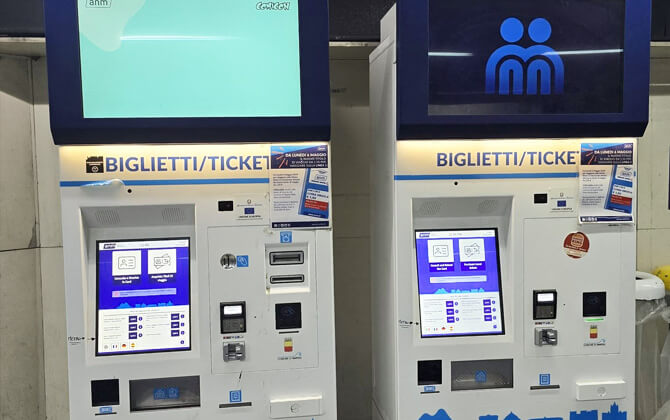
Tickets can be bought at tobacco shops, many newspaper stands, and ticket machines at many railway, metro, and cable railway stations, as well as some bus stops. Monthly passes are sold only between the last four days of the previous month and the first two days of the month of validity.
Hourly tickets must be validated in the electronic machines on buses or inside train and metro stations before boarding. Daily, weekly, and monthly tickets must be validated at first use, and you must write your name and date of birth on the back and be able to show ID if asked. If a machine is out of order, write the day, month, and hour on the back in the space provided.
Interconnections with Other Systems
The Naples Metro is tightly integrated with the wider railway and urban transport network of Naples and Campania. Alongside the metro, the city is served by the Naples metropolitan railway service, including six Circumvesuviana lines, Line 2, the Cumana railway, and the Circumflegrea railway. Taken together, these networks make the metro part of a much larger transport system.
Within the metro network, several key interchanges shape the route options. Line 1 connects with Line 2 at Museo-Piazza Cavour and Garibaldi, with Line 6 at Municipio Porto, and with Line 11 at Piscinola Scampia. There is also an underground walkway linking Museo with Piazza Cavour on Line 2.
Outside the metro, Montesanto is an important hub for the Circumflegrea and Cumana lines and the cable car to Vomero. Additional nearby connections are available to Line 2 and to Line 1 stations at Piazza Dante and Toledo. At Piazza Garibaldi, passengers can transfer between Lines 1 and 2, the Circumvesuviana network, and national and regional rail services.
Future Line 10 is planned to improve these interconnections even further. It is designed to link central Naples with the Napoli-Afragola High-Speed station and to connect with Lines 1 and 11 at Di Vittorio. It will also provide access to Piazza Garibaldi and a planned regional rail connection at Casoria-Afragola.
ANM manages Lines 1 and 6, pedestrian subways, and the funicular railways, while EAV is responsible for Line 11 and pedestrian subways.
Airport Connections
Naples Airport is served by several public transport lines. Near the airport, the listed routes include bus lines 02-NA, 180, 3, 928, and ALIBUS, train lines L2, L6, and R, and metro line L1.
For most travelers, the bus is the simplest option. The nearest stops are Napoli Apt Capodichino Terminal Bus- Partenze and Ruffo Di Calabria – Aeroporto, both about a 1-minute walk from the airport. Other nearby stops include Capodichino Terminal, Ruffo Fulco Di Calabria, and Aeroporto Capodichino.
Rail and metro connections are less direct. Nearby light rail stations include Nuova Poggioreale and Nuova Poggioreale – Biscardi, while the nearest listed metro station is Centro Direzionale, around a 53-minute walk away.
Bus lines serving the airport include ALIBUS, which connects Aeroporto Capodichino with Stazione Centrale and the port, along with other local and regional routes such as 180, 928, ATC, C68, and NA-AV. Nearby train connections include L2, L6, and R, while L1 is the metro line shown for nearby service.
So if you are planning transportation in Naples to or from the airport, bus service offers the most direct access. Metro and train options are possible, but they involve a much longer walk.
Rules and Regulations
Before using the Naples Metro, make sure you have the correct ticket and validate it when required. Paper tickets must be validated before use, and inspectors can issue fines for unvalidated tickets. Digital tickets from the official app are activated in the app and do not need physical validation.
Single tickets are valid for transfers within the permitted time window. Daily, weekly, and multi-day pass products must be used according to their own validity rules. The integrated ticket system covers metro, buses, funiculars, and other urban transport services, though some services, including Alibus and the Circumvesuviana, may require a separate ticket unless covered by a specific pass.
Rules also apply to luggage, bicycles, and animals. Small or medium-sized dogs may travel free if they are leashed and muzzled. Children under 6 may travel free with an adult holding a valid ticket, provided they do not use a seat.
Luggage is allowed only within the stated limits, and bicycles are permitted on Lines 1 and 6 under the conditions set for each line. Passengers who do not follow the rules may be fined.
If you lose something on the metro or another ANM service, you can contact the Lost and Found Office.
Prohibited Actions
The customer code of conduct sets out actions that are not allowed in metro facilities and vehicles. These rules are meant to keep the service safe, orderly, and accessible for everyone.
Loitering is prohibited. This includes unnecessary lingering that interferes with metro use, storing personal property in a facility or vehicle, camping or sleeping when not riding for transportation, and remaining without a lawful transportation purpose or refusing to provide identification.
Bicycles and wheeled devices such as tandem, three-wheeled, or fuel-powered bicycles are not permitted in, attached to, or on metro facilities or vehicles. Bicycles or other wheeled riding devices over 6 feet long are also prohibited.
Animals are generally not allowed unless they are in a fully enclosed and secure carrier, are certified police or security animals accompanied by a peace officer, or are service animals as defined by the Americans with Disabilities Act and accompanied by a patron. Handlers must keep control of animals at all times, remove animal waste promptly, and make sure animals do not block aisles or deprive others of a seat.
Boarding, exiting, and seating rules require passengers to stay out of tracks except at designated crossings, keep control of children, avoid signaling in the path of or touching a moving bus, and yield priority, reserved, wheelchair, or similarly designated seating to senior citizens, older adults, and passengers with disabilities.
Disorderly conduct is prohibited in or near metro facilities and vehicles. This includes spitting, carrying explosive or hazardous materials, urinating or defecating outside a lavatory, throwing objects at people or metro property, gambling, hanging from hand rails, inciting violence, lewd conduct, prostitution, placing feet or shoes on seats, graffiti, vandalism, littering, injuring another person or property, and throwing objects from a metro vehicle.
Food, alcohol, and drugs are also restricted. Prohibited conduct includes eating, drinking, smoking, vaping, or carrying a lit cigar, cigarette, or pipe outside designated areas; placing chewed gum on surfaces; drinking or carrying alcohol in an open container except where permitted; possessing illegal drugs or substances; being under the influence in a way that affects safety or service use; creating a nuisance by dropping food outside proper receptacles; and smoking or vaping within 20 feet of a metro facility entrance, exit, or operable window.
Solicitation rules prohibit aggressive requests for money or other things of value in a metro facility or vehicle, including at or near an ATM or ticket machine, using insults, profanity, or threats, making repeated requests after refusal, or blocking access to a facility.
Fare requirements must also be followed. Passengers must pay all applicable fares and fees, show proof of payment on request, and avoid fare evasion in any form, including boarding without valid fare media, altering or transferring fare media without authorization, using invalid payment methods, falsely claiming eligibility for reduced fare, refusing to show proof of valid fare media, misusing fare media to avoid payment, or using discount tickets without proper eligibility.
Metro may refuse service or access, suspend or revoke the application of the code, and exclude or eject persons who do not comply with the code or applicable laws. Acts prohibited by the code may be allowed only when specifically authorized.
Precautions when Boarding and Alighting the Train
When using the Naples Metro, stay alert on the platform and move calmly with the flow of passengers. Station names are usually announced in Italian and English, and signs on the platform and inside the train help confirm your stop. If you are new to the system, checking the route map or stations map on your phone beforehand makes things easier.
Watch the gap between the train and the platform when getting on or off. At busy times, especially during rush hour, trains and stations can be crowded, so keep bags and valuables close and avoid distractions. If you are traveling with children or luggage, stick together.
Ticket validation is another important point. Some stations do not have barriers, so you need to validate your ticket before boarding. Look for the validators, often green or yellow, and stamp the ticket before entering the train area. If you fail to validate, you can be fined. If you cannot find a validator, board and speak to the train manager as soon as possible.
For a smoother trip, allow a little extra time, especially if you need to change lines or connect with other rail services. Some older stations involve stairs, while newer ones are generally easier to use. Simple, but important.
- Check station and train signs before boarding.
- Validate your ticket where required.
- Watch the gap between the platform and the train.
- Keep bags and valuables secure in crowded areas.
- Allow extra time if you are traveling with luggage or children.
History
The history of the Naples Metro goes back to the early 20th century. Construction began in 1911 on the urban section of the Rome-Formia-Naples railway. After a pause during World War I, this line opened on 28 September 1925 as an urban railway service and later became known as Line 2, the first service of its kind in Italy.
After World War II, the Circumvesuviana railway was upgraded into a modern commuter rail network, while the Cumana railway also became important for commuter travel. The Circumflegrea railway opened in 1962.
Planning for Line 1 started in 1963, when the Ente Autonomo del Volturno proposed a funicular connection between Vomero and the Museum. That idea was later replaced by metro proposals, and by 1968 studies had outlined a line of about 4.5 km (2.8 miles) with 12 stations. Funding problems delayed the project for years, but in 1972 Metropolitana di Napoli was formed. Final approval came on 24 December 1974, and construction began on 22 December 1976.
The first section of Line 1 opened on 28 March 1993 between Vanvitelli and Colli Aminei. On 19 July 1995, it was extended to Piscinola-Scampia. That made Line 1 the first underground metro line in Naples after decades of planning and delay.
In the late 1990s, city authorities introduced a new transport plan aimed at better integration, stronger financing, and wider access. Metronapoli was created with support from the municipality and the regional government, and it took over operation of the urban rail network on 1 February 2001. In the same year, Line 1 was extended from Vanvitelli to Museo, improving interchange with Line 2.
Expansion continued through the 2000s. In 2005, Line 11 opened between Piscinola Scampia and Mugnano. Line 6, a light metro line, opened in February 2007 with four stations. Line 1 later reached Università in 2011, Toledo in 2012, Garibaldi in 2013, Municipio in 2015, and Duomo in 2021. On 16 July 2024, Line 6 was extended from Mergellina to Municipio.
On 1 April 2025, Line 1 was extended from Garibaldi to Centro Direzionale. Work is also underway on the remaining sections between Centro Direzionale and Capodichino and between Piscinola Scampia and Di Vittorio, with the goal of completing the loop. A future Line 10 has also been announced as part of the broader expansion of the network.
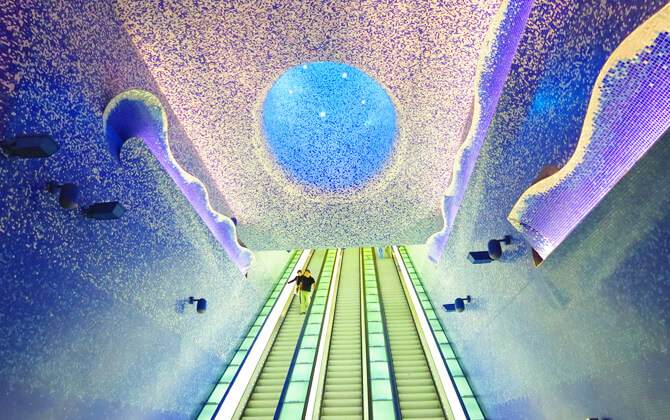
Alongside this technical growth, the metro developed a strong artistic and archaeological identity. New station construction uncovered important historical remains, and several stations were designed as art spaces, giving the system a character that feels quite distinct within Italy.
Future Extensions
Naples Metro Line 10 is planned as a phased expansion project. The signed contract covers Phase 1A of Lot 1, including the first 6.5 km (4.0 miles) and seven stations. The full Lot 1 will add another 7.3 km (4.5 miles) to complete the link between central Naples and the Naples-Afragola High-Speed Rail Station.
The future extension will also complete four stations already started in Phase 1A and add five new stations. A parking facility with about 1,000 spaces is included in the broader completion plan for the Afragola station area.
Once built, Line 10 is expected to improve connections at several key interchange points. Di Vittorio station will connect with Lines 1 and 11, while the extension toward Piazza Garibaldi will create links with Lines 1 and 2, the Circumvesuviana railway, and national and regional rail services.
An additional interchange is planned at Casoria-Afragola station through the existing railway station. The project is intended to strengthen Afragola’s role as a major hub and make trips between the city center and the high-speed rail network easier.
The available information also notes that the consortium has exclusive rights to carry out additional works, though those later steps are still awaiting funding. No parking charges or parking charges per day are specified for the planned station parking.
Nearby Tourist Attractions
Naples is an excellent base for day trips. With direct trains, metro links, and regional rail services, you can reach archaeological sites, volcanic areas, and coastal destinations without too much trouble.

Royal Palace of Caserta
Caserta is about 30 km (18.6 miles) from central Naples and can be reached by direct train in roughly an hour. The Royal Palace is impressive, and the park behind it is especially striking. It stretches for more than 3 km (1.9 miles) and includes lawns, wooded areas, and a long water feature.
Pozzuoli
Pozzuoli is a lively neighboring city with history, food, and a busy waterfront. Its oldest quarter, Rione Terra, was originally built by the Greeks in the 6th century BC and later taken over by the Romans. Two of its best-known sites are the Macellum of Pozzuoli and the Flavian Amphitheatre, the third largest amphitheatre in Italy.
You can reach Pozzuoli on Metro Line 2, which makes it a straightforward day trip from Naples.
Pompeii
Pompeii is one of the world’s most famous archaeological sites and a classic trip from Naples. Preserved after the eruption of Mount Vesuvius in 79 AD, it offers a remarkable look at Roman life. Direct trains run from Naples on both the Circumvesuviana line and Trenitalia.
Herculaneum
Like Pompeii, Herculaneum was buried by the eruption of Mount Vesuvius in 79 AD, when it was covered by 16 meters of ash and mud. That is about 0.016 km or 52.5 feet. It is another major archaeological site near Naples and can be reached by the Circumvesuviana line or Trenitalia.
Mount Vesuvius
Mount Vesuvius dominates the skyline around Naples and remains one of the area’s defining landmarks. The usual way to get there is by bus from Ercolano Scavi station on the Circumvesuviana line, though it can be a bit of a hassle.
Campi Flegrei
West of Naples, near Pozzuoli, lies Campi Flegrei, also known as the Phlegraean Fields. It is a large volcano rather than a high mountain, and its caldera contains about 24 craters, most of them underwater.
Paestum
Paestum is about 90 km (55.9 miles) southeast of Naples and makes a rewarding, if slightly less obvious, day trip. Founded by Greek settlers around 600 BC, it later became a wealthy and important city. Today, the three surviving temples are the main draw. A direct train runs from Naples, but there are only a few departures each day, so planning ahead helps.
Capri
Capri is an easy ferry trip from Naples, taking about 50 minutes. It is known for beach clubs, boat tours, and the Blue Grotto. You can go in the morning and return later the same day.
More Options
If you have extra time, Naples also works well as a base for exploring the Amalfi Coast and other nearby destinations. Still, the city itself offers plenty, so you do not need to go far to fill your trip.