Public transportation in Frankfurt is built for heavy daily demand, not just for residents but also for commuters, business travelers, and visitors moving across the wider Rhein-Main region. The system combines S-Bahn, U-Bahn, trams, buses, and regional rail under the RMV fare network, so one ticket can cover more than one mode on the same route. Frankfurt Central Station is the city’s main rail hub, and the wider system supports both local transport inside the city and longer trips across the region.
| Key | Information |
|---|---|
| Transport system | Integrated public transport network under RMV |
| Main modes | S-Bahn, U-Bahn, trams, buses, regional trains, taxis |
| Main rail hub | Frankfurt Central Station |
| Daily station use | More than 460,000 passengers and visitors at Frankfurt Central Station |
| Commuter flow | Around 350,000 commuters enter the city on work days |
| Ticketing | Common fare system with proof of payment; tickets should be kept ready for inspection |
| Regional reach | Links Frankfurt with the surrounding Rhein-Main region and other parts of Germany |
Map of Frankfurt transport
Map of Public transportation in Frankfurt showing different lines and stations. Click on the map to enlarge it or download the map in PDF format.
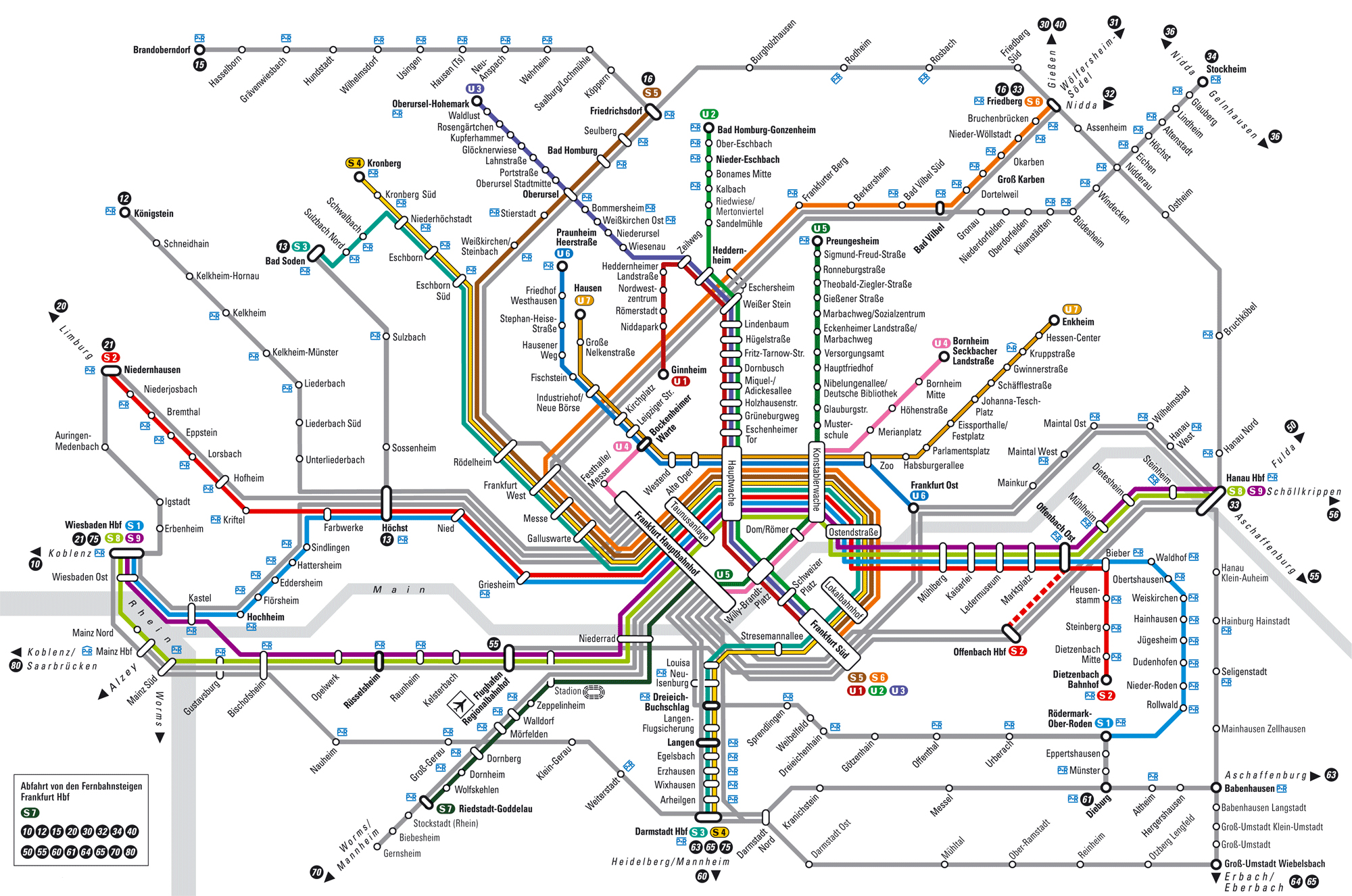
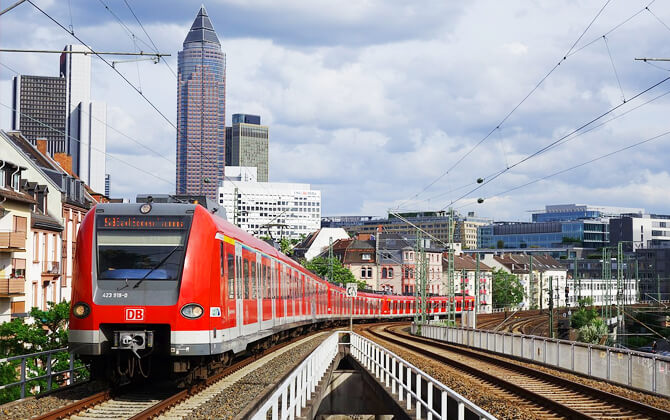
S-Bahn and U-Bahn in Frankurt
Frankfurt’s rail-based public transport is part of the Rhein-Main-Verkehrsverbund, or RMV, so the fare system is shared across operators. In practical terms, that means one ticket can be used for a journey even when it includes different types of transport. Tickets can be bought in advance at vending machines or on board a bus.
S-Bahn
The Rhine-Main S-Bahn is the suburban rail system for the wider region, with Frankfurt at its core. It is especially important for commuters traveling between the city and surrounding areas. Most lines run together through the City Tunnel under the center before branching out farther away. Outside the core, lines are usually double-tracked or share tracks with regional, long-distance, and freight trains.
S-Bahn trains can be up to 200 m long, about 0.12 miles, and reach speeds of up to 140 km/h, around 87 mph. Normal frequency is every 15 or 30 minutes, while the central shared sections run more often during rush hour. The S8 and S9 operate 24/7, which is useful if you need late-night transport, early departures, or airport access outside standard opening hours.
U-Bahn
The U-Bahn is Frankfurt’s Stadtbahn system. It has nine lines running on three main routes, with several lines sharing central sections and others branching into districts in the north, west, east, and south. In the city center, trains run underground; farther out, they often continue on reserved surface tracks.
The minimum frequency is 2.5 minutes, though the usual timetable is every 7.5 to 10 minutes per line. On central sections where several lines overlap, combined service can arrive about every 3 to 5 minutes. For short urban trips, the U-Bahn is the backbone of city transport.
How the two systems work together
One of Frankfurt’s strengths is how closely the S-Bahn and U-Bahn connect. Many stations work as transfer points, so changing lines is generally straightforward. Hauptwache is one of the key interchange stations, linking S-Bahn, U-Bahn, and several tram routes.
This integrated system makes it easier to travel between the airport, the city center, residential districts, and the wider region. For route planning, stations map checks, or a train schedule today, the shared RMV structure keeps things relatively simple.
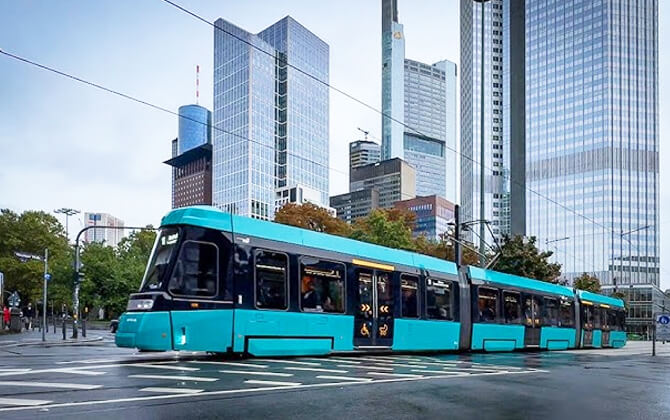
Tram service in Frankfurt
Frankfurt am Main has a long-running tramway network that remains an important part of city transport. As of 2023, it included 10 regular tram lines, two special lines, and one heritage tourist tramline. The network had 141 stops, a total route length of 68.67 km, about 42.67 miles, and carried 66.9 million passengers in the same year.
The tram system is also the oldest light rail network in Frankfurt. Horse trams began operating on 19 May 1872, and electrified service started in 1884, making Frankfurt home to one of the world’s earliest electric tramways. Today, tram services are operated by Verkehrsgesellschaft Frankfurt and are part of the RMV fare system.
Service and network
Trams usually run every 10 minutes. On shared central sections, two lines often combine to provide a 5-minute frequency during rush hour. Low-floor trams have been used on all regular lines since April 2007, and the Alstom Citadis SX05 is the newest fleet addition mentioned in the draft.
The network has also seen expansion and renovation. Since the 1990s, the city’s transport policy has shifted toward renewing and extending the tram system. Line 18 opened in 2011, and a new section through Stresemannallee opened in December 2014, improving connections in the south of the city.
Special and heritage services
Frankfurt also runs special tram services. The Ebbelwei Express is a sightseeing route that operates on weekends in a loop from Zoo to Messe/Schleife via Altstadt and Sachsenhausen. Historic K-type trams are used on this service.
The Stadtbahn line U5 also includes a street-running section that uses tracks from a former tram line. Former P-type trams were once used there, and since April 2016 the street-level stations on Eckenheimer Landstraße have been converted to high-level platforms for newer U5 trains.
Notes on the network’s development
Frankfurt’s tram network expanded quickly after electrification and reached its peak in 1938. From the 1960s onward, major closures followed as underground and S-Bahn lines were built. Even so, the tram system remains a key part of public transport and still serves neighborhoods where rail-based local transport is practical and efficient.
| Station | Details |
|---|---|
| Zoo | Part of the Ebbelwei Express loop |
| Messe/Schleife | Part of the Ebbelwei Express loop |
| Altstadt | Served on the Ebbelwei Express sightseeing route |
| Sachsenhausen | Served on the Ebbelwei Express sightseeing route |
| Eckenheimer Landstraße | Street-level stations converted to high-level platforms for U5 trains in April 2016 |
Bus service in Frankfurt
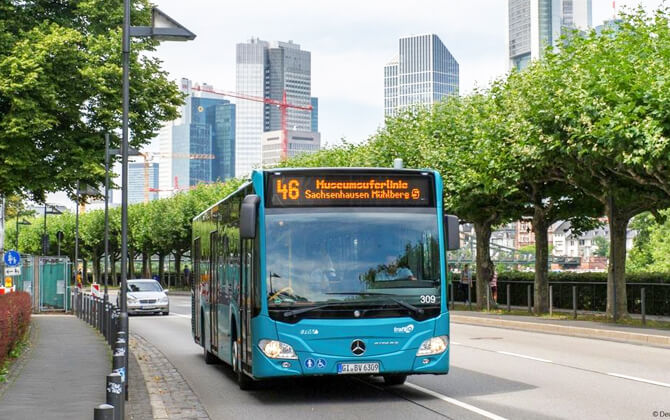
Buses play a smaller role in Frankfurt than rail, because the main travel corridors are already covered by the S-Bahn, U-Bahn, and trams. Still, the bus network matters for cross-town journeys, especially in the north of the city, and for feeder links to underground lines.
Because Frankfurt is part of the RMV system, one ticket can be used across different operators and modes within the same journey. Bus fares are generally paid in advance, either at a ticket machine or on board the bus.
Several companies operate bus services in Frankfurt, including Verkehrsgesellschaft Frankfurt, In Der City Bus, MainMobil Frankfurt, Alpina, and Regionalverkehr Kurhessen. There have also been proposals to reorganize bus routes into franchises that European operators could tender for.
Buses are particularly useful outside regular daytime service, since Frankfurt also has night bus routes. When rail frequency drops, buses can still provide practical connections across the city.
Taxi service in Frankfurt
Taxi service in Frankfurt is a convenient option for city trips, airport transfers, and direct travel to places such as the Städel Museum. One booking option is SIXT ride, which works with local ride-hailing and on-demand taxi companies to offer aligned prices and competitive rates.
On-demand taxi services can include live driver tracking, cashless payment, and monitored rides. If you want something more premium, professional chauffeur service is also available with high-end vehicles, door opening, and free bottled water. This type of service usually needs to be booked at least an hour in advance.
Main Taxi Frankfurt is another option, offering 24/7 service with booking by app, online, or by phone, plus fixed fares on many routes. Airport transfers are available around the clock, and rides can also be arranged for medical appointments, business travel, and longer trips.
Taxi payments are typically cashless and may include card, PayPal, and other methods, depending on the provider. If you prefer to call directly, Frankfurt’s taxi number is 069 230001. Taxis can also be found at designated stands, including major stations and the airport.
- 24/7 availability from selected providers
- Airport transfers
- Advance booking options
- Cashless payment methods
- Professional chauffeur service for premium travel
Airport Connections
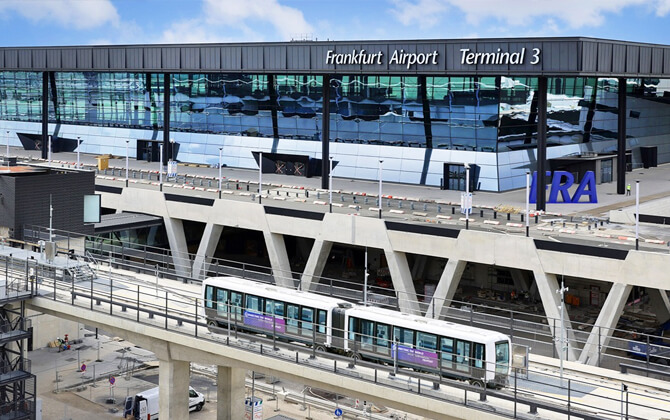
Frankfurt Airport is the second largest passenger airport in Europe and offers connections to more than 300 destinations worldwide. If you are arriving here, there are several straightforward ways to continue into the city using public transport or taxi service.
By Train
Frankfurt Airport has two railway stations: Frankfurt Flughafen Regionalbahnhof for regional trains and Frankfurt Flughafen Fernbahnhof for long-distance services. The regional station is served by S-Bahn lines S8 and S9, which connect the airport with Frankfurt city center.
To reach downtown, take S8 toward Offenbach (Main) Ost or S9 toward Hanau Hauptbahnhof. From the city to the airport, use S8 or S9 toward Wiesbaden Hauptbahnhof. You need a valid ticket before boarding, and tickets are available from on-site machines or online via RMV and Deutsche Bahn.
| Station | Details |
|---|---|
| Frankfurt Flughafen Regionalbahnhof | Regional rail station at the airport, served by S8 and S9 |
| Frankfurt Flughafen Fernbahnhof | Long-distance rail station at the airport |
| Offenbach (Main) Ost | S8 direction from the airport toward the city area |
| Hanau Hauptbahnhof | S9 direction from the airport toward the city area |
| Wiesbaden Hauptbahnhof | S8 and S9 direction from Frankfurt city to the airport |
By Bus
Several bus lines also connect the airport with the city. Depending on the operator, tickets can be bought at airport ticket booths, from the driver, or online via RMV and Deutsche Bahn.
By Car
Taxis are available around the clock at both terminals and at the long-distance train station. Taxi stands are located at P39 Terminal 1 drop-off area and P17 Terminal 2 drop-off area.
Travelers also often use the Frankfurt Card or the RheinMainCard, which include free travel on public transport in Frankfurt, including Frankfurt Airport, plus discounts for attractions and tours in the city and region.
Frankfurt-Hahn Airport
Frankfurt-Hahn Airport is located about 120 km from Frankfurt, roughly 74.6 miles. It serves international flights and offers a shuttle service to Frankfurt.