The Hamburg U-Bahn is the city’s rapid transit system, serving Hamburg as well as Norderstedt and Ahrensburg in Germany. It is operated by Hamburger Hochbahn within the HVV network and has been running since February 1912. Despite the name, most of the system is above ground rather than underground. As of 2019, the network had four lines, 93 stations, and a route length of 106.4 km (66.1 miles), with strong links to the S-Bahn for everyday public transport across the city.
| Key | Information |
|---|---|
| System | Hamburg U-Bahn |
| Operator | Hamburger Hochbahn within HVV |
| Opened | February 1912 |
| Lines | 4 |
| Stations | 93 |
| Route length | 106.4 km (66.1 miles) |
| Coverage | Hamburg, Norderstedt, and Ahrensburg |
| Network type | Mostly above ground, with underground sections |
Hamburg U-Bahn Map
Map of Hamburg U-Bahn showing different lines and stations. Click on the map to enlarge it or download the Hamburg U-Bahn map in PDF format.
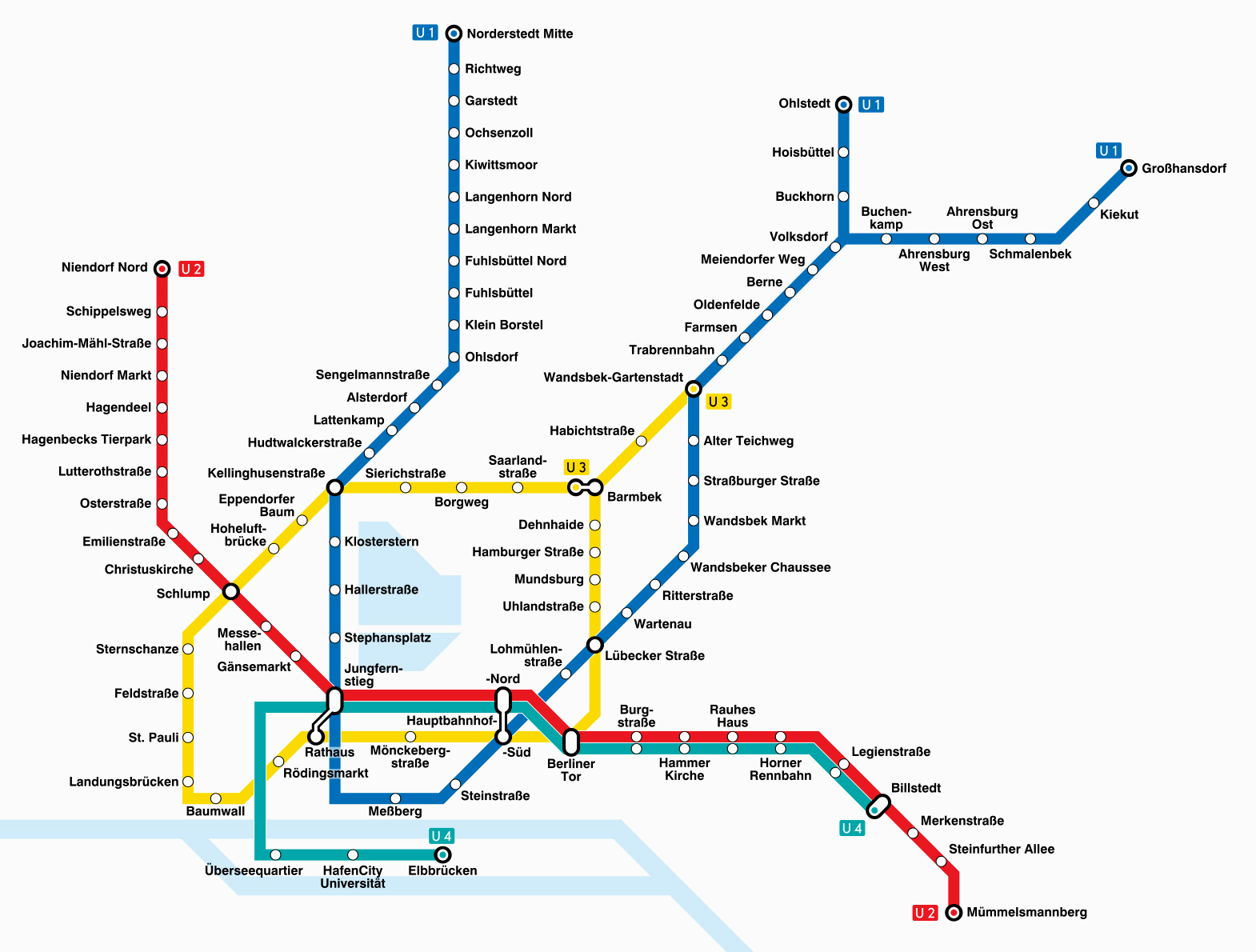
Lines and Stations of the Hamburg Metro
The Hamburg U-Bahn is part of the HVV public transport system and serves Hamburg, Norderstedt, and Ahrensburg. The network has four lines, 93 stations, and a total route length of 106.4 km (66.1 miles). Many riders think of it as a classic metro, but in practice much of the route runs above ground.
The system connects closely with the S-Bahn, so changing between lines is usually straightforward. The main interchange is Hamburg Hauptbahnhof, split into Hauptbahnhof Süd and Hauptbahnhof Nord for different U-Bahn routes.
Lines
| Line | Route | First opened | Length | Stations |
|---|---|---|---|---|
| U1 | Norderstedt Mitte – Jungfernstieg – Hauptbahnhof Süd – Ohlstedt / Großhansdorf | 1914 | 55.4 km (34.4 miles) | 46 |
| U2 | Niendorf Nord – Jungfernstieg – Hauptbahnhof Nord – Mümmelmannsberg | 1913 | 24.5 km (15.2 miles) | 25 |
| U3 | Barmbek – Circle – Barmbek – Wandsbek-Gartenstadt | 1912 | 20.7 km (12.9 miles) | 25 |
| U4 | Elbbrücken – Jungfernstieg – Hauptbahnhof Nord – Billstedt | 2012 | 13.3 km (8.3 miles) | 11 |
Main stations and interchanges
| Station | Details |
|---|---|
| Hamburg Hauptbahnhof | Central interchange for U-Bahn and S-Bahn services. |
| Hauptbahnhof Süd | Serves the U1 and U3. |
| Hauptbahnhof Nord | Serves the U2 and U4. |
| Ohlsdorf | Important interchange with the S1 and the nearest station for changing toward Hamburg Airport. |
| Jungfernstieg | Connects with the U1, U2, U4, S1, and S3. |
Service pattern
Train frequency is usually every 5 or 10 minutes, though the outer branches of the U1 can run every 10 or 20 minutes. During peak periods, service becomes more frequent. Since December 2004, the U-Bahn has also operated all night every 20 minutes on Friday and Saturday nights. From Sunday to Thursday, trains generally run from about 4 am to 1 am.
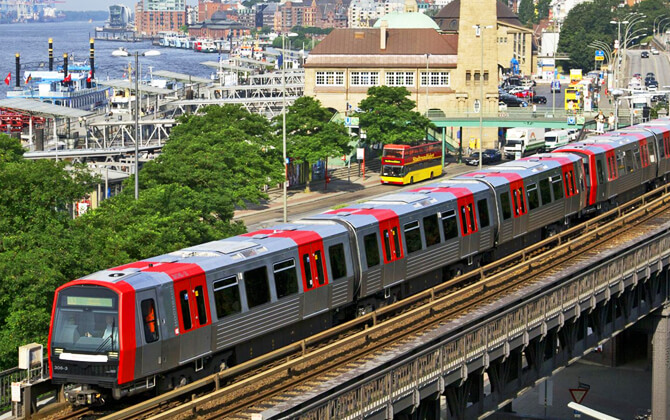
Operating Hours and Train Frequency
The Hamburg U-Bahn operating hours generally start early in the morning and continue until shortly after midnight. On weekdays, U-Bahn and S-Bahn services run from 4:30 a.m. to 0:30 a.m. the next morning. From Friday through Sunday, trains run continuously, so the system does not close overnight on weekends. Night buses cover key routes when rail services are not running overnight on other days.
Opening times, working hours, and train frequency depend on the line and time of day. In general, daytime service is frequent, while evening and night timings are less intensive. Average frequency is about every five minutes during the day and every ten minutes at night. Timings today or on public holidays may differ slightly.
| Service detail | Timings |
|---|---|
| Weekday operating hours | 4:30 a.m. to 0:30 a.m. the next morning |
| Weekend operating hours | Continuous service from Friday through Sunday |
| Typical daytime frequency | About every 5 minutes |
| Typical night frequency | About every 10 minutes |
| Night replacement transport | Night buses on main routes |
U1 Line
The U1 starting time is early in the morning, and the line keeps running until late at night. From opening until 8:00 p.m., trains usually run every five minutes. Later in the evening, frequency drops to every ten minutes. On weekends and public holidays, trains generally run every 20 minutes.
U2 Line
The U2 follows a similar timetable. On weekdays, trains usually arrive about every five minutes. After 8:00 p.m., the interval changes to every 15 minutes. On Saturdays, Sundays, and public holidays, the train schedule is typically every 20 minutes.
U3 Line
The U3 has stronger frequency in the middle of the day. On weekdays, trains run every ten minutes from opening until 10:00 a.m., then every five minutes afterward. On weekends and public holidays, the average schedule is every ten minutes.
U4 Line
The U4 runs every 10 minutes on weekdays throughout the day. On Saturdays, Sundays, and public holidays, trains run every 20 minutes between 4:00 a.m. and 7:30 a.m., then every 10 minutes for the rest of the day.
Exact opening hours, closing time, and last train details can vary a little by line, day, and holiday schedule.
Prices, Tickets, and Passes
Hamburg U-Bahn fare rules are set by HVV and follow an area-based system. The city is divided into concentric fare rings, and the ticket price depends on how many rings your journey covers. Rings A and B cover Hamburg itself and are the only rings served by the U-Bahn.
You can buy a ticket, day pass, or group pass in the Online Shop or in the hvv apps, where a 7% discount is available. Tickets are also sold at ticket machines and on buses. In Hamburg and Lüneburg, you need the hvv prepaid card, while cash payment is still possible in the surrounding region.
| Areas / Fare zones | Single Ticket | Single Ticket Child | Day Ticket | Day Ticket Child | Group Ticket |
| 1–2 fare rings | 4.10 € (about $4.46) | 1.50 € (about $1.63) | 8.20 € (about $8.91) | 3.00 € (about $3.26) | 16.40 € (about $17.81) |
| 3 fare rings | 7.00 € (about $7.60) | – | 14.00 € (about $15.20) | – | 28.00 € (about $30.40) |
| 4 fare rings | 8.90 € (about $9.67) | – | 17.80 € (about $19.35) | – | 33.00 € (about $35.86) |
| 5 fare rings | 10.80 € (about $11.74) | 3.00 € (about $3.26) | 21.60 € (about $23.47) | 6.00 € (about $6.52) | 28.00 € (about $30.40) |
| 6 fare rings (A-F) | 12.60 € (about $13.69) | 4.50 € (about $4.89) | 25.20 € (about $27.38) | 9.00 € (about $9.78) | 35.00 € (about $38.03) |
| Hamburg AB | 4.10 € (about $4.46) | 1.50 € (about $1.63) | 8.20 € (about $8.91) | 3.00 € (about $3.26) | 16.40 € (about $17.81) |
Special Single Tickets
| Single tickets Hamburg AB only | Price |
| Short journey | 2.10 € (about $2.28) |
| Local journey | 3.50 € (about $3.80) |
| Single tickets only inside rings C-F (outside Hamburg AB) | Price |
| Citycard | 2.10 € (about $2.28) |
| 1 zone (rings C-F) | 2.90 € (about $3.15) |
Other Tickets
| Other tickets | Validity | Price |
| Upgrade ticket 1st class trains RB/RE (rings A-F) | valid for 1 journey | 3.70 € (about $4.02) |
| Upgrade ticket 1st class trains RB/RE (rings A-F) | valid for 1 day | 6.30 € (about $6.85) |
| Upgrade ticket 1st class trains RB/RE (rings A-F) | valid per calendar month | 54.30 € (about $59.00) |
| Upgrade Ticket Weekend + * | valid per calendar month | 16.00 € (about $17.39) |
| Bicycle ticket RB/RE (rings A-F) | valid for 1 day on regional trains RB/RE | 3.50 € (about $3.80) |
Monthly Tickets
If you travel often, a monthly pass may cost less than paying the fare for each trip separately. Options include a one-month ticket for the full HVV network at 69.00 € per month (about $75.00) and the Deutschland-Ticket at 49.00 € per month (about $53.26). The Deutschland-Ticket can be cancelled monthly and is valid on local public transport across Germany. First-class seating on Regionalbahn still requires an extra payment.
Tickets and passes are sold at station machines and desks, and buses also sell tickets. Ticket machines usually offer destination-based fare calculation, much like a fare calculator, and generally have an English-language touchscreen. There are no ticket barriers, so tickets are checked by inspectors.
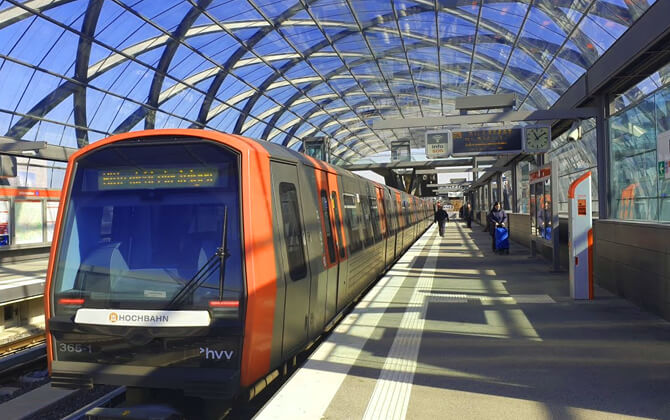
Integration with Other Transport Networks
Hamburg’s public transport system works as one connected network, so the U-Bahn links closely with the S-Bahn, regional trains, buses, and harbor ferries within HVV. That makes it easy to combine different types of transport in a single trip across the city and region.
The rail network is the backbone of this system. Hamburg has four U-Bahn lines, four S-Bahn suburban lines, and nine regional rail services connecting the center with destinations beyond the city. Additional U-Bahn and S-Bahn lines are also planned.
Interchanges are especially important here. Hamburg Hauptbahnhof is the main hub, with connections between all U-Bahn lines, all S-Bahn lines, and mainline rail services. Other important transfer stations include Jungfernstieg, Berliner Tor, Dammtor, and Landungsbrücken.
The bus network extends the reach of the rail system with metro buses, express buses, sprinter buses, and regional buses. These services connect stations with surrounding districts and towns, helping the U-Bahn function as part of a much bigger transport network.
Hamburg’s harbor ferries are included in the same ticket system. There are six ferry lines serving the harbor and the River Elbe, with route numbers starting at 61. With a valid hvv ticket, passengers can use them as part of the same journey.
The network is organized into five rings centered around the Alster Lakes. Rings A and B cover the city itself, while Rings C, D, and E extend up to 60 km (37.3 miles) from the center. Some regional trains are also included in the fare within the larger travel area.
Tickets are available as single, daily, and weekly options and are valid on buses, trains, and ferries. That simple fare structure makes transfers easier and helps the U-Bahn fit smoothly into Hamburg’s wider public transport system.
Operating hours also support easy transfers. On weekdays, U-Bahn and S-Bahn services run from 4:30 a.m. to 0:30 a.m. the next morning, with night buses operating after midnight. From Friday through Sunday, U-Bahn and S-Bahn trains run 24 hours.
Connection to the Airport
Hamburg Airport is connected to the city by S-Bahn line S1. From Hamburg Central Station, trains run every 10 minutes, and the running time is about 25 minutes each way.
You can reach Hamburg Airport (Flughafen) station directly from Terminals 1 and 2 at Arrivals by elevator, escalator, or stairs. If you are coming from the city, the route goes via Ohlsdorf, where you can change to the U1 one stop before the airport.
For bus connections, stops are directly in front of Terminal 1 on Level 0. If you are changing between different modes of transport, it is smart to leave a little extra time.
- Train: S1 from Hamburg Central Station to the airport
- Frequency: every 10 minutes during the day
- Journey time: about 25 minutes
- Transfer option: U1 at Ohlsdorf
- Bus stops: in front of Terminal 1 on Level 0
The airport station is connected to central Hamburg through the S-Bahn via Ohlsdorf.
Advice
If you want to get around Hamburg efficiently, use both a route planner and the available stations map. A full route plan helps with rail connections, while additional maps can be useful for buses, night services, and harbor ferries.
It is also worth checking the fare map before you travel, so you know which ticket is valid for your journey. If accessibility matters, a live lift map can help you see whether elevators are available.
The four current lines, U1, U2, U3, and U4, cover many key parts of the city. The U3 is especially well known as a ring route through the center, while the U4 connects HafenCity and the southern part of Hamburg. The U5 is under construction and is planned to open gradually from 2029.
The U-Bahn runs daily from about 4:00 a.m. to about 1:00 a.m. On Friday and Saturday nights, and before Sundays and public holidays in Hamburg, there is continuous night service. In the city center, trains usually run every 5 minutes on weekdays and Saturdays until about 9:00 p.m., and every 10 minutes during the day on all lines.
For transfers, the main hubs are Hamburg Central Station, Berliner Tor, and the Jungfernstieg/Rathaus station complex. These stations offer especially convenient connections to other U-Bahn and S-Bahn lines, and at Central Station also to regional, long-distance, and bus services.
Most stations are accessible with elevators and tactile guidance systems. Only four stations are listed as exceptions: Kiekut on the U1, and Saarlandstraße, Sierichstraße, and Sternschanze on the U3.
If you want a scenic ride, the U3 around the city center is a very good choice. The U1 also passes several interesting areas. Around Jungfernstieg, for example, you get easy access to the Rathaus and the Alster.
Parking near the Metro
Station parking is available here for drivers who want to switch to U-Bahn or S-Bahn services. The listed options are:
| Station | Details |
|---|---|
| Stellingen Volksparkstraße 73 | Open-air parking option, 22 parking spaces. |
| Stellingen Volksparkstraße 79-81 | Open-air parking option, 13 parking spaces. |
Details on parking facilities can be found at parkenambahnhof.de, where other parking options may also be listed.
At barrier-free parking facilities operated by DB BahnPark GmbH, people with a physical disability, or the person accompanying them, may park free of charge for up to 24 hours. This applies to holders of a blue or orange special parking permit valid throughout Europe. The authorized person does not have to be the driver, but must be transported in the vehicle. The parking card should be placed clearly behind the windshield instead of a parking ticket.
P+R facilities at selected U-Bahn and S-Bahn stations are intended to make switching from car to public transport easier, helping reduce traffic in the city. Specific parking charges or parking charges per day are not provided in the available information.
Trivia
The Hamburg U-Bahn is one of Germany’s oldest metro systems. It opened in 1912, making Hamburg the third German city to get a U-Bahn after Berlin and Schöneberg.
Despite the name, the network is not mainly underground. A large part of the route runs on embankments, viaducts, or open sections, while about 45 km (28.0 miles) are in tunnels.
The system serves not only Hamburg but also nearby places such as Norderstedt and Ahrensburg. It is operated by Hamburger Hochbahn AG, which also owns the system except for the section between Norderstedt Mitte and Garstedt.
Hamburg’s U-Bahn currently has four lines: U1, U2, U3, and U4. A fifth line is under construction and is expected to open gradually from 2029.
One of the better-known oddities is the 0.505 km (0.31 miles) Moorkamp curve between Schlump and Christuskirche. It has not been used in regular passenger service since 3 June 1973 and now serves only as an operating track.
The U3 is the only line with stations on a viaduct, and the Jungfernstieg/Rathaus station complex is the largest interchange complex in the Hamburg rapid transit network in tunnel conditions.
Historical Background
The Hamburg U-Bahn is a rapid transit system serving Hamburg, Norderstedt, and Ahrensburg. Although the name suggests an underground railway, most of the network runs above ground. It is operated by Hamburger Hochbahn within HVV, and many stations connect with the city’s S-Bahn system.
Planning for a modern rapid transit line began in the early 20th century, when Hamburg was growing quickly and existing transport links were no longer enough. In 1906, the Hamburg Senate awarded the contract for the Elevated and Underground Railway to Siemens & Halske and AEG of Berlin. Construction began on 7 October 1906, and the first section of the future Ringbahn opened on 15 February 1912 between Rathaus and Barmbek. That made Hamburg the third German city with a U-Bahn, after Berlin and Schöneberg.
The original system was built as a circular route around the city center, with branches planned toward Eimsbüttel, Ohlsdorf, and Rothenburgsort. By 1915, the Ringbahn and its first spurs were complete. In the following decades, the network expanded steadily. Extensions to Ochsenzoll, Jungfernstieg, Großhansdorf, and Ohlstedt were completed by the 1930s, and the network had reached 88.5 km (55.0 miles) by 1969.
The U-Bahn was heavily damaged during the Second World War, especially in 1943 during Operation Gomorrha. The section from Hauptbahnhof to Rothenburgsort was never repaired because the area had been destroyed. Full restoration took several years after the war.
Major postwar expansion began in the 1960s. The KellJung line was extended into the city center and eastward to Wandsbek Markt and Wandsbek-Gartenstadt, while the western section toward Hagenbecks Tierpark was also developed. Later came new connections to Billstedt, Merkenstraße, Niendorf Nord, Norderstedt Mitte, HafenCity, and Elbbrücken. Line numbers were introduced in 1966, and new cross-city and underground sections helped shape the modern system.
Today, the Hamburg U-Bahn reflects more than a century of development, combining early ring-line infrastructure, postwar rebuilding, and later extensions in one network.
Future expansions
Plans for a fourth line were already being discussed in the 1970s. At that time, the proposed route would have linked City Nord and Uhlenhorst with the city center at Hauptbahnhof Nord and Jungfernstieg, then continued via Altona to Lurup and Osdorfer Born. A limited service between Altona and Osdorfer Born was also considered.
More recently, the main expansion projects have focused on the U4 and the new U5. In 2015, major plans were published, including a new eastern U4 branch from Horner Rennbahn to Horner Geest with two stations, and a new U5 line from Osdorfer Born in the west to Bramfeld in the east via Uhlenhorst. The first section of the U5 was intended to be built between Sengelmannstrasse and Bramfeld.
The U4 has already gone beyond its original HafenCity terminus. After opening between Billstedt and HafenCity University in 2012, it was extended to Elbbrücken in December 2018. The new station was designed so the line can be extended further in the future, including a possible bridge crossing.
In 2026, work on the U4 extension to Horner Geest is continuing on schedule. The tunnel under Manshardtstraße is due to be completed in the first half of the year, and the structural shell of the project, including the two new stations, is expected to be finished by autumn. From the end of 2027, the U4 is planned to run from Horner Rennbahn via Stoltenstraße to Horner Geest.
Other projects are still under discussion. Earlier ideas included extending the U4 south to Harburg Rathaus via Wilhelmsburg to provide a second rapid transit link to southern Hamburg and relieve the S3/S5 corridor, but no concrete plans have been made so far.
Several planned stations and route sections are already tied to current development, including City Nord on the U5 and stations such as Horner Geest, Stoltenstraße, Osdorfer Born, Lurup, and Fuhlsbüttler Straße. The final route plan and timetable for expansion will depend on future planning and implementation.
Sightseeing with the Hamburg Metro
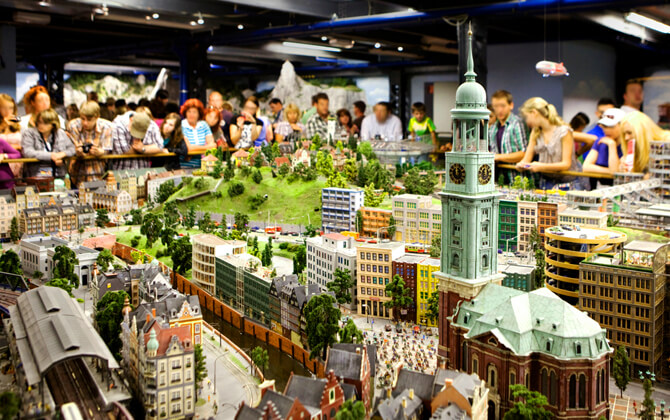
Hamburg is one of Germany’s most attractive cities, with a mix of trade, culture, leisure, and green spaces. For visitors, the U-Bahn is a practical way to reach major sights quickly and keep travel simple.
If you are planning a route through the city, these places are easy to include:
- Miniatur Wunderland: the largest miniature model in the world, designed as a model railway exhibit with five sections spanning 11,000 metres. It is on Kehrwieder Street 2-4, Block D, 20457, and can be reached from the U3 with a short walk from Rödingsmarkt station.
- Hamburgmuseum: Germany’s largest history museum. The building is one of the city’s key classical buildings and dates back to the early 20th century. Take the U3 to St Pauli station.
- Heiligengeistfeld: a popular attraction, especially for families, in the St Pauli quarter. Take the U2 to Messehallen station.
A scenic way to explore the city
Some routes are worth riding for the view alone. The elevated U3 section between Rödingsmarkt and Landungsbrücken runs along the harborfront and gives you views of ocean liners and historic storage buildings. Another pleasant route is the S21, which looks out over the downtown lakes between Dammtor and Hauptbahnhof.
If you have extra time, riding the circular U3 is a relaxed way to get a broad feel for the city and its stations.
Helpful tips for visitors
- The Hamburg U-Bahn is fully integrated with the S-Bahn, bus network, and other HVV services, so combining local transport is easy.
- Most tourist attractions are within zones A and B, which cover Hamburg city proper and nearby suburbs.
- The Hamburg Card is a practical option for visitors who want unlimited public transport and discounts on attractions.
- For special experiences, HVV has also offered guided metro tours, and an MP3 audio tour is available for the U3 in German.
With efficient connections and direct access to major sights, the Hamburg Metro is an easy way to explore the city.