The Hamburg S-Bahn is an electric rapid transit system in the Hamburg metropolitan region and a core part of public transport in the city. Together with the U-Bahn, AKN railway, regional rail, bus, and ferry services, it forms the backbone of local transport under the HVV system. The network has operated since 1907, has four lines, serves 68 stations, and covers 147 kilometres (91.3 miles) of route. On an average working day, it carries about 590,000 passengers.
| Key | Information |
|---|---|
| System | Electric rapid transit in the Hamburg metropolitan region |
| Operator | S-Bahn Hamburg GmbH, a subsidiary of DB Regio |
| Integrated transport network | HVV |
| Lines | 4 |
| Stations | 68 |
| Route length | 147 kilometres (91.3 miles) |
| Opened | 1907 |
| Average working day ridership | About 590,000 passengers |
| Power supply | 1,200 V DC third rail and 15 kV AC overhead lines |
Hamburg S-Bahn Map
Map of Hamburg S-Bahn showing different lines and stations. Click on the map to enlarge it or download the Hamburg S-Bahn map in PDF format.
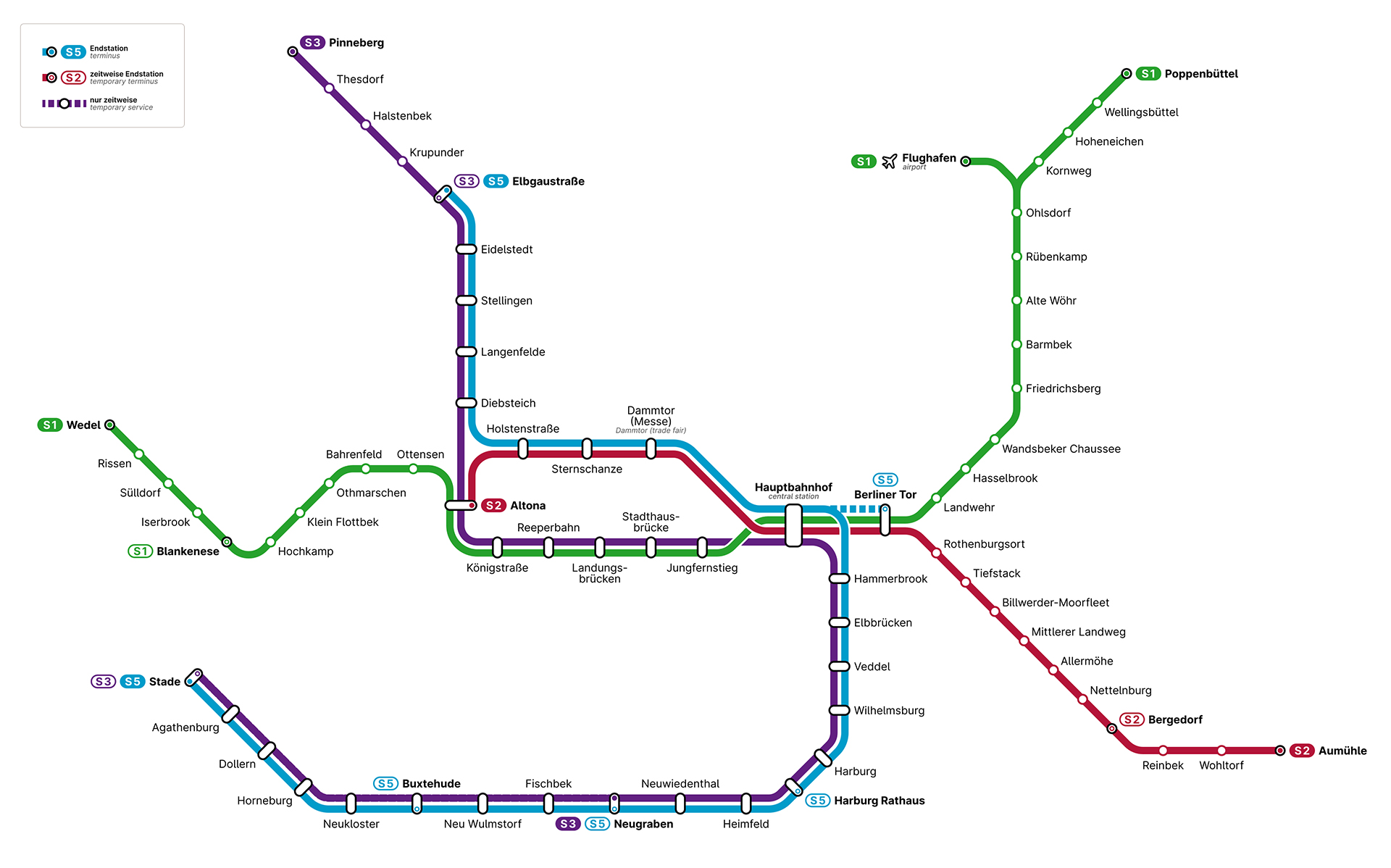
Lines and Stations
The Hamburg S-Bahn route network is built around two main trunk corridors: the northern Hamburg-Altona link line and the southern City S-Bahn. They meet at Altona and Hauptbahnhof, the main interchange stations in the system. Most of the network is separated from other rail traffic, though some stretches are shared with regional and freight services. A few sections run in tunnel, and some are single track.
The four main lines are straightforward:
- S1: Wedel – Blankenese – Hamburg Airport / Poppenbüttel
- S2: Altona – Bergedorf – Aumühle
- S3: Pinneberg – Neugraben – Stade
- S5: Elbgaustraße – Stade
For stations map and route plan purposes, it helps to know that S1 and S3 use the City S-Bahn via Jungfernstieg, while S2 and S5 use the Verbindungsbahn via Dammtor. Several stations also connect with the U-Bahn, regional trains, the AKN railway, and long-distance services.
The network has ten fully underground stations, including the five stations on the City S-Bahn, the S-Bahn part of Altona, three stations in central Harburg, and Hamburg Airport. Most stations use a single island platform, though some major interchanges have special layouts.
Here is a useful stations list of key stops across the network:
| Station | Details |
|---|---|
| Wedel | Western terminal on the S1 |
| Blankenese | Major stop on the S1 and access point for the Elbe area |
| Altona | Main interchange with regional and long-distance rail |
| Hauptbahnhof | Central interchange for S-Bahn, U-Bahn, regional, and long-distance trains |
| Berliner Tor | Important interchange with other city transport services |
| Barmbek | Key transfer station to the U-Bahn |
| Ohlsdorf | Transfer point where the S1 splits toward the airport and Poppenbüttel |
| Hamburg Airport (Flughafen) | Direct airport station below the terminals |
| Bergedorf | Eastern interchange with regional rail connections |
| Harburg Rathaus | Central station in Harburg |
| Neugraben | Major southern interchange and outer-network transfer point |
| Buxtehude | Regional stop on services toward Stade |
| Stade | Outer terminus on services beyond Neugraben |
| Aumühle | Eastern terminal of the S2 |
Fare, Tickets and Card
Hamburg S-Bahn fare options include single, day, and group tickets. Tickets can be bought in the Online Shop or HVV apps with a 7% discount, at ticket machines, or on the bus. In Hamburg and Lüneburg, the HVV prepaid card is required for payment on board, while cash is still accepted in the surrounding region.
A single ticket is valid for one journey per person. A day pass allows unlimited travel for one day and covers 1 adult plus up to 3 children aged 6 to 14 until 6:00 a.m. the following day. Group tickets are available for up to 5 people at one flat price.
| Areas / Fare zones | Single Ticket | Single Ticket Child | Day Ticket | Day Ticket Child | Group Ticket |
|---|---|---|---|---|---|
| 1–2 fare rings | €4.10 ($4.46) | €1.50 ($1.63) | €8.20 ($8.91) | €3.00 ($3.26) | €16.40 ($17.83) |
| 3 fare rings | €7.00 ($7.61) | – | €14.00 ($15.22) | – | €28.00 ($30.44) |
| 4 fare rings | €8.90 ($9.67) | – | €17.80 ($19.34) | – | €33.00 ($35.87) |
| 5 fare rings | €10.80 ($11.74) | €3.00 ($3.26) | €21.60 ($23.48) | €6.00 ($6.52) | €28.00 ($30.44) |
| 6 fare rings (A-F) | €12.60 ($13.70) | €4.50 ($4.89) | €25.20 ($27.40) | €9.00 ($9.78) | €35.00 ($38.05) |
| Hamburg AB | €4.10 ($4.46) | €1.50 ($1.63) | €8.20 ($8.91) | €3.00 ($3.26) | €16.40 ($17.83) |
Within Hamburg AB, short journey and local journey tickets are also available. In fare rings C-F, additional single ticket options apply.
| Single tickets Hamburg AB only | Price |
|---|---|
| Short journey | €2.10 ($2.28) |
| Local journey | €3.50 ($3.81) |
| Single tickets only inside rings C-F (outside Hamburg AB) | Price |
|---|---|
| Citycard | €2.10 ($2.28) |
| 1 zone (rings C-F) | €2.90 ($3.15) |
Other ticket products include first-class upgrade tickets for RB/RE trains, a Weekend+ upgrade ticket, and a bicycle ticket for RB/RE services.
| Other tickets | Validity | Price |
|---|---|---|
| Upgrade ticket 1st class trains RB/RE (rings A-F) | Valid for 1 journey | €3.70 ($4.02) |
| Upgrade ticket 1st class trains RB/RE (rings A-F) | Valid for 1 day | €6.30 ($6.85) |
| Upgrade ticket 1st class trains RB/RE (rings A-F) | Valid per calendar month | €54.30 ($59.02) |
| Upgrade Ticket Weekend + | Valid per calendar month | €16.00 ($17.39) |
| Bicycle ticket RB/RE (rings A-F) | Valid for 1 day on regional trains RB/RE | €3.50 ($3.81) |
The Hamburg CARD is the main visitor card for city transport in the HVV AB area. It includes free travel on local public transport and discounts at more than 150 attractions. If you are comparing ticket price, pass options, and overall cost, this card can be a practical choice for short stays.
| Hamburg CARD | Price |
|---|---|
| Day Ticket | €12.90 ($14.02) |
| 2-Day Ticket | €24.90 ($27.07) |
| 3-Day Ticket | €35.90 ($39.04) |
| 4-Day Ticket | €46.90 ($51.00) |
| 5-Day Ticket | €54.90 ($59.67) |
| Group Day Ticket | €24.90 ($27.07) |
| Group 2-Day Ticket | €43.90 ($47.72) |
| Group 3-Day Ticket | €60.90 ($66.20) |
| Group 4-Day Ticket | €77.90 ($84.68) |
| Group 5-Day Ticket | €94.90 ($103.16) |
Validity starts at 0:00 on the selected day and ends at 6:00 a.m. on the morning after the final valid day. The Hamburg CARD is personal and can be bought as a print-at-home ticket, mobile ticket, app ticket, or at tourist information offices, HVV service points, ticket machines, hotels, and youth hostels.
Hamburg S-Bahn Metro Hours
The Hamburg S-Bahn timetable follows the HVV train schedule. From Monday to Friday, operating hours are generally from 4:30 a.m. to 1:00 a.m. During the day, trains usually run every 10 minutes.
At quieter times, frequency drops to about every 20 minutes. This applies before 6:00 a.m., after 11:00 p.m., and on nights before holidays as well as weekend nights. The S2 and S11 run more often during the morning and afternoon rush.
On weekends and public holidays, the S-Bahn runs all night. So if you are checking opening hours, opening times, or timings today for late travel, that is the key point to remember.
For route timetable planning, the HVV network map shows all lines and stops. Bus services follow similar working hours on many corridors, and night bus routes continue after midnight.
| Service detail | Timings |
|---|---|
| Starting time Monday to Friday | 4:30 a.m. |
| Closing time Monday to Friday | 1:00 a.m. |
| Daytime frequency | About every 10 minutes |
| Early morning and late evening frequency | About every 20 minutes before 6:00 a.m. and after 11:00 p.m. |
| Rush-hour service | S2 and S11 run at shorter intervals |
| Weekend and public holiday schedule | Runs all night |
Connections to Other Systems
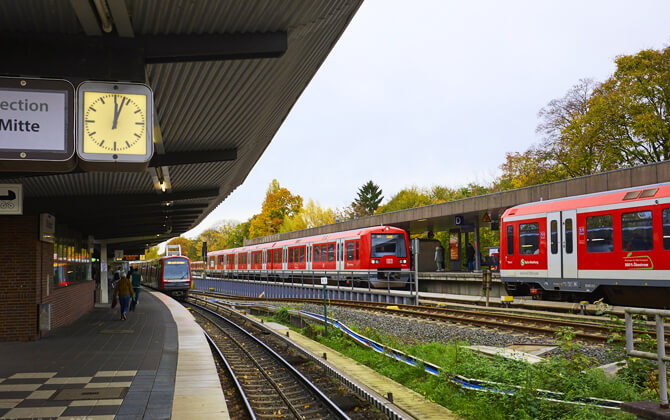
The Hamburg S-Bahn is integrated into the wider HVV public transport system, which also includes the U-Bahn, AKN railway, regional rail, bus, and ferry services. That makes transfers fairly simple across the city and the surrounding metropolitan region.
Several stations connect directly with other transport modes. Landungsbrücken links with Elbe ferries, while Jungfernstieg connects to Alster boats. Important bus interchanges are available at Altona, Barmbek, Bergedorf, Harburg, and Poppenbüttel. Hauptbahnhof also gives access to the central bus terminal for long-distance and international services.
U-Bahn interchange is available at several major hubs, including Barmbek, Berliner Tor, Dammtor/Stephansplatz, Eidelstedt, Elbbrücken, Hauptbahnhof, Hamburg-Harburg, Jungfernstieg/Rathaus, Landungsbrücken, Ohlsdorf, Sternschanze, and Wandsbeker Chaussee. Some of these transfers are within shared station complexes, while others require a short walk.
Regional and long-distance rail connections are available at Altona, Bergedorf, Hauptbahnhof, Harburg, Dammtor, Pinneberg, Stade, Buxtehude, Hasselbrook, and Horneburg. The network also connects with the AKN railway at Eidelstedt.
In addition, several stations have hvv-switch points with bicycle rental and car-sharing services. P+R facilities are available at 36 stations across the network.
Airport Connections
Hamburg Airport has direct links by S-Bahn, bus, taxi, car, and shuttle service, so transportation in and out of the airport is pretty easy.
S-Bahn
The S1 provides the main path train connection between Hamburg Central Station and the airport. Running time is about 25 minutes, and trains run every 10 minutes. Hamburg Airport (Flughafen) station sits directly below the terminals and can be reached from Terminals 1 and 2 by elevators, escalators, and stairs.
At Ohlsdorf, one stop before the airport, you can change to the U1. If you are traveling from the city center, board one of the first three cars, because the S1 splits at Ohlsdorf and the front section continues to the airport.
Tickets are available from machines in the arrivals area and between arrivals level and the platform. Standard HVV tickets are valid on this route, including day tickets and season tickets.
Bus
Bus stops are directly in front of Terminal 1 on Level 0. Several bus routes serve the airport, which is especially useful for local transport connections and late-night travel.
- Line 274
- Line 292
- Line X95
- Night bus line 606
Taxi
Taxis are available at the stands outside Terminal 1 and Terminal 2 on the arrivals level.
Car and motorcycle
Drivers can reach the airport via the A7. Take exit Schnelsen Nord and continue along the Airport Bypass / Zeppelinstrasse.
Shuttle service
Airport shuttle service is available by app only. The telephone number is +49 (0)40 80007500.
It is wise to allow a bit of extra time, especially during busy travel periods.
Parking near S-Bahn
Station parking is available through Park+Ride facilities across the Hamburg region. This setup makes it easier to leave the car outside the busiest areas and continue by train. In many cases, that means less stress, lower overall transport cost, and no hunt for city-center parking.
There are more than 100 Park+Ride facilities in the wider Hamburg region, and some are free of charge. For the onward trip, you simply continue with an HVV ticket.
How it works
- Drive to a Park+Ride facility near an S-Bahn station.
- Park your car and switch to the train for the rest of the route.
- Check available locations and details through the Park+Ride overview.
For accessible use, free station parking for up to 24 hours is available at barrier-free DB BahnPark facilities for people with a physical disability, or for an accompanying person, if they hold a valid blue or orange special parking permit. The permit should be displayed clearly behind the windshield instead of a parking ticket.
Parking charges per day are not listed here, and in some areas parking charges may be zero because parking is free.
Rules and Tips
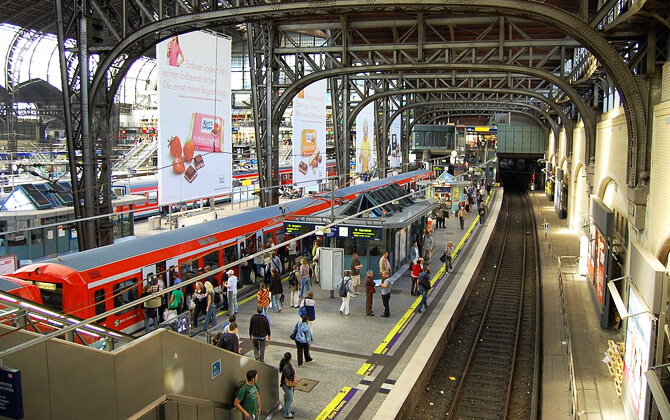
Hamburg’s S-Bahn is easy to use once you know the basics. Electronic displays at stations show the line, route, next stop, destination, and service changes. Platform signs also show the direction of travel, so check them before boarding.
Trains are marked by line number and final destination. In Hamburg, the main lines are S1, S21, S3, and S31, while S11 and S2 run during peak periods. One-digit lines use the inner-city tunnel, while double-digit lines use the connecting route to Dammtor.
Buy your ticket before travel, usually from a ticket machine. Payment can be made with coins, notes, or card. If you are not sure about the fare calculator logic or the right fare zone, use the destination selection key on the machine and enter your station.
- Check direction signs before you go down to the platform.
- Keep your ticket ready, especially when changing lines.
- Use station maps and online stations map tools to understand interchanges.
- Allow extra time in peak periods, when busy platforms can slow things down.
- On weekends and public holidays, trains run all night.
Bicycles are allowed free of charge on the S-Bahn before 6:00 a.m., between 9:00 a.m. and 4:00 p.m. Monday to Friday, and all day on weekends and public holidays. The limit is two bicycles per car.
If you drive into the city, Park & Ride can be a practical option. It helps avoid inner-city traffic and lets you finish the journey by public transport.
The system is generally straightforward and efficient, and following the signs makes it simple to travel safely and confidently.
History
The history of the Hamburg S-Bahn begins with the Hamburg-Altona City and Suburban Railway, opened on 5 December 1906 by the Prussian railway division in Altona. The first service used steam trains between Blankenese, Altona (Elbe), and Hamburg.
Electrification came quickly. In 1907, the line was equipped with overhead wires supplying 6,600 V AC at 25 Hz, and the first electric trains started running on 1 October 1907. From 29 January 1908, the route between Blankenese and Ohlsdorf was served exclusively by electric trains. These dates are generally treated as the start of the Hamburg S-Bahn.
In 1924, the network expanded to Poppenbüttel after the takeover and electrification of the Alster Valley Railway. In 1934, the term S-Bahn was officially applied to Hamburg’s network.
During the late 1930s, Hamburg switched from overhead AC to a DC third-rail system. The first DC trains of type ET 171 entered service in 1939, and regular operation began in July 1940 alongside the remaining AC trains. Mixed operation continued until 1955. The network then expanded to Sülldorf in 1950, Wedel in 1954, and Bergedorf in 1958.
In the 1960s, the line reached Langenfelde and Elbgaustraße via the AKN corridor. HVV was founded in 1965, and the S-Bahn joined in 1966. From January 1967, lines were numbered S1 to S6.
Construction of the City S-Bahn started in 1967 to relieve the busy Verbindungsbahn. The first underground section between Hauptbahnhof and Landungsbrücken opened in 1975 as interim line S10. The tunnel reached Altona in 1979 and was completed above ground to Diebsteich in 1981.
In the 1980s, the network expanded south to Harburg Rathaus and then Neugraben. In the 1990s, growing traffic on the Hamburg-Berlin corridor led to separate S-Bahn tracks toward Bergedorf and Aumühle, and service there was temporarily suspended in 1994 before later reopening.
From the late 1990s into the 2000s, Allermöhe station opened in 1999, the extension to Aumühle was completed in 2002, the S3 reached Stade in December 2007, and the airport branch to Hamburg Airport opened on 12 December 2008.
In June 2022, S-Bahn Hamburg GmbH announced a new network structure that took effect in December 2023. It introduced 5-minute intervals on much of the network and simplified the line system, including changes to the S2, S3, and S5.
Future Extensions
The Hamburg S-Bahn expansion program is focused on rising demand, more reliable operation, and extra capacity. In the south of the city, major modernization work is underway to prepare for tighter intervals, longer trains, and stronger performance across the corridor.
One of the biggest projects is the expansion of the line between Hamburg Central Station and Neugraben. This section is set to be modernized by the end of 2029 with new power supply, switching, and signaling technology. The plan also includes eight rectifier stations and a new electronic interlocking in Harburg.
The expected result is more stable service, better frequency, more room for passengers, and an extra connection through the new S6. The project is intended to allow up to three trains every ten minutes between Central Station and Neugraben, while also making longer S2 trains possible between Altona and Bergedorf.
Another major step is the future expansion of the S4. The first construction section is already underway, and other sections are moving through planning and approval. The long-term goal is a new S-Bahn connection to Bad Oldesloe and improved service in the eastern part of the Hamburg region.
In the short term, passengers can expect construction-related restrictions. After that, the network should be stronger and better prepared for future demand.
Nearby Attractions
The Hamburg S-Bahn is a practical way to reach many of the city’s best-known sights. Along the S1, Reeperbahn is the stop for nightlife and theaters, Landungsbrücken for the harbor and museum ships, and Jungfernstieg for the Alster, shopping, and the City Hall area.
If you are near Hauptbahnhof, the area around the main station is a good base for shopping and culture. Mönckebergstraße is close by, and nearby venues include the Museum of Arts and Crafts, the Deichtorhallen, and the Deutsches Schauspielhaus.
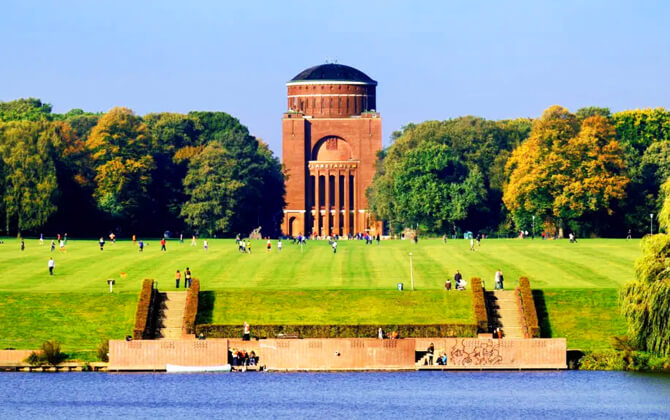
For greener outings, Blankenese is a good stop for walks by the Elbe and through the Treppenviertel. Klein Flottbek gives access to Jenischpark, and Alte Wöhr is the station for Stadtpark and its Planetarium. From Ohlsdorf, it is also a short trip to Ohlsdorf Cemetery, known as the world’s largest park cemetery.
At the end of the line, Poppenbüttel gives access to the Alstertal shopping center, handy if you want to combine city transport with a shopping stop.