The Duisburg Stadtbahn is a core part of public transport in Duisburg, North Rhine-Westphalia, and belongs to the wider Rhine-Ruhr Stadtbahn system. Operated by Duisburger Verkehrsgesellschaft (DVG) and integrated into the VRR network, it combines one true light rail line with two tramway lines that run underground in the city centre and on surface sections farther out. Construction started in the late 1960s, but the original route plan was only partly completed, so today the system reflects both big ambitions and a more limited final build-out.
| Key | Information |
|---|---|
| System | Duisburg Stadtbahn, part of the Rhine-Ruhr Stadtbahn system |
| Operator | Duisburger Verkehrsgesellschaft (DVG) |
| Fare network | VRR |
| Lines | U79, 901, 903 |
| Type | One light rail line and two tram premetro lines |
| Main interchange | Duisburg Hbf |
| City centre alignment | Underground |
| Outer sections | Surface running |
| Construction start | 1969 in the general project history; concrete work near Sittardsberg began in 1970 |
| Inner-city tunnel opening | 1992 |
Duisburg Metro Map
Map of Duisburg Metro showing different lines. Click on the map to enlarge it or download the Duisburg Metro map in PDF format.
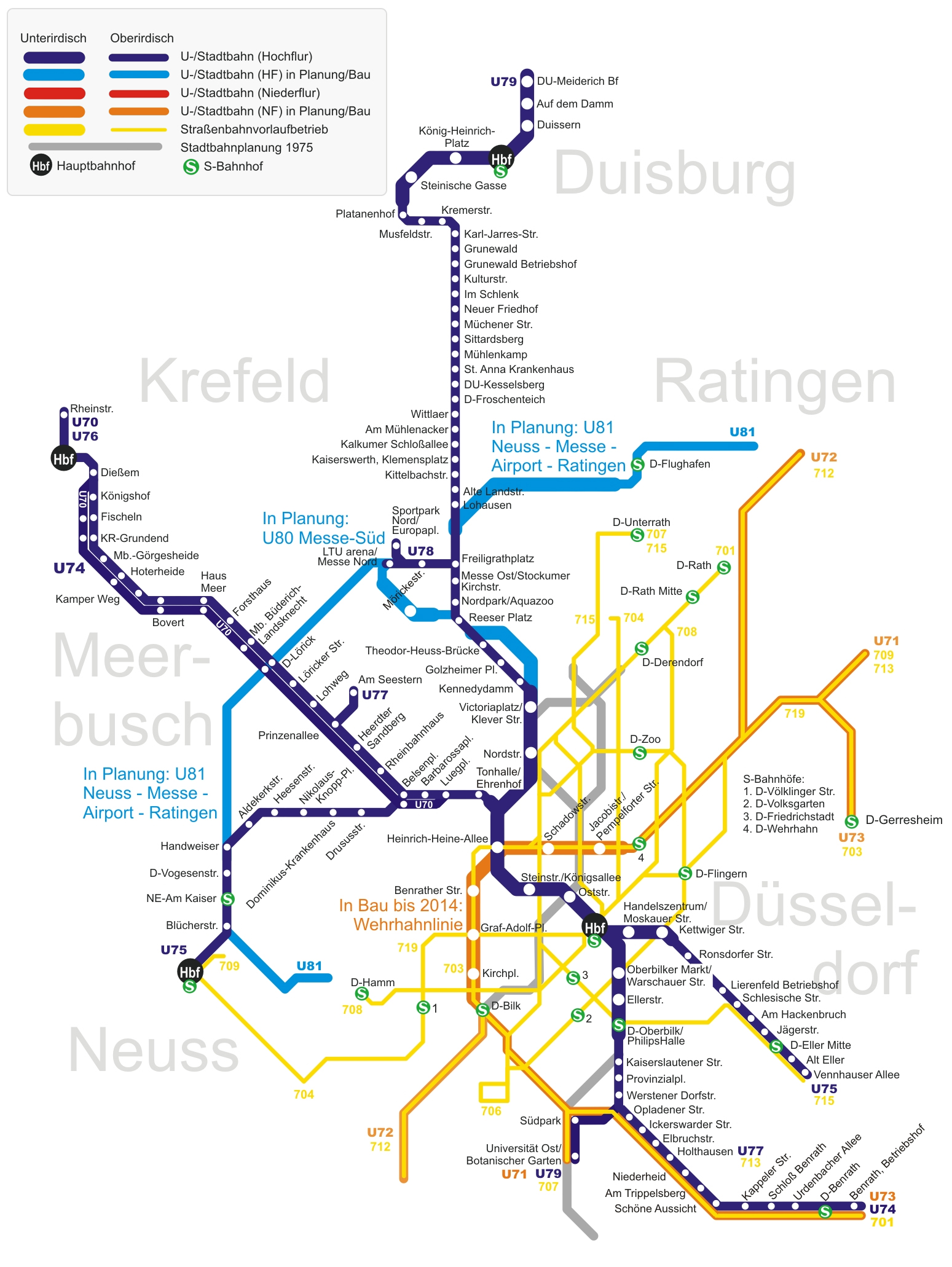
Duisburg Stadtbahn Lines and Stations
The Duisburg Stadtbahn is part of the Rhine-Ruhr Stadtbahn system and is operated by DVG. It includes three lines, one light rail service and two tram lines, all integrated into the VRR fare system.
Line U79
U79 is the network’s true light rail or path train style service. It runs from Meiderich Süd Bf through Duisburg Hbf, König-Heinrich-Platz, Grunewald, DU-Kesselsberg, D-Wittlaer, Kaiserswerth, and Heinrich-Heine-Allee to Düsseldorf Hbf, then continues via Oberbilk S/Philipshalle and Kaiserslauterner Straße to Universität Ost/Botanischer Garten.
| Station | Details |
|---|---|
| Meiderich Süd Bf | Western/northern end of the Duisburg section |
| Duisburg Hbf | Main interchange with rail and other public transport |
| König-Heinrich-Platz | Central city station |
| Grunewald | On the southbound route |
| DU-Kesselsberg | Intermediate station toward Düsseldorf |
| D-Wittlaer | On the intercity section |
| Kaiserswerth | Serves northern Düsseldorf area |
| Heinrich-Heine-Allee | Key Düsseldorf stop |
| Düsseldorf Hbf | Main station in Düsseldorf |
| Oberbilk S/Philipshalle | Further stop on the route |
| Kaiserslauterner Straße | Intermediate stop |
| Universität Ost/Botanischer Garten | Southern end of the line |
Line 901
Line 901 runs from Obermarxloh Schleife via Marxloh Pollmann, Beeck Denkmal, Laar Kirche, Ruhrort Bf, König-Heinrich-Platz, and Duisburg Hbf to Zoo/Uni, then continues to Mülheim-Speldorf and Mülheim (Ruhr) Hbf.
| Station | Details |
|---|---|
| Obermarxloh Schleife | One end of line 901 |
| Marxloh Pollmann | Important stop in the north |
| Beeck Denkmal | Intermediate stop |
| Laar Kirche | Intermediate stop |
| Ruhrort Bf | Rail connection point |
| König-Heinrich-Platz | Central city stop |
| Duisburg Hbf | Main interchange |
| Zoo/Uni | Useful for Zoo Duisburg and university access |
| Mülheim-Speldorf | Intermediate stop toward Mülheim |
| Mülheim (Ruhr) Hbf | Line terminus in Mülheim |
Line 903
Line 903 links Dinslaken Bf with Duisburg and continues via DU-Walsum, Marxloh Pollmann, Hamborn Rathaus, Meiderich Süd Bf, Duisburg Hbf, König-Heinrich-Platz, Hochfeld Süd Bf, Wanheimerort, and Hüttenheim Schleife.
| Station | Details |
|---|---|
| Dinslaken Bf | Northern end of the line |
| DU-Walsum | Intermediate stop |
| Marxloh Pollmann | Shared corridor stop |
| Hamborn Rathaus | Important district stop |
| Meiderich Süd Bf | Connection with U79 area |
| Duisburg Hbf | Main interchange |
| König-Heinrich-Platz | Central underground station |
| Hochfeld Süd Bf | Southern intermediate stop |
| Wanheimerort | Intermediate district stop |
| Hüttenheim Schleife | Southern end of the line |
In the city centre, the lines share an underground alignment. In the suburbs, they run above ground. For most riders, that combined setup is what makes the Duisburg stations map easy to understand: one central tunnel, then surface branches.
Tariffs, Tickets, and Cards
If you travel only now and then, a subscription is usually unnecessary. For single rides, group travel, or several journeys in one day, there are ticket options that can reduce cost.
You can buy a ticket in several ways:
- At DVG ticket machines at most stops. Payment can be made by cash or card. Tickets bought there are not validated automatically, so you need to validate them when boarding.
- In the myDVG Bus&Bahn app, where all tickets are available and the eezy fare can also be used.
- At the DVG customer center or another sales point, where you can also pay by card and get advice.
- On the bus, directly from the driver. From 1 September 2024, only single, child, and bicycle tickets are sold on board, and these are validated immediately.
Children under 6 travel free with an adult and do not need a ticket. Children from age 6 need child fares, and from age 15 the adult fare applies.
Main ticket types include the Single Ticket, 4-trip ticket, 24-hour ticket for one to five people, Additional Ticket for pass holders, and Bicycle Ticket valid for 24 hours after validation. For travel beyond the VRR area, NRW-wide options are also available, including the EinfachWeiterTicket NRW, SchöneFahrtTicket NRW, SchönerTagTicket NRW, SchönerTagTicket NRW for 5 people, SchönesJahrTicket NRW, and Schöne60Ticket NRW.
The table below shows the published fare and ticket price in euro and approximate US dollars.
| Ticket type | Who? | Price level A | Price level B | Price level C |
| Single Ticket | Adults | €3.80 (about $4.10) | €7.80 (about $8.42) | €19.80 (about $21.38) |
| Single Ticket | Children | €2.10 (about $2.27) | €2.10 (about $2.27) | €2.10 (about $2.27) |
| 4-trip ticket | Adults | €15.20 (about $16.42) | €31.20 (about $33.70) | €79.20 (about $85.54) |
| 4-trip ticket | Children | €8.40 (about $9.07) | €8.40 (about $9.07) | €8.40 (about $9.07) |
| 24-hour ticket | 1 person | €7.60 (about $8.21) | €15.60 (about $16.85) | €38.40 (about $41.47) |
| 24-hour ticket | Each additional person (up to 5) | +€5.10 (about +$5.51) | +€6.20 (about +$6.70) | +€6.90 (about +$7.45) |
| Additional Ticket | €4.60 (about $4.97) | €4.60 (about $4.97) | €4.60 (about $4.97) | |
| Bicycle Ticket | €4.60 (about $4.97) | €4.60 (about $4.97) | €4.60 (about $4.97) |
Price level A covers one city or tariff area, price level B covers a central tariff area and adjacent ones, and price level C is valid across the entire VRR area. Single ticket validity is 90 minutes for level A, 120 minutes for level B, and 300 minutes for level C.
If you need a fare calculator, the exact fare for a single journey can be checked in the electronic timetable information. That is the easiest way to confirm the right price for your route.
Operating Hours and Timetable
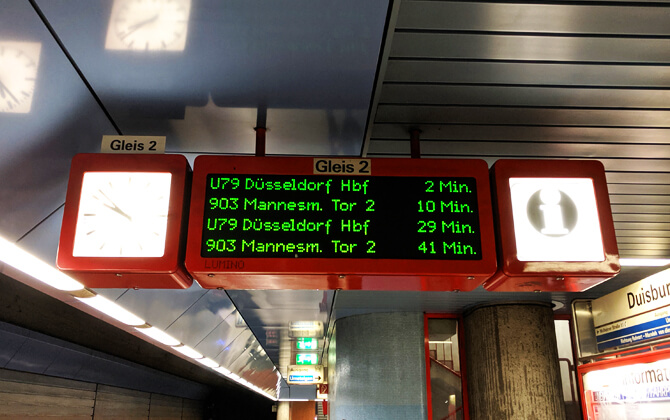
The Duisburg transport system is not a 24-hour service. Opening times differ by line, but the general running time of the network is from early morning until around midnight.
| Service detail | Timings |
|---|---|
| Network operating hours | Roughly from 4:30 a.m. until midnight |
| U79 starting time | 4:52 a.m. |
| U79 last train / closing time | 12:35 a.m. |
| U79 frequency | Usually every 15 minutes, every 10 minutes in peak periods |
| 901 starting time | 4:20 a.m. |
| 901 last train / closing time | 11:40 p.m. |
| 901 frequency | Usually every 15 minutes, every 10 minutes in peak periods |
| 903 starting time | 3:54 a.m. |
| 903 last train / closing time | 12:34 a.m. |
| 903 frequency | Every 8 minutes throughout the day |
If you need timings today, schedule today, or a full train schedule for a specific stop, it is best to check real-time timetable information before travel. The route timetable can change by day and service pattern.
For quick planning, keep in mind that U79 and 901 usually run at 15-minute intervals outside peak times, while 903 is more frequent. If you are trying to catch the last train, check your exact station in advance, especially for late-evening trips.
Interconnectivity with Other Systems
The Duisburg Stadtbahn is tightly integrated with the wider Rhine-Ruhr public transport network. Within the VRR system, it connects Duisburg with cities such as Bochum, Dortmund, Düsseldorf, and Essen, while also linking into regional tram and rail services.
In addition to the Stadtbahn, Duisburg is served by the Rhine-Ruhr S-Bahn. Lines S1 and S2 stop at Duisburg Hauptbahnhof, where you can transfer to all three Stadtbahn lines. Several bus routes support local transport across the city, and with more than 400 bus stops, the bus network gives the broadest area coverage.
Duisburg Hbf is the key interchange. It connects the Stadtbahn with S-Bahn services, long-distance Deutsche Bahn trains, and the rest of the city’s transport network. For most visitors, it is the main hub for city transport in Duisburg.
The source material mentions bus links and rail transfers, but it does not provide details on station parking or parking charges per day.
Connectivity to the Airport
Duisburg does not have its own airport, so air travelers usually use Düsseldorf Airport. It is the third busiest airport in Germany, after Munich and Frankfurt.
There are two main rail options from the airport area to Duisburg, but the more practical one for most travelers is the S-Bahn. At Düsseldorf Airport Station, the lower-level S-Bahn station is served by line S1, which goes directly to Duisburg Hauptbahnhof.
From Duisburg Hbf, all three Stadtbahn lines are accessible. That makes the S1 connection the simplest route for reaching the Duisburg Stadtbahn after landing.
Duisburg Hauptbahnhof is also an important interchange within the wider transport system, linking local transport, regional rail, and long-distance trains.
Historical Overview
The Duisburg Stadtbahn is part of the Rhine-Ruhr Stadtbahn system and has become a central element of public transport in the city. It is operated by DVG and integrated into the VRR network.
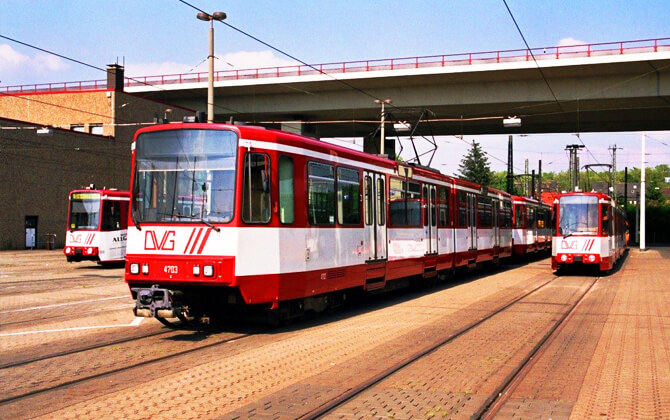
Planning began with the idea of creating a largely grade-separated light rail system on its own right-of-way, connecting the city centre with key districts. The original route plan included an east-west axis toward Mülheim an der Ruhr and Moers, plus northern routes toward Oberhausen-Holten and Dinslaken, while the south would be served via Wanheimerort and Hochfeld.
Construction began in 1967, and on 16 December 1970 an 800 m section near Sittardsberg entered the excavation phase. That equals about 0.8 km or 0.5 miles. In 1974, the section from Sittardsberg to Huckingen was completed. It ran at ground level on its own right-of-way as far as St.-Anna-Krankenhaus, then continued as an elevated line.
During this period, Angerbogen station was also built near the Düsseldorf city boundary. It never opened because the planned surrounding district was not developed at the expected scale.
The project was shaped by financial pressures and changing priorities. Although the city council backed further underground construction in 1974, progress slowed during the economic crisis of the mid-1970s. Major tunnel structures were not completed until 1983, and the underground line beneath central Duisburg finally opened on 11 July 1992.
That 1992 opening included five underground stations: Steinsche Gasse, König-Heinrich-Platz, Duisburg Hbf, Duissern, and Rathaus. It also changed the city centre by removing street-running tracks from central areas and allowing places like Königstraße to be redesigned for pedestrians.
At the same time, the former tram line 2 between Duisburg-Hochfeld Süd and Platanenhof returned to service, and line 903 gained a direct connection from Hüttenheim to the city centre without the earlier detour via Grunewald and Neudorf.
Another major step came in 2000, when the tunnel was extended with two more underground stations, Auf dem Damm and Meiderich Bahnhof. This northern extension continued beyond Duissern, passed under the harbor area, and cut journey times on U79.
By the early 2000s, the Stadtbahn had become the main structure of Duisburg’s rapid transit system, even though only U79 was fully realized as a true Stadtbahn line. Lines 901 and 903 continued to operate as tram services.
Over time, platform heights and station facilities were adapted for high-floor service. On the southern U79 branch, several stations were raised for level boarding, and later upgrades included converting stops such as St.-Anna-Krankenhaus into full stations with lifts.
| Station | Details |
|---|---|
| 79 → U79 | Extended to Meiderich Bf. in 2000; extended in 2012 to Universität Ost/Botanischer Garten |
| 901 → 901 | Still operates as line 901; route differs in Mülheim, with underground running to Mülheim Hauptbahnhof |
| 904 / 909 → 903 | Reduced to one line; lines to Huckingen and Laar are no longer in service |
Future Expansions
The Duisburg Stadtbahn has limited room for major network growth, and the available material suggests the current system will stay broadly stable. Earlier expansion plans were far more ambitious, but they were never fully carried out.
What is moving ahead are targeted upgrades to the existing system. In Duisburg, planned works focus mainly on accessibility, stop rebuilding, and renewals along the current route network. Locations mentioned include Stockumer Straße, Brauerei, Neumühler Straße / Bahnhofstraße, Karl-Lehr-Brückenzug, Kulturstraße, Karlstraße, Marxloh Pollmann, Grunewald Betriebshof, Albertstraße, Wilfriedstraße, Hamborn Betriebshof, Platanenhof, Neustraße, Ruhrort Bahnhof, Schweizer Straße, and Fischerstraße.
Several of these projects are planned between 2025 and 2030. The material also notes that some short-term works are not listed, which points to an ongoing modernization program rather than rapid system expansion.
Another important development is fleet renewal on U79. DVG and Rheinbahn have jointly ordered new high-floor Stadtbahn vehicles from Siemens to replace the older B80 fleet and improve comfort, safety, and accessibility on the Duisburg-Düsseldorf line.
So the clearest future changes are stop upgrades, bridge and track reconstruction, and new trains on U79, not a major new route plan.
Useful Tips
When using public transport in Duisburg, remember that the system works on a proof-of-payment basis. There are no entrance barriers, but you should always carry a valid ticket because inspections can happen at any time.
Keep your belongings with you. Unattended bags can quickly become a security concern.
Before traveling, check the timetable for your line. Operating hours, opening hours, and frequency vary, and the system does not run all night. If you need schedule today information or timings today, use real-time service updates.
For fares, choose the ticket that matches your route and number of rides. Short trips cost less, while longer journeys depend on the zone. If you are making multiple rides in one day, a day pass or 24-hour ticket may make more sense than buying separate singles.
If you are arriving through Düsseldorf Airport, the easiest route is usually S1 to Duisburg Hauptbahnhof, then a transfer to U79, 901, or 903.
The source material does not include information about station parking, parking charges, or parking charges per day.
Interesting Facts
The Duisburg Stadtbahn is part of the wider Rhine-Ruhr system and sits at the heart of local transport in the city. It is operated by DVG and integrated into VRR.
The network has three lines: U79, 901, and 903. U79 is the only true light rail line, while 901 and 903 continue to operate as tram lines. Together, they connect Duisburg with Düsseldorf, Mülheim an der Ruhr, and Dinslaken.
Construction began in 1967, and a first 800 m section near Sittardsberg entered construction in 1970. The inner-city tunnel opened on 11 July 1992 and gave the network its main underground section through central Duisburg.
One of the best-known oddities is Angerbogen station. It was built for €10.5 million, about $11.34 million, but never opened because the planned nearby district was not developed as expected. It remains a ghost station.
U79 was extended to Meiderich Bahnhof in 2000 and now continues all the way to Düsseldorf. On the Duisburg section, 16 of its 20 stations have high platforms for level boarding.
Another notable feature is the two-level track layout between König-Heinrich-Platz and Duisburg Hbf. This arrangement supports line operations and direction-based operations, making it an especially important transfer section.
Modernization has also reached lines 901 and 903. Rebuilt stops increasingly use 26 cm central platforms, and dynamic passenger information displays are now found even outside the city centre, including in Marxloh, Obermarxloh, and Laar.
Because of narrow track spacing in some places, Duisburg needed a special 2.2 m wide version of the GT 8 NC-DU vehicle rather than the wider standard models used elsewhere. That is about 2.2 km? No, here it is a vehicle width measurement, which equals roughly 7.2 ft.
The network also gives direct access to several city landmarks. Line 903 serves Landschaftspark-Nord, line 901 stops at Zoo/Uni for Duisburg Zoo, and U79 provides access to Duissern for Tiger & Turtle.
Tourist Attractions and Sightseeing
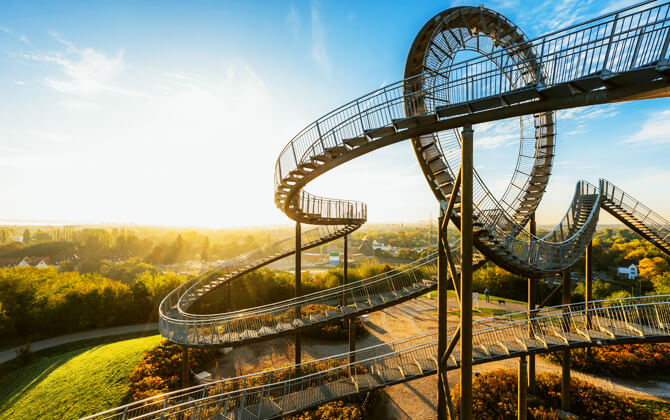
Duisburg has several memorable sights that are easy to combine with a Stadtbahn or tram ride. The city’s best-known attractions include industrial heritage sites, museums, and striking public art, so it works well for both short visits and longer days out by public transport.
Landschaftspark Duisburg-Nord
Landschaftspark Duisburg-Nord is one of the city’s standout attractions. This former ironworks has been turned into a public park, and it is especially impressive at night when the structures are illuminated. It combines industrial history, open space, museums, and art in one place.
Tiger and Turtle – Magic Mountain
Tiger and Turtle – Magic Mountain is another landmark that stands out right away. It looks like a roller coaster, but it is actually a walkable sculpture. After dark, it becomes even more striking when lit up.
City Centre Sights
In the city centre, visitors can see places such as the Duisburg Christmas Market and Mercatorhalle Duisburg. This area is also a practical base for sightseeing, with Stadtbahn access at König-Heinrich-Platz and Steinsche Gasse.
Museums and Culture
Duisburg Mitte and Dellviertel are good areas for museums and culture. Mentioned highlights include the Lehmbruck Museum, the Museum of Cultural and Local History, and Theater am Marientor. Duisburg Mitte is noted for archaeological and museum visits, while Dellviertel is also known for bars and museum stops.
Zoo Duisburg
Zoo Duisburg is a popular stop and easy to reach by public transport. It is known for primates, a dolphinarium, and koala bears.
Rhine and the Harbor Area
The Rhine and harbor districts are also worth seeing. Duisburg is famous for having the world’s biggest inland harbour, and boat trips on Duisport offer a different way to experience it. The Innenhafen mixes museums, restaurants, pubs, and bars in a redeveloped industrial setting.
For sightseeing without a car, the Duisburg Stadtbahn and tram network make it easy to move between these places and explore different parts of the city.