The Dortmund Stadtbahn is Dortmund’s light rail system and part of the wider Rhine-Ruhr Stadtbahn network. Operated by DSW21, it has eight lines and a 75-kilometre (46.6-mile) route network, including 20.5 kilometres (12.7 miles) in tunnels. The system combines metro-style underground sections with tramway-style surface running, and its main city-centre interchanges are Kampstraße, Reinoldikirche, and Stadtgarten.
| Key | Information |
|---|---|
| Operator | DSW21 |
| System type | Light rail / Stadtbahn |
| Lines | 8 |
| Route length | 75 kilometres (46.6 miles) |
| Tunnel length | 20.5 kilometres (12.7 miles) |
| Total stations | 125 |
| Street-level stations | 98 |
| Underground stations | 27 |
| Main interchange stations | Kampstraße, Reinoldikirche, Stadtgarten |
| Network structure | Three trunk routes crossing in a triangular pattern in the city centre |
Dortmund Metro Map
Map of Dortmund Metro showing different lines. Click on the map to enlarge it or download the Dortmund Metro map in PDF format.
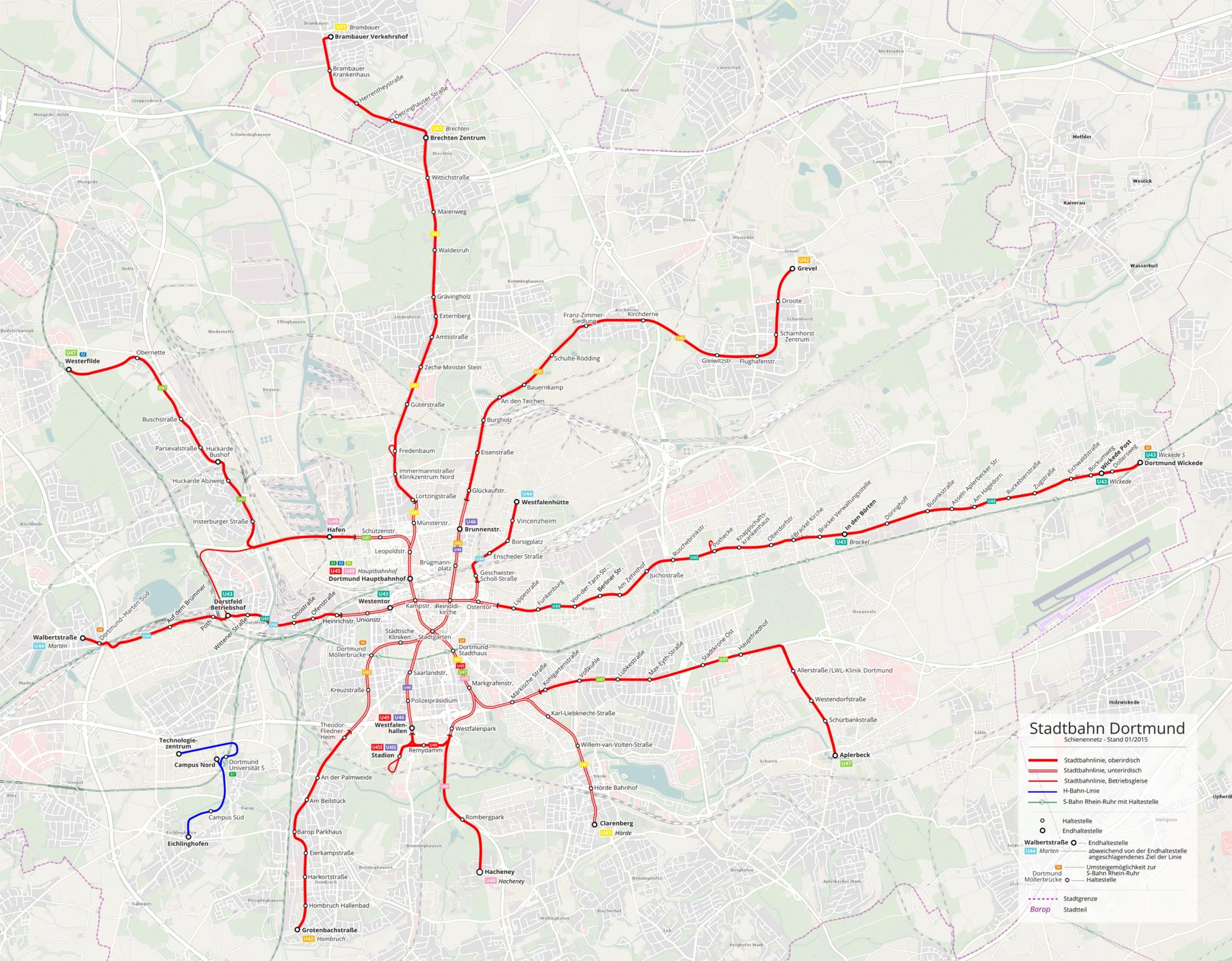
Lines and Stations of the Dortmund Stadtbahn
The Dortmund Stadtbahn is integrated into the Rhine-Ruhr Stadtbahn network and serves the city with eight lines. The route runs for 75.0 kilometres (46.6 miles), of which 20.5 kilometres (12.7 miles) are underground and 54.5 kilometres (33.9 miles) are above ground on dedicated alignments. It is a mixed system, part metro and part tramway, and that blend shapes both the route plan and the stations map used by passengers.
The network opened in stages between 1976 and 2008, as inner-city tram tracks were moved into tunnels and faster surface corridors were developed away from road traffic. DSW21 operates the whole system.
Network
Here is the Dortmund Stadtbahn stations list by line and route.
| Station | Details |
|---|---|
| U41 | Route: Dortmund-Hörde – Lünen–Brambauer |
| U42 | Route: Hombruch – Grevel |
| U43 | Route: Dorstfeld – Wickede |
| U44 | Route: Marten – Westfalenhütte |
| U45 | Route: Westfalenhallen – Dortmund Hbf – (Fredenbaum) |
| U46 | Route: Westfalenhallen – Brunnenstraße |
| U47 | Route: Westerfilde – Aplerbeck |
| U49 | Route: Hacheney – Dortmund Hbf – (Hafen) |
The U41 and U47 also connect with bus 490 for airport travel.
Stations and connections
Several stations provide easy interchange with the S-Bahn Rhein-Ruhr. Key transfer points include Dortmund Stadthaus, Dortmund Möllerbrücke, Dortmund-Westerfilde, Dortmund-Marten Süd, Dortmund-Wickede, and Dortmund Hauptbahnhof. Hörde is within walking distance of Dortmund-Hörde station and also connects with regional rail services.
Rolling stock
| Station | Details |
|---|---|
| B80C; B6 | 43 vehicles built by Duewag and BBC between 1986 and 1993; in regular operation since 1987 on U41, U42, U45, U46, U47, and U49. All B6 cars are planned for full refurbishment. |
| B80C; B8 | 21 vehicles built by Duewag, BBC, and Adtranz between 1994 and 1999; in regular operation since 1996 on U41, U42 (occasionally), U45, U46, U47, and U49. The first ten B8 cars, numbered 344–354, were rebuilt from former B6 cars. |
Operating Hours and Schedules
The Dortmund Stadtbahn does not run around the clock. Operating hours usually begin at about 3:00 a.m., and trains continue after midnight until roughly 1:15 a.m. the next day. After that, night bus services take over. Opening hours, closing time, and exact timings vary by line and by day, so schedule today details can differ from the standard timetable.
On weekdays, most lines run every 10 minutes during the day. Evening service on many routes shifts to every 15 minutes. Sundays are generally less frequent, and some lines move to longer intervals late at night. U49 is the main exception, with 30-minute frequency near the end of service.
First and Last Departures by Line
| Service detail | Timings |
|---|---|
| U41 | Weekday starting time 3:10 a.m.; Saturday 4:01 a.m.; Sunday 7:18 a.m.; last train 12:59 a.m. |
| U42 | Weekday starting time 3:55 a.m.; Saturday 4:49 a.m.; Sunday 7:18 a.m.; last train 12:51 a.m. |
| U43 | Weekday starting time 3:01 a.m.; Saturday 4:28 a.m.; Sunday 7:13 a.m.; last train 12:25 a.m. |
| U44 | Weekday starting time 3:45 a.m.; Saturday 4:54 a.m.; Sunday 7:46 a.m.; last train 12:34 a.m. |
| U45 | Weekday starting time 4:03 a.m.; Saturday 5:13 a.m.; Sunday 8:13 a.m.; last train 1:17 a.m. |
| U46 | Weekday starting time 4:27 a.m.; Saturday 5:24 a.m.; Sunday 8:09 a.m.; last train 12:01 a.m. |
| U47 | Weekday starting time 3:45 a.m.; Saturday 5:01 a.m.; Sunday 7:16 a.m.; last train 12:42 a.m. |
| U49 | Weekday starting time 4:15 a.m.; Saturday 5:37 a.m.; Sunday 8:07 a.m.; last train 11:48 p.m. |
Frequency Overview
- U41: every 10 to 20 minutes on most days; every 15 to 30 minutes on Sundays.
- U42: usually around every 10 minutes in the afternoon; every 15 minutes on Sundays.
- U43: around every 20 minutes early in the morning, then every 10 minutes for most of the day, and every 15 minutes later on.
- U44: every 10 minutes on weekdays, with 15-minute evening service; weekends vary between 10 and 15 minutes.
- U45: every 10 minutes on weekdays for most of the day; every 15 minutes on weekends, with 30-minute night service.
- U46: every 10 minutes at peak times and every 15 minutes off-peak; weekends range from 10 to 15 minutes, then 30 minutes late in the day.
- U47: every 10 minutes in the morning and every 15 minutes in the afternoon on weekdays; every 15 minutes on weekends, with 30-minute night service.
- U49: every 20 minutes early on weekdays, then every 10 minutes for most of the day; weekends range from 10 to 15 minutes, with 30-minute late service.
For the most reliable train schedule, route timetable, and timings today, it is best to check the live departure boards before you travel, especially in the evening and on Sundays.
Fares, Tickets, and Cards
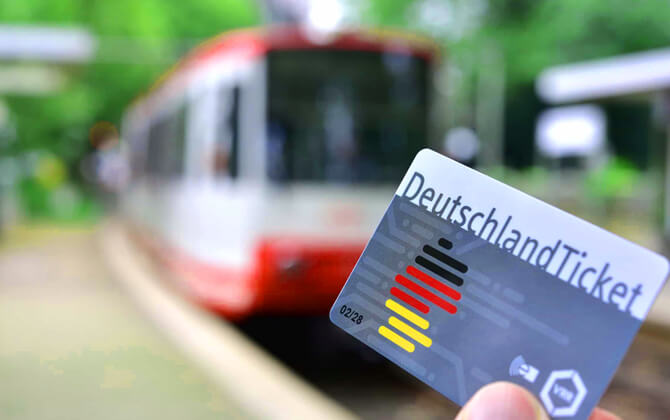
The Dortmund Stadtbahn uses the VRR fare system, which applies across much of the Rhine-Ruhr region. Fare and ticket price depend on distance and the number of zones crossed. There are four fare zones: A, B, C, and D, with Zone A split into A1, A2, and A3.
For occasional trips, a short-trip ticket costs €1.60 (about $1.73). Standard fares are €2.70 (about $2.92) for Zone A, €5.80 (about $6.26) for Zone B, €12.10 (about $13.07) for Zone C, and €15.00 (about $16.20) for Zone D. Children pay a flat fare of €1.60 (about $1.73).
There are also multi-ride tickets. A four-ride ticket costs €5.90 (about $6.37) for short trips, €10.00 (about $10.80) for Zone A, €20.90 (about $22.57) for Zone B, €42.80 (about $46.22) for Zone C, and €52.90 (about $57.13) for Zone D. A ten-ride ticket costs €13.60 (about $14.69) for short trips, €22.00 (about $23.76) for Zone A, €44.00 (about $47.52) for Zone B, €88.00 (about $95.04) for Zone C, and €100.00 (about $108.00) for Zone D.
A day pass is available for unlimited travel. Prices are €6.80 (about $7.34) for Zone A, €13.90 (about $15.01) for Zone B, €23.60 (about $25.49) for Zone C, and €28.40 (about $30.67) for Zone D. Seven-day passes cost €21.90 (about $23.65) for Zone A1, €26.65 (about $28.78) for Zone A2, €27.65 (about $29.86) for Zone A3, €40.40 (about $43.63) for Zone B, €53.15 (about $57.40) for Zone C, and €67.70 (about $73.12) for Zone D.
For regular travel, monthly pass options such as Ticket1000 and Ticket2000 are widely used. Ticket2000 includes added benefits such as taking another person at certain times, bringing children under 15, or carrying a bicycle. A cheaper version valid from 9:00 a.m. is also available.
Special ticket and card options are offered for some groups, including the SchokoTicket for students under 25, the YoungTicket, the FirmenTicket, the MeinTicket, and the BärenTicket for passengers aged 60 and over.
No fare calculator is provided here, but the zone-based structure makes the cost easy to follow once you know your route.
Connections to Other Systems
Dortmund’s public transport system is designed around straightforward interchange. The Stadtbahn is the city’s main rail-based transport network, but it works closely with S-Bahn, bus, and long-distance rail services, making it a key part of transportation in Dortmund and the wider Ruhr area.
The most important rail connection is the Rhine-Ruhr S-Bahn. Four S-Bahn lines serve Dortmund, and several Stadtbahn stations connect directly with them. From Dortmund Hauptbahnhof, the U41, U45, U47, and U49 link with the S1, S2, and S5. The S4 connects through Dortmund-Wickede, Dortmund Stadthaus, and Dortmund Möllerbrücke.
Bus services, also operated by DSW21, are fully integrated into the local transport network. Many bus stops sit right next to Stadtbahn stations, so changing between modes is usually simple.
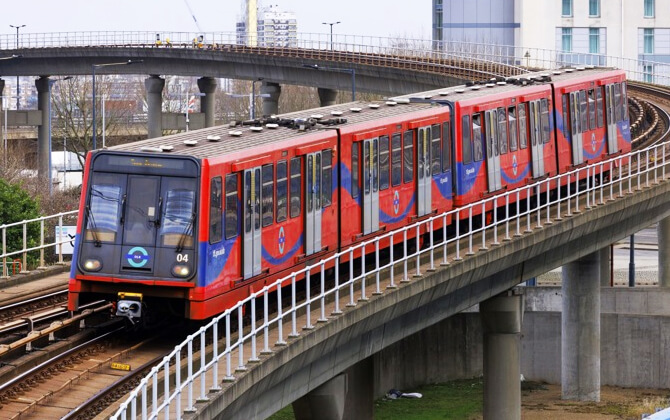
Dortmund also has the H-Bahn, a suspended system linking the two University of Dortmund campuses. There is no direct Stadtbahn connection, so passengers need to use the S-Bahn to reach it.
Dortmund Hauptbahnhof is the city’s central rail hub and an important interchange within the Stadtbahn system. It also offers long-distance rail services, including connections toward the Netherlands and Belgium.
For airport trips, Dortmund Airport can be reached by bus through the AirportExpress to Dortmund Hauptbahnhof or by bus 440, which connects with U47. For Düsseldorf International Airport, passengers can take the S1 to Dortmund Hauptbahnhof and transfer there.
Access to the Airport
Dortmund Airport is reached by public transport using bus connections rather than a direct path train or Stadtbahn line. The AirportExpress runs nonstop between Dortmund Central Station and the airport terminal, while the AirportShuttle links Holzwickede station with the terminal. Both rail stations are served by Deutsche Bahn local and long-distance trains.
The AirportExpress and AirportShuttle are not part of the VRR fare system, so you need a separate ticket.
Public transport details
- The AirportExpress runs during airport opening hours between Dortmund Central Station and the terminal. The running time is about 25 minutes.
- The AirportExpress stop at Central Station is on the forecourt at the Königswall/City exit, near the taxi rank.
- A single AirportExpress ticket costs €10.00 (about $10.80). Children under 14 pay €2.00 (about $2.16), and children under six travel free.
- Tickets can be bought from the driver with cash only, or from the machine in front of the terminal with cash or cashless payment.
- The AirportShuttle between Holzwickede station and the terminal takes about 6 minutes. A single ticket costs €3.00 (about $3.24). Children under 14 pay €2.00 (about $2.16), and children under six travel free.
- AirportShuttle tickets are sold by the driver or at the terminal ticket machine.
- If you are coming from the west of Dortmund, bus 490 also serves the airport and stops at car parks P6 East/West and P5 before the terminal.
- Bus line 440 ends in Dortmund-Aplerbeck, where bus 490 continues to the airport from Rodenbergstraße.
- From Unna station, VKU bus C41 runs hourly to the airport.
If you are heading to the airport by bus, leave extra time for the journey, especially because of traffic restrictions linked to the six-lane expansion of the A40 motorway.
A Short History of the Dortmund Stadtbahn
The Dortmund Stadtbahn is part of the Rhine-Ruhr Stadtbahn network and is operated by DSW21. Its history is one of gradual conversion, as older tram routes were upgraded and moved into tunnels between 1976 and 2008.
The first section to open was a 4.1-kilometre (2.5-mile) express tram route between Kirchderne and Grevel on 15 May 1976. It was first served by line 2, later 402 and 406, and today forms part of the U42. Even earlier, Dortmund had already introduced a grade-separated tramway route from Markgrafenstraße via Westfalenpark to Hacheney on 30 April 1959. The city’s first underground station, Westfalenhalle, followed in 1967.
The official start of Stadtbahn construction is tied to a 1968 city council decision and the first pile-driving work on 22 October 1969. A major milestone came on 27 May 1983, when the first longer tunnel section opened in Hörde. Before the full city-centre tunnel was ready, that section was still used by tram lines 401 and 406. On 2 June 1984, the inner-city section between Leopoldstraße and Westfalenpark opened together with the first Stadtbahn services.
Further extensions followed in the 1980s and 1990s, including Stammstrecke II and additional tunnel stations such as Reinoldikirche and Brügmannplatz. The east-west corridor, Stammstrecke III, arrived much later. U43 and U44 started operating on 27 April 2008, replacing former tram lines 403 and 404. From that point, all rail traffic in Dortmund’s city centre ran underground.
The system also changed technically over time. It originally ran on 600 V DC, then was gradually converted to 750 V to match newer trains. The conversion was completed on Stammstrecke I in December 1999, on Stammstrecke II in June 2002, and on Stammstrecke III in 2012.
Today, the network has eight lines and a total route length of 75 kilometres (46.6 miles), including 20.5 kilometres (12.7 miles) in tunnels.
Future Expansions
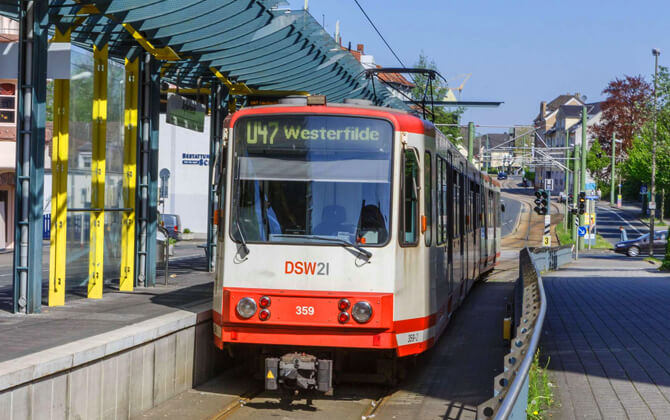
Future expansion plans focus on fleet renewal as well as selected route extensions. DSW21 is introducing a new generation of high-floor Stadtbahn vehicles, while older B80C units are being modernized in the same design. In total, 98 vehicles are set to be newly acquired or upgraded as part of the B-Wagen project, which has a volume of around €250 million (about $270 million).
When the program is complete, the fleet will grow from 121 to 145 vehicles. The new and rebuilt trains are meant to improve accessibility, add more multi-purpose space, and provide more modern passenger information. They are also expected to reduce energy use, including lower heating demand and lower power consumption for the high-floor fleet.
Network expansion is still being discussed. One planned project is an extension of the U44 from Westfalenhütte to the logistics center at Warmbreitbandstraße. Another possible route would branch from Heinrichstraße toward the new Smart Rhino quarter and could support future development areas.
The H-Bahn may also expand. A connection from the campus to the U42 at Barop is being advanced, though route studies, environmental assessments, and design planning still need to be completed. If the project goes ahead, construction of a test track could begin as early as 2027, with full opening of the 2-kilometre (1.2-mile) extension expected no earlier than 2029.
Tips
If you are using the Dortmund Stadtbahn for the first time, it helps to remember that the system has eight lines and strong links with other city transport and local transport services. Several stations are especially useful for transfers, including Dortmund Stadthaus, Möllerbrücke, Westerfilde, Marten Süd, Wickede, and Dortmund Hauptbahnhof.
For day-to-day trip planning, the timetable is usually straightforward. On weekdays, most lines run every 10 minutes during the day. Evenings and Sundays often shift to a 15-minute schedule, though some services vary and special event operations can change the pattern.
The network is split in two operationally: Stammstrecke I and II use high-floor vehicles, while Stammstrecke III uses low-floor trains. In practice, that means U43 and U44 differ from U41, U42, U45, U46, U47, and U49.
Before you travel, check current schedule today information through DSW21 channels, especially if you need exact opening times, last train details, or service changes. That is particularly useful if you are traveling with children, a bicycle, or a dog.
During large events, some services run later than usual and certain lines may be linked at key points such as Dortmund Hauptbahnhof or Westfalenhallen. Handy to know if you want a smoother trip.
Fun Facts
The Dortmund Stadtbahn is part of the Rhine-Ruhr Stadtbahn network and is operated by DSW21.
The system has eight lines and a total route length of 75 kilometres (46.6 miles), including 20.5 kilometres (12.7 miles) in tunnels.
Out of 125 stations, 98 are above ground and 27 are underground.
The network is built around three trunk routes that meet in a triangle in the city centre, with Kampstraße, Reinoldikirche, and Stadtgarten as the main interchange stations.
Stadtgarten is not just an interchange. It is also home to the operations control centre.
The system is split into two sub-networks: trunk routes I and II use high-floor vehicles, while trunk route III uses low-floor trains and feels closer to a tram system.
The first section of the modern network was an express tram route between Kirchderne and Grevel, opened on 15 May 1976, and it later became the predecessor of today’s U42.
Long before the formal Stadtbahn era began, Dortmund’s first underground station, Westfalenhalle, entered service in 1967.
The first long tunnel section opened in Hörde on 27 May 1983 and was still used by tram lines 401 and 406 before the official Stadtbahn launch in 1984.
The newest trunk route, Stammstrecke III, was completed in 2008 and made way for U43 and U44.
The system originally used 600 V direct current, but that was later increased to 750 V.
From the planning stage, Dortmund aimed for three lines crossing in a triangular pattern through the city centre.
Nearby Attractions
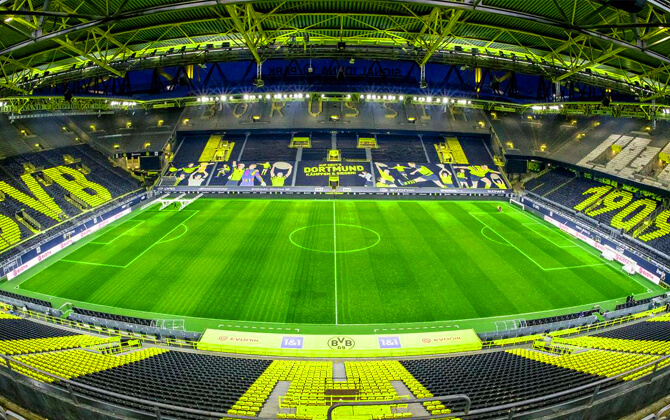
The Dortmund Stadtbahn is an easy way to reach several of the city’s best-known attractions using public transport.
- Westfalenstadion: Home of Borussia Dortmund and one of the city’s biggest draws. Use U45 to Stadion and walk west.
- Westfalenpark: A quieter stop for green space and a break from the city. Reach it from Westfalenpark on U45 or U49.
- German Football Museum: A popular stop for football fans interested in the sport’s history. Nearby stations include Westentor (U43 and U44), Kampstraße (U41, U43, U44, U45, U47 and U49), and Dortmund Hauptbahnhof (U41, U45, U47 and U49).
These stops also place you close to central Dortmund, where changing lines is simple if you want to keep exploring.