The São Paulo Metro, commonly called the Metrô, is a rapid transit system serving São Paulo, Brazil. It is part of the largest metropolitan rail transport network in Latin America, working alongside CPTM, Motiva Linha 4, ViaMobilidade, and TIC Trens. The metro carries about 4.2 million passengers a day, runs across seven lines, covers 110.3 kilometers (68.5 miles) of route, and serves 98 stations. Together with the metropolitan train network, it forms a combined 388-kilometer (241-mile) public transport system that can be used with a single ticket.
| Key | Information |
|---|---|
| System name | São Paulo Metro, also known as the Metrô |
| City | São Paulo, Brazil |
| Network role | Part of the largest metropolitan rail transport network in Latin America |
| Daily ridership | About 4.2 million passengers |
| Metro lines | Seven lines |
| Stations | 98 stations |
| Route length | 110.3 kilometers (68.5 miles) |
| Combined rail network | 388 kilometers (241 miles) with metropolitan trains |
| Notable technology | Platform screen doors, communications-based train control, fully automated Lines 4 and 15 |
Sao Paulo Metro Map
Map of Sao Paulo Metro showing different lines and stations. Click on the map to enlarge it or download the Sao Paulo Metro map in PDF format.
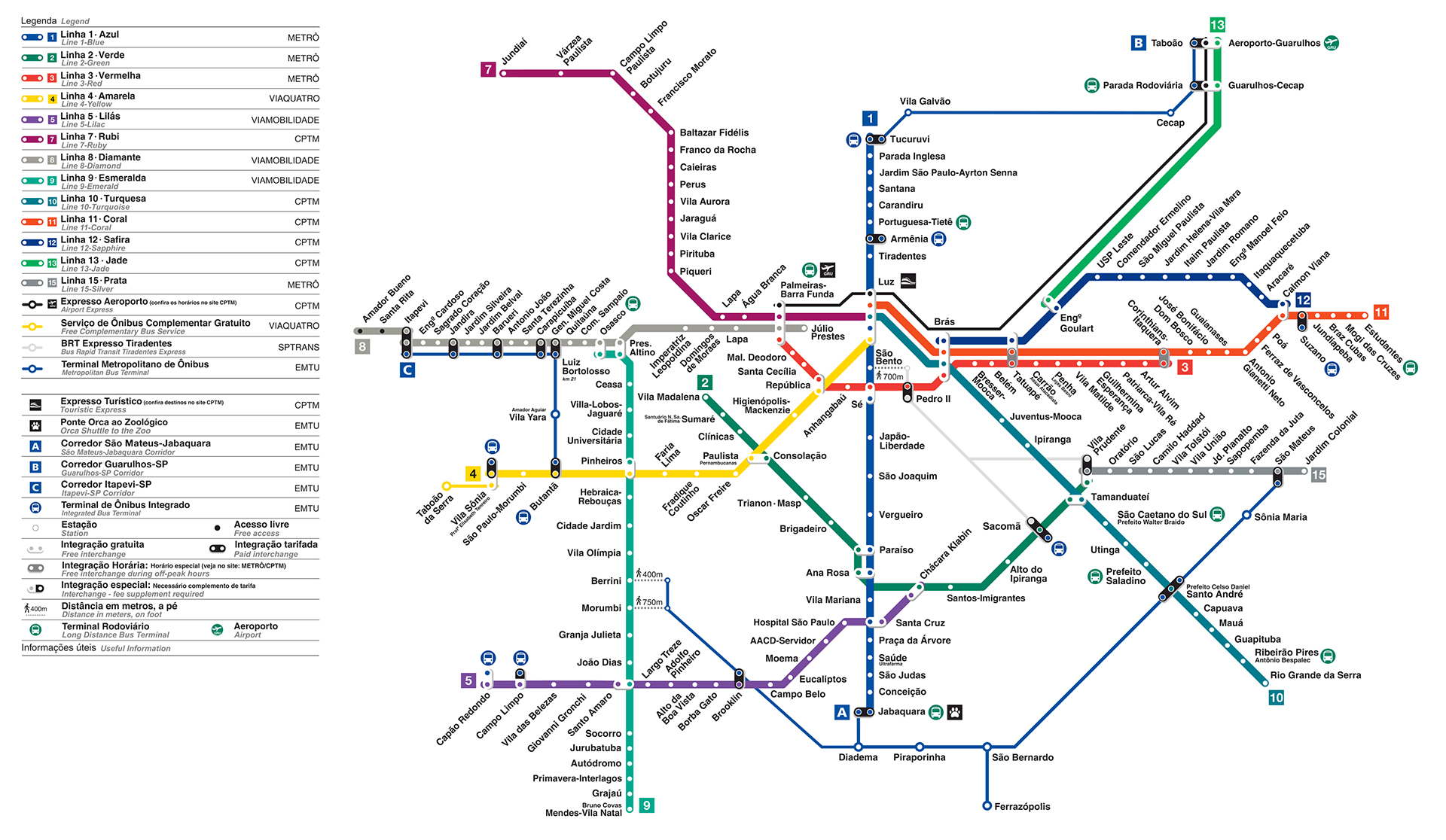
The Metro Lines and popular Stations
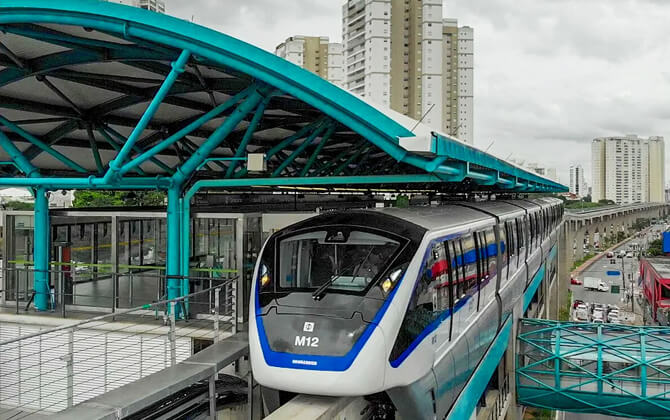
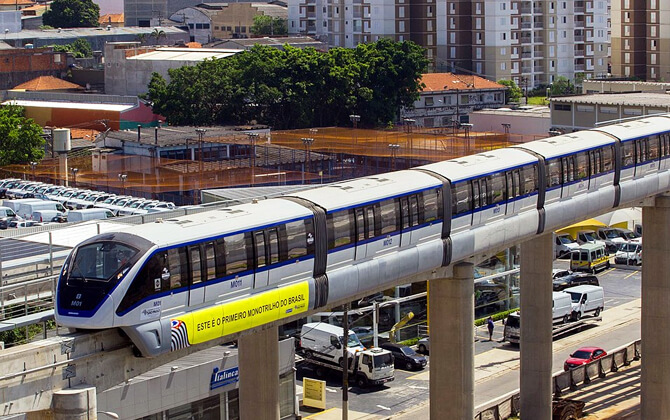
The São Paulo Metro route plan is color-coded, which makes the system easier to read even on a busy day. The main lines are Line 1 Blue, Line 2 Green, Line 3 Red, Line 4 Yellow, Line 5 Lilac, Line 15 Silver, and Line 17 Gold. Line 15 is a high-capacity monorail route, while Line 17 Gold is also listed as a monorail line.
Line 1 Blue, Line 2 Green, Line 3 Red, Line 4 Yellow, Line 5 Lilac, and Line 15 Silver form the main operational network. For route planning, the most useful stations are usually the major transfer points, central stops, and terminals linked to bus or rail services.
| Station | Details |
|---|---|
| Line 1 Blue | Runs between Tucuruvi and Jabaquara-Comitê Paralímpico Brasileiro. Key stations include Luz, Sé, Paraíso, Ana Rosa, Santana, and Jabaquara-Comitê Paralímpico Brasileiro. |
| Line 2 Green | Runs between Vila Madalena and Vila Prudente. Popular stations include Consolação, Paraíso, Ana Rosa, Chácara Klabin, Sacomã, and Vila Prudente. |
| Line 3 Red | Connects Palmeiras-Barra Funda and Corinthians-Itaquera. Important stations include República, Sé, Brás, Tatuapé, Penha, and Corinthians-Itaquera. |
| Line 4 Yellow | Links Luz and Vila Sônia–Professora Elisabeth Tenreiro. Well-known stations include República, Paulista, Faria Lima, Pinheiros, Butantã, and São Paulo-Morumbi. |
| Line 5 Lilac | Connects Capão Redondo and Chácara Klabin. Frequently used stations include Santo Amaro, Largo Treze, Adolfo Pinheiro, Brooklin, Campo Belo, Santa Cruz, and Chácara Klabin. |
| Line 15 Silver | Monorail route from Vila Prudente to Jardim Colonial. Stations include Oratório, São Mateus, Jardim Colonial, and several elevated stops along the path train route. |
| Line 17 Gold | Monorail line with stations such as Morumbi, São Paulo-Morumbi, Chucri Zaidan, Campo Belo, Aeroporto de Congonhas, and Jabaquara-Comitê Paralímpico Brasileiro. |
Some of the most important interchange stations are Sé, Paraíso, Ana Rosa, Luz, República, Brás, Pinheiros, and Vila Prudente. These stops are especially useful when switching lines or building a route timetable across the city.
The metro also connects with bus terminals and transport corridors at stations such as Jabaquara-Comitê Paralímpico Brasileiro, Palmeiras-Barra Funda, Tietê Road Terminal, Santana, Vila Prudente, Santo Amaro, and Pinheiros. That makes it easier to continue trips beyond the rail network using local transport.
| Station | Details |
|---|---|
| Sé | Central transfer point and one of the most useful stations for cross-city trips. |
| Luz | Major interchange with rail connections and central access. |
| República | Busy transfer station used for central São Paulo journeys. |
| Paulista | Useful for Avenida Paulista and nearby cultural stops. |
| Pinheiros | Important for metro and suburban rail connections. |
| Tatuapé | Key eastern connection point in the transport network. |
| Jabaquara | Important terminal area with bus connections. |
Operating Hours
São Paulo Metro operating hours generally start at 4:40 AM and run until midnight from Sunday to Friday. On Saturdays, service is extended to 1:00 AM. These opening hours make the system practical for commuting, sightseeing, and late evening trips, although opening times and closing time can vary slightly by line and station.
| Service detail | Timings |
|---|---|
| Sunday to Friday working hours | 4:40 AM to midnight |
| Saturday working hours | 4:40 AM to 1:00 AM |
| General starting time | 4:40 AM |
| General closing time | Midnight on most days, 1:00 AM on Saturdays |
| Bicycles, Monday to Friday | From 8:30 PM until the metro closes |
| Bicycles, Saturday | From 2:00 PM until closing |
| Bicycles, Sunday | All day |
Some transfer stations and boarding areas have specific closing rules. At stations such as Sé, Paraíso, and Ana Rosa, passengers need to enter the relevant lines before midnight. The same applies to the connection between Line 2 Green and Line 15 Silver at Vila Prudente.
Station opening and closing times may differ slightly from the overall train schedule. Some stations close a few minutes earlier or later, and not every ticket office stays open throughout the full operating window. If you need the last train, timings today, or the route timetable for a specific line, check before entering the station.
Service is frequent during daily operations, but the exact frequency can vary by line, time of day, and operating conditions. For most city transport trips, the metro remains one of the most reliable ways to move across São Paulo.
Ticketing and Fare Options
The São Paulo Metro uses a flat fare system, so a single journey costs the same regardless of distance. Fare information in the provided material includes R$ 4.40, about US$0.80, for a standard single trip, while updated ticket details also mention R$ 5.00, about US$0.90, and a QR Code Bilhete Unitário at R$ 5.40, about US$1.00. Because the ticket price can change, check the current fare before you travel.
For most passengers, the main card is Bilhete Único, the integrated transport card used across the metro, buses, and metropolitan rail network. It can be loaded with journey credits and used for transfers within the allowed time limits.
| Ticket type | Main use |
|---|---|
| Single Trip Ticket, Bilhete Unitário | One metro journey. Listed fare information includes R$ 4.40, about US$0.80, with metro transfers allowed for 90 minutes. |
| Prepaid Card, Bilhete Pré-pago | Rechargeable option. Discounts may be available when recharging, with a minimum recharge of R$ 10.00, about US$1.80. |
| Student Ticket, Bilhete Estudante | 50% discount with valid student ID. |
| Senior Ticket, Bilhete Idoso | Free for seniors aged 60 and above. |
| 1-Day Pass, Bilhete de 1 Dia | Unlimited rides within 24 hours for R$ 15.00, about US$2.80. |
Integrated fares are available for passengers combining bus, subway, and commuter rail. The provided fare information lists the regular bus fare at about R$ 5.00, about US$0.90, while bus plus metro or train integration is R$ 8.90, about US$1.60.
Tickets and recharge services are available at station counters and automated machines. Machines accept cash and credit cards, and contactless payment is available at some stations. For frequent travel, a rechargeable card, day pass, or time-based option may be better value than buying a single ticket each time.
Metro Tickets
The São Paulo Metro has several ticket and fare products for different types of passengers. If you use only rail transport, Cartão Fidelidade allows electronic credits to be bought at prices lower than the unit fare.
The Bilhete Unitário is a QR Code ticket used on the Metro and CPTM network. It costs R$ 5.40, about US$1.00, and is valid for one trip. You can buy it at ticket counters, self-service machines in stations, the TOP mobile app for Android and iOS, WhatsApp, Google Wallet, and authorized retail locations.
Bilhete Único Comum allows one rail trip and up to three municipal bus boardings in São Paulo within a 3-hour period, with integration taking place during the first 2 hours. Bilhete Único Vale-Transporte allows one rail trip and one bus trip within 3 hours, with the same integration rule when the first boarding is by bus.
Time-based options are also available. Bilhete Único Comum Mensal allows up to 10 trips per day for 31 days from first use, while Bilhete Único 24 Horas is valid for 24 hours from the first use. On rail journeys, the required time interval between uses depends on the station and line, including 30-minute and 60-minute intervals in the cases described by the operator.
TOP card users can use Cartão TOP Comum on the rail system and on intermunicipal buses in the São Paulo metropolitan region, with a fare reduction on the second boarding. Cartão TOP Vale-Transporte is intended for workers receiving a transport benefit from their employers and can also be used on the rail system and intermunicipal buses.
Discounted morning fares are available through Tarifa do Madrugador for Bilhete Único Comum and Vale-Transporte users who travel early in the day. Fare exemptions are available for eligible groups, including seniors, students, and passengers with disabilities.
The Metro does not have to provide change above R$ 20.00, about US$3.70, at ticket booths and counters, or above R$ 10.00, about US$1.80, at vending machines. Free transfer areas are available at Brás, Luz, Palmeiras-Barra Funda, and Tamanduateí stations, and free integration also applies at Tatuapé and Corinthians-Itaquera during specified hours.
| Ticket type | Main use |
|---|---|
| Bilhete Unitário | One ride on Metro and CPTM |
| Bilhete Único Comum | Rail plus up to 3 municipal bus boardings in 3 hours |
| Bilhete Único Vale-Transporte | Rail plus 1 municipal bus boarding in 3 hours |
| Bilhete Único Comum Mensal | Up to 10 trips per day for 31 days |
| Bilhete Único 24 Horas | Travel for 24 hours from first use |
Single Tickets
São Paulo Metro single tickets are simple: one ride, one fare, no distance-based price calculation. A Single Trip Ticket, or Bilhete Unitário, can also be used for transfers within the metro system for 90 minutes, according to the provided fare details.
The supplied fare information lists more than one single-ticket price: R$ 4.40, about US$0.80; R$ 5.00, about US$0.90; and the QR Code Bilhete Unitário at R$ 5.40, about US$1.00. If you are checking the schedule today or planning a trip soon, confirm the current cost at the station or through the available ticket channels.
You can buy single tickets at station counters or automated machines. The TOP app is also mentioned as an option for individual QR Code tickets, and some stations have contactless payment tests at the entry gate.
- Single Trip Ticket, Bilhete Unitário: one journey.
- Transfer validity: metro transfers allowed for 90 minutes.
- Purchase locations: ticket counters, self-service machines, and in some cases mobile app or QR Code channels.
If you only need one ride, a single ticket is the easiest option. For repeated travel, prepaid cards or discounted fare products are usually more convenient.
Interconnections
The São Paulo Metro is part of a wider metropolitan rail and public transport network that includes suburban trains, monorail services, and private operators. Together with CPTM, Motiva Linha 4, ViaMobilidade, and TIC Trens, it forms the largest metropolitan rail transport network in Latin America.
Passengers can use a single ticket across the combined metro and metropolitan train system, which stretches for about 388 kilometers (241 miles) and serves São Paulo and the wider metropolitan region. The metro itself has seven lines and 98 stations, while the broader system gives access to many more areas beyond the city center.
| Station | Details |
|---|---|
| Brás | Direct connection with the metropolitan train system. |
| Palmeiras-Barra Funda | Metro, rail, and intercity bus terminal connections. |
| Tatuapé | Metro and metropolitan train interchange. |
| Corinthians-Itaquera | Metro and metropolitan train connection point. |
| Luz | Important metro and rail interchange, also linked to Line 4. |
| Santo Amaro | Connection with the metropolitan train system. |
| Tamanduateí | Metro and rail transfer point. |
| Pinheiros | Metro and suburban rail interchange. |
| Jabaquara | Metro station connected with an intercity bus terminal. |
| Portuguesa-Tietê | Metro access to an intercity bus terminal. |
Fare integration extends to São Paulo’s municipal bus network through Bilhete Único, allowing transfers between buses, metro, and metropolitan trains at reduced cost. Passengers from the São Paulo Metropolitan Region can also use Cartão BOM on metro and train systems.
Key transfer routes make the system feel connected rather than fragmented. Line 4 connects with Line 1 at Luz, Line 3 at República, Line 2 at Consolação, and the suburban network at Pinheiros and Luz. Line 5 connects with Line 1 and Line 2 through central extensions, while Line 15 links the east side of the city to the metro network at Vila Prudente.
This interlinked structure explains why the São Paulo transport system can move more than 4 million passengers on working days, combining metro, suburban rail, monorail, and bus connections into one large urban mobility network.
Airport Connection
São Paulo has a direct rail link to Guarulhos Airport through Line 13 Jade of the CPTM network, also known as the Guarulhos Train. It connects Engenheiro Goulart in São Paulo to Aeroporto-Guarulhos in Guarulhos, covering 12.2 kilometers (7.6 miles) and serving 3 stations.
Opened on March 31, 2018, this was the first line completely built and operated by CPTM. It also made São Paulo/Guarulhos International Airport the first major South American airport hub to have a direct railway connection.
The regular Line 13 Jade service links the city rail network with the airport area. Since December 2020, Airport Express has offered direct trips from Luz to Aeroporto-Guarulhos, with selected intermediate stops depending on direction.
Effective September 1, 2023, Airport Express was extended to Palmeiras-Barra Funda, creating direct connections between Palmeiras-Barra Funda, Luz, and Aeroporto-Guarulhos without transfers.
| Service detail | Timings |
|---|---|
| Airport Express frequency | Every hour from both terminus stations |
| Airport Express operating hours | 5:00 AM to midnight |
| Station | Details |
|---|---|
| Palmeiras-Barra Funda | Airport Express only; connections with Barra Funda Bus Terminal and Barra Funda Road Terminal. |
| Luz | Airport Express only; connection with the Touristic Express. |
| Brás | Airport Express only. |
| Engenheiro Goulart | Regular Line 13 Jade connection point. |
| Guarulhos-CECAP | Connections with Guarulhos Road Terminal and the Guarulhos-São Paulo Metropolitan Corridor. |
| Aeroporto-Guarulhos | Connections with GRU Airport Shuttle Service, GRU Airport People Mover, Taboão Metropolitan Terminal, and the Guarulhos-São Paulo Metropolitan Corridor. |
At Aeroporto-Guarulhos station, passengers can continue by shuttle or people mover to reach the airport terminals. For travelers heading to GRU, Line 13 Jade is the most direct rail option, while Airport Express provides a faster one-seat ride from central stations.
Rules and Regulations
The available material does not provide a full rules-and-regulations list for the São Paulo Metro, but it does confirm several practical access and fare rules. The system uses a flat fare, and Bilhete Único supports integrated travel between metro and bus services within the stated time window.
- The metro uses a flat fare system.
- Bilhete Único allows integrated travel, including transfers between the metro and buses within the stated time window.
- On the contactless payment pilot, only physical cards with contactless technology are accepted.
- During the pilot, one ticket per card is allowed every 30 minutes, after an initial interval of two uses separated by 1 minute.
- The contactless pilot does not include bus integration.
- Virtual cards on phones, smartwatches, and wristbands are not accepted in the current pilot phase.
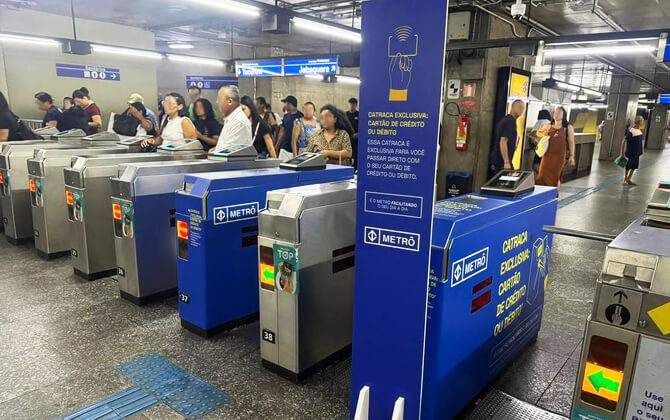
The system also has signed exclusive turnstiles for proximity payment at participating stations, and trained staff are present at busy locations to help passengers. The source material also notes operating hours generally from 4:30 AM to midnight, with some service information varying by line and day.
History
Companhia do Metropolitano de São Paulo was founded on April 24, 1968. Construction of the first North-South line began eight months later, and the first test train trip took place in 1972 between Jabaquara and Saúde stations. Commercial service started on September 14, 1974, between Jabaquara and Vila Mariana.
The first line, now Line 1 Blue, was influenced by San Francisco’s BART system. That influence can still be seen in the design of Line 1’s fleet, whose front ends are nearly identical to BART’s original Rohr cars. Early construction used cut-and-cover tunneling, a method widely used on Lines 1 and 3.
Expansion continued with Line 3 Red in 1979, Line 2 Green in 1991, and Line 5 Lilac in 2002. Line 4 Yellow, operated by ViaQuatro, began service later and marked another stage in the metro’s development. Over time, the system grew into one of the most important pieces of transportation in São Paulo.
Construction methods also changed as the network expanded. Tunnel boring machines were introduced for Line 2 and are now used for nearly all tunnel construction in the system. The metro is known for modern, safe, and clean stations, and it has become the largest subway system in South America and one of the most advanced in the world.
Future Developments
São Paulo Metro expansion is continuing, with major projects already under way. The extension of Metro Line 4 to Taboão da Serra will be the first time the network crosses beyond city limits, adding two new stations over 3.3 kilometers (2.1 miles) and improving access for about 50,000 daily passengers by 2030.
The project is designed to support faster, cleaner, and safer travel while strengthening access to jobs and services for low-income and socially vulnerable residents. It includes universal accessibility, climate-resilient infrastructure, seamless bus-to-metro integration, driverless operation, platform screen doors, and flood-resistant design.
Line 6 Orange is another major future route. The first phase, between Brasilândia and Perdizes, is expected to open in stages, with the line continuing to expand afterward. Work includes tunneling, station construction, and systems installation, and the line is set to become an important north-central link.
Line 17 Gold is also part of the next wave of deliveries. It is expected to enter assisted operation first before moving toward fuller service, adding another connection in the south of the city.
- Line 4 extension to Taboão da Serra: 3.3 kilometers (2.1 miles) and two new stations.
- Expected benefit: around 50,000 daily passengers by 2030.
- Estimated project cost: US$893.6 million, including US$400 million from the World Bank.
- Line 6 Orange and Line 17 Gold remain among the most important upcoming additions.
Beyond these projects, the broader expansion program includes further extensions and new lines, with public transport planning focused on access, congestion reduction, and stronger regional mobility.
Tourist Attractions
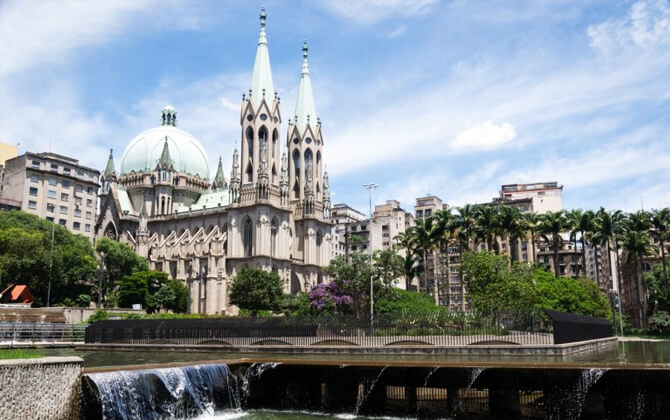
São Paulo’s metro is one of the easiest ways to reach many of the city’s best-known sights. Museums, cultural centers, historic landmarks, shopping streets, parks, and football stadiums are often close to a station or reachable with a short walk.
The stations map is especially useful for visitors who want to combine different neighborhoods in one trip. In the central area, São Bento, Sé, Luz, and Anhangabaú connect passengers to major landmarks. Around Avenida Paulista, stations such as Trianon-MASP, Brigadeiro, Consolação, and Paulista put you close to museums and cultural spaces.
| Station | Details |
|---|---|
| São Bento | Useful for Mercado Municipal, Rua 25 de Março, and nearby central sights. |
| Sé | Best for Catedral da Sé, Pateo do Collegio, and Centro Cultural Banco do Brasil. |
| Luz | Close to Pinacoteca, Estação da Luz, and Museu da Língua Portuguesa. |
| Trianon-MASP | Good for Avenida Paulista attractions, including MASP. |
| Brigadeiro | Useful for Japan House, Itaú Cultural, Casa das Rosas, and nearby Paulista-area stops. |
| Clínicas | Useful for the Pacaembu area and nearby cultural venues. |
| Paulista | Convenient for Avenida Paulista and nearby cultural attractions. |
| Vila Madalena | Best for Beco do Batman. |
| Liberdade | Useful for the Japanese-Brazilian neighborhood and its weekend fair. |
| Santos-Imigrantes | Useful for Museu do Ipiranga and Aquário de São Paulo. |
| Corinthians-Itaquera | Best for Neo Química Arena. |
For visitors, the metro is practical, affordable, and comfortable, especially when exploring art, history, food, architecture, and sports across different parts of São Paulo.
whom do we approach for carrying oversize luggage ( eg cycle box ) in sao paulo metro? do we write a mail or can we get an approval at the station.
thanks