The Rio de Janeiro Metro, known as MetrôRio, is the rapid transit system serving Rio de Janeiro, Brazil. It opened commercial service with Line 1 in March 1979, added Line 2 in 1981, and became the first metro system in Brazil to receive a concession in 1998. Today, it has 41 stations on 3 lines, although Lines 1 and 4 operate as one through service in daily use. The network links the North Zone, the city center, the South Zone, and Barra da Tijuca, making it a key part of public transport and city transport in Rio.
| Key | Information |
|---|---|
| System name | Rio de Janeiro Metro, or MetrôRio |
| Stations | 41 |
| Lines | 3 lines, with Lines 1 and 4 operating as a single through-run route |
| Network length | 58 kilometers, about 36 miles |
| Trains | 64 |
| Current operator | HMOBI S.A. manages, maintains, and operates Lines 1, 2, and 4 |
| Current concession term | 2048 |
| Shareholding interest | 100% Inverpar |
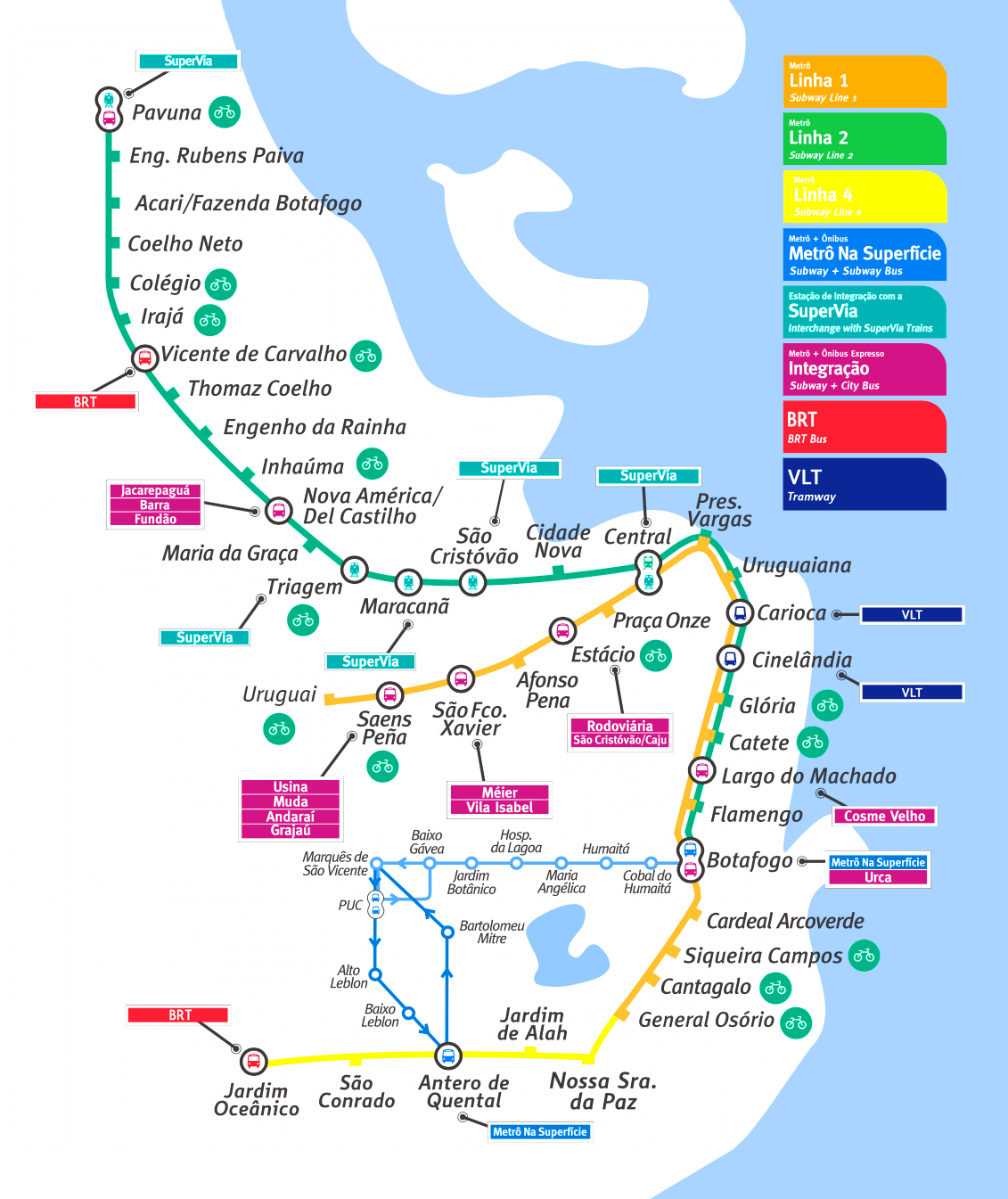
Rio de Janeiro Metro Map
Map of Rio de Janeiro Metro showing different lines. Click on the map to enlarge it or download the Rio de Janeiro Metro map in PDF format.
Metro Lines and Stations
The Rio de Janeiro Metro route plan is simple once you understand how the lines work. The system is formally divided into Lines 1, 2, and 4, but Lines 1 and 4 run as one continuous service between Uruguai / Tijuca and Jardim Oceânico / Barra da Tijuca. In practice, passengers use two main operating corridors: Line 1/4 and Line 2.
Line 1/4 is 32 kilometers, about 19.9 miles, and serves Tijuca, the city center, the South Zone, São Conrado, and the eastern edge of Barra da Tijuca. Most of the route is underground, with a short elevated section near Jardim Oceânico. Line 2 runs 30.2 kilometers, about 18.8 miles, from Pavuna to Botafogo, serving residential areas in the North Zone before joining the shared central corridor.
The two lines share tracks between Central and Botafogo, a section with 10 stations and about 5 kilometers, or 3.1 miles, of track. Central do Brasil / Centro is the main interchange and the busiest station in the system. For riders checking a stations map or stations list, this shared section is important because it lets many trips through the center happen without changing trains.
| Station | Details |
|---|---|
| Uruguai / Tijuca | Line 1/4 northern terminal; island platform |
| Saens Peña / Tijuca | Line 1/4 station in Tijuca |
| São Francisco Xavier / Tijuca | Line 1/4 station in Tijuca |
| Afonso Pena / Tijuca | Line 1/4 station in Tijuca |
| Estácio | Line 1/4 station; seldom-used Spanish-solution platforms are noted |
| Praça Onze | Line 1/4 station near the Sambadrome area |
| Central do Brasil / Centro | Line 1/4 and Line 2 interchange; connects with suburban rail, light rail, buses, and the Providência Cable Car |
| Saara / Presidente Vargas | Shared central corridor station |
| Uruguaiana / Centro | Shared central corridor station |
| Carioca / Centro | Major interchange point with bus and light rail connections |
| Cinelândia / Centro | Central station with light rail access; island platform on Line 1/4 |
| Glória | Shared corridor station with nearby inclined elevator access |
| Catete | Shared corridor station |
| Largo do Machado | Shared corridor station; useful for trips toward Cosme Velho |
| Flamengo | Shared corridor station |
| Botafogo | Shared corridor station and Line 2 terminal; Spanish-solution layout |
| Cardeal Arcoverde / Copacabana | Line 1/4 station serving Copacabana |
| Siqueira Campos / Copacabana | Line 1/4 station serving Copacabana |
| Cantagalo / Copacabana | Line 1/4 station serving Copacabana |
| General Osório / Ipanema | Line 1/4 station; connection point between Line 1 and Line 4 services |
| Nossa Senhora da Paz / Ipanema | Line 1/4 station in Ipanema |
| Jardim de Alah / Leblon | Line 1/4 station in Leblon |
| Antero de Quental / Leblon | Line 1/4 station in Leblon |
| São Conrado | Line 1/4 station with island platform |
| Jardim Oceânico / Barra da Tijuca | Line 1/4 western terminal; connects with BRT services |
| Pavuna | Line 2 terminal; connects with the suburban rail network |
| Engenheiro Rubens Paiva | Line 2 station |
| Acari/Fazenda Botafogo | Line 2 station near the TransBrasil BRT corridor |
| Coelho Neto | Line 2 station |
| Colégio | Line 2 station |
| Irajá | Line 2 station |
| Vicente de Carvalho | Line 2 station with TransCarioca BRT connection |
| Thomaz Coelho | Line 2 station with a nearby suburban rail transfer |
| Engenho da Rainha | Line 2 station |
| Inhaúma | Line 2 station |
| Del Castilho | Line 2 station with a nearby suburban rail transfer |
| Maria da Graça | Line 2 station |
| Triagem | Line 2 station with suburban rail connection |
| Maracanã | Line 2 station with three tracks, two island platforms, and suburban rail connection |
| São Cristóvão | Line 2 station with suburban rail connection |
| Cidade Nova | Line 2 station; transition area before the shared underground section |
Line 2 is above ground from Pavuna to Cidade Nova and underground from Central do Brasil / Centro to Botafogo. Pavuna, Carioca / Centro, and Botafogo use the Spanish-solution platform arrangement, while other stations use island or side platforms depending on location.
Operating Hours and Frequency
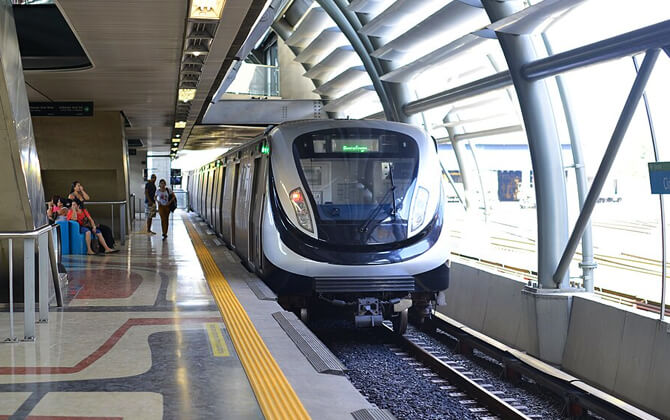
Rio de Janeiro Metro operating hours vary by line and day. Lines 1 and 2 usually run from early morning until midnight from Monday to Saturday, with shorter opening hours on Sundays and holidays. Line 4 has the same opening times every day. For timings today, it is still smart to check current service notices before traveling, especially during major events.
| Service detail | Timings |
|---|---|
| Lines 1 and 2, Monday to Saturday | 05:00 to 24:00 |
| Lines 1 and 2, Sundays and holidays | 07:00 to 23:00 |
| Line 4, daily | 06:00 to 23:00 |
| Peak-hour frequency | Trains can arrive every 2 to 3 minutes on the busiest sections |
| Special events | Service hours may be extended for events such as Carnival, and the metro may run later than usual or 24 hours on some occasions |
The main train schedule patterns are Line 1 from Uruguai to General Osório, Line 2 from Pavuna to Botafogo, and Line 4 from General Osório to Jardim Oceânico. These route timetable patterns help explain why some trips feel like a single path train journey even when the line numbers change on the map.
Closing time depends on the line and day, so do not assume the last train is the same across the whole system. If you are riding close to the end of service, check the schedule today before entering the station.
Fares
MetroRio uses a flat-fare approach for metro travel, and several ticket and card products are available. Public transport in Rio can be affordable for a single ride, but the cost rises if you make many short trips because the supplied fare information does not list a day pass or weekly pass.
| Key | Information |
|---|---|
| Metro + Subway Bus fare | R$ 7.90, about US$1.58 |
| Integrated Subway + Ferry fare with Riocard | R$ 8.55, about US$1.71 |
| Standard user rate listed in fare notes | R$ 4.10, about US$0.82 |
| Combined Metro + Bus fare listed in fare notes | R$ 4.10, about US$0.82 |
| Standard single ticket reference | R$ 6.90, about US$1.38 |
| Discounted ticket reference | R$ 3.45, about US$0.69 |
| Card purchase reference | R$ 5.00, about US$1.00 |
| GIRO Card initial cost | R$ 7.90 minimum fare plus R$ 4.00 refundable deposit, total R$ 11.90, about US$2.38 |
| GIRO Card maximum stored value | R$ 500, about US$100 |
A Metro + Subway Bus ticket includes an immediate transfer between the metro and a Subway Bus, with a total time limit of 2 hours. If you need a quick fare calculator approach, multiply the single ticket price by the number of rides you expect to take, since no day pass is listed in the fare information.
Free travel is available for Rio de Janeiro public school students, people over 65, people with disabilities accompanied by an authorized person, people with chronic illnesses, and children up to 6 years old when traveling with a responsible adult.
Types of Cards
The MetrôRio Card can be used for a single multimodal trip with the metro and Subway Bus, or as a reloadable fare card. It is useful if your route includes both rail and the Metrô na Superfície bus service.
The GIRO Card is a reloadable card that can be topped up at MetroRio ticket offices, automated vending machines, or through the GIRO app. It works across the metro system, on MetrôRio buses, and for Bike Rio rentals. If you keep a large balance on it, register the card so you can block it and transfer the balance if it is lost or stolen.
The MetrôRio Prepaid Card is another option for travelers who want to use the metro system and buses while avoiding long ticket lines. The minimum loaded value listed is R$ 5.00, about US$1.00, and the card also offers discounts for theater visits.
The Unitary Card is a single-use metro ticket. If it is not used, you can request a refund at any metro station. The Metrô na Superfície card is valid for the bus line extensions that complement the metro route.
RioCard+Mais is accepted across public transit systems. If buying it from subway station machines, the supplied information notes that travelers should choose the pink version marked expresso when broader transport use is needed.
Payment Methods
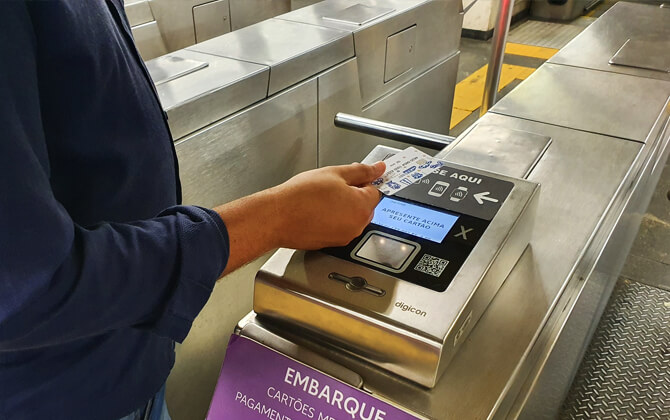
You can buy tickets and cards at MetroRio stations, usually at ticket offices or self-service vending machines. Card credit can be added at ticket booths, machines, and, for some products, online or through an app.
MetroRio also supports contactless payment at self-service machines and marked validators in stations. Accepted methods include Visa, MasterCard, Elo, and Diners Club credit or debit cards, as well as NFC-enabled phones, watches, wristbands, and compatible digital wallets such as Apple Pay and Samsung Pay.
Some fare notes mention cash-only payment at certain station sales points, while other station machines and validators support cards and contactless payment. In practice, carry a little cash in Brazilian reais if you are buying or reloading at a booth, and use contactless when the validator or machine clearly supports it.
Connections to Other Systems
The Rio de Janeiro Metro connects closely with local transport across the city, including suburban rail, BRT, buses, ferries, light rail, cable car service, and tramway links. This makes it one of the most useful tools for transportation in Rio de Janeiro, especially when combining metro rides with surface transport.
Central do Brasil / Centro is the main hub. It connects with the suburban rail system, Rio de Janeiro Light Rail, local bus and van lines, and the Providência Cable Car. Carioca / Centro is another important interchange, with bus connections, light rail transfers, ferry access via Praça XV, and access to the Santa Teresa Tram.
Suburban rail transfers are available at Central do Brasil / Centro, São Cristóvão, Maracanã, Triagem, and Pavuna. Nearby walking transfers also exist around stations such as Del Castilho and Thomaz Coelho. For BRT, Vicente de Carvalho connects with TransCarioca, while Jardim Oceânico / Barra da Tijuca connects with TransOeste. Acari/Fazenda Botafogo is near the TransBrasil BRT, although the supplied information notes that this transfer does not include a fare discount.
Light rail connections are available at Central do Brasil / Centro, Carioca / Centro, and Cinelândia / Centro. Other useful links include Carioca / Centro for ferries at Praça XV, Glória for the Outeiro da Glória inclined elevator, and General Osório / Ipanema for the Cantagalo-Pavão-Pavãozinho inclined elevator.
- Metro + suburban rail: Central do Brasil / Centro, São Cristóvão, Maracanã, Triagem, and Pavuna
- Metro + BRT: Vicente de Carvalho and Jardim Oceânico / Barra da Tijuca
- Metro + VLT light rail: Central do Brasil / Centro, Carioca / Centro, and Cinelândia / Centro
- Metro + ferry: via Carioca / Centro and Praça XV
- Metro + bus: available at every station on the metro system
RioCard is accepted across the metropolitan area, and the Bilhete Único Intermunicipal benefit allows limited fare integration with metro, BRT, suburban rail, ferries, and intermunicipal buses. Jaé cards also support selected metro integrations, but fare integrations cannot be chained together.
Airport Transfers
Rio de Janeiro has two main airports, Galeão Airport and Santos Dumont Airport. The metro can form part of the airport transfer route to both, but neither journey is direct.
For Galeão Airport, take Metro Line 2 to Vicente de Carvalho station, then continue by BRT. You can use either the TransCarioca line with stops or the TransCarioca Express line.
For Santos Dumont Airport, travel to Cinelândia station and change to the VLT. The VLT ride to the airport takes about 7 minutes.
The VLT requires a prepaid Bilhete Único Carioca card. These cards can be bought at Santos Dumont Airport, at other RioCard outlets, or from vending machines. The machines accept cash but do not give change.
Special Services at Stations
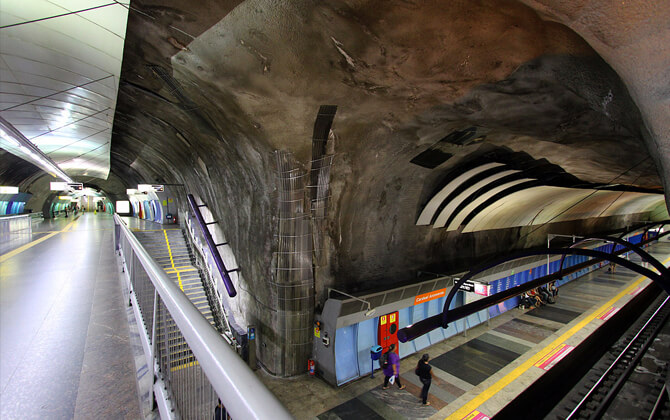
MetroRio stations offer practical services for everyday riders and visitors moving through the public transport system. Facilities vary by station, but the network includes useful support for ticketing, transfers, and basic needs.
- Free Wi-Fi in all subway stations
- Shops in different station areas
- Vending machines for buying or recharging cards
- 24-hour electronic banking boxes at selected stations
- Public restrooms at Acari Fazenda Botafogo, Botafogo, Cantagalo, Carioca, Cidade Nova, Coelho Neto, Del Castilho, Estacio, General Osório, Pavuna, and Siqueira Campos
These services make it easier to recharge a card, stay connected, and handle quick errands while using the metro.
A Brief History
The history of the Rio de Janeiro Metro began on 5 March 1979, when the system opened with five stations on a single line. In its first 10 days, it carried more than half a million passengers, quickly becoming an important part of the city’s transport network.
Expansion followed in the early 1980s. Uruguaiana and Estácio opened in 1980, and more stations followed, including Carioca, Catete, Flamengo, Botafogo, Afonso Pena, São Francisco Xavier, and Saens Peña. Line 2 began operating in 1981 and later changed its service pattern and infrastructure.
Over time, the metro expanded toward Tijuca, Copacabana, Pavuna, and other neighborhoods. Line 4 later added a major link toward Barra da Tijuca and was integrated with Line 1 operations. Private operation began in 1998, followed by further ownership and concession changes in the 2020s.
Today, the system serves 41 stations and remains one of Brazil’s busiest metro networks, shaped by decades of expansion, new stations, and continued investment in trains and operations.
Future Extensions
MetroRio expansion plans have focused on completing Gávea Station, extending Line 2 to Praça XV, and developing Line 3 toward Niterói and São Gonçalo. Another major proposal is extending Line 4 west to Recreio dos Bandeirantes, with Terminal Alvorada expected to become an important interchange for future lines and other transport modes.
Gávea Station is under construction and is expected to open first as a shuttle connection to São Conrado. Later, it is planned to become a transfer point between a deinterlined Line 1 and Line 4. Work resumed in 2025, with the shuttle expected to open by July 2028.
The Line 2 extension from Estácio to Praça XV is intended to restore the line’s original concept and reduce operational conflicts at Central and Botafogo. In these plans, Carioca would become a major interchange with Line 1, and the new section would run below the surface.
Line 3 is planned as the state’s first intermunicipal metro line, connecting Rio de Janeiro, Niterói, and São Gonçalo through a tunnel under Guanabara Bay before continuing at surface level. A possible later extension to Itaboraí has also been discussed.
Line 4 has been studied for a western extension to Recreio dos Bandeirantes. This would strengthen service in the growing Barra and Recreio corridor and make Alvorada a more important transfer hub.
Other long-term ideas have appeared in planning documents, including routes via Uruguai, Del Castilho, Gávea, Santa Teresa, Cocotá, and other parts of the metropolitan area. Morro de São João, a partially constructed infill station, has also been mentioned in the wider expansion picture.
Guide to Traveling via the Metro
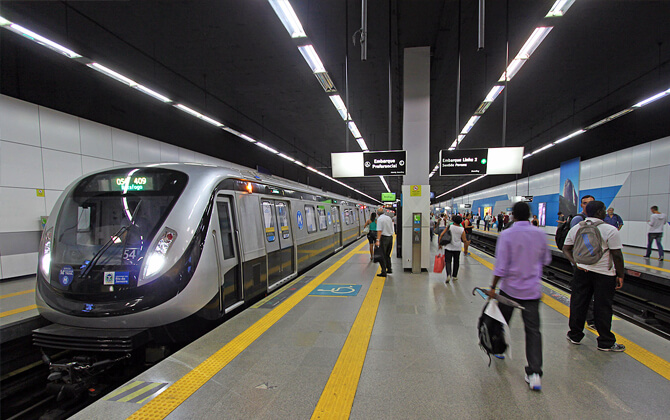
Rio de Janeiro’s metro is a clean, modern, and efficient way to move between major parts of the city. It is especially useful for reaching tourist areas, business districts, beaches, and transport hubs without getting stuck in road traffic.
Before riding, check the route, the opening times, and the latest train schedule. The metro uses a flat fare, so the ticket price does not depend on distance. Ticket booths are marked Bilheteria, and free subway maps are available at many booths. The official app also provides route information and service updates.
- Use Line 1 for trips between Uruguai, the city center, and General Osório
- Use Line 2 for Pavuna, Maracanã, Central, and Botafogo
- Use Line 4 for Ipanema, São Conrado, and Jardim Oceânico / Barra da Tijuca
- Check the last train and closing time if traveling late
- Keep your bag in front of you in crowded cars and stay alert at busy stations
The metro is generally safe and comfortable, but it can get crowded during rush hours. If possible, avoid traveling between 7:00 AM and 9:00 AM or between 5:00 PM and 7:00 PM. For longer cross-city trips, it is often easier to take the metro first, then walk, ride a bus, or use another local transport option for the final leg.
Interesting places near the Metro
The Rio de Janeiro Metro is a practical way to reach many of the city’s best-known sights. Several stations put you close to beaches, landmarks, stadiums, museums, and major visitor areas.
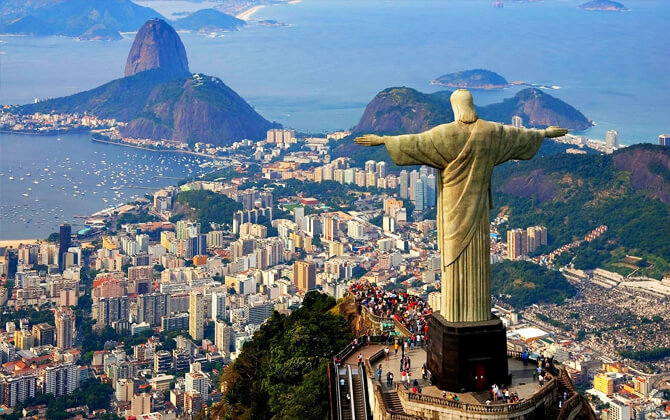
- Christ the Redeemer: from Largo do Machado Station, take the bus to Cosme Velho and continue with the Corcovado train
- Sugar Loaf Mountain: from Botafogo Station, take bus 513 to Pão de Açúcar
- Sambadrome: from Praça Onze Station, walk toward Avenida Marques de Sapucaí
- Ipanema Beach: from General Osório Station, walk toward Vieira Souto Avenue
- Copacabana Beach: use Cardeal Arcoverde, Siqueira Campos, or Cantagalo stations
- Maracanã Stadium: Line 2 provides direct access to the Maracanã area
- Museum of Tomorrow: from Uruguaiana Station, continue toward the revitalized port area and nearby museums
For many visitors, the metro is one of the easiest ways to move between the South Zone, the historic center, and major transfer points while keeping transport costs under control.