Kharkiv Metro is the rapid transit system of Kharkiv, Ukraine. Opened on 23 August 1975, it was the sixth metro in the USSR and the second in Ukraine. Today, the system has three lines, 30 stations, and a total route length of about 38.1 km (23.7 miles), with three central interchange hubs that make transfers simple. It remains a core part of public transport in the city, linking residential districts, rail connections, and major urban areas through a triangular route plan.
| Key | Information |
|---|---|
| System type | Rapid transit metro system |
| City | Kharkiv, Ukraine |
| Opening date | 23 August 1975 |
| Lines | 3 |
| Stations | 30 |
| Network length | 38.1 km (23.7 miles) |
| Layout | Triangular system with central interchange stations |
| Operator | Municipal enterprise Kharkiv Metro |
| Annual ridership | 223 million passengers in 2018 |
| Depots | TCh-1 Nemyshlianske and TCh-2 Saltivske |
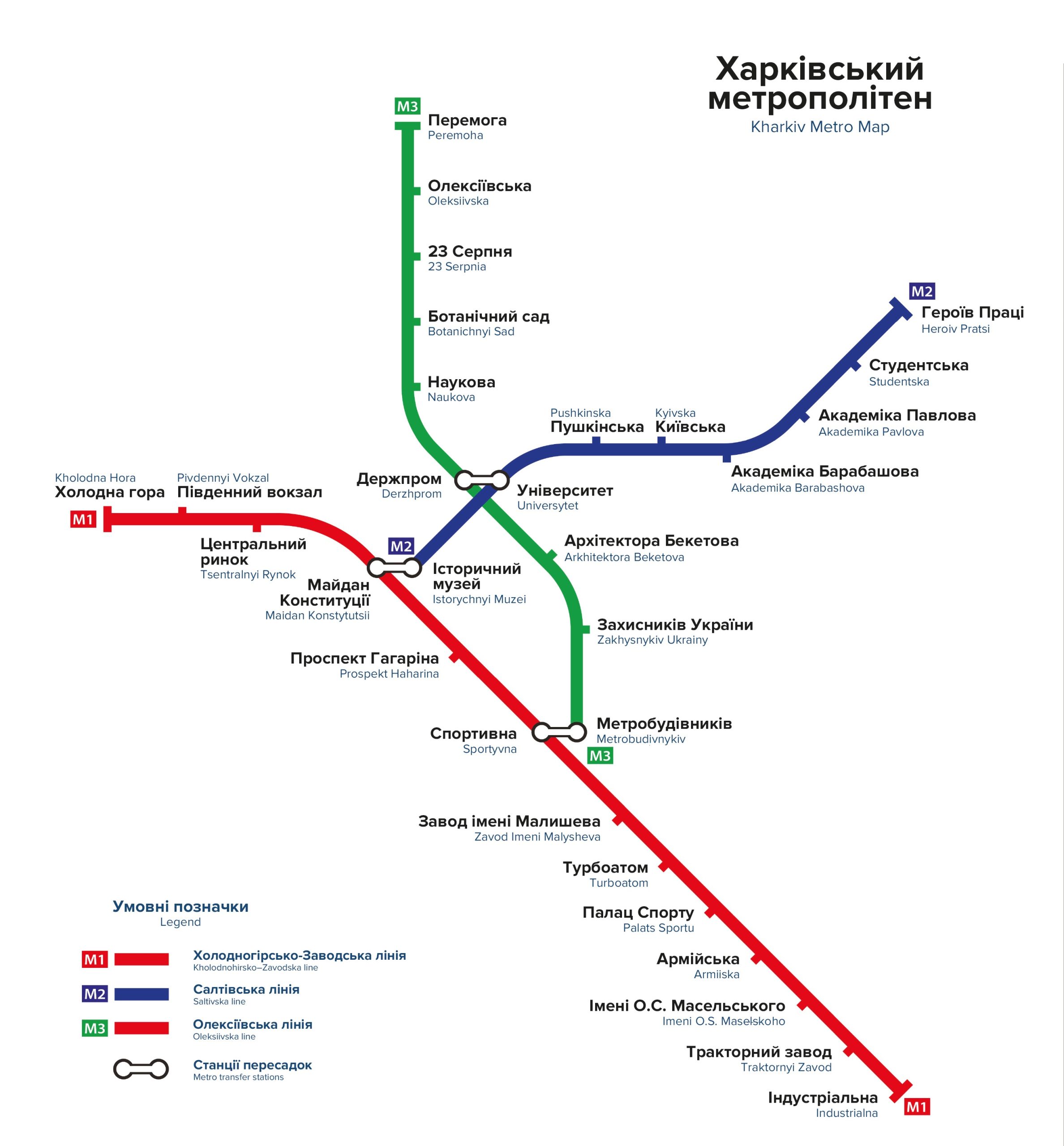
Kharkiv Metro Map
Map of Kharkiv Metro showing different lines. Click on the map to enlarge it or download the Kharkiv Metro map in PDF format.
Lines and Stations
Kharkiv Metro has three operational lines and 30 stations, all within the city limits. The network runs for approximately 38.1 km (23.7 miles) and is arranged around three underground interchange hubs in the center, so passengers can change lines with a single transfer. For trip planning, the stations map is fairly straightforward once you know the triangle-shaped layout.
| Station | Details |
|---|---|
| Kholodnohirsko-Zavodska Line | Opened 23 August 1975; length 17.39 km (10.8 miles); 13 stations |
| Saltivska Line | Opened 11 August 1984; length 10.39 km (6.5 miles); 8 stations |
| Oleksiivska Line | Opened 6 May 1995; length 10.98 km (6.8 miles); 9 stations |
| Total network | 38.1 km (23.7 miles); 30 stations |
Station opening hours usually start at 5:30 am, and stations close at 11:59 pm. The last train generally leaves at around 12:10 am, depending on the line. There is no regular night service, though the system may run later on special occasions.
The network extends outward from the center in a radial pattern. Vokzalna station connects directly with the main railway station, giving passengers easy access to platforms and ticket facilities without going above ground.
All stations have two tracks and an island platform. Nearly the whole system is underground, except for the enclosed metro bridge on the Saltivska Line between Kyivska and Akademika Barabashova. That fully enclosed design also helps protect the system during heavy winter weather.
Line 1: Kholodnohirsko-Zavodska Line
This is the oldest and longest line in the system, and also the busiest. The red line runs roughly east to west, serving industrial zones, transport hubs, and central districts.
Three of its 13 stations are deep-level: Maidan Konstytutsii, Vokzalna, and Kholodna Hora. The rest are shallow stations. The line is served by the TCh-1 Nemyshlianske depot.
Line 2: Saltivska Line
The blue line is the second line in the network by ridership and frequency. It runs on a northeast-southwest axis from the center toward Saltivka.
Its deep-level stations are Istorychnyi Muzei, Universytet, and Yaroslava Mudroho. Yaroslava Mudroho is the deepest station in the system, at 30 meters underground. The line is operated from the TCh-2 Saltivske depot and includes the metro’s only bridge crossing.
Line 3: Oleksiivska Line
The Oleksiivska Line is the newest route in the Kharkiv Metro system. It opened in 1995 and was later extended in stages. Today it has nine stations and connects with both other lines.
Most stations here are shallow. The two deep stations are Derzhprom and Arkhitektora Beketova.
Future stations
Two future stations are listed for the Oleksiivska Line: Derzhavinska and Odeska. Their current status is preparation for construction.
Schedule and Train Frequency
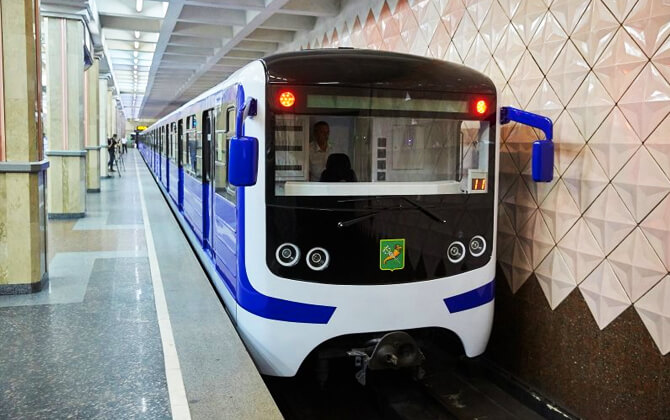
The Kharkiv Metro timetable usually runs from 5:30 am to midnight, although exact operating hours, opening times, and closing time can vary by season and line. If you are checking timings today or the schedule today, it is worth allowing for those small changes.
In the standard train schedule, frequency is usually every 2 to 3 minutes during rush hour and every 4 to 6 minutes off-peak. Later in the day, service becomes less frequent. Around 5:30 pm, trains arrive about every 10 minutes, and from 10:00 pm to midnight the wait is roughly 13 to 18 minutes. After 11:00 pm, the drop in frequency is noticeable on all lines.
Seasonal timetable changes also affect the running time between departures. In summer, Lines 1 and 2 operate at 24 trains per hour, with the shortest waits between 7:00 and 9:00 am at around 1.5 to 2.2 minutes. In winter, those two lines increase to 26 trains per hour, and the shortest interval is typically 1.5 to 3 minutes between 7:00 and 10:30 am. Autumn service is similar to winter, with minimum waits of around two minutes.
Line 3 follows a steadier schedule throughout the year, with about 12 trains per hour. The system does not normally run overnight, though night service may appear on special occasions.
| Service detail | Timings |
|---|---|
| General operating hours | 5:30 am to midnight |
| Station opening hours | 5:30 am |
| Station closing time | 11:59 pm |
| Last train | Around 12:10 am, depending on the line |
| Rush-hour frequency | Every 2 to 3 minutes |
| Off-peak frequency | Every 4 to 6 minutes |
| Late evening frequency | Every 13 to 18 minutes |
| Line 3 frequency | About 12 trains per hour |
Fares, Tickets, and Cards
Kharkiv Metro uses a flat fare system. A single ride costs ₴8.00, about $0.20, no matter which route you take or how many transfers you make within the metro. In simple terms, the ticket price stays the same across the whole system.
Passengers can pay the fare in several ways:
- paper barcode tickets
- contactless E-ticket card
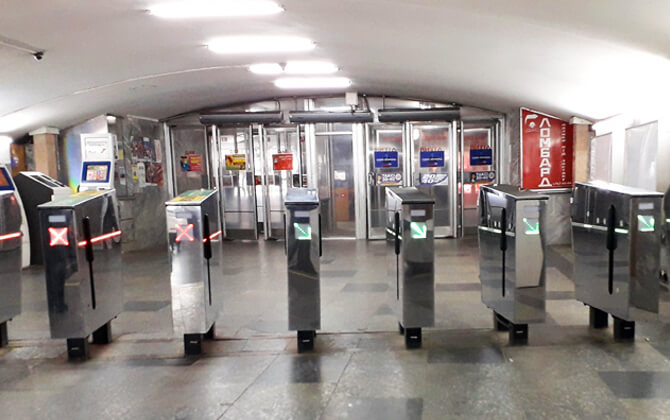
- contactless bank card or an NFC-enabled smartphone or device at blue turnstiles
The metro stopped selling tokens through ticket offices in 2010. Instead, stations have ticket machines and electronic top-up machines. Automatic machines were first installed at Maidan Konstytutsii station on the Kholodnohirsko-Zavodska Line.
The unified E-ticket transport card can be recharged at terminals in metro station lobbies and passageways, as well as at tram, trolleybus, and bus stops. The card itself costs ₴36, about $0.90, at a self-service terminal, and the maximum balance is ₴550, about $13.80.
Passengers can check the card balance on the validator screen while paying or through the Card Info menu on validators in surface transport. An E-ticket service center is located in the lobby of Historical Museum station and works on weekdays from 9:00 am to 6:00 pm.
There is no fare calculator mentioned in the available information, likely because the fare is fixed. There is also no day pass listed.
Connections with Other Systems
Kharkiv Metro is the backbone of transportation in Kharkiv, but it works closely with the rest of the city transport network too. Transfers to trams, trolleybuses, and buses are common, so local transport connections are a big part of how the system works day to day.
The tramway is the oldest public transport mode in Kharkiv, dating back to 1882. It began as horse-drawn transport and became electric in 1906. Today, the city has 13 tram lines with a total length of 217.6 km (135.2 miles), and many connect with metro stations.
The trolleybus network adds another layer to the system. Opened in 1939, it has four partly separate sections and 23 routes, with a total length of 259.9 km (161.5 miles). Direct trolleybus links serve several metro stations, including Palats Sportu on lines 1 and 25, Moskovskyi Prospekt on lines 20 and 31, Akademika Barabashova on line 24, and Armiiska on line 36.
Kharkiv also has an extensive bus network that has operated since 1925. It includes around a thousand vehicles, from minibuses to larger buses, and remains an important part of city transport. The city also has a small railway in the south and an aerial tramway between Sumskaya Street and Pavlovo Field.
Rail transport matters as well. Kharkiv’s railway station, rebuilt in 1989, is served by Ukrainian Railways and offers long-distance travel to cities including Astana and Moscow.
The metro does not directly reach Kharkiv International Airport, but several bus and trolleybus routes connect the airport with metro stations. Trolleybus line 5 links the airport with Prospekt Haharina on Line 1. Bus line 115 also serves Prospekt Haharina. Bus line 119 connects the airport with Maidan Konstytutsii on Line 1, Derzhprom on Line 3, and Botanichnyi Sad on Line 3. Bus lines 152 and 255 connect the airport with Akademika Barabashova on Line 2.
The triangular layout of the metro helps these transfers work smoothly. Since all three lines meet through central interchange points, it is easy to move between metro, bus, trams, and trolleybus routes without too much backtracking.
Connection to the Airport
Kharkiv International Airport is about 12 km (7.5 miles) southeast of the city. The metro does not currently provide a direct airport route, though future expansion plans have long included metro access in that direction.
According to development plans, the route toward the airport is intended to continue beyond the Odeska area, with future stations including Motel Druzhba and Aeroport. Earlier plans also mentioned a Levada-Airport line in a later development phase. The proposed airport connection is expected to be built as an elevated line on a viaduct along the median of Aerospace Avenue, where underground construction is considered less practical.
For now, passengers need to use other public transport. Trolleybus line 5 connects the airport with the city via Levada metro station, while trolleybus line 58 runs to Prospekt Peremohy, also via Levada. Bus line 115 connects the airport with Prospekt Haharina station. Bus line 119 links the airport with Maidan Konstytutsii, Derzhprom, and Botanichnyi Sad stations. Bus lines 152 and 255 add another link through Akademika Barabashova station.
So, while there is no direct path train or airport metro service yet, several stations already work as practical transfer points for airport travel.
System Rules
The Kharkiv Metro follows rules designed to keep the system safe, orderly, and reliable. They cover ticket access, baggage, passenger conduct, and the responsibilities of the carrier.
Ticketing and access
Passengers must pay for each entry beyond the automatic control points. Travel is available by electronic ticket, single-use ticket, or the Kharkiv resident card. Reduced-fare travel requires the correct preferential electronic ticket or resident card together with the original supporting document. Passengers with reduced mobility may use a mechanical turnstile with registration.
Tokens are no longer sold through ticket offices. Stations instead use ticket machines and electronic top-up machines. The fare remains fixed regardless of destination or transfers within the metro.
Baggage and prohibited items
Payment is required for each piece of baggage carried through the control points. One passenger may carry no more than two pieces of baggage. Dangerous items such as fire-hazardous, explosive, poisonous, narcotic, corrosive substances, gas cylinders, and similar materials are prohibited.
Passengers may not enter stations with ice cream or other food and drinks that could dirty other people. Bicycles, skates, sports equipment, and similar items are subject to safety requirements and must not interfere with passengers or train movement.
Passenger conduct
Passengers must use the proper entrance and exit doors, follow staff instructions, and behave carefully on escalators, platforms, and inside trains. Running in stations, entering an escalator in the wrong direction, standing on safety lines, or riding on tracks, roofs, or between cars is forbidden.
Smoking, open flame, pyrotechnics, littering, damaging metro property, or interfering with doors, emergency devices, or communications equipment is also prohibited. Passengers should give up seats for people with reduced mobility, passengers with children, and pregnant women. Lost items or suspicious objects should be reported to metro staff or police officers.
Carrier responsibilities
The carrier must ensure safe transportation, maintain trains and station areas in proper technical and sanitary condition, provide information about operations, announce station names, and warn passengers before doors close. In unusual situations or periods of heavy passenger flow, the carrier may regulate movement, change escalator operation, restrict access, or close stations.
Passenger rights
Passengers have the right to safe and quality transport to their destination, to buy valid tickets, and to receive information about operations, fare conditions, baggage rules, and accessibility from staff or the official website.
Tips
If you want an easier visit, try a weekday daytime trip. The system is usually simpler to navigate then, and stations feel less hectic.
Use the central interchanges to move across the network without returning to street level. That triangular route plan makes station-to-station travel pretty efficient.
Bring a payment method that works at your station. The fare is flat, and contactless payment is available at blue turnstiles.
If you plan to take photos, keep it respectful and low-key. Avoid blocking busy areas, pay attention to staff, and be ready to stop if asked.
Some stations have unusual layouts and escalator positions, so leave yourself a little extra time if you are changing lines or focusing on architecture.
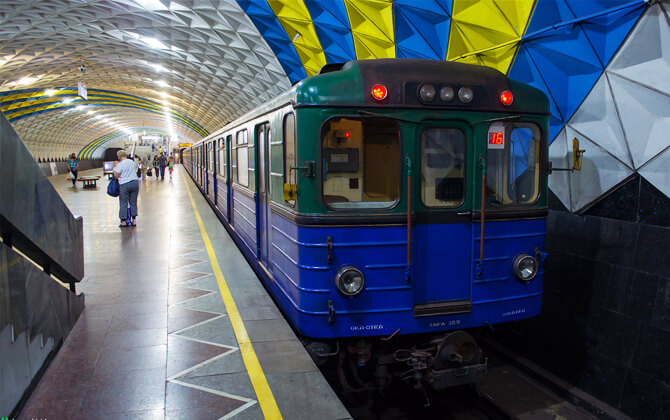
And yes, look up from your phone now and then. Marble, murals, and Soviet-era design details are a big part of the experience.
It is also worth remembering that the metro has served as shelter during difficult periods, so a respectful attitude matters in stations and trains.
History
After World War II, Kharkiv went through major reconstruction and rapid growth. New residential districts appeared, the city expanded, and by the early 1960s its population had passed 1 million. Even with a large network of bus, tram, and trolleybus services, transport problems kept growing.
By the late 1950s and early 1960s, planners and engineers concluded that surface transport alone could not handle passenger demand. Kharkiv’s radial street layout, narrow roads, dense development, rivers, ravines, and uneven terrain made a high-capacity off-street system necessary. Studies showed that only a metro could meet present and future needs, especially along the key west-east corridor linking factories, residential areas, railway hubs, and the center.
The idea of building a metro was formally raised in 1962. Several options were discussed, including a monorail and a high-speed tram, but a conventional metro was chosen. By the end of 1965, the Council of Ministers of the USSR had instructed the Ministry of Transport Construction to prepare the first phase of the project.
Design work then moved forward under major Soviet planning and construction institutions. The first line was planned along the city’s busiest corridor, but engineers had to deal with difficult hydrogeological conditions, river crossings, and construction near the central railway station and historic center. As a result, the route was adjusted and extended toward Kholodna Hora.
The formal decision to build the first phase was made on 29 April 1968. Construction started soon after. The first shaft was laid in July 1968, excavation began in August near the future Center station, and the first tunnel breakthrough came in April 1970. By October 1970, a dedicated construction management organization had been established.
Testing of the first section was completed in 1975. The first test train ran in late July, and the State Commission accepted the line in August. Kharkiv Metro opened to passengers on 23 August 1975. The first section was 9.8 km (6.1 miles) long and included eight stations, running from Sverdlova Street, now Kholodna Hora, to Moskovskyi Prospekt, now Turboatom.
The network expanded steadily afterward. In 1978, the first line was extended, and in 1986 three new stations opened on the Saltivska Line. The Oleksiivska Line began operating in 1995 and was later extended in 2004 and 2010. These additions connected more residential districts with the center and strengthened the metro’s role in city transport.
After Ukrainian independence, several station and line names were changed. In 2009, the metro moved from state to municipal ownership and was reorganized as the municipal enterprise Kharkiv Metro.
During the COVID-19 pandemic, service was suspended on 17 March 2020 and resumed on 25 May 2020, with face coverings required for passengers.
In 2022, during the Battle of Kharkiv in the Russian invasion of Ukraine, the metro served as a bomb shelter. On 19 May 2022, the mayor announced that operations would restart and that residents should leave the system.
Future Expansions
Kharkiv Metro has several expansion plans aimed at extending the current network and improving capacity. The most advanced project is the continuation of the Oleksiivska Line beyond Metrobudivnykiv toward Odeska, with two new stations, Derzhavinska and Odeska, plus a planned depot for the line.
According to available plans, this route may later continue farther south to Motel Druzhba and Aeroport. The project is supported by financing from the European Bank for Reconstruction and Development and the European Investment Bank.
Other long-term expansion ideas include extending the Saltivska Line south from Istorychnyi Muzei to Ploshcha Urytskoho, adding a future transfer-related station at Druzhby Narodiv in the north, and possible further development toward Novobavarska. The Kholodnohirsko-Zavodska Line is also expected to grow in both directions, toward Zalyutyno on one end and toward Skhidna, Rohanska, and Pivdenna on the other.
Beyond track expansion, the metro is also planning rolling stock renewal and modernization. Recent testing of a new train design began in 2025, with updated interiors, improved lighting, digital passenger displays, and a new exterior color scheme tied to Kharkiv’s public transport identity.
Fun Facts
- The Kharkiv Metro was the sixth metro system to open in the USSR and the second in Ukraine.
- It opened on 23 August 1975 with a first section of 9.8 km (6.1 miles) and eight stations.
- The system has three lines, 30 stations, and an operational length of about 38.1 km (23.7 miles).
- Three interchange stations in the city center give the network its triangular shape.
- The system includes the only metro bridge in Kharkiv, between Kyivska and Akademika Barabashova.
- Kharkiv was the first metro to use a single-vault design for shallow stations.
- Its stations are known for preserving a Soviet-era look while still having distinct designs.
- The metro has its own museum focused on history, construction, and awards.
- During the Soviet period, the system was named after Vladimir Lenin.
- In 2020 and again during the 2022 Russian invasion of Ukraine, service was suspended and stations were used as shelters.
- In 2009, the metro was transferred to municipal management.
- The system introduced the first escalator speed control system in the Commonwealth of Independent States.
Sightseeing from the Kharkiv Metro
The Kharkiv Metro is not just practical transport. It is also an easy way to reach some of the city’s best-known sights, especially if you want to combine everyday travel with a bit of sightseeing.
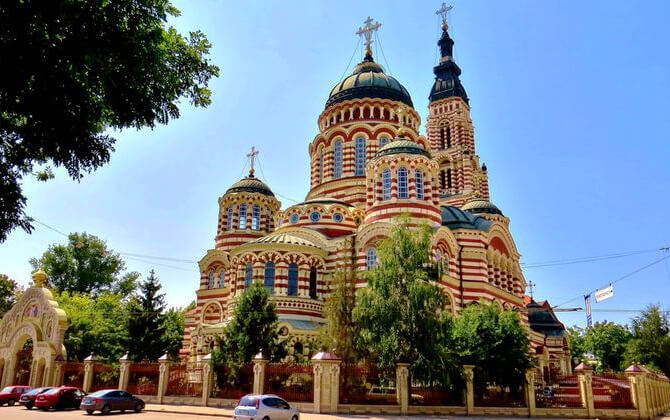
- Annunciation Cathedral — one of the main religious landmarks in Kharkiv and the city’s largest Orthodox church. It was built between 1899 and 1901 in the Byzantine style. The nearest stations are Maidan Konstytutsii and Pivdennyi Vokzal on Line 1. From Maidan Konstytutsii, walk west; from Pivdennyi Vokzal, walk east.
- Kharkiv Zoo — one of the oldest zoos in the country and a recently renovated attraction. The best route is via Universytet station on Line 2, then walk to the left.
- Kharkiv Art Museum — one of the key museums in Kharkiv and Ukraine. Founded in 1905, it holds Ukrainian and Russian works from the revolutionary period as well as Eastern European art from the 16th to the 20th centuries. Use Arkhitektora Beketova station on Line 3 and walk down one block.
These places show how the metro connects visitors not only with stations and transport hubs, but also with cultural and historic sites across the city.