Public transportation in Singapore is an integrated city transport system built around MRT and LRT trains, public buses, taxis, private hire cars, walking, and cycling. The network is known for efficient connections, wide island coverage, and practical airport access through Changi Airport. For most daily trips, the MRT and bus system forms the easiest route plan, while taxis and private hire cars add door-to-door convenience when speed, luggage, or late-night travel matters.
| Key | Information |
|---|---|
| Main modes | MRT, LRT, public bus, taxi, private hire car, walking, and cycling |
| Rail network | MRT has more than 160 stations on six lines and covers about 240 km (149 mi) |
| LRT network | More than 40 stations on two lines, covering about 28 km (17.4 mi) |
| Bus network | More than 300 scheduled bus services and over 100 short-trip variants |
| Typical train operating hours | From about 5:30 AM to around midnight, with extended opening hours during festive periods |
| Airport access | Changi Airport connects to the city by MRT, public bus, taxi, private hire car, and airport transfer |
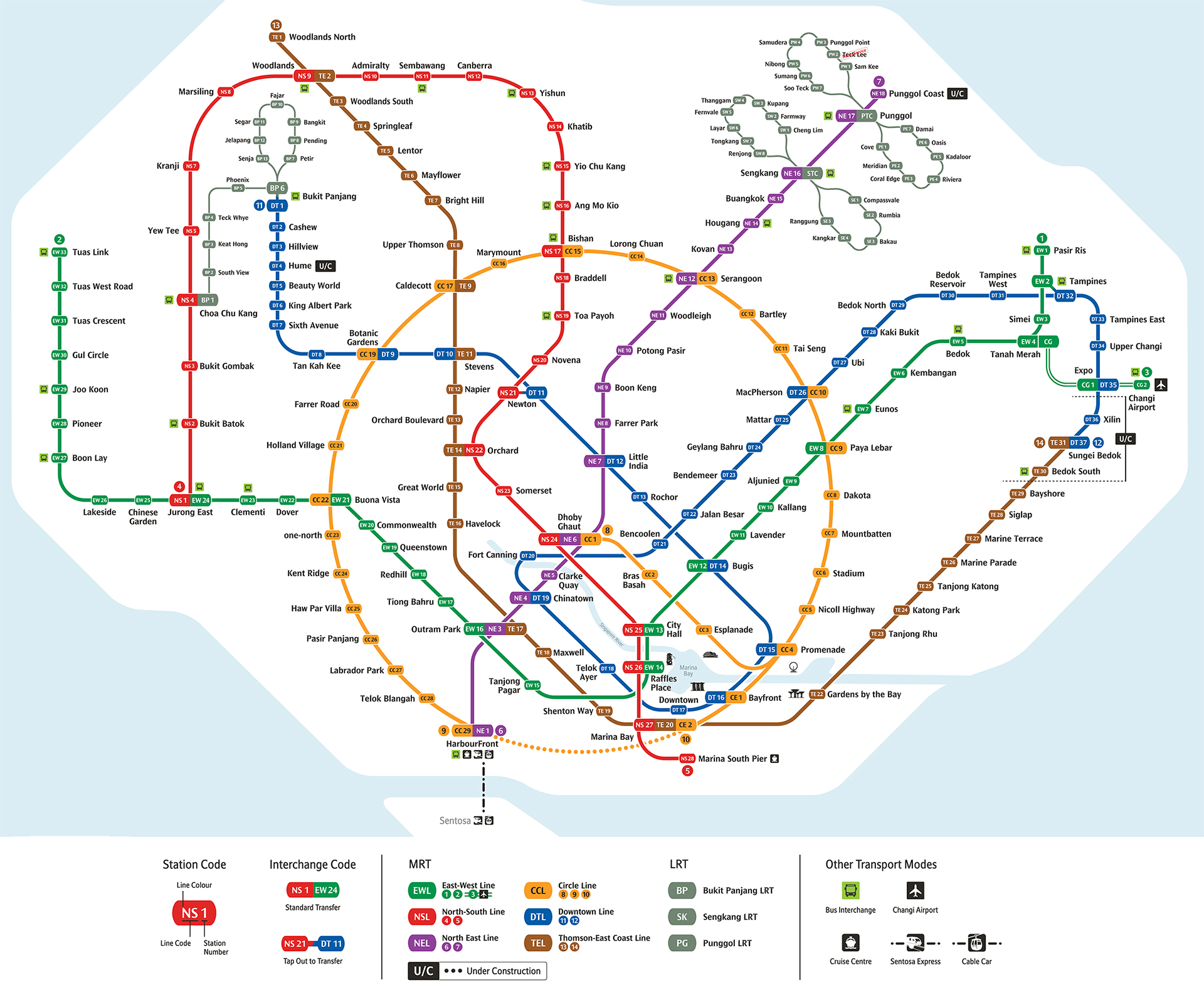
Map of Public Transportation in Singapore
Map of LRT and MRT showing different lines and stations. Click on the map to enlarge it or download the map in PDF format.
Getting around in Singapore
Getting around Singapore is straightforward because the city combines trains, buses, taxis, roads, walking paths, and cycling routes into one connected transport network. For visitors and residents, that means fewer complicated transfers and more practical choices for each trip.
Singapore’s public transport system carries millions of passengers daily. The rail network handles heavy commuter demand, while the public bus network reaches almost every part of the island. Together, they keep local transport reliable for work, errands, school, and leisure.
MRT and bus services are the backbone of public transportation in Singapore. The MRT is usually the fastest option across longer distances, and buses provide strong first- and last-mile links. Integrated Transport Hubs make many train-and-bus transfers smoother, especially in busy town centers.
Taxis and private hire cars are useful when you want door-to-door travel, need a late-night ride, or are carrying luggage. You can hail a taxi on the street where allowed, use a designated taxi stand, or book through a mobile app.
Walking and cycling also play a bigger role in city transport. Sheltered walkways, park connectors, and car-lite planning support greener travel and make short trips easier, safer, and more comfortable.
Bus Service in Singapore
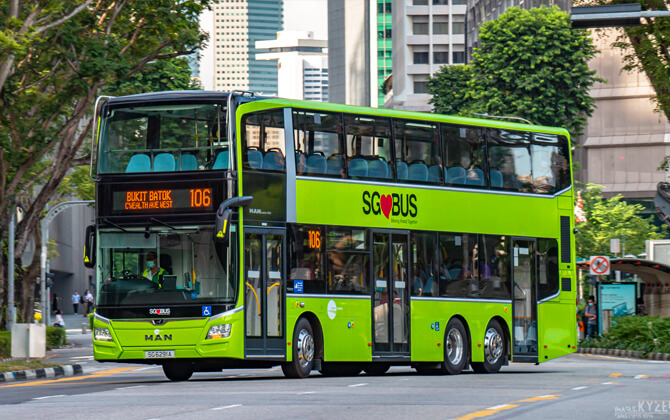
Public bus services are a major part of public transport in Singapore, with over 3.6 million rides taken per day on average as of December 2021. The system includes more than 300 scheduled bus services and over 100 short-trip variants, operated by SBS Transit, SMRT Buses, Tower Transit Singapore, and Go-Ahead Singapore.
As of 2024, around 5,800 buses are in operation. The bus network supports both long-distance travel and local commuter trips, while also complementing the MRT route network across the island.
Singapore’s bus route types include trunk, feeder, express peak hour, short trip, Jurong Industrial Services, express, Resorts World Sentosa Bus services, and Scheme B Bus services. Trunk routes connect towns, feeder routes operate within towns or in dual-loop patterns, and express routes usually stop at selected stops while using expressways or longer express stretches for faster running time.
Short-trip services cover selected sections of a parent route. Peak-hour express services skip lower-demand stops and charge basic bus fares. Jurong Industrial Services serve the Jurong and Tuas industrial areas, while Resorts World Sentosa Bus services operate on weekends and public holidays.
Since 2016, the public bus system has run under the Bus Contracting Model. The Land Transport Authority owns the bus assets, and operators bid to run bus services under contract. Services are grouped into bus packages and assigned to operators.
This model allows new services, route changes, and improved frequency to be introduced when travel patterns shift. It has also supported newer vehicle features, including electric buses, USB charging ports, and trials of three-door buses.
The Bus Service Enhancement Programme improved bus connectivity and capacity by adding new and extended routes, government-funded buses, and tighter service quality standards to reduce waiting times and crowding.
In July 2024, the Bus Connectivity Enhancement Programme was announced to further improve bus connectivity. Planned measures include buying more buses, adding new bus services, increasing the frequency of existing services, recruiting more staff, and building new transport infrastructure.
Buses have a long history in Singapore. The Singapore Traction Company was established in 1925 to replace the electric tramway with a trolleybus system. The first trolleybuses began operating in August 1926, and trams were phased out by 1927.
In the 1970s, the government studied bus service reforms, and Singapore Bus Services was formed in 1973 through the merger of regional operators. From the 1980s to the 1990s, bus services were modernized, competition increased with the launch of Trans-Island Bus Service, and routes were gradually aligned with MRT operations after the rail system opened in 1987.
More recently, the network has changed through fleet renewal, accessibility upgrades, and service adjustments during the COVID-19 pandemic, when some bus services were temporarily suspended and later restored or withdrawn as demand changed.
Singapore’s bus fleet is made up mainly of single-deck and double-deck vehicles across all four operators. SMRT Buses operates articulated buses, with some units transferred to SBS Transit and Tower Transit Singapore under the Bus Contracting Model.
Recent vehicle introductions include the BYD BC12A04, BYD C6, BYD K9, and Linkker LM312. Wheelchair-accessible buses and hybrid buses are also part of the fleet renewal story.
LRT and MRT in Singapore
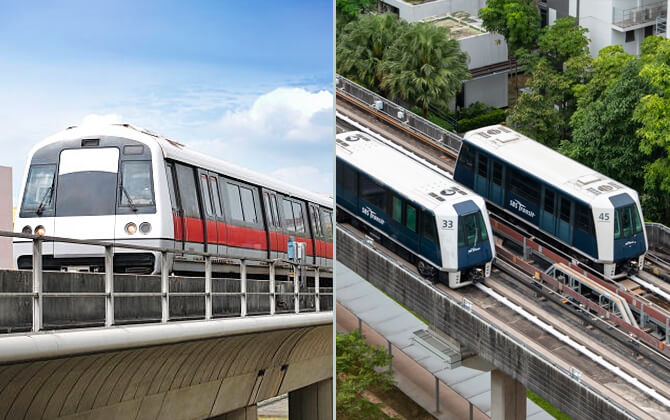
Singapore’s rail network is made up of the Mass Rapid Transit, or MRT, and the Light Rail Transit, or LRT. Together, they are central to the city-state’s public transportation system and offer fast, convenient travel across much of the island.
The MRT is the main heavy rail system. It has more than 160 stations across six lines and covers about 240 km (149 mi), with more than three million trips made each day. Expansion is ongoing, with more lines and stations being built to improve rail coverage.
The LRT works as a feeder network to the MRT in selected residential areas. It has more than 40 stations across two lines, covers about 28 km (17.4 mi), and carries over 200,000 passengers daily. For neighborhoods farther from main rail lines, it fills an important gap.
Two public transport operators run the train system. SMRT Corporation Ltd operates the North-South Line, East-West Line, Circle Line, Thomson-East Coast Line, and Bukit Panjang LRT. SBS Transit operates the North East Line, Downtown Line, and Sengkang-Punggol LRT.
| Service detail | Timings |
|---|---|
| Typical opening times and starting time | Train services generally start from about 5:30 AM daily |
| Typical closing time | Services usually run until around midnight |
| Peak-hour frequency | About every 2 to 3 minutes from 7:00 AM to 9:00 AM |
| Off-peak frequency | About every 5 to 7 minutes |
| Festive operating hours | Opening hours and working hours are usually extended during festive periods |
| Schedule today | For current train schedule, route timetable, and timings today, check SMRT, SBS Transit, or the MyTransport app |
If you are planning a specific route, check the latest timetable before traveling. Service updates can affect running time, last train connections, and the best path by train.
Trolley bus service in Singapore
The Singapore trolleybus system was part of the city-state’s transport network from 1926 to 1962. It was built between 1926 and 1927 as a replacement for the Singapore tramway network, with old tram routes converted into trolleybus routes.
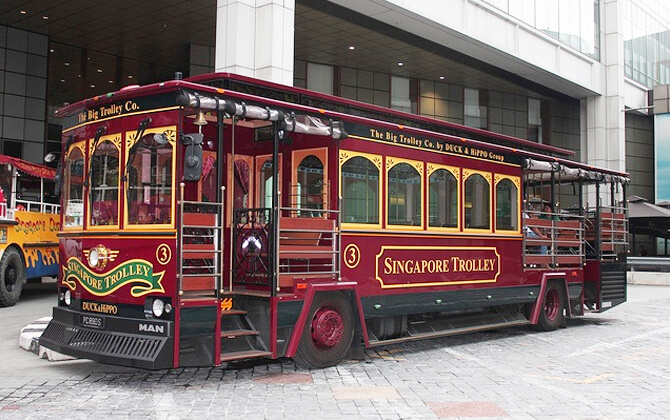
The service opened on 14 August 1926 and was operated by the Singapore Traction Company. In its early years, the system expanded quickly and became one of the world’s largest trolleybus networks in the 1930s. At its peak, it had a route length of 40.17 km (24.96 mi) and a fleet of 108 trolleybuses.
Trolleybuses were popular at first and carried far more passengers than the trams they replaced. After World War II, though, they had become outdated and no longer met Singapore’s transport needs. Motor buses gradually took over, and the last trolleybus service ended at midnight on 15 December 1962.
| Key | Information |
|---|---|
| Locale | Singapore |
| Open | 14 August 1926 |
| Close | 15 December 1962 |
| Status | Closed |
| Operator | Singapore Traction Company |
| Electrification | 540V DC |
The conversion from trams to trolleybuses was authorized in 1925, and the Singapore Traction Company took over the old tram operating assets later that year. Trolleybus service began with 30 vehicles on two routes, and the remaining tram routes were converted during 1927.
In the late 1920s, the service faced safety issues, including accidents involving passengers alighting from moving trolleybuses. The operator responded with passenger-control measures, including a central rod at the second-class entrance and inward-opening doors at third-class exits.
By October 1931, the network had carried almost 40 million riders. New operating rules arrived in 1939, including a maximum speed limit of 40 km/h (25 mph), a ban on exterior advertising, and a requirement for vehicles to be brightly lit.
After the fall of Singapore in February 1942, the local administration took over operations. First-class service ended in 1943, and new single-class trolleybuses were introduced with fares based on former second-class rates.
When British rule returned, only 20 of the pre-war trolleybuses were roadworthy. Service resumed in September 1945 with reduced passenger limits, but shortages meant some routes were temporarily operated by omnibuses. The trolleybus era finally closed in 1962.
The first trolleybuses were assembled in Singapore from chassis built by the Associated Equipment Company in England and bodies made in Shanghai. They were shipped in kit form and assembled at the Tanjong Pagar docks. Later fleets included post-war vehicles with new electrical equipment and pneumatic tyres.
The trolleybus network first used electricity generated by the Singapore Traction Company. In 1927, supply switched to the municipal grid. Because the routes needed 540V direct current, the company operated substations to convert alternating current into direct current.
Taxi service in Singapore
Taxis are a comfortable door-to-door transport option in Singapore, especially late at night, when you are traveling with luggage, or when a direct ride is simply easier. They cost more than the MRT or bus, but for some trips the convenience is worth it.
Official taxis have a small electronic Taxi sign on the roof. Outside the Central Business District, you may hail one along the road where stopping is allowed, or use a designated taxi stand. In the CBD, taxis can stop only at designated taxi stands and must follow local road restrictions.
You can also book taxis by mobile app or by phone. Taxis and private hire cars are both widely used in Singapore, and app booking is often the simplest option when street-hailing is inconvenient.
Taxi fares are meter-based, and extra surcharges may apply depending on time of day, pickup point, and route. Since all taxis use a meter, there is no need to negotiate the fare. Cash is the preferred payment method, although some taxis accept cards with an additional service fee.
If you are comparing taxi travel with other city transport options, remember that Singapore’s public transport network is extensive. For everyday commuting, the MRT and bus are usually better value; for comfort, luggage, or speed, a taxi can make sense.
Airport Connections
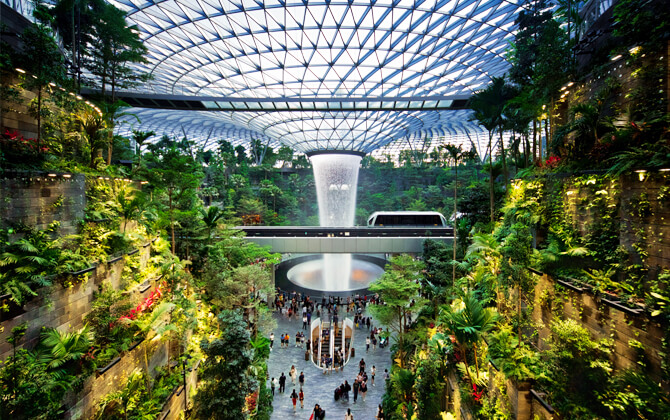
Singapore Changi Airport connects to the city and other parts of Singapore by public bus, MRT, taxi, private hire car, and airport transfer service. The best choice depends on your budget, luggage, and how quickly you need to travel.
Public buses serve all terminals. For Terminals 1, 2, and 3, bus stops are located at the basement bus bays. From there, you can take buses 24, 27, 34, 36, 53, 110, and 858. At Terminal 4, buses 24, 34, 36, and 110 stop next to Car Park 4B, while buses 27, 53, and 858 stop near the SATS Inflight Catering Centre 1.
When paying bus fare by cash, prepare the exact amount because no change is given. Public transport also accepts contactless Mastercard, Visa, and NETS bank cards, mobile wallets, stored-value EZ-Link cards, and other supported cards. EZ-Link cards can be bought at Changi Recommends stores, the Passenger Service Centre, or the TransitLink Ticket Office at Changi Airport MRT Station.
By train, the main city route runs from Changi Airport MRT Station (CG2) to Tanah Merah MRT Station (EW4), then onward on the East West Line toward Tuas Link MRT Station (EW33). Another route is from Changi Airport MRT Station to Expo MRT Station (CG1/DT35), then onto the Downtown Line toward Bukit Panjang MRT Station (BP6/DT1).
To reach Pasir Ris, take the train from Changi Airport MRT Station to Tanah Merah MRT Station, then continue on the East West Line toward Pasir Ris MRT Station (EW1).
| Service detail | Timings |
|---|---|
| First train from Changi Airport MRT Station to Tanah Merah MRT Station, Monday to Saturday | 5:31 AM |
| First train from Changi Airport MRT Station to Tanah Merah MRT Station, Sundays and public holidays | 5:59 AM |
| Last train connection to Tuas Link | 11:18 PM daily |
| Last train connection to Pasir Ris | 12:06 AM daily |
| Current airport train timings | Check the SMRT Journey Planner for the latest timetable and last train updates |
Accepted train payment options include contactless Mastercard, Visa, and NETS bank cards, mobile wallets, stored-value EZ-Link and NETS FlashPay cards, and the Singapore Tourist Pass. Admin fees apply for foreign-issued bank cards.
Taxis are available at the taxi stands in the Arrival areas of Terminals 1, 2, 3, and 4. A ride to the city takes about 30 minutes and costs about S$25 to S$45, roughly US$19 to US$33. All fares are metered.
An additional airport surcharge applies to trips starting at the airport: S$8, about US$6, from Monday to Sunday between 5:00 PM and 11:59 PM, and S$6, about US$4.50, at all other times. Midnight and peak-hour surcharges also apply to taxi hires country-wide.
Private hire cars can be booked through Grab, Gojek, Zig, Tada Mobility, or Ryde. Bookings are made through each provider’s mobile app, with pick-up points in the Arrival and Ride-Hailing areas at Terminals 1, 2, 3, and 4.
Only Singapore taxis and Malaysian taxis with an ASEAN Public Service Vehicle Permit are licensed for cross-border taxi or private hire car services between Singapore and Malaysia. These taxis can be hired at Ban San Street Terminal in Singapore and Johor Larkin Terminal in Malaysia, the designated pick-up and drop-off points for cross-border taxi services. Passengers may also book cross-border trips through licensed Singapore taxi operators.
Changi Airport’s 24-hour Ground Transport Concierges provide airport transfer services to destinations in Singapore. You can book in advance through the Changi App or approach the counters at the airport.
The counters are located at T1 Arrival Pick-up Basement, T2 Arrival Hall Level 1 Door 6, T3 Arrival Hall Level 1 next to the information counter, and T4 Arrival Hall Level 1 next to the information counter.
Airport transfer options include a 4-seater vehicle at S$55.00, about US$41, per trip to any destination in Singapore, and a 6-seater vehicle at S$60.00, about US$44, per trip to any destination in Singapore.
Additional surcharges apply for some services and destinations, including large taxi and limousine taxi bookings, as well as trips to Sembawang Shipyard, Jurong Island, Changi Airfreight Centre, and Tuas Mega shipyard or PSA Tuas port beyond Seatrium Tuas yard.
Nearby Attractions
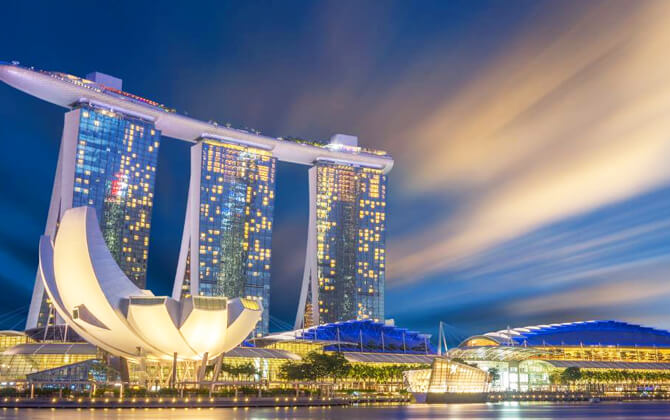
Singapore’s transport network makes sightseeing easy. You can build a route around the places you want to visit instead of spending the day on long transfers. The MRT is especially useful for major districts such as Orchard Road, Chinatown, Little India, Marina Bay, and the Botanic Gardens.
For visitors using a stations map or planning a simple stations list for sightseeing, these MRT stations are especially convenient:
| Station | Details |
|---|---|
| Botanic Gardens | Useful for Singapore’s only UNESCO World Heritage Site |
| Chinatown | Good for temples, food, and heritage streets |
| Little India | Best for colorful streets and local flavours |
| Marina Bay | Convenient for the Marina Bay area |
| Bayfront | Useful for Gardens by the Bay and Marina Bay Sands |
| Orchard Road | Good for the city’s main shopping district |
| HarbourFront | Access point for Sentosa |
Several popular attractions are also easy to pair with bus routes, taxi rides, or sightseeing services. Places commonly linked with Singapore tours and transport stops include Gardens by the Bay, Merlion Park, Singapore Flyer, Singapore River, Clarke Quay, Boat Quay, Raffles Hotel, National Gallery of Singapore, Singapore Botanic Gardens, and Orchard Road.
If you prefer slower travel, cycling routes can also take you to areas such as Marina Bay, Coney Island, and the eastern coast. It is a practical way to combine transport with sightseeing and see more of the city in one day.