The Copenhagen S-train, or S-tog, is a core part of public transport in Copenhagen, Denmark. It is a hybrid urban-suburban rail system that links the inner city with Hillerød, Klampenborg, Frederikssund, Farum, Høje-Taastrup, and Køge. The network covers 170 km (105.6 miles) of double track and has 87 stations. S-trains are operated by DSB S-tog A/S, while Banedanmark owns the tracks and signals. Alongside the Metro, regional trains, local transport services, trams history in the wider region, harbour buses, and bus connections, the system plays a major role in city transport and transportation in Copenhagen.
| Key | Information |
|---|---|
| System | Copenhagen S-train (S-tog) |
| Type | Urban-suburban rail system |
| Network length | 170 km (105.6 miles) of double track |
| Stations | 87 |
| Daily ridership | More than 357,000 passengers |
| Operator | DSB S-tog A/S |
| Infrastructure owner | Banedanmark |
| Rolling stock | 104 8-car Class SA train sets and 31 4-car Class SE train sets |
| Fare system | Common fare zone and ticket system shared with Metro, buses, regional trains, and harbour buses |
Map of Copenhagen S-trains
Map of S-trains in Copenhagen with different lines and stations. Click on the map to enlarge it or download the S-trains in Copenhagen map in PDF format.

Copenhagen S train lines and stations
The Copenhagen S-train route plan is built around six radial lines and two connecting lines. Most of these routes began as commuter rail links in the late 19th and early 20th centuries and still shape the network today.
The radial lines
Reading counterclockwise from north to south, these are the main radial routes in the system:
| Station | Details |
|---|---|
| Klampenborgbanen | Runs from Klampenborg to Østerport and connects with the Boulevard Line. It carries Line C to the north. |
| Nordbanen | Runs from Holte and Hillerød to Østerport. It carries Lines A and E to the northwest. |
| Hareskovbanen | Runs from Farum to Østerport. It carries Lines B and H to the northwest. |
| Frederikssundbanen | Runs from Frederikssund to Copenhagen Central Station and connects with the Boulevard Line. It carries Lines C and H to the west. |
| Vestbanen | Runs from Høje Taastrup to Copenhagen Central Station. It carries Lines B and Bx from the west. |
| Køge Bugt-banen | Runs from Hundige and Køge to Copenhagen Central Station. It carries Lines A and E from the south. |
The connecting lines
Two connecting lines tie the network together and make cross-city travel easier.
| Station | Details |
|---|---|
| Ringbanen | Runs from Hellerup in the north to København Syd in the south, with interchanges to radial lines. It carries Line F. |
| Boulevard Line (Roret) | An underground route from Østerport to Copenhagen Central Station through the city centre. It carries Lines A, B, Bx, C, E, and H. |
Five suburban services continue through the central section as cross-city routes. Line F works differently, forming a semicircular path train around central Copenhagen between Hellerup and København Syd. By changing at Ryparken or Hellerup in the north and København Syd in the south, you can also piece together an approximate 20 km (12.4 miles) circular route inside the city and inner districts.
The system links three southern and western branches with three northern and northwestern branches. In theory, a train from one southern branch can continue onto any of the northern branches, and vice versa. The ring line connects to both Nordbanen and Klampenborgbanen at Hellerup, though in normal operation it is used only with Klampenborgbanen.
Stations and service patterns
The stations map includes 87 stations in regular operation. Of these, 32 are in the central fare zones, 35 more are in the Copenhagen urban area, and 17 can be described as suburban stations.
Main interchange and terminal stations include Hellerup, Hillerød, Holte, Høje Taastrup, København H, København Syd, Køge, Nørreport, Østerport, Valby, and Vesterport.
Most stations are served at least every 10 minutes until the evening. In the city core, frequency is much higher because several lines share the same route through the centre, so departures are roughly every two minutes. On many suburban sections, trains come every five minutes, while on Sundays those intervals are doubled.
Since December 2020, the line pattern has been: A on Nordbanen to Hillerød, B on Hareskovbanen to Farum, Bx on Hareskovbanen to Buddinge in rush hours, C on Frederikssundbanen to Frederikssund, E on Nordbanen to Holte, F on Ringbanen between København Syd and Hellerup, and H on the southern part of Frederikssundbanen to Ballerup.
A few stations have special notes. Høvelte is a military station with very few stops, Kildedal is not operated on Monday-Friday evenings, and Ny Ellebjerg was renamed København Syd on 10 December 2023.
Station types
- Elevated stations: Fuglebakken, Jægersborg, Bernstorffsvej, Nordhavn, Sjælør, Sydhavn, Dyssegård, Jyllingevej, Vanløse, and Vigerslev Allé.
- Stations with different levels: Flintholm, København Syd, Rødovre, and Danshøj.
- Underground station: Nørreport.
The S-trains are run by DSB S-tog A/S, while Banedanmark owns the tracks and signals. The system works alongside the Copenhagen Metro, which serves the city centre, Frederiksberg, and Amager.
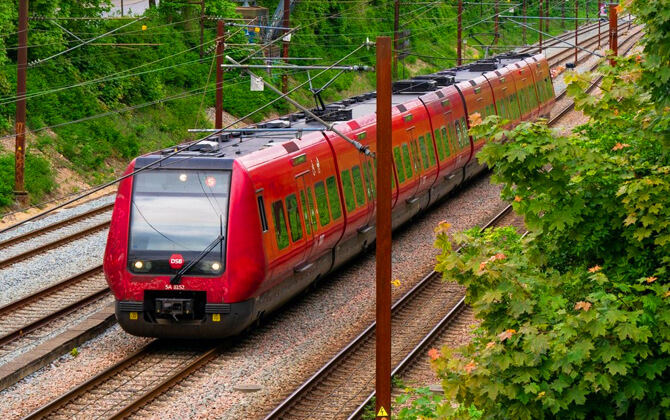
Running times of the Copenhagen S-trains
The Copenhagen S-trains usually run from about 05:00 until about 00:30. If you are checking operating hours, opening hours, opening times, working hours, or timings today, that is the general service window for the network.
| Service detail | Timings |
|---|---|
| Starting time | About 05:00 |
| Closing time / last train window | About 00:30 |
| Line F daytime frequency | Every 5 minutes |
| Lines A, B, C and E daytime frequency | Every 10 minutes |
| Lines H and Bx daytime frequency | Every 20 minutes |
| Early morning and late evening running time pattern | Typically every 20 minutes |
| Sunday service | Intervals are doubled |
| Weekend daytime service | Lines A, B, C and F run six times an hour between 10:00 and 18:00 |
| Weekend off-peak | 20-minute intervals outside 10:00-18:00 |
| Friday and Saturday night Line F | Every 30 minutes during night hours |
| Friday and Saturday all-night service | Night network runs twice an hour and stops at every station on the relevant radials |
During the day, the timetable is frequent across the network. Line F runs every 5 minutes, Lines A, B, C, and E every 10 minutes, and Lines H and Bx every 20 minutes. In the central corridor, the train schedule feels much denser because most lines share the same path through the city centre.
On weekdays, all stations are served at least every 10 minutes until evening. Outside peak periods, the route timetable typically shifts to every 20 minutes in the early morning and late evening. On Sundays, those intervals are doubled.
Weekend service is lighter. Only Lines A, B, C, and F run, with six departures an hour from 10:00 to 18:00 and 20-minute intervals outside that window. Line F is the exception at night, running every 30 minutes on Friday and Saturday nights.
Friday and Saturday nights also have all-night service. During those hours, trains run twice an hour and stop at every station on the relevant radial routes.
One thing to keep in mind: other trains in the Copenhagen area, such as the Kystbanen coastal line, are not part of the S-train system.
Ticket price
The right ticket depends on how often you plan to travel and how many zones your route covers. For a single trip, a standard ticket is usually enough. If you expect several journeys over 1 to 5 days, a City Pass or Copenhagen Card may offer better value.
Fares are based entirely on zones. The minimum trip is 2 zones, and the same ticket is valid on the metro, S-trains, buses, regional trains within the paid zones, and harbour buses. That shared fare system makes switching between public transport modes pretty straightforward.
| Service detail | Timings |
|---|---|
| Single ticket, 2 zones | DKK 24 (about USD 3.48) |
| Single ticket, 3 zones | DKK 30 (about USD 4.35) |
| Single ticket, 8 zones | DKK 60 (about USD 8.70) |
| 4 to 6 zone tickets | Increased by DKK 2 (about USD 0.29) from 18 January 2026 |
| City Pass validity | 24, 48, 72, 96, or 120 hours |
Single ticket price starts at DKK 24 (about USD 3.48) for 2 zones. A 3-zone ticket costs DKK 30 (about USD 4.35), while 8 zones cost DKK 60 (about USD 8.70). Tickets for 4 to 6 zones increased by DKK 2 (about USD 0.29) from 18 January 2026.
City Pass is a time-based pass for unlimited travel in selected zones. City Pass Small covers zones 1-4, while City Pass Large covers zones 1-99. Both options are sold for 24, 48, 72, 96, or 120 hours.
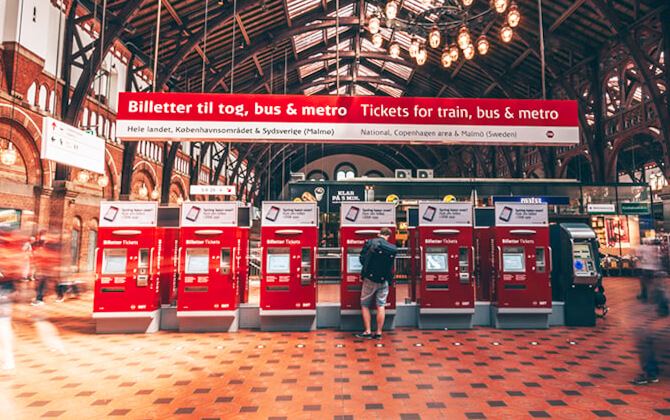
You can buy a ticket in the Rejsebillet app, which also helps with zones for your trip. Tickets are also available at ticket machines on metro and train platforms and at 7/11 kiosks near stations. The Rejsekort app and DSB app can also be used to buy tickets or check in by mobile.
If you need fare details, a fare calculator-style zone check in the official apps is the easiest way to confirm cost, ticket price, and the right pass or card for your journey.
Connections to Other Systems
The Copenhagen S-train works closely with the separately owned Copenhagen Metro. Together, the two systems carry 700,000 passengers a day, with S-tog accounting for more than 357,000 daily riders.
The network also connects with regional trains, local diesel-powered trains in Metropolitan Copenhagen, an extensive bus network, and two harbour bus lines. At many stations, bus terminals sit right next to S-train or Metro platforms, so changing between local transport options is easy.
Fare integration is a big advantage. The different systems share fare zones and ticketing, so one ticketing framework covers buses, regional trains, the metro, and the S-train network.
At the outer edges of the route, other rail services continue beyond the S-train area. Regional trains and local diesel trains reach more distant towns, while services across Øresund connect Copenhagen with Scania and Malmö. In the city centre, the S-train also shares tunnel sections with regional trains.
The wider transport network has shaped the system over time. The Frederiksberg-Vanløse-Grøndal line closed after the Metro arrived, while the former Godsbaneringen Grøndal-Ny Ellebjerg route was converted into an S-line.
Line F has the closest relationship with the Metro. The current interchanges between Line F and the Metro are Flintholm and Nørrebro, and the Danish Transport Authority has suggested converting the F line to metro standard as an M5 line.
Airport Connections
Copenhagen Airport is about 8 km (5 miles) from central Copenhagen, and travel time is usually 13 to 35 minutes depending on which transport option you choose. From Terminal 3, both the train and the Metro are easy to access.
Train services from the airport station in Terminal 3 leave every 10 minutes during the day and take about 15 minutes to Copenhagen Central Station. In the evening, they run every 20 minutes, and at night there is one train per hour. Copenhagen Central Station offers onward connections to S-trains, buses, and trains across Denmark, and it is within walking distance of Tivoli Gardens, Glyptoteket, and Strøget.
The Metro is a convenient choice for Kongens Nytorv, Nørreport, or Frederiksberg/Vanløse. A trip to Kongens Nytorv takes about 13 minutes. From there, you can change to Metro line M3, the 17-stop circle line that opened in 2019. For cruise terminals in Nordhavn, change at Kongens Nytorv and take the M4 toward Orientkaj.
Buses are available outside Terminal 3, while taxis can be found outside both Terminal 1 and Terminal 3. There are also other bus services, including routes to northern Jutland and between Malmö and Copenhagen.
The key point is simple: the S-train does not serve the airport directly, so use regional trains, the Metro, or bus connections instead.
Parking facilities around stations
Station parking is an important part of commuting around Copenhagen. Instead of driving all the way into the city centre, many passengers leave their cars at stations outside the core and continue by train. This Park and Ride model helps reduce congestion and supports cleaner air.
City officials have described this as a practical way to move more drivers onto public transport. Mayor Line Barfod of the Red-Green Alliance has called for more parking capacity at rail stations around Copenhagen to make that switch easier.
A working example at Køge Nord
Køge Nord Station is a clear example of how station parking can support the network. Opened in 2019 next to the motorway, it became popular quickly. Its parking facility was expanded to 900 cars, and one commuter cited in the source material said the setup saves half an hour each way.
The station also uses a smart parking system to manage occupancy and direct drivers to available spaces. In short, it is designed for high commuter demand.
Places where demand is already high
Trekroner Station in Roskilde is another case where parking charges and capacity planning matter. Demand already exceeds supply there. According to the source material, more cars arrive each day than there are spaces, and a proposal has been made to expand capacity from 102 to 900 spaces.
Funding and policy questions
One major issue is funding. Copenhagen collects more than 700 million kroner in annual parking revenue, but a significant share is returned to the state. Mayor Barfod has argued that some of that money should instead support Park and Ride infrastructure across greater Copenhagen.
That debate is tied to broader policy questions about how parking charges per day, station parking investment, and public transport funding should work together beyond the city borders.
Rules and tips for the Copenhagen S trains
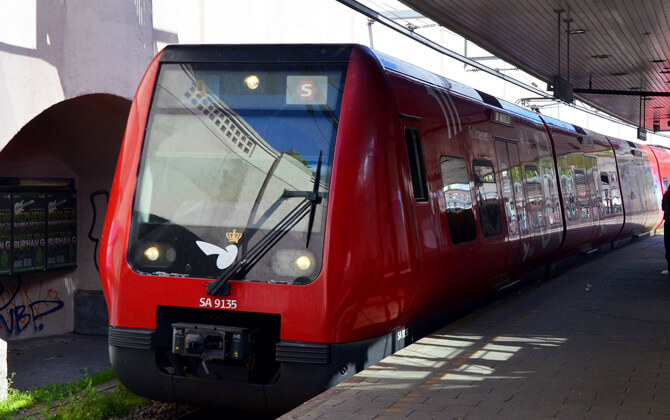
The Copenhagen S-train is simple to use, but a few basic rules make the trip smoother and safer. You need a valid ticket before boarding because stations do not have barriers and inspections take place regularly. Tickets can be bought from ticket machines, 7-Eleven stores at stations, or in the DSB, DOT, and Rejseplanen apps.
When boarding, press the button on the outside door after you hear the beep. Let passengers get off first, and try not to block the doors, especially during busy periods. If you are bringing a bicycle, use the designated bike carriages. Bicycles are not allowed on or off at Nørreport Station during weekday rush hours.
On board, watch the electronic displays and listen for announcements in Danish and English. If you want a quiet trip, use the quiet zone carriage and respect the silence there. For wheelchair users, it is best to wait at the end of the platform nearest the train stopping point and let the driver know assistance is needed.
- Check the platform boards and destination before boarding.
- Use Rejseplanen to plan your route and check the schedule today.
- Travel off-peak if you want more space.
- There are no toilets, first-class carriages, or seat reservations on the S-train.
- If you are going to Copenhagen Airport, use regional trains or the Metro, since the S-train does not go there.
These simple habits help keep travel safe and make the system easier to use, especially for first-time visitors.
History
The Copenhagen S-train history begins with the idea of electrifying the existing local rail network around the capital. The network now consists of six radial lines and two connecting lines, many of them built in the late 19th and early 20th centuries for commuter travel between residential areas and the city centre.
Preparations advanced with the Electrification Commission of 1926, which reviewed earlier proposals. In 1929, the commission recommended electrifying the short-distance lines from Copenhagen to Klampenborg first, and possibly the Frederiksberg-Vanløse-Hellerup section as well. It also suggested electrifying the line to Holte later, after the double-track Holte-Hillerød line had entered ordinary use.
After DSB reviewed the plan, the section to Valby was added as the first stage of electrification for the Ballerup line. A bill was submitted and adopted in April 1930. The first section opened on 3 April 1934, running from Klampenborg to Hellerup and from Vanløse to Frederiksberg. It was Denmark’s first electrically powered railway.
Several existing lines were then folded into the new system, including Hellerup to Hillerød, Svanemøllen to Farum, and the line between Frederikssund and Valby. The Valby to Vanløse section opened in 1941, was extended to Ballerup in 1949, and finally reached Frederikssund in 1989. Single-track operation remained between Ballerup and Veksø until 2000, and between Veksø and Frederikssund until 2002.
New tracks were built along the existing Valby to Høje Taastrup route between Valby and Glostrup, opening in 1953. The line was extended to Taastrup in 1963 and to Høje Taastrup in 1986. A completely new route, the Køge Bay line, was built in four stages between Dybbølsbro and Køge: Dybbølsbro to Vallensbæk in 1972, Vallensbæk to Hundige in 1976, Hundige to Solrød Strand in 1979, and Solrød Strand to Køge in 1983.
The Frederiksberg to Vanløse to Grøndal line later closed after the Copenhagen Metro opened. The former Godsbaneringen route from Grøndal to Ny Ellebjerg was converted into an S-line. Originally, the lines had no letters or numbers, but with the summer timetable introduced on 14 May 1950, the system switched to line letters. Since 1978, the S-train has been fully one-man operated.
Future Extensions
The future expansion of the S-train network has been discussed in several official plans and studies. One major proposal is a new north-south tunnel under the densely populated inner city, prompted by very heavy traffic on the Dybbølsbro-Svanemøllen section.
Another long-discussed idea is extending Vestbanen from Høje Taastrup to Roskilde along existing tracks. Recent studies have looked at this option, which would push the S-train farther west if the required infrastructure changes are made.
There have also been proposals for northern expansion. One suggestion is to continue from Klampenborg to Elsinore by converting the coastal railway to S-train standard, though this would be harder because spare capacity in the central tunnel is limited. A further extension toward Hørsholm and Kokkedal has also been proposed.
Other plans focus on better access to major destinations. A link to Copenhagen Airport has been proposed, even though the airport already has regional train and Metro service. In the longer term, Line F stands out: it has been discussed as a possible conversion to Metro standard, and there are plans for it to become driverless and operate around the clock.
More broadly, the Future S-network programme points toward a fully automated system, with new rolling stock and infrastructure updates designed to support growth, improve flexibility, and handle higher-capacity operations.
Nearby Attractions
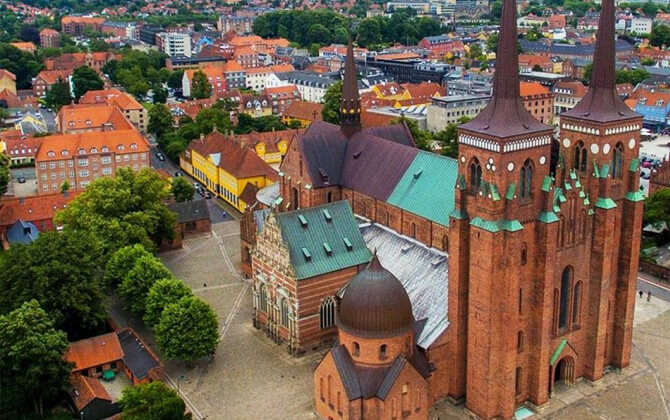
Copenhagen S-trains make it easy to reach a number of places in and around the capital. From the city centre, you can use the suburban rail network for local sightseeing as well as short day trips.
Popular destinations on or near the network include Klampenborg, Hillerød, Roskilde, Lyngby, and Helsingør. Some are reached directly by S-train, while others are reached by rail connections from Copenhagen.
- Klampenborg is reachable by Line C and is noted as a short trip from Copenhagen.
- Hillerød can be reached by S-train via Nordbanen.
- Lyngby is served by the S-train and offers access to Lyngby Hovedgade Shopping Street, the Open-Air Museum, and Lyngby Lake.
- Roskilde is accessible by train from Copenhagen Central Station and is known as a historic rail destination.
- Helsingør is reachable by train from Copenhagen Central Station via the Coast Line.
Within Copenhagen itself, the S-train is also useful for getting around major stations and central districts without needing a car.