Metrorrey, officially the Sistema de Transporte Colectivo Metrorrey, is Monterrey’s rapid transit system and a core part of city transport in the metropolitan area of Nuevo León. Service began on 25 April 1991, and the network has grown to 3 lines, 40 stations, and 40 km (25 mi) of route. It operates 50 high-floor electric trains, mainly on elevated viaducts, with some underground and surface sections, and carried 134.84 million passengers in 2023.
| Key | Information |
|---|---|
| Official name | Sistema de Transporte Colectivo Metrorrey |
| City | Monterrey metropolitan area, Nuevo León, Mexico |
| Opening date | 25 April 1991 |
| Lines | 3 |
| Stations | 40 |
| Network length | 40 km (25 mi) |
| Rolling stock | 50 high-floor electric trains |
| 2023 ridership | 134.84 million passengers |
| Infrastructure | Mainly elevated, with underground and surface sections |
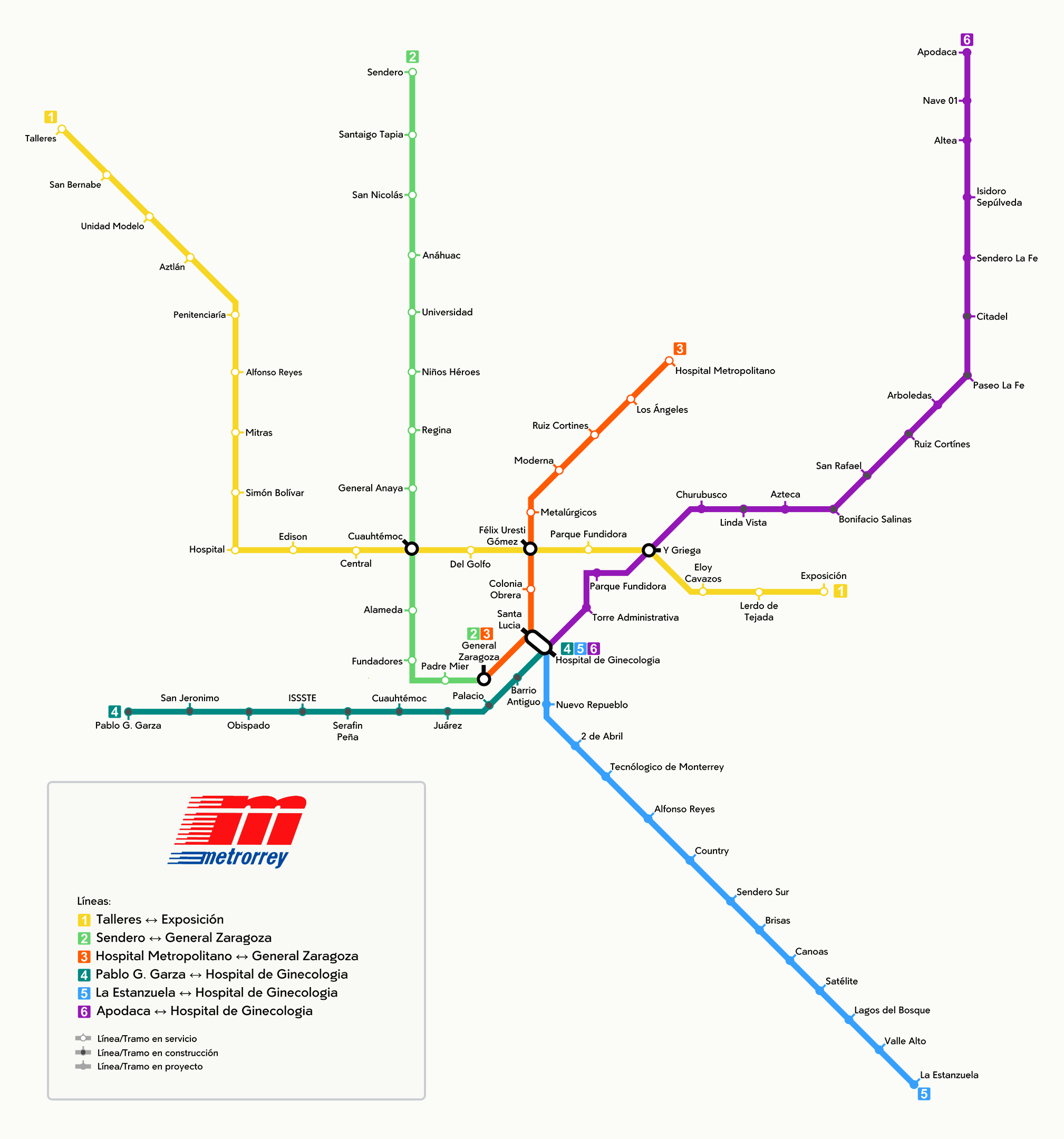
Metro Map of Monterrey
Map of Monterrey Metro showing different lines. Click on the map to enlarge it or download the Monterrey Metro map in PDF format.
Lines and Stations
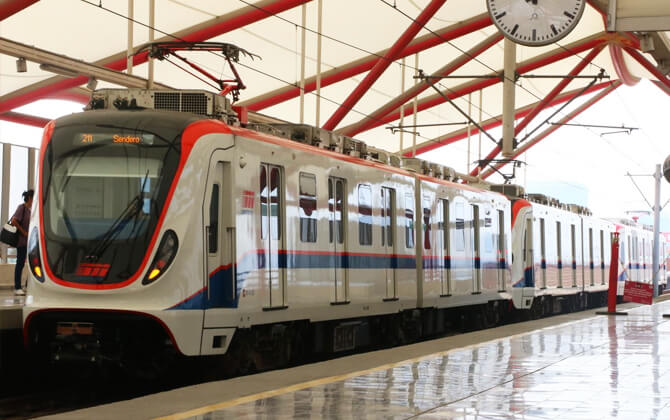
The Monterrey Metro system has three lines and serves key parts of the metropolitan area through a fully grade-separated network. Depending on the section, the route runs underground, elevated, or at ground level. Stations and trains are air-conditioned, some Line 2 stations have escalators, and stations can also be identified by symbols. If you are checking the stations map or building a route plan, the main transfer points are especially important.
Line 1
Line 1 opened in 1991 and runs east-west through central Monterrey before continuing toward the northwestern districts. It is 18.5 km (11.5 mi) long with 19 stations. The line operates on an elevated concrete structure from Exposición in Guadalupe to San Bernabé, and a full running time from end to end is about 27 minutes. You can transfer to Line 2 at Cuauhtémoc.
Line 2
Line 2 started service in 1994. It originally had 6 stations over 4.5 km (2.8 mi) and was built mainly with tunnelling machines along a north-south axis, about 17 m below street level. An extension began in 2005 and opened in two phases in 2007 and 2008, adding both elevated and underground sections. Today, the line runs from Sendero to General I. Zaragoza, with a transfer to Line 1 at Cuauhtémoc.
Line 3
Line 3 opened in February 2021 on a 7.5 km (4.7 mi) route that is mostly elevated. It runs from General I. Zaragoza northeast to Hospital Metropolitano. Lines 2 and 3 are operated jointly as one single line.
Stations by Line
| Station | Details |
|---|---|
| Line 1 | Exposición – San Bernabé; 18.5 km (11.5 mi); 19 stations; elevated, with a ground-level section at Talleres |
| Line 2 | Sendero – General I. Zaragoza; 13.0 km (8.1 mi); 13 stations; mostly underground and elevated |
| Line 3 | General I. Zaragoza – Hospital Metropolitano; 7.5 km (4.7 mi); 8 stations; mostly elevated |
The stations list reflects how the network has expanded over time. Cuauhtémoc and General I. Zaragoza are the key transfer stations, and Félix U. Gómez is another important connection point on the system.
Hours of Operation and Frequency
Metrorrey operating hours are generally from 4:45 a.m. to midnight every day. Stations open at 4:45 a.m., the first train starting time from each terminus is 5:00 a.m., and the last train leaves at 11:30 p.m. For anyone checking opening hours, opening times, working hours, or timings today, that is the standard schedule.
| Service detail | Timings |
|---|---|
| Station opening hours | 4:45 a.m. |
| First train | 5:00 a.m. |
| Regular closing time | Midnight |
| Last train | 11:30 p.m. |
| Peak period 1 | 6:30 a.m. to 9:30 a.m. |
| Peak period 2 | 5:00 p.m. to 8:00 p.m. |
| Line 1 frequency in busy hours | About 4 minutes 12 seconds |
| Line 2 frequency in busy hours | About 4 minutes |
| Christmas Eve and New Year’s Eve close | 11:00 p.m. |
| Christmas Day and New Year’s Day starting time | 7:00 a.m. |
| Special event service at Y Griega and Parque Fundidora | Until 3:00 a.m. |
The train schedule is not fixed by exact arrival times, so the timetable works more like estimated intervals than a minute-by-minute route timetable. During busy periods, frequency is higher; off-peak service runs less often. On holidays and special event days, schedule today may change. At large events in Fundidora Park, Y Griega and Parque Fundidora stay open until 3:00 a.m., while other stations remain open only for disembarking.
Fares, Tickets and Cards
Metrorrey uses a flat fare system, so the ticket price stays the same regardless of distance. The regular single-trip fare is MXN 7.70 (about USD 0.45). Discounted prices are available for some riders, including seniors and UANL students using the E-UANL app.
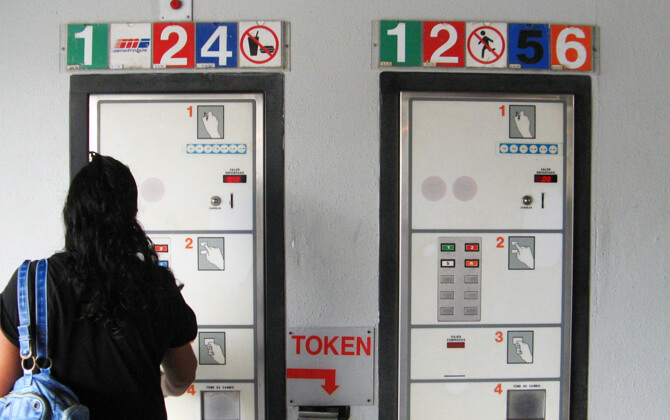
Passengers can use cash tickets or rechargeable smart cards. Options mentioned for the system include Me Muevo and Mia NFC cards, QR codes generated by the Urbani or E-UANL apps, and Spin by Oxxo contactless debit cards. NFC cards cost MXN 20.00 (about USD 1.18) and can be recharged up to MXN 500.00 (about USD 29.41).
The fare includes unlimited transfers within the metro system for one trip and also allows transfers to Ecovía at Mitras station. An integrated fare, called Tarifa Integrada, costs MXN 15.00 (about USD 0.88) and includes up to two transfers between TransMetro bus services and Metrorrey within two hours of the first validation.
- Single trip fare: MXN 7.70 (about USD 0.45)
- Tarifa Integrada: MXN 15.00 (about USD 0.88)
- Senior single-trip fare: MXN 3.00 (about USD 0.18)
- UANL student single-trip fare: MXN 7.50 (about USD 0.44)
- UANL student Tarifa Integrada: MXN 9.50 (about USD 0.56)
If you are comparing cost, looking for a pass, or checking whether there is a day pass, the source information only confirms these ticket and card options. A fare calculator is not mentioned.
Connections to the Airport
General Mariano Escobedo International Airport, also called Monterrey International Airport, is about 20 km (12.4 mi) from the city in Apodaca. Metrorrey does not reach the airport directly, so airport access usually involves combining the metro with a bus.
One practical route is to travel to Central Camionera de Monterrey, which is within walking distance of Central and Cuauhtémoc stations. From there, several private bus companies run to the airport.
Another useful option is Y Griega station on Line 1. From there, the Ruta Express Y Griega-Aeropuerto bus goes to the airport and stops at Terminal A and Terminal C. This bus service runs from 4:00 a.m. to 11:00 p.m., with frequency of about 9 to 11 minutes. Available information also mentions Wi-Fi and USB ports on board.
For passengers coming from elsewhere on the network, the most useful stations for this airport connection can include Cuauhtémoc, Félix Uresti Gómez, General Ignacio Zaragoza, and Y Griega, depending on your route and direction of travel.
Connections to Other Systems
Metrorrey is part of a wider public transport network in Monterrey and connects with other local transport services across the city. The system links directly with the TransMetro bus network through integrated fare options. As of April 2024, the Tarifa Integrada costs MXN 15.00 (about USD 0.88) and includes up to two transfers between TransMetro and Metrorrey within two hours from the first validation.
TransMetro routes usually begin at or pass by metro stations. On Line 1, services start at Talleres, Mitras, Cuauhtémoc, Félix U. Gómez, Y Griega, and Exposición. On Line 2, they begin at Sendero and Universidad. On Line 3, routes start at Hospital Metropolitano.
Metrorrey also connects with the Ecovía bus rapid transit system. At Mitras station on Line 1, the transfer is integrated at no additional cost. At Ruiz Cortines on Line 3, there is also a connection with Ecovía, but passengers need to exit the station and pay a new fare.
A standard metro ticket costs MXN 7.70 (about USD 0.45) and allows travel anywhere in the system with unlimited transfers, including the transfer to Ecovía at Mitras. These links make Metrorrey a central part of transportation in Monterrey and its broader city transport system.
Tips and Advice
It helps to plan your route before you travel. The metro does not cover the entire city, so some trips still require a bus or another form of transport after you leave the station.
For a smoother ride, avoid carrying large bags or suitcases when possible. It is also smart to buy your ticket or top up your card in advance, especially at busy times.
Because the system uses a flat fare, price does not depend on distance. If you expect to make several trips, a rechargeable card can be a practical choice, and transfers between lines are free within 120 minutes.
Before heading out, check the official schedule, operating hours, and any holiday notices. If you want route information, maps, hours, or arrivals, the official Metrorrey app can help.
- Plan your route in advance, including any onward transport.
- Keep your belongings secure during busy periods.
- Buy your ticket or reload your card before boarding when possible.
- Check official announcements for schedule changes.
- Use the official app for stations map and real-time information.
History
Metrorrey, officially Sistema de Transporte Colectivo Metrorrey, was developed to provide Monterrey with a rapid transit alternative and has grown into a three-line system. In the 1980s, a consortium led by Siemens was awarded the contract to build the metro.
The first line opened on 25 April 1991 with 17 stations. Line 1 ran from Exposición to San Bernabé and was later extended to Talleres, with that additional section opening in 2002.
Line 2 opened on 30 November 1994 with six underground stations. It later expanded in two phases, which opened on 31 October 2007 and 9 October 2008, extending the line northward with both underground and elevated sections.
Construction of Line 3 started in 2013 and was completed by January 2020, although rolling stock was still pending at that point. The line was finally inaugurated on 27 February 2021. It runs mostly on an elevated structure and connects with Line 2 at Zaragoza station.
By 2024, the system had 3 lines, 40 stations, and 40 km (25 mi) of route, served by 50 high-floor electric trains. Of the 40 stations, 32 are elevated, 7 are underground, and 1 is at surface level. In 2022, Metrorrey was the sixth largest metro system in North America by ridership.
Plans for expansion were announced in November 2021, when Governor Samuel García presented proposed routes for Lines 4 and 5. Line 6 was announced later. Together, the plans call for 41 km (25.5 mi) of new track and 41 new stations by 2027.
Future Expansions
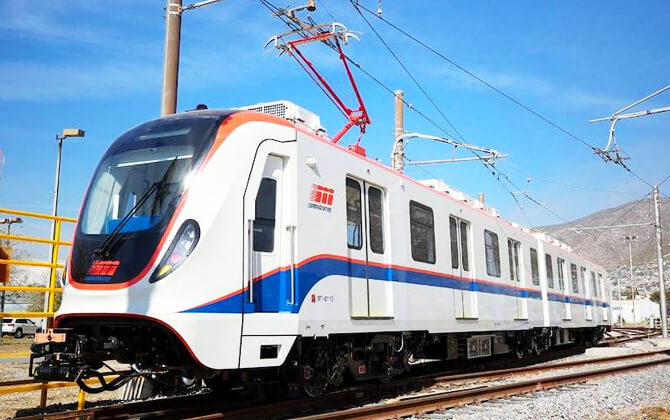
Metrorrey expansion plans focus on three new lines that would significantly increase the size of the system. In November 2021, planned routes for Lines 4 and 5 were unveiled, and Line 6 was later added to the same broader project.
Under the published route plan, Line 4 would connect Santa Catarina with Downtown Monterrey, Line 5 would run south toward the Carretera Nacional area, and Line 6 would link Downtown Monterrey with Apodaca as the longest route in the system.
Altogether, the expansion would add 41 km (25.5 mi) of new track and 41 new stations by 2027, effectively doubling the network’s length and station count. The proposals also sparked debate, especially in South Monterrey, where some residents argued that affected sections should be underground rather than elevated.
For Line 6, procurement and construction moved ahead first. An international public tender was launched in April 2022, and construction began on 11 February 2023. The first phase is planned as a 9 km (5.6 mi) section from Y Griega to Citadel, with Line 6 expected to connect with Lines 3, 4, and 5 at Saint Lucia station.
As of May 2024, Lines 4 and 6 were reported to be 30% complete, and the state government expected them to open before the 2026 FIFA World Cup.
Parking near the Metro
Information on station parking, parking charges, and parking charges per day varies by station and can change over time. The available text describes parking terms in general, but it does not provide a confirmed Metrorrey station-by-station list of prices.
Some stations may have free parking, while others may include paid parking, monthly permits, reserved spaces, EV charging stalls, or overnight and time-limit rules. Signs posted at each lot should be checked before leaving your vehicle.
Parking terms and common rules
- Free means free vehicle parking at a metro facility.
- Paid means station parking is available for a fee.
- Paid reserved means monthly spaces reserved for permit holders.
- Waiting zones are pick-up and drop-off areas marked by a Waiting Zone sign or a 5-10 minute parking sign.
For frequent riders, parking permits are available at select stations and may be purchased online. In some cases, permits may also be sold at the station. The available information also says that a registered TAP card must be used on 10 separate calendar days during the month for certain parking-related benefits, and TAP card parking payment is not currently available.
Helpful parking reminders
- Parking is allowed in metro lots for up to 72 consecutive hours while using transit.
- To park longer than 72 hours, a permit is required.
- If you need a receipt after parking, a copy can be requested by email.
- If you receive a parking citation, payment options include online, mail, in-person, and phone methods.
Accessible parking spaces are provided near station entrances for riders with disabilities, and some stations also have bike racks, lockers, storage rooms, or EV charging stalls.
Fun Facts
- Each station has its own design, helping illiterate passengers recognize locations more easily.
- The system has seven elevators in total, located across six different stations.
- Metrorrey is described as an ecofriendly public transport system, with 82% of its energy coming from bioenergy and biogas.
- Beyond the rail network, it connects with MetroEnlace, TransMetro, Ecovía, and Metrobús.
- In 2022, it was the sixth largest metro system in North America by ridership.
- Most of the route runs above ground on elevated viaducts.
- Line 1 opened on 25 April 1991, and its end-to-end running time is about 27 minutes.
- Regular opening hours are from 4:45 a.m. to midnight, though timings can vary on holidays and special event days.
What to See from the Metrorrey
Monterrey mixes mountain views, modern landmarks, and busy public spaces, and Metrorrey can get you close to several of the city’s best-known sights.
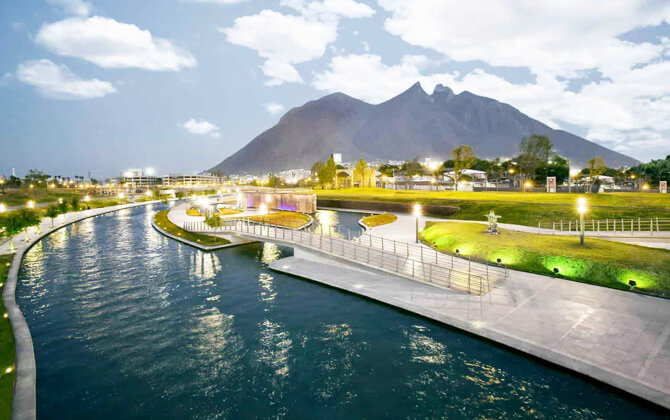
- Paseo de Santa Lucía: a short walk northeast of General Zaragoza station brings you to this scenic waterway, described as the longest artificial river in Latin America. It is a pleasant place to walk, and boat rides are available.
- Parque Fundidora: reached from Parque Fundidora station, this major urban park includes the Museo del Acero Horno, a children’s museum, an ice rink, historical archives, and part of the Paseo de Santa Lucía.
- Museo de Arte Contemporáneo (MARCO): just outside General Zaragoza station near the Macroplaza exit, this museum displays important works by local artists.
With affordable fares, useful transport connections, and easy access to central attractions, Metrorrey is a practical way to explore Monterrey.