Metro Bilbao is the rapid transit system serving Bilbao and Greater Bilbao. Built to metre gauge, the network had 51.64 km (32.09 mi) of route and 48 stations as of 2021. Lines 1 and 2 form the core Y-shaped system on both banks of the Ibaizabal river, while Line 3 links higher eastern neighborhoods and connects with the wider Euskotren Trena network. All three lines meet at Zazpikaleak/Casco Viejo, and the system is integrated with trams, commuter rail, long-distance rail, and the main bus station, making it a key part of public transport and city transport in Bilbao.
| Key | Information |
|---|---|
| System | Rapid transit network serving Bilbao and Greater Bilbao |
| Route length | 51.64 km (32.09 mi) |
| Stations | 48 |
| Current lines | 3 |
| Main interchange | Zazpikaleak/Casco Viejo |
| Opening | 1995 |
| Line 2 opening | 2002 |
| Line 3 opening | 2017 |
| Integration | Bilbao tram, commuter rail, long-distance rail, and Bilbao Intermodal bus station |
| Rank in Spain | Third-busiest metro system after Madrid and Barcelona |
Metro Bilbao Map
Map of Bilbao Metro showing different lines and stations. Click on the map to enlarge it or download the Bilbao Metro map in PDF format.
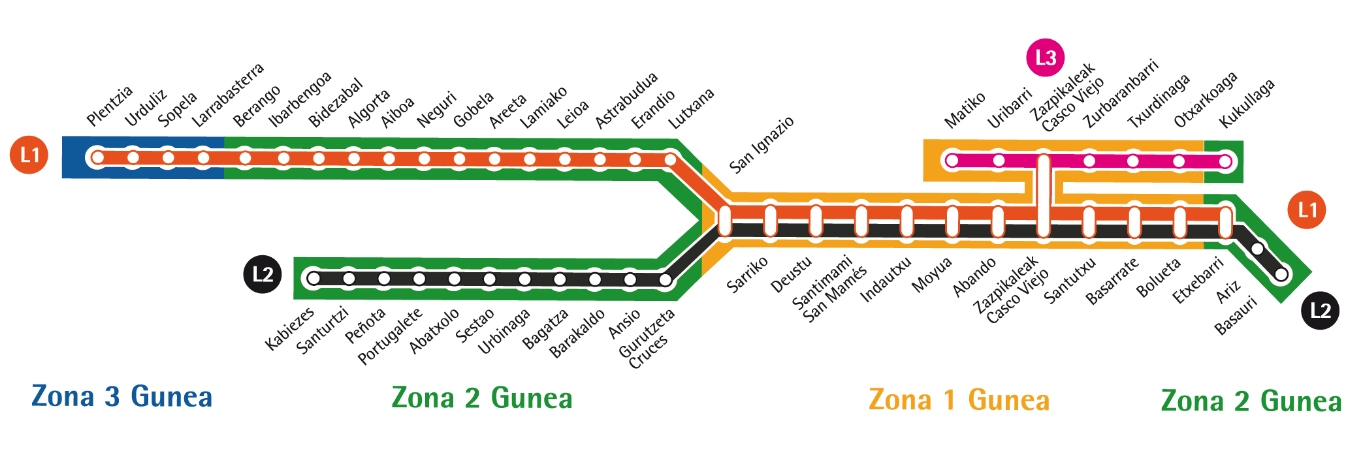
Metro Bilbao Lines and Stations
Metro Bilbao has three metre-gauge lines. Lines 1 and 2 share a central trunk through Bilbao and branch out along both sides of the river, creating the network’s distinctive Y-shaped route plan. Line 3 connects eastern hillside areas and is operated jointly with Euskotren Trena.
Lines
| Line | Terminals | Length | Stations | Operator |
|---|---|---|---|---|
| Line 1 | Etxebarri-Plentzia | 28.83 km (17.91 mi) | 29 | Metro Bilbao S.A. |
| Line 2 | Basauri-Kabiezes | 22.98 km (14.28 mi) | 25 | Metro Bilbao S.A. |
| Line 3 | Matiko-Kukullaga | 5.88 km (3.65 mi) | 7 | Euskotren |
| Total | Total | 51.64 km (32.09 mi) | 48 |
Stations
Zazpikaleak/Casco Viejo is the main interchange where all three lines meet. Because Line 3 is part of the wider Euskotren Trena system, this station is also an important hub for commuter rail.
Other major interchange stations include Abando, with connections to Cercanías, Feve, and Renfe long-distance services, and Santimami/San Mamés, which links with Cercanías and Bilbao Intermodal bus services. Urbinaga on Line 2 was designed as a future interchange with two Cercanías lines, though that station had not yet been built as of 2021.
Bilbao tram connections are also available near Santimami/San Mamés, Abando, and Zazpikaleak/Casco Viejo. Most stations have bus links as well, so local transport connections are generally easy.
| Station | Details |
|---|---|
| Zazpikaleak/Casco Viejo | Main interchange for Lines 1, 2, and 3; key hub for Euskotren commuter rail |
| Abando | Connections to Cercanías, Feve, and Renfe long-distance services |
| Santimami/San Mamés | Connections to Cercanías and Bilbao Intermodal bus station |
| Urbinaga | Designed as a future interchange with two Cercanías lines, not yet built as of 2021 |
Key line sections
- Line 1 runs from Etxebarri to Plentzia.
- Line 2 runs from Basauri to Kabiezes.
- Line 3 runs from Matiko to Kukullaga.
The system opened in 1995. Line 2 followed in 2002, and Line 3 entered service in 2017.
Fares, Tickets, and Cards
Metro Bilbao fare rules depend on the zones crossed during your journey. Some examples mentioned in the fare system are Santurtzi-Sopela for zones 1, 2, and 3; Basauri-San Inazio for zones 1 and 2; San Inazio-Casco Viejo in zone 1; Moyua-Plentzia for zones 1, 2, and 3; and Barakaldo-Areeta for zones 1 and 2.
Journeys on Lines 1, 2, and 3 are treated as a single trip when fares are calculated by zones. Transfers between Lines 1 or 2 and Line 3 at Zazpikaleak/Casco Viejo are free within 15 minutes, as long as each stage is correctly validated. There is no fare calculator in the provided information, but the zone-based price structure is clear enough for basic trip planning.
Creditrans in Barik
Creditrans in Barik is a prepaid card that deducts the ticket price of each trip. It is transferable and can be used for group travel.
The fare is 0.99 € (about $1.08) for 1 zone, 1.16 € (about $1.26) for 2 zones, and 1.26 € (about $1.37) for 3 zones.
Large Family Discounts
Passengers who can show proof of large family status can use discounted tickets. Two discount types are listed: F20 for the general category and F50 for the special category. These tickets are personal and non-transferable.
| Zone | 1 | 2 | 3 |
|---|---|---|---|
| F20 | 0.79 € (about $0.86) | 0.93 € (about $1.01) | 1.01 € (about $1.10) |
| F50 | 0.50 € (about $0.54) | 0.58 € (about $0.63) | 0.63 € (about $0.69) |
Gizatrans in Barik
Gizatrans is a subsidised pass for people of a predetermined age and for those with a pre-established degree of physical or mental disability. It is available only to eligible users with proof of status. The card is personal and non-transferable, and the same cost applies across all zone combinations.
| Fare type | Price |
|---|---|
| Normal Fare | 0.39 € (about $0.42) |
| Fare F20 | 0.31 € (about $0.34) |
| Fare F50 | 0.20 € (about $0.22) |
Single Ticket and Mallona Lift Tickets
The single ticket is valid for one trip and remains valid for 2 hours after entry validation. Ticket price depends on the number of zones. F20 and F50 discounts are also available for eligible large families, and those tickets are personal and non-transferable.
| Type | 1 | 2 | 3 |
|---|---|---|---|
| Ordinario | 1.90 € (about $2.07) | 2.10 € (about $2.29) | 2.15 € (about $2.34) |
| F20 | 1.50 € (about $1.63) | 1.70 € (about $1.85) | 1.75 € (about $1.91) |
| F50 | 0.95 € (about $1.03) | 1.05 € (about $1.14) | 1.05 € (about $1.14) |
For the Mallona Lift, a single ticket costs 0.45 € (about $0.49), and a Bono 10 ticket for 10 trips costs 3.50 € (about $3.81). Both are sold at Casco Viejo station.
Temporary and Special Cards
Temporary multimodal Barik products include Bidai 50, Bidai 70, Gazte 70, Bidai Oro, and Gazte Oro.
Metro Bilbao also had special cards in the past, but these were retired and replaced by Barik cards in 2017.
- Carnet Kidea Socio: for monthly tickets and Super 50 tickets.
- Carnet Gaztea Joven: for the youth ticket, monthly ticket, and Super 50 tickets.
- Carnet Hirukotrans: for the Hirukotrans ticket.
Schedule, Timetables, and Calendar
Metro Bilbao timetable information is organized by line and by day type, with separate schedule today patterns for weekdays, Saturdays, Sundays, and public holidays. Available route timetable data covers Line 1 between Etxebarri and Bidezabal, Line 1 between Sopela and Etxebarri, and Line 2 between Basauri and Kabiezes. The published train schedule shows opening hours, closing time, and frequency.
| Service detail | Timings |
|---|---|
| Line 1: Etxebarri to Bidezabal, Monday to Friday and eve of public holidays | Starting time 6:05 from Etxebarri; closing time 23:06 at Bidezabal; frequency every 5 to 10 minutes |
| Line 1: Etxebarri to Bidezabal, Saturdays | Starting time 6:04 from Etxebarri; closing time 23:08 at Bidezabal; frequency every 10 minutes |
| Line 1: Etxebarri to Bidezabal, Sundays and holidays | Starting time 6:04 from Etxebarri; closing time 23:05 at Bidezabal; frequency every 10 to 20 minutes |
| Line 1: Sopela to Etxebarri, Monday to Friday and eve of public holidays | Opening time 5:47 at Sopela; closing time 23:10 at Etxebarri |
| Line 1: Sopela to Etxebarri, Saturdays | Opening time 6:07 at Sopela; last train service closes at 6:50 the following day at Etxebarri |
| Line 2: Basauri to Kabiezes, Monday to Friday and holiday eves | Starting time 5:57 from Basauri; closing time 22:37 at Kabiezes; frequency every 5 to 10 minutes |
| Line 2: Basauri to Kabiezes, Saturdays | Starting time 5:57 from Basauri; closing time 23:09 at Kabiezes; frequency every 10 minutes |
| Line 2: Basauri to Kabiezes, Sundays and holidays | Starting time 6:17 from Basauri; closing time 22:51 at Kabiezes; frequency every 10 to 20 minutes |
| General operating hours | Monday to Thursday 6:00 to 23:00; Fridays and Saturdays until 2:00; Sundays 7:00 to 23:00 |
When checking the timetable, keep in mind that operating hours and opening times change on holidays and the eve of public holidays. If you need timings today, the most reliable option is to check the latest official train schedule before you travel.
Connections
Metro Bilbao is closely integrated with the wider transport system in the city. All three lines meet at Zazpikaleak/Casco Viejo, the main interchange and a major hub for Euskotren commuter services.
Abando is one of the most important transfer points, with connections to Renfe Cercanías, Renfe long-distance services, Euskotren TRAM, Renfe Cercanías AM, Bizkaibus, and Bilbobus. Santimami/San Mamés links the metro with Cercanías, Euskotren TRAM, and Bilbao Intermodal, the city’s main long-distance bus terminal.
The metro also connects with the Bilbao tramway, Bilboko Aldiriak, Euskotren Trena, Feve, and Renfe services. Most stations have bus links too, which helps with transportation in Bilbao and across Greater Bilbao.
| Station | Details |
|---|---|
| Bolueta | Euskotren TRAM Line A; Bizkaibus lines A2610, A3613, A3622, A3932; Bilbobus lines 30 and 40 |
| Basarrate | Bilbobus lines 13, 34, 40, 43, 48, and G7 night line |
| Casco Viejo/Zazpikaleak | Euskotren TRAIN lines E1, E3, and E4; Euskotren TRAM Line A; Bilbobus lines 11, 22, 62, A9, and G4 and G8 night lines |
| Abando | Renfe Cercanías lines C-1, C-2, C-3, and C-4; Renfe long and medium distance services; Euskotren TRAM Line A; Renfe Cercanías AM services; Bizkaibus and Bilbobus routes |
| San Mames | Renfe Cercanías lines C-1 and C-2; Euskotren Tranbia Line A; Bilbao Intermodal |
| San Ignazio | Bilbobus lines 10, 13, 18, and 71 |
| Lutxana | Euskotren Trena shuttle line E3a |
Urbinaga was designed as a future interchange with Cercanías commuter rail, but as of 2021 that station had not been built.
Airport Connection
There is no direct metro route to Bilbao Airport. The nearest metro station for airport access is San Mamés on Lines 1 and 2.
The most practical public transport option is the Bizkaibus A3247. From the airport, take this bus to Bilbao Intermodal or Moyua Plaza, then continue on foot to the metro depending on your route.
San Mamés is the key interchange for this journey because it connects metro, rail, and bus services in one place.
Running time and frequency for the A3247 vary by season, so it is best to check the current timetable before traveling.
Rules in Metro Bilbao
Metro Bilbao has straightforward passenger rules. It is a closed system, so you must validate your ticket or Barik card both when entering and when leaving the metro.
At the barriers, only a ticket or Barik card is accepted. Contactless debit and credit cards do not work. For most passengers, the Barik card is the standard and most practical option for metro and other transport in Bizkaia.
Small dogs and cats are allowed. Cats must travel in carriers, while dogs must be either in a carrier or on a lead and held in the passenger’s arms. Pets must not touch seats or the train floor.
Priority spaces are available for passengers with limited mobility. Children under 5 travel free when accompanied by an adult with a valid ticket or travel card.
Bicycles and surfboards must go in the designated area. Eating and drinking are prohibited on trains and platforms.
It is also important to check the destination before boarding. Lines 1 and 2 split at San Ignazio, so if you are heading north, double-check the platform and the train before the doors close.
Tips and Advice
Metro Bilbao is modern, clean, and easy to use. For visitors, it is often the simplest way to get around by public transport.
Choose the right ticket
For most visitors, the Barik card is the best option. Metro barriers accept either a ticket or a Barik card, but not contactless bank cards. You can buy and top up the card at station machines, and the card itself costs 3 € (about $3.27). The machines do not give change, so any extra amount is added to the card balance.
With a Barik card, travel costs less than with single tickets. One card can also be used by up to 10 people if everyone makes the same journey and gets on and off at the same stations.
- With Barik: one zone 0.48 € (about $0.52), two zones 0.57 € (about $0.62), three zones 0.62 € (about $0.68)
- Without Barik: one zone 1.70 € (about $1.85), two zones 1.90 € (about $2.07), three zones 1.95 € (about $2.12)
Know your line before you board
Metro Bilbao has a simple stations map once you understand the layout. Lines 1 and 2 form the main Y-shaped system, while Line 3 connects with the network at Casco Viejo/Zazpikaleak.
Useful central stations include Casco Viejo, Abando, Moyua, Indautxu, and San Mames. If you are going north, check the platform and destination carefully because Lines 1 and 2 split at San Ignazio.
Check opening times and train frequency
According to the provided timetable information, regular working hours are 6:00 to 23:00 from Monday to Thursday, with later service until 2:00 on Fridays and Saturdays. Sunday service is listed as 7:00 to 23:00. For exact timings today, always check the current schedule.
Frequency depends on the line, direction, and day type. In the timetable data provided, trains run every 5 to 10 minutes on many weekday services and every 10 to 20 minutes on Sundays and holidays.
Use park and ride if needed
If you are arriving by car, park-and-ride facilities are available near stations in Leioa, Etxebarri, Ibarbengoa, and Ansio. That can be a convenient way to avoid city traffic and continue by metro.
Specific station parking prices and parking charges per day are not included in the provided material.
Follow the basic rules
- Small dogs and cats are allowed, but pet rules apply.
- Priority spaces are reserved for passengers with limited mobility.
- Children under 5 travel free with an adult holding a valid ticket or card.
- Bicycles and surfboards must stay in the designated area.
- Eating and drinking are prohibited on trains and platforms.
For an easier trip, check the stations list before you travel, look at the final destination shown on the train, and use the official route information when you need a route plan.
Future Expansions
Several metro expansion projects have been discussed, though not all have a confirmed delivery timeline.
Extensions to existing lines
A new depot in Ortuella was proposed in 2010. If built with a new station, it could extend Line 2 beyond Kabiezes, although further extension on that branch has been tentatively discarded.
Line 1 may be extended east to Sarratu in Basauri. That station would create an interchange with the Euskotren Trena suburban rail network. Sarratu was once tied to Line 5 plans, but the newer concept would make it the eastern terminus of Line 1 while Line 5 is treated more like an extension of Line 3.
There are also plans to extend Line 3 to the airport using the double-tracked tunnel under Mount Artxanda that opened in 2017. The first phase would rebuild Sondika station so Txorierri line trains could run between Matiko and Lezama without reversing. The second phase would add a new underground branch from Sondika to the airport terminal.
Line 4 project
Line 4 was first outlined in 2008 as the Moyúa-Rekalde line. Early plans included Zabalburu and Irala, and later studies also considered Deusto and Matiko as part of a broader route concept.
On 5 December 2025, the Provincial Council of Bizkaia and the Basque Government announced an agreement on the construction and financing of Line 4. The approved route would connect Matiko and Alonsotegi via the University of Deusto campus, Doña Casilda Iturrizar Park, Moyúa, Zabalburu, Irala, and Rekalde.
Construction is expected to begin in late 2027. The agreement also includes procedures to incorporate rail infrastructure currently managed by the Administrador de Infraestructuras Ferroviarias, with the aim of extending the line to Enkarterri and adding stations in Basurto, Zorrotza, Santa Ageda, Kastrexana, and Iraulegi in Alonsotegi.
Line 5 project
Line 5 was also presented in 2008. It was first planned to connect Etxebarri and Galdakao, with stations including Aperribai, Galdakao, Galdakao Hospital, and Usansolo. A stop at Bengoetxe was later proposed as well. Sarratu was considered the western terminus because of its interchange with Line 1 and Euskotren Trena.
After repeated delays, the project shifted toward a new underground route between Sarratu and Usansolo, effectively working as an extension of Line 3. Five stations were planned on this version: Sarratu, Aperribai, Bengoetxe, Galdakao, and Galdakao Hospital.
In late 2022, the first three sections between Sarratu and Galdakao Hospital were tendered. The Sarratu-Galdakao section is planned to open in 2027, while the full line, including its connection with the Euskotren mainline, is expected by 2029.
Shuttle connection between Areeta and Sestao
In 2022, a tunnel under the estuary was announced, with a shuttle train linking Areeta on Line 1 and Sestao on Line 2 in four minutes. Work was originally expected to begin in 2024, but delays pushed the start to the first half of 2026. The future of this path train shuttle remains unclear.
History
The history of Metro Bilbao goes back to the 1920s, when the first metro proposal was put forward. It included two lines from Atxuri to the westernmost parts of the city, but the plan collapsed after Banco Español de Crédito withdrew financial support in 1925. After the Civil War, the idea was abandoned.
Interest returned in the 1970s. In 1971, the government of Biscay, Bilbao City Council, and the Commerce Bureau created a commission to study transport needs in Greater Bilbao. Financial backing from the Spanish government followed in 1974, and the Biscay Transport Consortium was created in 1976. In 1977, three proposals were presented for a metro line to be built by 1985, and the first was very close to today’s system. Still, objections and institutional disagreements delayed the project.
In 1983, the Basque Government approved a transport plan for the right bank of the estuary, though implementation was delayed. The plan was rewritten in 1985, and in 1987 the metro project was finally approved and funded. In 1988, an open competition selected Sir Norman Foster and partners to design the underground stations.
Construction began in late 1988. Erandio station was placed underground, and a new tunnel was built between San Inazio and Casco Viejo. Work was especially difficult in Deusto and San Inazio, where cut-and-cover construction caused noise, traffic disruption, and minor building damage. Moyúa square stayed closed to pedestrians from 1990 to 1997.
Line 1 opened on 11 November 1995 with 23 stations between Casco Viejo and Plentzia. Its outer sections were based on Euskotren’s former Bilbao-Plentzia railway, parts of which dated back to 1887. By 5 July 1997, Santutxu, Basarrate, and Bolueta had been added, bringing the total to 27 stations.
Line 2 opened in stages starting in 2002. The first five stations on the southern bank of the estuary entered service on 13 April 2002. Later extensions in 2005, 2007, 2009, 2011, and 2014 eventually brought the line to Kabiezes.
Line 3 opened on 8 April 2017 after work that began in 2009. Unlike Lines 1 and 2, it is operated by Euskotren and forms part of the wider Euskotren Trena network. It links eastern hillside neighborhoods with the rest of the metro at Zazpikaleak/Casco Viejo.
By 2021, Metro Bilbao had 51 km (31.69 mi) of route and 48 stations. It remained the third-busiest metro system in Spain after Madrid and Barcelona.
Fun Facts
- All Metro Bilbao trains have air conditioning.
- The glass tubular station entrances are known as fosteritos, named after architect Norman Foster.
- Station names are usually announced in Basque only, while transfer stations are announced in both Spanish and Basque.
- When train doors close, the sound is loud; when they open, it is softer and higher-pitched.
- Line 1 and Line 2 form a Y shape, while Line 3 has a V shape and meets the others at Zazpikaleak/Casco Viejo.
- Sarriko station stands out architecturally and won the 1998 Brunel Award for Railway Design.
- The metro logo and signage were designed by Otl Aicher.
- The rolling stock is built by CAF, a manufacturer also used in other metro systems around the world.
Nearby Attractions
San Mamés is a useful starting point for reaching many of Bilbao’s main attractions. With a short metro ride and a manageable walk, you can get to several of the city’s best-known sights.
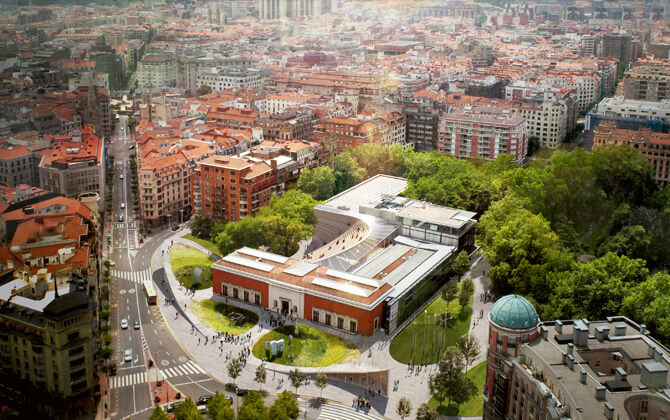
- Bilbao Museum of Fine Arts: take Line 1 from San Mamés towards Basauri, get off at Moyua, then walk about 7 minutes.
- Euskal Museo Bilbao: take Line 1 from San Mamés towards Basauri, get off at Casco Viejo, then walk about 6 minutes.
- Guggenheim Museum: take Line 1 from San Mamés towards Etxebarri, get off at Moyua, then walk about 11 minutes.
- Begoña Basilica: take Line 1 from San Mamés towards Basauri, get off at Casco Viejo, then walk about 11 minutes.
- Parque Doña Casilda de Iturrizar: take Line 1 from San Mamés towards Etxebarri, get off at Indautxu, then walk about 9 minutes.
- Archaeological Museum: take Line 1 from San Mamés towards Basauri, get off at Casco Viejo, then walk about 4 minutes.
- Mercado de la Ribera: take Line 1 from San Mamés towards Basauri, get off at Casco Viejo, then walk about 10 minutes.
Other stations are useful too. Moyua and Abando are handy for shopping and dining, while Casco Viejo gives direct access to the historic center. For the Puente Colgante, take the metro to Portugalete and continue on foot. If you want coastal views, Line 1 toward Plentzia is the route to look at.
Most major attractions are in Zone 1, so a one-zone ticket can be a practical option for a day of sightseeing.