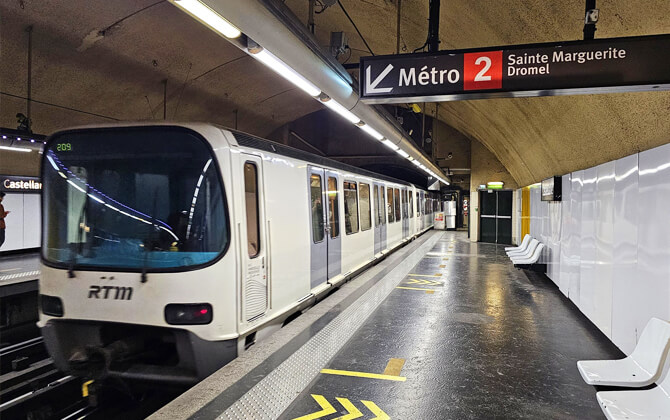
The Marseille Metro, or Métro de Marseille, is the rapid transit system serving Marseille in southern France. It has two mostly underground lines, M1 and M2, with a total route length of 22.7 kilometres (14.1 miles). Line 1 opened in 1977 and Line 2 followed in 1984. Today, the system serves 29 named stations and 31 stopping points, including the two main interchange stations, Saint-Charles and Castellane. Operated by the Régie des transports métropolitains since 1986, the metro is a core part of public transport and city transport in Marseille, using MPM 76 rubber-tyred trains developed from Paris Metro technology.
| Key | Information |
|---|---|
| System | Marseille Metro (Métro de Marseille) |
| Lines | 2 lines: M1 and M2 |
| Route length | 22.7 km (14.1 miles) |
| Stations | 29 named stations and 31 stopping points |
| Main interchange stations | Saint-Charles and Castellane |
| Line 1 | 18 stations over 12.9 km (8.0 miles) |
| Line 2 | 13 stations over 9.8 km (6.1 miles) |
| Operator | Régie des transports métropolitains |
| Rolling stock | MPM 76 rubber-tyred trains |
| Ridership | About 76.7 million passengers in 2012 |
Marseille Metro Map
Map of Marseille Metro showing different lines and stations. Click on the map to enlarge it or download the Marseille Metro map in PDF format.
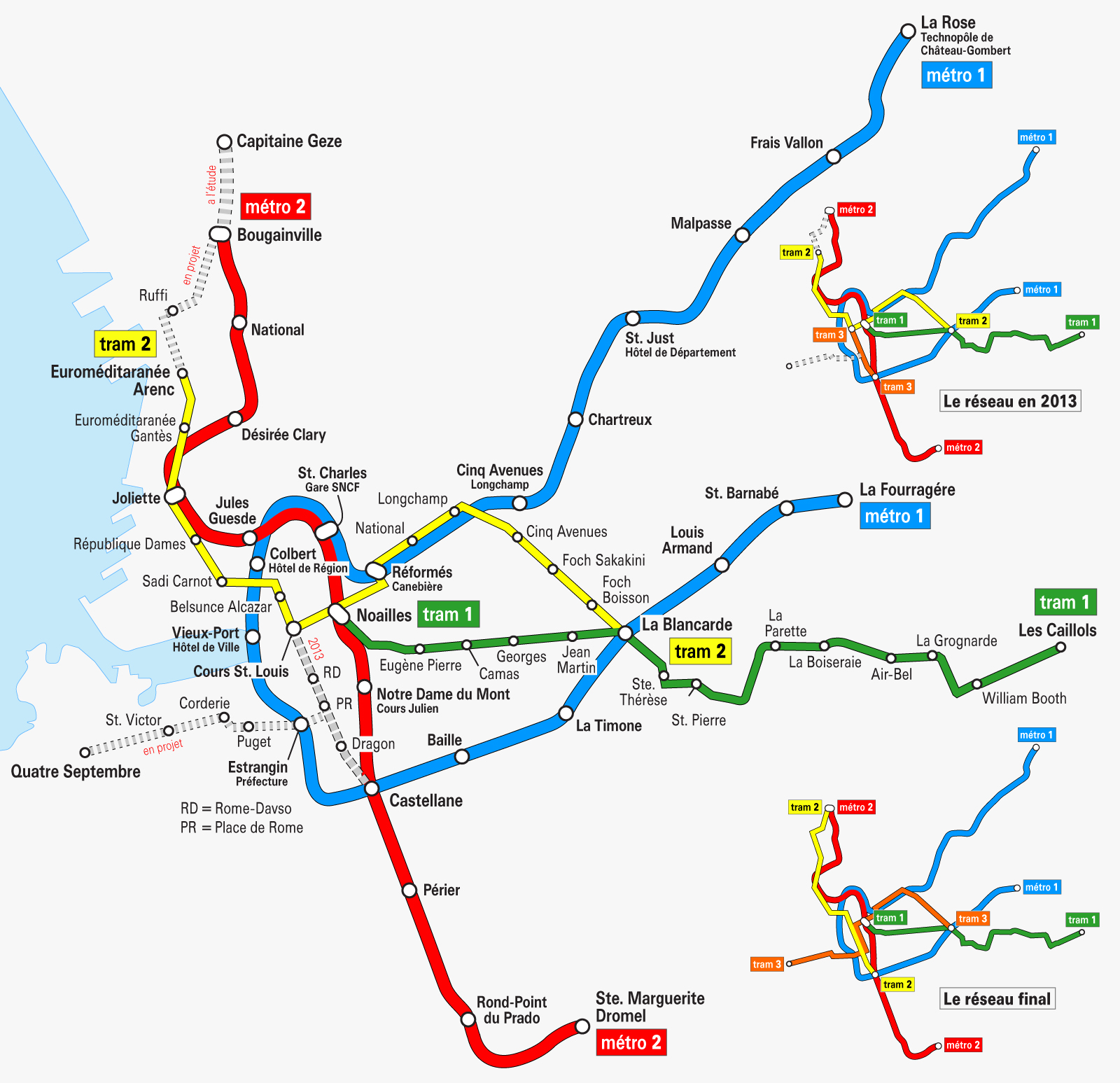
Marseille Metro Lines and Stations
Marseille Metro has two lines, M1 and M2. Together, they form a compact system with key interchange points that make transportation in Marseille straightforward for both daily commuters and visitors checking a stations map or stations list before travel.
Line M1 runs from La Rose in the north to La Fourragère in the east. It has 18 stations. Well-known stops on this route include La Timone, Cinq Avenues Longchamp, Vieux-Port, and Réformés/Canebière.
Line M2 links Sainte-Marguerite Dromel in the south with Gèze in the north. It has 13 stations, with major stops including Rond-Point du Prado, Castellane, Notre-Dame du Mont – Cours Julien, and Joliette.
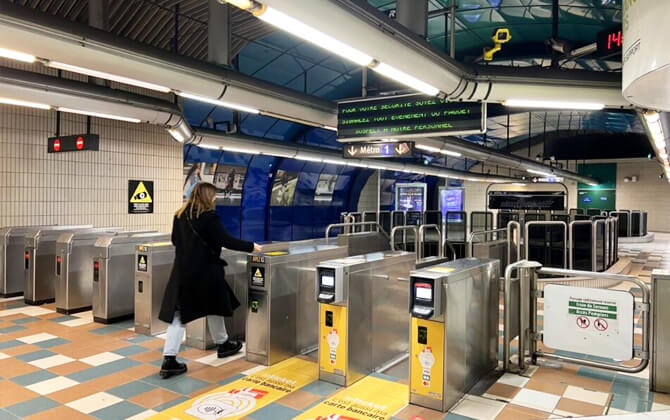
The two lines meet at Castellane and Saint-Charles, the system’s main interchange stations. Stations also have Open Payment terminals, so you can use a contactless bank card for your ticket. If you need help, RTM reception points are available at Castellane, Saint-Charles, Vieux-Port, Gèze, La Rose, and Sainte-Marguerite, open daily from 6:50 am to 7:40 pm. There is also a city-centre reception point near Centre Bourse at 6 Rue des Fabres, open Monday to Friday from 8:30 am to 6:30 pm.
The RTM mobile app gives real-time updates on metro and bus arrivals and departures, which is handy when checking the route, route plan, or train schedule.
A Glimpse into Some Key Stations
Some Marseille Metro stations matter more than others when it comes to changing lines or reaching busy parts of the city. Castellane and Saint-Charles are the big ones, since both connect M1 and M2 and sit at the heart of the network.
| Station | Details |
|---|---|
| Castellane | Main interchange station between M1 and M2 |
| Saint-Charles | Main interchange station between M1 and M2 and a key transfer point in the network |
| La Timone | Important station on Line M1 |
| Cinq Avenues Longchamp | Important station on Line M1 |
| Vieux-Port | Important station on Line M1 and one of the stations with an RTM reception point |
| Réformés/Canebière | Important station on Line M1 |
| Rond-Point du Prado | Important station on Line M2 |
| Notre-Dame du Mont – Cours Julien | Important station on Line M2 |
| Joliette | Important station on Line M2 |
| Gèze | Station with an RTM reception point |
| La Rose | Northern terminus of M1 and a station with an RTM reception point |
| Sainte-Marguerite | Station with an RTM reception point |
Several stations also provide practical passenger services. Open Payment terminals support contactless card payment, and RTM reception points can help with subscriptions and local transport information. For live departures and arrivals, the RTM app remains the easiest tool to use.
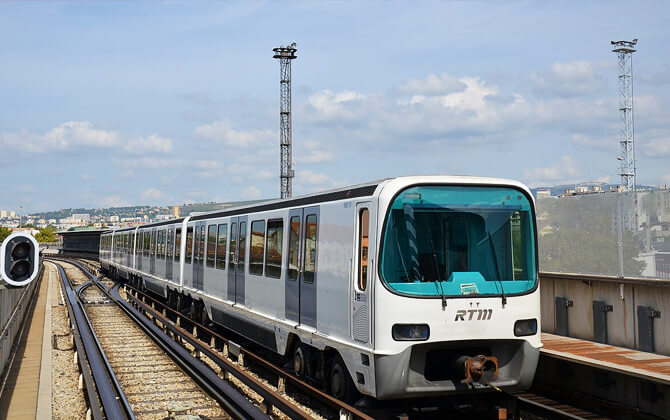
Schedule, calendar, and timetables
Marseille Metro runs daily. In the general timetable, service is available from 5:00 am until 1:00 am the next day. Frequency is higher during the day and lower in the evening, so checking the timetable, route timetable, or schedule today before you travel is a smart move.
| Service detail | Timings |
|---|---|
| Daily metro service | 5:00 am to 1:00 am |
| Monday to Friday frequency | Every 4, 5, or 6 minutes |
| Saturday frequency | Every 5 to 6 minutes |
| Sunday frequency | Every 9, 10, 11, or 12 minutes |
If you are looking for timings today, last train information, or a train schedule for a specific station, it is worth confirming details before setting out, as station-level opening times can vary.
Station Operating Hours
Below are the listed station opening hours and closing time details for both lines from Monday to Friday. These working hours may differ slightly by station.
| Service detail | Timings |
|---|---|
| Line 1: La Rose | 5:00 am to 12:30 am |
| Line 1: Frais Vallon | 5:01 am to 12:33 am |
| Line 1: Malpassé | 5:03 am to 12:33 am |
| Line 1: St Just – Hôtel de Département | 5:05 am to 12:35 am |
| Line 1: Chartreux | 5:06 am to 12:37 am |
| Line 1: Cinq avenues Longchamp | 5:08 am to 12:38 am |
| Line 1: Réformés Canebière | 5:09 am to 12:40 am |
| Line 1: Saint Charles | 5:10 am to 12:41 am |
| Line 1: Colbert – Hôtel de Région | 5:12 am to 12:43 am |
| Line 1: Vieux-Port – Hôtel de Ville | 5:13 am to 12:44 am |
| Line 1: Estrangin – Préfecture | 5:15 am to 12:45 am |
| Line 1: Castellane | 5:17 am to 12:47 am |
| Line 1: Baille | 5:06 am to 12:34 am |
| Line 1: La Timone | 5:05 am to 12:32 am |
| Line 1: La Blancarde | 5:21 am to 12:51 am |
| Line 1: Louis Armand | 5:02 am to 12:29 am |
| Line 1: Saint Barnabé | 5:24 am to 12:54 am |
| Line 1: La Fourragère | 5:00 am to 12:27 am |
| Line 2: Sainte-Marguerite Dromel | 5:00 am to 12:32 am |
| Line 2: Rond point du Prado | 5:01 am to 12:33 am |
| Line 2: Périer | 5:02 am to 12:47 am |
| Line 2: Castellane | 5:01 am to 12:46 am |
| Line 2: Notre Dame du Mont – Cours Julien | 5:06 am to 12:39 am |
| Line 2: Noailles | 5:07 am to 12:40 am |
| Line 2: Saint Charles | 5:10 am to 12:41 am |
| Line 2: Jules Guesde | 5:10 am to 12:43 am |
| Line 2: Joliette | 5:11 am to 12:45 am |
| Line 2: Désirée Clary | 5:13 am to 12:46 am |
| Line 2: National | 5:14 am to 12:47 am |
| Line 2: Bougainville | 4:50 am to 12:34 am |
A separate service update notes different metro operating hours by day. From Monday to Thursday, the metro runs from 5:30 am to 9:30 pm. Since 23 October 2023, this earlier evening close has been part of the train renewal project. On Fridays, Saturdays, Sundays, public holidays, the eve of public holidays, and some event evenings, the usual opening times are 5:30 am to 12:30 am.
Customer service points have their own opening hours:
| Service detail | Timings |
|---|---|
| Saint-Charles, Noailles, Vieux-Port, and Castellane welcome points | Daily, 6:50 am to 7:40 pm |
| Gèze, La Rose, and Sainte Marguerite-Dromel welcome points | Monday to Saturday, 6:50 am to 7:40 pm |
| Bourse customer service centre, 6 rue des Fabres | Monday to Friday, 8:30 am to 6:00 pm |
For live timetable information, station timings, and service alerts, check updated RTM information before you travel.
Cost, Ticketing, and Fare Options
Marseille Metro fare options are built for both occasional trips and regular commuting. Tickets and subscriptions are sold at metro and tramway machines, RTM Saint-Charles and Espace Clients Bourse sales points, and approved RTM dealers. Some metro gates also support direct card payment.
The system uses a contactless card. You must validate your ticket or card at the entrance. Once validated, it covers 60 minutes across bus, tram, and metro services, but you need to validate again when changing modes of transport.
Here are the listed occasional ticket price options, with prices shown in euros and approximate US dollars:
- 1-trip card (solo): €1.50 (about $1.64), plus €0.10 (about $0.11) for the rechargeable card the first time.
- 2-trip card: €3.00 (about $3.28), plus €0.10 (about $0.11).
- 10-trip card: €13.40 (about $14.63), plus €0.10 (about $0.11).
- Group card for 4 people: €4.80 (about $5.24).
- 24-hour XL pass: €5.20 (about $5.68).
- 72-hour XL pass: €10.80 (about $11.79).
- City Pass: €24 (about $26.21) for 24 hours, €31 (about $33.85) for 48 hours, or €39 (about $42.58) for 72 hours.
The City Pass is available at the Tourist Office, at City Pass machines in Old Port and Saint-Charles stations, and at the Port machine near the cruise terminal entrance.
For longer stays, the metro system also offers XL Pass subscriptions:
- Permanent XL Pass: monthly subscription with a minimum duration of 12 months.
- Annual XL Pass: valid for 365 days.
- 30-day XL Pass: valid for 30 days from first validation.
- 7-day XL Pass: valid for 7 days from first validation.
| Service detail | Timings |
|---|---|
| Permanent XL Pass | €37.10/month (about $40.50); €18.55/month (about $20.25) for employees with reduced transport allowance; €18.30/month (about $19.98) for under-26s in education, apprentices, trainees, and civic service in the MPM zone; €18.55/month (about $20.25) for CMUC beneficiaries and unemployed under 26; €14.70 (about $16.04) for scholarship holders and children from large families |
| Annual XL Pass | €446 (about $486.89); €223 (about $243.45) for employees; €220 (about $240.17) for under-26s; €223 (about $243.45) for CMUC beneficiaries and unemployed under 26; €178 (about $194.33) for scholarship holders and children from large families |
| 30-day XL Pass | €46 (about $50.21); €23 (about $25.11) for employees, CMUC beneficiaries, and unemployed under 26; €36.70 (about $40.06) for under-26s |
| 7-day XL Pass | €13.70 (about $14.95) |
These passes must be validated on every journey.
Some services have separate fares. In summer, boat buses run on certain routes, with tickets sold on board in cash only. The one-way fare is €5 (about $5.46), while the Old Port to Les Goudes trip, with a stop and connection at Pointe Rouge, costs €8 (about $8.73) one way.
For station parking and park-and-ride use, a flat rate of €15 (about $16.38) is deducted from your card if you do not use a return bus, metro, or tram ticket in certain car parks. Parking charges apply, and parking charges per day are limited by the rule that parking is not allowed for more than 24 hours.
You can also use a contactless bank card directly across the RTM network, including metro, bus, trams, and ferry boat services.
Interchange Facilities
Marseille Metro has two main interchange stations where M1 and M2 connect: Saint-Charles and Castellane. These are the key transfer points in the system and make moving across the network much easier.
Saint-Charles is especially notable because the Line 1 platform sits in the centre, with Line 2 tracks on either side. Castellane is the other major transfer hub and plays a similar role in everyday transport across the city.
The network also includes a service track at Saint-Charles that links the two lines and is used to move trains between the system’s depots.
For wider public transport connections, RTM customer service points are available at Saint-Charles, Castellane, Vieux-Port, Gèze, La Rose, and Sainte-Marguerite-Dromel, with another central service point at 6 Rue des Fabres near Centre Bourse. Stations also have real-time information displays, and the RTM app helps with transfer planning by showing live bus and metro departures. Contactless Open Payment is available at station gates too.
Connection to the airport
The simplest way to reach Marseille Provence Airport from the metro is through Saint-Charles station. From there, the airport shuttle gives a direct connection to the airport bus station between terminals T1 and T2.
The shuttle operates every day, including Sundays and public holidays. Departures from Marseille Saint-Charles start early and continue through the day, with frequent service at busy times. Running time is usually between 25 and 50 minutes, depending on traffic.
As of August 25, 2025, the former line 91 Marseille–Marseille Provence Airport is renumbered as line A1. Departures from Saint-Charles leave from platforms 13 or 14. If you travel at night, access to the bus station from 1:00 am to 4:30 am is via the stairs on Place V. Hugo, on the university side.
Tickets can be bought at La Métropole Mobilité stores, at Marseille Saint-Charles Exchange Center, at Marseille Provence Airport Bus Station, at the Aix-en-Provence Bus Station, or online. The ticket should be printed before boarding.
There are also bus connections to the airport from Martigues, Aix-en-Provence, and Salon-de-Provence, but for metro users, Saint-Charles is the main airport transfer point.
Metro Rules
Marseille public transport uses a contactless ticket or card. To start your journey, place it against the reader at the entrance of the service you are using. The card may be in a bank-card format, with or without a name.
Once validated, a ticket can be used across the Marseille bus, tram, and metro network for 60 minutes. If you change modes, you must validate again each time. During that first hour, the terminal shows an unchanged balance, so you only pay once.
- Solo secours: €2 (about $2.18), a one-trip ticket sold on board the bus. Exact change is required.
- Solo: €1.70 (about $1.86), available at metro station machines, tram stop machines, or RTM retailers, plus €0.10 (about $0.11) for the card holder.
- 10-trip card: €15 (about $16.38), valid for 10 one-hour trips across the bus and metro network, plus €0.10 (about $0.11) for the card holder.
- Group ticket for 4 people: €4.90 (about $5.35), valid for one hour.
For Solo and Solo secours tickets, only one metro entry is allowed. You can change lines inside the metro, but once you leave the station, you cannot re-enter with the same ticket.
- 24h pass: €5.20 (about $5.68)
- 72h pass: €10.80 (about $11.79)
These passes allow unlimited travel on buses, metros, trams, and the ferry-boat line from first validation.
The 7-day pass for all costs €15.50 (about $16.92). It is valid for 7 days from first validation and allows unlimited travel on the RTM network, including buses, metros, trams, and the ferry-boat line. It also includes seasonal maritime shuttles linking L’Estaque, the Old Port, Pointe-Rouge, and Les Goudes, plus use on TER trains as far as L’Estaque, Septèmes-les-Vallons, and La Barasse, and on buses outside Marseille in the BLUE zone.
If you do not have a photo ID card to load this pass, you need to visit an RTM welcome desk with a recent colour ID photo and proof of identity. The card is issued free of charge.
You can buy or top up tickets by bank card on the RTM network, from tram stop machines, in metro stations, or at approved vendors. The Solo secours ticket is the only one sold by the bus driver. Some station machines accept cash, while others are bank-card only.
Helpful to know: RTM welcome points at Saint-Charles, Noailles, Vieux-Port, and Castellane are open daily from 6:50 am to 7:40 pm. At Gèze, La Rose, and Sainte Marguerite-Dromel, they are open Monday to Saturday from 6:50 am to 7:40 pm. The Bourse customer service centre is open Monday to Friday from 8:30 am to 6:00 pm.
Metro opening hours are listed as 5:30 am to 9:30 pm from Monday to Thursday. On Fridays, Saturdays, Sundays, public holidays, the eve of public holidays, and some special-event evenings, the metro runs until 12:30 am.
Park-and-ride facilities are reserved for holders of a personal card, shown at entry and exit. Parking is free for 7-day, monthly, annual, or permanent pass holders. Other nominative card holders can also use these car parks, but station parking fees are deducted from the transport card. Parking for more than 24 hours is not allowed.
Interesting Facts
The Marseille Metro is a relatively compact system, but it plays a big role in daily transport across the city. It has two mostly underground lines, a total route length of about 22.7 kilometres (14.1 miles), and 29 stations.
Saint-Charles and Castellane are the two stations where both lines connect, making them the backbone of the network’s interchange layout.
One of the system’s most distinctive features is its rubber-tyred metro technology, developed by the RATP for the Paris Metro.
In 2023, the metro carried 71.3 million passengers. That gives a pretty clear sense of how important it is for local transport in Marseille.
Line 1 opened in 1977 and Line 2 in 1984. The network has expanded several times since then, including the 2019 extension of Line 2 north from Bougainville to Gèze.
The metro has been operated by the Régie des transports métropolitains since 1986 on behalf of the Aix-Marseille-Provence Metropolis. Accessibility has also improved over time, and more upgrades are planned.
History
Plans for a Marseille metro go back to the early 20th century, not long after the Paris Metro opened. In 1918, the Compagnie d’électricité de Marseille put forward the first serious proposal and created the Société pour l’étude du chemin de fer métropolitain de Marseille to promote it. The idea was for an underground network with technical features close to those of Paris and separate from the city’s tramway system.
The plan faced strong opposition from the Compagnie générale française de tramways, which ran Marseille’s trams. The tramway operator responded with its own modernization project, including partial underground sections for trams. For nearly twenty years, the two sides pushed rival schemes.
In 1937, the city rejected the last project from the metro study company as too expensive and instead gave priority to reorganizing the surface transport network. In 1943, the tramway operator proposed two tunnels, one linking Joliette to Chartreux via Saint-Charles and another linking Joliette to Castellane, but that project never moved forward, mainly because of the Second World War.
After the war, the focus shifted to restoring damaged transport infrastructure. In 1947, the Monnet plan revisited the idea of three fully underground tram lines, but reconstruction needs pushed it aside. During the 1950s, the tramway network was gradually dismantled and metro plans faded again.
The idea returned in 1964 as growing car traffic caused heavy congestion in the city centre. The Régie Autonome des Transports de la ville de Marseille studied an underground line to replace the busiest bus routes. In 1966, the city commissioned a two-line metro study, and in 1969 the municipal council approved the future network. SOMICA then defined a two-line system totaling 25 kilometres (15.5 miles) and 26 stations, including a first line close to today’s Line 1.
The Société du Métro de Marseille was created in 1970 to manage the project, but construction was delayed while state funding was still uncertain. After a competing light metro proposal appeared during the 1971 municipal campaign and was later dropped, state authorities launched an international competition for the Marseille and Lyon metro projects. SOMICA organized the Marseille competition around the so-called blue line between La Rose and Castellane. In 1973, the state approved the project and granted a subsidy of 210 million francs excluding tax, for a total estimated cost of 760 million francs excluding tax.
Construction began on 13 August 1973. Because of the local geology, tunnels were built by drilling rather than using tunnel boring machines. Access shafts were dug, galleries were driven from them, elevated sections were built, and the La Rose depot was developed. The first trainsets arrived in 1976. By early 1977, work was almost done, and open days in February let residents try the future metro between La Rose and Malpassé. More than 70,000 people took part.
The first section of Line 1, between La Rose and Saint-Charles, opened on 26 November 1977. The full line entered service on 11 March 1978. Studies for Line 2 began in 1975, and its final route was approved in 1978. Because state support was paid over time, Line 2 was built in stages. The section between Joliette and Castellane opened on 3 March 1984, the southern extension to Sainte-Marguerite Dromel on 1 February 1986, and the northern extension to Bougainville on 14 February 1987.
Later expansion continued. On 5 September 1992, Line 1 was extended from Castellane to La Timone, adding Baille and La Timone. On 5 May 2010, it was extended again to La Fourragère, adding La Blancarde, Louis Armand, Saint-Barnabé, and La Fourragère. On 16 December 2019, Line 2 was extended north from Bougainville to Gèze.
Since 1986, the Marseille Metro has been operated by the Régie des transports métropolitains, formerly the Régie des Transports de Marseille, on behalf of the Aix-Marseille-Provence Metropolis.
Future Expansions
Marseille’s metro expansion is focused first on modernization. The NEOMMA project is replacing the current fleet and moving the system toward fully automatic operation. Work is planned in phases, with phase 1 in 2025 and phase 2 in 2027. The aim is to renew older trains, raise capacity, and improve frequency.
The new fleet is expected to include 38 metro trains, replacing the current 36 vehicles. Capacity is set to rise from 472 to 500 passengers per train, with service increases of 17% on Line M1 and 23% on Line M2.
There is also a possible future extension of Line 2 east from Sainte-Marguerite Dromel to Saint-Loup Pagnol. The available material describes it as a planned extension before 2030, with 6 new stations over between 4.1 and 4.6 kilometres, or about 2.5 to 2.9 miles.
More broadly, Marseille’s transport strategy ties metro upgrades to wider improvements in public transport, including tramway extensions, new bus services, and multimodal hubs linking metro, tram, bus, and rail.
Key projects mentioned in the source material are the NEOMMA fleet renewal and automation project, and the planned Line 2 extension toward Saint-Loup Pagnol before 2030.
Nearby Attractions
Marseille Metro is a practical way to reach several of the city’s best-known sights. Many attractions are easiest to access from central stations, especially Saint-Charles.
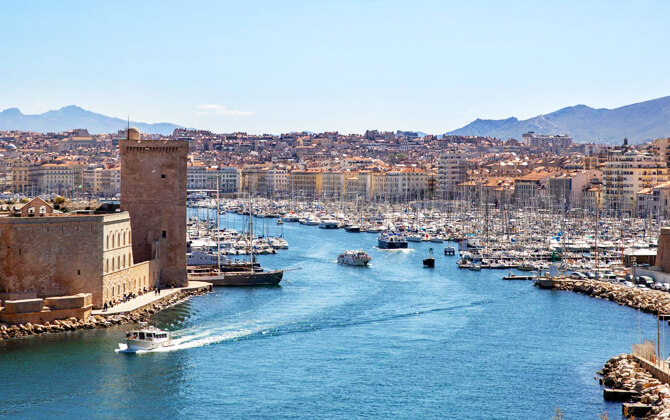
From Saint-Charles, you can reach several popular places by metro, bus, and on foot:
- Vieux Port — about 10 minutes away. Take Line 1 from Saint Charles toward La Rose-La Fourragère and get off at Vieux Port.
- Notre-Dame de la Garde Basilica — about 20 minutes away. Travel on Line 1 to Vieux Port, then continue by bus 81 and walk to Rue Fort du Sanctuaire.
- MuCEM — about 15 minutes away. From Saint Charles, take Line 1 to Vieux Port, then continue by bus 82 S to La Major and walk to 7 Promenade Robert Laffont.
- Saint-Victor Basilica — about 15 minutes away. Use Line 1 to Vieux Port, then bus 81 and a short walk to 3 Rue de l’Abbaye.
- Cathédrale de la Mayor — about 15 minutes away. Take Line 2 from Saint Charles toward Bougainville, get off at Joliette, and walk 700 metres (0.4 miles) to Place de la Major.
Other stations such as Vieux Port, Joliette, Noailles, and Castellane also place you close to busy districts and major landmarks. So if you are planning sightseeing, the metro works well as a starting point.
Travel Tips
Marseille public transport uses a contactless ticket or card, and you need to validate it at the reader every time you enter a new mode of transport. Once validated, it stays valid for 60 minutes across bus, tram, and metro services, though you must validate again each time you change vehicles.
For occasional travel, you can choose from solo tickets, a 10-trip card, group tickets for 4 people, and 24-hour or 72-hour passes. RTM also offers a 7-day pass for unlimited travel on buses, metros, trams, and the ferry line, plus some seasonal maritime and regional connections. One thing to remember: solo and solo secours tickets allow only one metro entry. If you leave the station, you will need a new ticket to go back in.
Tickets can be bought or topped up at metro stations, tram stops, RTM sales points, and approved retailers. Contactless bank cards can also be used directly on validators across the network. If you need assistance, RTM welcome points are available at stations including Saint-Charles, Noailles, Vieux-Port, and Castellane.
Before you head out, check the operating hours, timetable, or schedule today, especially if you are travelling late. Metro, bus, and tram timings vary by day, and the city centre is compact enough that combining the metro with walking often makes the trip easier.