The Helsinki Metro, known in Finnish as Helsingin metro and in Swedish as Helsingfors metro, is the rapid transit system serving the Helsinki capital region in Finland. It is the only metro system in the country and the northernmost metro in the world. Open to the public since 2 August 1982, it is run for the Helsinki Regional Transport Authority and carries 92.6 million passengers a year. The system is a core part of public transport in Helsinki, linking East Helsinki, central areas, and western Espoo through 2 lines, 30 stations, and a 43 km (26.7 mi) route.
| Key | Information |
|---|---|
| System | Helsinki Metro |
| Location | Helsinki capital region, Finland |
| Opened | 2 August 1982 |
| Lines | 2 |
| Stations | 30 |
| Route length | 43 km (26.7 mi) |
| Underground stations | 21 |
| Above-ground stations | 9 |
| Operator | Helsinki Regional Transport Authority |
| Annual ridership | 92.6 million passengers |
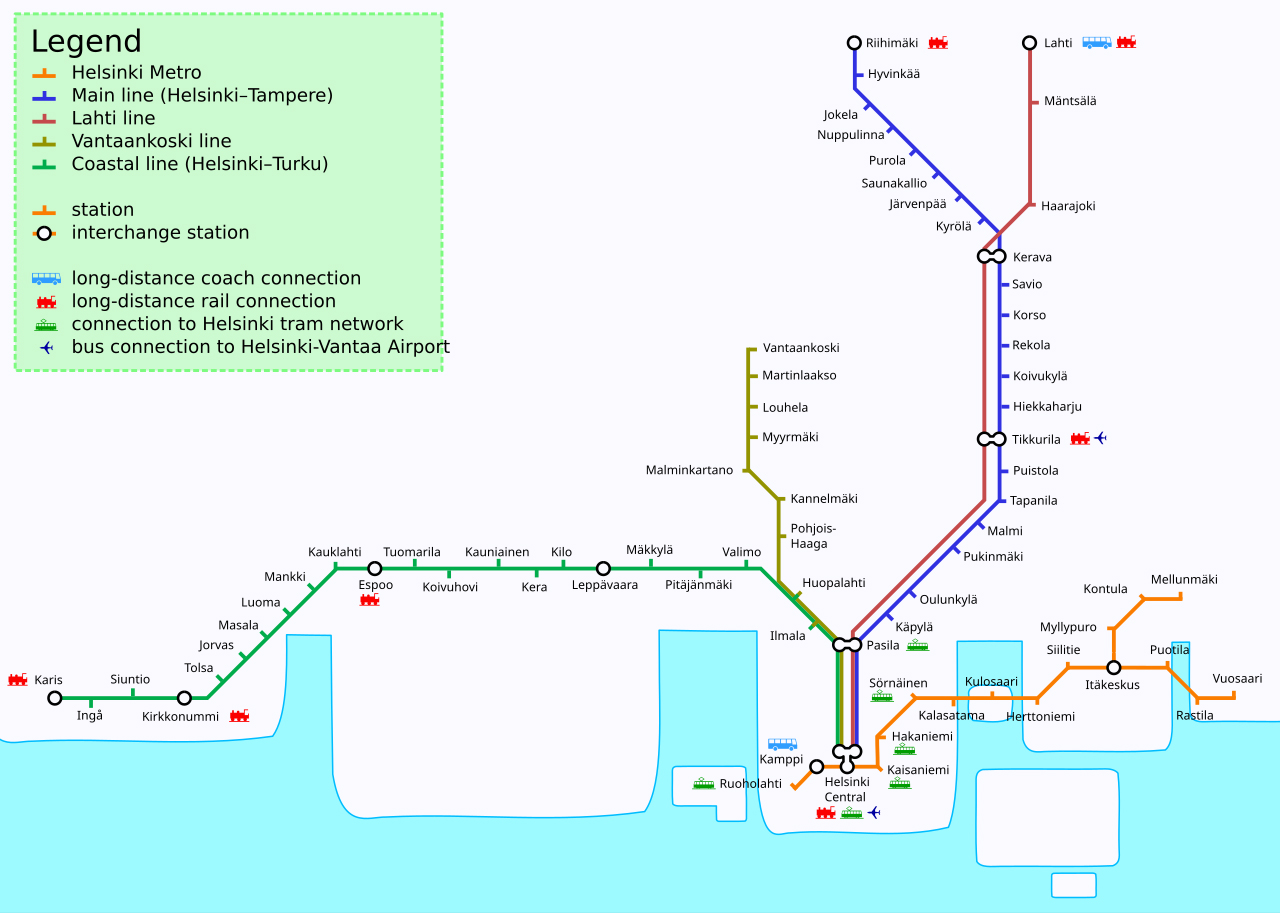
Helsinki Metro Map
Map of Helsinki Metro showing different lines and stations. Click on the map to enlarge it or download the Helsinki Metro map in PDF format.
Lines and Stations
The Helsinki Metro system has 2 lines, M1 and M2, with a 43 km (26.7 mi) route running from southern Espoo through central Helsinki to the eastern suburbs. Most of the network is shared by both lines. M1 runs between Kivenlahti and Vuosaari, while M2 runs between Tapiola and Mellunmäki. Some early-morning and evening services also appear as M1B, M2B, or M2A on parts of the route plan.
Station names are shown in Finnish and Swedish, and some are also announced in English. The network includes underground, surface, and elevated stations. According to the source material, 21 stations are in tunnels, including every station west of Sörnäinen as well as Puotila and Itäkeskus.
| Station | Details |
|---|---|
| Kivenlahti | Western terminus of M1 |
| Espoonlahti | Station on the western extension in Espoo |
| Soukka | Station on the western extension in Espoo |
| Kaitaa | Station on the western extension in Espoo |
| Finnoo | Station on the western extension in Espoo |
| Matinkylä | Western extension station in Espoo |
| Niittykumpu | Station in Espoo |
| Urheilupuisto | Station in Espoo |
| Tapiola | Western terminus of M2 |
| Aalto University | Station in Espoo |
| Keilaniemi | Station in Espoo |
| Koivusaari | Notable undersea station |
| Lauttasaari | Western Helsinki station |
| Ruoholahti | Former western terminus |
| Kamppi | Central Helsinki station |
| Rautatientori | Central station under Helsinki Central Station |
| University of Helsinki | Central Helsinki station |
| Hakaniemi | Central area station |
| Sörnäinen | Transition point before eastern above-ground sections |
| Kalasatama | Eastern Helsinki station |
| Kulosaari | Eastern Helsinki station |
| Herttoniemi | Eastern Helsinki station |
| Siilitie | Eastern Helsinki station |
| Itäkeskus | Major junction for eastern branches |
| Myllypuro | Branch station toward Mellunmäki |
| Kontula | Branch station toward Mellunmäki |
| Mellunmäki | Eastern terminus of M2 |
| Puotila | Tunnel station on the Vuosaari branch |
| Rastila | Branch station toward Vuosaari |
| Vuosaari | Eastern terminus of M1 |
The system also has two depots: Roihupelto in Helsinki and Sammalvuori in Espoo. The Länsimetro expansion extended the network west into Helsinki and Espoo.
Hours of Operation and Frequency
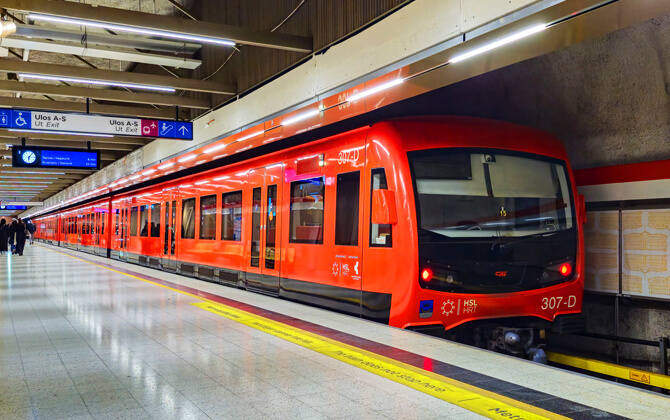
The Helsinki Metro operating hours generally start at around 5:30 am on weekdays and around 6:30 am on weekends. Opening hours and opening times can vary slightly by day, but service usually ends at around 11:30 pm. If you are checking timings today or the schedule today, it is worth confirming in the latest timetable.
Trains usually run every 5 minutes, with higher frequency during the busiest parts of the day. In peak periods, trains can arrive as often as every 2.5 minutes on the central shared section. Off-peak working hours bring longer gaps, especially in the evening, so the last train and closing time matter more then.
| Service detail | Timings |
|---|---|
| Weekday starting time | Around 5:30 am |
| Weekend starting time | Around 6:30 am |
| Typical closing time | Around 11:30 pm |
| M1 route timetable | Kivenlahti–Vuosaari; first trains at 05:30, last trains at 23:30; peak frequency 2.5 minutes, off-peak frequency 5 minutes |
| M2 route timetable | Tapiola–Mellunmäki; first trains at 05:30, last trains at 23:30; peak frequency 4 minutes, off-peak frequency 10 minutes |
| Stopping pattern | All trains stop at every station; no express service |
Some early-morning and evening trains operate as short turns, including M1B between Itäkeskus and Vuosaari, M2B between Itäkeskus and Mellunmäki, and M2A between Kivenlahti and Mellunmäki. Historically, passenger service first ran on 1 June 1982 during rush hours before full daytime operation followed shortly after.
Fares and discounts
HSL divides the area into four fare zones: A, B, C, and D. Most of Helsinki lies in the AB zone. For many visitors, that is the ticket you will use most often.
An AB single ticket costs EUR 3.30 (about USD 3.60) and is valid for 80 to 110 minutes. HSL also offers 10-journey and 20-journey tickets. For more regular travel, you can buy a season ticket as a one-off purchase or renew it every 30 days. A day pass is available for 1 to 13 days, which can be a practical option if you plan to use city transport a lot over a short stay.
Tickets for 1 to 7 days can be bought from sales and service points and from ticket machines. Day passes are also available in the HSL app and at the HSL service point. In everyday use, the app or an HSL card is usually the simplest choice.
Discounts are available for children, students, pensioners, customers over 70, and people with reduced mobility. Customers with impaired visibility and wheelchair users can travel free of charge. Travelers with a child aged 0 to 6 years in a pram, stroller, or bicycle trailer can also travel free.
If you travel without a valid ticket, the penalty fare is EUR 100 (about USD 109) plus the price of a single ticket. If you use the HSL app, make sure the ticket is already on your phone before boarding a bus, tram, or train, or before entering the metro payment area.
Connections to Other Systems
The Helsinki Metro is a key part of public transport in the capital region, even though it is separate from Finland’s main railway network. It connects closely with commuter rail, bus services, trams, ferries, and other local transport across Helsinki and Espoo.
One of the most important interchange points is the Helsinki Central Station area. The metro runs beneath the main station, making transfers to commuter rail easy, including trains on the Ring Rail Line toward the airport.
The metro also acts as the backbone for many feeder bus routes. In eastern Helsinki and southern Espoo, many bus services end at metro stations instead of continuing into the city center. That setup makes the metro the main rail link into central Helsinki from surrounding districts.
At several stations, passengers can connect to other rail-based transport in the HSL network. Common ticketing ties together the metro, commuter rail, trams, and other city transport services, which keeps transfers simple.
In Vuosaari, the metro infrastructure connects technically to the Finnish Main Line through the Vuosaari harbour rail. This link is used for rail access to the harbour area.
The wider transportation in the region also includes projects such as the Raide-Jokeri light rail line and the Vantaa Light Rail, both relevant within the same urban transport landscape.
- Helsinki Central Station for commuter rail and Ring Rail Line transfers
- Major metro stations with feeder bus terminals
- Vuosaari for the rail connection to the Finnish Main Line
Airport Connections
Helsinki Airport is not on the metro route, but it is easy to reach by train through the commuter rail network. The I and P trains run directly to the airport railway station beneath the terminal, and from there you can walk to either terminal without going outside.
The airport trains also connect with Helsinki Central Railway Station, Tikkurila, and Pasila. Helsinki Central Railway Station is in the heart of the city, while Pasila and Tikkurila are useful transfer points for longer rail journeys across Finland. The Ring Rail Line, opened in 2015, links the airport with the commuter rail system, and the running time between the airport and central Helsinki is around 30 minutes.
If you are continuing beyond Helsinki, the easiest transfer points to long-distance trains are usually Tikkurila and Pasila. For example, travel to Turku can involve taking the P train from the airport and changing at Pasila, while Tampere or Kuopio can be reached by changing at Tikkurila. Trains to Rovaniemi are also available, including night trains with sleeper cabins.
- Tickets can be bought in the HSL mobile app or from the ticket machine on the station platform.
- Timetable, fare, and train schedule details are available through HSL services.
- Long-distance train schedule and fare details are available through VR.
Helsinki Metro Rules and Tips
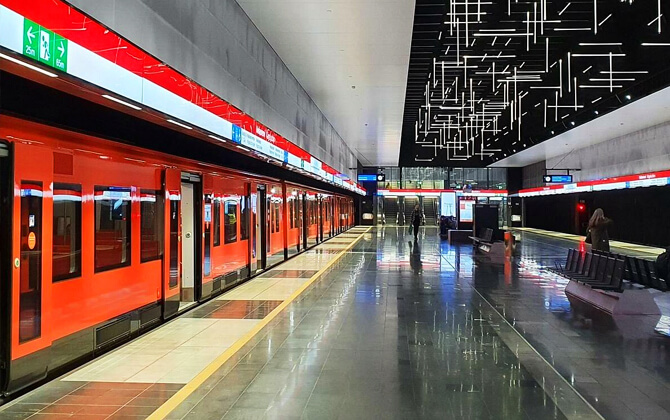
The Helsinki Metro is straightforward to use, but one rule matters from the start: you must have a valid ticket before entering the metro platform area. The payment area begins at the card readers, and in tunnel stations it starts at the top of the escalators leading down to the platforms.
You can board through any door, and you do not need to show your ticket when boarding. Still, keep it ready. Ticket inspectors may ask to see it at any time. If you are buying in the HSL app, make sure the ticket has arrived on your phone before you enter the payment area.
If you use contactless payment or stored value on an HSL card, buy your ticket at a card reader. Tickets are not sold on board, so buying in advance is the safe option.
Useful travel tips
- Let passengers get off before you board.
- At stations, a lift can be a safer option than stairs.
- Stand on the right on escalators and leave the left side clear.
- You can travel free when accompanying a child aged 0 to 6 years in a pram, pushchair, or wheelchair.
- Bicycles are allowed free of charge when there is space.
- Pets are allowed, and guide dogs, assistance dogs, and service dogs are always permitted.
- Mobility scooters for people with limited mobility are allowed and do not need a separate ticket.
Skateboards and kick scooters are allowed, but skateboards should be carried under your arm and not get in anyone’s way. Roller skates must be removed before boarding. Other electric scooters are not allowed on HSL public transport.
Regular luggage can be taken free of charge as long as it does not disturb other passengers. Large items may be refused if they cause inconvenience, and prams, pushchairs, or wheelchairs may also be refused if there is no space available.
The metro is part of the wider HSL system, so the same ticket rules apply across the journey, whether you continue by bus, tramway, or train.
Helsinki Metro Parking
If you are driving into central Helsinki, parking halls are often the easiest option. Street parking is available too, but in the inner city it is usually paid on weekdays from 9:00 to 21:00 and on Saturdays from 9:00 to 18:00.
Street parking charges in Helsinki typically range from EUR 2 to EUR 4 per hour (about USD 2.20 to USD 4.40), depending on the zone. In the city center, zone 1 costs EUR 4 per hour (about USD 4.40), while zone 2 costs EUR 2 per hour (about USD 2.20). Always check the local sign because payment times and rules can vary.
There are no free parking spaces in central Helsinki during normal daytime hours. Low-emission cars may qualify for a discount on fees. If you are looking for station parking specifically, the source material focuses on city-center parking rather than dedicated metro station parking lots.
How to pay for parking
You can pay for parking with a mobile app, by text message, or at a ticket machine. Available apps include Aimo, EasyPark, eParking.fi, Moovy, and ParkMan. Each app adds a small service fee and requires registration.
If you pay by text message, one hour of parking can be bought for an extra EUR 1 (about USD 1.10) on top of the regular parking fee. Send your license plate number and payment zone to 16234, then confirm by replying with A. The parking session starts once you receive the confirmation message.
Ticket machines accept debit and credit cards, including contactless payment, Apple Pay, and Google Pay. Some machines also accept coins. After payment, place the printed ticket clearly on your dashboard.
Parking halls
Parking halls are a practical choice in the city center. Recommended operators include Aimo Park, EuroPark, Finnpark, and Pasilan pysäköinti.
For parking charges per day, exact daily rates are not given in the source material. The city service map can help you compare locations and see more details for street parking and parking halls.
Regulations
The Helsinki Metro follows the same ticketing rules as the rest of the HSL public transport system. You must have a valid ticket before entering the metro platform area. In practice, that means buying and activating your ticket before you reach the payment area.
You do not need to show your ticket when boarding, and you can enter through any door. Even so, random ticket inspections take place, so you must be able to present a valid ticket if asked.
Accessibility is built into the system. Stations have elevators for passengers with limited mobility and for travelers with prams or bicycles. High platforms make boarding easier because the train floor is level with the platform.
There are also clear rules for items, pets, and family travel. Free travel is available when traveling with a child aged 0 to 6 years in a pram, pushchair, or wheelchair. Bicycles are allowed free of charge if there is room. Pets are allowed, but on the metro and commuter trains they may only travel in carriages that do not display a prohibition sign on the outside. Mobility scooters for people with limited mobility are allowed, and no ticket is required for them.
Metro operations are governed by internal regulations approved by the Board of Helsinki City Transport. These rules cover safety responsibilities, competence requirements, driver and traffic-control licenses, train equipment, and inspections. According to the source material, the metro is not subject to railway legislation in the same way as other rail transport modes.
Tips
Buy your ticket, pass, or HSL card before you ride, then check the zone map so you choose the right fare and avoid extra charges. A single ticket or day pass can cover metro, tram, bus, and other HSL transport within the validity window.
For the smoothest trip, validate your ticket before entering the metro platform area or when using a card reader, depending on how you pay. The app and ticket machines are straightforward, and station staff can help if needed.
The system is easy to navigate because trains run in two directions only. Signs are clear, station names are shown in Finnish and Swedish, and finding the right platform usually takes very little effort.
During peak hours, trains generally arrive every 2 to 2.5 minutes on the busiest section, so waits are usually short. If you want live timetable information, check the app for schedule updates and service changes.
All metro stations have elevators, and the train and platform are level, which makes the system accessible for wheelchairs and strollers. Travelers with a child in a stroller up to age six travel free on HSL services, including metro, trains, buses, and ferries.
If you are arriving from Helsinki Airport, use the commuter rail connection rather than looking for a path train or direct metro link, because the airport is served by the I and P trains. The journey to central Helsinki takes about 30 minutes.
For central sightseeing, walking often works well because Helsinki is compact. You can also combine a short metro ride with trams to cover more ground without much hassle.
Keep your ticket handy for inspections. The penalty fare stated in the source material is EUR 100 (about USD 109) plus the price of a single ticket, so planning ahead is worth it.
Future Expansion
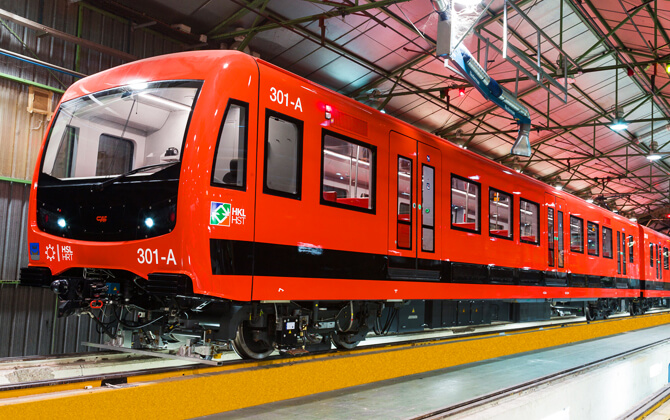
Future expansion of the Helsinki Metro is focused more on capacity and reliability than on major new lines. The METKA project brings together Helsinki, Espoo, HSL, Länsimetro Ltd, and City Transport Ltd to modernize the system over the next decade.
Planned upgrades include replacing the current train control and radio communication systems and introducing a new traffic management system. The goal is to allow shorter intervals, with a target of 120 seconds during peak periods, and to increase capacity by 25 percent. The new system is planned to be phased in during the early 2030s.
The project also includes new M400-series trains, which will replace the oldest M100 and M200 units now in service. Passenger service with the new rolling stock is expected to begin in the early 2030s.
This modernization is intended to support growing demand by making better use of the existing infrastructure. It is also meant to improve safety and reliability without large new construction projects.
According to the source material, the capacity increase is considered equivalent to the effect of building three light rail lines, ten new bus routes, or one motorway lane, but with a smaller carbon footprint and lower cost.
History
The history of the Helsinki Metro goes back to September 1955, when the first motion to build a metropolitan railway system was made. A suburban traffic committee led by Reino Castrén later studied whether Helsinki needed a tunneled public transport system and concluded that the city should build a metro on a separate right-of-way. This was also the first time the word metro was used for the planned system.
In 1963, Castrén’s committee presented a light rail proposal, but it was considered too extensive. After further review, experts from Hamburg, Stockholm, and Copenhagen agreed in 1964 that a metro was needed and that the first sections should be built by 1970. Detailed planning for a first line from Kamppi to Puotila began in 1965.
In late 1967, Unto Valtanen took over the committee and shifted the plan from light rail to a heavy rail system in deep bedrock tunnels. On 8 May 1969, the city council approved the initial line from Kamppi to Puotila, with opening then expected in 1977.
Construction started in 1969 with a 2.8 km (1.7 mi) test track from Roihupelto to Herttoniemi. Excavation of the central tunnels began in June 1971, and the first prototype trains arrived later that year. The original schedule slipped several times. Underground stations were also designed to function as bomb shelters. Test trains developed during the 1970s led to the M100 series, while an early automatic-train concept was eventually dropped in favor of manually controlled operation.
The metro opened to the public in stages in 1982. Test services began on 1 June, provisional service reached Rautatientori on 1 July, and the official opening took place on 2 August 1982, 27 years after the first motion. Regular all-day service between Rautatientori and Itäkeskus started the following day.
After that, the network expanded gradually. Service reached Kamppi in 1983, Sörnäinen in 1984, Kontula and Myllypuro in 1986, Mellunmäki in 1989, Ruoholahti in 1993, Kaisaniemi in 1995, and the Vuosaari branch in 1998. M200 trains entered passenger service in 2000 and 2001.
The western expansion was approved by Espoo in 2006. Construction began in 2009, the first stage opened on 18 November 2017 to Matinkylä, and the extension to Kivenlahti followed on 3 December 2022.
The system has also seen disruptions and controversy. Rautatientori was closed in 2009 after flooding caused by a burst water main and again in 2019 after heavy rain. Its history also includes a corruption scandal linked to rolling-stock procurement during construction.
| 1955 | First motion to build a metro system in Helsinki |
| 1969 | City council approval for the initial metro line |
| 1982 | Public opening and start of regular traffic |
| 1998 | Vuosaari branch completed |
| 2017 | Western extension to Matinkylä opened |
| 2022 | Extension to Kivenlahti opened |
Curious Facts
The Helsinki Metro is the only metro system in Finland and the northernmost one in the world. It opened to the public on 2 August 1982 after 27 years of planning and has become a central part of public transport in the capital region.
One of its most recognizable features is the orange color used on trains, signs, and staff uniforms. The color was chosen by the public in a vote in the 1970s.
The system started as a single line and later grew into a network of 2 lines and 30 stations. The stations are bilingual, reflecting Finland’s two official languages, Finnish and Swedish.
The metro is separate from the national railway network, yet it works as a core part of local transport alongside commuter rail, light rail, and trunk bus lines.
Another detail many visitors remember: the underground stations were designed for dual use and can also serve as bomb shelters.
Today, the metro is operated for the Helsinki Regional Transport Authority and carries around 92.6 million passengers per year.
Nearby Attractions
The Helsinki Metro is a practical way to reach attractions in both Helsinki and Espoo. It connects with shopping areas, cultural landmarks, parks, and other city destinations, so using transport for sightseeing is easy.
- Itäkeskus is about a 9-minute walk from the metro area and is a convenient stop for shopping and everyday services.
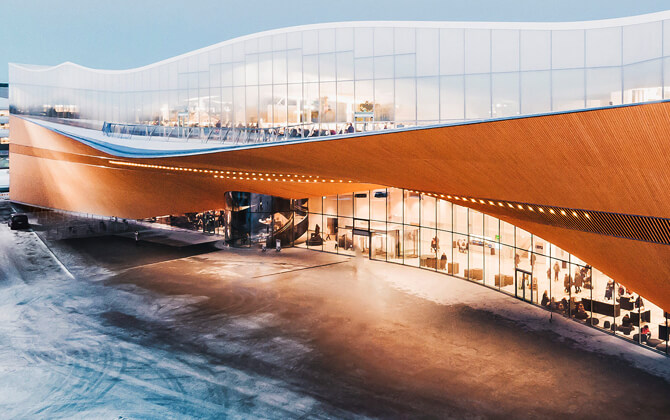
- Central Library Oodi is one of Helsinki’s best-known modern landmarks and a popular place for architecture lovers.
- Sea Fortress Suomenlinna is a major historic attraction in the city.
- Uspenski Cathedral, the National Library of Finland, and the Natural History Museum are all listed among nearby places worth considering.
- The Helsinki tramway system is also useful if you want to continue exploring with another part of the public transport network.
- Koivusaari station stands out as the world’s only undersea metro station, which makes it a curious stop in its own right.
For a broader day out, the metro also gives access to areas with station artwork, sculptures, and easy transfers to buses, trams, and local trains within the same fare zones.
Recommended ways to explore the area
- Use the metro as a starting point for walking around central Helsinki.
- Combine metro rides with trams to reach more attractions in the city center.
- Choose a day pass if you plan to visit several sights in one trip.