The Prague Metro is the rapid transit system in Prague, Czech Republic, and a core part of the city transport network. Opened in 1974 and operated by the Prague Public Transit Company, it has three operating lines: A, B, and C. Together they serve 61 stations across 65.2 kilometres (40.5 miles), with daily service from early morning until midnight and easy connections to trams, bus routes, ferries, the Petřín funicular, and other public transport in the city.
| Key | Information |
|---|---|
| System | Prague Metro (Pražské metro) |
| City | Prague, Czech Republic |
| Opened | 1974 |
| Operator | Prague Public Transit Company |
| Lines | 3 operating lines: A, B, C |
| Stations | 61 |
| Network length | 65.2 kilometres (40.5 miles) |
| Main interchange stations | Florenc, Můstek, Muzeum |
| Operating hours | Generally from early morning until midnight |
| Rolling stock | 81-71M and Metro M1 |
| Integrated transport | Part of Prague Integrated Transport (PID) |
Prague Metro Map
Map of Prague Metro showing different lines and stations. Click on the map to enlarge it or download the Prague Metro map in PDF format.
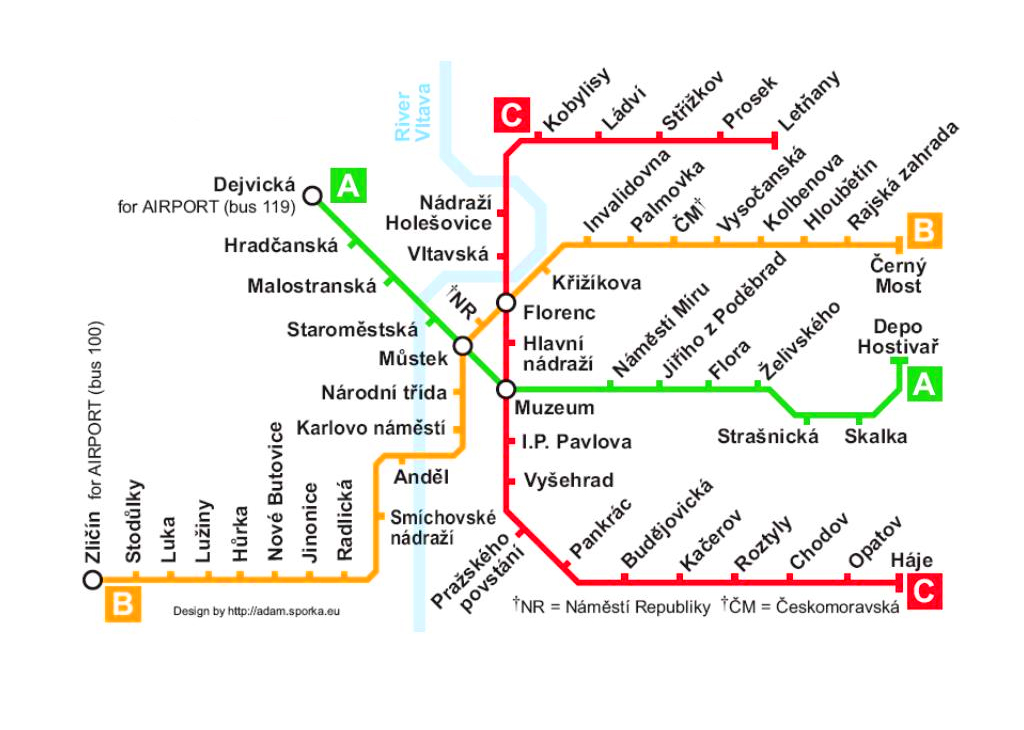
Prague Metro Lines and Stations
The Prague Metro has three operating lines and one future expansion line under construction. The current route plan is built around the city centre, where Lines A, B, and C form a triangle rather than meeting at one central station.
Line A, the green line, runs from Nemocnice Motol to Depo Hostivař. It has 17 stations and a route length of 17.1 kilometres (10.6 miles). Line B, the yellow line, runs from Zličín to Černý Most, with 24 stations over 25.6 kilometres (15.9 miles). Line C, the red line, runs from Letňany to Háje, with 20 stations and a length of 21.4 kilometres (13.3 miles).
Line D is planned as the blue line between Náměstí Míru and Depo Písnice. Under current plans, it will open with 10 stations.
The key interchange stations are Florenc, Můstek, and Muzeum. Each transfer station has two halls, one for each line. Most stations use a central island platform, though station depth and layout vary a lot across the system. Náměstí Míru is the deepest station, at 52 metres below ground.
For travelers looking at a stations map or stations list, these are some of the most important stops for transfers and access to central Prague:
| Station | Details |
|---|---|
| Florenc | Interchange between Lines B and C |
| Můstek | Interchange between Lines A and B |
| Muzeum | Interchange between Lines A and C |
Several stations are also known for their architecture, layouts, and former names, which helps make the Prague Metro one of Europe’s most recognizable metro systems.
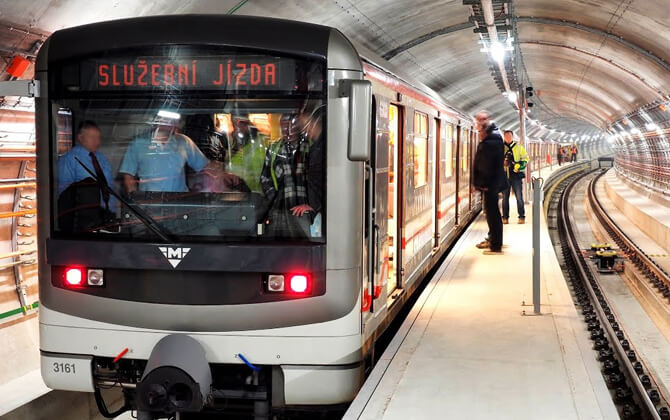
Schedule and Frequency
The Prague Metro timetable runs daily from 05:00 to 24:00. These opening hours and operating hours can vary slightly in general descriptions, but the regular schedule today is based on this daily service window. If you are checking timings today, the most useful reference is the line-specific train schedule.
Frequency depends on the line, day, and time. On weekdays, especially from Monday to Thursday between 6:30 and 8:00 AM, trains can run about every 2 minutes. Across the week, the average interval is around 4 minutes. Outside peak periods, trains usually come every 4 to 10 minutes, with longer waiting times in the evening and on weekends.
For quick route timetable planning, here is a simplified summary of service timings.
| Service detail | Timings |
|---|---|
| Daily operating hours | 05:00 to 24:00 |
| Peak weekday frequency | About every 2 minutes at the busiest times |
| Average frequency across the week | About every 4 minutes |
| Off-peak service | Usually every 4 to 10 minutes |
| Evening and weekend service | Longer intervals than peak periods |
| Line A peak | About 2 to 3 minutes |
| Line A off-peak and evening | Typically 3 to 10 minutes, then 10 minutes late evening |
| Line B peak | About 2 to 3 minutes |
| Line B off-peak and evening | Typically 3 to 10 minutes, then 10 minutes late evening |
| Line C peak | About 1 to 4 minutes |
| Line C off-peak and evening | Typically 2 to 10 minutes, then 5 to 10 minutes late evening |
If you need exact opening times, starting time by station, last train information, or the closing time for a specific route, check the individual timetable for Line A, Line B, or Line C.
Prices, tickets and discounts
For most visitors, the simplest ticket option is a 24-hour or 72-hour pass. Once validated, it allows unlimited rides across Prague public transport during its validity period. That includes the metro, trams, buses, ferries, and more. It is an easy choice if you want straightforward transportation in Prague without thinking about each trip.
The 24-hour ticket price is 140 CZK in the PID Lítačka app and 150 CZK as a paper ticket, about $6.00 and $6.40. The 72-hour day pass costs 340 CZK in the app and 350 CZK on paper, about $14.60 and $15.00.
Single tickets are also available. The 30-minute fare is 36 CZK in the app or 39 CZK on paper, about $1.55 and $1.70. The 90-minute ticket costs 46 CZK in the app or 50 CZK on paper, about $2.00 and $2.15.
For longer stays, standard subscription tickets cost 550 CZK for one month, 1,480 CZK for three months, and 3,650 CZK for one year, roughly $23.60, $63.60, and $156.80. Anonymous transferable passes cost 1,000 CZK for one month, 2,700 CZK for three months, and 7,800 CZK for one year, about $42.90, $115.90, and $335.00.
Some groups travel free. These include children until 6 years old when accompanied by a person older than 10, children from 6 to 10 with proof of age, children from 10 to 15 with proof of age, seniors from 65 with proof of age, and one person accompanying a child under 3 years old with the required ID or card.
Discounted fare options are available for selected passengers, including seniors aged 60 to 65, adolescents from 15 to 18, and students aged 18 to 26 with valid proof. Reduced monthly, quarterly, and annual tickets are also offered for longer travel.
Short-term tickets are valid on the main Prague transport system with unlimited transfers during the validity period. The 24-hour and 72-hour tickets are also valid on the Petřín funicular, while 30-minute and 90-minute tickets are not.
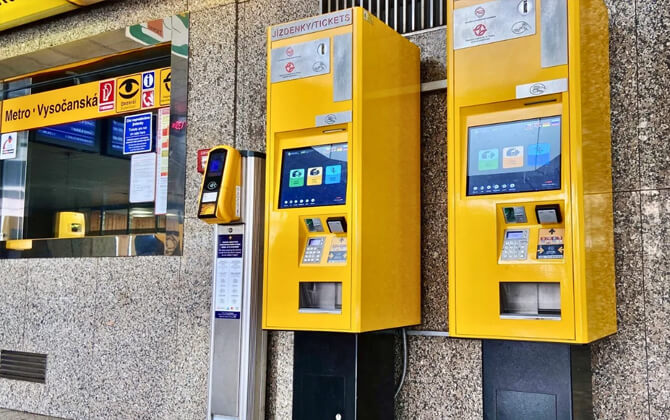
You can buy a ticket from yellow vending machines, ticket offices at many metro stations, newsstands, and tourist information centers. Long-term passes are sold at ticket offices at many stations and at the Prague Public Transit Central Office at Na Bojišti 5, Prague 2, near I. P. Pavlova station.
Ticket Types
The 24-hour and 72-hour ticket is the easiest option for visitors. It starts when you stamp it and gives unlimited travel on PID trams, the metro, buses, ferries, and trains in Prague. It is also valid on the Petřín funicular, which makes it especially practical for sightseeing.
For shorter trips, Prague offers these standard ticket types:
- 30 minutes: 36 CZK in the app, 39 CZK as a paper ticket, about $1.55 and $1.70
- 90 minutes: 46 CZK in the app, 50 CZK as a paper ticket, about $2.00 and $2.15
- 24 hours: 140 CZK in the app, 150 CZK as a paper ticket, about $6.00 and $6.40
- 72 hours: 340 CZK in the app, 350 CZK as a paper ticket, about $14.60 and $15.00
If you are staying longer, subscription pass options are available as non-transferable or transferable products.
- Non-transferable: 550 CZK for one month, 1,480 CZK for three months, and 3,650 CZK for one year, about $23.60, $63.60, and $156.80
- Transferable: 1,000 CZK for one month, 2,700 CZK for three months, and 7,800 CZK for one year, about $42.90, $115.90, and $335.00
Children under 15 and seniors over 65 travel free. Seniors aged 60 to 65 can use half-price tickets with valid proof of entitlement. For the Petřín funicular, passengers using 30-minute or 90-minute tickets need a separate 60 CZK single-ride ticket, about $2.60, while 24-hour, 72-hour, and subscription tickets include the ride.
Connections to Other Systems
The Prague Metro is part of the Prague Integrated Transport system, or PID. This wider public transport network includes trams, buses, commuter trains, ferries, the Petřín funicular, and the chairlift in Prague Zoo. Since 1993, the metro has also been connected with commuter rail, bus services, and park-and-ride facilities, creating a broader local transport system that reaches beyond the city centre.
Within Prague, the metro is the backbone of city transport. It sits fully inside the central fare zone, while the wider PID network uses zonal pricing. Tickets are valid across the main Prague transport modes, which makes transfers between metro, tramway, tram, and bus services simple on a single fare system.
The main interchanges are straightforward:
| Station | Details |
|---|---|
| Můstek | Transfer between Lines A and B |
| Muzeum | Transfer between Lines A and C |
| Florenc | Transfer between Lines B and C and connection to the central bus station |
Several other stations are important for onward travel. Nádraží Veleslavín links to tram and bus services and is the starting point for bus 119 to Václav Havel Airport. Smíchovské nádraží connects with a major railway station, while Hlavní nádraží and Nádraží Holešovice also link to rail services. At the outer parts of the network, some stations act as major hubs for surface transport.
Airport Connections
Prague Airport is about 15 kilometres (9.3 miles) from the city centre. By car, the trip usually takes around 25 to 30 minutes, or about 40 minutes in heavy traffic. By public transport, it takes roughly 30 minutes to reach central Prague using a bus and the metro.
If you plan to use local transport for sightseeing, the Prague Visitor Pass can be useful. It includes unlimited travel on Prague public transport, including airport journeys, and also covers access to many museums, galleries, and historical sites.
Public transport is the cheapest way to get downtown. It is reliable, clean, and frequent, though there may be some walking and crowding during busy hours.
Public transport options
- Trolleybus 59 connects the airport with Nádraží Veleslavín on Metro Line A. It is useful for the historic centre, Prague Castle, and areas along Line A such as Vinohrady and Žižkov. The ride takes about 13 to 17 minutes, with service every 7 to 20 minutes.
- Bus 100 connects the airport with Zličín on Metro Line B. It works well if your destination is near Line B, including New Town or Smíchov. The ride takes about 15 to 20 minutes, with frequent daytime service.
- Airport Express is a special bus to Hlavní nádraží on Metro Line C. The trip takes about 40 minutes, and the schedule is timed to train arrivals and departures. Regular public transport tickets are not valid on this service.
- Night bus 910 serves the airport when the metro is closed at night. It departs every 30 minutes and reaches the wider city centre in about 35 minutes.
For airport public transport, you need a 30-minute or 90-minute ticket. Tickets are sold at the Public Transport Information booth at the airport or by the bus driver, though buying from the driver costs a bit more. A separate ticket is required for each item of luggage larger than 25 cm x 45 cm x 70 cm.
If you are traveling with bags, keep an eye on your valuables, especially when changing between bus and metro.
Fun Facts
The Prague Metro is relatively young, but its history is surprisingly rich. Line C opened first in 1974, followed by Line A in 1978 and Line B in 1985.
Today, the system has 61 stations and carries around 620 million passengers a year, making it one of the busiest metro networks in Europe.
Some stations are memorable for engineering as much as design. Náměstí Míru is the deepest station in Prague, and its escalator is the longest in the network. Line C was originally built with the cut-and-cover method, while Line A goes much deeper underground.
After 1990, several station names changed from politically inspired names to more neutral ones. Moskevská became Anděl, and Leninova became Dejvická.
The metro is still expanding. Line D is planned to open in 2029 and will use fully automatic, unmanned trains.
Prague’s transport operator, DPP, runs not only the metro but also trams, buses, ferries, the Petřín funicular, and the zoo chairlift.
Tips and Rules
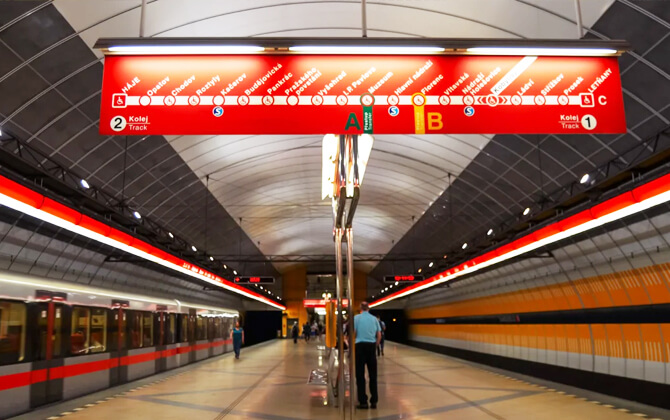
Validate your ticket as soon as you enter. In the metro, validation happens in the vestibule, not on the platform or inside the train. Tickets bought from onboard machines in trams or buses are already validated when issued.
The metro runs from approximately 4:30 a.m. to midnight, so if you are checking working hours, opening times, or when the system will close, remember that exact timings can depend on the line and station.
You cannot buy a ticket from the driver or operator, except on trams 41, 42, and K. In Prague, tickets can also be purchased by SMS, but only with Czech mobile operator numbers. The PID Lítačka app is another easy option, and you can pay by card.
If you need transport after the last train, use Prague’s night tram and bus network. Night route numbers always begin with 9, such as Tram 97, and normal fares apply.
Traveling without a valid ticket is not worth the risk. The on-the-spot fine is 1200 CZK, about $51.50.
You can usually use public transport in Prague without cash. Most vending machines, sales points, and DPP Info Centres accept cards, and ticket machines inside trams and buses accept cards only.
Maps, route details, fare information, and connection help are available at DPP Info Centres. There is also an information line at +420 296 19 18 17.
History
The idea of underground transportation in Prague goes back to the late 19th century. In 1898, engineer Ladislav Rott proposed building railway tunnels alongside sewer works in the city centre, but the city council rejected the plan.
The concept returned in 1926, when Bohumil Belada and Vladimír List presented a new underground transport proposal and used the word metro for the first time. During the 1930s and 1940s, planners debated whether Prague should build an underground tramway or a true metro system. After World War II, work stopped because of the economic situation, even though future lines had largely been designed.
In the early 1960s, the underground tramway idea was accepted, and construction of the first station, Hlavní nádraží, began in 1967. Later that same year, the plan changed again. After criticism from architects and urban planners, and with Soviet support, Czechoslovakia decided to build a true metro instead. That meant redesigning the project during construction.
Regular service on the first section of Line C began on 9 May 1974, between Sokolovská, now Florenc, and Kačerov. Line A opened in 1978, and Line B followed in 1985, creating the three-line system used today. The network has been extended several times since then, and Line D is planned to become operational in 2029.
The metro also reflects Prague’s political changes. On 21 February 1990, fourteen stations were renamed after the fall of communism. Some stations still preserve artworks from that era, including pieces linked to Soviet-Czechoslovak friendship.
Today, the Prague Metro is a busy, user-friendly system with frequent service, 61 stations, and three lines.
Future projects
The main Prague Metro expansion project is Line D, the city’s first new metro line in more than 40 years. Construction started in 2022, and the goal is to improve transport in the southern and southeastern parts of Prague while easing pressure on the busy Line C.
Under current plans, Line D will run for about 11 kilometres (6.8 miles) and connect the city centre with Vršovice, Krč, Libuš, and Písnice. Planned stations are Náměstí Míru, Náměstí bratří Synků, Pankrác, Olbrachtova, Nádraží Krč, Nemocnice Krč, Nové Dvory, Libuš, Písnice, and Depo Písnice. In a later stage, the line is planned to extend from Pankrác to Náměstí Míru for interchange with Line A.
The first section, Pankrác to Olbrachtova, began construction on 21 April 2022 and is expected to be completed in 2029. The next section, Olbrachtova to Nové Dvory, is in the tender phase, with expected completion in 2030. Project documentation is also being prepared for the Pankrác to Náměstí Míru section.
Line D is tied to wider modernization plans for the metro system. DPP has started a tender for automated train sets for Line D and existing Line C. The project includes driverless operation, CBTC technology, platform safety walls, a new train dispatcher, and depot upgrades. The aim is to reduce intervals on Line D and increase capacity on Line C.
There were also plans to extend Line A from Nemocnice Motol to Václav Havel Airport, but that idea has been dropped in favor of a rail link to the airport. Another long-term proposal is Line E, which may become a circular route, though its exact path has not been determined.
The city’s long-term metro development is being shaped by the draft Metropolitan Plan and Prague’s future transport needs.
What to see from the Prague Metro
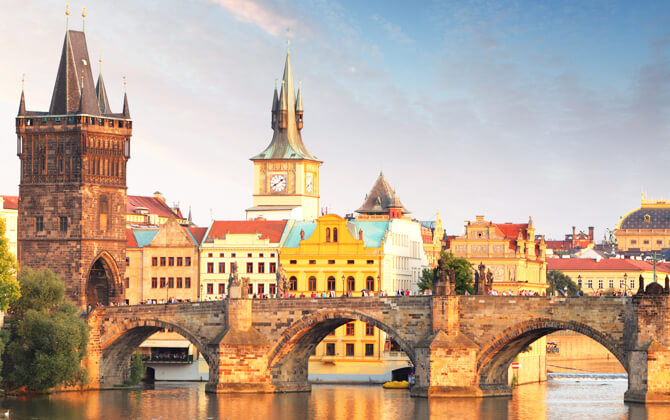
The Prague Metro is more than a fast way to move around. Several stations are worth seeing in their own right, thanks to architecture, public art, unusual engineering, and traces of the city’s past.
Stations in the city centre
In central Prague, Můstek, Náměstí Míru, and Staroměstská are known for wall panels with circular indentations. Each station has its own color scheme: yellow at Můstek, red at Staroměstská, and deep blue at Náměstí Míru. At Karlovo náměstí, the central hall features a large mosaic mural showing the life and times of Charles IV.
Station design and metro art
- Želivského on Line A has mosaics.
- Dejvická on Line A features abstract plastics.
- Malostranská on Line A has an entrance gate with a gold-colored key and sun.
- Skalka on Line A has a mosaic mural behind silver-colored pillars.
Other stations also stand out. Staroměstská sits beneath the heart of medieval Prague, while Vltavská is noted for its imaginative station design and nearby street-level art.
Communist-era traces and unusual stops
Anděl on Line B is one of the most interesting stations for communist-era history and design. It was originally called Moskevská, and after the 1990 rename, some wall panels were removed and later restored. A decoration in the central hall still recalls the friendship between Prague and Moscow.
At Vyšehrad, the metro passes through a tube suspended under Nusle Bridge, a striking example of communist-era engineering. The bridge was extensively tested before metro service began below it.
Klarov remains one of the network’s mysteries, with a sealed entrance and classified drawings in the city archives. On Line B, Hloubětín and Kolbenova were ghost stations for several years before completion.
Escalators and deep stations
Line A is the deepest line, and many of its stations have very long escalators. Náměstí Míru has the longest escalator in the EU, measuring 87 metres (0.087 kilometres, 0.054 miles) with 533 steps. At Jiřího z Poděbrad, the original fast communist-era escalators were restored during renovation.
Other places to notice
- Můstek preserves remains of a medieval bridge discovered during construction.
- Můstek also connects Lines A and B and is the busiest transfer station in the network.
- Rajská zahrada is the only two-level station.
- Lužiny is a good stop for seeing one of the suburbs planned in communist times.
- Vyšehrad gives access to Prague’s second castle.
If you have a little extra time, the metro can double as a sightseeing route. Grab a pass, hop off now and then, and explore a few stations along the way.