The Valparaíso Metro, also known as Merval, is a commuter rail-style public transport system serving Gran Valparaíso in Chile. The single 43 km (26.7 mile) route links Valparaíso, Viña del Mar, Quilpué, Villa Alemana, and Limache through 20 stations. It is operated by EFE Valparaíso S.A. and opened for passenger service in November 2005 after the modernization of an older interurban railway line.
| Key | Information |
|---|---|
| System type | Commuter rail and metro-like local transport system |
| Route length | 43 km (26.7 miles) |
| Stations | 20 stations |
| Main route | Puerto to Limache |
| Operator | EFE Valparaíso S.A. |
| Opening | Renovated line inaugurated on November 23, 2005; passenger service began the next day |
| Underground section | About 5 km (3.1 miles) between Miramar and Chorrillos in Viña del Mar |
| 2019 ridership | 20.17 million passengers |
Valparaiso Metro Map
Map of Valparaiso Metro showing different lines and stations. Click on the map to enlarge it or download the Valparaiso Metro map in PDF format.
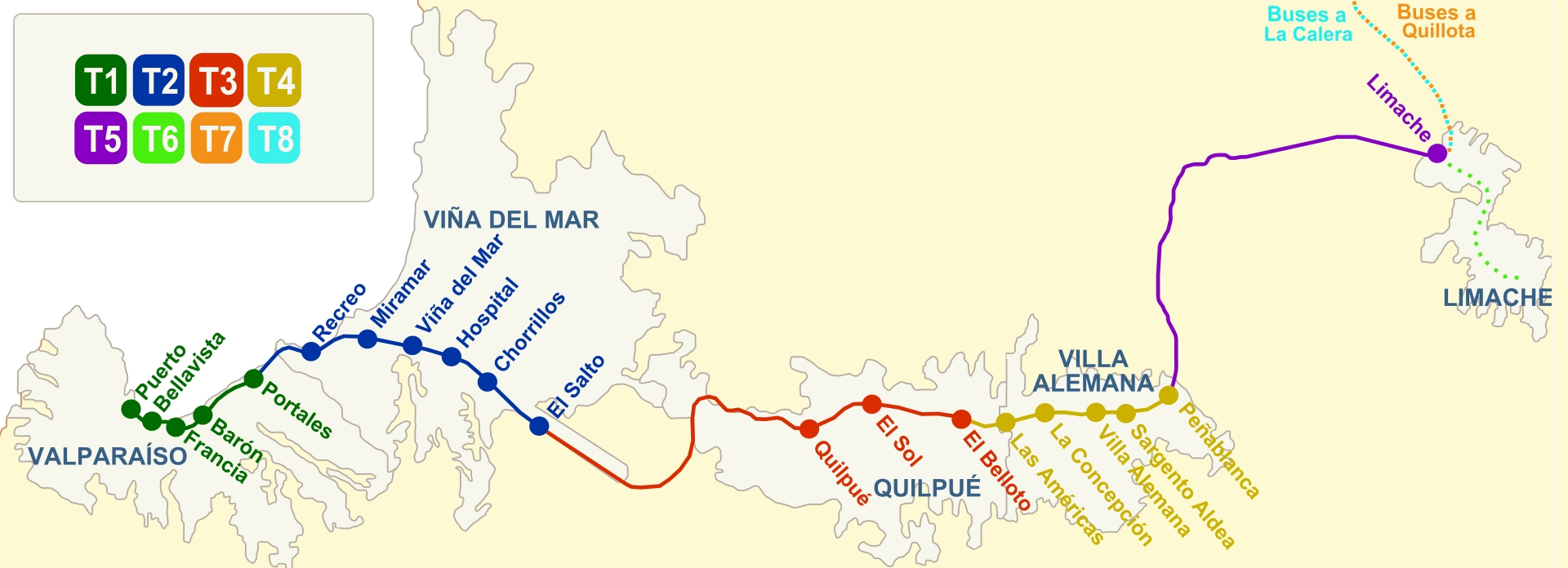
Metro Valparaiso: Stations, Lines, and Zones
Metro Valparaíso runs on one main line, but the route covers a varied path: coastal tracks near Valparaíso, an underground section in Viña del Mar, and inland city transport toward Quilpué, Villa Alemana, and Limache. Between Puerto and Recreo, trains run at street level along the coast. After that, the line enters a tunnel beneath Álvarez and Viana avenues, serving underground stations before emerging again near El Salto.
The current stations list is useful for reading a stations map or planning a trip across the system.
| Station | Details |
|---|---|
| Puerto | Coastal terminal in Valparaíso and a key stop for the port area |
| Bellavista | Serves the central Valparaíso area |
| Francia | Intermediate coastal station |
| Barón | Station on the Valparaíso coastal section |
| Portales | Useful for the Caleta Portales area |
| Recreo | Last part of the coastal approach before the Viña del Mar section |
| Miramar | Station near Viña del Mar coastline access |
| Viña del Mar | Central Viña del Mar station and customer information point |
| Hospital | Underground station in Viña del Mar |
| Chorrillos | Station near the end of the underground section |
| El Salto | Station where the line continues toward inland areas |
| Quilpué | Main stop for Quilpué |
| El Sol | Intermediate inland station |
| El Belloto | Serves the El Belloto area |
| Las Américas | Intermediate station on the inland route |
| La Concepción | Station between Quilpué and Villa Alemana |
| Villa Alemana | Main stop for Villa Alemana |
| Sargento Aldea | End of the busiest high-frequency central section |
| Peñablanca | Station before Limache |
| Limache | Inland terminal and Bus + Metro connection point |
The metro is divided into fare sections, and the cost depends on distance, time of day, and zone traveled. A full ride from Puerto to Limache takes about 55 minutes, so the running time is short enough for daily commuting but long enough that checking the route timetable helps, especially during peak periods.
Several low-use stations were removed in 2001, including Laboral, Valencia, Colegio Alemán, and Rumié. Future route plan studies also refer to new stops beyond Limache, including San Pedro, Quillota Sur, Quillota Centro, La Cruz, Guerra, and La Calera.
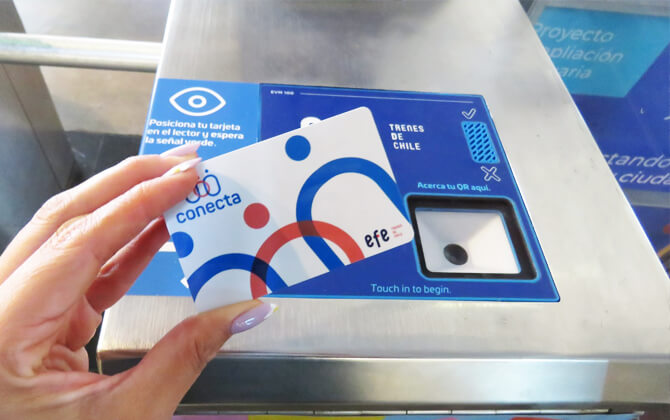
Access requires the Metroval card, because passengers must tap in and tap out. Customer service and information offices are available at Puerto, Viña del Mar, and Limache. The fleet includes 35 Alstom trains: X’Trapolis 100 and X’Trapolis Modular units.
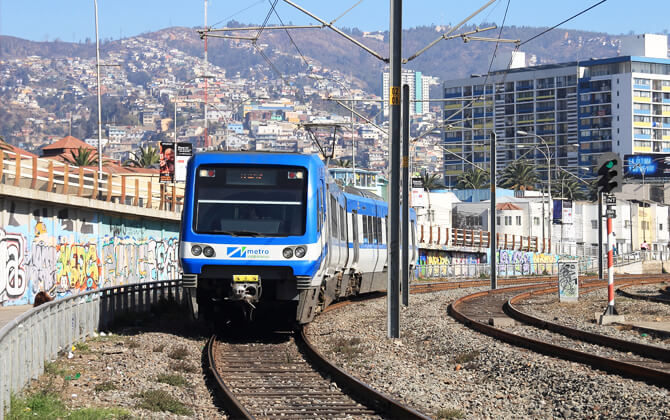
Service Timings and Frequency
Valparaíso Metro does not operate 24 hours a day. Its opening hours, closing time, starting time, and frequency vary by day, so check timings today before making a long cross-city trip.
| Service detail | Timings |
|---|---|
| Weekday operating hours | 06:30 to 22:30 |
| Saturday opening times | 07:30 to 22:30 |
| Sunday and public holiday working hours | 08:00 to 22:15 |
| Busiest section frequency | Every 6 minutes between Puerto and Sargento Aldea during peak hours |
| General weekday frequency | Normally every 12 minutes on other sections |
| Weekend and public holiday frequency | Generally every 12 minutes, with some Sunday and holiday periods extending to about 18 minutes |
| Full route running time | About 55 minutes from Puerto to Limache |
Weekdays use peak, regular, and off-peak time bands, which affect both the train schedule and fare. If you are traveling the full Puerto-Limache route, the timetable matters more than it does for a short central trip. The last train depends on the day and direction, but the published service window shows when the system is due to close.
Fares and Cards
The Valparaíso Metro fare is calculated by distance, time of day, and day of travel. Because the card is scanned at entry and exit, the system works like a fare calculator: your final ticket price depends on where you start, where you leave, and the fare band in effect.
The Metroval card is the only payment method for Metro Valparaíso services. It is a contactless card sold at all stations for CLP$1,350, about US$1.40. Top-ups are made at ticket offices with cash or Redcompra. Loads must be in multiples of CLP$100, about US$0.10. The minimum top-up is CLP$300, about US$0.30, for general users, or CLP$1,000, about US$1.05, when using Redcompra.
The card is also used for bus and metro travel. Concession cards are available for students, senior citizens, disabled passengers, and tourists. The tourist card works as a day pass with unlimited travel on the day of purchase and costs CLP$2,360, about US$2.50. Children under one metre in height travel free.
There are five zones and three time-of-day fare levels. Prices range from CLP$410, about US$0.45, in low-usage hours within Zone 1 to CLP$864, about US$0.90, for rush-hour travel across five zones, such as Valparaíso to Limache. The Bus + Metro service from Limache Station to Limache Viejo, Olmué, Quillota, and La Calera costs between CLP$787 and CLP$1,460, about US$0.85 to US$1.55.
Bicycles are allowed on board during weekends and holidays with a special Metrobici card costing CLP$5,000, about US$5.30. Each car can carry up to four bicycles. Bicycle-friendly stations include Puerto, France, Portales, Miramar, Hospital, El Salto, El Sol, La Concepción, Sargento Aldea, and Limache.
Station parking information, parking charges, and parking charges per day are not specified in the supplied service details.
Connections to Other Systems
The Limache-Puerto service connects with other transport options mainly through Limache Station. From there, Bus + Metro feeder services link passengers with Limache Viejo, Olmué, Quillota, and La Calera, extending transportation in the region beyond the current rail route.
These bus connections are especially important for towns not yet served directly by rail. Studies also examine an inland expansion along the Valparaíso-Santiago Railway to reach Quillota, La Cruz, and La Calera.
Passenger and freight service between Valparaíso and Santiago has also been proposed for the same corridor, which would strengthen regional transport connections. Within Chile’s urban rail landscape, Valparaíso Metro is often compared with Santiago Metro, although its level crossings and wider station spacing make it closer to commuter rail than a conventional metro.
No trams or tramway connection is described in the supplied system information.
Airport Connections
Valparaíso does not have its own commercial airport. The nearest major airport is Arturo Merino Benítez International Airport in Santiago, about 1½ hours away by road under typical travel assumptions.
To travel from Santiago Airport to Valparaíso, take a bus from outside the airport terminal to Pajaritos. From Pajaritos, frequent buses continue to Valparaíso and other destinations. If you start in downtown Santiago, you can reach Pajaritos by metro and then transfer to a Valparaíso bus.
After arriving at the Valparaíso bus terminal, local transport or ride-hailing options such as Uber or Cabify are often used for the port area or Cerro Alegre, because the terminal is not right in the central tourist zone. Once in the metro region, the Valparaíso Metro connects Valparaíso, Viña del Mar, Quilpué, Villa Alemana, and Limache. Buy a Metroval card, add enough credit, then scan it when entering and exiting stations.
During the day, trains usually run about every 12 minutes, with more frequent service on the busiest section. Some stations show the wait time until the next train, which makes the transfer easier to manage.
Interesting Facts
Valparaíso Metro is one of only two underground urban rail systems in Chile mentioned in the supplied material, alongside Santiago Metro, but it is not a full metro in the strict sense. It has level crossings and longer distances between stations, while still including a 5 km (3.1 mile) underground section in Viña del Mar.
The line is 43 km (26.7 miles) long, serves 20 stations, and connects five main urban areas: Valparaíso, Viña del Mar, Quilpué, Villa Alemana, and Limache. In 2019, it carried 20.17 million passengers.
Service began after the older interurban railway on the Santiago-Valparaíso line was rebuilt and modernized. The system is administered by EFE Valparaíso S.A., a subsidiary of Chile’s state-owned railway company.
Passenger service uses 35 trains, including 27 X’Trapolis 100 train sets and 8 X’Trapolis Modular train sets. On weekdays, the regular operating hours are 06:30 to 22:30, and trains can run every 6 minutes between Puerto and Sargento Aldea.
The fare system is based on the Metroval smart card, with ticket cost tied to distance and time band. Children below one metre in height ride free, and concession cards are available for students, senior citizens, disabled passengers, and tourists.
History
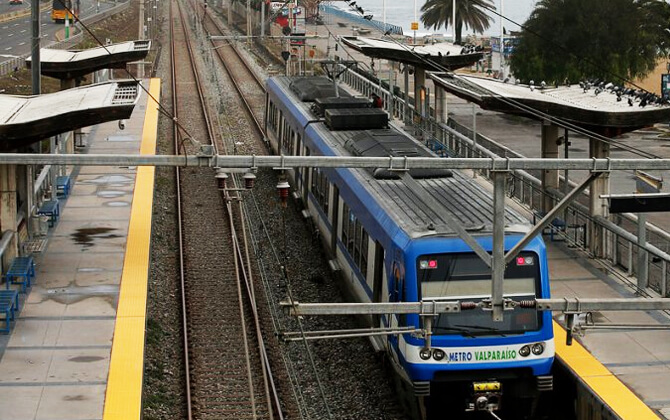
Valparaíso has had interurban passenger rail since the 19th century. Work on the current system began in 1999, when older interurban stations were rebuilt and new stations were added in a matching design. In Viña del Mar, a tunnel of more than 5 km (3.1 miles) was also constructed.
New trains arrived in Chile on February 22, 2005. The old system was decommissioned on June 30, 2005, in favor of the new Limache-Puerto service. The renovated line was inaugurated on November 23, 2005, and passenger service began the following day.
On May 29, 2019, basic engineering studies were awarded to the CDI and Consultrans consortia for an extension toward La Calera. The project was also submitted for environmental impact studies. At one stage, plans referred to construction beginning in 2023 and opening in 2027; later reports indicated construction in 2025 and completion in 2028.
In early September 2020, the design of Valencia station was finalized. By May 2022, the bidding process had begun. Construction started on August 5, 2022, with an estimated duration of 18 months and a budget of CLP$10 billion, about US$10.5 million. The opening was first expected in late 2023 or during 2024, but slower progress while trains continued operating pushed the tentative date to the second half of 2025.
Future Extensions
The main future expansion project is the extension beyond Limache toward Quillota and La Calera. Available studies describe a corridor of about 26 to 27.4 km (16.2 to 17 miles), plus expansion work at Limache station and rehabilitation of La Calera station.
| Station | Details |
|---|---|
| San Pedro | Proposed station beyond Limache |
| Quillota Sur | Proposed station in the Quillota extension corridor |
| Quillota Centro | Proposed central Quillota stop |
| La Cruz | Proposed station between Quillota and La Calera |
| Guerra | Proposed station on the extension route |
| La Calera | Proposed terminal area with rehabilitation of the existing station |
The extension has moved through feasibility and environmental review stages, with different construction schedules mentioned over time. Later reports describe the project as potentially staged, first reaching Quillota, then La Cruz, and finally La Calera.
The project is intended to improve travel times and replace or complement current Bus + Metro feeder services. Planning documents also describe new infrastructure for passenger service and, in some versions, an additional freight track.
Beyond Quillota and La Calera, a separate long-term study looks farther inland from La Calera toward Llay Llay, San Felipe, and Los Andes. Other planning concepts mention possible extensions toward Reñaca, Casablanca, and urban areas within Valparaíso and Viña del Mar, but the supplied information does not describe them as approved projects.
Nearby Attractions
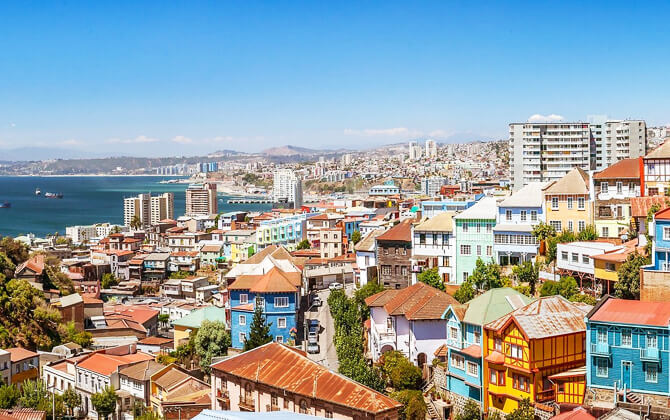
The Metro Valparaíso line is more than a commuter route. It links the historic port, Viña del Mar’s beach areas, and inland towns with a quieter local feel, making it useful for visitors as well as daily passengers.
| Station | Details |
|---|---|
| Puerto | Best for Valparaíso’s port district, waterfront, Cerro Alegre, Cerro Concepción, street art, funiculars, Baburizza Museum, La Sebastiana, and the Museo Marítimo Nacional |
| Bellavista and Francia | Useful for the area between Valparaíso and Viña del Mar, with access toward the beachside center via Puente Casino |
| Miramar | Good for Viña del Mar’s coastline, including Caleta Abarca, Avenida Marina, and the seaside promenade |
| Viña del Mar | Convenient for Plaza Vergara, Quinta Vergara, the Flower Clock, Wulff Castle, Vergara Pier, museums, shopping, nightlife, and restaurants |
| Portales | Useful for Playa Caleta Portales, the fish market, sea lions, and seafood restaurants |
| Quilpué | Connects with inland attractions such as Zoológico de Quilpué, Viña Los Perales, and Granja Alturas del Sol |
| Villa Alemana | Close to heritage landmarks such as Teatro Pompeya, Capilla de Quebrada Escobar, and the Sunday market atmosphere around Plaza de Armas |
| Limache | Gateway to the rural interior, with access to Olmué Valley and La Campana National Park |
For one of the most scenic rides, travel between Puerto and Recreo. On that stretch, the train follows the coast and opens up views of the Pacific.