The Montreal Metro is a rubber-tired underground rapid transit system serving Greater Montreal, Quebec, Canada. Operated by the Société de transport de Montréal (STM), it opened on October 14, 1966. Today, the system has 68 stations on four lines and a total network length of 69.2 kilometres (43.0 miles). It links the center, north, and east of the Island of Montreal, with direct connections to Laval on the Orange Line and Longueuil on the Yellow Line. The metro is fully underground, closely tied to Montreal’s Underground City, and remains a core part of daily public transport and city transport across the region.
| Key | Information |
|---|---|
| System | Montreal Metro (Métro de Montréal) |
| Operator | Société de transport de Montréal (STM) |
| Opening date | October 14, 1966 |
| Lines | 4 |
| Stations | 68 |
| Network length | 69.2 kilometres (43.0 miles) |
| Daily weekday ridership | 977,800 average unlinked passenger trips as of Q4 2025 |
| Annual trips | 311,929,200 in 2025 |
| Coverage | Montreal, Laval, and Longueuil connections |
| Notable feature | Fully underground rubber-tired metro with station-specific architecture |
Montreal Metro Map
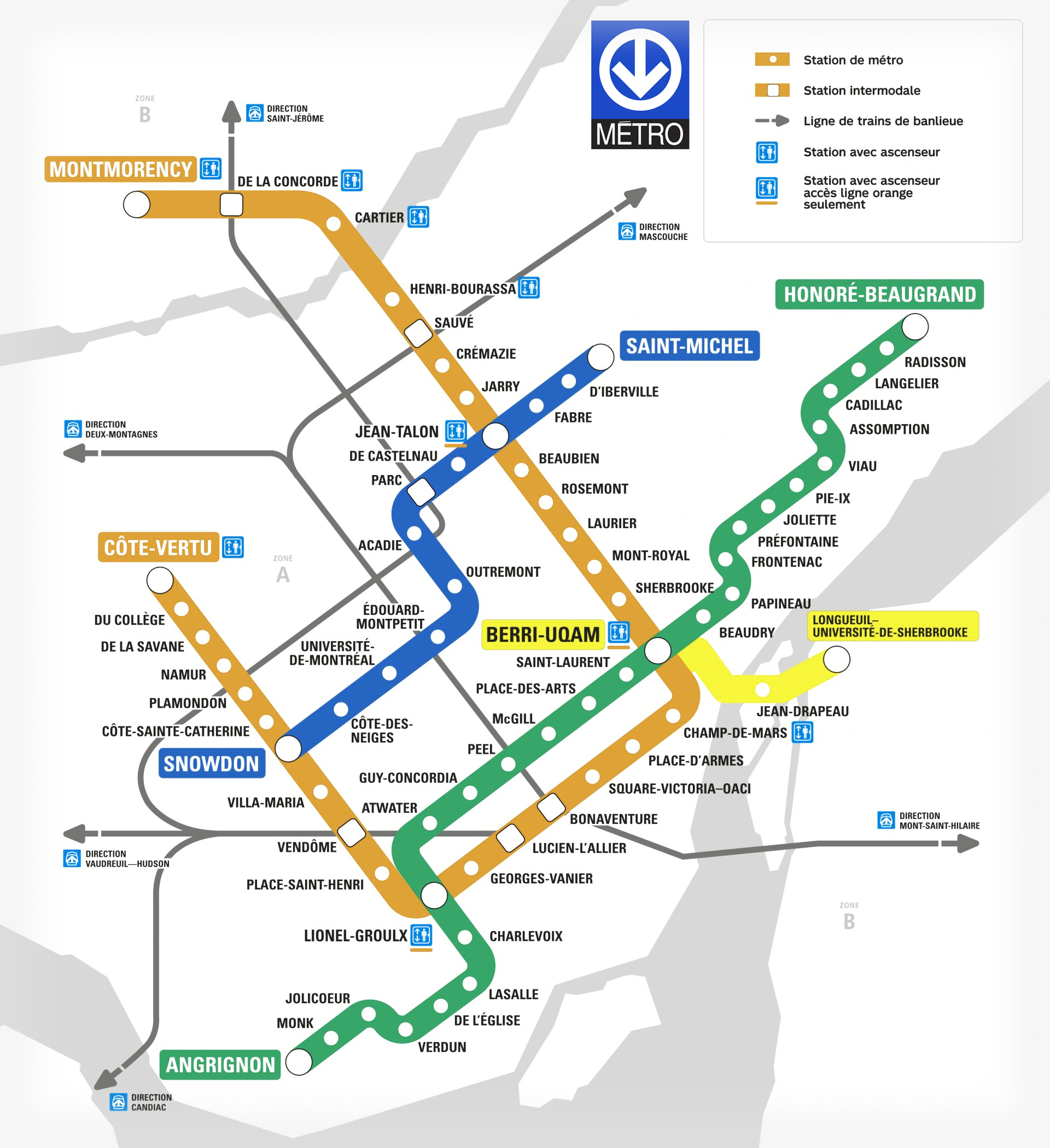
Map of Montreal Metro showing different lines. Click on the map to enlarge it or download the Montreal Metro map in PDF format.
Lines and Stations
The Montreal Metro has four lines: Green, Orange, Yellow, and Blue. Together they serve 68 stations across Greater Montreal. On the stations map and in service updates, line colors are the main way routes are identified.
The Green Line runs from Angrignon to Honoré-Beaugrand and has 27 stations. It is the main east-west route through the city center and includes key downtown stops such as Atwater, Guy–Concordia, Peel, McGill, and Berri–UQAM.
The Orange Line runs from Côte-Vertu to Montmorency and has 31 stations. It is the longest route in the system and connects downtown Montreal with Laval, along with major interchange stations including Berri–UQAM, Lionel-Groulx, and Jean-Talon.
The Yellow Line is the shortest, with 3 stations. It links Berri–UQAM to Longueuil–Université-de-Sherbrooke via Jean-Drapeau and crosses the Saint Lawrence River.
The Blue Line runs from Snowdon to Saint-Michel and has 12 stations. It serves central and northern neighborhoods, including Côte-des-Neiges, Université-de-Montréal, Édouard-Montpetit, Outremont, Parc, and Fabre.
Some stations are especially important for transfers, either between metro lines or to other transport services. Station spacing also varies quite a bit across the network. The average distance between stations is 950 metres (0.95 kilometres, 0.59 miles), with the shortest gap between Peel and McGill and the longest between Berri–UQAM and Jean-Drapeau.
Accessibility has expanded over time. As of April 2026, 31 stations are accessible. All interchange stations between subway lines are accessible, although Berri–UQAM remains only partially accessible.
| Station | Details |
|---|---|
| Green Line | Angrignon to Honoré-Beaugrand, 27 stations, main east-west backbone |
| Orange Line | Côte-Vertu to Montmorency, 31 stations, longest line, connects to Laval |
| Yellow Line | Berri–UQAM to Longueuil–Université-de-Sherbrooke, 3 stations, crosses the river |
| Blue Line | Snowdon to Saint-Michel, 12 stations, serves central and northern districts |
| Berri–UQAM | Major interchange; connects Green, Orange, and Yellow lines |
| Lionel-Groulx | Interchange between Green and Orange lines |
| Snowdon | Interchange between Orange and Blue lines |
| Jean-Talon | Interchange between Orange and Blue lines |
| Vendôme | Important transfer point to other rail services |
| De la Concorde | Transfer point and link toward Laval-area services |
| Sauvé | Transfer point to other transport services |
| Parc | Transfer point to other rail connections |
Service Times and Frequencies
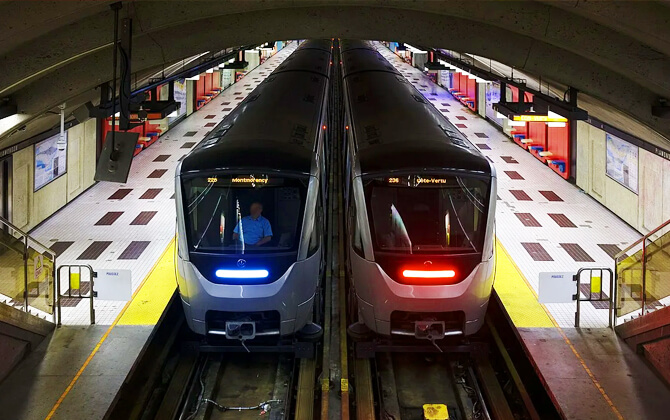
Montreal Metro operating hours start at 05:30 every day. For riders checking opening hours, opening times, or starting time, service begins at the same time across the network.
The last train and closing time vary by day. On weekdays and Sunday, last trains start their run between 00:30 and 01:00. On Saturday, they start between 01:00 and 01:30. So if you need timings today or schedule today, late-night service depends on the day and the line.
Frequency changes by line and time of day. During rush hour, Orange and Green Line trains can run every 2 to 4 minutes. Late at night, trains generally come every 12 minutes. That makes the route timetable fairly easy to follow, especially on the core lines.
The Blue Line had more limited working hours when it first opened, with weekday operation from 5:30 am to 7:30 pm and shorter three-car trains. Evening service was later extended to 11:10 pm and then to 0:15 am in 2002.
STM metro and bus transfers are free within 120 minutes after first validation, which helps when planning a route with local transport connections.
| Service detail | Timings |
|---|---|
| Daily starting time | 05:30 |
| Last train on weekdays and Sunday | 00:30 to 01:00 |
| Last train on Saturday | 01:00 to 01:30 |
| Green Line frequency | Rush hour: 3 to 4 minutes; off-peak: 4 to 10 minutes; weekend: 6 to 12 minutes |
| Orange Line frequency | Rush hour: 2 to 4 minutes; off-peak: 4 to 10 minutes; weekend: 6 to 12 minutes |
| Yellow Line frequency | Rush hour: 3 to 5 minutes; off-peak: 5 to 10 minutes; weekend: 5 to 10 minutes |
| Blue Line frequency | Rush hour: 3 to 5 minutes; off-peak: 5 to 10 minutes; weekend: 8 to 11 minutes |
| Late-night service | Generally every 12 minutes |
| Transfer window | 120 minutes after first validation |
Ticket Prices, Records, and Passes
The Montreal Metro uses a regional fare system, so the fare, ticket price, and pass cost depend on the travel zone and the product you choose. The fares below reflect prices from July 1, 2024, with an update noted for January 1, 2025.
For Zone A, the regular price is CA$3.75 (US$2.70) for a 1-trip ticket, CA$7.00 (US$5.04) for a 2-trip ticket, and CA$33.25 (US$23.94) for a 10-trip ticket. Short-term passes include a 24-hour ticket at CA$11.00 (US$7.92), a 3-day pass at CA$21.25 (US$15.30), a weekly pass at CA$31.00 (US$22.32), a monthly pass at CA$100.00 (US$72.00), and a 4-month pass at CA$233.00 (US$167.76).
For travel between Zones A and B, fares are CA$4.75 (US$3.42) for 1 trip, CA$9.50 (US$6.84) for 2 trips, and CA$45.25 (US$32.58) for 10 trips. The monthly pass costs CA$160.00 (US$115.20).
For travel in and between Zones A, B, and C, the fare is CA$7.00 (US$5.04) for 1 trip, CA$13.50 (US$9.72) for 2 trips, and CA$59.00 (US$42.48) for 10 trips. The 24-hour pass costs CA$17.25 (US$12.42), the 3-day pass CA$40.50 (US$29.16), and the monthly pass CA$196.00 (US$141.12).
For travel in and between Zones A, B, C, and D, prices are CA$9.50 (US$6.84) for 1 trip, CA$18.50 (US$13.32) for 2 trips, and CA$81.50 (US$58.68) for 10 trips. The 24-hour pass costs CA$22.25 (US$16.02), the 3-day pass CA$55.50 (US$39.96), and the monthly pass CA$271.00 (US$195.12).
Unlimited passes are also available. The Unlimited Evening pass costs CA$6.25 (US$4.50) and is valid from 6 p.m. to 5 a.m. The Unlimited Weekend pass costs CA$15.75 (US$11.34) and is valid from Friday 4 p.m. to Monday 5 a.m.
Cash payment is accepted on the bus, with exact change required. The cash fare is CA$3.75 (US$2.70) for travel in or between Zones A and B, between Zones A and C, and in or between Zones B, C, and D. Travel between Zones A and D costs CA$9.50 (US$6.84). On route 747 to Montréal–Trudeau Airport, the cash fare is CA$11.00 (US$7.92).
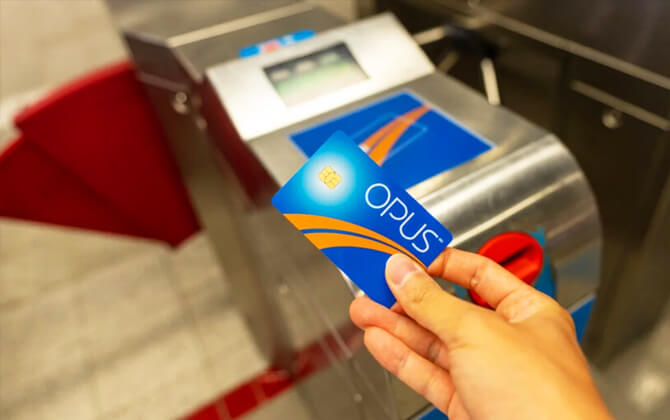
Reduced fares are available for eligible riders, including children, students, and seniors. In many cases, a photo OPUS card is required. A standard OPUS card costs CA$6.00 (US$4.32).
- Total planned network: 69.2 kilometres (43.0 miles)
- Operational network: 69.2 kilometres (43.0 miles)
- Operational stations: 68
- Operations began: October 14, 1966
Connections
The Montreal Metro connects to Longueuil on the Yellow Line and to Laval on the Orange Line. It also links with commuter rail at six interchange stations: Bonaventure, Lucien-L’Allier, Vendôme, De la Concorde, Sauvé, and Parc.
There are four metro interchanges between lines, and all of them are accessible, though Berri–UQAM is only accessible for the Orange and Green lines at present.
The system is also complemented by the REM, an independent rail network that opened in phases starting in August 2023. A branch between Deux-Montagnes and Gare Centrale opened in November 2025, creating new interchanges at McGill and Édouard-Montpetit.
Connections Between Lines
The main interchanges are concentrated in the central part of the system, where riders can change lines quickly and continue along a different route.
| Station | Details |
|---|---|
| Berri–UQAM | Connects the Green, Orange, and Yellow lines |
| Lionel-Groulx | Connects the Green and Orange lines |
| Snowdon | Connects the Orange and Blue lines |
| Jean-Talon | Connects the Orange and Blue lines |
Beyond the metro itself, the Orange Line continues to Laval and the Yellow Line to Longueuil. The Metro also connects with commuter rail and with the REM at stations such as McGill and Édouard-Montpetit.
Connections with Other Systems
The Montreal Metro is closely integrated with the wider public transport network in Greater Montreal. It connects with STL in Laval, RTL in Longueuil, Exo commuter rail, metropolitan bus services, and the REM.
Fare integration is handled through the ARTM system. Metro, Exo, and REM fares are coordinated within the same zoned structure, and transfers inside the STM network are free within 120 minutes after first validation. The OPUS contactless card can be used across multiple transport networks, including commuter rail tickets and Montreal-only passes.
The six main Exo interchange stations are Bonaventure, Lucien-L’Allier, Vendôme, De la Concorde, Sauvé, and Parc. The REM also connects directly with the metro at McGill and Édouard-Montpetit, while Central Station links the system to other rail services downtown.
The metro also sits within a broader transportation in Montreal network through nearby access to Via Rail and Amtrak at Central Station, plus bus links such as the 747 airport route.
Airport Connection
The REM is planned to provide a fast and direct airport connection regardless of traffic. From downtown, travel time is expected to be about 20 minutes.
The airport will connect to the STM network through three main metro lines: the Orange Line at Bonaventure, the Green Line at McGill, and the Blue Line at Édouard-Montpetit. This route plan is intended to make airport access more reliable and frequent.
All stations on the REM network will be equipped with elevators, which should make travel easier for passengers with luggage.
Aéroport de Montréal began work on the station in 2022, and construction is set to continue until 2026. The Alice tunnel boring machine completed drilling the tunnel linking the technopark to the airport. Once station construction is complete, systems integration and testing will begin, with commissioning of this REM segment planned for 2027.
| Station | Details |
|---|---|
| Brossard | 41 minutes to the airport |
| Du Quartier | 38 minutes |
| Panama | 35 minutes |
| Île-des-Soeurs | 31 minutes |
| Griffintown – Bernard-Landry | 27 minutes |
| Central Station | 25 minutes |
| McGill | 24 minutes |
| Édouard-Montpetit | 21 minutes |
| Canora | 18 minutes |
| Ville-de-Mont-Royal | 17 minutes |
| Côte-de-Liesse | 15 minutes |
| Montpellier | 13 minutes |
| Du Ruisseau | 11 minutes |
| Bois-Franc | 9 minutes |
| Marie-Curie | 2 minutes |
| Sunnybrooke | Approximately 24 minutes |
| Pierrefonds-Roxboro | Approximately 26 minutes |
| Des Sources | Approximately 26 minutes |
| Fairview-Pointe-Claire | Approximately 30 minutes |
| Kirkland | Approximately 33 minutes |
| Anse-à-l’Orme | Approximately 36 minutes |
| Île-Bigras | Approximately 29 minutes |
| Sainte-Dorothée | Approximately 31 minutes |
| Grand-Moulin | Approximately 34 minutes |
| Deux-Montagnes | Approximately 36 minutes |
If you are traveling from the West Island or the North Shore, you will need to transfer at Bois-Franc to reach the airport. The travel times listed above include a conservative 10-minute connection time.
Rules, Tips, and Notices
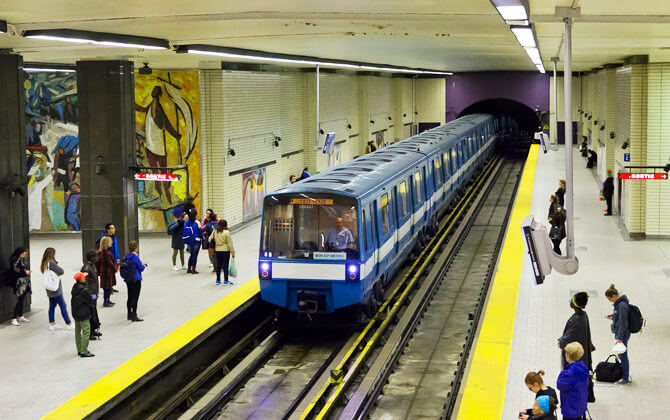
The Montreal Metro is designed to be safe and comfortable for everyone. Basic rules are simple: do not vandalize property, put trash in bins, keep your feet off the seats, and do not lie down on them. Avoid blocking passengers or holding train doors, since that can disrupt the whole system.
For safety, do not bring dangerous items into the metro and do not interfere with equipment unless you are trained to use it. Keep noise down, use headphones, and respect other riders. Never place any part of your body in the path of a train. The metro is for travel, not for riding bikes, roller skates, or skateboards.
Some items are allowed only under certain conditions. Sporting goods such as skis, sleds, and bicycles are permitted outside rush hour. Guide dogs assisting disabled riders are allowed, and pets carried in a cage are also permitted. Other animals are prohibited.
Fare payment is mandatory. Keep your ticket, card, or other fare medium with you as proof of payment during the whole trip, because inspectors may check it at any time.
Safety and Incident Reporting
Stand behind the yellow line and keep an eye on your belongings. Bags should stay closed and close to you, and valuables are best kept out of sight. Never go onto the tracks. If someone falls onto the tracks, use the emergency station on the platform and pull the red handle to cut power before following the instructions on the red phone.
For non-emergency incidents in the metro, riders can text the location and details to 1-888-786-1119. For emergencies, use 911, the intercom, or the assistance phone. Emergency phones are available on every platform and are marked by blue lighting. On board a train, use the intercom near the doors to contact the operator. Automated external defibrillators are available in all stations.
Use the emergency brake only in a real emergency. If possible, pull it when the train is stopped at a station with the doors open. If it is used while the train is moving, the train will generally stop in the station or at the next one so the operator can assess the situation.
Helpful Travel Notes
- Travel support teams are present across the network.
- Some stations are still not wheelchair accessible, so check before you travel if needed.
- Metro entrances are marked with the metro symbol, line color, and station name.
- Wireless reception is available throughout the system.
Interesting Facts
The Montreal Metro opened on October 14, 1966, under Mayor Jean Drapeau. It started with 22 stations on two lines and has grown to 68 stations on four lines over 69.2 kilometres (43.0 miles).
It was the first subway in North America to run on rubber tires instead of metal wheels. That remains one of the system’s most distinctive features.
The network reaches beyond the island through the Yellow Line to Longueuil and the Orange Line to Laval.
In 2025, the metro completed 311,929,200 trips and averaged 977,800 weekday unlinked passenger trips, making it Canada’s second busiest rapid transit system and North America’s fourth busiest.
The first network opened in stages between October 1966 and April 1967, and the Yellow Line was completed in time for Expo 67. Montreal became the seventh city in North America to operate a subway.
The Blue Line uses its number because the planned Red Line was never built. That canceled line would have used a railway corridor later renovated for commuter rail.
Construction of the first two lines involved more than 5,000 workers, and 12 workers lost their lives during the project.
Montreal Metro stations are well known for architecture and artwork. Each station was designed with its own identity, which gives the system a distinctive look and a strong cultural character.
Accessibility was added gradually. The first accessible stations were the three Laval stations opened in 2007, and more than 30 stations now have elevators.
The metro is also integrated with other regional transport systems, including Exo and the REM.
History
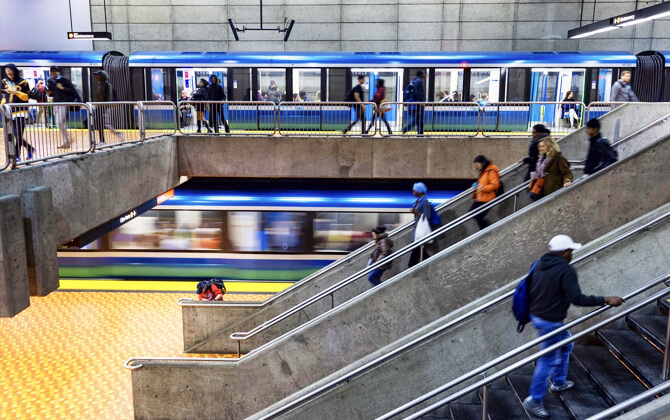
Urban transport in Montreal began in 1861 with horse-drawn cars on Craig and Notre-Dame streets. As the city grew, a large tramway network spread across Montreal. Over time, congestion made streetcar service less reliable and pushed officials to consider an underground system.
Fifty years of projects
In 1902, the federal government created the Montreal Subway Company to promote the subway idea in Canada. From 1910 onward, many plans were proposed, but none moved forward. Railway companies resisted some tunnel projects, and negotiations repeatedly failed.
The Montreal Tramways Company received provincial approval in 1913, but the city would not fund construction. World War I, the postwar recession, and the Great Depression all delayed the project. Another plan proposed by Mayor Camillien Houde in 1939 also went nowhere.
Interest returned during World War II. In 1944, the Montreal Tramways Company proposed a two-line network. In 1951, the Montreal Transportation Commission took over the tramway company, replaced trams with buses, and revived the subway idea, but councillors stayed cautious. In 1959, a private company offered to build a rubber-tired metro, and the commission rejected it.
The breakthrough came after Jean Drapeau returned as mayor and Lucien Saulnier took office. In the early 1960s, Montreal was benefiting from economic growth and the Quiet Revolution. On November 3, 1961, city council approved CA$132 million to build and equip an initial 16-kilometre (9.9-mile) network.
Construction
The 1961 plan reused earlier studies and called for three lines through rock beneath downtown. Chief engineer Lucien L’Allier worked with French consultant SOFRETU, whose influence can still be seen in station design and rolling stock. Rubber tires were chosen because they allowed steeper grades and faster acceleration, and 80 percent of the tunnels were built through rock rather than by cut-and-cover.
The first two lines were the Green and Orange lines. Construction began on May 23, 1962. In 1963, lower-than-expected tunnel costs allowed the Orange Line to be extended at both ends. More than 5,000 workers were employed at peak construction, and 12 workers died during the project. Service opened gradually from October 1966 to April 1967.
A third line, later known as the Red Line, was planned to use CN tracks under Mount Royal, but negotiations stalled. When Montreal was selected to host Expo 67 in 1962, the city chose instead to build the Yellow Line to the South Shore. The Red Line was never built, and its number was never used.
The Yellow Line crossed under the river from Berri-de-Montigny to Longueuil, with an extra stop for Expo 67. Saint Helen’s Island was enlarged with backfill from metro excavation, and Notre Dame Island was created from the same material. The Yellow Line opened on April 1, 1967, and the first metro network was completed with its public opening on April 28, 1967.
Extensions and unbuilt lines
In 1970, the Montreal Urban Community took responsibility for metro extensions. After Montreal won the 1976 Summer Olympics, funding was approved for Green and Orange line extensions and for the new Blue Line. Work began on October 14, 1971.
The Green Line reached the Olympic Stadium area and Honoré-Beaugrand, while the Orange Line was also extended. The first extension was completed in June 1976, and the Green Line later reached Angrignon in 1978.
Rising costs led the Quebec government to impose a moratorium on expansion in 1976. Some projects were frozen, including parts of the Orange Line and the Blue Line. The moratorium was partially lifted in 1977, and the Orange Line was extended westward in stages until it reached Côte-Vertu in 1986. The Blue Line opened in sections between 1986 and 1988, crossing the Orange Line at Jean-Talon and Snowdon.
In the late 1980s, more lines were proposed, including the White Line and several surface routes, but those plans were later rejected or replaced by commuter rail projects. In the early 1990s, recession and falling ridership pushed the government to withdraw operating subsidies, and new extensions were put on hold.
Creation of AMT, RTM, ARTM, and improvements
In 1996, Quebec created the Agence métropolitaine de transport to coordinate transportation in Greater Montreal, including metro development and commuter trains. On June 1, 2017, AMT was replaced by the Autorité régionale de transport métropolitain and the Réseau de transport métropolitain, now known as exo.
The Orange Line extension to Laval was announced in 1998, launched on March 18, 2002, and opened on April 28, 2007. It added 5.2 kilometres (3.2 miles) and three stations: Cartier, De la Concorde, and Montmorency.
Since 2004, most STM investment has focused on rolling stock replacement and infrastructure renewal. New MPM-10 trains have replaced older MR-63 cars, tunnels and stations have been rehabilitated, surface electrical and ventilation structures were rebuilt in 2016, and full cellular coverage was completed in 2020. Accessibility has also improved, with elevators added to more than 30 stations since 2007.
In August 2023, the first phase of the REM opened between Gare Centrale and Brossard, linking with the Metro. In November 2025, the second phase opened between Deux-Montagnes and Gare Centrale, adding interchanges at McGill and Édouard-Montpetit, with an Exo interchange at Côte-de-Liesse opening in January 2026.
Accessibility
The Montreal Metro adopted accessibility later than many other systems. The first accessible stations were the three Laval stations that opened in 2007 as part of the Orange Line extension. Four existing stations, Lionel-Groulx, Berri–UQAM, Henri-Bourassa, and Côte-Vertu, were made accessible between 2009 and 2010.
Future Expansions
The clearest metro expansion project is the eastern extension of the Blue Line to Anjou. After decades of proposals and studies, construction is now underway, and the extension is scheduled to open in 2031.
The project will add five new accessible stations, about 6 kilometres (3.7 miles) of tunnel, two bus terminals, an underground pedestrian tunnel linked to the Pie-IX BRT, and a pedestrian walkway under Autoroute 25 in Anjou. It also includes operational facilities such as auxiliary structures, a power station, a service center, a métro garage, and rectifier stations.
The project has evolved as funding and design plans changed. In 2024, contracts were awarded for tunnel and signaling work, and STM confirmed the extension would use communications-based train control. A tunnel boring machine arrived in 2025, with digging expected to begin in 2026.
For the Blue Line, this future route is intended to improve mobility in the east end and support redevelopment in surrounding neighborhoods. It is also tied to broader accessibility and infrastructure upgrades across the network.
A western extension from Snowdon was part of the original concept for the Blue Line, but no such project is currently underway.
Sightseeing with the Montreal Metro
Exploring Montreal by public transport is one of the easiest ways to get around the city. The metro and bus network connects downtown with major visitor areas, and the wider STM system includes 68 metro stations and 220 bus lines, so it is easy to mix sightseeing with efficient local transport.
The metro is also useful for visitors arriving at Montréal–Trudeau Airport. The 747 bus runs 24 hours a day, seven days a week, with service to downtown and Lionel-Groulx station. Fare machines and the 747 information booth are on the airport’s international arrivals level.
Families get a helpful bonus: up to five children aged 11 and under can travel free when accompanied by a person aged 14 or older.
Main tourist destinations
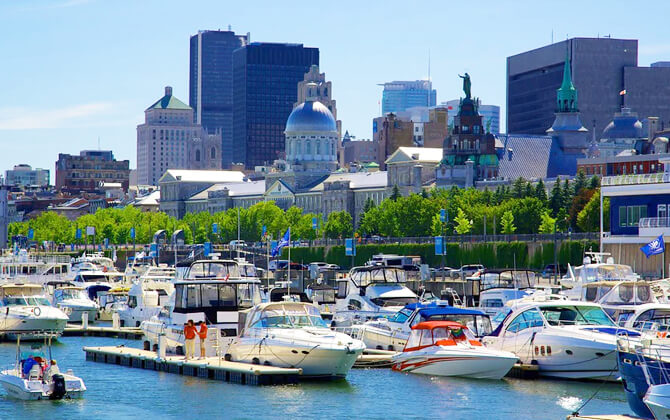
The bus and metro remain the easiest way to reach many of Montreal’s main landmarks. If you are planning a day out, combining metro stations with bus routes usually works best.
| Station | Details |
|---|---|
| Old Port of Montreal | Champ-de-Mars, bus 715 |
| Quartier des spectacles | Place-des-Arts, Saint-Laurent, Berri-UQAM |
| Casino de Montréal | Jean-Drapeau, bus 777 |
| Espace pour la vie – Biodôme | Viau |
| Espace pour la vie – Insectarium | Viau |
| Espace pour la vie – Botanical Garden | Pie-IX |
| Espace pour la vie – Planétarium | Viau |
| Place des Festivals | Place-des-Arts |
| Jean-Doré Beach | Jean-Drapeau, bus 767 |
| Saint-Joseph Oratory | Snowdon, Côte-des-Neiges, bus 51 or 711 |
| Jean-Talon Market | Jean-Talon |
| Vieux-Montréal | Place-d’Armes, Champ-de-Mars, bus 715 |
| Parc olympique de Montréal | Pie-IX, Viau |
| Parc Jean-Drapeau | Jean-Drapeau |
| Parc du Mont-Royal | Mont-Royal, Snowdon, bus 11 or 711 |
| Musée des beaux-arts de Montréal | Guy-Concordia |
| Musée d’art contemporain | Place-des-Arts |
| Musée McCord | McGill |
| La Ronde | Jean-Drapeau, bus 767 or 769 |
| Quartier chinois | Saint-Laurent, Place-d’Armes, bus 55 |
Whether you are heading to a museum, a market, a park, or Old Montreal, the Montreal Metro makes getting around without a car pretty straightforward.