Fortaleza Metro, widely known as Metrofor, is the metropolitan rail system serving Fortaleza and nearby parts of Ceará, Brazil. It combines one metro line with light rail services and plays a major role in public transport and local transport across the region. Operations began on June 15, 2012, and the system is run by Companhia Cearense de Transportes Metropolitanos, a state-controlled company founded on May 2, 1997. Metrofor connects Fortaleza with nearby municipalities and transport hubs, including important bus terminals and, since 2026, the airport branch.
| Key | Information |
|---|---|
| System name | Fortaleza Metro (Metrofor) |
| Operator | Companhia Cearense de Transportes Metropolitanos |
| Founded | May 2, 1997 |
| Operations started | June 15, 2012 |
| Network in 2026 | 59.3 km / 36.8 miles and 41 stations |
| Services | One metro line and diesel light rail vehicle lines |
| Main role | Public transport in Fortaleza and the wider metropolitan region |
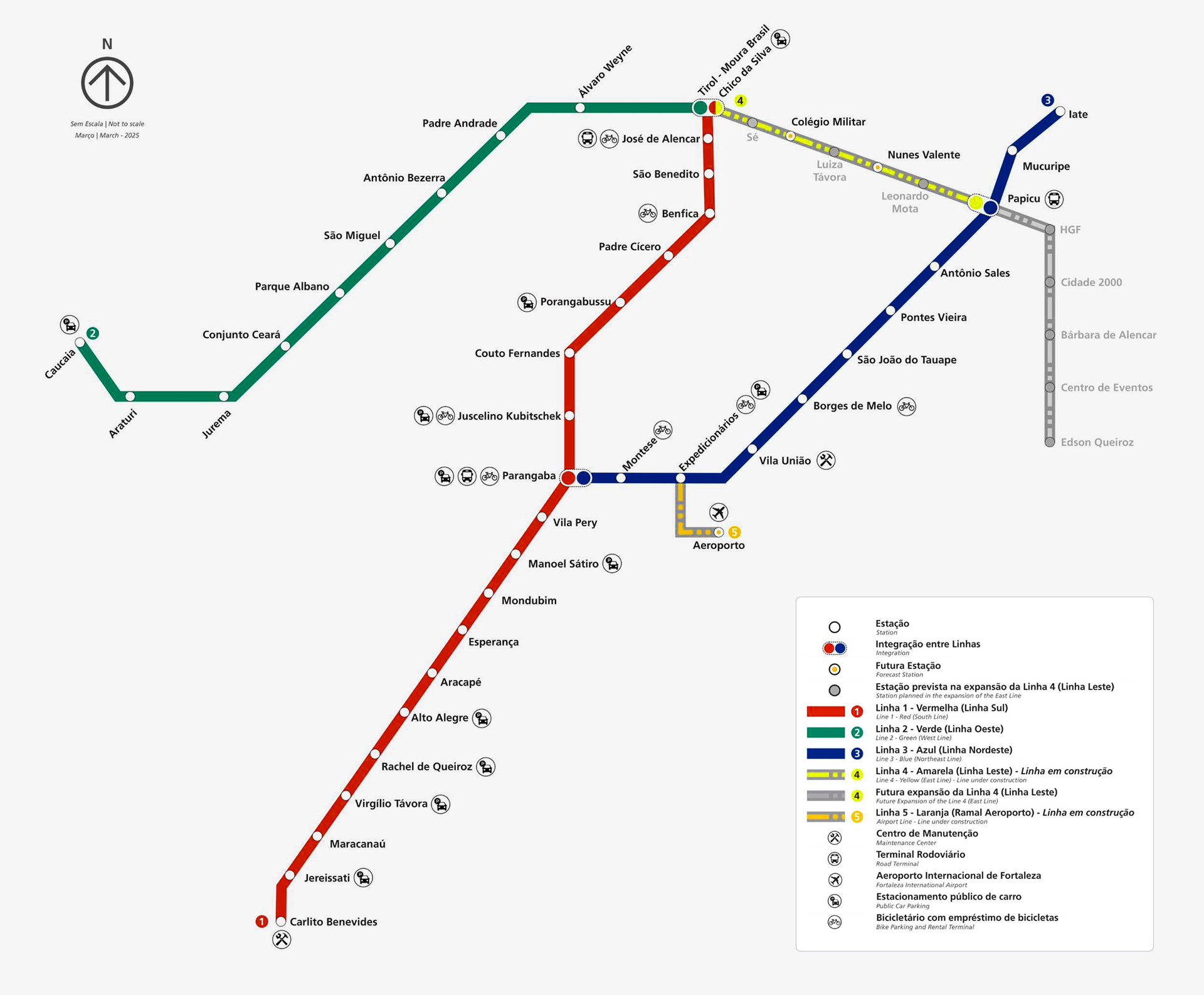
Fortaleza Metro Map
Map of Fortaleza Metro showing different lines. Click on the map to enlarge it or download the Fortaleza Metro map in PDF format.
Lines and Stations
The Fortaleza Metro system includes a core metro route and several light rail services across Fortaleza and nearby municipalities. The main metro route is Line 1 – Red, running between Central – Chico da Silva and Carlito Benevides. Other lines extend service toward Caucaia, Parangaba, Iate, Expedicionários, and Fortaleza–Pinto Martins International Airport.
The broader route plan also includes future projects. Line 4 – Yellow is expected to connect Central – Chico da Silva and Papicu, while the East Line is listed as an under-construction project with a planned route from Central – Chico da Silva to Fórum Clóvis Beviláqua.
Metro line details
| Station | Details |
|---|---|
| 1 – Red (South / Sul) | Central – Chico da Silva ↔ Carlito Benevides; opened 2012; 24.1 km / 15.0 miles; 20 stations; opened and operating with higher frequency |
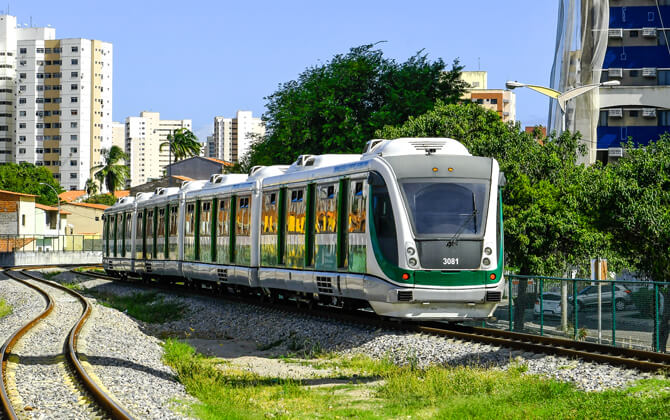
| 2 – Green (West / Oeste) | Caucaia ↔ Central – Chico da Silva; opened 2014; 19.5 km / 12.1 miles; 10 stations; operational as a commuter rail line with lower frequency |
| 3 – Green / Northeast | Parangaba ↔ Iate; opened 2017; 13.2 km / 8.2 miles; 10 stations; in operation |
| 5 – Orange | Expedicionários ↔ Aeroporto; opened 2026; 2.4 km / 1.5 miles; 2 stations; in operation |
| East (Leste) | Central – Chico da Silva ↔ Fórum Clóvis Beviláqua; opening date TBD; 12 km / 7.5 miles; 13 stations; under construction |
The South Line is the main metro-standard corridor. Its stations include Carlito Benevides, Jereissati, Maracanaú, Virgílio Távora, Rachel de Queiroz, Parangaba, Benfica, São Benedito, José de Alencar, and Estação Central – Chico da Silva. The West Line links Caucaia with Central – Chico da Silva, while the Parangaba–Mucuripe tramway route serves stations between Parangaba and Iate.
The airport branch on Line 5 – Orange opened on February 9, 2026, starting from Expedicionários station. A second Orange section toward Castelão is planned for a later phase. Across the wider Ceará rail network described in the source material, figures vary by project stage, but one cited total is 62 stations across 84.3 km / 52.4 miles.
Operating Hours
| Service detail | Timings |
|---|---|
| Operating hours / opening times | Not specified in the source material |
| Working hours by line | Not specified |
| Starting time | Not specified |
| Closing time | Not specified |
| Last train | Not specified |
| Frequency | Higher on Line 1 – Red; lower on Line 2 – Green |
| Schedule today / timings today | Check locally before travel |
Prices, tickets and discounts
Metrofor is a low-cost transport option for getting around Fortaleza and nearby areas. The standard single ticket price is R$ 3.60 (about US$ 0.72), valid for one trip.
| Ticket type | Price | Discount / notes |
| Single Ticket (Bilhete Unitário) | R$ 3.60 (about US$ 0.72) | Valid for one trip |
| Student Ticket (Bilhete Estudantil) | R$ 1.80 (about US$ 0.36) | 50% discount with valid student ID |
| Senior citizens and people with disabilities | Free | Identification required |
Tickets are sold at station ticket counters and ticket machines. Frequent riders can use prepaid Vale-Transporte cards, which can be recharged at metro stations or authorized retailers.
- South Line fare: R$ 3.60 (about US$ 0.72) full fare, R$ 1.80 (about US$ 0.36) half fare.
- West Line fare: R$ 1.00 (about US$ 0.20) full fare, R$ 0.50 (about US$ 0.10) half fare.
- Northeast Line (VLT Parangaba-Mucuripe): free boarding during assisted operation.
- VLT services in Sobral and Cariri: R$ 1.00 (about US$ 0.20) full fare and R$ 0.50 (about US$ 0.10) half fare.
For daily travel, the system keeps fare and ticket cost relatively accessible for regular passengers, students, and eligible groups.
Payment Methods
Payment methods vary by line and station. Metrofor has started testing Pix at some stations, though the service is still being evaluated and full operating details have not yet been released.
At the moment, Pix is available at Estação Raquel de Queiroz in Maracanaú and at Parangaba, Carlito Benevides, Chico da Silva, and Virgílio Távora stations in Fortaleza.
On Line Sul and the VLT de Sobral, fare payment uses electronic cards. Passengers can use the Cartão MÚLTIPLO for full fares and stored credit, the Cartão UNITÁRIO for a single trip, and the Cartão do ESTUDANTE for half-fare travel, with registration required.
On other lines, the rules are different. On Line Oeste and the VLT do Cariri, tickets are bought at the ticket office and boarding is immediate. On Linha Nordeste, boarding is free during assisted operation.
Tickets and cards are available at station ticket counters. On Line Sul, rechargeable card options are also offered for passengers loading credit in advance or buying multiple trips.
Connections to Other Systems
The Fortaleza Metro is integrated with the Integrated Transport System of Fortaleza (SIT-FOR), allowing fare integration with the city bus network. That makes it easier to combine metro and bus travel as part of city transport and transportation in Fortaleza.
The system was designed to connect with two of Fortaleza’s seven bus terminals: Parangaba and Papicu. These are key transfer points for everyday public transport trips.
Beyond bus links, future extensions are planned to improve access to Mucuripe Port’s passenger terminal and Fortaleza International Airport. Metrofor also operates within a broader rail system in Ceará, including services in Sobral and Cariri.
Airport Connections
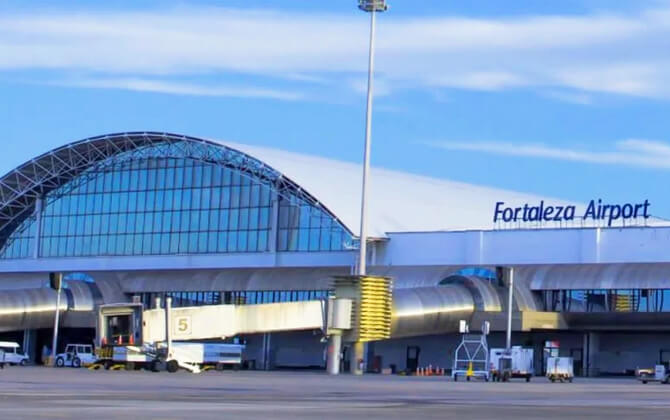
Fortaleza Airport (FOR) is linked to the city by metro, bus, taxi, shuttle, and even walking. The cheapest option listed is bus line 405 at R$ 4.00 (about US$ 0.80), with a running time of about 39 minutes. The fastest option is a taxi, which takes around 14 minutes and costs R$ 45.00–55.00 (about US$ 9.00–11.00).
For public transport, one suggested route is to take the metro from José de Alencar to Parangaba on Linha Sul, then continue by bus. This route timetable is listed at about 37 minutes. Another direct bus service runs hourly from Praça Terminal José De Alencar, S/N to Avenida Bernardo Manoel, 7154, with a typical running time of around 32 minutes.
From the airport back to the city, line 405 is again the cheapest choice, while taxis are the fastest. The airport is about 11 km / 6.8 miles from Fortaleza Station and about 9 km / 5.6 miles from Praça do Ferreira in the city center.
According to the available information, ETUFOR operates the bus services. Parangaba is the nearest metro and tram station to the airport, at about 4 km / 2.5 miles away.
Other transport options include a private shuttle and walking. The shuttle is listed at R$ 60.00 (about US$ 12.00), while walking takes well over an hour.
- Cheapest option: line 405 bus
- Fastest option: taxi
- Direct bus service: available hourly
- Nearest metro/tram station from the airport: Parangaba
Timetable, schedule, and timings may vary, so it is smart to check the train schedule or bus schedule today before you travel.
Tips and Rules
Fortaleza Metro and its VLT services are used by many people every day. A few simple rules help keep the system safe, orderly, and comfortable.
- Keep trains and stations clean. Use bins at stations or hold onto your trash until you can dispose of it properly.
- Do not rush to board. If you miss a train, wait for the next one.
- Check the direction of travel before boarding. Look at station maps and ask staff if needed.
- Stay behind the yellow line on platforms.
- Stand to the right of the doors, let people exit first, and do not block the doors from closing.
- Give priority seats to elderly passengers, pregnant women, people with children, and passengers with disabilities.
- Use elevators properly. They are reserved for passengers with disabilities, reduced mobility, older adults, pregnant women, and people in fragile condition.
- Use headphones for music, games, and videos.
- At fare gates, follow the light signals and do not force the turnstile.
- Keep your transit card in good condition.
- Watch your belongings and ask staff for help if something is lost.
- Dangerous, disruptive, or bulky items are not allowed onboard, including fuels, explosives, corrosive or toxic materials, sharp objects, large electronics, bikes outside permitted hours, surfboards, hand carts, grain bags, mattresses, gas cylinders, and drums.
- Smoking, drinking alcohol, drug use, handing out flyers, posting signs, public political or religious speeches, misuse of emergency equipment, damaging property, eating inside train cars, putting feet on seats, lying on seats or floors, and disturbing other passengers are prohibited.
- Maximum change at ticket offices is R$ 20.00 (about US$ 4.00). Children should be supervised, and standing passengers should hold support bars.
- For help, speak to station or onboard staff. For complaints or detailed requests, contact the Ombudsman by phone at 155.
Some groups are entitled to free travel with valid identification, including seniors aged 65 and over, people with disabilities, police officers, firefighters, court officers, labor inspectors, postal workers on duty, people living with HIV, and other eligible groups listed by the operator.
History
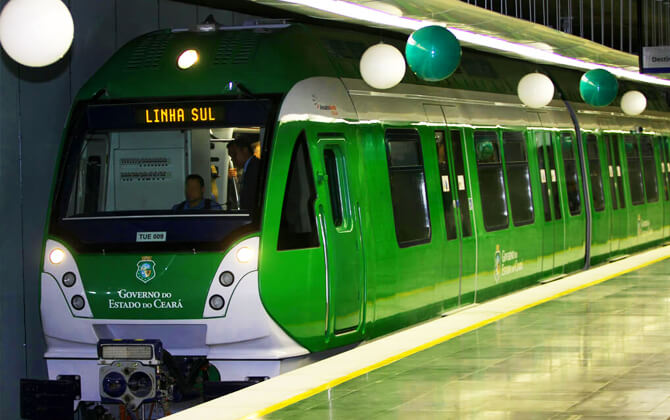
The history of Fortaleza Metro begins with the creation of Metrofor on May 2, 1997, after the former Fortaleza Metropolitan Train consortium was dissolved. The new company took responsibility for managing, building, and planning rail transport in Ceará.
Work on the system started in 1999 with the first phase of the South Line. The project went through delays, budget constraints, and technical revisions, but modernization moved forward with double tracking, electrification, new signaling and communications systems, station construction, and new rolling stock.
Operations began on June 15, 2012, with part of the South Line entering assisted operation. Commercial service on the South Line started on October 1, 2014. Later, the West Line and the Parangaba-Mucuripe VLT were developed as additional parts of the system.
Expansion has continued in recent years. The airport branch opened in 2026, and more growth is planned.
Background
Metrofor has been modernizing Fortaleza’s rail network since 1999, with planning roots going back to the 1980s. The aim has been clear: create a faster, more frequent, and better integrated transport system for Fortaleza and nearby municipalities.
The network is intended to serve large daily passenger flows and connect major urban areas, bus terminals, the port area, and the airport.
Upcoming Expansions
Fortaleza Metro expansion remains part of Metrofor’s long-running modernization program. The focus is on new tracks, stations, signaling, and better service across the system.
By November 2023, the network measured 56.8 km / 35.3 miles with 40 stations. In 2026, it reached 59.3 km / 36.8 miles and 41 stations after the first section of Line 5 – Orange opened between Expedicionários and Aeroporto.
The next major step is expected in 2028, when the network should grow to 71.7 km / 44.6 miles. That expansion is planned to include the first 7.3 km / 4.5 miles section of Line 4 – Yellow from Central–Chico da Silva to Papicu, plus the 5.1 km / 3.2 miles second section of Line 5 – Orange from Aeroporto to Castelão.
The East Line is another key future project. It is planned as a fully underground route linking Central–Chico da Silva with Fórum Clóvis Beviláqua, covering 12 km / 7.5 miles with 13 stations. Its opening date has not been determined.
These additions are meant to improve mobility and strengthen links to major districts, bus terminals, the port area, and Fortaleza International Airport.
Fun Facts
- The system is widely known as Metrofor, or the Metropolitan of Fortaleza.
- Its network uses 1,000 mm metre-gauge track.
- Operations began on June 15, 2012, with assisted service on the South Line.
- Commercial service started on October 1, 2014.
- The South Line is 24.1 km / 15.0 miles long and has 20 stations.
- The West Line is 19.5 km / 12.1 miles long and has 10 stations.
- The Parangaba–Mucuripe tramway line opened in stages and reached its current 10-station length in September 2020.
- The line to Fortaleza International Airport opened on February 9, 2026.
- The system reached 41 stations in 2026 after the first section of Line 5 – Orange opened.
- Trains can reach a maximum speed of 80 km/h.
- The South Line includes four underground stations in the city center within a 4.0 km / 2.5 miles tunnel.
- Planned links include key hubs such as Parangaba, Papicu, Mucuripe Port, and the airport.
Local riders often appreciate the system as a practical way to avoid road traffic while using city transport across Fortaleza.
Attractions Nearby
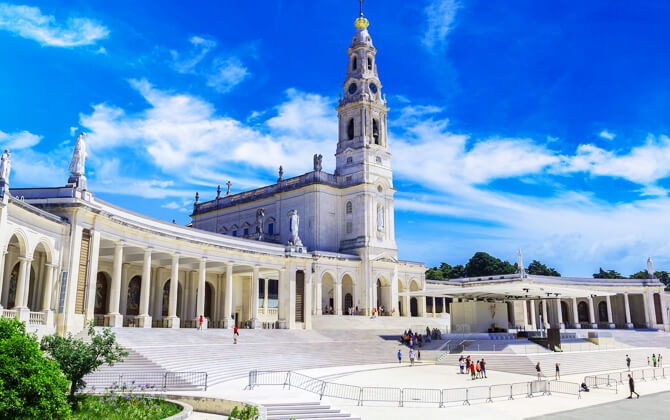
The Fortaleza Metro gives access to a wide range of places nearby, from central districts and churches to shopping centers, museums, plazas, and neighborhood landmarks.
South Line highlights include Central Fortaleza, Benfica, part of Damas, Capistrano de Abreu Plaza, Metrô Shopping Center, Benfica Shopping Center, Bom Jesus dos Aflitos Church, Parangaba Shopping Center, Discipulado de Jesus Cristo Catholic Church, 7th Day Adventist Church, Mondubim Cultural Center, Nuestra Señora del Perpetuo Church, Firmeza Mini-museum, Atrativo Padaria Shopping Center, Major Braz Plaza, Maracanaú, São José Catholic Church, and Sara Nossa Terra Vila das Flores in Pacatuba.
Some stations are especially useful for sightseeing. José de Alencar Station is near the José de Alencar Theatre, Plaza Lagoinha, and Cesar Cals General Hospital. São Benedito Station is close to the Acal shop and San Benito Church. Parangaba Station serves the Parangaba bus stop, Parangaba Mall, and Matriz de Parangaba Church, while Mondubim Station is near the Urban Centre for Culture, Art, Science and Sport.
West Line stops connect to a different mix of local places, including Nuestra Señora de Fatima Catholic Church, Bar Do Detim, 24-hour Bar Italo, Magda Lanchonete, Joao e Maria Restaurant, Deus Canaa Olavo Oliveira Evangelical Church, José Maria Market, LuryBurguer, Sabor Da Casa Restaurant, Ministerio Galardao Pentecostal Church, Exito Mercantil Supermarket, CAJU Museum, Sao Francisco Churrascaria, Quebra Pote Espentinho, and Estrela Supermarket.
The West Line also provides access to sites such as Sao Joao Batista Cemetery near Moura Brasil Station and Liceu do Conjunto Ceará School near Parque Albano Station.
Near Shopping Metrô in Centro, visitors can also reach Praça do Ferreira, Centro de Turismo do Ceará (Emcetur), Praça da estação fortaleza, Museu do Ceará, Praça General Tiburcio, Palácio da Luz, Martyrs Square, Praça Clóvis Beviláqua, Praça da Sé, Catedral Metropolitana de Fortaleza, Fortress of Our Lady of the Assumption, Mercado Central de Fortaleza, Largo Dom Lustosa, Parque da Liberdade Fortaleza, and Centro Dragão do Mar de Arte e Cultura.
In a city known for beaches, culture, and busy streets, the metro can be a handy way to get around without relying only on surface transport.