The New York City Subway is a rapid transit system serving Manhattan, Brooklyn, Queens, and the Bronx. Opened on October 27, 1904, it is one of the oldest and busiest public transport systems in the world, with 472 stations in operation, or 423 if connected station complexes are counted as single stations. The system runs 24/7 in normal conditions, covers 248 miles (399 km) of routes, and includes 28 services, most of which pass through Manhattan.
| Key | Information |
|---|---|
| System | New York City Subway |
| Operator | New York City Transit Authority, part of the MTA |
| Opening date | October 27, 1904 |
| Boroughs served | Manhattan, Brooklyn, Queens, and the Bronx |
| Stations | 472 in operation, or 423 station complexes |
| Route length | 248 miles (399 km) |
| Revenue track | 665 miles (1,070 km) |
| Operating hours | 24 hours a day, 7 days a week, except during emergencies |
| Services | 28 routes or services |
| Above-ground track | About 40% |
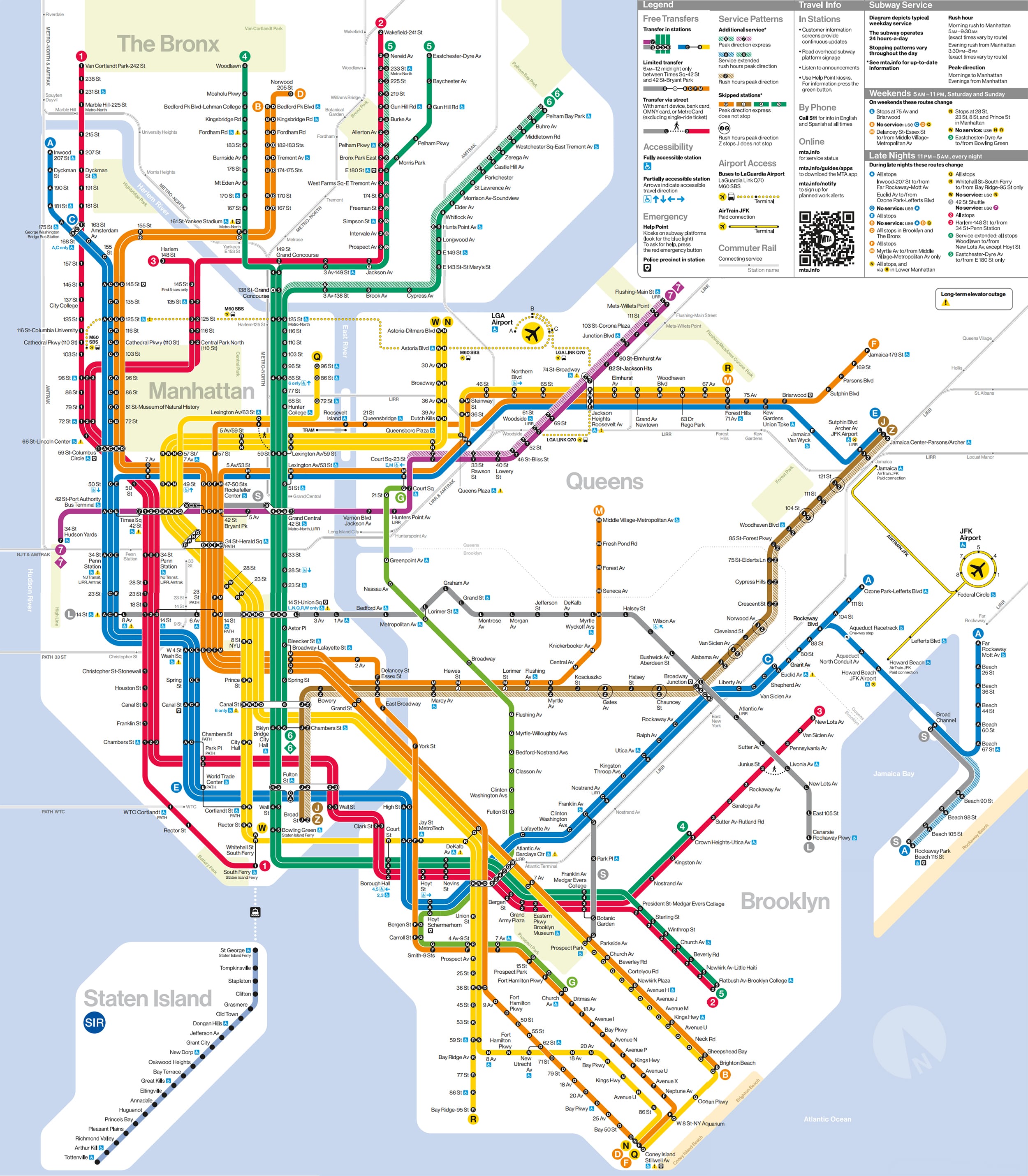
New York City Subway Map
Map of New York City Subway showing different lines. Click on the map to enlarge it or download the New York City Subway map in PDF format.
Lines and Stations
The New York City Subway system grew from the former IRT, BMT, and IND networks. Today, the IRT is known as the A Division, while the former BMT and IND together make up the B Division.
Each service has a color, and since 1979 that color has usually matched the Manhattan trunk line it uses most. A few lines break that pattern, including the Crosstown Line, Nassau Street Line, and shuttle services. If you are using a stations map or checking a route plan, these colors make the network much easier to read.
| Station | Details |
|---|---|
| IND Eighth Avenue Line | Blue; PMS 286; Hex #0039a6 |
| IND Sixth Avenue Line | Orange; PMS 165; Hex #ff6319 |
| IND Crosstown Line | Lime; PMS 376; Hex #6cbe45 |
| BMT Canarsie Line | Light slate gray; 50% black; Hex #a7a9ac |
| BMT Nassau Street Line | Brown; PMS 154; Hex #996633 |
| BMT Broadway Line | Yellow; PMS 116; Hex #fccc0a |
| IRT Broadway–Seventh Avenue Line | Red; PMS 185; Hex #ee352e |
| IRT Lexington Avenue Line | Green; PMS 355; Hex #00933c |
| IRT Flushing Line | Purple; PMS Purple; Hex #b933ad |
| IND Second Avenue Line | Turquoise; PMS 638; Hex #00add0 |
| Shuttles | Dark slate gray; 70% black; Hex #808183 |
There are currently 36 rail lines. The Archer Avenue Lines and the 63rd Street Lines are each counted as two separate lines because they include distinct BMT and IND sections.
Examples of active lines include the IND Eighth Avenue Line, IRT Broadway–Seventh Avenue Line, BMT Broadway Line, BMT Canarsie Line, IRT Flushing Line, and IND Queens Boulevard Line. Many lines combine local and express service, which is why checking the route, stations list, and platform signs matters.
Station counts vary depending on how connected complexes are treated. Officially there are 472 stations, but if complexes are counted as one, the total is 423. The newest stations are 72nd Street, 86th Street, and 96th Street on the Second Avenue Subway, opened on January 1, 2017.
Some station names repeat across the city. For example, 125th Street can refer to stations on several different lines, so riders often use the line name and nearby cross street to tell them apart.
Major station complexes include 14th Street/6th Avenue, 34th Street–Herald Square, Atlantic Avenue–Barclays Center, Chambers Street–World Trade Center/Park Place/Cortlandt Street, Grand Central–42nd Street, and Times Square–42nd Street/Port Authority Bus Terminal.
MTA New York City Transit Schedule and Hours of Operation
The MTA provides subway, bus, and regional rail service information, including maps, timetable details, train schedule updates, fares, and route timetable tools. For local transport in New York, the subway is the core system, linking Manhattan, Brooklyn, Queens, and the Bronx through 25 subway lines and 472 stations.
The subway operates 24 hours a day, 7 days a week, every day of the year. That means there is no regular closing time for the full system, though service patterns change by period and some routes run differently late at night. If you are checking opening hours, working hours, or timings today, this is the key point: the network does not normally close.
| Service detail | Timings |
|---|---|
| Rush hours | 6:30 a.m. to 9:30 a.m. and 3:30 p.m. to 8:00 p.m., Monday to Friday |
| Middays | 9:30 a.m. to 3:30 p.m., Monday to Friday |
| Evenings | 8:00 p.m. to 12:00 a.m., Monday to Friday |
| Weekends | 6:30 a.m. to 12:00 a.m., Saturday and Sunday |
| Late nights | 12:00 a.m. to 6:30 a.m., every day |
Frequency depends on the time of day. In the busiest periods, trains generally run every 3 to 5 minutes. During other daytime and evening periods, service is usually every 4 to 12 minutes. Late-night frequency is about every 20 minutes, with some outer sections seeing longer gaps.
Most routes are local, express, or a mix of both. Fully local services include the 1, C, G, L, M, R, and W. The 6 and 7 have diamond express variants during rush hours, and the J is joined by the Z in the peak direction during rush hours.
For many riders, the most useful schedule today detail is simple: there is no single last train for the whole network, because service continues around the clock. Still, individual routes can change their running time, stopping pattern, or frequency, especially late at night or during planned work.
A single subway ride costs $2.90 USD, and OMNY is often the easiest ticket option for frequent travel because the weekly fare cap starts after the 12th trip at $34.80 USD. MetroCard remains valid for subway and bus travel until the end of 2026.
Starting on December 8, 2025, F and M trains will swap parts of their weekday route between Queens and Manhattan from about 6:00 a.m. to 9:30 p.m. On weekdays, F trains will stop at Queens Plaza, Court Sq-23 St, Lexington Av/53 St, and 5 Av/53 St, while M trains will stop at 21 St-Queensbridge, Roosevelt Island, Lexington Av/63 St, and 57 St. On weekends and late nights, those stations are served by the opposite line.
Fare, Tickets, and Cards
The standard subway fare is $3.00 USD for most riders on subways and local, limited, rush, and Select Bus Service buses. Express bus fare is $7.25 USD. Reduced fares for seniors and riders with qualifying disabilities are half price.
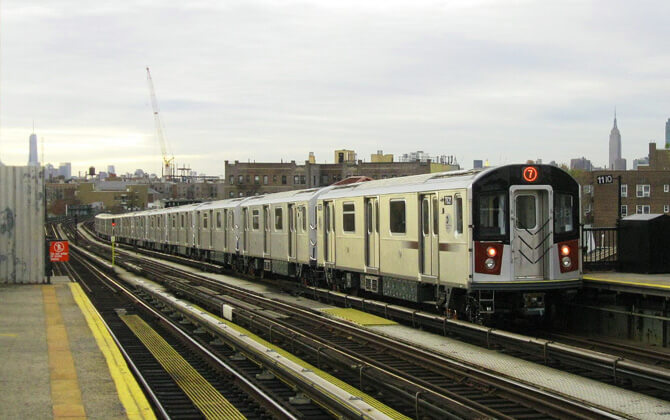
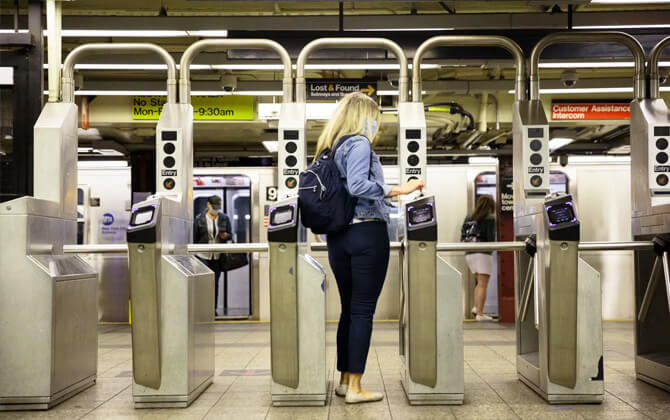
You can pay with a contactless credit card, debit card, smartphone, wearable device, or an OMNY Card. On the subway, tap at the turnstile when you enter. On buses, tap on the reader when boarding, with Select Bus Service allowing boarding through any door.
Tap-and-go payment does not require an app or registration. If you use the same card or device, you pay no more than $35.00 USD in a 7-day period for subway and local bus rides, or $67.00 USD for subway, local bus, and express bus rides.
Transfers are free within two hours when you use the same card or device. You can transfer from subway to bus, bus to subway, or bus to bus. If you change from the subway or a local bus to an express bus, you pay the difference in fare.
Up to three children under 44 inches ride free with a fare-paying adult on the subway and on local, limited, rush, and Select Bus Service buses. On express buses, infants under two ride free when seated on an adult’s lap.
MetroCard can no longer be bought or refilled as of January 1, 2026. If you still have one, you can transfer its value to an OMNY Card at a Customer Service Center or use the remaining balance for rides. Cash is still accepted on local, limited, rush, and Select Bus Service buses, and exact change is required.
On Select Bus Service, cash riders need a sidewalk kiosk ticket before boarding and must keep that ticket for the whole trip. Once buses stop accepting cash, riders will still be able to add value to an OMNY Card with cash and coins at subway station vending machines and retail locations.
If you are comparing ticket price, pass value, or cost for frequent travel, OMNY fare capping works much like a day pass or weekly pass alternative, even though it is based on taps rather than a traditional unlimited card.
Connections
The New York City Subway has several physical links between the old IRT, BMT, and IND systems. Some are used in normal passenger service, while others are limited to yard moves or non-revenue operations.
Revenue-service connections include the 60th Street Tunnel Connection in Queens, the 63rd Street Lines in Manhattan, Coney Island–Stillwell Avenue station, and the Chrystie Street Connection, which ties together services using the Manhattan Bridge and Williamsburg Bridge.
There is also one inter-division connection not used for passenger service because of different train widths: the link between the Astoria Line and the Flushing Line in Queens.
Yard and freight connections
Some links exist only inside yards and are not part of regular passenger transport.
- 207th Street Yard in Manhattan links the IND Eighth Avenue Line and IRT Broadway–Seventh Avenue Line.
- Coney Island Complex in Brooklyn links the IND Culver Line, BMT Sea Beach Line, and BMT West End Line.
- Concourse Yard in the Bronx links the IND Concourse Line and IRT Jerome Avenue Line.
- Linden Yard in Brooklyn links the BMT Canarsie Line and IRT New Lots Line.
There are also connections to the national rail network, including the BMT West End Line and South Brooklyn Railway, as well as Linden Yard and the Bay Ridge Branch of the LIRR.
Notable in-system links
- Broadway Junction has an unused flyover between the BMT Canarsie Line and the BMT Jamaica Line.
- At Prospect Park, the BMT Franklin Avenue Line becomes the local tracks of the BMT Brighton Line.
- DeKalb Avenue has an unused connection between the BMT Brighton Line and the BMT Broadway Line through the Montague Tunnel.
- West Fourth Street–Washington Square has an unused connection between the IND Eighth Avenue Line and the IND Sixth Avenue Line.
- Between Bowling Green and the South Ferry loops, the IRT Lexington Avenue Line and the IRT Broadway–Seventh Avenue Line connect through crossovers on the balloon loop tracks.
- The 42nd Street Shuttle connects to the IRT Broadway–Seventh Avenue Line at one end and the IRT Lexington Avenue Line at the other, but it cannot be used for through service between those lines.
- South of Broad Street on the BMT Nassau Street Line, the two-track line widens to four tracks, allowing J and Z trains to turn while the outer tracks continue toward Brooklyn.
- On the IND Rockaway Line, a single track connects the branches of the wye at Hammels south of Broad Channel and was previously used for shuttle and emergency service.
Connection to the Airport
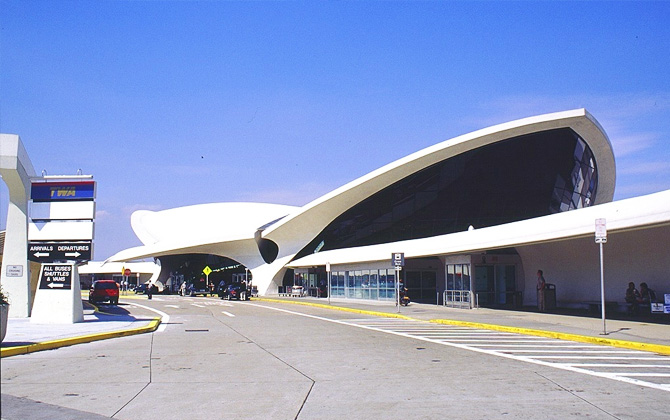
All three major New York airports, JFK, LaGuardia, and Newark, can be reached by public transport. The final leg often involves an airport rail link or bus, so it helps to check the route plan before you leave.
For JFK, the main options are the subway plus AirTrain or the Long Island Rail Road plus AirTrain. From Midtown Manhattan or Downtown Brooklyn, the LIRR is usually faster. From many other parts of the city, the subway is often the lower-cost choice. In both cases, the AirTrain covers the last section to the terminals.
For subway access to JFK, take a Jamaica Center-bound train to Sutphin Blvd-Archer Av-JFK Airport, or a Far Rockaway-bound train to Howard Beach-JFK Airport. At Jamaica, follow signs to the AirTrain after exiting the subway fare zone. At Howard Beach, make sure the train is going to Far Rockaway, not Lefferts Boulevard.
If you are taking the LIRR, use a train that stops at Jamaica from Penn Station, Grand Central, or Atlantic Terminal. From Jamaica Station, transfer to the AirTrain and pay that separate fare at the turnstiles. Children under 5 ride free on the AirTrain, and unlimited passes do not cover it.
LaGuardia has no direct train service, but it is connected by bus. The free Q70 LaGuardia Link runs to Jackson Heights–Roosevelt Ave/74 St for subway connections. The M60 Select Bus Service is another practical option, especially for Astoria or uptown Manhattan.
Newark Liberty International Airport is reached by AirTrain Newark and NJ Transit. Take the AirTrain to Newark Liberty Airport Station, then transfer to NJ Transit for service to New York Penn Station. On weekdays, this is often a strong option. At other times, the Newark Airport Express shuttle may be more convenient.
Airport trips can involve stairs, elevators, and paid transfers, so give yourself extra time, especially with luggage. It is worth double-checking your terminal and train or bus direction before boarding.
Subway Regulations
The New York City Subway is the largest and busiest rapid transit system in North America, with 472 stations across 25 routes and 665 miles (1,070 km) of track. It runs 24 hours a day, 7 days a week, making it one of the most practical ways to get around the city.
Before traveling, check service status and use the MTA app for trip planning, maps, arrival times, real-time updates, and station information. If needed, you can also speak with an MTA employee, call 511, or use the trip planner.
Most riders pay a $3.00 USD fare. Reduced fares are available for people 65 and older, riders with disabilities, and low-income New Yorkers.
Paying your fare
You can pay with OMNY by tapping a contactless bank card, smartphone, wearable device, or OMNY Card at the turnstile reader. When the screen says GO, walk through.
If you still use MetroCard, swipe it at the turnstile when entering. As of January 1, 2026, you can no longer buy or refill a MetroCard, but a valid one can still be used until it expires. The final date of MetroCard acceptance will be announced later in 2026.
At the station and on the train
Subway services are identified by letters or numbers. Colors show the Manhattan trunk line, but they do not guarantee similar service patterns, so always check platform signs, notices, and announcements.
In Manhattan, Downtown means south and Uptown means north. Signs may say Uptown & The Bronx or Downtown & Brooklyn. Once on board, the train’s destination appears on the side of the train, and announcements can change as the route changes.
For safety, stand back from the platform edge when trains are arriving or leaving. Never step onto the tracks. If you drop something there, leave it and notify an MTA employee.
If you are traveling with a stroller or personal mobility device and there is no marked area, boarding near the center of the train is often best. The conductor is usually there, which can make getting help easier. You can also ask a station agent or use a blue Help Point intercom. The red button is for emergencies and the green button is for information.
On board conduct
Let riders exit before boarding. Keep your belongings close, make room for others, and do not take more than one seat.
When leaving the train or moving through stations, make sure you have everything with you. Fold strollers and carry children on stairs and escalators. Use elevators when possible, and ask MTA staff for help if needed.
Things you can and can’t bring
Bring only what you can carry yourself, and if you have something large, avoid rush hour when possible. Do not block doors, stairs, or passageways.
- You can bring personal mobility devices, including wheelchairs, canes, walkers, and scooters; dogs and other animals in a bag or container; service animals and working law-enforcement animals; bikes; strollers for children; and boxes, packages, and small furniture.
- You can’t bring motorcycles and other motorized vehicles; large wheeled carts over 30 inches in length or width; anything that sticks out of a subway window or door; or any item that is hazardous, blocks traffic, or interferes with MTA operations.
Accessible travel
Riders using mobility aids or other assistive tools can use the subway travel guide for accessible navigation. If the subway or bus is not a workable option, Access-A-Ride paratransit may be available.
Rules and fines
Some Rules of Conduct violations can lead to fines. Examples include fare evasion, littering, interference with movement, smoking, moving between subway cars without authorization, and blocking seats.
Other listed violations include carrying weapons, drinking alcohol, graffiti or defacement, riding outside the vehicle, entering restricted areas, bringing hazardous or obstructive objects, unauthorized commercial activity, excessive noise, unauthorized photography or filming, and unauthorized animals. Violations may also lead to criminal prosecution or civil penalties.
Tips and Rules
The subway is one of the fastest ways to handle transportation in New York, but a few practical habits make trips smoother. Before you go, check service status, the schedule today, and any route changes in the MTA app.
For most riders, the fare is $3.00 USD. OMNY is the easiest payment method for many visitors and regular riders, while MetroCard can still be used if valid, even though it can no longer be bought or refilled after January 1, 2026.
At the station
Trains are identified by letters or numbers, not just color. Platform signs will tell you where a train stops, whether it runs local or express, and if service has changed. In Manhattan, uptown means north and downtown means south, so keep an eye on those signs.
Stand well back from the edge as trains enter and leave. If you need help, ask a station agent or use a Help Point. And if you drop something on the tracks, do not try to retrieve it yourself.
On the train
- Let riders get off before you board.
- Stand to the side of the doors, not in front of them.
- Move toward the center of the car.
- Do not hold the doors open.
- Leave accessible seats for riders who need them.
- Hold on while the train is moving.
- Keep bags and valuables close.
- Make space for other riders.
- Do not take more than one seat.
Exiting and getting around
Check that you have your phone, wallet, bags, and anything else before leaving the train. Fold strollers on stairs and escalators, and use elevators when possible.
The E train from Sutphin Blvd-JFK to Manhattan can be an easy first ride for airport arrivals. On newer trains, digital route maps can also help you follow your path train stop by stop.
What to do if…
- You need help planning a trip: talk to an MTA employee, call 511, use the trip planner, or check the app.
- You drop something on the tracks: never go onto the tracks; ask the station agent for help.
- You miss your stop: stay on the train until you reach a station where you can transfer in the opposite direction.
- You leave something behind: if you are still in the system, speak to a station agent; otherwise, file a claim with MTA Lost & Found.
- You see a crime in progress: tell an MTA employee or police officer, use a Help Point, or call 911.
What you can and can’t bring
Try not to travel with more than you can carry, and avoid the busiest periods if you are moving something bulky. Keep doors, stairs, and passageways clear.
You can bring personal mobility devices, animals in containers, service animals, bikes, strollers, boxes, packages, and small furniture. You cannot bring motorcycles, oversized wheeled carts, objects sticking out of windows or doors, or anything hazardous or obstructive.
Accessible travel
If you need step-free planning, look for elevator and escalator status, the accessible stations map, and the accessible stations list. If subway or bus travel is not possible, Access-A-Ride may be an option.
More tips
It also helps to understand how the subway connects with bus services, airport links, and other city transport options. For quick orientation, a subway diagram or stations map is often enough to get started.
History
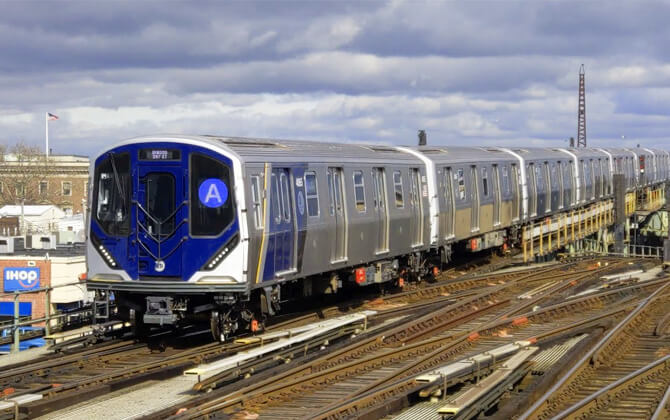
The history of the New York City Subway began with Alfred Ely Beach’s Beach Pneumatic Transit, a short underground demonstration line under Broadway that opened in 1870. It ran 312 feet from Warren Street to Murray Street and proved that underground transport could work in New York, though it was never expanded.
By the late 1870s, New York already had elevated railways in Manhattan and the Bronx, including the Second Avenue, Third Avenue, Sixth Avenue, and Ninth Avenue lines. Some early rights-of-way later became part of the modern subway system.
Serious planning for a full subway started after the Rapid Transit Act of 1894 created the Board of Rapid Transit Railroad Commissioners. The city chose to build the first line itself and lease operations to the Interborough Rapid Transit Company. Construction began in 1900, and the first underground line opened on October 27, 1904, from City Hall to 145th Street. More than 150,000 passengers rode on the first day.
The network soon expanded into the Bronx and Brooklyn. The city also worked with the Brooklyn Rapid Transit Company, later the Brooklyn–Manhattan Transit Corporation, which ran both elevated lines and subways. In 1913, the Dual Contracts accelerated expansion by funding new lines, upgrades, and additional city-built infrastructure leased to private operators.
Another major change came in 1932, when the first line of the city-owned Independent Subway System opened. It was meant to compete with the private companies and replace some elevated lines. Because it had to run at cost, fares could be higher than the five-cent fare on older lines.
The city took over both private systems in 1940, with the BMT on June 1 and the IRT on June 12. Integration took time, but the IND and BMT eventually became the B Division, while the narrower IRT routes became the A Division. In 1953, the New York City Transit Authority was created to run subway, bus, and streetcar operations, and in 1968 it came under the Metropolitan Transportation Authority.
The subway later went through both decline and recovery. Conditions worsened in the 1970s and 1980s, then improved through the 1990s and into the 21st century. Major disruptions after the September 11 attacks and Hurricane Sandy led to extensive repairs and resilience work.
| Year | Annual passenger ridership |
|---|---|
| 1901 | 253,000,000 |
| 1905 | 448,000,000 |
| 1910 | 725,000,000 |
| 1915 | 830,000,000 |
| 1920 | 1,332,000,000 |
| 1925 | 1,681,000,000 |
Future Extensions
Since 1904, a long series of official plans has aimed to expand the subway beyond its original corridors. Some became major construction programs, while many others were delayed, revised, or never funded.
The Dual Contracts created the first big wave of expansion and helped build much of the network in the Bronx, Brooklyn, and Queens. Later proposals, including Mayor John Hylan’s 1922 plan and the 1929 Independent Subway Second System, called for more than 100 miles (161 km) of new lines and included ideas such as the Second Avenue Subway, Queens bypasses, and routes toward Staten Island and the Rockaways.
Over time, those plans changed repeatedly. Important connections such as the Culver Ramp, the 60th Street Tunnel Connection, and the Chrystie Street Connection increased capacity on existing lines, while larger expansion projects were held back by funding problems and shifting priorities. The Program for Action in 1968 again promised major growth, but only a small part was built.
After years focused more on repair than expansion, interest in new routes returned in the 1990s. Construction of the Second Avenue Subway began in 2007, and the first phase opened in 2017. Since then, agencies and planners have continued discussing further expansion, including Triboro-style circumferential service, reuse of the Rockaway Beach Branch, and more phases of the Second Avenue Subway.
Recent ideas also point toward stronger regional links, including cross-borough projects, better service to underserved parts of Queens, Brooklyn, and the Bronx, and closer connections with commuter rail and neighboring New Jersey. Many remain proposals, but they show that expansion is still very much part of the conversation.
Interesting Facts
The New York City Subway is one of the oldest and busiest rapid transit systems in the world, and its history includes plenty of unusual details. The first underground line opened on October 27, 1904, but the idea had already been tested by the Beach Pneumatic Transit in 1870.
On opening day, about 150,000 riders used the system and paid just five cents. Today, the subway has 472 stations and serves millions of riders each day. Times Square is the busiest station, while Broad Channel is the least used.
The system also has some striking extremes. 191st Street is the deepest station, and Smith-9th Street in Brooklyn is the highest above street level. The oldest part still in use dates to the 1880s, while the newest stations opened in 2017 on the Second Avenue Subway.
There are a lot of lesser-known stories too. The subway once had its own baseball team, the IRT All-Stars. The MTA also ran the Miss Subway contest from 1941 to 1976. And in the 1960s, riders could briefly enjoy a bar car serving champagne, pretzels, and bagels.
Behind the scenes, there is even more to notice. More than 400 works of art are installed across the system, all subway signs are made in a Brooklyn sign shop, and some retired subway cars were sunk offshore to create artificial reefs. At 370 Jay Street, an armored money train once delivered fares to a secret room before the system switched to armored trucks in 2006.
The fare system has changed a lot too, moving from paper tickets to subway tokens, then MetroCards, and now OMNY. Delay verification letters are still available online for riders who need proof of a late train.
Attractions Nearby
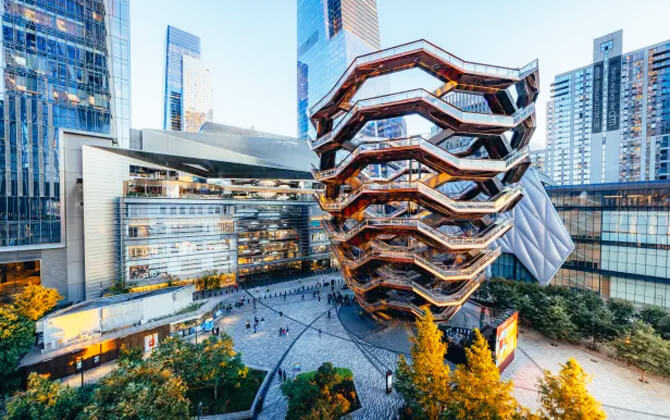
If you want to explore transit history in person, the New York Transit Museum in Brooklyn is a standout stop. It is housed in a decommissioned 1936 subway station at 99 Schermerhorn St and features exhibitions, education programs, and vintage subway and elevated cars dating back to 1907.
The museum can be reached by more than 20 subway and bus lines. Advance reservations are strongly encouraged, and a wheelchair-accessible entrance is available at the corner of Schermerhorn and Court Streets.
In Lower Manhattan, the New York Transit Museum Store at 2 Broadway is another easy transit-themed stop. It sits across from Bowling Green station, one of the first stations to open after the original 1904 subway debut, and is a good place to browse transport-related apparel, accessories, and collectibles.
Other transit landmarks nearby include Fulton Center, Westfield World Trade Center Transportation Hub, and Grand Central Station. Each gives you a different look at the scale, design, and character of New York City transport.