METRO Bus Houston is the bus network operated by the Metropolitan Transit Authority of Harris County, the public transportation agency serving Houston, most of Harris County, and selected nearby areas. The system includes local, express, and Park & Ride bus service, with connections to METRORail, METRORapid, METRO curb2curb, METROLift, transit centers, airports, and major employment areas. METRO’s service area covers 1,285 square miles (about 3,328 square kilometers), and its bus network carries the largest share of system ridership.
| Key | Information |
|---|---|
| Operator | Metropolitan Transit Authority of Harris County, branded as METRO |
| Service area | Houston, most of Harris County, Missouri City bus service, and vanpool service in parts of an eight-county region |
| Main bus services | Local bus, express bus, and Park & Ride commuter bus |
| Network size | 108 bus routes and 8,791 bus stops |
| Transit facilities | 20+ transit centers, 25+ Park & Ride facilities, and connections to more than 35 light rail stations |
| Accessibility | All local buses are ADA accessible and include free Wi-Fi and video surveillance cameras |
| Standard local bus fare | $1.25 |
| Trip planning | RideMETRO app, METRO website tools, Google Maps, Apple Maps, text alerts, digital signs, and phone support at 713-635-4000 |
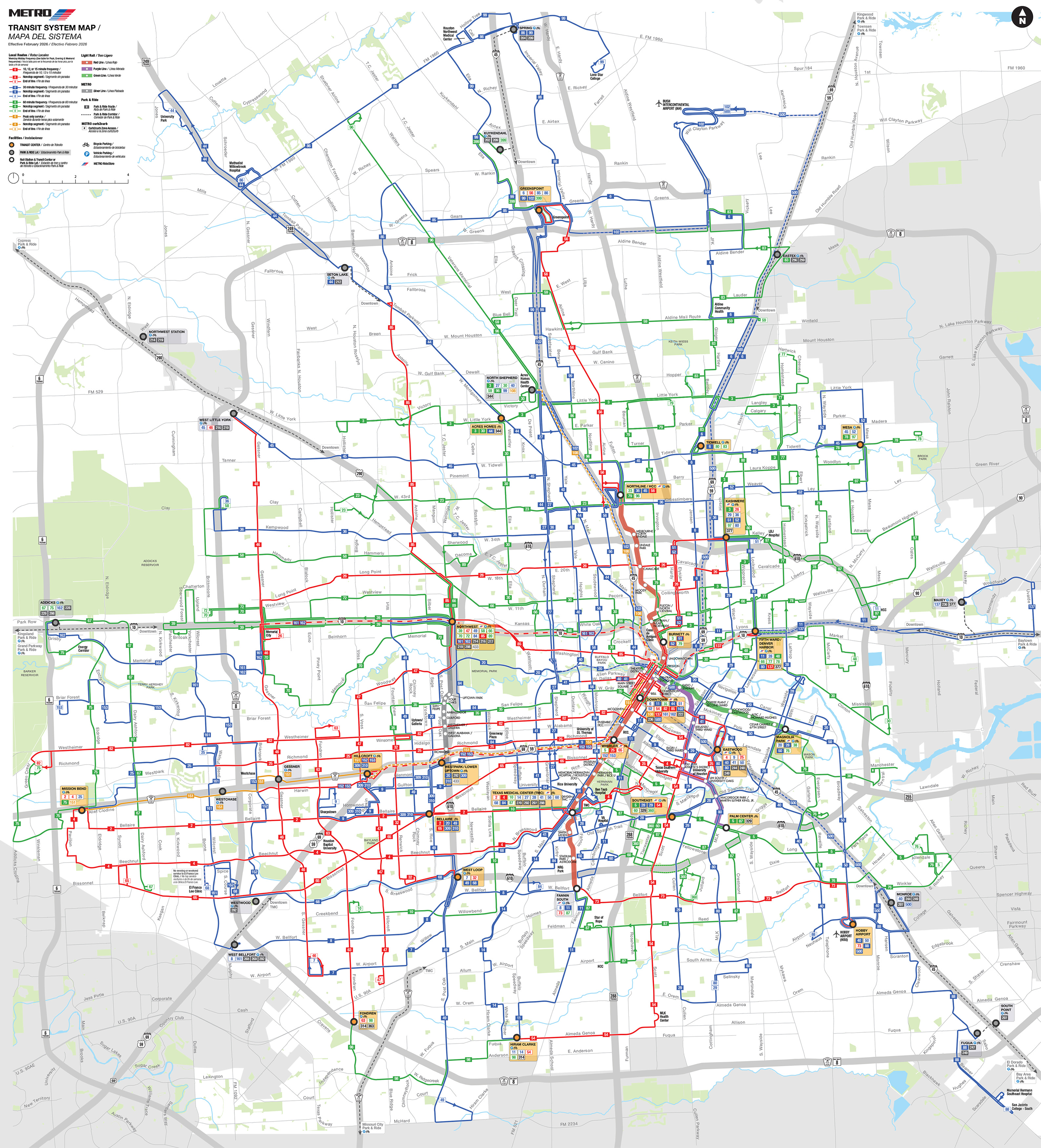
METRO Bus Houston Map
METRO Bus Houston map shows all available stops. Click on the map to enlarge it, or download a PDF version of the METRO Bus Houston map.
Routes, Stops, and Transit Centers
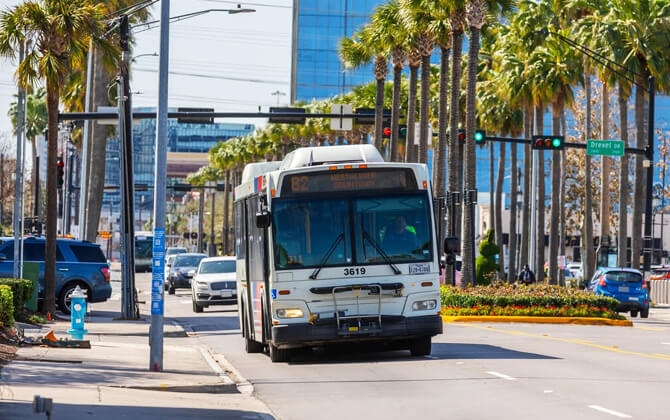
METRO Bus Houston serves the city with more than 80 local bus routes, plus express and Park & Ride routes. Local routes are usually numbered and named for a corridor, destination, or neighborhood, such as 2 Bellaire or 82 Westheimer. For everyday transportation in Houston, this route plan gives riders practical access to jobs, schools, shopping areas, medical appointments, and transit connections inside and outside the 610 Loop.
Local buses generally run on city streets and stop often, sometimes close to every other corner. Transfers are possible at major intersections and at METRO transit centers, which are sheltered waiting areas usually located near the start or end of a route.
The route network stretches from Kingwood Park & Ride in the north to Missouri City Park & Ride in the south, and from Grand Parkway Park & Ride on the west side to Baytown Park & Ride on the east side. Route 3 is listed as one of the longest lines, running between Burnett Transit Center and Victory Dr @ Antoine Dr with 162 stops. Route 39 is one of the shortest, running between Chatterton Dr @ Sherwood Forest St and Britoak Ln @ Yorkchester Dr with 9 stops.
For a stations map, stations list, bus stops, and route timetable details, riders can use METRO’s interactive system map or PDF map. Both show bus routes, rail lines, stations, transit centers, and transfer points.
| Station | Details |
|---|---|
| Texas Medical Center Transit Center | Major connection point for routes such as 2 Bellaire and 41 Kirby / Polk |
| Mission Bend Transit Center | Western terminal or connection point for routes including 2 Bellaire, 4 Beechnut, and 25 Richmond |
| Burnett Transit Center | Northside transfer point served by routes such as 3 Langley-Little York |
| Downtown Transit Center | Central transfer point for downtown local transport and regional connections |
| Greenspoint Transit Center | North Houston connection point served by routes including 6 Jensen / Greens |
| Eastwood Transit Center | East-side hub for routes such as 4 Beechnut, 25 Richmond, and 41 Kirby / Polk |
| Mesa Transit Center | East Houston connection point served by routes such as 45 Tidwell |
| West Little York Park & Ride | Park & Ride and bus connection point used by routes including 45 Tidwell |
To check a stop, text the bus stop number and route number to 697433. You can also use Track Your Bus or Train on the METRO website, digital signs at select stops and transit centers, Google Maps, Apple Maps, or the automated phone system at 713-635-4000.
Schedule, Frequency, and Real-Time Arrivals
METRO provides several ways to check the bus schedule, train schedule connections, route timetable, service frequency, and real-time arrivals. This is useful if you need the timings today, the next bus, the last train connection, or a quick check before leaving home.
For Next Bus Texting, use the stop number posted on the bus stop sign. Text that stop number to 697433, and METRO replies with scheduled arrival time, marked SC, and estimated real-time arrival, marked RT, for the next buses serving that stop.
On the METRO website, select your route, destination, and stop, then use Track Now. The tool shows the route number, estimated real-time arrival, and upcoming scheduled departures. In Google Maps or Apple Maps, enter your destination, choose public transport, and review the route options and arrival estimates.
Digital signs at select bus stops and transit centers may show real-time bus and train arrivals, service alerts, detours, stop closures, and other announcements. Riders can also call 713-635-4000 and follow the prompts to enter a stop number and route number, or press # for stop lookup.
| Service detail | Timings |
|---|---|
| Typical local bus frequency | Every 30 minutes during most operating hours on many routes; exact timings vary by route |
| Route pages | Show weekday and weekend frequency, stop-by-stop schedules, and downloadable PDF timetables |
| Route 102 Bush IAH example | Every 15 minutes Monday-Friday and every 30 minutes Saturday-Sunday during most operating hours |
| Real-time arrivals | Available by text to 697433, METRO website, RideMETRO app, Google Maps, Apple Maps, digital signs, and 713-635-4000 |
| Holiday service example | On Christmas Eve, bus routes are open; on Christmas Day, METRORail and METRORapid run on a regular Sunday schedule, while Park & Ride routes are not available |
Weekday, Weekend, and Holiday Service
METRO’s local bus network operates seven days a week, except for two express routes. Many routes follow separate weekday and weekend patterns, so the best way to confirm opening hours, working hours, starting time, closing time, and schedule today is to check the specific route page.
Route pages usually include frequency, stop-by-stop timing, and a PDF timetable. If you are connecting to rail or another bus, check the full path train or bus connection before you travel, especially on holidays.
For the most accurate timings, use real-time arrival tools close to your departure time. Service can change because of detours, events, weather, or holiday operating plans.
Fares, Tickets, and Payment Options
METRO fare options are simple for local bus riders. The standard local bus ticket price is $1.25, and eligible discounted riders pay $0.60. Park & Ride bus fare ranges from $2.00 to $4.50 depending on the zone where you board. Because Houston’s local currency is the U.S. dollar, all prices are listed in USD.
METRO’s 1-for-10 loyalty program gives one free ride after every 10 paid rides when you pay with a physical or virtual RideMETRO Fare Card. If you ride often, that card can lower your overall cost.
| Service | Fare |
|---|---|
| Local bus | $1.25 regular fare; $0.60 discounted fare |
| METRORail | $1.25 regular fare; $0.60 discounted fare |
| METRO curb2curb | $1.25 regular fare; $0.60 discounted fare |
| Park & Ride bus | $2.00-$4.50 depending on boarding zone; discounted riders pay half price |
| RideMETRO Fare Card | $2.00 to obtain, then load value as needed |
| Day Pass | $3.00 for unlimited rides on METRO Local Bus, METRORail, and METRO curb2curb through 2 a.m. the next day; not valid on Park & Ride bus |
Local Bus Fares
The regular fare for METRO local bus service is $1.25. The discounted fare is $0.60 for eligible riders. Local bus fares are the same across local routes.
Children five years old or younger ride free when accompanied by an adult. Seniors 70 or older, qualified veterans, and METROLift customers can also ride free with the proper fare card.
You can pay local bus fare with cash, a physical RideMETRO Fare Card, a virtual RideMETRO Fare Card in the RideMETRO app, a credit or debit card, Apple Pay, Google Pay, a 3-Hour Pass ticket, or a Day Pass ticket.
If you pay with cash, use exact fare. Deposit it into the fare box at the front of the bus. No change is given, and free transfers are not included.
RideMETRO Fare Card, Mobile App, Contactless Payment, and Cash
The RideMETRO system supports several payment options: physical card, virtual card in the RideMETRO app, contactless credit or debit card, mobile wallet, TVM paper tickets, and cash on buses and at Ticket Vending Machines.
A RideMETRO Fare Card costs $2.00 and can be loaded at METRO RideStore locations, the METRO Online RideStore, participating retailers, and Ticket Vending Machines. 3-Hour and Day Pass tickets can only be purchased from Ticket Vending Machines on METRORail platforms.
When boarding, tap or scan your own payment method. Physical RideMETRO Fare Cards, credit cards, debit cards, and mobile wallets are tapped on the fare validator. Virtual RideMETRO Fare Cards, 3-Hour Pass tickets, and Day Pass tickets are scanned under the validator.
The RideMETRO app works as a trip-planning and payment tool for local bus, Park & Ride bus, and METRORail. You can find routes and stops, plan a trip, pay your fare, track your ride, and manage your account.
Transfers, Discounts, and Free Ride Programs
Free transfers are available between METRO services of equal or lesser value for up to three hours when you pay with a physical or virtual RideMETRO Fare Card, credit or debit card, Apple Pay, Google Pay, a 3-Hour Pass ticket, or a Day Pass ticket.
If you transfer to a higher-cost service, you pay only the fare difference during that three-hour window. Use the same payment method you used at the start of the trip.
Discounted fares are available for eligible students, seniors ages 65-69, and people with disabilities who are not METROLift customers. A pre-approved RideMETRO Discount Fare Card is required. Riders who qualify may pay half price on local bus, Park & Ride bus, METRORail, and METRO curb2curb.
Free ride programs include children five or younger with an adult, seniors 70 or older with a RideMETRO Discount Fare Card, qualified veterans with a RideMETRO Discount Fare Card, and METROLift customers with a METROLift Fare Card plus up to one assistant.
Connections with Other METRO Services
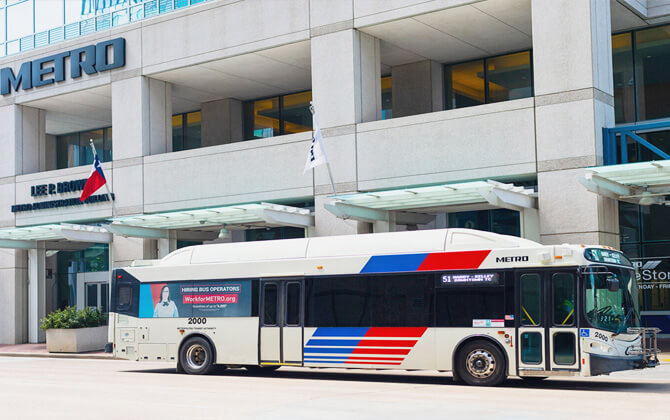
METRO Bus connects with the wider Houston transport system, including METRORail, METRORapid, METRO curb2curb, METROLift, Vanpool, transit centers, Park & Ride facilities, and rail stations. For many trips, combining services is the easiest way to reach jobs, schools, hospitals, airports, and downtown destinations.
Local routes are numbered 2-99, express routes 102-162, Park & Ride routes 202-298, shuttle and curb2curb routes 309-399, and the BRT route is 433. Many routes meet at transit centers or major street intersections, making transfers across the system fairly straightforward.
METRORail and METRORapid Connections
METRORail includes the Red, Green, and Purple lines. These lines connect downtown, north, east, and southeast Houston with destinations such as the Texas Medical Center, Museum District, Houston Zoo, Theater District, NRG Stadium, University of Houston, and Texas Southern University.
Important bus and rail transfer points include Northline Transit Center / HCC, Burnett Transit Center / Casa de Amigos, Downtown Transit Center, TMC Transit Center, Fannin South Park & Ride, Magnolia Park Transit Center, Palm Center, and Texas Medical Center Transit Center. Central Station Main and Central Station allow transfers between the Red, Green, and Purple lines.
METRORapid is METRO’s bus rapid transit service. The Silver Line, opened on August 23, 2020, is the only operational METRORapid line. It runs 4.7 miles (about 7.6 kilometers) from Westpark / Lower Uptown Transit Center to Northwest Transit Center, serving Uptown with dedicated bus lanes over most of the corridor. A Silver Line extension to Gulfton in southwest Houston is under review.
METRO curb2curb, Community Connector, and METROLift
METRO curb2curb provides customized curb-to-curb transportation within specific zones, including Acres Homes, Hiram Clarke, Kashmere / Maxey Road, Missouri City, and Sunnyside. It is ADA accessible and includes free Wi-Fi and video surveillance cameras. Trips can be booked up to seven days in advance or as late as 15 minutes before pickup through the METRO On Demand app or by calling 713-739-7433.
Community Connector is an on-demand rideshare service that offers flexible trips to METRO bus stops, rail stations, and neighborhood destinations. It serves selected areas including Downtown, Heights, Near Northside, Second Ward, and Third Ward, with bookings through the METRO On Demand app.
METROLift is METRO’s paratransit service for eligible riders with disabilities. It provides curb-to-curb transportation using ADA-accessible vans and minivans that can accommodate wheelchairs, scooters, and walkers. METROLift customers can also ride buses, light rail, and METRO curb2curb for free with up to one assistant.
Regional Transit and Downtown Connections
Downtown Houston is a major hub for METRO city transport. Local buses, express buses, rail connections, and transfer points such as Downtown Transit Center make it easier to move between neighborhoods, employment centers, and regional services.
For longer regional trips, METRO Park & Ride service connects outlying areas with downtown Houston and the Texas Medical Center, often using HOV lanes. METRO also operates bus service to Missouri City, while Vanpool may help riders who do not have a nearby bus option.
The METRORapid Silver Line connects Uptown with Northwest Transit Center, and the rail lines add more links into and through downtown. Together, these services support transfers between local, express, commuter, and rail routes.
Airport Connections
METRO Bus serves both major Houston airports: George Bush Intercontinental Airport and William P. Hobby Airport. Airport routes connect with downtown Houston, transit centers, and local bus lines. For airport trips, check the current schedule, opening times, and real-time arrivals before you leave, especially if you are catching a flight.
George Bush Intercontinental Airport (IAH)
George Bush Intercontinental Airport is about 20 miles (about 32 kilometers) north of downtown Houston. METRO offers two main bus routes between IAH and downtown.
Route 500 Downtown Direct is a nonstop airport route to downtown Houston for $4.50. From IAH, it departs every 15-30 minutes from Terminal E, Level 2, outside Door E-201 between signs 6A and 6B. From downtown, it serves Terminal E at IAH and leaves every 15-30 minutes from four downtown locations.
Route 102 Bush IAH is a local route to Downtown Transit Center for $1.25. It has frequent stops and departs every 15-30 minutes from Terminal C, outside Door C-105. From downtown to IAH, Route 102 serves Terminal C and stops at Greenspoint Transit Center and Downtown Transit Center.
For downtown travelers, Community Connector is an on-demand rideshare service operating Monday-Friday, 7 a.m.-7 p.m. Trips must be booked in the METRO On Demand app.
William P. Hobby Airport (HOU)
William P. Hobby Airport is 11 miles (about 18 kilometers) southeast of downtown Houston. METRO buses depart from Hobby Transit Center, just north of the baggage claim exit doors.
METRO Bus 500 Downtown Direct provides nonstop service between Hobby Airport and downtown Houston for $4.50, with buses every 15-30 minutes during regular hours of operation. METRO also offers four local bus routes with frequent stops across the city for $1.25, with buses arriving every 12-30 minutes.
Local routes serving Hobby provide pickups from different areas of Houston, while Route 500 connects downtown and the airport. Free transfers are available for up to three hours when you use a qualifying payment method, such as a RideMETRO Fare Card, RideMETRO app payment, contactless card, or mobile wallet.
Airport pickup and drop-off are at Curb Zone 3 outside Baggage Claim / Arrivals Level. Follow signs to Ground Transportation and look for Buses / Shuttles. Courtesy shuttles leave from Curb Zone 3, while off-airport parking shuttles use Curb Zones 3 and 4.
Park & Ride and Parking
METRO operates more than 20 transit centers and more than 20 Park & Ride lots across the Houston region. Transit centers are sheltered transfer points, and many offer free station parking. Park & Ride lots are usually outside the 610 Loop and connect commuters to express bus service into downtown Houston, the Texas Medical Center, and other major destinations.
Park & Ride lots are open 24 hours a day, seven days a week, and parking is free at all METRO Park & Ride lots. Limited parking is available at select transit centers. Transit centers with parking are also open 24 hours a day, seven days a week, and all transit centers offer free parking except Fannin South.
At Fannin South Park & Ride, parking charges are $3.00 per day per vehicle with no in-and-out privileges. A monthly hang tag costs $40.00 and includes in-and-out privileges. For three consecutive days of parking at any METRO Park & Ride facility, contact the METRO Police Department in advance; otherwise, the vehicle may be towed.
| Station | Details |
|---|---|
| Burnett Transit Center | 1450 North Main St., Houston, TX 77009 |
| Downtown Transit Center | 1900 Main St., Houston, TX 77002 |
| Eastwood Transit Center | 4400 Gulf Fwy., Houston, TX 77023 |
| Texas Medical Center Transit Center | 6934 Fannin St., Houston, TX 77030 |
| Northline Transit Center | 7705 Fulton St., Houston, TX 77022 |
| Greenspoint Transit Center | 12455 Greenspoint Drive, Houston, TX 77060 |
| Northwest Transit Center | 7373 Old Katy Road, Houston, TX 77024 |
| Hobby Transit Center | 7800 Airport Blvd., Houston, TX 77061 |
| Mission Bend Transit Center | 13855 Alief Clodine Road, Houston, TX 77083 |
| Baytown Park & Ride | 6550 Garth Road, Baytown, TX 77521 |
| Kingwood Park & Ride | 3210 West Lake Houston Pkwy., Houston, TX 77345 |
| Fannin South Park & Ride | 1604 West Bellfort St., Houston, TX 77054; daily parking fee applies |
| Missouri City Park & Ride | 20525 Fort Bend Parkway Toll Road, Missouri City, TX 77545 |
| Grand Parkway Park & Ride | 1030 North Grand Pkwy., Katy, TX 77449 |
| Addicks Park & Ride | 14230 Old Katy Road, Houston, TX 77079 |
METRO Police patrol facilities periodically, but there is no full-time security onsite and parking is not monitored around the clock. Lock your vehicle, keep valuables out of sight, park in a well-lighted area, stay aware of your surroundings, and check your vehicle before entering.
Safety, Rules, and Rider Etiquette
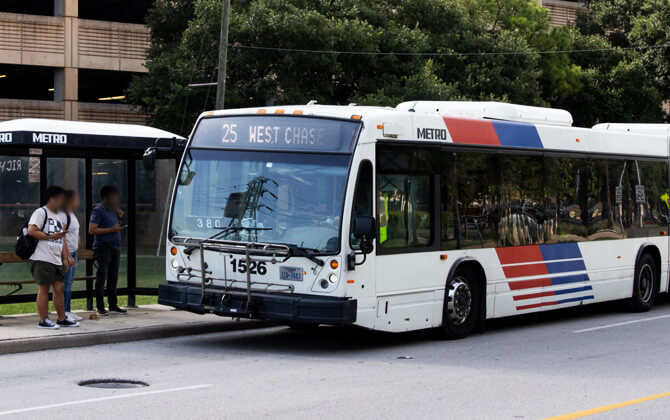
METRO’s stated mission is to provide safe, clean, reliable, accessible, and friendly public transportation for the Houston region. Riders help keep the system safe by following posted rules, respecting operators, and using common courtesy on buses, rail vehicles, stops, and transit facilities.
Basic rider etiquette matters. Allow passengers to exit before boarding, keep the aisle clear, do not block doors, keep phone conversations at a reasonable volume, and have your ticket or payment ready. Priority seating should be left for seniors, riders with disabilities, and people who need it.
METRO prohibits conduct that threatens safety, disrupts operations, or violates law. This includes fighting, threats, abusive language, disorderly conduct, theft, vandalism, fare misuse, unlawful drug use, unlawful weapons, smoking, open flames, alcohol consumption, and eating or drinking on buses and rail vehicles.
Code of Conduct
METRO’s Code of Conduct is designed to protect passengers, employees, and the transit system. It covers common courtesy, prohibited conduct, enforcement, and the suspension process.
Riders must follow operator instructions, obey posted signs, stand behind the yellow line near the operator, and avoid holding doors open or interfering with public transport operations. METRO property may not be used for non-transit purposes without permission.
METRO Police Officers may remove individuals for prohibited conduct and issue a written Suspension Notice. Depending on the violation, suspensions may last up to 14 days, 30 days, 60 days, or one year. Severe offenses may lead to a permanent ban. A person who receives a Suspension Notice may appeal within five business days by following the instructions in the notice.
Traveling with Luggage
METRO local buses are ADA accessible and include free Wi-Fi and video surveillance cameras. They can also carry up to two bikes on the front bike rack. Space for large bags is limited on local buses, so keep luggage close and out of the aisle.
Park & Ride commuter express buses are also ADA accessible and include free Wi-Fi and video surveillance cameras. These buses can store larger baggage and bikes in externally accessible compartments. On METRORail, riders may bring bikes on board, and vehicles are ADA accessible.
Route 500 to George Bush Intercontinental Airport allows baggage on board. The trip between Downtown Houston and IAH takes around 40 minutes, and the route operates every 30 minutes daily, including holidays, from 5:35 a.m. to 8:00 p.m. If you have oversized baggage, call 713-635-4000 to confirm details before traveling.
| Service detail | Timings |
|---|---|
| Route 500 Downtown Houston-IAH running time | About 40 minutes |
| Route 500 frequency | Every 30 minutes |
| Route 500 operating hours | Daily, including holidays, from 5:35 a.m. to 8:00 p.m. |
Tips for riders
Plan your trip before you leave. Use the RideMETRO app, METRO website, Google Maps, or Apple Maps to check your route, schedule, real-time arrivals, station map, and transfer options.
Arrive at the stop a little early. Check the route number and destination on the digital sign before boarding, then enter through the front doors and pay your fare. If you are using a Park & Ride mobile ticket or pass, make sure it is ready before you board.
Keep your belongings close and out of the aisle. If you use a wheelchair, scooter, walker, or other mobility device, wait for the operator to deploy the accessible ramp.
Cash fares do not include transfers, so a RideMETRO Fare Card, app payment, contactless card, or mobile wallet is usually easier if your trip includes more than one METRO service.
If a detour or service change could affect your ride, sign up for service alerts by phone or email. It is a small step, but it can save you from waiting at the wrong stop.
Brief History and Recent Service Improvements
METRO was created after Texas authorized local transit authorities in 1973. Houston-area voters approved the agency in 1978, along with a one-cent sales tax to support operations. Service began in January 1979, when METRO took over the City of Houston’s HouTran bus system.
Over time, METRO expanded beyond buses to include light rail, bus rapid transit, HOV and HOT lanes, and paratransit service. The Red Line opened on January 1, 2004 and was later extended to 12.8 miles (about 20.6 kilometers). The Red Line extension opened in 2013, and the East End / Green Line opened in 2015. METRORapid Silver Line opened on August 23, 2020.
A major bus service change came with the New Bus Network in August 2015. METRO redesigned fixed routes into a more frequent, grid-based network with better weekend service and improved connections, without increasing operating costs.
More recently, METRO has focused on safety, cleanliness, reliability, accessibility, and customer experience through METRONext and METRONow. In 2024, METRO announced the indefinite postponement of the University Line, which had been planned as part of future expansion. In 2025, METRO introduced a new electronic account-based fare system with a reusable card, mobile payment options, and more ways to pay.
In 2025, METRO recorded 77,996,900 total rides across the system and 63,315,900 bus boardings. The bus network remains the core of local transportation in Houston and much of Harris County.
Best Places to Reach by METRO Bus
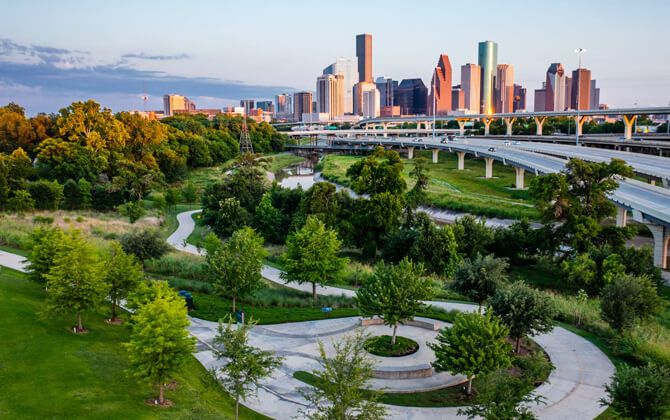
METRO Bus is useful for reaching many of Houston’s most important destinations, including downtown attractions, medical districts, sports venues, universities, airports, and shopping areas. Several places are served by multiple routes, which makes the trip easier to plan.
- Daikin Park — routes include 6 Jensen / Greens, 20 Canal / Memorial, 30 Clinton / Ella, 48 Market, 137 Northshore Express, and 151 Westpark Express.
- Discovery Green — routes include 20 Canal / Memorial, 82 Westheimer, and 433 Silver Line.
- George R. Brown Convention Center — routes include 20 Canal / Memorial, 82 Westheimer, and 433 Silver Line.
- Hermann Park — routes include 40 Telephone / Heights, 56 Airline / Montrose, 51 Hardy-Kelley, and 85 Washington.
- Houston Zoo — routes include 28 OST-Wayside and 56 Airline / Montrose.
- Museum District — routes include 11 Almeda / Lyons, 82 Westheimer, 5 Southmore, 28 OST-Wayside, and 56 Airline / Montrose.
- NRG Park — routes include 6 Jensen / Greens, 11 Almeda / Lyons, 40 Telephone / Heights, 41 Kirby / Polk, 51 Hardy-Kelley, 52 Hardy-Ley, and 137 Northshore Express.
- Shell Energy Stadium — routes include 6 Jensen / Greens, 20 Canal / Memorial, 30 Clinton / Ella, 48 Market, 137 Northshore Express, and 151 Westpark Express.
- Texas Medical Center — routes include 5 Southmore, 28 OST-Wayside, and 56 Airline / Montrose.
- Theater District — routes include 20 Canal / Memorial, 44 Acres Homes, and 162 Memorial Express.
- Toyota Center — routes include 20 Canal / Memorial, 44 Acres Homes, and 162 Memorial Express.
- William P. Hobby Airport — routes include 44 Acres Homes, 82 Westheimer, 85 Washington, 161 Wilcrest Express, and 162 Memorial Express.
Popular METRO Bus lines include 10, 79, 67, 84, and 30.
Downtown Houston and Convention District
Downtown Houston is one of the easiest areas to reach by METRO. Bus routes, rail lines, and transfer points connect downtown with neighborhoods across the city, while Downtown Transit Center serves as a key hub.
METRO’s network includes 108 bus routes with nearly 9,000 stops, plus 22.9 miles (about 36.9 kilometers) of METRORail connecting downtown to places such as the East End, Museum District, Texas Medical Center, and NRG Park. The standard fare is $1.25.
The Red Line crosses downtown north-south in under 10 minutes, with stops connecting riders to the Historic District, Trebly Park, and Downtown Transit Center. The Green and Purple lines run east-west on shared tracks and serve the Theater District, Discovery Green, George R. Brown Convention Center, and Shell Energy Stadium.
For airport travel, Route 500 IAH Downtown Direct offers nonstop service between downtown Houston and George Bush Intercontinental Airport. It runs daily every 30 minutes from 5:30 a.m. to 8:00 p.m., connects the George R. Brown Convention Center area with IAH Terminal C, and costs $4.50 one way.
Texas Medical Center and Major Employment Areas
The Texas Medical Center is a 2.1-square-mile area (about 5.4 square kilometers) of hospitals, research institutions, medical schools, and health facilities southwest of downtown Houston. METRO reaches the area by METRORail Red Line and multiple local bus routes.
The Red Line runs along Main Street and connects downtown Houston with the Texas Medical Center. Depending on your destination, you can exit at Memorial Hermann Hospital / Houston Zoo, Dryden / TMC, or TMC Transit Center. Riders coming from the Green or Purple Line can transfer to the Red Line at the Central Stations downtown.
Local bus routes serving the Texas Medical Center area include 2 Bellaire, 4 Beechnut, 10 Willowbend, 11 Almeda / Lyons, 14 Hiram Clarke, 27 Shepherd, 28 OST-Wayside, 41 Kirby / Polk, 56 Airline / Montrose, 60 Cambridge, 68 Braeswood, 84 Buffalo Speedway, and 87 Sunnyside.
METRO curb2curb also offers transfer options toward the Texas Medical Center area through the 314 Hiram Clarke and 344 Acres Homes services. Other major employment areas reachable by METRO include downtown Houston, the Theater District, EaDo, Second Ward, and Third Ward.
Stadiums, Universities, Shopping Areas, and Visitor Attractions
METRO Bus and METRORail make it easier to reach Houston’s stadiums, universities, shopping areas, and visitor attractions without driving and paying parking charges.
Route 500 IAH Downtown Direct links George Bush Intercontinental Airport with downtown Houston, including stops for the George R. Brown Convention Center area, Discovery Green, Daikin Park, and Shell Energy Stadium. The route operates seven days a week and costs $4.50 one way.
METRORail also serves major destinations. The Red Line reaches NRG Park, the Museum District, Hermann Park, Texas Medical Center, and Houston Zoo. The Green and Purple lines connect downtown Houston with Discovery Green, Daikin Park, Shell Energy Stadium, and the east side of the city. The Purple Line also serves the University of Houston and Texas Southern University.