Valley Metro Light Rail is the rail-based public transport system serving the Phoenix metropolitan area in Arizona, with light rail service in Phoenix, Tempe, and Mesa and a streetcar line in Tempe. The system opened on December 27, 2008, and has grown through extensions, infill stations, and the Valley Metro Streetcar. As of June 2025, the network includes two light rail lines and one streetcar line, with 51 light rail stations, 15 streetcar stations, and 38.5 miles (62 km / 38.5 miles) of combined track.
| Key | Information |
|---|---|
| System | Valley Metro Light Rail and Valley Metro Streetcar |
| Area served | Phoenix, Tempe, and Mesa, Arizona |
| Opening date | December 27, 2008 |
| Lines | A Line, B Line, and S Line Streetcar |
| Stations | 51 light rail stations and 15 streetcar stations as of June 2025 |
| Track length | 38.5 miles (62 km / 38.5 miles) |
| Typical full-service opening hours | About 4:30 a.m. weekdays and 4:50 a.m. weekends |
| Typical full-service closing time | About 11:00 p.m. daily |
| Airport connection | PHX Sky Train transfer at 44th St/Washington |
Valley Metro Light Rail Map
The Valley Metro Light Rail map shows all available lines and stations. Click on the map to enlarge it or download the Valley Metro Light Rail map in PDF format.
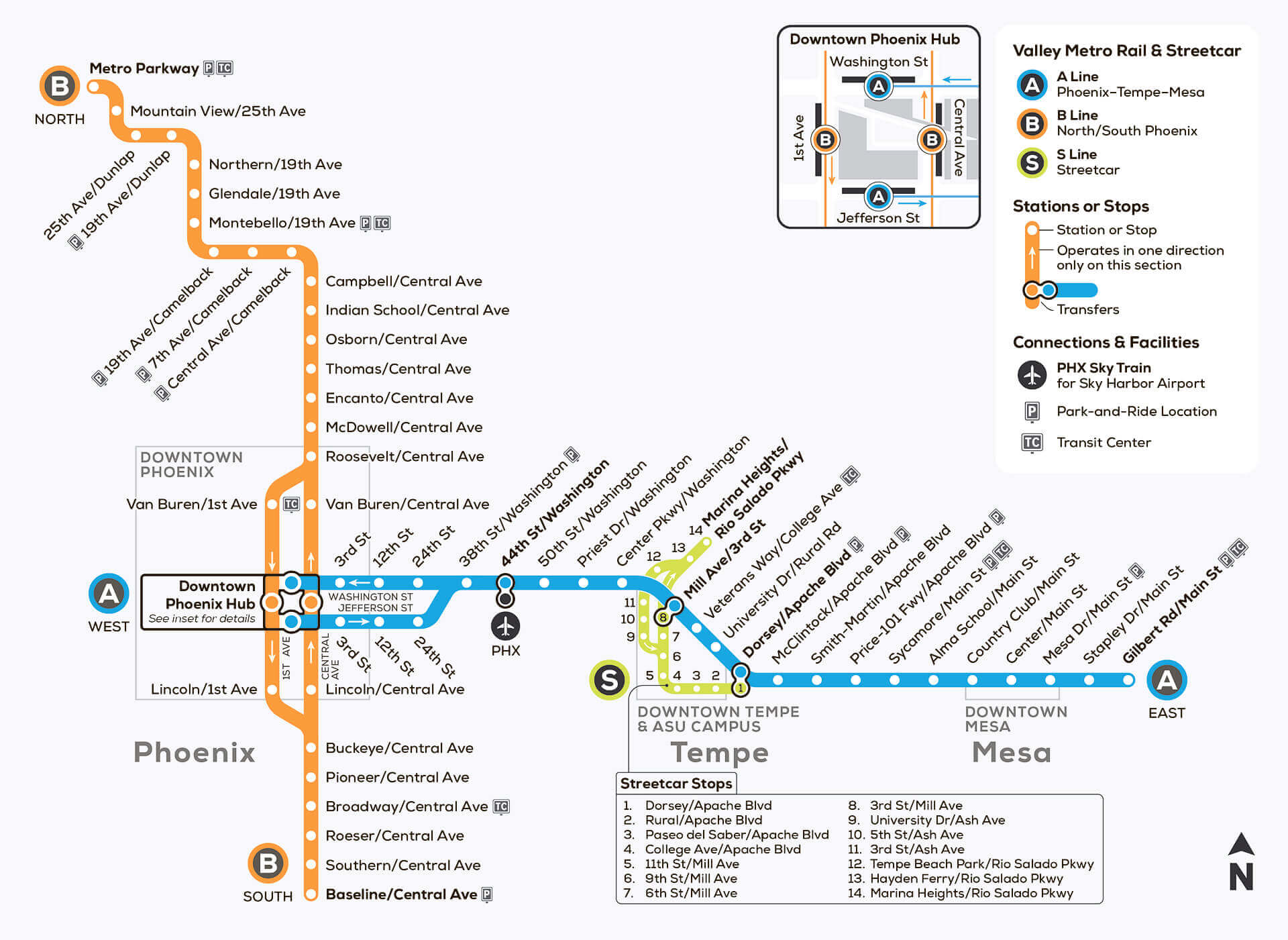
Valley Metro Light Rail Lines and Stations
Valley Metro Rail operates as a connected city transport system with two main light rail routes and the Tempe streetcar. The A Line runs east-west from Downtown Phoenix Hub to Gilbert Road/Main Street. The B Line runs north-south from Metro Parkway to Baseline/Central Avenue. The S Line Streetcar links Marina Heights/Rio Salado Parkway with Dorsey/Apache Boulevard in Tempe.
Stations are generally located at street intersections, with platform access at the ends. The system is designed for ADA accessibility and level boarding, which makes the route plan easy to follow for daily riders and visitors.
| Line | Details |
|---|---|
| A Line | 28 stations; Downtown Phoenix Hub to Gilbert Road/Main Street |
| B Line | 24 stations; Metro Parkway to Baseline/Central Avenue |
| S Line Streetcar | 14 stations; Marina Heights/Rio Salado Parkway to Dorsey/Apache Boulevard |
A Line: Phoenix–Tempe–Mesa
The A Line is the east-west Valley Metro Light Rail route. It connects Downtown Phoenix Hub with Gilbert Road/Main Street, passing through Phoenix, Tempe, and Mesa. The line follows Washington Street in Phoenix, continues through Tempe, and then runs along Apache Boulevard and Main Street into Mesa.
This route is especially useful for trips to Downtown Tempe, ASU, downtown Mesa, and the PHX Sky Train transfer at 44th St/Washington. As of June 2025, the A Line serves 28 stations and connects with the B Line in Downtown Phoenix.
- Route: Downtown Phoenix Hub to Gilbert Road/Main Street
- Cities served: Phoenix, Tempe, and Mesa
- Opened: December 27, 2008
- Stations: 28
- Airport connection: PHX Sky Train at 44th St/Washington
B Line: North/South Phoenix
The B Line is the north-south light rail route in Phoenix. It runs from Metro Parkway near the former Metrocenter Mall area to Baseline/Central Avenue in South Phoenix, with Downtown Phoenix Hub serving as the transfer point to the A Line.
The B Line became part of the two-line system after the South Central Extension opened on June 7, 2025. Its corridor includes Baseline/Central Avenue, Central Avenue, Downtown Phoenix, Camelback Road, 19th Avenue, Dunlap Avenue, and 25th Avenue.
- Route: Metro Parkway to Baseline/Central Avenue
- Stations: 24
- Main transfer: Downtown Phoenix Hub
- Typical daytime frequency: every 12 minutes on weekdays and Saturdays, and every 20 minutes on Sundays
Major Stations and Destinations
Several Valley Metro Light Rail stations act as key transfer points, visitor stops, or commuter hubs. These are the stations many riders check first when looking at a stations map, stations list, or trip route plan.
| Station | Details |
|---|---|
| Downtown Phoenix Hub | Central transfer point between the A Line and B Line in Downtown Phoenix |
| Metro Parkway | Northern terminus of the B Line; opened in 2024 as part of Northwest Extension Phase II and noted as the system’s first elevated station |
| Baseline/Central Avenue | Southern terminus of the B Line, added with the South Central Extension in 2025 |
| 44th St/Washington | A Line station with PHX Sky Train access to Phoenix Sky Harbor International Airport |
| Mill Avenue/3rd Street | Key Tempe stop with access to downtown Tempe, ASU, and the Tempe Streetcar |
| Dorsey/Apache Boulevard | Transfer point between the A Line and the S Line Streetcar |
| Sycamore/Main Street | Main Street corridor station serving Mesa |
| Mesa Drive/Main Street | Downtown Mesa corridor station |
| Stapley/Main Street | Mesa station on the Gilbert Road Extension |
| Gilbert Road/Main Street | Eastern terminus of the A Line |
Schedule, Hours, and Frequency
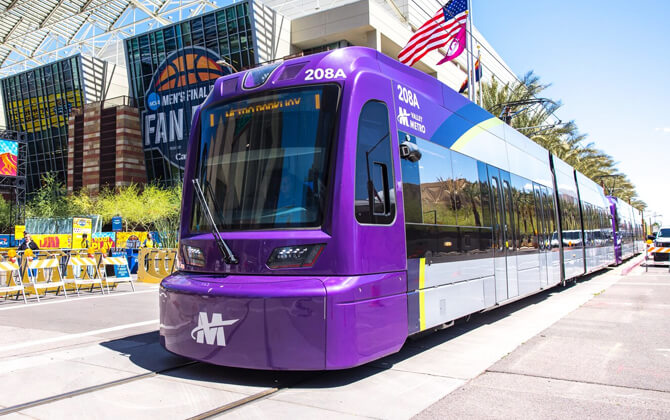
Valley Metro Light Rail runs seven days a week. Full rail service usually starts at about 4:30 a.m. Monday through Friday and about 4:50 a.m. on Saturdays and Sundays. Full service ends at about 11:00 p.m. daily, though limited early-morning and late-night service extends the operating hours on parts of the system.
For the exact train schedule, schedule today, timings today, and last train times, riders should check the current route timetable before traveling. Service can vary by line, direction, and time of day.
| Service detail | Timings |
|---|---|
| Full-service starting time on weekdays | Approximately 4:30 a.m. |
| Full-service starting time on weekends | Approximately 4:50 a.m. |
| Typical full-service closing time | Approximately 11:00 p.m. daily |
| Limited early and late service | As early as 3:30 a.m. and as late as 1:00 a.m. on selected segments |
| Weekday daytime frequency | About every 12 minutes |
| Saturday daytime frequency | About every 15 minutes |
| Sunday and holiday frequency | About every 20 minutes all day |
| Evening frequency | About every 20 minutes from around 8:00 p.m. until close of service |
| End-to-end running time | About 110 minutes for a complete trip |
Weekday, Weekend, and Evening Service
Weekday working hours are built around frequent daytime service, with trains generally arriving every 12 minutes. On Saturdays, daytime headways are usually every 15 minutes. Sundays and holidays are simpler: trains generally run every 20 minutes all day.
Evening service is less frequent. Trains typically run every 20 minutes after the daytime peak and continue that pattern until the end of service. Because the closing time and last train can vary by station and direction, checking the timetable for your exact stop is the safest move.
Fares, Tickets, and Payment Options
Valley Metro fare payment options include paper tickets, passes, the Valley Metro app, and the reloadable Copper Card. For light rail, a one-way ticket price listed in the draft is $2.00 USD, and an all-day pass costs $4.00 USD. If you are making a round trip, the day pass is often the better value.
| Fare item | Price |
|---|---|
| One-way light rail ticket | $2.00 USD |
| All-day pass | $4.00 USD |
| Copper Card issuance charge | $4.00 USD one-time charge |
Fare prices, pass rules, and eligibility can change, so riders should check current fare information before buying. Valley Metro’s Smart Fare system also helps regular riders avoid paying more than the daily, weekly, or monthly maximums.
Smart Fare and Copper Card
Smart Fare is available through the Valley Metro app or with a Copper Card. Pick one payment method and use it consistently, because each app account and each Copper Card has its own balance and fare-capping progress.
- Create a Valley Metro app account or buy a Copper Card.
- Add funds before you ride.
- Tap the Copper Card on the purple fare reader at light rail stations and on buses, or scan the app QR code.
- Keep using the same payment method so fare capping works correctly.
You can reload a Copper Card online, at retail locations, or at fare vending machines. Autoload, balance checks, trip history, transaction history, and lost-card deactivation are available through the fare account system.
Ticket Machines and Proof of Payment
Valley Metro Rail uses proof of payment. Buy or validate your ticket or pass before boarding, then keep it with you for the whole ride. Fare inspectors may ask to see it at any time.
Fare vending machines are located at each light rail station. At the machine, choose your fare category, select a ticket or pass type, confirm whether you need validation right away, and pay by the available method. If you already have a pre-purchased pass, validate it at the machine before riding when required.
All-day passes are valid on the day they are activated. Multi-day passes are valid for consecutive days, with the expiration date printed on the pass.
Reduced Fares and Eligibility
Reduced fares are available for eligible riders, including youth ages 6 to 18, seniors age 65 and older, persons with disabilities, and Medicare card holders. Riders need proper proof of eligibility, and reduced Smart Fare requires a reduced fare account.
Children ages 10 and younger may ride free when accompanied by a paying adult, with a limit of four children per paying adult, according to the fare information in the draft. Middle and high school students may qualify for reduced student pricing with proper ID.
Connections with Buses, Streetcar, and Transit Centers
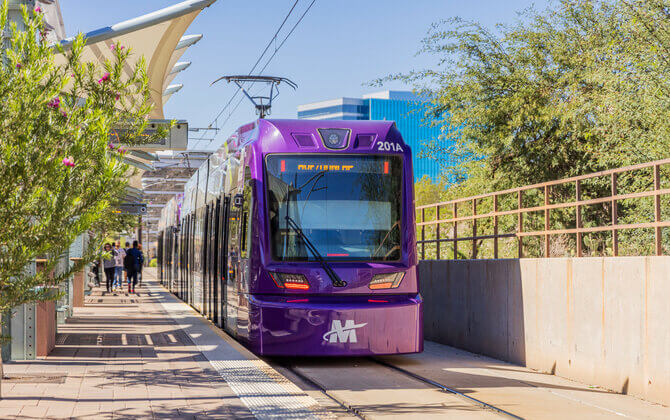
Valley Metro Light Rail is part of the wider Valley Metro public transport network. That means riders can connect between light rail, local bus service, limited-stop routes, Express buses, RAPID commuter routes, community circulators, and the Tempe Streetcar.
Five light rail stations have associated transit centers for bus-to-rail transfers. Ten stations have park-and-ride facilities, with about 4,500 public parking spaces combined across the system. For many riders, these connections make the rail line a practical backbone for local transport across the Phoenix metro area.
Valley Metro Bus Connections
Valley Metro operates more than 100 bus routes across the Phoenix area, including local routes, limited-stop services, Express service, RAPID commuter routes, and community circulators. Bus frequency, operating hours, and service days vary by route, so check the bus schedule before you travel.
Light rail stations and transit centers work as transfer points between rail and bus service. LINK routes and other bus services are designed to help riders reach rail stations, employment areas, downtown districts, and neighborhood destinations.
Tempe Streetcar and Downtown Transfers
The Valley Metro Streetcar, also called the S Line, serves downtown Tempe and the Arizona State University area. The route is 3 miles (4.8 km / 3 miles) long and connects Marina Heights/Rio Salado Parkway with Dorsey/Apache Boulevard.
The streetcar connects with the A Line at Dorsey/Apache Boulevard. Riders can also walk between the Third St/Mill and Third St/Ash streetcar stops and the Mill Avenue/3rd Street light rail station. Streetcar service runs seven days a week, with vehicles arriving about every 15 to 20 minutes depending on the time of day.
Airport Connection to Phoenix Sky Harbor
The PHX Sky Train provides the airport connection between Valley Metro Rail and Phoenix Sky Harbor International Airport. The transfer point is 44th St/Washington, where riders can move between the A Line and the free airport people mover.
The PHX Sky Train runs 24 hours a day, seven days a week. It connects the airport terminals, East Economy Parking, 24th Street Economy Parking, the Rental Car Center, and Valley Metro Rail. During the day, wait times can average about 3.5 to 7 minutes; overnight, waits may be 15 minutes or more.
44th St/Washington Station
44th St/Washington Station, also known as PHX Sky Harbor Airport station, is on the A Line in Phoenix. It is located at 4299 East Washington Street and opened on December 27, 2008.
The station has one island platform and two tracks at street level. It connects with the PHX Sky Train by escalator and skyway. It also connects with Valley Metro Bus routes 1, 32, and 44, along with Greyhound Lines and Flixbus service.
Transferring to the PHX Sky Train
To transfer from the airport to light rail, ride the PHX Sky Train to the 44th Street Station and follow signs for Valley Metro Rail. Ticket kiosks are on Level 2, while the PHX Sky Train platform is on Level 5. From there, use escalators or elevators and the enclosed pedestrian bridge to reach the rail station.
At a relaxed pace, the transfer takes about 5 minutes. During nightly maintenance windows, staged buses may operate from 10:00 p.m. to 5:00 a.m. on the south side of the 44th Street PHX Sky Train Station, serving Terminal 3 outer curb by Door 8 and Terminal 4 Level 2 outside Door 22.
- PHX Sky Train is free and operates 24/7.
- 44th St/Washington is the Valley Metro Rail transfer station.
- Daytime waits are usually shorter than overnight waits.
- Allow extra time during nightly maintenance.
How to Ride Valley Metro Light Rail
Riding Valley Metro Light Rail is simple: plan the trip, buy or activate your fare, wait on the correct platform, board the train in the right direction, and keep your ticket or pass available as proof of payment.
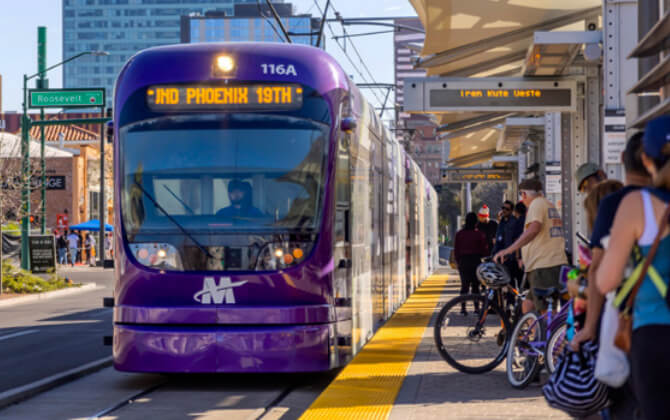
Trains display their final destination on the front and side. On board, stop announcements and signs help you follow the route. Doors open and close automatically, so be ready to exit when your station is announced.
Planning Your Trip
Start with the Valley Metro trip planner, system map, and current route schedule. The Valley Metro app can show step-by-step trip planning, real-time bus and light rail locations, service alerts, favorite stops, routes, and account details.
Arrive at the station at least five minutes before departure. If you are using a pass that needs validation, activate it before boarding. For the most reliable timings today, check the schedule today for your station, direction, and transfer point.
Boarding, Riding, and Transferring
Before boarding, let passengers exit first. Check the destination sign, then board through any open door. If you are standing, hold a rail or pole, especially when the train starts or stops.
For transfers, follow station signs and check whether your next leg is light rail, bus, streetcar, or PHX Sky Train. If you are unsure about the route or transfer, ask a Valley Metro employee or use the app before leaving the platform.
- Buy or activate fare before boarding.
- Keep your ticket, pass, Copper Card, or app fare ready for inspection.
- Use bike areas and accessibility spaces correctly.
- Do not block doors or aisles.
Park-and-Ride and Bike Access
Valley Metro has park-and-ride facilities at selected stations, with about 4,500 public parking spaces across the system. These lots are intended for daily transit use. Parking for more than 24 hours is prohibited and may result in towing.
The draft does not list station parking charges or parking charges per day, so riders should check current station information before driving to a park-and-ride. Overnight storage while traveling is generally not the purpose of these facilities.
Bikes are allowed on light rail at all hours with no additional fare. Look for bicycle symbols on train doors, board near the bike area, and use the racks in the center section of the car when available. If the rack is full, you may stand with your bike as long as you do not block the aisle or doorway.
Bicycles may be secured only at approved racks or lockers. Bikes locked to station structures, railings, or fences may be removed after warning procedures. At the Tempe Transportation Center, the Bicycle Cellar offers secured bike storage, gear, repairs, showers, and lockers.
Safety, Rules, and Rider Etiquette
Valley Metro rules are meant to keep the system safe, comfortable, and easy to use. Stay behind platform edges, do not step in front of trains or buses, and use handrails when boarding, exiting, or standing.
- Have your fare ready before boarding.
- Let exiting passengers leave before you get on.
- Keep aisles and doors clear.
- Use headphones at a reasonable volume.
- Do not litter, loiter, or bring open alcohol containers.
- Service animals are allowed but must remain under control and off seats.
- Non-service animals must be in carriers.
- Be considerate with bikes, bags, strollers, and luggage.
If you are not sure about a platform, route, transfer, or boarding rule, ask for help before the train arrives. It is easier than trying to fix the trip after you board the wrong service.
Brief History and Recent Extensions
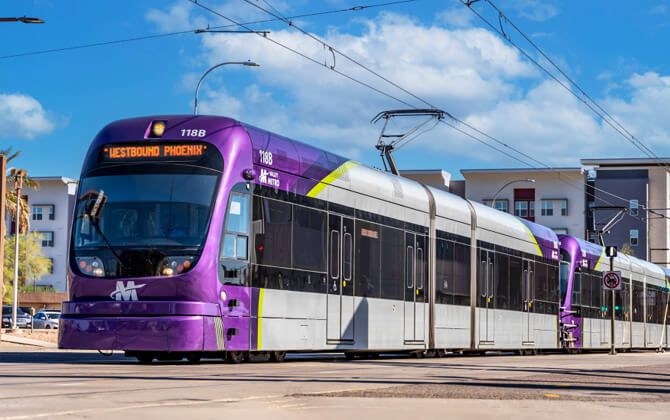
Valley Metro Rail opened on December 27, 2008, with a 20-mile (32 km / 20 miles) starter line connecting Phoenix, Tempe, and Mesa. Planning for the modern rail network followed earlier regional transit ideas, including the 1989 ValTrans plan and later voter-approved funding measures.
Construction began in March 2005 after additional funding approval through Proposition 400 in 2004. The initial line opened with 28 stations and became one of the region’s major transportation investments.
The Central Mesa Extension opened on August 22, 2015, extending service from Sycamore/Main Street to Mesa Drive/Main Street and adding four stations in downtown Mesa. Northwest Extension Phase I followed in 2016, extending the line north to 19th Avenue/Dunlap.
Later additions included the 50th Street infill station in 2019, the Gilbert Road Extension in 2019, the Tempe Streetcar in 2022, and Northwest Extension Phase II to Metro Parkway on January 27, 2024. The South Central Extension opened on June 7, 2025, creating the current two-line A Line and B Line structure.
Future Expansions and Planned Projects
Valley Metro’s expansion program includes high-capacity light rail corridors, streetcar work, and long-term regional transit improvements. The program is tied to more than $6.9 billion in transit improvements through 2034.
The South Central Extension/Downtown Hub opened in 2025 with a 5.5-mile (8.9 km / 5.5 miles) corridor and eight stations connecting Downtown Phoenix with southern neighborhoods along Central and 1st Avenues. The project also includes a 110-space park-and-ride facility at Baseline Road, more than 550 new trees and desert plantings, 18 art installations, and utility upgrades.
The Capitol Extension is a 1.8-mile (2.9 km / 1.8 miles) project in design. It is planned to run west from Downtown Phoenix along Washington Avenue toward the State Capitol area, then south along 15th Avenue and back east along Jefferson Avenue to reconnect with downtown.
The I-10 West Light Rail Transit Project is planned as a 10-mile (16.1 km / 10 miles) extension connecting with the Capitol Extension and continuing toward the Desert Sky Transit Center at 79th Avenue. The scope is expected to include eight stations, three park-and-ride facilities, and a crossing of the South Mountain Freeway.
Other planned or studied projects include the West Phoenix/Central Glendale corridor, a potential 5-mile (8 km / 5 miles) route from 19th Avenue and Camelback Road toward Glendale Avenue and Glenn Drive. The Northwest Phase II Light Rail Extension, a 1.6-mile (2.6 km / 1.6 miles) project to the former Metrocenter Mall area, was completed on January 27, 2024.
Valley Metro is also continuing streetcar planning. The Rio East-Dobson Streetcar Extension is in engineering design and is planned to extend the S Line from Marina Heights/Rio Salado Parkway to Dobson Road and Main Street in Mesa by 2029.
Best Stations for Visitors and Local Destinations
Valley Metro Light Rail is especially useful for visitors traveling between Downtown Phoenix, Phoenix Sky Harbor International Airport, Tempe, ASU, and Mesa. The best station depends on your destination, but downtown stops and transfer stations are often the most convenient.
| Station | Details |
|---|---|
| 3rd Street/Jefferson | Downtown Phoenix stop for eastbound service |
| 3rd Street/Washington | Downtown Phoenix stop for westbound service |
| Central Avenue/1st Street | Useful downtown starting point for major attractions |
| 44th St/Washington | Airport transfer to the PHX Sky Train |
| Mill Avenue/3rd Street | Tempe, ASU, Mill Avenue District, and streetcar transfers |
| Country Club/Main Street | Useful stop for Downtown Mesa |
Downtown Phoenix, Sports, and Convention Center
Downtown Phoenix is one of the easiest areas to reach by Valley Metro Light Rail. A one-way ticket costs $2.00 USD, and an all-day pass costs $4.00 USD. From downtown stations, visitors can walk to hotels, restaurants, sports venues, theaters, and the Phoenix Convention Center.
Stations in the downtown area also provide access to Footprint Center, Chase Field, CityScape, the Heard Museum, and the Phoenix Art Museum. For events, games, and conventions, the train is a practical way to avoid driving into the busiest part of the city.
Tempe, ASU, and Mill Avenue
Downtown Tempe is a strong light rail destination for Arizona State University, Tempe Town Lake, Hayden Butte, Rio Salado Park, and the Mill Avenue District. The A Line connects Tempe with Downtown Phoenix, Phoenix Sky Harbor Airport via PHX Sky Train, and Mesa.
Mill Avenue/3rd Street is the main visitor stop in this area. It also links riders with the Tempe Streetcar, which serves downtown Tempe and runs along the side of the ASU campus. The S Line Streetcar began service on May 20, 2022.
Downtown Mesa and East Valley Stops
Valley Metro Rail runs along Main Street into downtown Mesa and east to Gilbert Road/Main Street. This gives East Valley riders direct rail access to Mesa, Tempe, Phoenix, and the airport connection.
| Station | Details |
|---|---|
| Sycamore/Main St. | Main Street corridor stop at Dobson Road |
| Alma School Rd/Main St. | East Valley Main Street corridor stop |
| Country Club Dr./Main St. | Useful stop for Downtown Mesa |
| Center St./Main St. | Downtown Mesa stop |
| Mesa Dr./Main St. | Downtown Mesa stop added through the Central Mesa Extension |
| Stapley Dr./Main St. | Mesa stop on the eastward extension |
| Gilbert Rd/Main St. | Eastern terminus of the A Line |
Downtown Mesa includes Country Club/Main St, Center/Main St, and Mesa Dr/Main St. The Central Mesa Extension brought rail service directly into downtown Mesa and extended the line from Sycamore/Main Street to Mesa Drive/Main Street.