Dubai Metro is a rapid transit system in Dubai, United Arab Emirates. It operates two main lines, the Red Line and the Green Line, while the Blue Line is planned to open in 2029. Opened on 9 September 2009, it was the first rapid transit network in the Arabian Peninsula and the Gulf Cooperation Council. The system runs underground in central areas and on elevated viaducts elsewhere, with fully automated driverless trains, platform edge doors, and air-conditioned stations and carriages.
| Key | Information |
|---|---|
| System | Dubai Metro |
| Location | Dubai, United Arab Emirates |
| Operational lines | Red Line and Green Line |
| Future line | Blue Line planned for 2029 |
| Opening date | 9 September 2009 |
| Network length | 89.6 km / 55.7 miles |
| Stations | 55 |
| Train type | Fully automated and driverless |
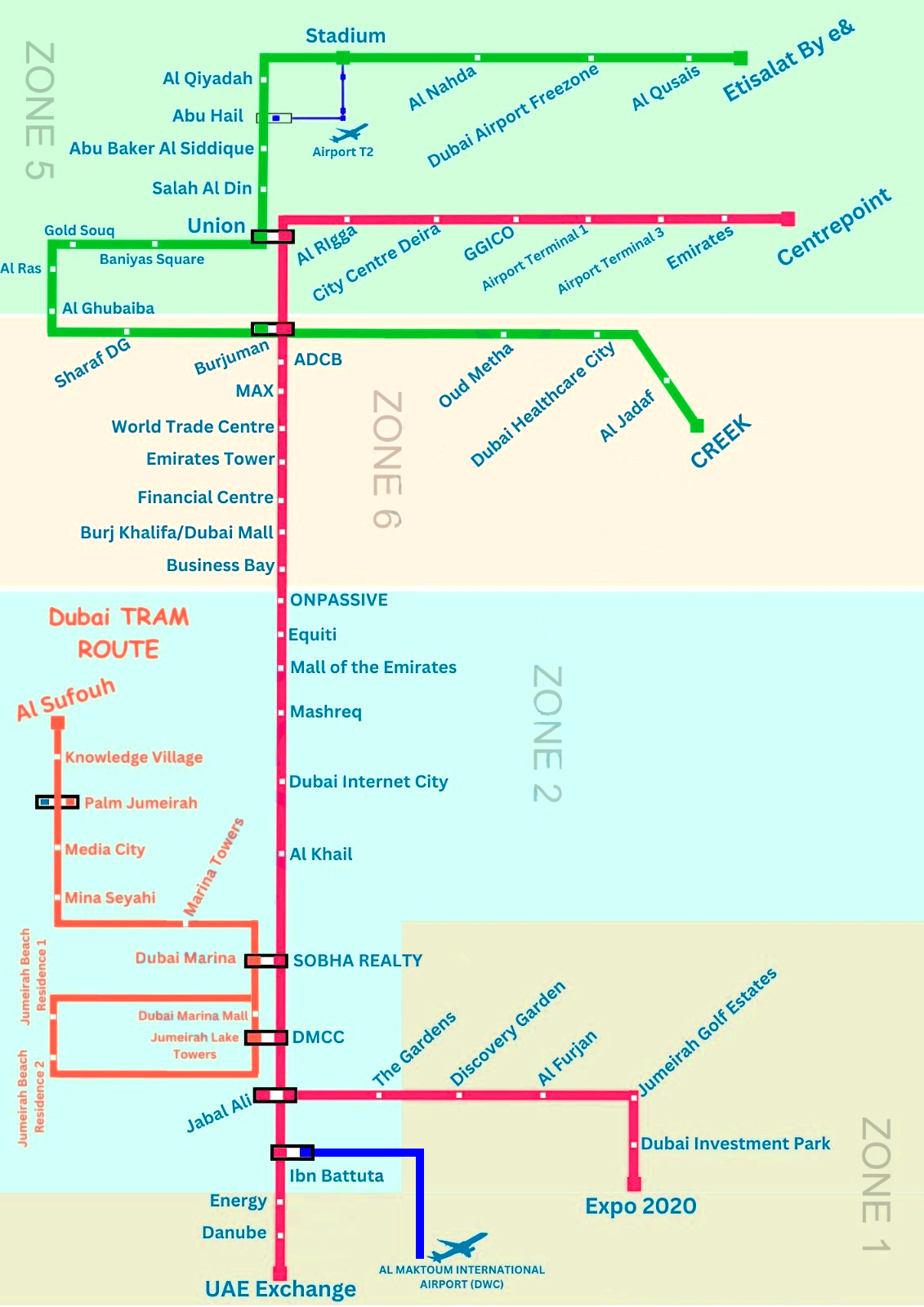
Dubai Metro Map
Map of Dubai Metro showing different lines. Click on the map to enlarge it or download the Dubai Metro map in PDF format.
Lines and Stations
Dubai Metro currently has two operational lines: the Red Line and the Green Line. Together, they cover key residential, commercial, and historic districts across the emirate. A third line, the Blue Line, is under construction and scheduled to open in 2029.
The network totals 89.6 km (55.7 miles) and 55 stations, with 35 stations on the Red Line and 20 on the Green Line. The Red Line serves major destinations such as Mall of the Emirates, Burj Khalifa, and Dubai Marina. The Green Line focuses more on older parts of the city, including Al Ghubaiba, Gold Souk, and Creek. If you are checking a Dubai Metro stations map or stations list, these two lines form the core of the current system.
Red Line
The Red Line runs from the Jebel Ali area to the border with Sharjah. It includes Route 2020, a 15 km (9.3 miles) extension from Jebel Ali Station to Expo 2020. This route also serves Dubai International Airport and some of the city’s busiest business and leisure areas.
Green Line
The Green Line stays within Old Dubai and links stations near historic districts and traditional markets. Transfers to the Red Line are straightforward at Union and BurJuman, the two main interchange stations.
Blue Line
The Blue Line is planned as a 30 km (18.6 miles) route with 14 stations. Once it opens in 2029, it will connect the termini of the Red Line and Green Line with newer parts of the city.
Major Interchange and Terminal Stations
| Station | Details |
|---|---|
| Centrepoint | Red Line terminus |
| e& | Green Line terminus |
| Union | Interchange between Red Line and Green Line |
| BurJuman | Interchange between Red Line and Green Line |
| Creek | Green Line terminus and future Blue Line connection |
| Expo 2020 | Red Line Route 2020 terminus |
The full stations map also shows links to tramway stops and transfer points, making it easier to understand the wider route plan across Dubai.
Schedule, Timetables, and Calendar
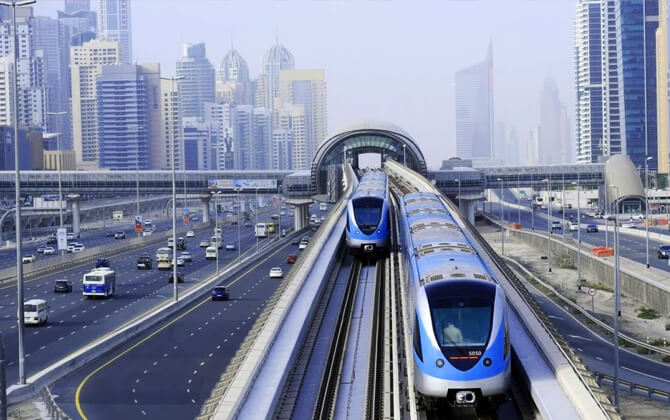
Dubai Metro has long daily operating hours, though opening hours and closing time can change on public holidays or during major events. If you need the latest timings today, schedule today, or route timetable information, check current RTA updates before you travel. First train and last train times can vary by station.
Train frequency is generally every 2 to 3 minutes in peak periods and every 5 to 7 minutes off-peak. That short running time between services makes the metro one of the most practical public transport options in the city.
Metro Stations Opening Hours
| Service detail | Timings |
|---|---|
| Monday to Thursday | 05:00 AM – 12:00 AM (Midnight) |
| Friday | 05:00 AM – 01:00 AM (Next day) |
| Saturday | 05:00 AM – 12:00 AM (Midnight) |
| Sunday | 08:00 AM – 12:00 AM (Midnight) |
Dubai Metro Journeys
The operational network includes the Red Line and the Green Line. These are the main services to check when planning your route, train schedule, or opening times for a specific trip.
| Station | Details |
|---|---|
| Red Line (MRed) | Between Centrepoint (R11) and Expo 2020 (R76) / Life Pharmacy (R42) |
| Green Line (MGrn) | Between e& (G11) and Creek (G30) |
Interchange Stations
| Station | Details |
|---|---|
| Union (R18/G20) and BurJuman (R19/G26) | Interchange between Metro Red Line and Green Line |
| SOBHA REALITY (R36) and DMCC (R37) | Interchange between Metro and Tram |
Tram Stations Opening Hours
| Service detail | Timings |
|---|---|
| Monday to Saturday | 06:00 AM to 01:00 AM (Next day) |
| Sunday | 09:00 AM to 01:00 AM (Next day) |
Calendar Notes
Operating hours, working hours, and opening times may be adjusted for holidays and special events. For the most accurate timetable and schedule, check the latest RTA service announcements before you travel.
This timetable information is meant to help with regular metro and tram trips across Dubai.
Prices, Tickets, and Cards
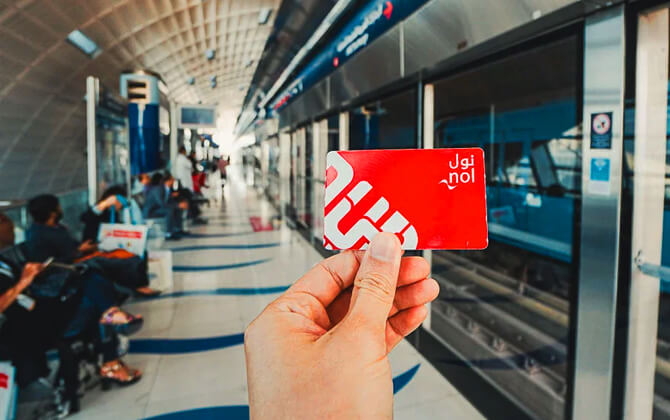
Dubai Metro fare depends on how many zones you travel through. The city is divided into 7 zones, and the system calculates the cost automatically when you tap in and tap out with a nol card or Red Ticket.
Fare Structure
| Ticket Type | 1 Zone / <3 km (<1.9 miles) | 2 Zones | 3+ Zones |
| Standard Adult Ticket (Red) | AED 4.00 (about $1.09) | AED 6.00 (about $1.63) | AED 8.50 (about $2.31) |
| Pre-paid Standard (Silver Nol) | AED 3.00 (about $0.82) | AED 5.00 (about $1.36) | AED 7.50 (about $2.04) |
| Concessionary (Blue Nol) | AED 1.50 (about $0.41) | AED 2.50 (about $0.68) | AED 3.75 (about $1.02) |
| Gold Class (Red Ticket) | AED 8.00 (about $2.18) | AED 12.00 (about $3.27) | AED 17.00 (about $4.63) |
| Gold Class Pre-Paid | AED 6.00 (about $1.63) | AED 10.00 (about $2.72) | AED 15.00 (about $4.08) |
How Fares Are Calculated
- Journeys under 3 km (1.9 miles) or within 1 zone: AED 3.00 (about $0.82) with a Silver Nol card.
- 2 zones: AED 5.00 (about $1.36) with a Silver Nol card.
- 3 or more zones: AED 7.50 (about $2.04) with a Silver Nol card.
- Tram rides: flat AED 3.00 (about $0.82).
- Daily fare cap: AED 14.00 (about $3.81) for Silver and Blue Nol cards.
If you are looking for ticket price, fare calculator, or day pass information, the key thing to know is that the system charges by zones and card type rather than by a fixed citywide fare.
Nol Card Types
- Silver Nol Card: Standard travel card. It costs AED 25.00 (about $6.81), including AED 19.00 (about $5.17) credit and AED 6.00 (about $1.63) card cost.
- Gold Nol Card: Gives access to Gold Class cabins. It costs the same as Silver, but fares are doubled.
- Blue Nol Card: Designed for students, seniors, and people of determination. It costs AED 70.00 (about $19.06).
- Red Nol Ticket: A one-time-use paper ticket. It costs AED 2.00 (about $0.54) plus the fare and is useful for tourists.
Special Discounts
- Children under 5 travel free.
- People of Determination get 50% off with a Blue Nol card.
- Senior citizens aged 60+ get 50% off with a Blue Nol card.
- Students get 50% off with a Blue Nol card.
Tickets and nol cards are available at metro station counters and ticket machines. nol cards can also be bought online through the nol Pay app. Metro travel is cashless, so you need a valid ticket or card before you ride.
Public Transport Card Types in Dubai
Dubai’s nol card is a smart card used across public transport with a single tap. It works on Dubai Metro, buses, Dubai Tram, marine transport such as Dubai Ferry, Dubai Water Taxi, and Dubai Abra, and it can also be used for station parking and other parking charges through RTA parking meters.
The transport map is divided into 7 zones, and your fare is calculated automatically based on how many zones you cross. Transfers between transport modes are possible within 30 minutes, and the fare is deducted from your e-purse at the end of the journey.
There are several card types to match different travel needs:
- Red Ticket — suitable for occasional travelers and short-term use.
- Silver Card — a common choice for regular commuters.
- Gold Card — includes access to Gold Class cabins on the Metro and Tram.
- Blue Card — a personalized card with concessionary fares for eligible users.
For single trips on the Metro, Tram, and bus network, the fare depends on both the card type and the number of zones traveled. Red Ticket fares are AED 4.00, AED 6.00, and AED 8.50 (about $1.09, $1.63, and $2.31). Silver Card fares are AED 3.00, AED 5.00, and AED 7.50 (about $0.82, $1.36, and $2.04). Gold Card fares are AED 6.00, AED 10.00, and AED 15.00 (about $1.63, $2.72, and $4.08) for the same zone bands.
Personalized cards offer discounted travel for eligible groups. Students, social affairs beneficiaries, and senior Emiratis and citizens receive a 50% discount with a personalized card, while people of determination travel free. Children aged 5 and below travel free on all card types.
For frequent travel, nol cards also support pass products. Available pass durations are 7, 30, 90, and 365 days, with prices depending on card type and zones. Anonymous Silver and Gold cards are eligible only for 7-day passes, while registered cards, including Blue Cards, can use all pass durations.
nol cards can also be used for parking charges per day where applicable through RTA parking services. Cards can be purchased and topped up at ticket offices, vending machines, RTA customer happiness centres, authorized sales agents, and online.
Connections to Other Transportation Services
Dubai Metro is tightly integrated with other transportation in Dubai, so it works as part of a larger local transport network rather than as a standalone rail system. Connections include feeder bus services, taxis, the Dubai Tram, and marine transport such as water buses and abras.
Many stations connect with bus routes nearby, and feeder buses are especially useful for neighborhoods not directly served by the metro. If you transfer from the metro to a feeder bus within 30 minutes, the bus ride is free.
Taxi connections are available at most major stations, usually with dedicated taxi stands or lay-bys near station exits. That makes the final part of a trip simple when your destination is not within walking distance.
The metro also links with the Dubai Tram, which connects Dubai Marina to Al Sufouh. These tram connections are particularly helpful along the coast, and the tramway network also connects with the Palm Monorail.
For waterfront trips, marine transport options such as water buses and abras are part of the same integrated public transport system and can be accessed with a nol card.
Because the same card works across metro, tram, bus, and marine transport, changing between city transport modes is fairly seamless.
Connection to Airport
Dubai Metro provides direct airport access to Dubai International Airport (DXB) on the Red Line, which serves Terminals 1 and 3. Stations are connected to the terminals by air-conditioned walkways, escalators, and elevators, so airport transfers are straightforward.
Trains from the airport run roughly every 10 minutes. The main operating hours are the same as the metro schedule across the network.
| Service detail | Timings |
|---|---|
| Monday to Thursday | 5:00 AM to 12:00 AM |
| Friday | 5:00 AM to 1:00 AM (next day) |
| Saturday | 5:00 AM to 12:00 AM |
| Sunday | 8:00 AM to 12:00 AM |
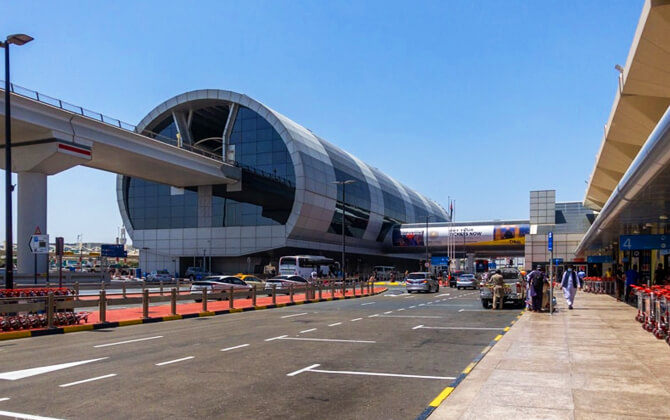
During public holidays and citywide celebrations, opening hours may be extended. For timings today, last train details, or any temporary schedule changes, check the latest RTA information before you travel.
Metro tickets and nol cards are available at ticket offices and vending machines in DXB Terminals 1 and 3. Travelers can choose from different card types, including Silver and Gold.
For Al Maktoum International Airport, the nearest practical metro connection is Ibn Battuta Mall Metro Station. From there, travelers can continue by bus or taxi. RTA bus routes F55 and N55 connect DWC with Expo Metro Station and Ibn Battuta bus and metro stations, with both routes running every 30 minutes.
For easier route planning, the RTA s’hail app can help you check the route, timetable, and transfer options in advance.
Metro Travel Tips
Dubai Metro is a fast, reliable, and cashless way to get around, whether you are commuting, sightseeing, or heading to the airport. It connects major neighborhoods, malls, business districts, and cultural areas, and it links smoothly with bus, tram, and marine transport.
Before you travel, check your route plan, keep your nol card ready, and allow extra time during busy periods or holidays. It sounds basic, but it makes a real difference.
Practical tips for a better journey
- Avoid peak hours when possible, especially around 7:00 to 9:00 AM and 5:00 to 7:00 PM.
- Keep your nol card ready before reaching the gates.
- Use Women & Children carriages if you are traveling with family.
- Do not eat, drink, or chew gum on trains.
- Plan line changes at Union or BurJuman for Red Line and Green Line transfers.
- Leave extra time if you are connecting to feeder bus services or the Dubai Tram.
Ticketing and fare basics
Dubai Metro uses a tap-in, tap-out ticket system. Fares are zone-based and start from AED 3.00 (about $0.82) with a Silver nol card. Cards can be topped up at machines, service centres, or online.
- Silver Card: a practical option for regular standard travel.
- Gold Card: for Gold Class cabins.
- Red Ticket: useful for short-term visitors.
- Personalized cards: better for frequent commuters and eligible discounted travel.
Useful travel notes
Stations are air-conditioned, accessible, and easy to navigate. Many are close to major destinations such as Burj Khalifa/Dubai Mall, Mall of the Emirates, Dubai Marina, and Dubai International Airport.
If you are traveling on a holiday or making a longer trip, check the latest operating hours, schedule today, and last train information before you leave. Frequent service and clear signage make the metro one of the simplest ways to move around Dubai.
Metro Rules and Fines
Dubai Metro rules are enforced strictly to keep the system safe, clean, and comfortable. Fines range from AED 100.00 to AED 2,000.00 (about $27.23 to $544.52), so it is worth knowing the basics before you travel.
Always carry a valid ticket or nol card, tap in at the gates, and tap out when leaving. Keep your ticket until you exit, make sure your card has enough balance, and follow station signs and staff instructions.
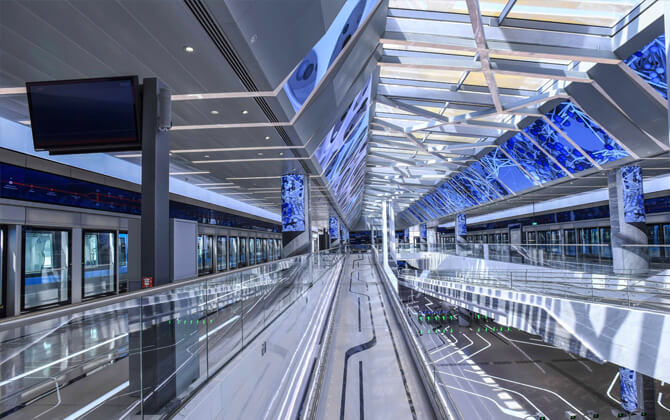
Common Rules to Follow
- No eating or drinking on trains or platforms, including chewing gum.
- Sealed water bottles may be carried, but they must remain unopened inside metro premises.
- No smoking, vaping, e-cigarettes, alcohol, or illegal substances anywhere in the metro.
- Do not bring prohibited items such as dangerous materials, sharp objects, oversized items, or commercial goods without permission.
- Respect cabin rules, including the Women and Children cabin and the Gold Class cabin.
- Do not litter, spit, block doors, or use emergency equipment without a real emergency.
Selected Fines and Penalties
| Violation | Fine Amount (AED) |
|---|---|
| Traveling without a valid ticket or sufficient Nol balance | AED 200 (about $54.45) |
| Eating, drinking, or chewing gum | AED 300 (about $81.68) |
| Smoking or vaping | AED 500 (about $136.13) |
| Feet on seats | AED 100 (about $27.23) |
| Littering or spitting | AED 500 (about $136.13) |
| Unauthorized photography | AED 1,000 (about $272.26) |
| Bringing prohibited items | AED 500 (about $136.13) |
| Misuse of emergency equipment | AED 2,000 (about $544.52) |
| Using the wrong cabin | AED 100 (about $27.23) |
| Vandalism or graffiti | AED 1,000 (about $272.26) |
Some violations, especially those involving safety systems or indecent behavior, can lead to the highest penalties. Fines generally need to be paid within 60 days.
How to Pay a Metro Fine
You can pay a fine online through the RTA website or app, at an RTA customer service centre, or at ticket vending machines in metro stations. Payment methods include credit or debit cards, cash at service centres, and nol cards.
Special Cabin Rules
- The first cabin of every train is reserved for women and children under 12.
- Men are not allowed in the Women and Children cabin during peak hours from 7:00 to 9:00 AM and 5:00 to 8:00 PM, Saturday to Thursday.
- The Gold Class cabin requires a Gold Class ticket or nol card.
- Violating the Gold Class rule can result in a fine of AED 200.00 (about $54.45).
Fun Facts
Dubai Metro marked its 15th anniversary on 9 September 2024. Since opening in 2009, it has carried more than 2.4 billion passengers and become one of the city’s defining public transport systems.
It has also been known for its scale and automation. The network grew from 10 stations to 53, and from 79 trains to 129, while maintaining a punctuality record of 99.7%.
- The Red Line opened on 9 September 2009 with 10 stations.
- The Green Line followed on 9 September 2011.
- The first metro stop was Dubai International Financial Centre Station, where a golden commemorative coin was placed.
- The system carried more than 110,000 passengers in its first two days.
- Ridership passed 6 million in the first four months.
- The network expanded from 52 km (32.3 miles) to 90 km (55.9 miles) over time.
- Route 2020 opened on 8 July 2020 and added seven stations, including the Expo site.
- The approved Blue Line will run 30 km (18.6 miles) and connect 14 stations.
- Stations are themed around earth, air, fire, water, and heritage.
- The system includes Wi-Fi, full mobile coverage, CCTV monitoring, and dedicated Metro Police.
History
Plans for Dubai Metro began after studies in 1997 showed that Dubai needed a rail system to ease traffic and support urban development. In 2003, under the directive of Sheikh Mohammed bin Rashid Al Maktoum, the project moved into formal planning as the city prepared for strong population and visitor growth.
In 2004, five consortia were shortlisted to build the first section. The main design and build contract was awarded in May 2005 to the Dubai Rail Link consortium, while project and construction management went to a joint venture between Systra and Parsons Corporation. Construction officially started on 21 March 2006.
The metro opened on 9 September 2009 with 10 Red Line stations in service. The public launch took place at 9:09:09 PM, and more than 110,000 passengers used the system in the first two days. Regular service began the next morning, and ridership quickly reached 10 million within five months.
Expansion followed in stages. More Red Line stations opened in 2010 and 2011, the Green Line opened on 9 September 2011, additional Green Line stations were added in 2014, and Route 2020, a 15 km (9.3 miles) extension to Expo 2020, was announced in 2016 and opened in 2020.
Dubai Metro also held a major international record. From 2009 to 2016, it was the world’s longest driverless metro network, a title recognized by Guinness World Records in 2012. It later lost and regained the record for fully automated metro systems before being surpassed again in December 2024.
In November 2023, Dubai announced the Blue Line, a 30 km (18.6 miles) third line with 14 stations and a planned opening in 2029.
Future Expansions
Dubai Metro’s next major expansion is the Blue Line, which is under construction and set to become the city’s third metro line. It is expected to open in 2029 and add 30 km (18.6 miles) of track and 14 stations to the network.
The line is designed to improve access to growing districts such as Ras Al Khor Industrial Area, Al Warqaa, Mirdif, Dubai Creek Harbour, Dubai Silicon Oasis, Dubai Academic City, and Dubai International City. It will also connect with existing and future metro lines, as well as the Etihad Rail network.
Several stations will be modified for the new route, including Creek and Centrepoint, both of which will receive extensions and additional platforms. Dubai Creek Harbour station is planned to become the tallest metro station in the world, while the underground interchange at International City will be a major hub.
The project was approved on 24 November 2023 with an investment of AED 18 billion (about $4.90 billion). It is intended to strengthen public transport in Dubai and improve connectivity for residents and visitors as the city continues to grow.
Longer-term plans also mention possible future lines such as the Purple, Gold, and Pink lines, though those projects remain subject to change.
Nearby Attractions
Dubai Metro is an easy way to reach many of the city’s best-known attractions. The Red Line and Green Line connect shopping malls, heritage districts, beaches, and landmark sights, so planning a day out by station is often the simplest approach.
Popular stops and what you can visit nearby
| Station | Details |
|---|---|
| Burj Khalifa/Dubai Mall Station | Burj Khalifa, Dubai Mall, and Dubai Fountain |
| Mall of the Emirates Station | Mall of the Emirates, Ski Dubai, and Magic Planet |
| DMCC Station | Dubai Marina, Jumeirah Lakes Towers, waterfront dining, and tram connections |
| Al Ras Station | Gold Souk, Spice Souk, and Dubai Creek with traditional abra rides |
| Al Ghubaiba Station | Heritage Village, Sheikh Saeed Al Maktoum House, and creek cruises |
| City Centre Deira Station | Deira City Centre Mall and nearby traditional souks |
| Emirates Towers Station | Museum of the Future and Emirates Towers |
| Max Station | Zabeel Park and Dubai Frame |
| Ibn Battuta Station | Ibn Battuta Mall and Gurunanak Sikh Temple |
| Energy Station | Jebel Ali Hindu Temple |
Some stations also connect with the tramway network, which is handy for reaching places such as Jumeirah Beach, Dubai Marina, Marina Walk, Palm Jumeirah, and Dubai Media City.
Best areas for sightseeing by line
The Red Line is especially useful for modern Dubai attractions, including large malls, business districts, and major landmarks. The Green Line is the better choice for Old Dubai, where you can explore souks, the creek, and traditional neighborhoods.
If you want to combine shopping, culture, and classic city views in one day, the metro makes it surprisingly easy without relying on private transport.