The Lausanne Metro is a two-line urban rail system in Lausanne, Vaud, Switzerland. It is the country’s only metro system and a key part of local transport, linking the city center, Lausanne railway station, the university area, and Ouchy by the lake. Line M2 is the fully automated rapid transit line, while M1 operates as light rail. Parts of the route trace back to 1877, giving the network an unusual mix of transport history and modern city transport.
| Key | Information |
|---|---|
| System | Two-line urban rail network in Lausanne, Switzerland |
| Lines | M1 and M2 |
| Full metro line | M2 |
| Light rail line | M1 |
| Opening of M2 | 27 October 2008 |
| Historic origin | Part of the network has been used for urban rail transport since 1877 |
| Main role | Connects central districts, the railway station, university area, and lakeside |
| Future expansion | Line M3 is planned |
Lausanne Metro Map
Map of Lausanne Metro showing different lines and stations. Click on the map to enlarge it or download the Lausanne Metro map in PDF format.

Structure and Stations
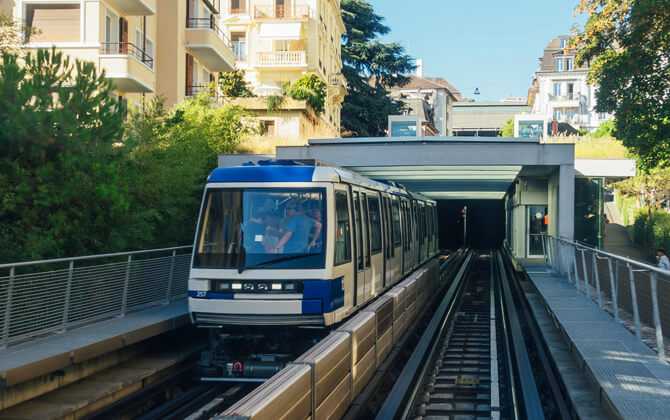
The Lausanne Metro system has two operating lines. Of them, only M2 is a true grade-separated metro. It is fully automated, runs on rubber tyres, and uses technology derived from the Paris Métro. A third line, M3, is planned with the same technology.
The network stands out for its layered route plan. Some sections have carried urban rail traffic since 1877, when the route between the city center and Ouchy opened as Switzerland’s first public funicular railway. Today, the system blends reused alignments with newer tunnels and stations.
Line structure
M1 is 7.8 kilometers (4.8 miles) long and links Lausanne-Flon with Renens to the west. It opened in 1991 and was originally called TSOL until 2000. The line serves the Lausanne campus and is especially important for student travel.
M2 is 5.9 kilometers (3.7 miles) long and runs from Ouchy-Olympique to Croisettes, crossing Lausanne from south to north. It uses part of the former Lausanne-Ouchy railway alignment and also includes a newer route toward Epalinges. The line opened on 27 October 2008.
Stations on Line M2
| Station | Details |
|---|---|
| Ouchy-Olympique | Altitude 373 m (1,224 ft), existing station, outdoors, stopping time 70 sec |
| Jordils | Altitude 392 m (1,286 ft), existing station, outdoors, stopping time 25 sec |
| Délices | Altitude 408 m (1,339 ft), new station, indoors, stopping time 25 sec |
| Montriond | Altitude 420 m (1,378 ft), deleted station, outdoors |
| Grancy | Altitude 425 m (1,394 ft), new station, outdoors, stopping time 25 sec |
| Lausanne railway station | Altitude 451 m (1,480 ft), existing station, underground, stopping time 35 sec, connections R1 R2 R3 R4 R5 R6 R9 |
| Lausanne-Flon | Altitude 473 m (1,552 ft), existing station, underground, stopping time 35 sec |
| Riponne – Maurice Béjart | Altitude 492 m (1,614 ft), new station, underground, stopping time 35 sec |
| Bessières | Altitude 500 m (1,640 ft), new station, underground, stopping time 25 sec |
| Ours | Altitude 517 m (1,696 ft), new station, underground, stopping time 35 sec |
| CHUV | Altitude 570 m (1,870 ft), new station, underground, stopping time 35 sec |
| Sallaz | Altitude 610 m (2,001 ft), new station, indoors, stopping time 35 sec |
| Fourmi | Altitude 651 m (2,136 ft), new station, underground, stopping time 25 sec |
| Vennes | Altitude 683 m (2,241 ft), new station, underground, stopping time 25 sec |
| Croisettes | Altitude 711 m (2,333 ft), new station, underground, stopping time 70 sec |
The underground stations are built as close to the surface as possible. They include stairs, lifts, and facilities for passengers with reduced mobility. Lausanne’s steep slopes help create multi-level access, improve ramp access, and bring in natural light where possible.
Connections and access
At Lausanne-Flon, passengers can transfer to M1 and the R20 service of leb. At Lausanne railway station, M2 connects with RER Vaud regional services and long-distance trains operated by Swiss Federal Railways and TGV Lyria.
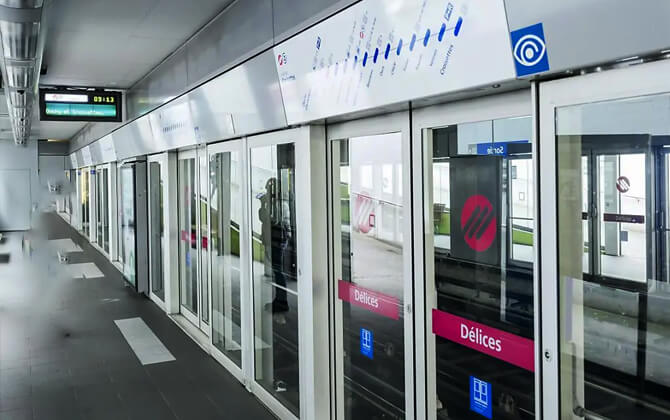
The M2 line is entirely automated and controlled from a central command station. Platform screen doors are installed at stations, and staff are available to help passengers. All new sections were built as double track, and the reused Lausanne-Ouchy alignment was also rebuilt as double track, except for the tunnel under the CFF station.
M2 is known for its steep gradients, with an average incline of 5.7% and slopes reaching 12% in some sections. The route runs mostly in tunnel, and the rubber-tyred system was chosen to handle this terrain. The regular passenger route is 6.5 kilometers (4.0 miles) long from Ouchy to Epalinges and includes a vertical gain of 338 meters (1,109 feet).
Fares and Payment Options
Lausanne Metro fare rules are based on the Mobilis zone system, with prices paid in Swiss francs. The draft does not provide a fare calculator or full ticket price table for each zone, but it does outline the main ticket and pass options for getting around the system. Depending on how often you travel, you can choose single tickets, a day pass, subscriptions, or special cards.
Tickets can be bought in several ways. For occasional trips, you can use the tl app, SMS, or ticket machines. tl_shop is used for annual, monthly, and flexiAbo passes, while FAIRTIQ automatically charges the cheapest fare for your journey, even if you change lines or switch between metro, bus, and other public transport.
Ticket machines at stations and bus stops accept credit cards, debit cards, and cash, though some older machines may not return change. Hotel guests in Lausanne can ask about the Lausanne Transport Card, which gives free travel on covered local transport zones during the stay.
Ticket Categories
Metro ticket categories in Lausanne are based on Mobilis zones. The main products mentioned here are Billet Court Parcours, Billet Grand Lausanne, Carte Journalière, and Billet Mini Groupe.
- Single ticket: suited to occasional travel and available by SMS, in the tl app, or at ticket machines.
- Day pass: allows unlimited travel in selected zones until 5am the next day and is often the better price if you make three or more trips in one day.
- Supersaver ticket: for off-peak trips booked in advance, with discounts of up to 30%.
- Group ticket: available for groups of 10 or more, with discounts of up to 30%.
- Subscription plans: offered for different age groups and for dogs, with weekly, monthly, and yearly options across two to four zones.
Most of Lausanne is covered by zones 11 and 12, and the Grand Lausanne ticket covers this area. A single ticket is valid for one hour, while a day pass stays valid until 5am the following day.
Special Passes
The main passes mentioned for the Lausanne Metro are the Mobilis Pass and the Swiss Pass. The Mobilis Pass is required for travel on the Lausanne metro and is valid across more than 300 municipalities, with connections to other operators in the network, including buses and regional rail.
The Swiss Pass is aimed at wider travel across Switzerland’s public transport network and includes the Half Price subscription. If you are staying overnight in Lausanne, you may also receive the Lausanne Transport Card from your accommodation. It covers metro, bus, and train travel in the included areas.
Visitors can also use the Lausanne City Pass, which includes public transport in Mobilis zones 11 and 12 and access to more than 25 activities at included or reduced prices.
Operation Hours and Timetables
The Lausanne Metro timetable follows a weekday-based pattern, with small changes on weekends and public holidays. For exact operating hours, opening times, timings today, and the last train, passengers should check the official TL app or website before traveling.
M1 runs between Lausanne-Flon and Renens-Gare. The line generally starts in the early morning and continues until after midnight, with station-by-station schedule times shifting slightly along the route.
| Service detail | Timings |
|---|---|
| M1 from Lausanne-Flon | First train 05:00, last train 00:30 |
| M1 from Vigie | First train 05:03, last train 00:33 |
| M1 from Montelly | First train 05:06, last train 00:36 |
| M1 from Provence | First train 05:09, last train 00:39 |
| M1 from Malley | First train 05:12, last train 00:42 |
| M1 from Bourdonnette | First train 05:15, last train 00:45 |
| M1 from UNIL-Chamberonne | First train 05:18, last train 00:48 |
| M1 from UNIL-Sorge | First train 05:21, last train 00:51 |
| M1 from EPFL | First train 05:24, last train 00:54 |
| M1 from Bassenges | First train 05:27, last train 00:57 |
| M1 from Cerisaie | First train 05:30, last train 01:00 |
| M1 from Crochy | First train 05:33, last train 01:03 |
| M1 from Epenex | First train 05:36, last train 01:06 |
| M1 from Renens-Gare | First train 05:40, last train 01:10 |
M2 operates every day between Ouchy-Olympique and Croisettes. Its usual starting time is 05:26. The closing time is normally 23:42, extended to 00:11 on Friday and Saturday. Frequency is typically every 3 to 5 minutes, and every 3 to 6 minutes on Sunday.
| Service detail | Timings |
|---|---|
| M2 Monday | Operating hours 05:26-23:42, frequency 3-5 min |
| M2 Tuesday | Operating hours 05:26-23:42, frequency 3-5 min |
| M2 Wednesday | Operating hours 05:26-23:42, frequency 3-5 min |
| M2 Thursday | Operating hours 05:26-23:42, frequency 3-5 min |
| M2 Friday | Operating hours 05:26-00:11, frequency 3-5 min |
| M2 Saturday | Operating hours 05:26-00:11, frequency 3-5 min |
| M2 Sunday | Operating hours 05:26-23:42, frequency 3-6 min |
The M2 route has 14 stations, and the full running time is about 20 minutes.
Airport Accessibility
The nearest airport to Lausanne is Geneva Airport (GVA). Reaching the metro’s central hub takes about one hour, and there are four trains per hour to Lausanne. A one-way fare is CHF 27, about USD 30.
From the airport, take InterRegio train 1717 toward Brig and get off at Lausanne. From there, it is a short 5-minute walk to Gare station. Then transfer to the M2 toward Epalinges, Croisettes and get off at Flon station.
Flon is the key connection point in the system, with access to both M1 and M2 for onward travel across the city.
History
The history of the Lausanne Metro begins with the former Lausanne-Ouchy railway, opened in 1877 as a funicular. In 1959, the line was rebuilt as a rack railway under the name métro. Flon and Gare CFF stations were demolished and replaced by concrete underground stations, but riders kept the old nickname La Ficelle.
The line also carried freight trains between the main station and the harbor storage area in Flon until a direct connection between Sébeillon freight station and the Flon valley was built in 1954. The route closed completely on 21 January 2006. During the transition, the rolling stock was sold to Villard-de-Lans in France, and a replacement bus service called Métrobus ran until the new metro opened.
M2 opened on 27 October 2008, reusing part of the former Lausanne-Ouchy alignment and extending north toward Epalinges. It became Switzerland’s only full metro system and made Lausanne the smallest city in the world to have a complete metro network at the time. The line is fully automated and rubber-tyred, based on Paris Métro technology.
M1 opened in 1991 and is part of the wider system, though it is generally classified as light rail rather than a full metro. M3 is now planned using compatible rubber-tyred technology.
Planned Extensions
The main expansion projects for the Lausanne Metro are a northward extension of M2 and the new Lausanne-Gare section. These works are meant to improve capacity, ease bottlenecks, and support the future M3 line.
The planned M2 extension would continue beyond Les Croisettes toward Epalinges-Village, with a further possibility of reaching Le Chalet-à-Gobet. The end station was designed with that future route in mind.
The new Lausanne-Gare section is intended to solve the current single-track bottleneck under the main railway station. Plans include a new double-track tunnel and a relocated metro station closer to the mainline platforms. This would increase service frequency across the line and leave the original tunnel and 2006 station available for future use by M3.
Work on the new tunnel and platforms was expected to begin in 2022, with the new route projected to open in 2027. The wider development program also supports Line M3, which is planned to use the same rubber-tyred system.
Line M3 is proposed to serve La Blécherette and western Lausanne, including Malley and Renens Bussigny. It is planned to connect with M1, M2, and the LEB railway at Lausanne-Flon. According to the approved proposals, M2 and M3 would share part of the route toward Ouchy, while the new tunnel under Lausanne Gare would improve timetable flexibility and frequency for the station.
Interesting Trivia
Lausanne’s metro has a few details that make it memorable. First, it is Switzerland’s only metro system. M1 opened in 1991, and the fully automated M2 followed in 2008.
The voice announcing stops on M2 belongs to Renato Häusler, the city’s current Watchman, continuing a Lausanne tradition that goes back more than 600 years.
Even the sounds before certain stops have local meaning: seagulls at Ouchy, a choo-choo-style signal at the station, and dance steps at Riponne-Maurice-Béjart.
M2 runs without a driver, making Lausanne the smallest city in the world with an automatic metro at the time referenced here. At some stations, passengers also get a front-facing view that feels a bit like driving the train yourself.
Another local detail is the promenade de la ficelle, a walking route above the underground section between Délices and Ouchy. It recalls the old funicular that once linked the station area to the lake.
For one of the best-known metro views in Lausanne, Bessières is the place to go. From there, you can photograph the metro with the cathedral above it.
And yes, there is more on the way: M3 is planned to connect the station with Blécherette via districts including Chauderon and Beaulieu.
Travel Guidelines
The Lausanne Metro is easy to use, but a few practical habits help. Hold onto the handles while standing, especially when the train brakes suddenly, and do not rush onboard when the doors are closing. It is a safe and efficient system, though like anywhere in public transport, a little awareness goes a long way.
If you are traveling with a pushchair or large luggage, use the designated seating areas and secure prams properly. Rollators should also be fastened so they do not inconvenience other passengers.
Ticket rules matter. Electronic ticket users must carry ID and keep an active subscription to the ticket service. Special tickets are required for animals and bicycles.
Bicycles are allowed only in limited numbers per car, as shown on the stickers inside the train. M1 allows two bicycles per car, while M2 allows four. Bikes are not permitted at peak times or when trains are full. Folded bikes and children’s bikes travel free, adults accompanied by a person aged 6 to 16 pay half price, and adults otherwise pay the full fare.
Segways, motorcycles, and other fuel-powered vehicles are not allowed. Wheelchairs are accepted up to 70 cm wide, 120 cm long, and 140 cm high.
One last practical note: Lausanne is a hilly city, so the metro is often the easiest way to move between different levels of the city without much effort.
Attractions Nearby
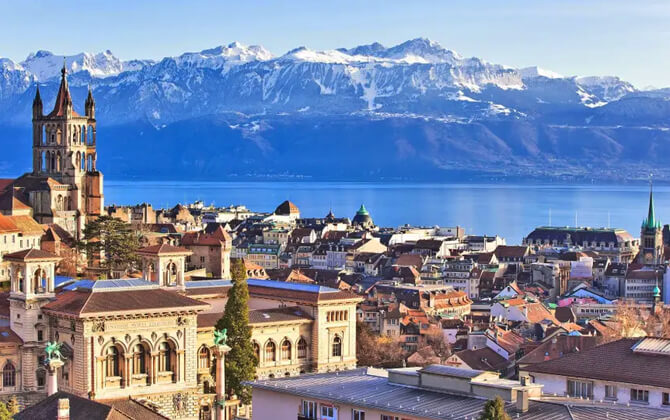
The Lausanne Metro is especially useful for reaching major attractions, from the lakeshore to the historic center and museum areas. For most visitors, M2 is the most practical route, connecting Ouchy-Olympique, Flon, and the upper parts of the city.
- Ouchy-Olympique: Lake Geneva, the lakeside promenade, ferry departures, and the Olympic Museum.
- Flon: the city’s main transport hub, plus shopping, dining, and nightlife.
- Bessières: Lausanne Cathedral and the surrounding old streets.
- Riponne-M. Béjart: Palais de Rumine and several museums.
- Vennes: Aquatis Aquarium-Vivarium.
- Sallaz: Fondation de l’Hermitage.
Other sights are easy to combine with a metro ride and a short walk. The Old Town, the cathedral, and the waterfront at Ouchy fit naturally into one day. The metro also makes it simple to move between the station area, the city center, and the lakeside without worrying too much about Lausanne’s steep streets.
From Ouchy, CGN ferries offer another way to enjoy Lake Geneva and visit nearby towns. If you are planning several museum stops or a broader city transport route through Lausanne, the metro keeps things simple.