Busan Metro is the urban rail system operated by Busan Transportation Corporation in Busan, South Korea. It opened in 1985 with 17 stations and became the second metro system in South Korea and the third on the Korean Peninsula after Seoul and Pyongyang. Today, the core system includes four numbered lines covering 116.5 km (72.4 miles) and 114 stations, while the wider network, including the Busan–Gimhae Light Rail Transit and the Donghae Line, reaches 205.6 km (127.8 miles) and 158 stations. The system is easy to use for visitors, with Korean and English signage, multilingual announcements, and station numbering that matches each line number.
| Key | Information |
|---|---|
| Operator | Busan Transportation Corporation |
| Opening year | 1985 |
| Core system | 4 numbered metro lines |
| Core network length | 116.5 km (72.4 miles) |
| Core stations | 114 |
| Wider network length | 205.6 km (127.8 miles) |
| Wider network stations | 158 |
| Languages on signs and announcements | Korean and English, with Mandarin and Japanese at transfer stations |
| Key interchange | Seomyeon Station |
Busan Metro Map
Map of Busan Metro showing different lines and stations. Click on the map to enlarge it or download the Busan Metro map in PDF format.
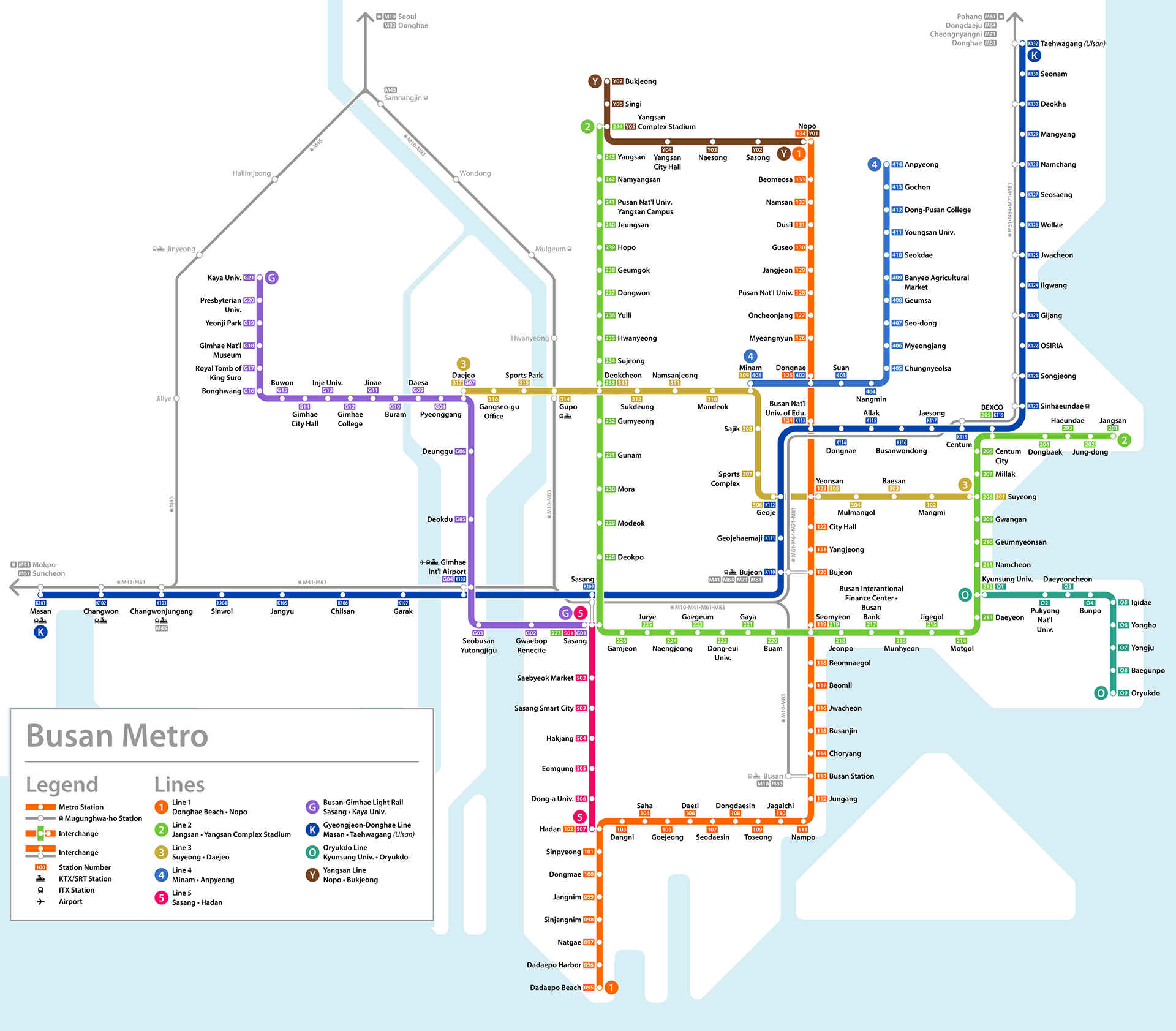
Lines and Stations
The Busan Metro route plan is built around four main lines, with the wider system extended by the Busan–Gimhae Light Rail Transit and the Donghae Line. Altogether, this public transport network connects central Busan with nearby areas including Gimhae and Yangsan.
All stations are numbered, and the first digit matches the line number. That makes the stations map easier to follow, especially if you are using the system for the first time. Signs appear in Korean and English, while onboard announcements cover the next stop, transfers, and exit side in Korean and English, with Mandarin and Japanese added at transfer stations.
Seomyeon Station is the main interchange on the core network, linking Lines 1 and 2 in central Busan.
| Station | Details |
|---|---|
| Line 1 | Dadaepo Beach to Nopo, 40 stations, 40.5 km (25.2 miles) |
| Line 2 | Jangsan to Yangsan, 43 stations, 45.2 km (28.1 miles) |
| Line 3 | Suyeong to Daejeo, 17 stations, 18.1 km (11.2 miles) |
| Line 4 | Minam to Anpyeong, 14 stations, 12.7 km (7.9 miles) |
| Main metro network | 114 stations across 116.5 km (72.4 miles) |
| Busan–Gimhae Light Rail Transit | Sasang to Kaya University, 21 stations, 23.4 km (14.5 miles) |
| Donghae Line | Bujeon to Bugulsan, 23 stations, 65.7 km (40.8 miles) |
| Wider network total | 158 stations across 205.6 km (127.8 miles) |
Photography is allowed in the system, and the metro map also shows which station and exit number to use for major attractions.
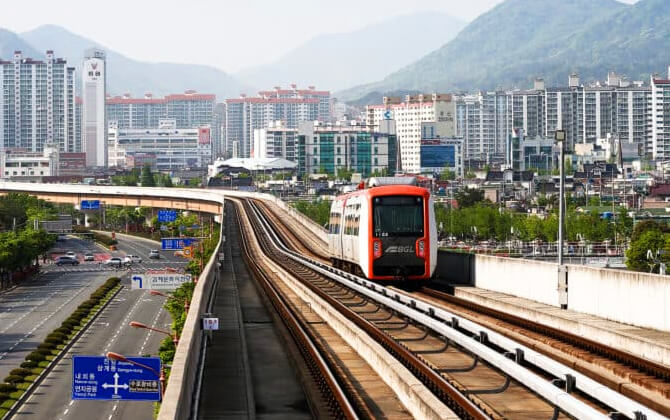
Operating Hours and Frequency
Busan Metro operating hours are generally from around 5:30 AM until about 11:30 PM to 12:00 AM daily, though exact opening times, closing time, and last train details vary by line and station. If you need timings today or a station-specific train schedule, check the station timetable before you travel.
| Service detail | Timings |
|---|---|
| Starting time | Around 5:30 AM |
| Last train | Around 11:30 PM to 12:00 AM |
| Peak hours | 7:00 AM to 9:00 AM, 6:00 PM to 8:00 PM |
| Frequency | Every 3 to 5 minutes during peak hours, every 6 to 10 minutes off-peak |
Weekday mornings and evenings are the busiest, especially in business districts. For a more comfortable ride, late morning or early afternoon usually works better.
Because working hours and route timetable details can differ by station, it is worth checking the official schedule today if you are travelling early, late, or planning around the last train.
Fares, Tickets, and Cards
Busan Metro uses a distance-based fare system. You can pay with a transportation card, a single-use QR ticket, or cash. As of October 6, 2023, the adult fare on Line 1 is 1,450 won ($1.08) with a transportation card and 1,550 won ($1.15) by cash or QR ticket. On Line 2, the ticket price is 1,650 won ($1.23) with a transportation card and 1,750 won ($1.30) by cash or QR ticket.
Children aged 6 to 12 ride free when using a children’s transportation card. These cards are sold at convenience stores including CU, GS25, 7-Eleven, and emart 24, then registered with the child’s birth date. Registration is also available through the mobile app 로카M충전소.
Available ticket options include single-use QR tickets, mobile passes, commuter passes, and public transit cards. Single-use QR tickets are sold at station ticket machines. Mobile passes work through the Busan Subway app, and transit cards are usually the most practical option for regular city transport.
Busan also offers transfer discounts when you use a transit pass within a 30-minute limit. For Busan Metro, these discounts apply only when you stay inside the subway platform. Hanaro Card is the official card in Busan, and Mybi, T-money, Cashbee, and the Gimhae-for-you Card can also be used for transfer discounts.
If you are comparing fare, cost, and convenience, a transport card is typically the better choice. The draft information does not include a fare calculator or station parking details, so parking charges and parking charges per day are not listed here.
Connections to Other Systems
Busan Metro is well integrated with other public transport services in the city and the wider region. Alongside Lines 1 to 4, the system connects with the Busan–Gimhae Light Rail Transit and the Donghae Line, giving passengers a broader transportation in and around Busan.
The Busan–Gimhae Light Rail Transit connects Busan with Gimhae and links to the metro at Sasang Station on Line 2 and Daejeo Station on Line 3. This route is especially useful for travel between the two cities and for airport access.
The Donghae Line also ties into the metro at several key stations. These include Geoje Station on Line 3, Busan National University of Education Station on Line 1, and BEXCO Station on Line 2. Together, these transfers strengthen local transport and regional rail connections.
Busan’s bus network complements the metro and helps cover areas not directly served by rail. Transfer discounts are available in some cases when using a transit pass, although the exact rules depend on the mode of transport.
For many travelers, especially those heading to or from the airport, the light rail connection via Sasang or Daejeo is the best-value option.
Airport Connections
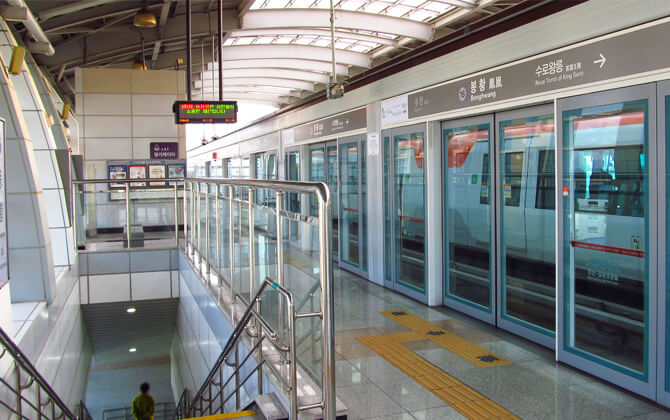
From Gimhae International Airport, you can reach central Busan by rail in about 60 minutes. The most practical route is to take the Busan-Gimhae Light Rail from either the Domestic Terminal or the International Terminal, then transfer to Busan Metro Line 2 or Line 3.
How to get to the city centre
From either terminal, take the light rail to Sasang Station or Daejeo Station and transfer there. The light rail running time to the transfer point is about 15 minutes.
At Sasang Station, connect to Line 2. At Daejeo Station, connect to Line 3.
Metro schedules
| Service detail | Timings |
|---|---|
| Line 2 from Sasang Station, weekday | 05:04 AM to 11:11 PM |
| Line 2 from Sasang Station, Saturday | 05:04 AM to 11:11 PM |
| Line 2 from Sasang Station, Sunday | 05:40 AM to 11:11 PM |
| Line 3 from Daejeo Station, weekday | 05:56 AM to 12:38 AM |
| Line 3 from Daejeo Station, Saturday | 05:56 AM to 12:38 AM |
| Line 3 from Daejeo Station, Sunday | 05:56 AM to 12:38 AM |
Frequency may vary by day, so if you need exact schedule today information, check before you set off.
Fares
Airport connection fares are listed by section and payment type.
- Traffic card, 1 section: 1,300 won ($0.97) adult, 1,050 won ($0.78) adolescent, 650 won ($0.48) child
- Traffic card, 2 sections: 1,500 won ($1.12) adult, 1,200 won ($0.89) adolescent, 750 won ($0.56) child
- Paper boarding card, 1 section: 1,400 won ($1.04) adult, 1,150 won ($0.86) adolescent, 700 won ($0.52) child
- Paper boarding card, 2 sections: 1,600 won ($1.19) adult, 1,300 won ($0.97) adolescent, 800 won ($0.60) child
History
The history of Busan Metro starts in 1985, when the system opened with 17 stations. That made Busan the second city in South Korea and the third on the Korean Peninsula to launch a metro system.
Development began with Line 1. Planning started in 1979, construction began in 1981, and the first section opened in July 1985. Over time, the line expanded southward, and its final extension to Dadaepo Beach was completed in 2017.
Line 2 followed, with construction beginning in 1991 and the first section opening in 1999. Further sections opened between 2001 and 2003, eventually extending the route to Yangsan. Pusan National University Yangsan Campus Station opened later, in 2009.
Line 3 started construction in November 1997 and opened in 2005 after delays. During construction, platform screen doors were installed at every station, making it one of the early lines in Korea and in the world to do so throughout the full line.
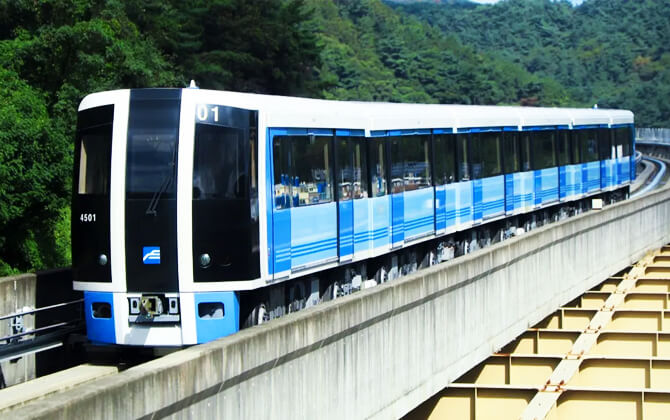
Line 4, also known as the Bansong Line, had originally been planned as an extension of Line 3. It opened in 2011 as a rubber-tyred metro between Minam and Anpyeong.
The Busan–Gimhae Light Rail Transit also opened in 2011, while the Donghae Line became part of the broader rail system linked with Busan Metro services.
Over the years, the system has also updated station names and passenger information. In 2000, station names on Lines 1 and 2 were revised to follow Korean romanization rules. In 2014, Munjeon Station was renamed Busan International Finance Center–Busan Bank Station.
Future Expansions
Busan Metro expansion plans include several projects that will extend the current system and improve regional links.
One of the clearest projects is an extension of Line 2 from Jangsan Station to the East Busan Tourism Complex in Gijang County, expected by late 2026.
Another major project is Busan Metro Line 5, a light metro planned between Sasang and Hadan. It is expected to open in December 2026 with 7 stations across 6.9 km (4.3 miles), with further expansion also planned toward the southwest.
The Yangsan Metro is under construction as well. This light rail line will link Nopo on Line 1 with the Yangsan Sports Complex area associated with Line 2, with completion expected by late 2026.
Beyond the core metro, the Donghae Line is scheduled to extend from Taehwagang to Bugulsan by September 2026. The Gyeongjeon Line is also being upgraded between Bujeon and Masan, with future integration planned through a combined Gyeongjeon-Donghae corridor.
At the regional level, the Busan–Yangsan–Ulsan Metropolitan Railway has received preliminary feasibility approval. The project will span 47.6 km (29.6 miles), including 8.9 km (5.5 miles) in Busan, and connect Nopo Station with Ulsan through 11 stations.
Busan Transportation Corporation has also said that future development will focus on safety, service innovation, network integration, and Busan-style Mobility as a Service initiatives.
Tips
Busan Metro is clean, safe, affordable, and straightforward to use. For most visitors, it is the easiest way to get around the city.
These tips can make your trip smoother.
Plan Around the Operating Hours
Opening hours vary by station and line. In general, trains start around 5:00 to 5:30 AM and close around 11:30 PM to midnight. If you are staying out late, check the last train in advance.
Choose the Right Ticket Option
If you only need a few rides, a single-use ticket is fine. For longer stays, a transport card such as T-money or Cashbee is usually more convenient and can also be used on some bus services and taxis.
QR tickets, mobile passes, commuter passes, and public transit cards are all available, so pick what fits your travel plans.
Use the Best Navigation Apps
For route planning, Naver Map or KakaoMap is generally more useful than Google Maps. These apps help with the best route, station exits, and train timings.
Pay Attention to Exit Numbers
Some stations, especially Seomyeon and Haeundae, are large. Choosing the wrong exit can mean a surprisingly long walk.
Travel Outside Peak Hours When Possible
Rush hours are busiest on weekday mornings and evenings. Late morning or early afternoon is usually more comfortable.
Stand on the Right
In Busan, people usually stand on the right side of escalators and walk on the left. It’s a small thing, but it helps traffic move smoothly.
Keep Your Card Ready and Board Calmly
Have your card ready before you reach the gates, and let passengers get off before boarding. It keeps things moving and makes crowded stations safer.
Check Station Facilities and Signage
Stations are clearly marked in English and Korean, and many have toilets, elevators, and customer service points. If you are unsure, station staff can usually help.
If you are travelling with luggage or moving around late at night, check the last train time and your station exit before you start.
Interesting Facts
Busan Metro opened in 1985 with 17 stations, giving the city one of the earliest metro systems in South Korea.
The core system has four lines, 114 stations, and 116.5 km (72.4 miles) of route. Including the Busan–Gimhae Light Rail Transit and the Donghae Line, the wider system reaches 158 stations and 205.6 km (127.8 miles).
Every station is numbered, and the first digit shows the line number. That simple system makes the stations list easier to understand at a glance.
Announcements on trains cover the next station, transfers, and exit side first in Korean and then in English. Transfer announcements also include Mandarin and Japanese.
Line 3 is notable for having platform screen doors at every station, a feature introduced during construction after the 2003 Daegu Subway Fire.
Line 4 is different from the other main lines because it uses rubber-tyred metro technology.
Busan International Finance Center–Busan Bank Station is known for having the longest station name among urban railways in the country.
The system also uses an unusual exit numbering method that divides exits by downhill and uphill sides instead of following a simple loop around the station.
Exploring Busan via Busan Metro
Busan Metro is a practical way to explore Busan, Gimhae, and Yangsan. With Lines 1 to 4, the Busan-Gimhae Light Rail Transit, and the Donghae Line, the network covers many major districts and attractions.
The system operates roughly from 05:00 to 23:59, though exact opening times, working hours, and the last train vary by station. Train frequency changes through the day as well, so checking the timetable is a smart move.
Tickets and Passes
Busan Metro offers several ticket and pass options: QR Ticket, Mobile Pass, Commuter Pass, and Public transit card.
- QR Ticket: single-use and available for Adults, Teenagers, Multi-child families, Children, and Preferential Ticket holders
- Mobile Pass: available for Adults, Teenagers, and Children through the Busan Subway application
- Commuter Pass: offered in 1-day, 3-day, and 30-day versions; not valid on the Donghae Line or Busan-Gimhae Light Rail Transit
- Public transit card: available for Adults, Teenagers, and Children
QR tickets, mobile passes, and public transit cards use distance-based pricing, while commuter passes have fixed rates regardless of distance.
Fare and Transfer Notes
Fares depend on distance, and public transit cards can give transfer benefits. Hanaro Card is the official transit pass in Busan, while Mybi, T-money, Cashbee, the Gimhae-for-you Card, and deferred payment transit passes may also be used for transfer discounts.
You can top up a transit card at ticket machines in Busan Metro stations and Donghae Line railway stations, as well as at convenience stores and Busan Bank branches.
Transfer discounts on Busan Metro are available only when you stay inside the subway platform, so it is worth checking the rules before starting your route.
Getting to Downtown Busan from the Airport
For many travelers, the path train connection from Gimhae International Airport is the cheapest and most practical option. Take the light rail from the airport and transfer at Sasang Station for Line 2 or Daejeo Station for Line 3.
If you have heavy luggage or want to avoid transfers, an Airport Limousine may be easier.
Useful Travel Tips
- Check the first train, last train, and schedule for your specific station
- Use a transit card if you want easier transfers and possible fare savings
- Buy single-use QR tickets from station ticket machines if you only need occasional rides
- Use the Busan Subway app for mobile pass access
- Confirm your airport route and timetable before heading to downtown Busan
Whether you are commuting, sightseeing, or connecting from the airport, Busan Metro makes city transport simple and efficient.
Media