The Rinkai Line is a Tokyo railway operated by Tokyo Waterfront Area Rapid Transit. It connects Shin-Kiba and Osaki via the Tokyo waterfront, serving Aomi, Odaiba, and nearby bayfront districts, while some JR East Saikyō Line trains continue through to Shinjuku, Ikebukuro, Ōmiya, and Kawagoe. The line is 12.2 km (7.6 mi) long, has 8 stations, and functions as an important public transport link even though it is not part of the Tokyo subway network.
| Key | Information |
|---|---|
| Operator | Tokyo Waterfront Area Rapid Transit |
| Route | Shin-Kiba to Osaki |
| Length | 12.2 km (7.6 mi) |
| Stations | 8 stations in Tokyo |
| Route plan | Mostly underground, with the Shinonome to Shin-Kiba section elevated |
| Underground section | Nearly 10 km (6.2 mi) of the route runs underground |
| Deepest point | About 40 meters (131 feet) below ground under the Port of Tokyo |
| Through service | Some trains continue onto the JR East Saikyō Line toward Shinjuku, Ikebukuro, Ōmiya, and Kawagoe |
| First opening | March 30, 1996, between Shin-Kiba and Tokyo Teleport |
| Completed | December 1, 2002, with the extension to Osaki |
| Ridership | 200,200 passengers per day in 2010 |
Rinkai Line Map
Map of Rinkao Line showing its stations. Click on the map to enlarge it or download the Rinkao Line map in PDF format.
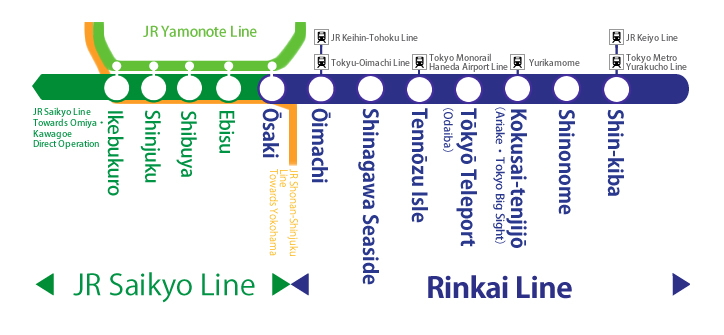
Rinkai Line Stations
The Rinkai Line stations list includes 8 stops, all within Tokyo. Trains stop at every station, so the route is simple to follow whether you are checking a stations map, planning a transfer, or heading toward Odaiba.
| Station | Details |
|---|---|
| Shin-Kiba | Station code R01. Located in Kōtō. Transfers to the Keiyō Line and Yūrakuchō Line. |
| Shinonome | Station code R02. Located in Kōtō. No transfer listed. |
| Kokusai-Tenjijō | Station code R03. Located in Kōtō. Connects with the Yurikamome at Ariake and is useful for Tokyo Big Sight. |
| Tokyo Teleport | Station code R04. Located in Kōtō. Connects with the Yurikamome and serves Odaiba attractions. |
| Tennōzu Isle | Station code R05. Located in Shinagawa. Transfer to the Haneda Airport Line. |
| Shinagawa Seaside | Station code R06. Located in Shinagawa. No transfer listed. |
| Ōimachi | Station code R07. Located in Shinagawa. Transfers to the Keihin-Tōhoku Line and Ōimachi Line. |
| Ōsaki | Station code R08. Located in Shinagawa. Transfers to the Yamanote Line, Shōnan–Shinjuku Line, Saikyō Line, and Sōtetsu–JR Link Line. |
The Shin-Kiba to Shinonome segment is elevated and uses the former Keiyō Freight Line. The rest of the route is largely underground, giving the line a direct path train service through the waterfront area.
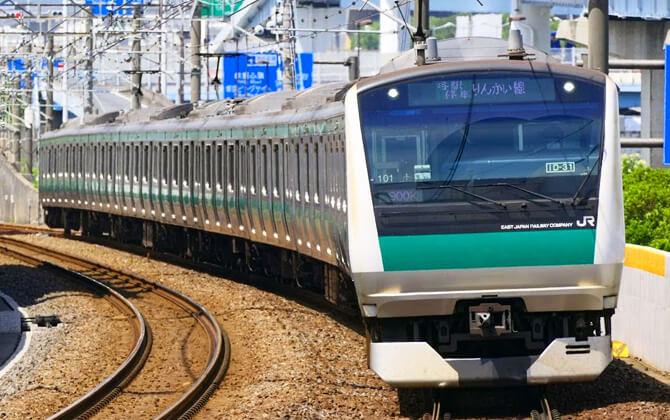
Rinkai Line Timings and Schedule
The Rinkai Line operates daily, with weekday and Saturday/holiday timetables listed separately. The full running time between Shin-Kiba and Osaki is about 19 minutes, and all trains stop at every station on the line.
| Service detail | Timings |
|---|---|
| Full route running time | Approximately 19 minutes between Shin-Kiba and Osaki |
| Weekday service shown in the timetable | 07:17 to 09:34 |
| Weekday frequency shown | Every 25 to 70 minutes |
| Saturday and holiday service shown | 06:33 to 19:30 |
| Train types listed | Local, Rapid, and Commuter Rapid |
| Example Saturday/holiday local train | Train 1600K from Osaki at 16:15 to Shin-Kiba at 16:34 |
| Through service destinations shown | Kawagoe, Ōmiya, Musashi-Urawa, Akabane, Ikebukuro, and Tokyo Teleport |
For timings today, check the station timetable for your direction before you travel. Opening hours, opening times, working hours, closing time, and the last train can vary by station, day type, and destination, so the route timetable matters for late trips.
The schedule today may also show different service types. If you are comparing a train schedule with a transfer route plan, confirm whether the departure is Local, Rapid, or Commuter Rapid.
Station coverage in the timetable includes Shin-Kiba, Shinonome, Kokusai-Tenjijō, Tokyo Teleport, Tennōzu Isle, Shinagawa Seaside, Ōimachi, and Ōsaki.
Rinkai Line Fares, Tickets and Cards
Rinkai Line fare levels are based on the distance between stations. Short trips start at 210 yen (about US$1.40), while the highest fares listed for the line reach 400 yen (about US$2.70). The exact ticket price depends on your origin and destination, so check the fare table or a fare calculator before boarding.
Adult and child fares are different. Children aged 6 to 12 pay the child fare, passengers over 12 pay the adult fare, and children under 1 year old ride free on the Rinkai Line.
IC card fares can be slightly lower than paper ticket fares on some sections. Examples in the fare table include 210 yen (about US$1.40) by ticket and 210 yen (about US$1.40) by IC card, 280 yen (about US$1.90) by ticket and 272 yen (about US$1.80) by IC card, and 340 yen (about US$2.30) by ticket and 335 yen (about US$2.30) by IC card.
Commuter pass prices are also listed for workers and students, with 1-month, 3-month, and 6-month options. These passes are useful for regular city transport trips along the same section of the line.
Rinkai Line commuter tickets are issued for travel between your requested station and each station on the line. They are sold as 11 tickets for the price of 10 ordinary tickets and are valid for 3 months. They are issued at each Rinkai Line station.
Commuter tickets are valid only within the printed area on the ticket. If you travel beyond that area, you must pay the ordinary fare for the extra section. Through-commutation tickets with other railway lines are not issued.
The Rinkai Line One-Day Ticket works like a day pass and allows unlimited rides on the entire Rinkai Line for one day. It costs 730 yen (about US$4.90) for adults and 370 yen (about US$2.50) for children.
The One-Day Ticket is sold at Rinkai Line stations, excluding Osaki Station for counter sales. Some automatic ticket machines also issue it, but machine-issued tickets are valid only on the day of issue. Coupon tickets with a specified use date are available through JTB Japan Travel and Kinki Nippon Tourist and must be exchanged at a Rinkai Line station counter, excluding Osaki Station.
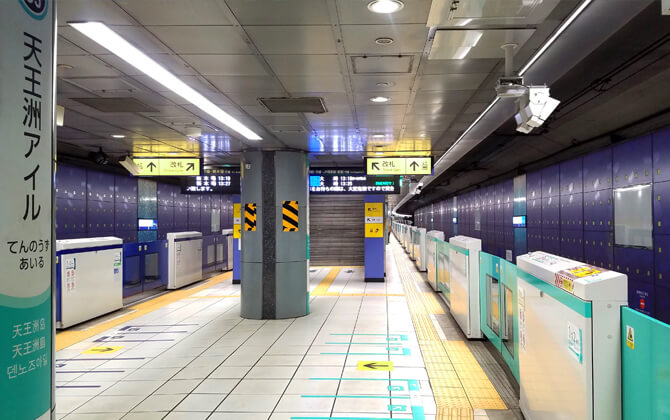
Connections to Other Systems
The Rinkai Line links central Tokyo with the waterfront area and connects with several other rail systems. Its main through service is with JR East’s Saikyō Line, allowing direct travel to Shinjuku, Ikebukuro, Ōmiya, and Kawagoe without a transfer.
At Shin-Kiba, passengers can transfer to the JR East Keiyō Line and the Tokyo Metro Yūrakuchō Line. Kokusai-Tenjijō connects with the Yurikamome at Ariake, while Tokyo Teleport also connects with the Yurikamome for Odaiba access.
Other important transfer points include Tennōzu Isle for the Haneda Airport Line, Ōimachi for the Keihin-Tōhoku Line and Ōimachi Line, and Ōsaki for the Yamanote Line, Shōnan–Shinjuku Line, Saikyō Line, and Sōtetsu–JR Link Line.
Although it is not part of the Tokyo subway network, the Rinkai Line is fully grade separated and plays a major role in transportation in the Tokyo waterfront area. Future plans have also mentioned possible connections with the Tokyo Waterfront Subway Line and the Haneda Airport Access Line.
- Shin-Kiba: Keiyō Line and Yūrakuchō Line
- Kokusai-Tenjijō: Yurikamome
- Tokyo Teleport: Yurikamome
- Tennōzu Isle: Haneda Airport Line
- Ōimachi: Keihin-Tōhoku Line and Ōimachi Line
- Ōsaki: Yamanote Line, Shōnan–Shinjuku Line, Saikyō Line, and Sōtetsu–JR Link Line
Tips and Rules
The Rinkai Line is a private railway, so the standard JR Pass is not valid. Use a regular ticket or an IC card such as Suica or Pasmo for easier local transport and transfers.
For a smooth trip, plan around the main interchange stations at Osaki and Shin-Kiba. Osaki connects with the JR Yamanote Line and other JR services, while Shin-Kiba links to the JR Keiyō Line and Tokyo Metro Yūrakuchō Line.
If you are visiting major waterfront attractions, choose the station closest to your destination. Tokyo Teleport Station works well for Odaiba shopping and attractions, while Kokusai-Tenjijō is useful for Tokyo Big Sight.
- Tokyo Teleport Station: shopping areas and attractions in Odaiba
- Odaiba Kaihin-Koen Station: beach area and Statue of Liberty replica
- Kokusai-Tenjijō Station: Tokyo Big Sight
- Tokyo International Cruise Terminal Station: cruise access
First-time riders should pay attention at large stations such as Osaki, where Rinkai Line platforms may be separate from JR platforms. Follow the signs closely; it saves time.
Check the last train before staying late in Odaiba, because the Rinkai Line timetable may differ from the JR Yamanote Line. During major events such as Tokyo Game Show or Comic Market, trains can become very crowded, so allow extra time if you are traveling to Big Sight.
Transit apps such as Google Maps or Japan Travel by NAVITIME can help with routing, fare checks, and service updates. If you want a different travel experience in Odaiba, the Tokyo Cruise Ship from Hinode Pier can be a useful one-way alternative.
Follow standard Tokyo train etiquette: keep conversations quiet, avoid phone calls on board, and be mindful of rush hour crowds. The system is generally easy to use, but crowded event days need a little patience.
History
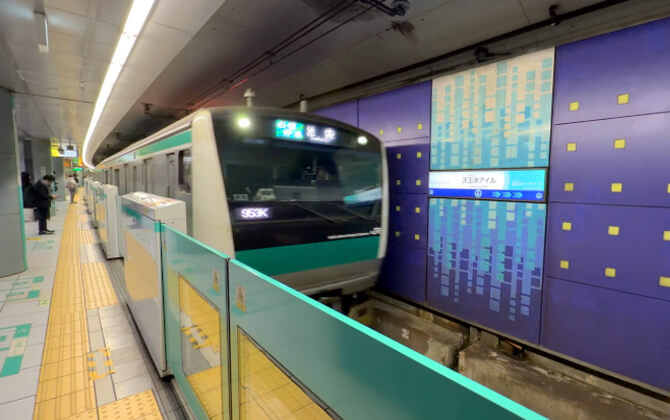
Construction of the Rinkai Line began in 1992, using the former right-of-way of the Keiyō Freight Line on the eastern end of the route. The first section, between Shin-Kiba and Tokyo Teleport, opened on March 30, 1996, under the original name Rinkai Fukutoshin Line.
The line was renamed Rinkai Line on September 1, 2000. Service then extended to Tennōzu Isle on March 31, 2001, and the final section to Osaki opened on December 1, 2002, completing the line.
The project went severely over budget, with a final cost estimated at more than ¥440 billion (about US$2.9 billion). Ridership reached an average of 140,000 passengers per day in 2005, and the line recorded its first operating profit in 2006. Debt-related interest payments, however, continued to affect its finances.
Passenger numbers increased over time, reaching 200,200 passengers per day in 2010. Further growth was expected as development continued in the areas served by the line. Station numbering was introduced across the line in 2016.
Tokyo Waterfront Area Rapid Transit, Inc. was founded on March 12, 1991, specifically to construct and operate the line. In 2014, reports said JR East was in negotiations to buy out the Rinkai Line, a move that could support future direct services and a possible Haneda Airport connection.
Future Extensions
Several future expansion projects have been discussed around the Rinkai Line, mainly to improve access between central Tokyo, Tokyo Bay, and major interchange points.
- A planned Tokyo Rinkai Subway Line would run between Tokyo Station and the Ariake area, with construction expected to begin in the 2030s and opening projected for the 2040s.
- A southern connection from Ariake to the Rinkai Line has been discussed.
- A northern extension toward the Tsukuba Express at Akihabara Station has also been considered.
- JR East has plans to create a connection from the Haneda Airport Access Line to the Tokyo Rinkai Subway Line after completion.
- A spur from Kachidoki is planned to connect with future Toyozumi Line platforms at Toyosu Station.
The planned Tokyo Rinkai Subway Line is expected to be about 6.1 km (3.8 mi) long, with seven stations and through service possibilities involving the Rinkai Line and the Tsukuba Express.
In February 2024, the Tokyo Metropolitan Government announced that JRTT and Tokyo Waterfront Area Rapid Transit had reached an agreement to construct and operate the planned line, respectively.
Nearby Attractions
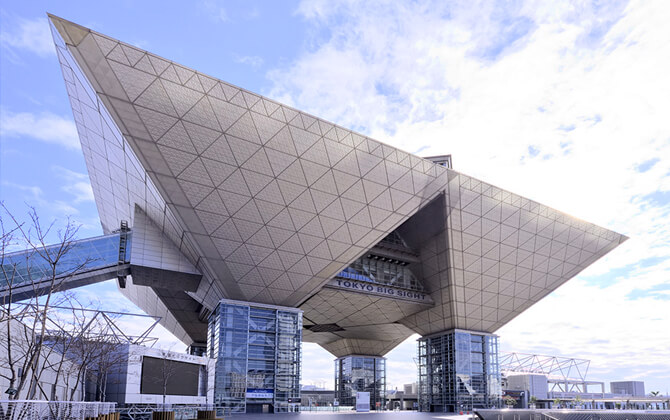
The Rinkai Line puts many Tokyo Bay attractions within easy reach, from exhibition halls and museums to parks, shopping areas, and waterfront viewpoints.
- Tokyo Big Sight: a major venue for trade shows and events, located a short walk from Kokusai-Tenjijō Station.
- National Museum of Emerging Science and Innovation, also known as Miraikan: a science museum with permanent zones themed around exploring the frontiers and creating the future.
- Fuji TV: one of Odaiba’s recognizable landmarks, near shopping and sightseeing areas.
- Panasonic Center Tokyo: a showroom near Kokusai-Tenjijō Station presenting the company’s latest technologies and products.
- Shiokaze Park and the Water Fountain Plaza: known for a 180-degree view of Tokyo Bay and especially attractive sunset scenery.
- Odaiba Kaihin Park Marine House: a quiet spot with a café, restaurants, and an observation deck for relaxed bay views.
- Ferris Wheel: offers wide views of Tokyo SkyTree, Tokyo Tower, and the illuminated nightscape.
- Ariake Passenger Ship Terminal: a place to board a 25-minute ocean trip to Hinode Pier.
- Aomi Water Bus Stop: a convenient point for water bus trips, including routes with views of the Dream Bridge.
- Ariake Arena: a modern multipurpose arena used for sports, concerts, ceremonies, and events.
Many of these places are easy to combine in one day, especially if you want shopping, exhibitions, waterfront scenery, and evening views along Tokyo Bay.
Station areas such as Tokyo Teleport, Kokusai-Tenjijō, and Ariake place you close to shopping malls, museums, parks, and event venues. The Rinkai Line is also useful for reaching waterfront destinations with direct links toward Shibuya and Shinjuku.