The Kyoto Municipal Subway, also called the Kyoto City Subway, is Kyoto’s rapid transit system. It is operated by the Kyoto Municipal Transportation Bureau and has two lines: the north-south Karasuma Line and the east-west Tozai Line, which meet at Karasuma Oike Station. The network is compact, but it plays a key role in public transport and city transport across Kyoto, especially for trips between Kyoto Station, downtown areas, and major transfer points.
| Key | Information |
|---|---|
| System | Kyoto Municipal Subway / Kyoto City Subway |
| Operator | Kyoto Municipal Transportation Bureau |
| Lines | 2 |
| Main interchange | Karasuma Oike Station |
| Opening years | Karasuma Line: 1981; Tozai Line: 1997 |
| Total network length | 31.2 km (19.4 miles) |
| Total stations | 31 |
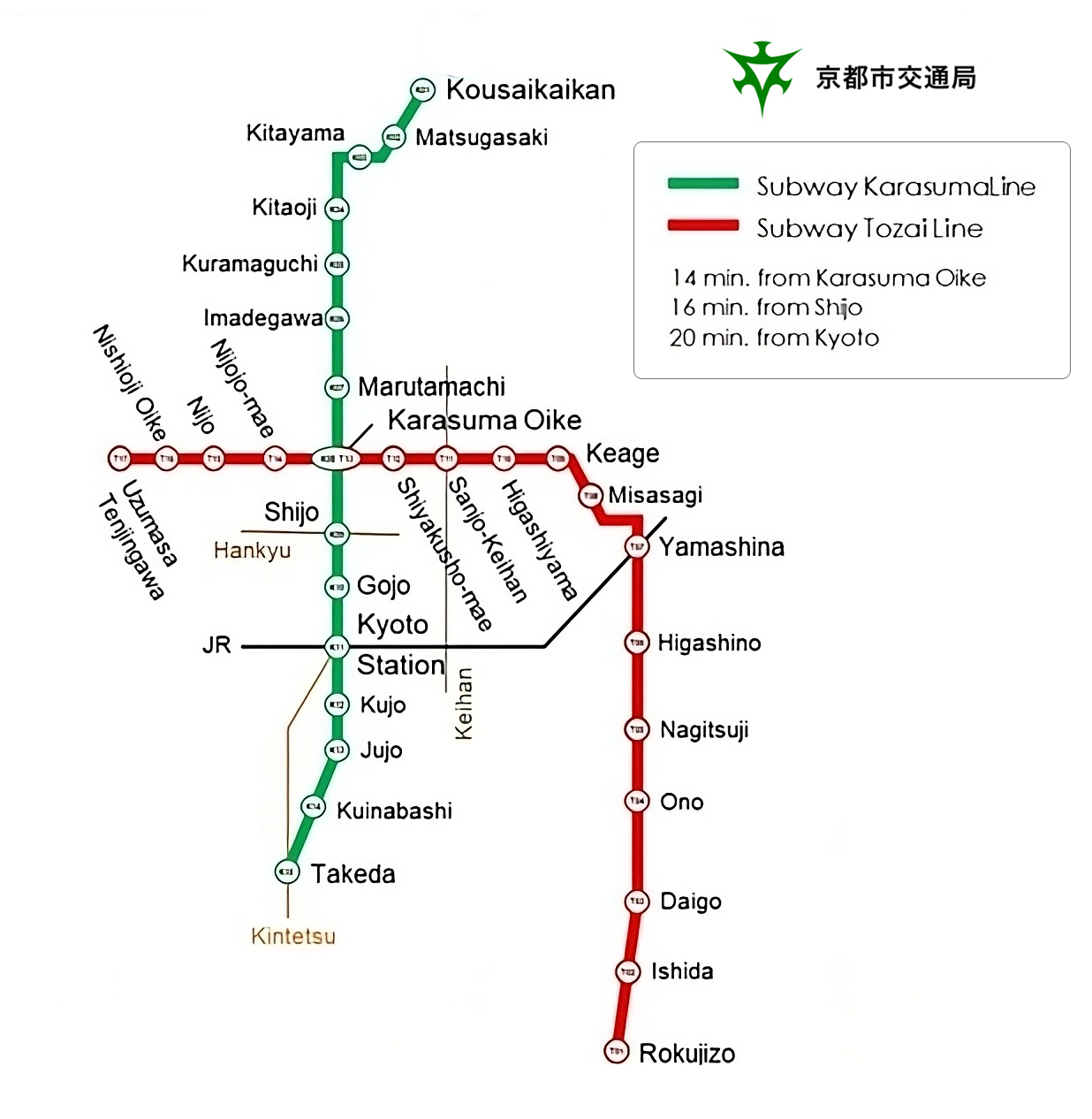
Kyoto Municipal Subway Map
Map of Kyoto Municipal Subway showing different lines. Click on the map to enlarge it or download the Kyoto Municipal Subway map in PDF format.
Lines and Stations
The Kyoto Municipal Subway has two lines and a straightforward route plan, so it is easy to understand even on a first visit. The Karasuma Line runs north to south, the Tozai Line runs east to west, and both connect at Karasuma Oike Station, the system’s main interchange.
For many visitors, this stations map is enough to plan the basics: Kyoto Station and central districts are on the Karasuma Line, while Nijo Castle, Higashiyama, and other sightseeing areas are linked by the Tozai Line.
Karasuma Line
The Karasuma Line route runs from Kokusaikaikan Station in the north to Takeda Station in the south. It is especially useful for travel between Kyoto Station and the city center, with key stops including Shijo Station, Karasuma Oike Station, Imadegawa Station, and Kitaoji Station.
Useful destinations on this line include Kyoto International Manga Museum, Gosho Imperial Palace Park, the Daitokuji Temple complex, Kyoto Botanical Garden, and Kyoto International Conference Center.
| Station | Details |
|---|---|
| Kokusaikaikan | Northern terminus of the Karasuma Line. |
| Kyoto Station | Major stop for intercity and local transport connections. |
| Shijo | Underground access to Karasuma Station on the Hankyu Kyoto Main Line. |
| Karasuma Oike | Main interchange with the Tozai Line. |
| Imadegawa | Useful for central Kyoto and nearby attractions. |
| Kitaoji | Convenient for northern Kyoto destinations. |
| Takeda | Southern terminus; connection with the Kintetsu Kyoto Line. |
Tozai Line
The Tozai Line route runs from Uzumasa Tenjingawa Station in the west to Rokujizo Station in the south-east. It is a practical line for reaching central Kyoto, the Higashiyama sightseeing district, and Nijo Castle.
Important stations include Nijojo-mae Station, Kyoto Shiyakusho-mae Station, Sanjo Keihan Station, Higashiyama Station, and Keage Station. From these stops, travelers can access Nijo Castle, Pontocho, Gion, Nanzenji Temple, Daigoji Temple, and Toei Uzumasa Eigamura.
| Station | Details |
|---|---|
| Uzumasa Tenjingawa | Western terminus; connection with the Keifuku Randen tramway. |
| Nijojo-mae | Nearest subway stop for Nijo Castle. |
| Kyoto Shiyakusho-mae | Useful for central Kyoto and shopping areas. |
| Sanjo Keihan | Connection with the Keihan Main Line. |
| Higashiyama | Convenient for the Higashiyama sightseeing area. |
| Keage | Useful for Nanzenji Temple and nearby sights. |
| Rokujizo | South-eastern terminus; connections with the JR Nara Line and Keihan Uji Line. |
Connections
The subway connects with several other rail and bus services, which makes transportation in Kyoto much easier. Takeda Station links with the Kintetsu Kyoto Line, Shijo Station connects underground to Karasuma Station on the Hankyu Kyoto Main Line, Rokujizo Station links with the JR Nara Line and Keihan Uji Line, Sanjo Keihan Station connects with the Keihan Main Line, Nijo Station connects with the JR Sagano Line, and Uzumasa Tenjingawa Station connects with the Keifuku Randen tram line.
| Station | Details |
|---|---|
| Takeda | Transfer to the Kintetsu Kyoto Line. |
| Shijo | Underground access to Karasuma Station on the Hankyu Kyoto Main Line. |
| Rokujizo | Transfer to the JR Nara Line and Keihan Uji Line. |
| Sanjo Keihan | Transfer to the Keihan Main Line. |
| Nijo | Transfer to the JR Sagano Line. |
| Uzumasa Tenjingawa | Transfer to the Keifuku Randen tramway. |
| Line | Details |
|---|---|
| Karasuma Line | 13.7 km (8.5 miles), 15 stations |
| Tozai Line | 17.5 km (10.9 miles), 17 stations |
| Total | 31.2 km (19.4 miles), 31 stations |
Timetable & Schedule
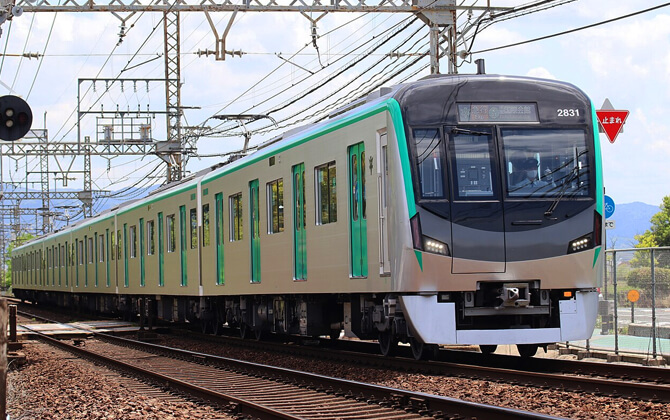
The available timetable information here is for the Karasuma Line route from Karasuma Oike to Kyoto. The running time is about 5 minutes. Trains operate from early morning to late at night, with higher frequency during the morning and evening peaks.
Based on the listed train schedule, the first departure shown is 05:32 and the last train shown is 23:55. Destinations in the schedule include Takeda, Shin-tanabe, and Kintetsu-Nara. For timings today, schedule today updates, or a full stations map and route timetable, travelers can use the Kyoto City Bus & Subway timetable and station map system.
Supported payment methods include IC cards such as PASMO and Suica, contactless credit cards, and cash. If you want the latest opening times, operating hours, working hours, or service timings, it is best to check the official timetable system before travel.
| Service detail | Timings |
|---|---|
| Starting time | First listed departure: 05:32 |
| Closing time | Last listed departure: 23:55 |
| Route | Karasuma Oike to Kyoto |
| Running time | About 5 minutes |
| Frequency | More frequent during morning and evening peak periods |
| Train schedule destinations | Takeda, Shin-tanabe, Kintetsu-Nara |
Fares
Kyoto Municipal Subway fare levels depend on distance and the number of segments traveled. Adult ticket price ranges from 220 yen (about $1.47) to 360 yen (about $2.40), while child fares range from 110 yen (about $0.73) to 180 yen (about $1.20).
You can pay with a disposable ticket or a rechargeable IC card, and tickets should be purchased before boarding. If you plan to ride more than once in a day, a day pass may offer better value than buying individual tickets. There is no fare calculator included here, but the fare table below covers the standard price bands.
| Segments | Distance | Adult | Child |
|---|---|---|---|
| 1 segment | 0 to 3 km (0 to 1.9 miles) | 220 yen (about $1.47) | 110 yen (about $0.73) |
| 2 segments | 3 km to 7 km (1.9 to 4.3 miles) | 260 yen (about $1.73) | 130 yen (about $0.87) |
| 3 segments | 7 km to 11 km (4.3 to 6.8 miles) | 290 yen (about $1.93) | 150 yen (about $1.00) |
| 4 segments | 11 km to 15 km (6.8 to 9.3 miles) | 330 yen (about $2.20) | 170 yen (about $1.13) |
| 5 segments | Over 15 km (over 9.3 miles) | 360 yen (about $2.40) | 180 yen (about $1.20) |
Available pass options mentioned in the source include the Subway & Bus 1-Day Pass at 1,100 yen (about $7.33) for adults and 550 yen (about $3.67) for children, and the Kyoto City Subway 1-Day Pass at 800 yen (about $5.33) for adults and 400 yen (about $2.67) for children. The subway also offers commuter pass products for IC card users, including monthly, quarterly, and semi-annual options.
Ticket types
Passengers can choose from several ticket and pass options depending on how often they travel and whether they also plan to use bus or other local transport services.
- Single-ride tickets for adults and children, with fare based on travel distance.
- One-day passes for unlimited subway travel for one day.
- Monthly, quarterly, and semi-annual commuter passes for IC card users.
- School commute passes for college and secondary school students with IC cards.
- Subway & Bus 1-Day Pass for unlimited rides on the subway and selected bus services for one day.
- Kyoto City Subway 1-Day Pass for unlimited rides on all subway lines, with extra perks and discounts.
- Kyoto City Subway and Randen One-day Pass combining subway travel with Keifuku Railway.
- Other sightseeing passes that combine the subway with railway or bus networks.
Some ticket types can be bought in advance, while others are valid only on the day of purchase or exchange. Availability, cost, and benefits vary by pass.
Discounts
Some passes include discounts or preferential treatment at facilities near subway stations. Benefits vary by location, and the ticket usually needs to be shown on the same day it is used.
The Kyoto Municipal Subway One-day Pass, the Subway & Bus One-Day Pass, and the Kyoto City Subway 1-Day Pass all mention special benefits at selected tourist attractions. The Subway & Bus 1-Day Pass Users’ Guide lists where these discounts may apply.
Other products mentioned in the source include the Traffica-Kyo Card, which gives a 10% discount on Kyoto City Buses and the Kyoto Municipal Subway, the Kansai One Pass, and the Kansai Thru Pass for broader transport use across private railway networks and related systems.
Connections to Other Systems
The Kyoto Municipal Subway becomes much more useful when combined with other transport networks across the city. The Karasuma Line and Tozai Line meet at Karasuma Oike Station, and from there travelers can branch out across Kyoto and beyond.
On the Karasuma Line, Takeda Station connects with the Kintetsu Kyoto Line. Kyoto Station is the city’s main transport hub, with links to JR lines, Kintetsu Railway, and Kyoto City Bus services. Shijo Station has direct underground access to Hankyu Kyoto Main Line services via Karasuma Station.
On the Tozai Line, Rokujizo Station connects with the JR Nara Line and Keihan Uji Line, Sanjo Keihan Station links with the Keihan Main Line, Nijo Station connects with the JR Sagano Line, and Uzumasa Tenjingawa Station connects with the Keifuku Randen tramway.
These connections help passengers reach many parts of Kyoto as well as nearby destinations such as Uji, Nara, Osaka, and Arashiyama. IC cards and discount passes can also make transfers between subway, bus, and private railway services more convenient.
Airport Connection
Kyoto does not have its own airport, so most travelers arrive through Kansai International Airport and continue by train, bus, or taxi. One of the fastest rail options is the JR Haruka limited express to Kyoto, which takes about 70 minutes and costs 3,060 yen (about $20.40) with an unreserved seat or around 3,500 yen (about $23.33) with a reserved seat. Departures run every 30 minutes. A Haruka 1-Way Ticket for foreign tourists is listed at 2,200 yen (about $14.67).
Another route uses the JR Airport Rapid to Osaka Station and then a special rapid train on the JR Kyoto Line to Kyoto. This trip takes about 100 minutes and costs 1,860 yen (about $12.40).
A different route uses Nankai trains: travel from Kansai Airport to Tengachaya Station in about 40 minutes for 970 yen (about $6.47), then continue via the Sakaisuji Subway Line and Hankyu Kyoto Line to central Kyoto in about 60 minutes for 700 yen (about $4.67). This option involves one transfer along the way, typically at Awaji, Ibarakishi, or Takatsuki Station, and can be useful for travelers staying near Shijo-dori Street.
For eastern Kyoto, another Nankai-based option goes from Kansai Airport to Tengachaya Station, then on the Sakaisuji Subway Line to Kitahama in about 10 minutes for 240 yen (about $1.60), followed by the Keihan Main Line to central Kyoto in about 50 minutes for 490 yen (about $3.27).
Direct airport bus services to Kyoto Station take about 100 minutes and cost 2,800 yen (about $18.67). A regular taxi costs around 35,000 yen (about $233.33) and takes about 90 to 150 minutes, depending on the destination. Shared shuttle services are also available from several taxi companies for around 5,000 yen (about $33.33) per person, with advance reservation required.
Rules
To keep the subway safe and comfortable, passengers are expected to follow station and onboard rules.
- Keep large luggage and suitcases from blocking other passengers.
- Offer help if you notice a passenger who is visually impaired or blind.
- Do not use smartphones, cellular devices, or hand-held gaming systems while walking in the station.
- Priority seats should be given to disabled passengers, elderly passengers, and pregnant women.
- If an emergency happens, such as a person falling onto the tracks or collapsing on the train, press the nearest emergency button.
- Wheelchair users can ask station staff for assistance if needed.
- Baby strollers are allowed on every train.
- Do not shout or cause a disturbance on trains or in stations.
- Do not leave trash on trains or at stations.
- Smoking is prohibited on the train and at the station.
- Turn mobile phones off near priority seats or when trains are crowded; otherwise keep them in silent mode and avoid calls.
- Do not enter the tracks. If you drop something, ask the nearest station attendant for help.
- Do not try to board at the last minute.
- Train doors open and close automatically; do not try to force them with an umbrella, cane, or anything else.
- Wait behind the white line when a train enters the station.
- Do not stand on or place luggage on the dotted yellow line.
- Let passengers get off first before boarding.
- Watch the gap between the platform and the train.
- If no seats are available, hold onto straps or handrails.
- When getting off, wait until the train fully stops and keep hands clear of the doors.
- In an emergency, follow staff instructions.
History
The history of the Kyoto Municipal Subway goes back to early plans for faster urban transport in Kyoto. In 1931, Kyoto City’s Civil Engineering Bureau proposed a municipal development plan that included a high-speed railway connected to Kyoto Station, though the exact form of the system had not yet been decided.
In 1939, the city’s urban planning department pushed for formal study of a subway system, partly because of concern over the vulnerability of surface transport during wartime. After World War II, interest continued to grow. In 1965, the Kyoto City Transportation Business Council stated that Kyoto’s long-term transport system should shift toward subways and buses, while streetcars were to be gradually abolished. The 1966 Kyoto City Long-Term Development Plan also identified trams as an obstacle to road traffic flow in an increasingly motorized city.
On October 24, 1972, the Minister of Transport granted Kyoto City a license to operate a local railway and approved construction of the Karasuma Line between Kitayama and Takeda. Construction officially began on November 29, 1974, and the first section, between Kitaoji Station and Kyoto Station, opened on May 29, 1981.
The Tozai Line followed later. Early postwar plans considered a new municipal tramway linking Rokujizo, Daigo, and Keage, but this was eventually reworked into a subway project. Planning for east-west transport links began in 1965 and was approved in 1969. Construction was complicated by negotiations with the Keihan Keishin Line, as well as archaeological remains and difficult tunneling conditions beneath Kyoto, including sections under the Kamo River and the Tokaido Shinkansen.
The Tozai Line section from Daigo to Nijo opened on October 12, 1997. It was extended from Rokujizo to Daigo on November 26, 2004, and from Nijo to Uzumasa Tenjingawa on January 16, 2008. The Karasuma Line is also supported by through connections with the Kintetsu Kyoto Line, while the Tozai Line is complemented by the Keihan Keishin Line.
As of 2015, the subway carried about 372,000 passengers daily. Later improvements included moveable platform barriers at major Karasuma Line stations and expanded commercial spaces in stations under the Kotochika brand.
Future Extensions
Several expansion ideas have been discussed for the Kyoto Municipal Subway, especially for the Tozai Line. One proposal has been a westward extension toward Rakusai in Nishikyo-ku, but the line still ends at Uzumasa Tenjingawa and the outlook remains unclear.
Issues cited for this possible extension include the stable or declining population of Rakusai New Town, existing rail access through Rakusaiguchi Station on the Hankyu Kyoto Main Line and Katsuragawa Station on the JR Kyoto Line, and the high construction cost of a subway project.
Earlier planning also showed that the subway was meant to support a broader modern transport system for Kyoto. The city studied how land use, roads, housing, industry, and transport could work together, with the goal of moving from a network centered on trams and buses to one based on urban railways and buses.
Within that framework, the Karasuma Line and the former Oike Line, now the Tozai Line, were planned as the backbone of a rapid urban railway network. More recent tourism policy has also linked transport planning with the goal of safe, convenient, and comfortable subway travel while reducing dependence on automobiles.
Nearby Attractions
The Kyoto Municipal Subway is one of the easiest ways to reach major sightseeing spots across the city. Because the two lines meet at Karasuma Oike Station, moving between central Kyoto, historic districts, and shopping areas is fairly simple.
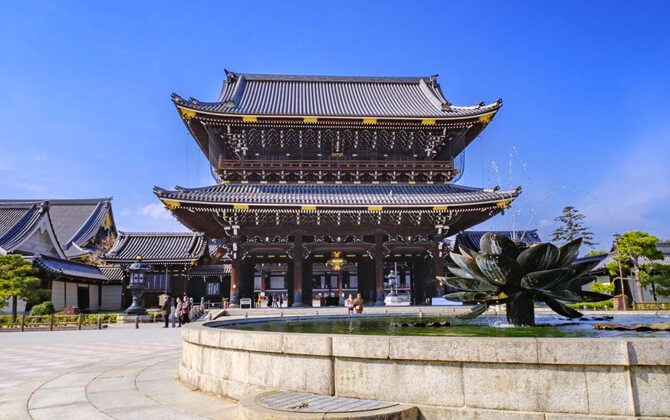
Attractions on the Karasuma Line
- Kyoto Station — a major gateway to the city, with access to Kyoto Tower, Kyoto Railway Museum, and Kyoto Aquarium.
- Gojo Station — convenient for Higashi Honganji Temple and Shoseien Garden.
- Karasuma Station — close to Shijo Street and Nishiki Market.
- Imadegawa Station — useful for Kyoto Gyoen National Garden and Kyoto Imperial Palace.
- Kitayama Station — a stop for Kyoto Botanical Gardens.
Attractions on the Tozai Line
- Uzumasa Tenjingawa Station — access to Toei Kyoto Studio Park.
- Nijojo-mae Station — the nearest stop for Nijo Castle, a World Heritage site.
- Kyoto Shiyakusho-mae Station — convenient for Teramachi Shopping Arcade and Honno-ji Temple.
- Higashiyama Station — a good starting point for Heian Shrine and the Okazaki area.
- Keage Station — useful for Nanzen-ji Temple and Eikando Temple.
- Daigo Station — access to Daigo-ji Temple.
Places Within Walking Distance of Key Stations
- Karasuma Oike Station — Kyoto International Manga Museum is about a 2-minute walk away, and Nishiki Market is also within walking distance.
- Imadegawa Station — Kyoto Imperial Palace is about a 5-minute walk from the station.
- Nijojo-mae Station — Nijo Castle is about a 1-minute walk from Exit No. 1.
- Higashiyama Station — Heian Jingu Shrine, Kyoto City Zoo, and the Yasaka Shrine and Gion area can all be reached on foot in around 10 minutes.
- Keage Station — Nanzen-ji Temple is about a 5-minute walk, while Eikando Temple is about a 13-minute walk.
- Daigo Station — Daigo-ji Temple is about a 12-minute walk from Exit No. 2.
For a quieter break between sightseeing stops, the Karasuma Oike area also has cafes, bookstores, and shopping facilities. If you need local advice on restaurants, crafts, or nearby places to visit, the concierge can be helpful.