Hyderabad Metro Rail is the rapid transit system serving Hyderabad, Telangana, India. Built as a public-private partnership through L&T Metro Rail Hyderabad Limited, it runs on three elevated lines with 57 stations and forms a major part of city transport. Phase I opened in stages from 2017 to 2020, starting with the 30 km (18.6 mi) Miyapur-Nagole stretch, and the system later became a key option for daily public transport across the city.
| Key | Information |
|---|---|
| System | Rapid transit metro in Hyderabad, Telangana, India |
| Operator structure | Public-private partnership through L&T Metro Rail Hyderabad Limited |
| Current network | 3 lines, 57 stations |
| Network layout | Secant model |
| First opening | 28 November 2017 |
| Initial opened section | Miyapur to Nagole, 30 km (18.6 mi) |
| Project cost | ₹18,800 crore (US$2.2 billion) |
| Notable feature | Ladies-only coach introduced on all trains from 7 May 2018 |
| Ridership notes | About 490,000 daily users in February 2020; around 450,000 daily average by December 2022; 0.51 million on 3 July 2023 |
Hyderabad Metro Map
Map of Hyderabad Metro showing different lines and stations. Click on the map to enlarge it or download the Hyderabad Metro map in PDF format.
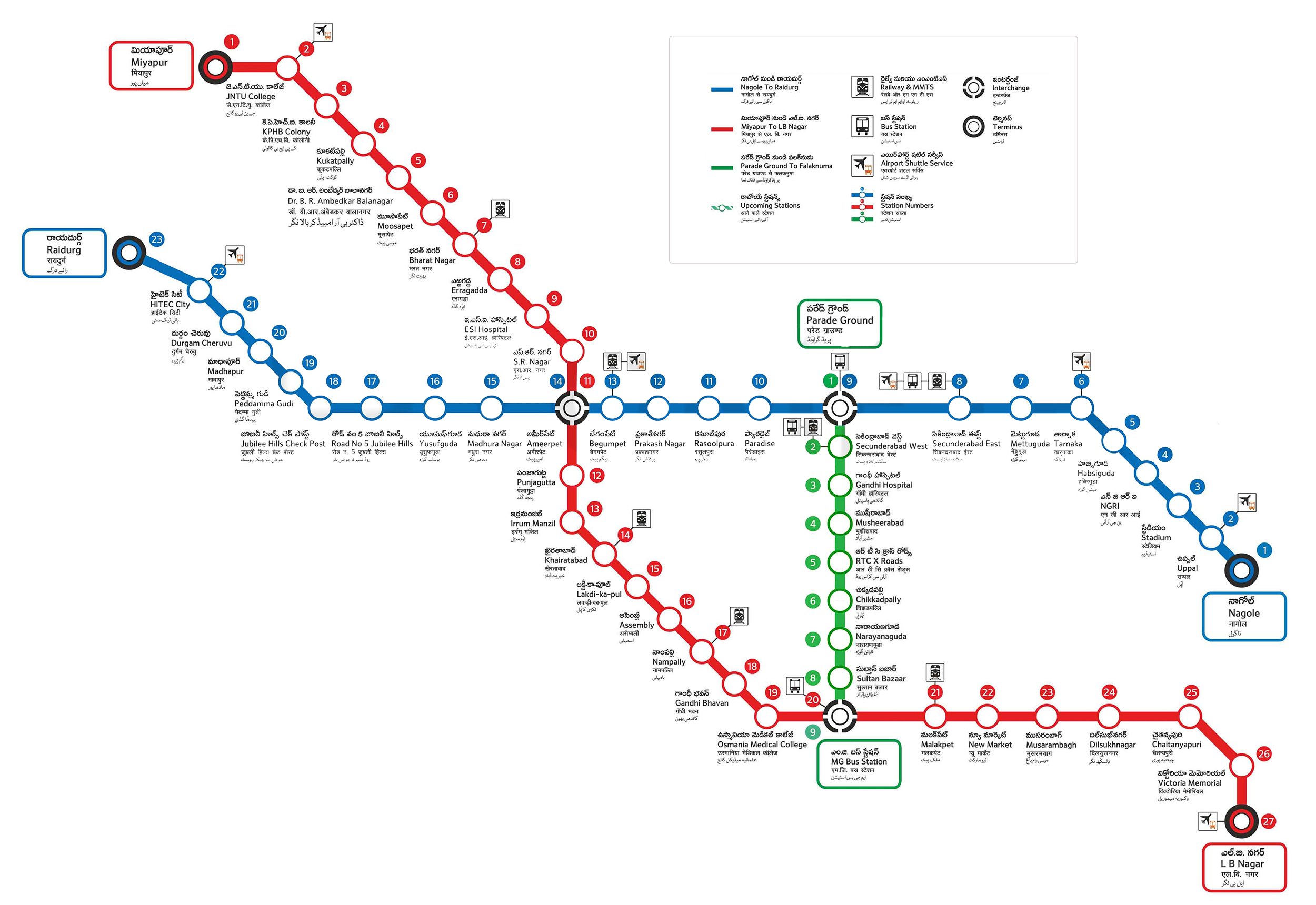
Hyderabad Metro Lines and Stations
Hyderabad Metro Rail currently operates on three main corridors. The route plan is arranged in a secant model, and all active stations are elevated. For anyone checking the stations map or building a route, the network centers on the Red Line, Blue Line, and Green Line.
Current lines
- Red Line – Miyapur to LB Nagar
- Blue Line – Raidurg to Nagole
- Green Line – JBS to MGBS
Phase I was opened in parts. The Red and Blue lines began first in 2017, while the Green Line followed in 2020. The original Phase I layout was later revised, and the Old City section was moved to Phase 2 planning.
| Station | Details |
|---|---|
| Red Line: Miyapur to Ameerpet | 11 stations; 11.3 km (7.0 mi); opened 29 November 2017 |
| Red Line: Ameerpet to LB Nagar | 16 stations; 16.8 km (10.4 mi); opened 24 September 2018 |
| Green Line: JBS to MGBS | 9 stations; 11 km (6.8 mi); opened 7 February 2020 |
| Blue Line: Raidurg to Hitech City | 1 station; 1.5 km (0.93 mi); opened 29 November 2019 |
| Blue Line: Hitech City to Ameerpet | 8 stations; 8.5 km (5.3 mi); opened 20 March 2019 |
| Blue Line: Ameerpet to Nagole | 14 stations; 16.8 km (10.4 mi); opened 29 November 2017 |
Important interchange stations shape the system. Ameerpet connects the Red and Blue lines, JBS Parade Ground links the Blue and Green lines, and MGBS is another key transfer point. Some stations also connect with Indian Railways or bus services, which helps when planning local transport in Hyderabad.
Phase 2 lines and stations
The expansion program is planned in two parts, Phase 2A and Phase 2B. Based on the available project details, Phase 2A would add 76.2 km (47.3 mi) and 56 stations, while Phase 2B would add 86 km (53.4 mi) and 42 stations.
| Station | Details |
|---|---|
| Red Line extension: LB Nagar to Hayathnagar | 6 stations; 7.1 km (4.4 mi) |
| Red Line extension: Miyapur to Patancheruvu | 10 stations; 13.4 km (8.3 mi) |
| Green Line extension: MGBS to Falaknuma | 6 stations; 7.5 km (4.7 mi) |
| Blue Line extension: Raidurg to Kokapet Neopolis | 10 stations; 11.6 km (7.2 mi) |
| Purple Line: Nagole to RGIA | 24 stations; 36.6 km (22.7 mi) |
| Station | Details |
|---|---|
| Corridor I: JBS to Shamirpet | 14 stations; 22 km (14 mi) |
| Corridor II: JBS to Medchal | 18 stations; 24 km (15 mi) |
| Corridor III: RGIA to Future City | 9 stations; 40 km (25 mi) |
All 57 current stations are elevated. Facilities include escalators, elevators, announcement boards, electronic displays, tactile pathways, and Braille buttons. Signage is available in Telugu, English, Hindi, and Urdu. Trains currently run in three-car formations, with provision for six-car trains in the future.
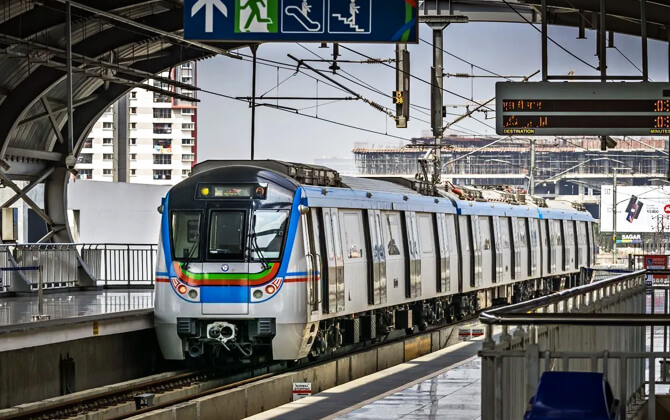
Timetable & Operating Hours
Hyderabad Metro Rail runs every day and serves all three corridors through a connected system of lines and interchange stations. If you are checking the timetable, operating hours, opening hours, or timings today, the network follows a simple daily schedule.
| Service detail | Timings |
|---|---|
| Starting time | First service at 06:00 hrs |
| Last train – Red Line | Last train leaves terminal stations at 23:00 hrs |
| Last train – Blue Line | Last train leaves terminal stations at 23:00 hrs |
| Last train – Green Line | Service runs until 23:35 hrs |
| Operating days | Seven days a week |
For route timetable planning, these are the active corridors:
- Red Line – Miyapur to L B Nagar via MG Bus Station, Nampally, and Ameerpet
- Green Line – JBS Parade Ground to MG Bus Station via Secunderabad
- Blue Line – Nagole to Raidurg via Secunderabad and Ameerpet
The available schedule information confirms the daily starting time and last train timings, but it does not list train frequency, exact running time by station, or separate schedule today variations. The service is designed to provide reliable city transport throughout the day.
Prices, tickets and discounts
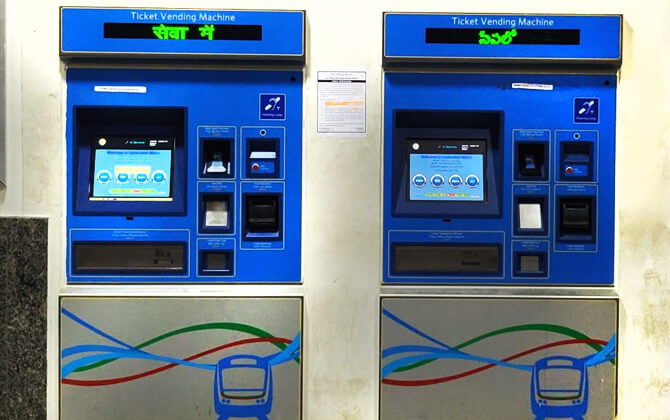
Hyderabad Metro Rail offers several ticket options for day-to-day travel. If you are looking for fare, ticket price, cost, or pass details, the system currently lists four main ticket types. All tickets are valid for one business day from the date of purchase.
- Paper QR Ticket
- Smart Card
- Digital QR Ticket
- Token
A 10% discount is applied to the percentage increase on fares, as determined by the Fare Fixation Committee, zone wise. No separate day pass or fare calculator details are provided in the draft.
| Distance | Fare |
|---|---|
| Up to 2 km (1.2 mi) | ₹11 (about US$0.13) |
| More than 2 km up to 4 km (1.2-2.5 mi) | ₹17 (about US$0.20) |
| More than 4 km up to 6 km (2.5-3.7 mi) | ₹28 (about US$0.34) |
| More than 6 km up to 9 km (3.7-5.6 mi) | ₹37 (about US$0.44) |
| More than 9 km up to 12 km (5.6-7.5 mi) | ₹47 (about US$0.56) |
| More than 12 km up to 15 km (7.5-9.3 mi) | ₹51 (about US$0.61) |
| More than 15 km up to 18 km (9.3-11.2 mi) | ₹56 (about US$0.67) |
| More than 18 km up to 21 km (11.2-13.0 mi) | ₹61 (about US$0.73) |
| More than 21 km up to 24 km (13.0-14.9 mi) | ₹65 (about US$0.78) |
| More than 24 km (14.9 mi) | ₹69 (about US$0.83) |
Connections to Other Systems
Hyderabad Metro was designed as part of a wider public transport network, so connections with other systems are a big part of how it works. The metro links with MMTS, Indian Railways, and major bus facilities, making it useful for both city transport and longer transfers.
The system connects with several bus terminals and bus stations, including Miyapur, MGBS, Dilsukhnagar, Jubilee Bus Station, Koti, and Rathifile. That makes it easier to switch between metro and bus services during daily travel.
Indian Railways links are available at major rail points such as Secunderabad, Begumpet, and Nampally. Some stations also have skywalk or interchange access to railway facilities, which helps commuters move between transport modes with less hassle.
MMTS interchange points mentioned in the materials include Bharatnagar, Begumpet, Khairatabad, Lakdikapul, and Malakpet. Inside the metro system itself, Ameerpet connects the Blue and Red lines, while MG Bus Station links the Red and Green lines. Begumpet, Secunderabad East, and Raidurg are also noted as useful transfer points.
For first- and last-mile access, Hyderabad Metro also uses feeder options such as e-autos, Tata Wingers, shuttle buses, bicycles, smart bikes, and taxi access at selected stations. Station service roads include drop-off and pick-up areas too, which supports smoother transportation in Hyderabad.
Airport Connections
Hyderabad Metro Rail has a planned airport route known as the Hyderabad Airport Express Metro, also referred to as Corridor IV. The proposed line is 31 km (19.3 mi) long and would run from Raidurg station to Rajiv Gandhi International Airport.
The project was described as mostly elevated, with one underground section near the terminal. The planned alignment includes 9 elevated stations and 1 underground station, with the airport station to be built below the passenger terminal.
According to the available details, the route would pass through Biodiversity Junction, Nanakramguda Junction, Narsingi, TS Police Academy, Rajendranagar, Shamshabad, Airport Cargo, and RGIA Terminal. It would also connect with the existing Blue Line near Raidurg.
Project materials say the airport station is intended to give direct terminal access through lifts, escalators, and stairs. They also mention multi-location check-in at Raidurg, flight information displays at stations, and a journey time of about 26 minutes from Mindspace Junction to the airport.
A foundation stone for the airport express line was laid on 9 December 2022, and the project was later described as targeted for completion by the beginning of 2026. As of December 2023, though, Union Government in-principle approval was still pending.
The materials also mention a separate airport connection proposal from the Old City via Chandrayangutta, with a revised plan extending toward Shamshabad Airport.
Tips and Rules
Before you ride, it helps to know the basic station and train rules. Hyderabad Metro Rail applies time limits, luggage restrictions, and conduct rules to keep travel safe and orderly.
Tokens are valid for only 30 minutes from the time of purchase. If you do not reach the platform within that time, the token is cancelled without refund. Smart card and token users may stay inside the premises for up to 2 hours, while non-passengers and visitors are not allowed to remain in restricted areas.
Luggage is limited to 40 kg per person. Charges apply for luggage above 10 kg at Re. 1 per kg. Gunny bags of rice or wheat are not allowed. Prohibited items include matchboxes, lighters, petrol, kerosene, gas cylinders, stoves, inflammable materials, explosives, knives, scissors, and other sharp objects.
Passengers must not sit on the train floor, obstruct officials, misuse alarms, damage property, or interfere with communication systems. Drunkenness, nuisance, spitting, quarrelling, unauthorized sales, fare evasion, and other unsafe behavior can lead to fines, removal, imprisonment, or both, depending on the offense.
Ticket rules matter too. Traveling without a ticket or pass, taking away a token without depositing it at exit, or going beyond the authorized distance can result in extra fare penalties. Entry should be made at the station where the token was purchased, and overstaying beyond the permitted time may also bring a penalty.
If you need help, use the Customer Care Center for assistance with lost or damaged cards, ticket issues, refunds, or general travel questions. It is also worth following station announcements, respecting reserved seating, and cooperating with security checks.
Fun Facts
Hyderabad Metro Rail was launched through a public-private partnership, with Larsen & Toubro developing the project through L&T Metro Rail Hyderabad Limited while the state government kept a minority equity stake.
The first major opening on 28 November 2017 covered a 30 km (18.6 mi) stretch from Miyapur to Nagole with 24 stations. At the time, it was the longest rapid transit metro line opened in one go in India.
Phase I was planned as three fully elevated corridors. In the final network, these became the Red, Blue, and Green lines, with Line 2 also known as the East West Metro.
Stations are built for barrier-free access, with escalators, elevators, tactile pathways, and Braille-enabled elevator buttons. Signboards appear in Telugu, English, Hindi, and Urdu.
A ladies-only coach has been available on all trains since 7 May 2018. Each three-coach train was also designed so another set could be attached later, allowing future six-coach operations if needed.
In May 2022, Hyderabad Metro Rail said it would not attach a single or double coach to existing three-coach sets. Each set can carry about 900 to 1,000 passengers per trip.
The system has crossed major ridership milestones too, including 100 million cumulative riders in 671 days and a daily ridership of 0.51 million on 3 July 2023.
The metro has also appeared in films such as Kalki 2898 AD, 18 Pages, 8 A.M. Metro, Kushi, and Single. Another notable detail: the security workforce includes 20 transgender personnel after specialized training, marking an important step for the city’s public transport system.
History
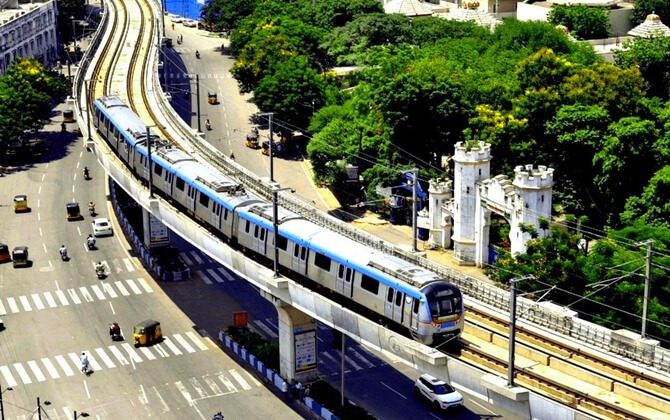
The Hyderabad Metro Rail project began in 2003, when the Union Ministry of Urban Development approved the proposal and asked Delhi Metro Rail Corporation to survey the suggested lines and prepare a Detailed Project Report. The aim was clear: ease growing transport demand and road congestion in Hyderabad and Secunderabad, where MMTS alone was no longer enough.
In 2005, the state government and South Central Railway launched MMTS to add transport capacity, with the metro intended to connect with it. In 2007, N. V. S. Reddy was appointed Managing Director of Hyderabad Metro Rail Limited, and the Central Government approved ₹1,639 crore (about US$197 million) under the Viability Gap Funding scheme. L&T ruled out an underground system because of hard rock, boulders, and local soil conditions.
The first bidding round ended in July 2008 with Maytas as the winner, but the company failed to achieve financial closure by March 2009. The contract was cancelled, and the state government called for fresh bids. In July 2010, Larsen & Toubro emerged as the lowest bidder and agreed to take up the project with viability gap funding. Progress then faced delays linked to state agitation and other government concerns.
Groundbreaking took place on 26 April 2012, and pillar erection began the same day. Rail laying started in November 2013 between Nagole and Mettuguda. The first train arrived from Korea in May 2014, and trial runs followed soon after. In December 2014, the system completed a training run in Automatic Train Operation mode between Nagole and Mettuguda.
Phase I opened in stages from 2017 to 2020. The 30 km (18.6 mi) Miyapur-Nagole stretch with 24 stations opened first on 28 November 2017 and began public service the next day. The Red Line extension to LB Nagar opened on 24 September 2018, the Blue Line reached HITECH City on 20 March 2019 and Raidurg on 29 November 2019, and the Green Line between Jubilee Bus Station and Mahatma Gandhi Bus Station opened on 7 February 2020.
After operations began, the government announced Phase II plans, including airport access. On 26 March 2018, Telangana announced Hyderabad Airport Metro Limited as a special purpose vehicle to extend the Blue Line from Raidurg to Rajiv Gandhi International Airport. Later proposals were revised, submitted, and debated as the project also faced financial strain, ownership talks, and wider expansion discussions.
By 3 July 2023, Hyderabad Metro Rail had reached a ridership of 0.51 million.
Initial bidding
The initial bidding process was completed by July 2008 and awarded to Maytas, but the company failed to achieve financial closure on schedule.
Re-bidding
After the original contract was cancelled, the state government invited fresh bids. Larsen & Toubro became the lowest bidder in July 2010 and took up the project under a public-private partnership model.
Construction milestones
The project advanced through a series of key steps: groundbreaking in 2012, rail laying in 2013, arrival of the first train in 2014, trial runs, safety approvals, and phased openings between 2017 and 2020.
Phase II
After the first Phase I sections opened, Hyderabad Metro Rail Limited outlined Phase II ideas covering new corridors and airport connectivity. Delhi Metro Rail Corporation was later asked to prepare the Detailed Project Report, while revisions, financial pressures, and policy changes affected the timing and scope of the expansion.
Ownership Transfer
After the first stretch opened, L&T raised concerns about cost overruns, delays, and operating losses. The company later withdrew from participating in Phase II, and discussions with the state government led to an agreement for the government to acquire L&T’s stake in the project.
Future Extensions
Hyderabad Metro Rail has a broad expansion roadmap aimed at improving transport links across the city and surrounding growth areas. The next stages focus on extending existing lines, adding new corridors, and improving access to the airport, the Old City, and developing suburbs.
Phase 2A
Phase 2A includes five corridors and is expected to add 76.2 km (47.3 mi) with 56 stations. The plan covers extensions to the Red, Green, and Blue lines, along with a new Purple Line to Rajiv Gandhi International Airport.
- Red Line extension: Miyapur to Patancheruvu
- Red Line extension: LB Nagar to Hayathnagar
- Green Line extension: MGBS to Chandrayangutta
- Blue Line extension: Raidurg to Kokapet Neopolis
- Purple Line: Nagole to RGIA
Phase 2B
Phase 2B proposes three more corridors covering 86 km (53.4 mi) with 42 stations. These routes are intended to improve suburban access and support growth in northern and airport-side areas.
- JBS to Shamirpet
- JBS to Medchal
- RGIA to Future City
Other proposed directions
Beyond the formal Phase 2 plan, the materials also mention more proposals under review, including the Old City route, links toward Future City and Mirkhanpet, and possible extensions toward Kandukur, Shameerpet, and Medchal. In short, the expansion vision is much wider than the currently operating system.
These future routes are intended to improve first- and last-mile connectivity, support transit-oriented development, and give faster travel options across the metropolitan area.
Nearby Attractions
Hyderabad Metro Rail makes it easier to reach many well-known places across the city. The Red Line, in particular, connects several central areas with shopping, parks, museums, temples, and other attractions.
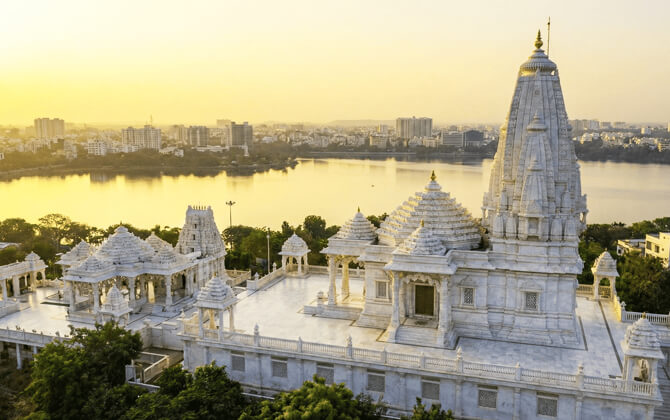
Stations such as Punjagutta, Irrum Manzil, Khairatabad, Lakdi Ka Pul, Assembly, Nampally, Gandhi Bhavan, New Market, and Victoria Memorial provide access to a broad mix of places worth visiting.
- Next Galleria Mall and Hyderabad Central near Punjagutta
- GVK One Mall, Hussain Sagar, and Jalavihar Water Park near Irrum Manzil
- NTR Garden and Lumbini Park near Khairatabad
- BM Birla Science Museum and Birla Mandir near Lakdi Ka Pul
- Telangana State Archaeology Museum near Assembly
- St Joseph’s Cathedral near Nampally
- ISKCON Temple near Gandhi Bhavan
- Race Club near New Market
- Priyadarshini Park and Saroornagar Lake near Victoria Memorial
The Red Line runs from Miyapur to LB Nagar and crosses central Hyderabad in a northwest-southeast direction. It is also planned for future extension beyond both ends, toward Hayath Nagar and Patancheru.
For sightseeing, MGBS is a practical stop for reaching Charminar by a short auto ride, while Lakdi Ka Pul is convenient for Birla Mandir. The metro also provides access to Hussain Sagar Lake, NTR Garden, Lumbini Park, and other places that are easy to combine in one trip.
The Blue Line adds more options, linking travelers to Shilparamam, Durgam Cheruvu, Rajiv Gandhi International Stadium, Sanjeevaiah Park, Butterfly Garden, and KBR National Park through stations such as HITEC City, Madhapur, Stadium, Rasoolpura, and Jubilee Hills Road No. 5.
For visitors using public transport, Hyderabad Metro Rail is one of the easiest ways to get around without dealing with road traffic.