The Copenhagen S-train, or S-tog, is a core part of public transport in Copenhagen, Denmark. It is a hybrid urban-suburban rail system that links the inner city with suburbs and outer towns including Hillerød, Klampenborg, Frederikssund, Farum, Høje-Taastrup, and Køge. The system has 170 km (105.6 miles) of double track and 87 stations, and it works alongside the Copenhagen Metro, regional trains, buses, local transport services, and harbour buses under a shared fare system.
| Key | Information |
|---|---|
| System | Copenhagen S-train (S-tog) |
| Type | Urban-suburban rail system |
| Coverage | Copenhagen inner city, suburbs, and nearby towns |
| Network length | 170 km (105.6 miles) |
| Stations | 87 |
| Operator | DSB S-tog A/S |
| Infrastructure owner | Banedanmark |
| Daily ridership | More than 357,000 passengers |
| Shared transport links | Metro, regional trains, bus network, harbour buses |
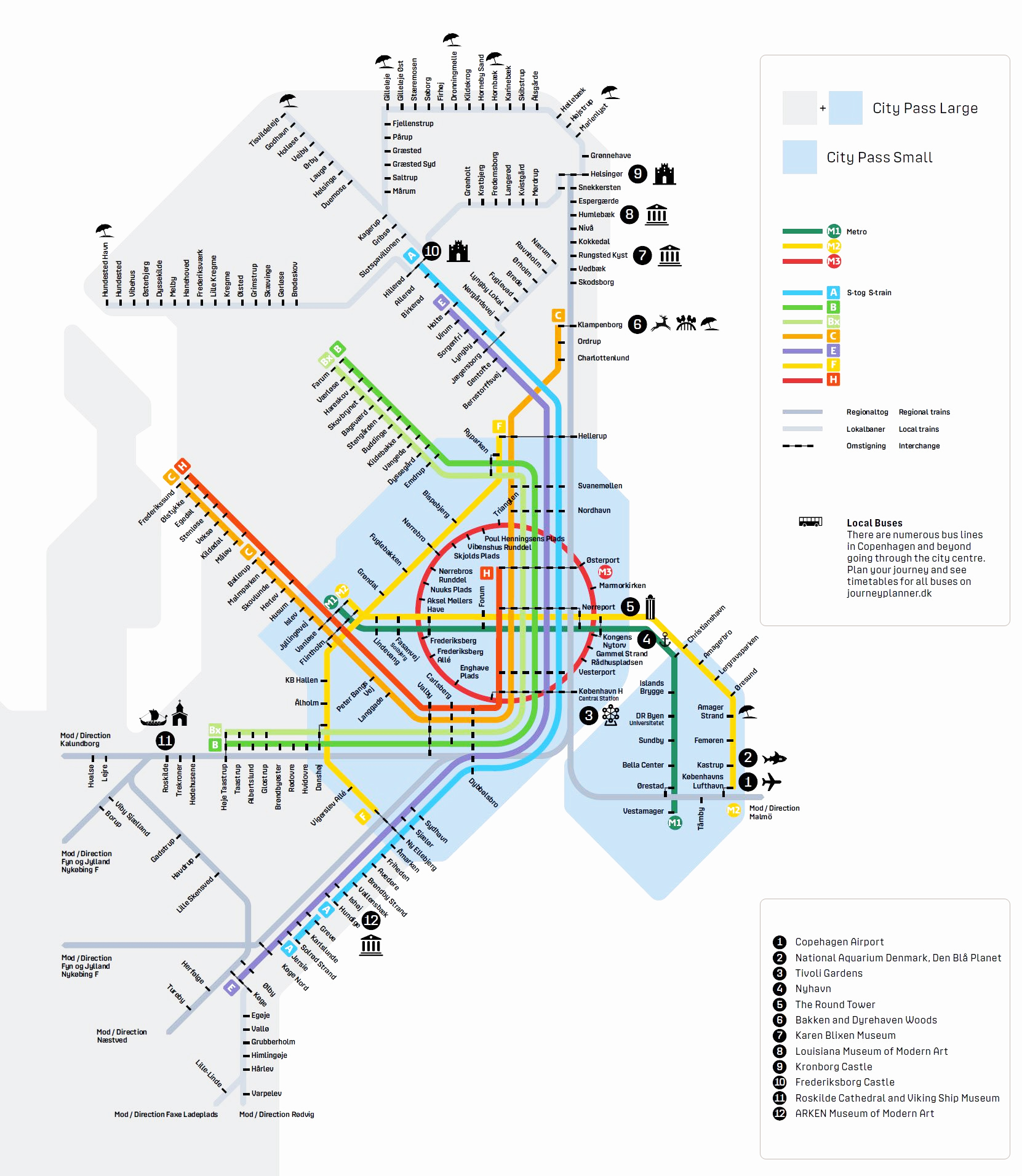
Copenhagen S-train Map
Map of Copenhagen S-train showing different lines and stations. Click on the map to enlarge it or download the Copenhagen S-train map in PDF format.
Lines and Stations
The Copenhagen S-train route plan is built around six radial lines and two connecting lines. The radial routes link the city center with the northern, western, and southern suburbs, while the connecting lines create cross-city links and make transfers easier across the system.
The six radial lines are:
- Klampenborgbanen from Klampenborg to Østerport, carrying the C service.
- Nordbanen from Holte and Hillerød to Østerport, carrying the A and E services.
- Hareskovbanen from Farum to Østerport, carrying the B and H services.
- Frederikssundbanen from Frederikssund to Copenhagen Central Station, connecting to the Boulevard Line and carrying the C and H services.
- Vestbanen from Høje Taastrup to Copenhagen Central Station, carrying the B and Bx services.
- Køge Bugt-banen from Hundige and Køge to Copenhagen Central Station, carrying the A and E services.
The two connecting lines are:
- Ringbanen, running from Hellerup to Ny Ellebjerg and carrying the F service.
- Boulevard Line (Roret), an underground city-centre connection between Østerport and Copenhagen Central Station, carrying the A, B, Bx, C, E, and H services.
Most routes follow a radial path train pattern through the city core, but cross-city travel is also well supported. At Valby and Dybbølsbro, several suburban services continue through the Boulevard Line, while the F line runs in a semicircle between Hellerup and Ny Ellebjerg.
The stations map includes 87 stations in normal operation. Of these, 32 are in fare zones 1 and 2, 35 are in the Copenhagen urban area, and 17 are considered suburban stations. Station types vary too: some are elevated, some are at street level, some are below street level, and one is underground.
| Station | Details |
|---|---|
| Copenhagen Central Station | Key central interchange station |
| Nørreport | Key central station; only underground S-train station |
| Østerport | Key central station and Boulevard Line connection |
| Vesterport | Key central station |
| Valby | Important interchange with through services |
| Dybbølsbro | Important interchange with through services |
| København Syd | Key station; formerly Ny Ellebjerg, renamed on December 10, 2023 |
| Hillerød | Important outer terminal |
| Klampenborg | Important outer terminal |
| Holte | Important outer terminal |
| Farum | Important outer terminal |
| Høje Taastrup | Important outer terminal |
| Frederikssund | Important outer terminal |
| Køge | Important outer terminal |
| Hundige | Important outer terminal |
| Solrød Strand | Important outer terminal |
| Høvelte | Military station with very limited stops |
| Kildedal | Not operated on Monday-Friday evenings |
| Enghave | Closed in 2016 to make room for Carlsberg station |
| Fuglebakken | Elevated station |
| Jægersborg | Elevated station |
| Bernstorffsvej | Elevated station |
| Nordhavn | Elevated station |
| Sjælør | Elevated station |
| Sydhavn | Elevated station |
| Dyssegård | Elevated station |
| Jyllingevej | Elevated station |
| Vanløse | Elevated station |
| Vigerslev Allé | Elevated station |
| Flintholm | Station with different levels |
| Rødovre | Station with different levels |
| Danshøj | Station with different levels |
| Ryparken | Station with different levels |
Copenhagen S-Train Timings, Frequency and Schedule
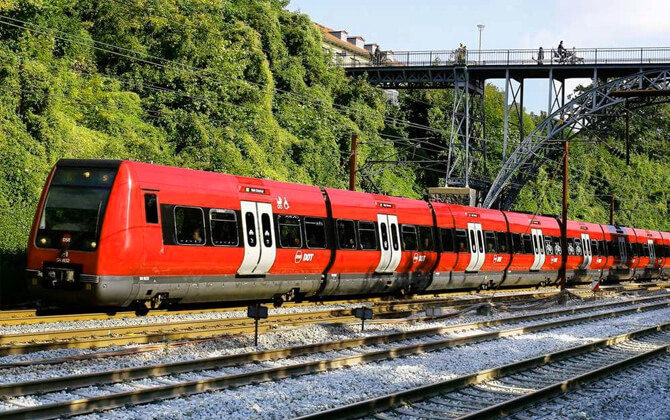
The Copenhagen S-train timetable covers the wider urban area and usually runs from about 05:00 until around 00:30. If you are checking operating hours, opening hours, or opening times for the network, that is the general daily pattern.
On weekdays, the train schedule is frequent through most of the day. Line F runs every 5 minutes, lines A, B, C, and E every 10 minutes, and lines H and Bx every 20 minutes. In the city center, where several routes share tracks, frequency is even better than on the outer branches.
Friday and Saturday nights have all-night service. During those hours, line F runs every 30 minutes. On Sundays, intervals are doubled, and weekend service uses a reduced set of lines while still keeping regular connections.
For timings today, schedule today, or route timetable planning, it helps to remember that weekday service keeps all stations at least every 10 minutes until the evening, after which working hours continue with longer intervals. The network is designed for all-day urban travel, with a later closing time than many commuter systems and a last train pattern extended by night service on Fridays and Saturdays.
| Service detail | Timings |
|---|---|
| Starting time | About 05:00 |
| Closing time | Around 00:30 |
| Line F frequency on weekdays | Every 5 minutes |
| Lines A, B, C and E frequency on weekdays | Every 10 minutes |
| Lines H and Bx frequency on weekdays | Every 20 minutes |
| Friday and Saturday night service | All-night service |
| Line F night frequency | Every 30 minutes |
| Sunday service | Intervals doubled |
Fare Zones, Tickets and Cards
The Copenhagen S-train uses the same zone-based fare system as buses, trains, and the Metro across Greater Copenhagen. Your fare, ticket price, and total cost depend on how many zones you travel through, so the best ticket depends on your route and how often you plan to use public transport.
If you only need occasional travel, a single ticket is the simplest option. It is valid for a set time period and a certain number of zones. For light use of city transport, that can be enough.
For more frequent travel, a travel card or day pass may be more practical. A City Pass gives unlimited transport in central Copenhagen for 24, 48, 72, or 120 hours. It is valid in zones 1-4 and also covers trips between Copenhagen Airport and the city centre.
The Copenhagen Card combines transportation in the city with sightseeing benefits. It includes free travel on buses, trains, and the Metro for 24, 48, 72, or 120 hours and includes access to more than 70 museums and attractions. It is valid in zones 1-99, including airport travel.
If you are staying for just one day, the DSB 24-hour ticket can be useful. It gives unlimited travel on buses, trains, and the Metro for 24 hours in all zones 1-99, and it is available for adults and children.
Children – tickets and discount cards
Children travel under special rules. Two children up to age 11 can travel free with an adult who has a valid ticket. Children traveling alone pay a child fare until age 16. Two children under 16 can also travel together on one adult ticket.
Where to buy tickets and travel cards
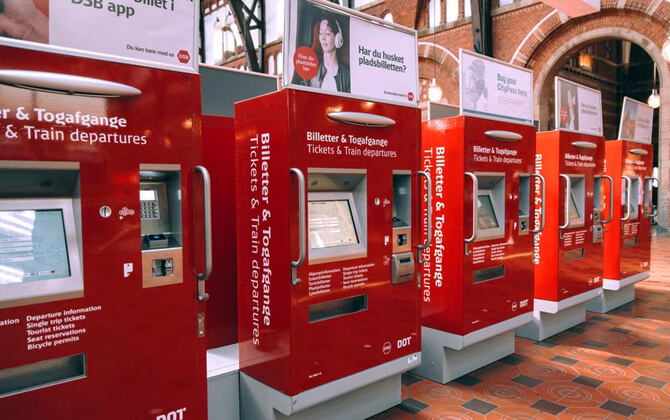
You can buy tickets and cards at most stations, from ticket machines, at some kiosks, on dinoffentligetransport.dk, or by mobile phone. The Copenhagen Card is also sold on copenhagencard.com. Single tickets can additionally be bought from bus drivers.
If you need current fare details, price information, or help choosing a pass, check with Movia, DSB, Metro Customer Service, or the official public transport website. The source text does not provide exact fares or a fare calculator.
Parking near Copenhagen S-train
If you want to combine station parking with public transport, one central option is Q-Park Nørreport at Linnésgade 1, 1363 København K. From Nørreport Station, the city center is within walking distance, and you have direct access to the S-train, regional trains, Metro, bus services, and taxis.
The facility has 1,187 parking spaces, 6 disabled spaces, 19 electric charging points, and a drive-through height of 2.10 m (6.9 ft). The barrier opens automatically on arrival, and you can book a space online by selecting the facility and registering your number plate.
There is also a weekend parking offer that guarantees a space from Friday at 16:00 to Monday at 08:00, with the option to leave and re-enter during that period. That makes it a practical choice if you want to park once and continue into the city by train.
If you need help, the operator can be contacted Monday to Friday from 09:00 to 15:00 on +45 7025 7212.
Parking charges and parking charges per day are not listed in the source text. In central Copenhagen, though, parking rules are strictly enforced, so station parking can be a sensible alternative to looking for street parking.
Connections to Other Systems
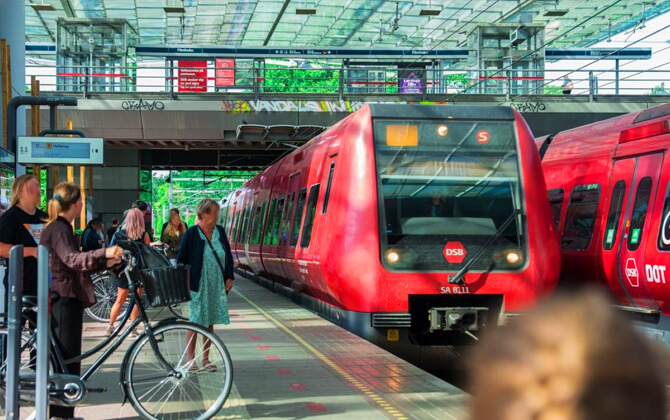
The Copenhagen S-train is tightly integrated with the rest of Copenhagen public transport. It runs alongside the Metro and connects with regional trains, local diesel-powered trains, buses, and harbour buses, making it a central part of transportation in Copenhagen.
A common fare system covers these networks. Rejsekort, paper single-trip tickets, and the DOT Tickets app can be used on S-trains, buses, regional trains, and the Metro, which makes transfers across the wider transport system much easier.
Bus terminals are often located next to an S-train or Metro station, so changing between train and bus is usually straightforward. At the outer ends of the network, regional rail provides access to the rest of Zealand and the islands between the Great Belt and Øresund, while local diesel lines connect more remote towns in the metropolitan area.
Trains across Øresund also connect the city centre with Scania and Malmö. Key interchange points include central stations, as well as Flintholm Station and Nørrebro Station, which are the only current interchanges between the F line and the Metro network.
Airport Connections
Copenhagen Airport is easy to reach from the city centre. It is about 8 km (5 miles) from central Copenhagen, and travel time is under 15 minutes by train or Metro. Both rail options depart from Terminal 3, with bus stops just outside.
Train
The train from the airport to Copenhagen Central Station takes about 15 minutes. During the day, trains depart every 10 minutes. In the evening, they run every 20 minutes, and at night there is one train per hour.
Copenhagen Central Station offers onward connections to the rest of Denmark by train, S-train, or bus.
Metro
The Metro takes about 13 minutes to Kongens Nytorv. From there, you can change to line M3, which circles the city with 17 stops and a full running time of 28 minutes.
If you are heading to Kongens Nytorv, Nørreport, or Frederiksberg/Vanløse, the Metro is a strong option. It runs frequently, and tickets can be bought at the airport station. For cruise terminals in Nordhavn, change at Kongens Nytorv and take the M4 towards Orientkaj.
Bus
Bus 5c also links the airport and Copenhagen Central Station. The trip takes around 35 minutes, and the stop is just outside Terminal 3.
Other bus companies serve the airport too. Abildskou Bus 888 goes to the northern part of Jutland from outside Terminal 2, while Greyhound-bus 999 runs between Malmö and Copenhagen and stops at Terminal 3, Sydhavnen, and Copenhagen Central Station.
Taxi
Taxis are available just outside Terminals 1 and 3.
Rules and Tips
The Copenhagen S-train is simple to use, but a few practical tips make the trip smoother and safer.
- Buy a valid ticket before boarding, since there are no barriers at the stations and ticket inspections are regular.
- Do not expect to buy tickets onboard; use ticket machines, station shops, or the DSB, DOT, or Rejseplanen apps.
- Let passengers get off first and avoid blocking the doors, especially during busy periods.
- Press the door button when needed, as exterior doors do not open automatically.
- Use the quiet zone respectfully; if you need to talk, move to another carriage.
- Follow bicycle rules carefully. Bikes are only allowed in designated carriages, and Nørreport has rush-hour restrictions for bicycles.
- There are no toilets, first-class carriages, or seat reservations on the S-train.
- Check line and platform information before travel, because some services only run on part of the route at certain times.
- For wheelchair access, notify the driver and wait at the end of the platform where the train will stop.
- During replacement bus services, follow station notices and app updates, as tickets cannot be bought on the bus.
English announcements and signs are widely available, which helps if you are unfamiliar with the system.
History
The history of the Copenhagen S-train begins with six radial and two connecting rail lines built in the late 19th and early 20th centuries to serve commuters traveling to and from residential areas around the city center. The main aim was to electrify the existing local rail network around Copenhagen.
Formal preparation started with the Electrification Commission of 1926, following earlier proposals. In its 1929 report, the Commission suggested electrifying the short-distance lines from Copenhagen to Klampenborg first, possibly including Frederiksberg-Vanløse-Hellerup, and then the line to Holte once the double track from Holte to Hillerød was in regular use. After review by DSB, the Valby section was added as the first stage of electrification for the Ballerup line, and a bill was adopted in April 1930.
The first section opened on 3 April 1934, running from Klampenborg to Hellerup and from Vanløse to Frederiksberg. It was the first electrically powered railway in Denmark.
Several existing lines were then reorganized into the new system, including Hellerup to Hillerød, Svanemøllen to Farum, and the line between Frederikssund and Valby. The Valby-Vanløse section opened in 1941, was extended to Ballerup in 1949, and finally reached Frederikssund in 1989. Single-track sections remained between Ballerup and Veksø until 2000, and between Veksø and Frederikssund until 2002.
New tracks were also built along the Valby-Høje Taastrup corridor. The section between Valby and Glostrup opened in 1953, extended to Taastrup in 1963, and reached Høje Taastrup in 1986. The Køge Bay line was built in four stages between Dybbølsbro and Køge: Dybbølsbro to Vallensbæk opened in 1972, Vallensbæk to Hundige in 1976, Hundige to Solrød Strand in 1979, and the final extension to Køge in 1983.
The Frederiksberg-Vanløse-Grøndal line was later closed after the arrival of the Copenhagen Metro, and the former Godsbaneringen Grøndal-Ny Ellebjerg route was converted to an S-line. Originally, the network did not use letters or numbers for individual lines, but line letters were introduced with the summer timetable on 14 May 1950. The S-train system has been entirely one-man operated since 1978.
Future Extensions
Several ideas for expansion have been discussed for the Copenhagen S-train, though they remain at different planning stages. One recurring proposal is a new north-south tunnel through the densely populated central area, where the existing core already handles a very high number of trains per hour.
Another long-discussed extension would continue the Vestbanen from Høje Taastrup to Roskilde along existing tracks. This option had been under investigation as of 2019. A further western extension from Klampenborg to Elsinore has also been mentioned, although it would be harder to deliver because of limited spare capacity in the central tunnel.
Other proposals go beyond the current route structure. One would connect Copenhagen Airport directly to the S-train system, even though the airport is already served by regional trains and the Metro. The Danish Transport Authority has also suggested converting the F-line to Metro standard as an M5 line.
Long-term development includes a driverless future. The new train program is intended to introduce fully automated operation gradually, with the first trains expected in 2032 and full automation planned by 2040. The aim is to improve capacity, regularity, and operating flexibility across the system.
Nearby Attractions
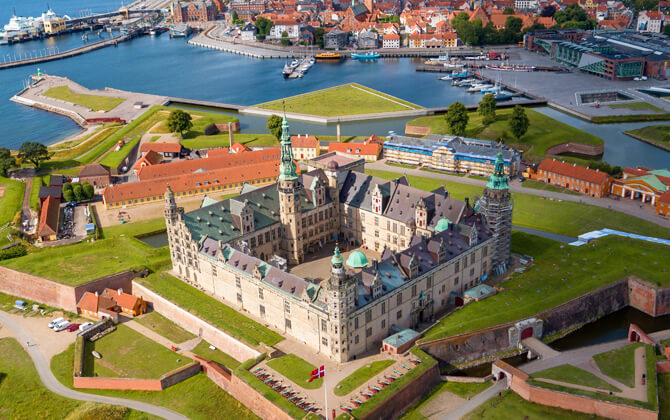
The Copenhagen S-train is a practical way to reach destinations beyond the immediate city center. Several lines connect Copenhagen with nearby towns, coastal areas, and major interchange points, so day trips are easy to plan.
One of the best-known destinations is Helsingør, reached via the Coast Line to Elsinore. It is the gateway to the historic port town and Kronborg Castle, which overlooks the Øresund Strait.
Hillerød is another popular stop. It is home to Frederiksborg Castle, its gardens, the Frederiksborg Museum, and other local sights. The journey from Copenhagen takes about an hour.
For a shorter outing, Klampenborg gives access to the forest park area near the coast and is a well-known starting point for outdoor recreation.
The wider network also serves useful travel hubs and local destinations including Lyngby, Hellerup, Østerport, Nørreport, København H, Valby, Carlsberg, Hvidovre, Glostrup, Hundige, Høje Taastrup, and Køge. Copenhagen also connects with the Øresund Line to Sweden, which adds another easy regional trip.
- Helsingør for Kronborg Castle and the ferry terminal
- Hillerød for Frederiksborg Castle and its gardens
- Klampenborg for access to the coastal forest park
- København H for central connections and onward rail travel
- Øresund Line for trips to Sweden