The Foshan Metro, branded as FMetro, is the rapid transit system serving Foshan in Guangdong, China. It is linked with Guangzhou Metro, making it a key part of public transport and city transport in the wider Foshan-Guangzhou area. The Guangfo Line is operated by Guangzhou Metro Corporation, while the other metro lines are run by the state-owned Foshan Metro Group. Construction started in 2002, and the first line opened on 3 November 2010. Today, the system includes the Guangfo Line, Line 2, Line 3, and tramway services in Nanhai and Gaoming, with Line 4 under construction and more expansion planned.
| Key | Information |
|---|---|
| System name | Foshan Metro (FMetro) |
| Location | Foshan, Guangdong, China |
| First opening | 3 November 2010 |
| Construction began | 2002 |
| Main operating lines | Guangfo Line, Line 2, Line 3 |
| Other services | Nanhai Tram Line 1, Gaoming Tram Line 1 |
| Cross-city connection | Direct links with Guangzhou Metro |
| Expansion status | Line 4 under construction; Line 11 and Line 2 western extension planned |
Foshan Metro Map
Map of Foshan Metro showing different lines and stations. Click on the map to enlarge it or download the Foshan Metro map in PDF format.
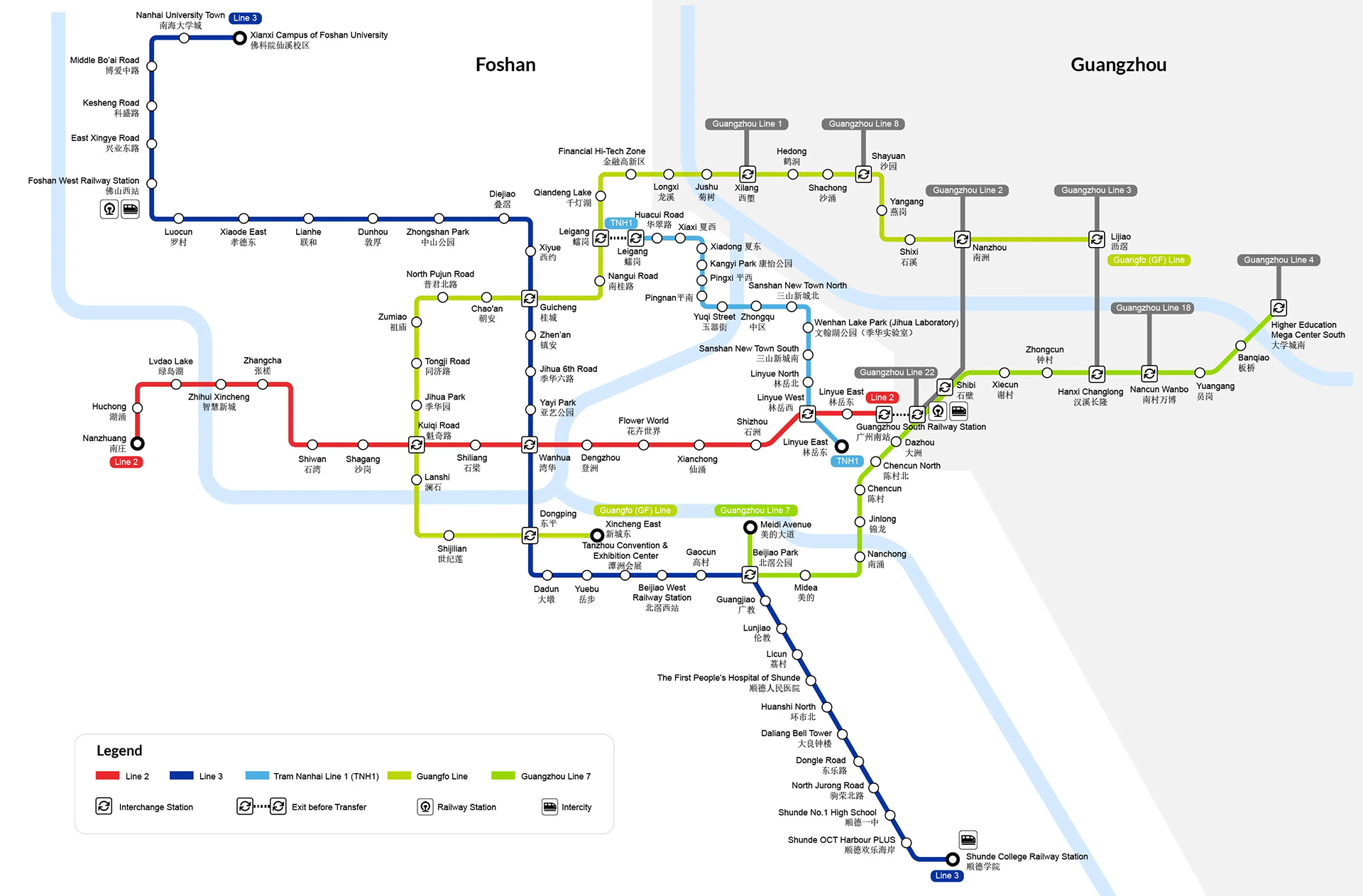
Foshan Metro Lines and Stations
Foshan Metro serves the city with a small but important system that connects major districts, transport hubs, and Guangzhou. For anyone checking the route plan, stations map, or stations list, the core network currently includes the Guangfo Line, Line 2, and Line 3, while Line 4 is under construction and Line 11 has already been approved.
| Line | Route | Stations | Status |
|---|---|---|---|
| Guangfo Line (Line 1) | Xincheng Dong – Lijiao | 25 | Operating |
| Line 2 | Nanzhuang – Guangzhou South Railway Station | 17 | Operating |
| Line 3 | Shunde College Railway Station / Lianhe – Zhongshan Park / Foshan University | 35 | Operating |
| Line 4 | Beijiang Dadao – Gangkou Lu | 33 | Under construction |
| Line 11 | Xijiao – Hedong East | 18 | Approved by the NDRC |
The Guangfo Line is a fully underground intercity route linking Foshan and Guangzhou. Line 2 runs east-west between Nanzhuang and Guangzhou South Railway Station. Line 3 is the main north-south backbone, connecting Shunde and Chancheng.
Stations and interchanges
| Station | Details |
|---|---|
| Guangfo Line | 25 stations, including Xincheng Dong, Kuiqi Lu, Zumiao, Guicheng, Qiandeng Lake, Xilang, and Lijiao. |
| Line 2 | 17 stations, with interchanges at Kuiqi Road, Wanhua, Linyue West, Linyue East, and Guangzhou South Railway Station. |
| Line 3 | 35 stations, with interchanges at Dongle Road, Beijiao Park, Dongping / Guicheng, Wanhua, and Jihua 6th Road. |
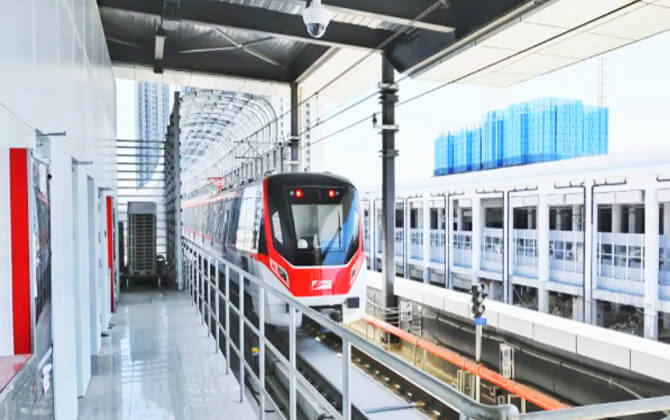
Foshan also has Nanhai Tram Line 1, a light metro-style tramway from Leigang to Linyue East. It connects with the Guangfo Line, Line 2, and the planned Line 11.
Taken together, the metro and trams give Foshan a broader local transport network and improve transportation in the city as well as links to Guangzhou.
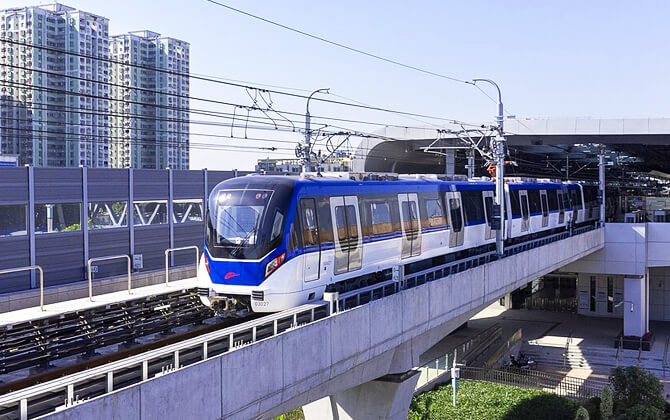
Timings and Frequency
Foshan Metro operating hours generally cover about 17 hours a day, though opening hours, closing time, and last train timings vary by line. Since May 2025, some services have had earlier last train departures, while weekend or holiday schedules may be extended depending on demand.
Typical frequency across the system is around 8 to 14 minutes, with shorter gaps in peak periods. During rush hours, some lines run every 4 minutes, and Line 2 can reach 2 to 3 minutes. If you are checking timings today, schedule today, or the train schedule for a specific route, it is worth confirming the latest timetable before travel.
| Service detail | Timings |
|---|---|
| Guangfo Line | 06:00–23:00 toward Lijiao; 06:00–22:30 toward New Town East; about every 4 minutes in weekday peak hours |
| Line 2 | 06:00–22:30 from Nanzhuang; 06:02–23:32 toward Linyuedong; every 2–3 minutes in rush hours and 5–10 minutes off-peak |
| Line 3 | 06:00–23:30 from Zhen’an; 06:05–22:45 toward Shunde University; every 4–5 minutes in rush hours and about 8 minutes off-peak |
| Guangzhou Metro Line 7 (Shunde Section) | 06:00–23:10 from Midea Avenue; 06:10–23:15 toward University Town South |
| Nanhai Tram Line 1 | 06:15–22:45 from Linyuedong; 06:30–22:00 in the return direction; about every 8 minutes throughout the day |
| Gaoming Tram Line 1 | 07:00–22:00; fixed schedule |
For running time, the Guangfo Line takes about 60 minutes end to end, Line 3 takes about 55 minutes for its full first-section route, and TNH1 takes about 40 minutes. Opening times and working hours can differ by line, so always check the current route timetable if you are traveling late.
Foshan Metro Fares, Tickets and Cards
Foshan Metro uses a distance-based fare system. Ticket options include single rides, passes, stored-value products, QR payment, and transport cards. If you need fare, price, ticket price, or cost details, the basic structure is straightforward.
Basic Fare Rules
| 0–4 km / 0–2.5 miles | ¥2 (about $0.28) |
| 4–12 km / 2.5–7.5 miles | +¥1 (about $0.14) for every additional 4 km / 2.5 miles |
| 12–24 km / 7.5–14.9 miles | +¥1 (about $0.14) for every additional 6 km / 3.7 miles |
| Over 24 km / 14.9 miles | +¥1 (about $0.14) for every additional 8 km / 5 miles |
| Gaoming Tram Line 1 | Flat fare of ¥2 (about $0.28) |
Special Tickets and Passes
- 1-Day Pass: ¥20 (about $2.80), unlimited rides within 24 hours of first use.
- 3-Day Pass: ¥50 (about $7.00), unlimited rides within 72 hours of first use.
- Group Discount: 10% off for groups of 30 or more passengers per trip.
The maximum allowed travel time is 270 minutes. If a trip goes beyond that, extra payment applies based on the maximum single fare. Cross-city travel with Guangzhou uses combined pricing, and some fares may be reduced by ¥2 to ¥3 (about $0.28 to $0.42) through the Guangzhou South Railway Station transfer channel.
How to Buy Tickets
- Ticket vending machines are available at all stations, with English support and payment by cash or mobile payment.
- Mobile QR codes can be used through the official Foshan Metro app or via Alipay and WeChat.
- Transit cards accepted include Lingnan Pass, Guangfo Pass, and National Intercity Transit Cards.
TVMs accept RMB 1, 5, 10, and 20 notes. For QR travel, scan the code at the gate after linking your payment account.
Cards, Discounts and Payment Options
Regular card users can access the fare discount plan for Guangzhou public transport and Foshan Metro. Children’s cards provide free rides, while student cards and some senior or disabled priority cards offer discounted or free travel depending on eligibility.
China T-Union cards issued in Guangzhou and Foshan also qualify for the fare discount plan. Cards issued elsewhere are treated as regular cards. Contactless bank card payment is supported on some services, including UnionPay credit cards. Visa, Mastercard, AmEx, and JCB are not available at the Cloud Ticket Gate in orange and on lines operated by Foshan Metro, including Nanhai Tram Line 1.
Stored-value metro tickets are available as well. The regular ticket gives 5% off, while commemorative tickets allow unlimited rides for 24 hours after the first tap-in. Student tickets and severely disabled tickets are sold to eligible Foshan residents at selected stations on the Guangfo Line and Line 7.
The 1-day pass and 3-day pass can be purchased at Foshan Metro and Nanhai Tram customer service centers. With either pass, you cannot exit at the same station where you entered.
If you want a fare calculator style option without using a machine, the Foshan Metro transit code is available in the Foshan Metro App, Alipay, and Yunshanfu, and it supports the local fare discount plan.
Connections to Other Systems
Foshan Metro is tightly connected with Guangzhou’s rail network, so it plays a major role in transportation in the region. The Guangfo Line is the original cross-city corridor and remains the main path train link between Foshan and Guangzhou.
Line 2 connects Nanzhuang with Guangzhou South Railway Station, where passengers can transfer to Guangzhou Metro Lines 2, 7, and 22, as well as intercity rail. It also links with the Guangfo Line at Kuiqilu Station.
Guangzhou Metro Line 7 extends into Foshan through the Shunde section. The main interchange with Foshan Metro Line 3 is Beijiao Park Station, while Guangzhou South Railway Station is another major connection point. The Guangfo Line also connects with Guangzhou Metro Line 1 at Xilang and with Guangzhou Metro Line 2 at Nanzhou.
Foshan’s tramway network is integrated with the metro too. Nanhai Tram Line 1 connects with the Guangfo Line at Leigang and with Line 2 at Linyue West and Linyue East. Gaoming Tram Line 1 is part of the wider transport system, although no direct metro interchange is listed in the source.
Transfer stations use bilingual Chinese and English signage, and designated transfer channels mean passengers usually do not need to leave and re-enter the paid area. Average transfer time is around 3 to 7 minutes, with the Guangfo Line and Line 2 interchange at Kuiqilu taking about 3 to 5 minutes.
- Guangfo Line — Xilang, Nanzhou, Lijiao, Leigang
- Line 2 — Kuiqilu, Guangzhou South Railway Station, Linyue West, Linyue East
- Line 3 — Beijiao Park, Wanhua, Dongping / Guicheng
- Guangzhou Metro Line 7 — Beijiao Park, Guangzhou South Railway Station
- Nanhai Tram Line 1 — Leigang, Linyue West, Linyue East
Airport Connections
Foshan has no direct metro route to the airport, but there are several bus, rail, and shuttle options. The metro network helps passengers reach major hubs such as Guangzhou South Railway Station, where onward connections become easier.
Airport Express Line services operate from several points in Foshan:
- Chancheng District: Foshan Terminal at the first floor of Lanshi International Metal Transaction Center, Kuiqi Yi Road, and a stop at Ramada Hotel, No. 80 Tongji East Road. Phone: 0757-88338833 for the terminal and 0757-82094355 for the stop.
- Nanhai District: Xiqiao Terminal building to Baiyun Airport, at Xiqiao bus station, No. 189 Qiao Jin Road. Phone: 0757-81166987.
- Nanhai District: Shishan Terminal building to Baiyun Airport, with stops at Nanguo Peach Garden station and Huameida Hotel station. Phone: 0757-85232288 for Shishan Terminal building (Nanguo Peach Garden station) and 0757-81166987 for Huameida Hotel station.
- Gaoming Express Line: Phone 0757-88223488 for Gaoming and 0757-81166987 for Shishan. Address: No. 238 Taihua Road in Hecheng, Hengwei hotel, Gaoming, Foshan. Stopping point: No. 61 Bo’ai Zhong Road, Huameida Hotel in Shishan, Nanhai, Foshan.
Port links are also available:
- Shunde Harbor: Desheng East Road, Daliang, Shunde District, Foshan. Phone: 0757-22822013.
- Gaoming Harbor: No. 303 Yan Jiang Road, Hecheng, Gaoming District, Foshan. Phone: 0757-88825755.
For Airport Station (MTR), available route options include bus and metro combinations. The fastest listed option is a bus via Shenzhen Bay, while other journeys use Foshan Metro connections to Guangzhou South Railway Station before continuing by train and subway.
One useful detail: Foshan Airport is in Shishan Town, Nanhai District, and the metro network mainly supports transfers rather than direct airport access.
Foshan Metro Parking
Station parking is available at some Foshan Metro-connected locations, especially around major rail hubs and transfer stations. The source does not list parking charges or parking charges per day, but it does show where drivers can find parking or drop-off areas.
| Station | Details |
|---|---|
| Zhangcha Station | Parking lots are available under the Chanxi Avenue Bridge, with the entrance on Leju Road. A temporary drop-off zone is also available nearby. |
| Shunde North Station | Drivers can use the outdoor lot opposite Dongping Plaza, with entrances on Junlan Road. A temporary drop-off zone is also available. |
| Beijiao West Station | There are no public parking lots near the station. Nearby bus connections or drop-off are the main alternatives. |
| Chencun Station | A nearby parking lot is available on the southwest side of Country Garden Sanlonghui, and drop-off is possible on safe roadside sections. |
| Foshan West Railway Station | Parking is available at the East Parking Lot and West Parking Lot, with taxi yards and online car-hailing pick-up and drop-off platforms also listed. |
For Foshan Lingnan Tiandi E Location Parking Lot in Chancheng District, nearby access includes Tongji Road Station and several bus stops, but the source does not provide specific parking information for that lot.
If you are driving to the metro, it is best to follow local signposts carefully, especially at stations where parking is limited and only short stop areas are available.
Rules and Tips
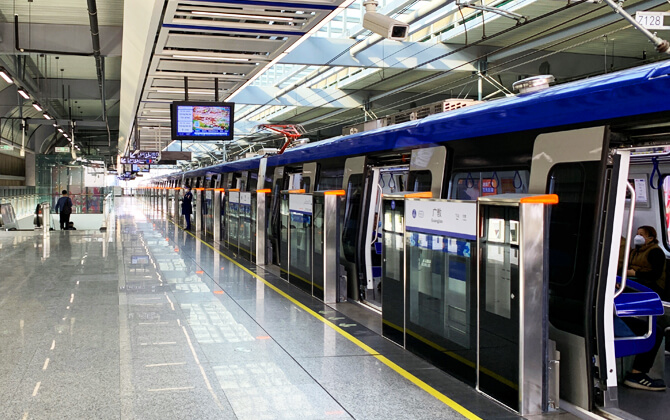
For a smooth trip, choose your ticket or card before you arrive at the gate. TVMs support cash and mobile payments, while QR code travel is available through the official app and approved payment platforms. Transit cards are also accepted at entry and exit.
Inside stations, follow the standard system rules. Pass security checks before entering the platform area, keep your ticket or QR code until the end of your journey, and use designated transfer passages when changing lines.
Check operating hours, opening times, and last train information if you are traveling late. Some lines close earlier than others, and schedule changes can happen on weekends or holidays. Off-peak frequency is usually lower too.
For cross-city trips to Guangzhou, check the route, fare rules, and transfer station in advance. Key interchanges include Xilang, Nanzhou, Kuiqilu, Beijiao Park, and Guangzhou South Railway Station.
Foreign visitors should find the network fairly easy to use. Bilingual signs and announcements are common, and staff can usually help with basic English. If you are unsure, follow the electronic displays and platform direction signs.
It is also smart to keep an eye on the maximum travel time and make sure your balance is enough for exit. If you are traveling with children, check the relevant free-ride rule before boarding. In short, the network is designed to be practical and safe, but a quick timetable check never hurts.
History
The history of Foshan Metro began in 2002, when construction started on the city’s rapid transit system. Foshan became the tenth mainland Chinese city to build a metro, although the project was later suspended because of a capital shortage before work resumed in 2007.
The first section of the Guangfo Line opened on 3 November 2010 between Kuiqi Lu and Xilang. This line is operated by Guangzhou Metro Corporation, while the rest of the metro system is operated by Foshan Metro Group. When service began, FMetro distributed 16,000 free tickets.
The network then grew in stages. The Xilang-Yangang section opened on 28 December 2015, followed by Yangang-Lijiao on 28 December 2018. Line 2 opened on 28 December 2021, and the first section of Line 3 opened on 28 December 2022. The rest of Line 3’s first phase entered service on 23 August 2024.
As the system expanded, new projects continued to move ahead. Line 4 is now under construction, while Line 11 and the western extension of Line 2 remain in planning. The source also notes ongoing financial pressure, with low ridership and limited non-fare revenue contributing to losses.
| Opening date | Details |
|---|---|
| 3 November 2010 | Kuiqi Lu – Xilang, 20.4 km / 12.7 miles, 14 stations |
| 28 December 2015 | Xilang – Yangang, 7.3 km / 4.5 miles, 4 stations |
| 28 December 2016 | Xincheng Dong – Kuiqi Lu, 6.7 km / 4.2 miles, 4 stations |
| 28 December 2018 | Yangang – Lijiao, 5.5 km / 3.4 miles, 3 stations |
| 28 December 2021 | Line 2 opens |
| 28 December 2022 | Line 3 first section opens |
| 23 August 2024 | Line 3 first phase completed |
Future Extensions
Foshan Metro expansion is still moving forward. The current pipeline includes new metro construction, approved projects, and additional work on Line 3.
Line 4 Phase 1 is under construction. Line 11 and Line 2 Phase II have NDRC approval, while parts of Line 3 are either under construction or still awaiting construction.
| 2025 | Line 3 | Dunhou to Foshan Railway Station | 3.97 km / 2.47 miles | 2 | Under construction |
| 2026 | Line 3 | Foshan Railway Station to Dunhou | 3.97 km / 2.47 miles | 2 | Under construction |
| TBD | Line 3 | Shunde College Railway Station to Shunde Port | 2.88 km / 1.79 miles | 1 | Awaiting construction |
| 2029 | Line 4 | Beijiang Dadao to Gangkou Lu | 55.2 km / 34.3 miles | 33 | Under construction |
| TBD | Line 11 | Xijiao to Hedong East | 36.3 km / 22.6 miles | 18 | Approved by the NDRC |
| TBD | Line 2 | Xi’an to Nanzhuang | 23.5 km / 14.6 miles | 10 | Approved by the NDRC |
Since the first opening in 2010, the network has kept developing, and the planned route extensions show that Foshan’s metro system is still growing.
Nearby Attractions
Foshan Metro Line 3 makes it easier to reach parks, museums, gardens, and cultural sites across the city. If you want to mix transport with sightseeing, several stations are handy starting points.
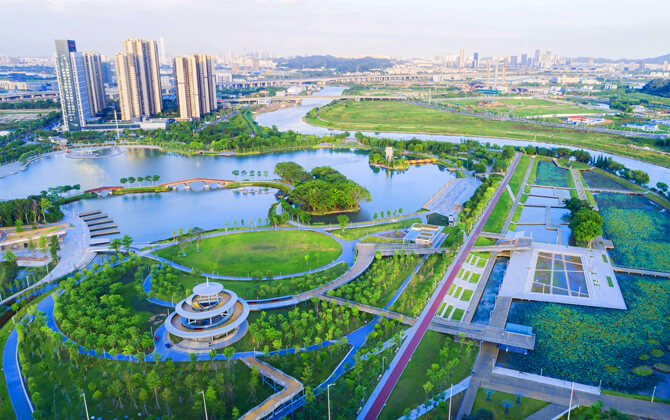
Dongping Station
Foshan City Exhibition Hall is open from 9:00-12:00 and 14:30-17:00, and it is closed on Mondays. Admission is free. It covers Foshan’s history, culture, and economic development. The hall is only 200 meters / 0.2 km / 0.1 miles from Foshan Science Museum, so visiting both is easy.
Binjiang Wetland Park is open all day and free to enter. It works well for picnics, camping, kite flying, frisbee, and cycling along the greenway. Nearby family-friendly places include Lokchung Aquatic Park and Xianlu Island.
Beijiao Park Station
Lingnan He Yuan is open from 9:00-17:30 and closed on Mondays. Tickets cost 30 RMB (about $4.20), with free entry for Foshan residents. It is known for scenic views, puppet performances, and shadow play.
Shunde Natural Science Museum is open from 9:00-12:00 and 14:00-17:00, and it is closed on Mondays. Admission is free. It is especially popular with children and dinosaur fans.
He Art Museum is open from 10:00-18:00, and admission is 150 RMB (about $21.00). Designed by Tadao Ando, it combines striking architecture with art exhibitions.
Daliang Zhonglou Station
Qinghui Garden is open from 9:00-17:30, and tickets cost 15 RMB (about $2.10). It is one of the four famous Lingnan gardens, with stained-glass windows, rockeries, old trees, and waterfalls.
Xishan Temple is open from 9:00-17:00 and free to visit. It features brick carvings, plasterwork, murals, and clay sculptures typical of Lingnan architecture.
Jinbang Street is open all day and free to explore. It is a good stop for local food in Shunde.
Shunde OCT Harbour Plus Station
Shunde OCT Harbour Plus is open from 10:00-22:00. Entry is free, though some facilities are charged. It is a nice place for sunset and evening views, with rides, shopping, and dining nearby.
Jurong Beilu Station
Shunfengshan Park is open all day and free of charge. This large park is well suited to cycling, camping, and picnics. Highlights include the Cantonese Opera Grand Garden, Tingzhi Garden, Box Art Museum, and Qingyun Lake.
Luocun Station
Xiaode Lake Park is open all day and free to enter. This traditional Lingnan-style park has wetlands, boardwalks, stone bridges, and aquatic plants, making it a calm spot for a walk.
Zhongshan Park Station
Zhongshan Park is open all day and free. Nearly a century old, it remains a favorite with locals thanks to its zoo, sandpit, games zone, boating, and lawn camping.
Yayi Park Station
Asian Arts Park is open all day and free to visit. Seasonal scenery stands out here, from lotus views in summer to Taxodium distichum in autumn, along with sculptures, architecture, and the Asian Arts Gateway.
Wenhua Park is open all day and free. Visitors can also see the 238-meter / 0.24 km / 0.15 mile Foshan TV Tower beside the Lingnan Pearl Gymnasium, plus flower fields, ceramic lion sculptures, and a children’s playground.
Wanhua Station
Foshan Police Museum is open from 9:30-11:30 and 14:30-17:30, and it is closed on Mondays. Admission is free. The museum includes historical exhibits, photos, and interactive games for adults and children.
Wanhua Village is open all day and free to explore. It offers a glimpse of Lingnan culture through oyster shell walls, ancestral halls, alleyways, and old banyan trees.
Greetings, where can we get the Foshan Metro maps for our reference in planning how to move around Foshan. Thanks