The Red Line is a CTA rapid transit route in Chicago’s “L” system. It runs 24 hours a day between Howard on the North Side and 95th/Dan Ryan on the South Side, passing through the State Street subway in downtown Chicago. The line is 21.8 miles (35.1 km) long, serves 33 stations, and is the busiest route in the CTA rail system, with 108,303 average weekday boardings in 2023. It is also the only Chicago “L” line with full-time connections to all seven other “L” lines.
| Key | Information |
|---|---|
| System | Chicago “L”, operated by the Chicago Transit Authority |
| Route | Howard to 95th/Dan Ryan via downtown Chicago |
| Length | 21.8 miles (35.1 km) |
| Stations | 33 current stations |
| Operating hours | 24 hours a day, every day of the year |
| Main downtown section | State Street subway |
| Railcars | Bombardier-built 5000-series railcars |
| Expansion | Planned extension south to 130th Street with four new stations |
Red Line Chicago “L” Map
The Red Line Chicago “L” map shows all available stations. Click on the map to enlarge it or download the Red Line Chicago “L” map in PDF format.
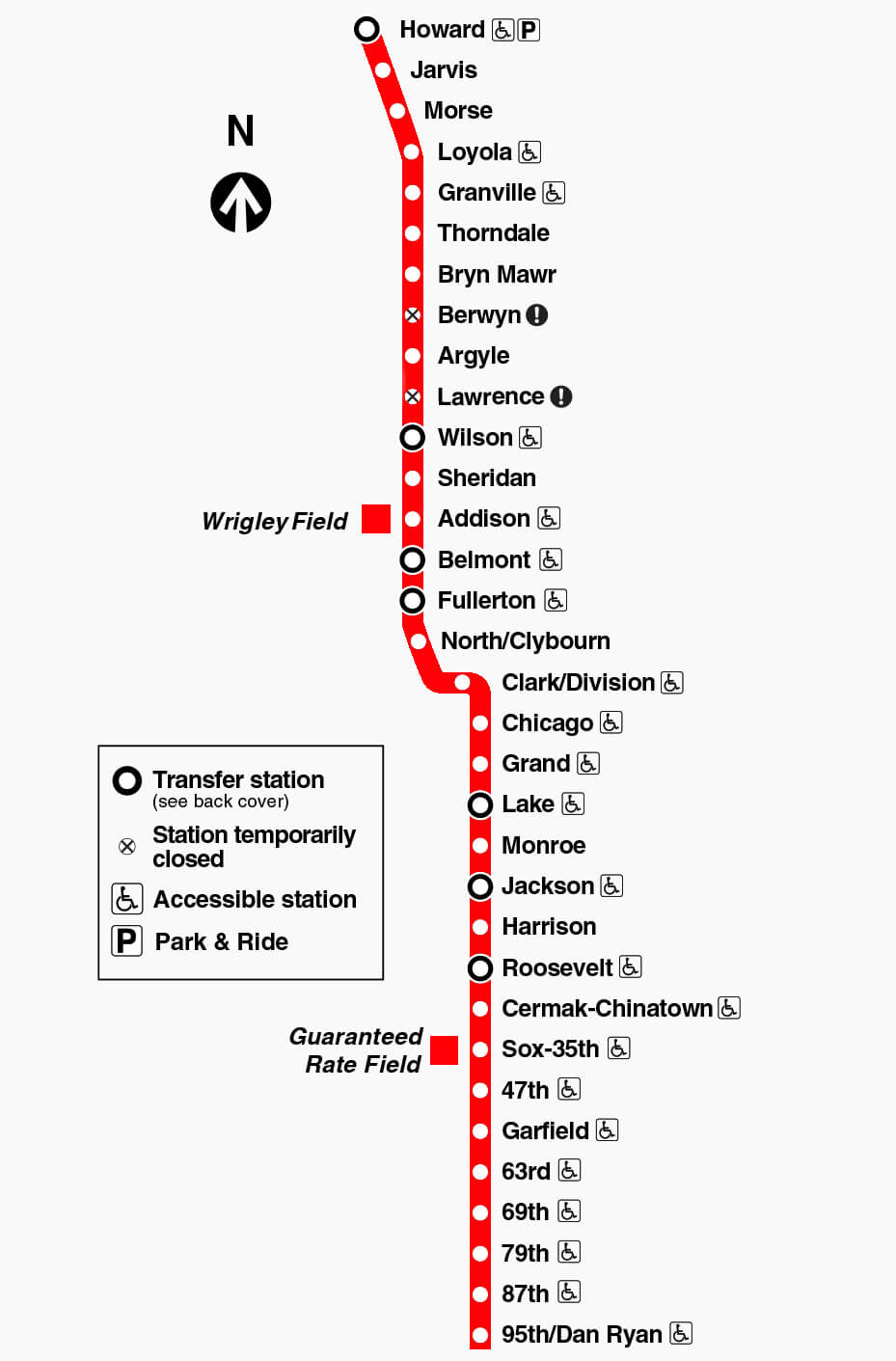
Stations and Key Stops
The Chicago Red Line route links Rogers Park, Edgewater, Uptown, Lincoln Park, downtown, Chinatown, the Dan Ryan corridor, and Roseland. For riders checking a stations map or stations list, the main pattern is simple: north-south service from Howard to 95th/Dan Ryan, with downtown service through the subway under State Street.
| Station | Details |
|---|---|
| Howard | Northern terminus in Rogers Park and a major transfer point |
| Loyola | Serves Loyola University Chicago |
| Wilson | North Side stop with Purple Line connections |
| Belmont | Transfer point for Brown and Purple Line service |
| Fullerton | Transfer point for Brown and Purple Line service; useful for DePaul University |
| Clark/Division | Near North Side access |
| Chicago | Useful for downtown, Streeterville, and Near North Side trips |
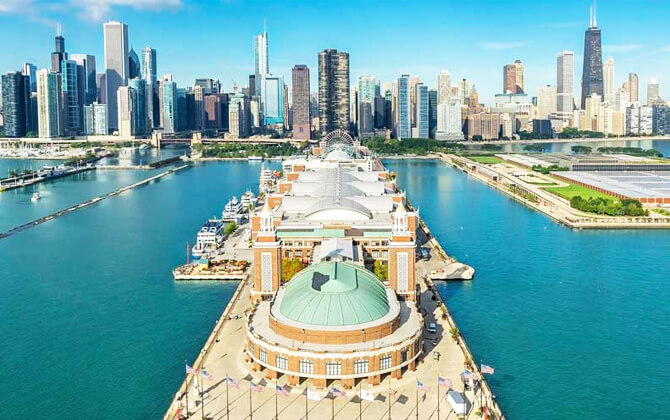
| Grand | Good for the Magnificent Mile, Navy Pier connections, and North Michigan Avenue |
| Lake | Central downtown stop with nearby rail connections |
| Jackson | Downtown stop near the Auditorium Building of Roosevelt University |
| Roosevelt | Useful for the South Loop and Museum Campus connections |
| Cermak-Chinatown | Main Red Line stop for Chinatown |
| Sox-35th | Serves Guaranteed Rate Field and the Illinois Institute of Technology |
| 95th/Dan Ryan | Southern terminal and major bus transfer hub |
The CTA is also building a Red Line Extension with new stations at 103rd, 111th, Michigan, and 130th. Once complete, the route plan will push service farther south and increase the total number of stations.
Major Stations for Visitors
For visitors, the Red Line is one of the easiest public transport routes in Chicago. It reaches sports venues, universities, downtown shopping areas, Chinatown, and museum connections without requiring a car.
| Station | Details |
|---|---|
| Addison | Closest Red Line stop to Wrigley Field |
| Sox-35th | Best Red Line stop for Guaranteed Rate Field and IIT |
| Roosevelt | Useful for Museum Campus connections |
| Cermak-Chinatown | Main stop for Chinatown |
| Fullerton | Serves DePaul University |
| Loyola | Serves Loyola University Chicago |
| Grand | Useful for the Magnificent Mile and Navy Pier connections |
| Monroe | Useful for the Art Institute of Chicago area |
If your trip is centered on downtown Chicago, the Red Line’s State Street subway stops are especially handy. You can move through the city center quickly and connect to other city transport with a short walk or transfer.
Important Transfer Stations
The Red Line connects with every other CTA “L” line full time, which makes it the backbone of rail transportation in Chicago. Several stations are especially useful when building a route plan across the system.
| Station | Details |
|---|---|
| Howard | Transfer point for Purple Line and Yellow Line connections, plus Pace buses |
| Wilson | Connects with Purple Line service |
| Belmont | Connects with Brown and Purple Line service |
| Fullerton | Connects with Brown and Purple Line service |
| Lake | Central downtown stop with nearby connections to Metra Electric and NICTD at Millennium Station |
| Jackson | Downtown connection point near Blue Line and Loop rail links |
| Roosevelt | Connects with Orange and Green Line service and nearby Museum Campus/11th Street rail access |
| 95th/Dan Ryan | Major South Side CTA bus hub |
On system maps, transfer symbols may mark stations with connections to the “L”, Metra, or the South Shore Line. Some stations are also marked for accessibility or airport connections.
Stadium, University, and Neighborhood Stops
The Red Line is useful for both daily local transport and major Chicago destinations. It serves Wrigley Field at Addison, Guaranteed Rate Field at Sox-35th, Loyola University Chicago at Loyola, DePaul University at Fullerton, and the Auditorium Building of Roosevelt University near Jackson.
| Station | Details |
|---|---|
| Addison | Wrigley Field and the Wrigleyville area |
| Sox-35th | Guaranteed Rate Field and Illinois Institute of Technology |
| Loyola | Loyola University Chicago |
| Fullerton | DePaul University and Lincoln Park access |
| Jackson | Auditorium Building of Roosevelt University |
| Cermak-Chinatown | Chinatown |
| Grand | Magnificent Mile and Navy Pier connections |
| Roosevelt | South Loop and Museum Campus connections |
Neighborhoods along the route include Rogers Park, Edgewater, Uptown, Lincoln Park, the Near North Side, Downtown, the South Loop, and Roseland.
Fares, Tickets, and Ventra
As of February 20, 2023, the standard CTA “L” fare is US$2.50 ($2.50). Reduced fares are available only to eligible riders. The O’Hare station is different: a premium fare is deducted when entering there, though an unlimited pass can be used instead.
Cash is not used at train turnstiles, but it can be used at Ventra vending machines to add value, buy passes, or purchase disposable Ventra Tickets. Cash is also accepted on buses and at many Ventra retailers.
| Fare type | Price |
|---|---|
| CTA “L” train fare | US$2.50 ($2.50) |
| CTA reduced “L” fare | US$1.25 ($1.25) |
| CTA bus fare with Ventra | US$2.25 ($2.25) |
| CTA bus cash fare | US$2.50 ($2.50) |
| Single-Ride Ventra Ticket | US$3.00 ($3.00), including up to 2 transfers within 2 hours and a limited-use media fee |
| Pace to CTA transfer | US$0.25 ($0.25) full fare; US$0.15 ($0.15) reduced fare |
A fare calculator is useful when comparing tickets, passes, and transfers, but for a basic Red Line ride the standard ticket price is simple: US$2.50 ($2.50) with Ventra or contactless payment.
Ventra Card, Ventra App, and Contactless Payment
Ventra is the main CTA payment system. You can pay with a Ventra Card, the Ventra app, a disposable Ventra Ticket, a contactless bankcard, or a mobile wallet such as Apple Pay, Google Pay, or Samsung Pay.
New Ventra Cards can be purchased at CTA rail stations, in the app, at participating retail locations, online, or by phone. A one-time US$5.00 ($5.00) Ventra Card purchase fee is refunded as transit value when the card is registered.
The Ventra app lets riders check balances, add value or passes, view arrival and departure times, and receive account alerts. You can also use Ventra transit value to buy mobile Metra tickets in the app.
When paying, touch only the card, ticket, or mobile device you want to use to the reader. Taking the card out of your wallet helps avoid card clash.
Passes, Transfers, and Reduced Fares
CTA, Pace, and Metra offer standard fares, reduced fares, and unlimited-ride passes. CTA and Pace passes are generally activated with first use.
| Fare type | Price |
|---|---|
| CTA “L” train fare | US$2.50 ($2.50) full fare; US$1.25 ($1.25) reduced fare |
| CTA bus fare | US$2.25 ($2.25) Ventra full fare; US$2.50 ($2.50) cash fare |
| Pace bus fare | US$2.00 ($2.00) Ventra full fare; US$2.25 ($2.25) cash fare |
| Pace premium bus fare | US$4.50 ($4.50) full fare |
| CTA/Pace transfers | Free in the listed fare table |
| Pace transfer to premium route | US$2.50 ($2.50) full fare; US$1.25 ($1.25) reduced fare |
| Regional Connect Pass | US$30.00 ($30.00) |
Reduced fares are available for riders with RTA-issued Reduced Fare permits, including seniors age 65 or older, qualified people with disabilities, and Medicare recipients. Reduced fares also apply to low-income riders with an RTA-issued Access card, K–12 students with school ID, and active duty military personnel with military ID. Children under 7 ride free with a fare-paying customer.
Pass options include 1-Day, 3-Day, 7-Day, and 30-Day passes. Starting June 20, 2025, the Regional Day Pass can be purchased only in the Ventra app. The Regional Day Pass on CTA and Pace expires 24 hours after activation.
Schedule, Hours, and Frequency
The Red Line runs 24 hours a day, 365 days a year. Its opening hours, closing time, and last train are easy to understand: the line does not close for normal daily service, and there is no final trip in the usual sense.
| Service detail | Timings |
|---|---|
| Operating hours | 24 hours daily |
| Starting time | Continuous service; trains run through the night |
| Closing time | No regular daily closing time |
| Weekday frequency | About every 5–10 minutes, with rush-hour service as frequent as 30 trains per hour |
| Saturday frequency | About every 6–12 minutes |
| Sunday frequency | About every 7–12 minutes |
| Overnight timings | Usually every 10–15 minutes between about midnight and 5:30 a.m. |
Service is most frequent during weekday rush hours. Midday, evening, and late-night trains run less often, but the full route remains open.
24-Hour Red Line Service
The Red Line provides 24-hour train service between Howard and 95th/Dan Ryan, including every station in between. That makes it one of only two CTA rail lines with round-the-clock service.
| Service detail | Timings |
|---|---|
| Weekdays | Frequent rush-hour service, then wider intervals during midday, evening, and overnight periods |
| Saturdays | Frequent daytime service, with overnight trains about every 15 minutes |
| Sundays and holidays | All-day service, with overnight trains about every 15 minutes |
Newly reconstructed stations at Bryn Mawr, Berwyn, Argyle, and Lawrence are being opened with elevators, escalators, and other accessibility features. The Wilson station’s west platform is also set to reopen.
Daytime, Evening, and Overnight Travel
During the day, Red Line trains are usually frequent enough that riders can use it without planning around a long wait. On weekdays, rush-hour service can be very frequent, while midday service is commonly around every 6 minutes on some segments.
| Service detail | Timings |
|---|---|
| Weekday rush periods | About every 4–8 minutes on some segments |
| Weekday midday | About every 6 minutes |
| Evening service | About every 7–10 minutes |
| Overnight owl service | About every 15 minutes |
| Saturday daytime | About every 6–8 minutes |
| Sunday daytime | About every 7–8 minutes |
For schedule today and timings today, riders should still check current service alerts before traveling, especially during construction or special events.
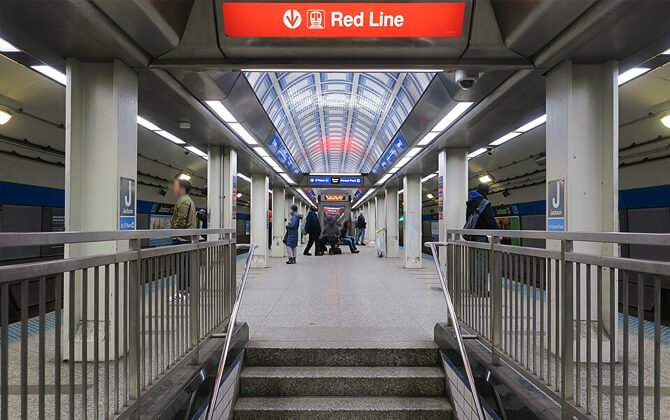
Connections with Other Transit Systems
The Red Line is the only Chicago “L” route that connects to all seven other “L” lines full time. This makes it one of the most important public transport routes in the city, especially for riders transferring across the CTA system.
The line also connects with CTA buses, Pace buses, Metra, and regional rail corridors at selected points. For many trips, the Red Line works as the main north-south path train through Chicago, with buses or other rail lines completing the route.
Transfers to Other CTA “L” Lines
Because the Red Line runs through downtown and reaches major transfer points on both sides of the city, it offers full-time connections to every other CTA rail line.
- Blue Line
- Brown Line
- Green Line
- Orange Line
- Pink Line
- Purple Line
- Yellow Line
At Howard, passengers can change between Red Line service and Purple Line shuttle service when the Purple Line is not operating its weekday rush-hour route.
Connections to CTA Buses
CTA bus connections are available at many Red Line stations. Howard connects with CTA routes 22, 97, 147, 201, and 206, while Morse connects with 96 and 155, and Loyola connects with 147 and 155. Other stations with bus links include Granville, Thorndale, Bryn Mawr, Berwyn, Argyle, Lawrence, Wilson, Sheridan, Addison, Belmont, Fullerton, North/Clybourn, Clark/Division, Chicago, Grand, Lake, Monroe, Jackson, Harrison, Roosevelt, and Cermak-Chinatown.
Downtown and South Side stops such as Lake, Monroe, Jackson, Harrison, Roosevelt, and Cermak-Chinatown have especially useful transfer options. Owl bus routes also serve late-night riders, including N4, N20, N22, N60, N62, and N66 at Washington/State, plus other overnight routes at additional points.
Connections to Metra, Pace, and Regional Transit
The Red Line connects directly or indirectly with Metra, Pace, and regional transit at several points. Howard is a key North Side hub for Purple Line and Pace bus transfers. In the Loop, Lake, Jackson, and Roosevelt connect riders with nearby Metra services and downtown rail terminals.
| Station | Details |
|---|---|
| Howard | Purple Line and Pace bus connections |
| Lake | Access to Metra Electric and NICTD services at Millennium Station |
| Jackson | Blue Line and nearby Loop rail connections |
| Roosevelt | Access to Metra Electric and NICTD at Museum Campus/11th Street |
| 95th/Dan Ryan | Major CTA bus hub and part of future regional corridor planning |
The Red Line Extension is planned with multimodal access at new stations, including bus, bike, pedestrian, and park-and-ride connections.
Getting to Airport from the Red Line
The Red Line does not go directly to O’Hare or Midway, but it connects to CTA airport routes. Use the Blue Line for O’Hare and the Orange Line for Midway.
For Midway, one option is to ride from Grand-Red to Roosevelt, transfer to the Orange Line, and continue to Midway. The listed trip takes about 34 minutes and costs US$2.50 ($2.50). Another option uses bus 36 from State and Grand to State and Lake, then the Orange Line to Midway; that route takes about 40 minutes and costs US$2.25 ($2.25).
For O’Hare from Rogers Park, one listed route uses the Red Line from Morse to Addison, then a bus transfer, then the Blue Line to O’Hare. That journey takes about 1 hour 13 minutes and costs US$2.50 ($2.50). Another option uses the Red Line from Morse to Lake, then the Blue Line from Washington-Blue to O’Hare, taking about 1 hour 28 minutes.
Red Line to O’Hare via the Blue Line
To reach O’Hare from the Red Line, transfer to the Blue Line. The Blue Line provides direct service to Chicago O’Hare International Airport and runs 24 hours a day, seven days a week.
The O’Hare station is in the lower level concourse and connects directly to Terminals 1, 2, and 3. Terminal 5 can be reached by the free airport shuttle train.
The normal running time from O’Hare to downtown is about 40–45 minutes. For current service information, riders can call 312-836-7000.
Red Line to Midway via the Orange Line
To reach Chicago Midway International Airport from the Red Line, take the Red Line to Roosevelt and transfer to the Orange Line. The Orange Line runs between the Loop and Midway Airport.
The Orange Line serves Midway, Pulaski, Kedzie, Western, 35th/Archer, Ashland, Halsted, Roosevelt, and Loop stations including Harold Washington Library-State/Van Buren, LaSalle/Van Buren, Quincy, Washington/Wells, Clark/Lake, State/Lake, Washington/Wabash, and Adams/Wabash.
| Service detail | Timings |
|---|---|
| Orange Line weekdays | 3:30 a.m. to 1:25 a.m. |
| Orange Line Saturday | 4:00 a.m. to 1:30 a.m. |
| Orange Line Sunday and holidays | 4:30 a.m. to 1:25 a.m. |
For most rail trips to Midway from the Red Line, Roosevelt is the standard transfer point.
Accessibility, Bikes, and Parking
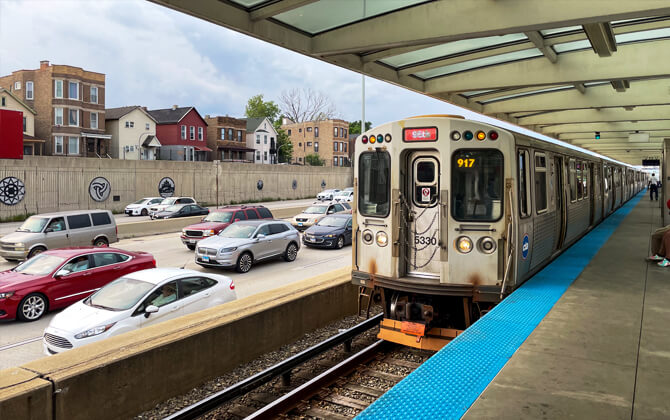
CTA buses and all CTA railcars are accessible. More than 100 “L” stations are accessible and marked on route and system maps. At accessible stations, elevators or ramps provide a step-free path between the street, station, and platform. Help Point call buttons are located near turnstiles and on platforms.
Bike parking racks are installed outside most “L” stations, and many stations also offer sheltered outdoor or indoor bike parking. Bicycles are allowed on CTA trains during most weekday hours and all day on Saturdays, Sundays, and holidays, except during weekday rush-period restrictions. Only two bicycles are allowed per railcar.
Use a wide turnstile gate with a bicycle when possible, or ask staff to open a manual access gate. Do not use rotogates, do not ride a bike inside a station, and do not take bicycles on escalators. Folding bikes are allowed on buses and trains at all times. Folded personal e-bikes and scooters are welcome, but commercial bikeshare bikes and scooters, including Divvy, are not permitted on CTA buses, trains, or fare-paid station areas.
Some stations support station parking and park-and-ride use. The Red Line Extension is also planned with bus, bike, pedestrian, and park-and-ride facilities at each new station.
Rules and Tips
The CTA rail system is color-coded, so always check both the line color and the train direction before boarding. On the Red Line, the main destination signs are Howard for northbound trips and 95th/Dan Ryan for southbound trips.
A standard ride on the “L” costs US$2.50 ($2.50). A trip from O’Hare into the city is usually about US$5.00 ($5.00), and transfers within two hours are usually US$0.25 ($0.25). Cash is not accepted at rail turnstiles, so use a Ventra card, Ventra ticket, or contactless payment.
Tap-to-pay is often the easiest option. Make sure your phone is awake and charged before scanning. If you ride often, a day pass or multi-day pass may reduce the total cost.
Use a navigation app such as Google Maps, Apple Maps, Transit, or Ventra to follow your route in real time. These apps help with stops, transfers, ride times, and wait times, which is useful because some Chicago station names repeat on different lines.
For a safer ride, stay aware of your surroundings, especially late at night or in crowded cars. Let passengers exit first, avoid blocking doors, keep noise low, and keep bags close to you.
How to Ride the Red Line
To ride the Red Line, enter a CTA station, pay at the turnstile with Ventra or a contactless method, and follow signs to the correct platform. Check the destination display before boarding.
Northbound trains generally go toward Howard. Southbound trains go toward 95th/Dan Ryan. Some trains may not travel the full length of the line, so listen for announcements and check service alerts.
The Red Line connects to all seven other “L” lines full time, which makes transfers straightforward at key stations. Common stops along the route include Wilson, Addison, Fullerton, Clark/Division, Roosevelt, Cermak-Chinatown, Sox-35th, Garfield, 63rd, and 95th/Dan Ryan.
All CTA railcars are accessible, and staff can help with boarding at accessible stations. Priority seating is reserved for seniors and people with disabilities. Up to two bicycles are permitted per railcar during most hours, except weekday rush periods.
Brief History of the Red Line
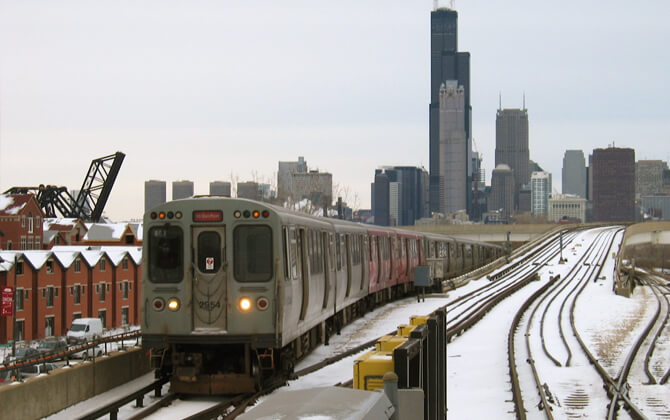
The oldest part of today’s Red Line opened on May 31, 1900, running from the Loop to Wilson. It was built by the Northwestern Elevated Railroad. The line later extended to Central Street in Evanston in 1908 and was through-routed with South Side “L” lines through the Loop in 1913.
The State Street Subway opened in 1943, giving north-south trains a faster route through downtown and reducing travel times. The Dan Ryan segment opened in 1969.
The Red Line name and current identity arrived on February 21, 1993, when CTA introduced color-coded route names and paired the Howard branch with the Dan Ryan branch. A new subway connector opened at the same time, creating today’s through route from the North Side to the South Side.
Today, the Red Line remains Chicago’s busiest “L” line and the only one with full-time connections to all seven other “L” routes.
Future Expansions and Improvements
The CTA is extending the Red Line south from 95th/Dan Ryan to 130th Street. The Red Line Extension will add about 5.5 to 5.6 miles (8.9 to 9.0 km) of track and four new fully accessible stations at 103rd Street, 111th Street, Michigan Avenue, and 130th Street.
The project is part of CTA’s Red Ahead program and is moving forward under a Full Funding Grant Agreement with the Federal Transit Administration. Construction began on April 24, 2026, and the project is expected to be completed in 2030, with revenue service projected for August 2031 in one planning document.
Planned improvements include bus, bike, pedestrian, and park-and-ride connections; a new railyard and maintenance shop near 120th Street; new traction power substations; and 78 rail cars.
Before major construction, CTA is carrying out demolition, soil boring, surveying, site preparation, utility relocation, and real estate acquisition. The alignment was finalized in 2018 along the rights-of-way of I-57, a Union Pacific Railroad line, and the South Shore Line.
When finished, the expansion is expected to lengthen the Red Line to roughly 31 miles (49.9 km) and increase the number of stations to 37. It will improve access to Roseland, Washington Heights, West Pullman, and Riverdale.
Best Red Line Stops for Attractions
The Red Line is one of the most useful CTA routes for attractions because it works well as a north-south backbone. Some stops are a short walk from major sights, while others connect easily to buses.
Downtown and Magnificent Mile
For downtown Chicago and the Magnificent Mile, the most useful Red Line stations include Chicago, Grand, Lake, Monroe, Jackson, Harrison, and Roosevelt. Grand is especially useful for the Magnificent Mile, Navy Pier connections, and North Michigan Avenue shopping.
| Station | Details |
|---|---|
| Grand | Magnificent Mile, Navy Pier connections, and North Michigan Avenue |
| Lake | Chicago Theatre area and central downtown access |
| Monroe | Useful for the Art Institute of Chicago area |
| Jackson | Downtown access and Auditorium Building area |
| Roosevelt | Museum Campus connections |
If your plans include several downtown landmarks, the Red Line is usually simpler than switching between multiple daytime-only routes.
Chinatown and South Side Highlights
Cermak-Chinatown is the key Red Line stop for Chinatown. The station is open 24/7 and has Chinese cultural details, including tile murals that say “Welcome to Chinatown”, lion statues at the entrance, and red and green platform bins.
| Station | Details |
|---|---|
| Roosevelt | South Loop and Museum Campus connections |
| Cermak-Chinatown | Main stop for Chinatown |
| Sox-35th | Guaranteed Rate Field and Illinois Institute of Technology |
| 95th/Dan Ryan | Southern terminal in Roseland |
South of downtown, the Red Line follows the Dan Ryan Expressway median toward 95th/Dan Ryan, serving key South Side destinations along the way.
Wrigley Field and North Side Neighborhoods
Addison is the Red Line stop for Wrigley Field. The station is accessible and is a short walk from the ballpark, making it the most convenient CTA rail option for Cubs games.
Riders can reach Addison from downtown via the State Street subway or from Howard, where connections are available from Purple and Yellow Line trains. CTA buses also serve the ballpark, including the 152 Addison and 22 Clark routes.
The North Side stretch also serves Uptown, Lincoln Park, and the area near Loyola University Chicago. For some riders, park-and-ride access at Howard can make game-day travel easier.
White Sox Baseball and Guaranteed Rate Field
Guaranteed Rate Field is home to the Chicago White Sox and sits on the South Side near the Dan Ryan Expressway in Armour Square, close to Bridgeport. Sox-35th is the main Red Line stop, just a short walk east of the ballpark.
After leaving the station, follow the crowd across the bridge over the Dan Ryan. Gate 6 near left field is the closest gate to the station. Since the Red Line runs 24/7, trains continue after night games.
The Green Line stop at 35th-Bronzeville-IIT is another option, about three short blocks east of the ballpark. CTA buses serving the area include routes 1, 4, 24, 29, 35, 39, and 44. Metra riders can use Lou Jones-Bronzeville at 35th and LaSalle, and Pace operates Guaranteed Rate Field Express buses from several locations with free parking at the lots.
Driving is possible, with parking near the stadium. Pre-paid parking is available, and the red lots A, B, and C north of the stadium are generally easier to exit than the green lots to the west and south.
FAQ
These quick answers cover the most common Red Line questions about route type, working hours, ticket payment, airport trips, and accessibility.
Is the Red Line in Chicago a subway?
Not entirely. The Red Line is part of the Chicago “L” system, and only part of the route runs underground. It is elevated on parts of the North Side, uses the State Street subway downtown, and runs in the Dan Ryan Expressway median on the South Side.
So yes, the Red Line includes a subway section, but the whole route is not a subway.
Does the Red Line run 24 hours?
Yes. The Chicago CTA Red Line runs 24 hours a day, 365 days a year, between Howard and 95th/Dan Ryan.
Late-night trains run less frequently than daytime trains, but service remains available through the night. Overnight service usually runs about every 10–15 minutes.
How do I pay for the Red Line?
You can pay with a Ventra Card, a disposable Ventra Ticket, a contactless bankcard, or a mobile wallet such as Apple Pay, Google Pay, or Samsung Pay. Payment is made at the turnstile before entering the boarding area.
A standard CTA rail ride costs US$2.50 ($2.50). Cash can be used at Ventra vending machines to add value or buy tickets, but not directly at train turnstiles.
Which Red Line stop is closest to Wrigley Field?
Addison is the closest Red Line stop to Wrigley Field. It is accessible and just a short walk from the stadium.
After Cubs games, Addison can become crowded. Some fans use Sheridan, the next station to the north, or CTA bus routes 152 Addison and 22 Clark.
Does the Red Line go to O’Hare or Midway Airport?
No. The Red Line does not provide direct airport service. O’Hare is served by the Blue Line, and Midway is served by the Orange Line.
From the Red Line, transfer to the Blue Line for O’Hare or to the Orange Line at Roosevelt for Midway.
Is the Red Line accessible?
All CTA railcars are accessible, and many Red Line stations are accessible, but not every station is wheelchair accessible.
The following Red Line stations are listed as not wheelchair accessible in the provided station information: Argyle, Berwyn, Bryn Mawr, Clark/Division, Harrison, Jarvis, Lawrence, Monroe, Morse, North/Clybourn, Sheridan, Thorndale, and Wilson.
Priority seating is reserved for seniors and people with disabilities. Up to two bicycles are permitted per railcar during most hours, except weekday rush periods.