The Pink Line is an 11.2-mile (18.0 km) CTA rapid transit route in the Chicago “L” system. It runs between 54th/Cermak in Cicero and the downtown Loop, serving West Side neighborhoods such as North Lawndale, Little Village, Pilsen, and the Near West Side. The line began service on June 25, 2006, as a 180-day trial after CTA rerouted the former Blue Line Cermak branch through the Paulina Connector and onto shared Green Line tracks near downtown.
| Key | Information |
|---|---|
| System | Chicago Transit Authority, Chicago “L” |
| Route | 54th/Cermak in Cicero to the downtown Loop |
| Length | 11.2 miles (18.0 km) |
| Opening date | June 25, 2006 |
| Railcars | Bombardier-built 5000-series cars |
| Neighborhoods served | Cicero, North Lawndale, Little Village, Pilsen, Near West Side, and the Loop |
| Annual ridership | More than 3 million boardings in 2023 |
| Notable operating note | As of April 2026, the Pink Line outside the Loop is one of three Chicago “L” branches without slow zones |
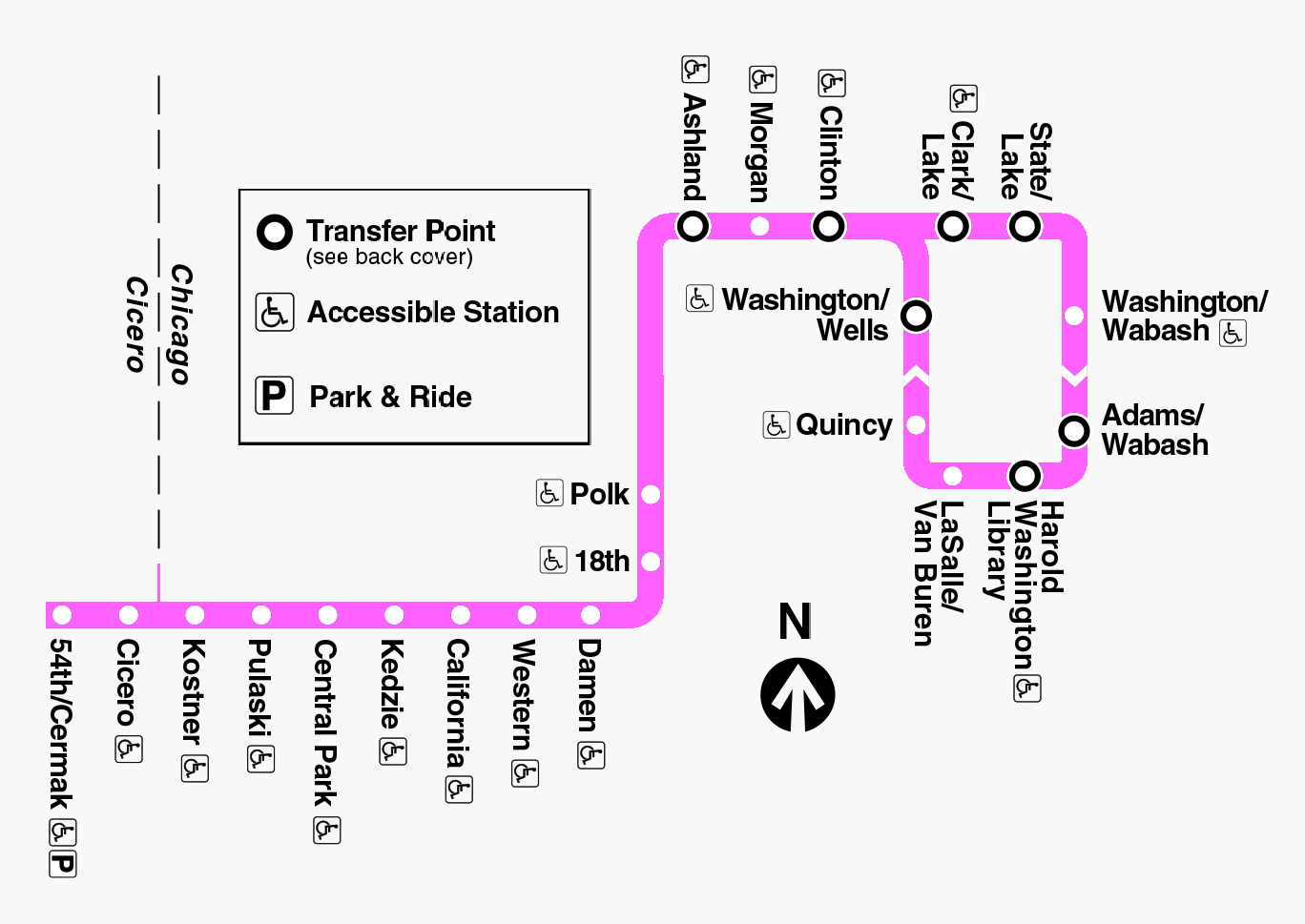
Pink Line Chicago “L” Map
The Pink Line Chicago “L” map shows all available stations. Click on the map to enlarge it or download the Pink Line Chicago “L” map in PDF format.
Stations and Neighborhoods Served
The Pink Line route starts at 54th/Cermak in Cicero, then heads east through Chicago’s West Side before entering the Loop. It uses a mix of at-grade and elevated track, and its stations list covers both local neighborhood stops and major downtown transfer points.
For riders checking a stations map or planning a path train into the Loop, the main pattern is simple: trains run from 54th/Cermak to downtown, circle the Loop clockwise, then return westbound.
| Station | Details |
|---|---|
| 54th/Cermak | Western terminal in Cicero; connects with CTA buses 21, 54B, and N60, plus Pace buses 316 and 322 |
| Cicero | Cicero-area station with CTA buses 21, 54, 54B, and N60, plus Pace buses 302 and 392 |
| Kostner | North Lawndale station on the Cermak branch |
| Pulaski | North Lawndale station with CTA bus connections 53 and 157 |
| Central Park | North Lawndale station with CTA buses 82 and 157 |
| Kedzie | North Lawndale station with CTA bus 52 |
| California | South Lawndale station with CTA bus 94 |
| Western | Lower West Side station with CTA buses 49 and X49 and a Metra BNSF connection at Western Avenue |
| Damen | Lower West Side station with CTA bus 50 and Pace bus 755 |
| 18th | Pilsen station with CTA bus 18 and indoor bike parking noted in the station listing |
| Polk | Near West Side station serving the Illinois Medical District area; connects with CTA buses 7 and 157 and Pace bus 755 |
| Ashland | Transfer point to the Green Line; connects with CTA buses 9 and X9 |
| Morgan | Near West Side and West Loop stop on the shared approach toward downtown |
| Clinton | Green Line connection; links to Metra Union Pacific routes at Ogilvie Transportation Center and CTA buses J14, 56, and 125 |
| Clark/Lake | Major Loop station with connections to the Blue, Brown, Green, Orange, and Purple lines |
| State/Lake | Loop station; listed as closed for reconstruction until 2029 |
| Washington/Wabash | Loop station with downtown access and connections toward Millennium Station services |
| Adams/Wabash | Loop station with Brown, Green, Orange, and Purple Line connections |
| Harold Washington Library-State/Van Buren | Loop station with nearby elevated-to-subway transfer access toward Jackson stations |
| LaSalle/Van Buren | Loop station with access to Metra’s Rock Island Line |
| Quincy | Loop station useful for Union Station connections and downtown destinations |
| Washington/Wells | Loop station with Brown, Orange, and Purple Line connections and access toward Ogilvie Transportation Center |
54th/Cermak and West Side Stations
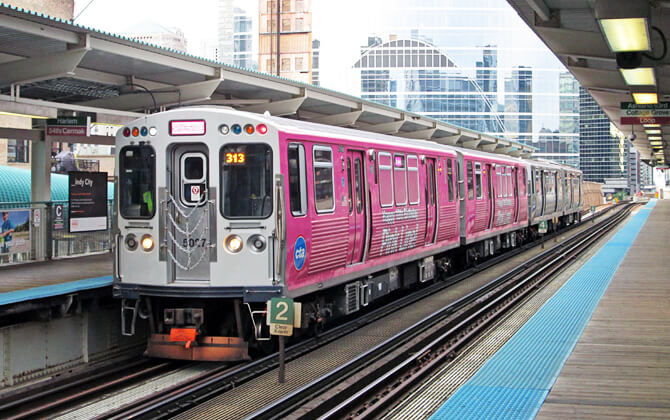
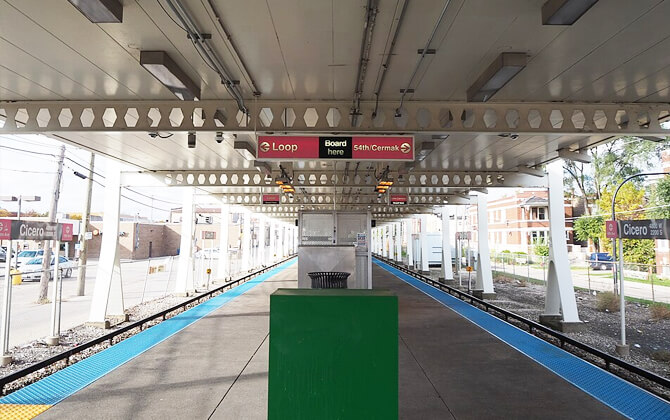
The western end of the Pink Line is 54th/Cermak in Cicero. From there, the line runs near Cermak Road, serving Cicero and a chain of West Side stations before reaching the Paulina Connector.
West Side stops include Cicero, Kostner, Pulaski, Central Park, Kedzie, California, Western, Damen, 18th, Polk, Ashland, Morgan, and Clinton. This part of the route supports local transport across North Lawndale, Little Village, Pilsen, and the Near West Side, while also feeding riders into downtown Chicago.
Ashland and Clinton are especially useful because they connect with the Green Line. Western also has a Metra BNSF connection at Western Avenue.
Pilsen, Illinois Medical District, and West Loop Stops
Through Pilsen and the Near West Side, the Pink Line links neighborhood stations with medical, cultural, and downtown destinations. Key stops in this stretch include 18th, Polk, Ashland, Morgan, and Clinton.
| Station | Details |
|---|---|
| 18th | Pilsen and Lower West Side stop; connects with CTA bus 18 |
| Polk | Near West Side stop serving the Illinois Medical District area; connects with CTA buses 7 and 157 and Pace bus 755 |
| Ashland | Green Line transfer point; connects with CTA buses 9 and X9 |
| Morgan | West Loop area station on the Paulina Connector approach |
| Clinton | Green Line, Metra Union Pacific routes, and CTA buses J14, 56, and 125 |
After Clinton, trains enter the Loop, run clockwise, and then head back toward 54th/Cermak.
Downtown Loop Stations
In downtown Chicago, Pink Line trains operate clockwise around the Loop. The Loop stations served are Clark/Lake, State/Lake, Washington/Wabash, Adams/Wabash, Harold Washington Library-State/Van Buren, LaSalle/Van Buren, Quincy, and Washington/Wells.
After Washington/Wells, trains leave the Loop and continue west through Clinton, Morgan, Ashland, Polk, 18th, Damen, Western, California, Kedzie, Central Park, Pulaski, Kostner, and 54th/Cermak.
State/Lake is listed as closed for reconstruction until 2029, so check current service before planning a trip that depends on that stop.
Fares, Tickets, and Ventra
The Pink Line uses CTA’s standard fare system. A regular “L” ride costs US$2.50, while a reduced fare costs US$1.25 for eligible riders. A disposable Single-Ride Ventra Ticket costs US$3.00 and includes up to two transfers within two hours, along with the limited-use media fee.
You can pay with a Ventra Card, a disposable Ventra ticket, a contactless bank card, or a mobile wallet. Ventra also supports passes, including day pass options and longer unlimited-ride products.
New Ventra Cards and tickets are available from station vending machines. Through the Ventra app, riders can add value, load passes, check balances, and buy tickets for CTA, Metra, and Pace.
Single Rides, Passes, and Transfers
A Single-Ride Ventra Ticket covers one entry to the “L” or bus system and includes two transfers. A 1-Day Pass is valid for 24 hours from first use, and the limited-use media fee is waived for that pass type.
Other pass options include 3-Day, 7-Day, and 30-Day CTA or CTA/Pace passes. These can be useful if your local transport plan includes several rides in a short period. For a single trip, stored value or a contactless payment card is usually enough.
Children under 7 ride free on CTA with a fare-paying customer. Older children and other qualifying riders may be eligible for reduced fare programs under CTA rules.
How to Pay at Pink Line Stations
Before entering, confirm that the Pink Line is the right route for your trip. CTA maps and trip-planning apps can show the route plan, direction, transfers, and estimated running time.
At the station, buy a ticket or load a Ventra Card at a vending machine, then tap at the turnstile. You can also tap a contactless bank card or mobile wallet such as Apple Pay or Android Pay.
Cash is not accepted directly at the gate. If you want to pay with cash, use the station vending machine and have at least US$3.00 available for a disposable ticket.
- US$3.00 disposable Ventra ticket with one ride and up to two transfers
- 1-Day Pass for unlimited CTA rides during the pass period
- Reloadable Ventra Card with stored value or passes
- Contactless bank card or mobile wallet
After paying, keep the same ticket, card, or device with you. You may need it if your transfer requires leaving one station and entering another.
Schedule, Frequency, and Real-Time Arrivals
The Pink Line operates daily between 54th/Cermak and the Chicago Loop. Its train schedule changes by day, and frequency is highest during busy travel periods. If you are checking schedule today or timings today, use real-time arrivals before heading to the platform.
| Service detail | Timings |
|---|---|
| Weekday operating hours | 4:00 a.m. to 1:00 a.m. |
| Saturday operating hours | 5:00 a.m. to 1:00 a.m. |
| Sunday and holiday operating hours | 4:30 a.m. to 1:30 a.m. |
| Typical train frequency | About every 8 to 15 minutes, with wider spacing late at night |
| After midnight | Service may be less frequent, with minimum headways around 20 minutes noted in the draft schedule information |
| Route pattern | 54th/Cermak to the Loop, clockwise around the Loop, then back to 54th/Cermak |
Schedules can change because of construction, elevator outages, holidays, or interval management. Real-time apps and CTA schedule tools show upcoming departures, the next train by station, and service alerts when available.
Hours of Operation
The Pink Line’s opening hours generally start before the morning commute and continue into late evening or after midnight. Weekday starting time is earlier than Saturday service, while Sunday and holiday timings follow their own schedule.
The closing time depends on the day and direction of travel, so always check the last train before a late trip. During weekday rush hours, trains can run about every 8–9 minutes; late at night, frequency may drop and waiting times can be longer.
Transfers and Connections
The Pink Line connects with other CTA rail lines, CTA buses, Pace buses, and Metra services. Its strongest transfer options are in the Loop and at West Side stations such as Ashland, Clinton, and Western.
The service pattern is easy to remember: trains run from 54th/Cermak to the Loop, circle clockwise, and then return westbound. That makes the Pink Line a practical part of city transport for commuters, visitors, and riders connecting across the wider CTA system.
Connections to Other CTA “L” Lines
The Pink Line shares tracks with the Green Line as it approaches downtown via Lake Street and the Paulina Connector. Ashland and Clinton are key Green Line connection points, and the Loop offers additional rail transfers.
Important Loop connections include Clark/Lake, Washington/Wabash, Adams/Wabash, Harold Washington Library-State/Van Buren, LaSalle/Van Buren, Quincy, and Washington/Wells. Clark/Lake is especially useful because it connects with the Blue, Brown, Green, Orange, and Purple lines.
The line also has a non-revenue track connection to the Blue Line near Harrison Junction, where a branch descends toward the expressway median. On weekends and holidays, the draft notes a free transfer between Pink and Blue Line trains at Clark/Lake. There is also a free elevated-to-subway transfer in the Loop area between Library-State/Van Buren and the Jackson stations.
Connections to CTA Buses, Pace, and Metra
Several Pink Line stations connect with CTA and Pace bus routes. 54th/Cermak connects with CTA buses 21, 54B, and N60 and Pace buses 316 and 322. Cicero connects with CTA buses 21, 54, 54B, and N60, plus Pace buses 302 and 392.
Other useful bus connections include Pulaski for CTA buses 53 and 157, Central Park for 82 and 157, Kedzie for 52, California for 94, Damen for CTA bus 50 and Pace bus 755, 18th for CTA bus 18, and Polk for CTA buses 7 and 157 plus Pace bus 755.
For regional rail, Western connects with Metra’s BNSF line at Western Avenue. Clinton connects with Metra’s Union Pacific North, Union Pacific Northwest, and Union Pacific West routes at Ogilvie Transportation Center. Washington/Wabash connects toward Metra Electric and NICTD service at Millennium Station, LaSalle/Van Buren connects with Metra’s Rock Island Line, and Quincy is useful for Union Station connections.
Airport Connections
The Pink Line does not go directly to either of Chicago’s major airports. O’Hare International Airport is served by the Blue Line, while Midway International Airport is served by the Orange Line.
For airport trips, plan a transfer in or near the Loop. Clark/Lake is the most important transfer point for O’Hare because it connects with the Blue Line. For Midway, transfer from the Pink Line to the Orange Line downtown.
From the Pink Line to O’Hare Airport
To reach O’Hare from the Pink Line, ride toward the Loop and transfer to the Blue Line at Clark/Lake. The Pink Line itself runs between 54th/Cermak and downtown, so a transfer is required.
The draft also notes that service to the O’Hare branch is maintained from 54th/Cermak via the Dearborn Subway during morning and afternoon rush hours. At other times, use the Clark/Lake transfer and check current service before you travel.
From the Pink Line to Midway Airport
The Pink Line does not serve Midway Airport directly. The CTA Orange Line is the rail route to Midway International Airport.
From the Pink Line, ride into the Loop and transfer to the Orange Line. Pink Line trains serve Loop stations such as Clark/Lake, Washington/Wabash, Adams/Wabash, Harold Washington Library-State/Van Buren, LaSalle/Van Buren, Quincy, and Washington/Wells before returning west.
Midway International Airport Station uses the regular CTA fare; it does not require the higher airport fare charged at O’Hare.
Parking, Bike Parking, and Accessibility
All CTA railcars are accessible, and the entire Cermak branch is listed as ADA accessible. At accessible stations, staff may assist with boarding when needed, including use of gap fillers.
Parking is available at select CTA Park & Ride lots. Some lots offer daily parking, while monthly spaces are reserved for monthly parkers. Parking charges, parking charges per day, and payment instructions are posted at the lot, and mobile payment is available at participating locations.
Bike parking is available at many CTA stations. Most “L” stations have outdoor racks, and some offer sheltered or indoor bike parking. For the Pink Line, indoor bike parking is noted at 18th.
CTA allows up to two bicycles per railcar during most hours, except weekday rush periods. Bikes are allowed all day on Saturdays, Sundays, and holidays. Folding bicycles are allowed on trains and buses at all times, while fuel- and gas-powered bicycles are not permitted.
Divvy and other bikeshare bikes are not allowed on CTA buses, trains, or in fare-paid station areas. During crowded periods, CTA staff may ask riders with bicycles to wait for a less crowded train.
Priority seating is reserved for seniors and people with disabilities. Give up those seats when they are needed.
Rules, Safety, and Rider Etiquette
Before riding, make sure you have valid fare media and know your destination. CTA trains do not accept cash on board, so pay before entering the platform with a Ventra ticket, Ventra Card, contactless bank card, or mobile wallet.
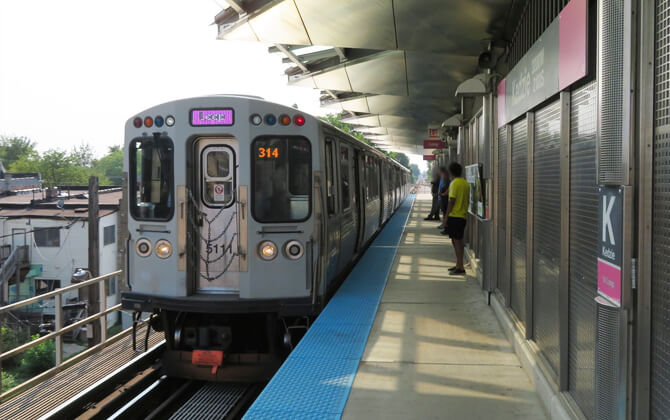
At the platform, check the train’s headsign and direction. Because the Pink Line uses the Loop, destination signs may refer to Loop service rather than a simple northbound or southbound direction.
Let passengers exit before boarding, then move away from the doors. Keep bags out of the aisle, hold a rail if standing, and avoid blocking the doors or leaning on vertical poles. If you have luggage, position it as compactly as possible.
Stay alert on platforms and trains. Keep valuables secure, use normal city caution, and avoid standing too close to the platform edge. CTA stations and railcars have emergency intercoms, but riders should still act quickly and seek help in an emergency.
Personal, noncommercial photography is allowed on CTA property as long as it does not create a safety risk, distract operators, block passenger flow, or enter restricted areas.
Tips for First-Time Riders
Chicago’s “L” is color-coded, so start by confirming that you need the Pink Line. Trip-planning apps can show your route, stations, transfers, schedule, and estimated travel time.
The easiest payment method is usually tap-to-pay with a contactless card or mobile wallet. Ventra Cards and disposable tickets also work, and station vending machines accept cash for ticket purchases or card reloads.
If you expect multiple rides in one day, compare the cost of a pass with single fares. A day pass can be better value for frequent city transport use, while a one-off ticket is fine for a single ride.
At the station, check both the line color and direction before entering the platform. Some station names appear on more than one line, so do not rely on the name alone.
For a smoother ride, let people off first, keep noise low, and avoid blocking doors. If your phone is your main payment method, a preloaded Ventra Card can be a useful backup if your battery dies.
Brief History of the Pink Line
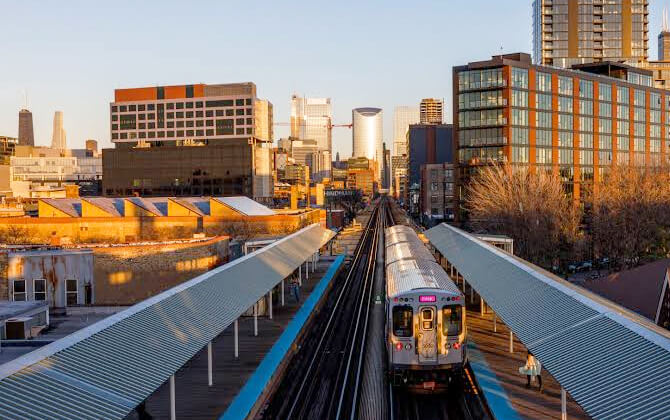
The Pink Line is the CTA’s newest rail line. It began operating on June 25, 2006, as a 180-day trial between 54th/Cermak in Cicero and the Loop in downtown Chicago.
Before the Pink Line name, the route was the Blue Line’s Cermak branch, and earlier it was known as the Douglas branch. Its history is tied to major changes in Chicago rail transport, including the removal of the Metropolitan West Side Elevated’s main line in the 1950s and the later use of the Paulina Connector and Lake Street tracks.
In January 2006, CTA proposed rerouting 54th/Cermak trains through the rebuilt Paulina Connector to Green Line tracks and around the Loop. The plan was approved in February 2006, and service began that June. The name “Pink Line” was selected after a student essay contest; “Silver Line” had been discussed informally before that.
The trial service was extended twice before CTA made the Pink Line permanent on December 4, 2008.
- Until 1996, the route was known as the Douglas branch.
- June 25, 2006: Pink Line service began as a 180-day trial.
- December 12, 2006: the trial was extended.
- June 2007: another 180-day extension was added.
- December 4, 2008: CTA made the Pink Line permanent.
Future Changes and Planned Improvements
The draft material does not describe a separate Pink Line expansion, extension, or major rebuild currently planned. The line remains an established part of the CTA network between 54th/Cermak and the Loop.
Broader CTA work that may affect Pink Line riders includes downtown station and track modernization, slow-zone reduction, maintenance, and targeted station upgrades. These projects are meant to improve reliability across the Chicago “L” system.
CTA has studied network ideas over the years, including the Circle Line concept, but those remain study concepts rather than active Pink Line construction projects.
Best Stops for Visitors and Nearby Attractions
For visitors, the most useful Pink Line stops are usually the Loop stations and neighborhood stops with easy access to attractions, public transport connections, and walkable destinations.
| Station | Details |
|---|---|
| Quincy | Convenient for Willis Tower and Union Station connections |
| Adams/Wabash | Useful for the Art Institute of Chicago |
| Washington/Wabash | Practical for Millennium Park and Cloud Gate, also known as the Bean |
| State/Lake | Close to the Wrigley Building and useful for the Chicago Theatre area; listed as closed for reconstruction until 2029 |
| Clark/Lake | Central Loop stop with strong rail connections and access toward the Chicago Theatre area |
| Ashland/Lake | Useful for trips toward the United Center area |
| 54th/Cermak | Western end of the line serving the Cicero area |
The Pink Line also serves North Lawndale, Little Village, and Pilsen, with stations such as Kostner, Pulaski, Central Park, Kedzie, California, Western, Damen, and 18th. From the Loop, riders can transfer to reach destinations such as O’Hare Airport, Chinatown, Navy Pier, Wrigley Field, and Museum Campus attractions.
Pilsen and 18th Street
The 18th station is at 1710 West 18th Street in Pilsen. It is a practical stop for exploring the neighborhood and is known for colorful murals painted by local Pilsen artists.
18th is an accessible Pink Line station and had a rebuild completed in 1993. The stop is closely connected to the Lower West Side and the broader Pilsen community, which was first known for its large Bohemian population after the Chicago Fire of 1871.
West Loop and Downtown Attractions
The Pink Line is a convenient way to reach the Loop and several downtown Chicago attractions. As trains enter downtown, they share Lake Street tracks with the Green Line and circle the elevated Loop before returning west.
From the Loop, the line provides access to City Hall/County Building, the Daley Center, the Thompson Center, and the Board of Trade. Clark/Lake, Washington/Wabash, Adams/Wabash, Harold Washington Library-State/Van Buren, LaSalle/Van Buren, Quincy, and Washington/Wells are the main downtown stops to know.
The line also serves points of interest beyond the immediate Loop, including the Mexican Fine Arts Center Museum and the Illinois Medical District.
Illinois Medical District and Nearby Destinations
The Pink Line is useful for reaching the Illinois Medical District area, especially through Polk and nearby bus connections. It also gives riders access to several nearby destinations for everyday trips and visitor travel.
Notable places along or near the line include the Illinois Medical District, Mexican Fine Arts Center Museum, National Museum of Mexican Art, City Hall/County Building, Daley Center, Thompson Center, Board of Trade, and Douglass Park.
For the Illinois Medical District area, the draft notes a connection to the #7 Harrison bus, which links UIC’s east campus with the district.
- Illinois Medical District
- Mexican Fine Arts Center Museum
- National Museum of Mexican Art
- City Hall/County Building
- Daley Center
- Thompson Center
- Board of Trade
- Douglass Park