PATCO, the Port Authority Transit Corporation Speedline, is a rapid transit system linking Center City Philadelphia with Camden and Lindenwold in New Jersey. Opened in 1969, it combined older rail infrastructure into a single cross-river service and became an important part of public transport in the Philadelphia region. The system is known for its route between Philadelphia and South Jersey, park-and-ride access, coordinated bus links, and a long history tied to earlier commuter rail and bridge transit services.
| Key | Information |
|---|---|
| System | PATCO Speedline |
| Operator | Port Authority Transit Corporation under the Delaware River Port Authority |
| Opened | 1969 |
| Route | Center City Philadelphia to Lindenwold, New Jersey |
| Stations | 14 active stations |
| Line length | 14.2 miles (22.9 km) |
| Typical running time | About 28 minutes end to end |
| Main role | Regional rapid transit and city transport link across the Delaware River |
PATCO Map
Map of PATCO showing different lines and stations. Click on the map to enlarge it or download the PATCO map in PDF format.

PATCO Speedline Stations
The PATCO Speedline, also called the Lindenwold Line or PATCO High Speed Line, has 14 active stations between Philadelphia and Lindenwold, New Jersey. It serves Center City Philadelphia, Camden, Collingswood, Haddonfield, Cherry Hill, Voorhees, and Lindenwold, making it a key part of transportation in the area.
Here is the stations list from west to east, with the main details riders usually look for in a stations map or route plan.
| Station | Details |
|---|---|
| 15–16th & Locust | Access to the Downtown Link concourse |
| 12–13th & Locust | Access to the Downtown Link concourse |
| 9–10th & Locust | Philadelphia station on the central route |
| 8th & Market | Connects with SEPTA Regional Rail at Jefferson Station, SEPTA Metro, and multiple bus routes |
| Franklin Square | Reopened in 2025 after renovation |
| City Hall | Limited late-night operation |
| Broadway | Connection to the River Line and Walter Rand Transportation Center |
| Ferry Avenue | New Jersey station with local transport connections |
| Collingswood | Some westbound morning rush trains skip this station |
| Westmont | Some westbound morning rush trains skip this station |
| Haddonfield | Some westbound morning rush trains skip this station |
| Woodcrest | New Jersey station on the route to Lindenwold |
| Ashland | New Jersey station on the route to Lindenwold |
| Lindenwold | Eastern terminal with Atlantic City Line connection |
Several stations offer transfers to other transport services, including NJ Transit bus routes at multiple New Jersey stops, the River Line at Broadway, and the Atlantic City Line at Lindenwold.
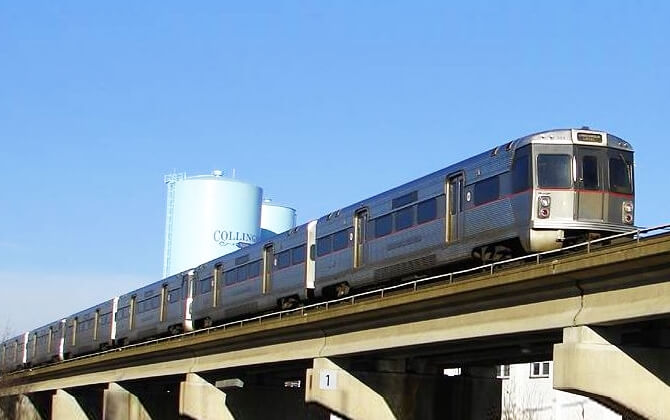
Timetable & Operating Hours
PATCO publishes a timetable in all stations, and trains are operating on or close to schedule. If you need schedule today updates, train schedule changes, or timings today during disruptions, check for travel alerts and special schedules before you go.
Customer service is available 24/7 at (856) 772-6900 or (215) 922-4600. For email support, use [email protected]. FREEDOM Card assistance is available at (877) 373-6777.
The regular operating hours, opening hours, and working hours are listed below.
| Service detail | Timings |
|---|---|
| Monday to Thursday opening times | 4:30 AM to 11:30 PM |
| Friday opening times | 4:30 AM to 4:00 AM |
| Saturday opening times | 5:00 AM to 4:00 AM |
| Sunday opening times | 5:00 AM to 11:30 PM |
| Weekday frequency | Every 7 to 15 minutes |
| Friday frequency | Every 7 to 16 minutes |
| Saturday frequency | Every 20 to 30 minutes |
| Sunday frequency | Every 30 minutes |
| Philadelphia-bound route | Starts at Lindenwold Station and ends at 15–16th & Locust |
| Approximate running time | 28 minutes end to end |
If you are planning around the starting time of the first train, the closing time of the system, or the last train feel of late-night service, note that some Philadelphia stations have limited overnight operation. Train frequency also drops after rush hour and becomes lighter after midnight.
For this route timetable, the Philadelphia-bound path train stops at Lindenwold, Ashland, Woodcrest, Haddonfield, Westmont, Collingswood, Ferry Avenue, Broadway, City Hall, Franklin Square, 8th Street, 9–10th & Locust, 12–13th & Locust, and 15–16th & Locust.
Frequency by day
| Service detail | Timings |
|---|---|
| Monday | 4:30 AM-11:30 PM; every 7-15 minutes |
| Tuesday | 4:30 AM-11:30 PM; every 7-15 minutes |
| Wednesday | 4:30 AM-11:30 PM; every 7-15 minutes |
| Thursday | 4:30 AM-11:30 PM; every 7-15 minutes |
| Friday | 4:30 AM-4:00 AM; every 7-16 minutes |
| Saturday | 5:00 AM-4:00 AM; every 20-30 minutes |
| Sunday | 5:00 AM-11:30 PM; every 30 minutes |
PATCO Fares and Tickets
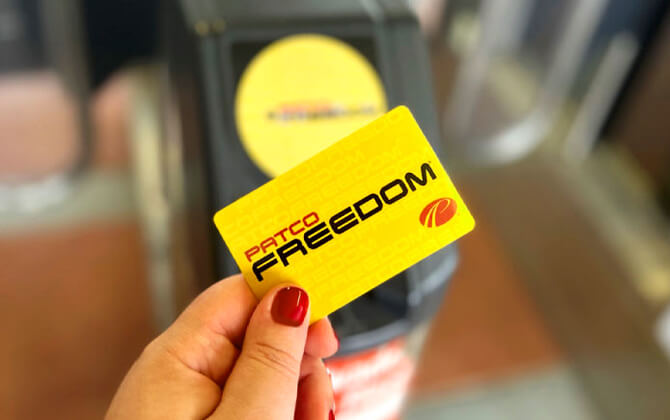
PATCO uses a distance-based fare system, so the ticket price depends on your trip. Tickets can be bought from station vending machines with cash, credit card, debit card, or a FREEDOM Card. If you are comparing fare, price, or cost before you travel, the table below covers the listed options.
| From | To | One-way | Round-trip |
|---|---|---|---|
| Lindenwold, Ashland & Woodcrest | Philadelphia | $3.00 | $6.00 |
| Haddonfield, Westmont & Collingswood | Philadelphia | $2.60 | $5.20 |
| Ferry Avenue (Camden) | Philadelphia | $2.25 | $4.50 |
| Any New Jersey station | Any New Jersey station | $1.60 | $3.20 |
| Broadway (Camden) | City Hall (Camden) | $1.40 | $2.80 |
| Broadway & City Hall (Camden) | Philadelphia | $1.40 | $2.80 |
| Any Philadelphia station | Any Philadelphia station | $1.40 | $2.80 |
Children age 4 and under ride free with a fare-paying adult.
A Reduced Fare Program is available for senior citizens, people with disabilities, and Medicare card holders. Eligible riders can travel between any two PATCO stations during off-peak hours for $0.70. Off-peak timings are weekdays from 9:00 AM to 4:00 PM and 7:00 PM to 6:00 AM, plus all weekend service.
Fare gates accept FREEDOM Cards, SHARE Cards, and paper tickets. The FREEDOM Card is a stored-value card, while paper tickets stay valid for 3 days from purchase. No fare calculator is provided in the source material, but the listed fares give a clear route-by-route reference.
Connections to Other Systems
PATCO is well connected to other public transport networks in both Philadelphia and New Jersey. In South Jersey, NJ Transit bus service reaches most PATCO stations, while the Atlantic City Line serves Lindenwold and the River Line connects at Broadway, also known as Walter Rand Transportation Center.
In Philadelphia, PATCO links with SEPTA at several major points. SEPTA Metro L connects at 8th & Market, and Jefferson Station is two blocks away. SEPTA Metro B connects through a short underground walkway serving the Walnut–Locust area, including 12–13th & Locust and 15–16th & Locust. The B3 spur also connects at 8th & Market through a pedestrian walkway.
Transfer arrangements have changed over time. A former SEPTA Transfer ticket once existed for riders starting in New Jersey. Now, passengers use a Freedom Share Card to transfer to the SEPTA system, with the transfer fare debited directly from the card account. The Freedom Share Card works with both PATCO Freedom and SEPTA Key systems.
These links make PATCO an important part of local transport and city transport across the Delaware River, especially for riders mixing rail and bus trips in one journey.
Airport Connections
PATCO does not have a direct airport rail route. Based on the available information, riders need to use other transport connections after leaving the PATCO system.
At 8th & Market, passengers can connect to SEPTA through Jefferson Station and continue to SEPTA’s Airport Rail Line. The available material also notes that PATCO’s links to SEPTA and New Jersey Transit are not physically integrated, so riders must exit PATCO or use a different platform and pay a separate fare.
In short, PATCO works as a transfer option for airport travel, not as an airport line itself.
Parking
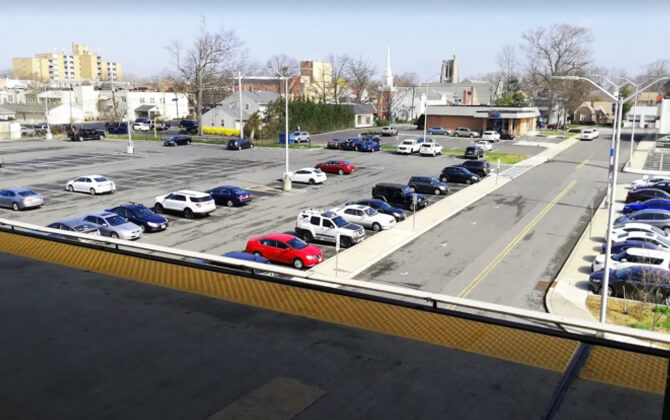
Lindenwold Station, the New Jersey terminal, is a major hub with station parking, bicycle racks, and full ADA accessibility. Elevators connect the parking areas, concourse, and platforms.
Parking charges at Lindenwold include both free and paid options. Free daily parking is available in Lots 1, 3, 4, and 5. Preferred parking is available in Lot 2 for $1.00 per day when entering between 5:00 AM and 10:00 AM. Payment is accepted with FREEDOM Cards only. After 10:00 AM, the gated lots are free.
Parking is limited to 24 hours. The station also has a large parking facility and solar canopies that help power PATCO trains.
| Service detail | Timings |
|---|---|
| Free parking lots | Lots 1, 3, 4, and 5 |
| Paid preferred parking | Lot 2 |
| Parking charges per day | $1.00 between 5:00 AM and 10:00 AM |
| Payment method | FREEDOM Card only |
| After 10:00 AM | Gated lots are free of charge |
| Parking limit | 24 hours |
Rules and Tips
PATCO describes itself as a 24-hour rail system, so it helps to know the basics before you ride. First things first: buy your ticket before boarding. Fares are distance based, and frequent riders can use a FREEDOM Card. Reduced fares are available for eligible riders.
If you drive to a New Jersey station, remember where you parked. PATCO notes that parking lots are numbered on light-pole signs. It is also smart to check the timetable or train schedule in advance, since frequency changes after rush hour and becomes lower after midnight. PATCO recommends arriving at least 10 minutes before your scheduled departure.
On platforms, stay behind the yellow warning line and never stand or sit beyond the yellow danger line. Wet pavement, concourses, and station floors can be slippery, so move carefully. If you drop something on the tracks, do not try to get it yourself; use the red Call for Aid phone for help.
Emergency assistance is available across the system. Red Call for Aid phones are at fare gates, and yellow emergency call boxes are on platforms and in parking lots. On trains, emergency intercoms are located near the flip-up seats behind the operator console. Riders can also text PATCO to 888777 for alerts between 6:30 AM and 7:00 PM on weekdays.
While riding, use the buddy system when possible and sit when a seat is available. If you need to stand, hold a seatback or pole because trains can move suddenly. When boarding or getting off, watch the gap between the train and platform. Late at night, stay alert, stay near other people when possible, and have your keys ready before you reach your car.
PATCO asks riders to report suspicious or objectionable conduct right away. You can tell a train operator, police officer, or employee, use a Call for Aid phone, or use the Look Up. Speak Up. app. DRPA Police is available 24/7 at (856) 963-7995.
Smoking and drinking are not allowed. Bicycles are permitted at no extra cost, but they may not be ridden inside PATCO property. Photography and videotaping are allowed only under certain conditions. Following these rules helps keep the system safe for everyone.
History
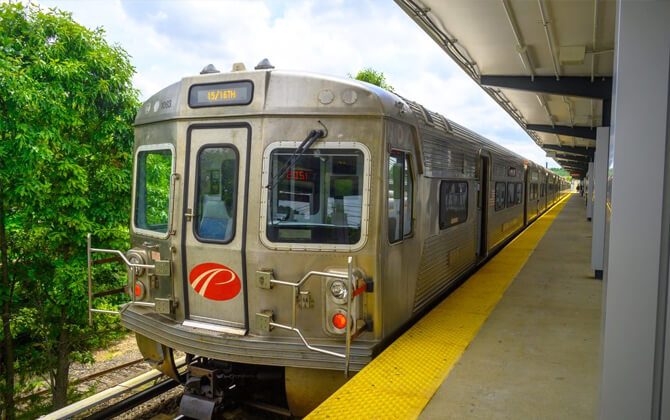
The history of PATCO goes back to 1926, when the Delaware River Bridge Commission was created and work began on the Delaware River Bridge, now the Benjamin Franklin Bridge. In 1931, the commission became the Delaware River Joint Commission and received authority to build a high-speed transit line between Philadelphia and Camden.
The Bridge Line opened on June 7, 1936. It was the first major piece of what later became PATCO. In 1951, Pennsylvania and New Jersey created the Delaware River Port Authority, expanding the agency’s powers and setting up a more integrated transport system.
Several studies followed. Parsons, Brinckerhoff, Hall and MacDonald recommended a three-corridor system with a new tunnel under the Delaware River. Route A would have served Moorestown, Route B Kirkwood, now Lindenwold, and Route C Woodbury Heights. The estimated price was $242 million. A later report by Louis T. Klauder & Associates proposed a lower-cost alternative that reused the existing bridge rail line and connected with Philadelphia subway lines instead of building a new tunnel. That plan, estimated at $94 million, identified the Kirkwood area as the strongest source of riders.
PATCO service began on February 15, 1969, with the first trip from Lindenwold to Center City Philadelphia. The original line was 14.2 miles long, or 22.9 km, and carried about 21,200 passengers per day. It started with 8 stations in Camden County and 4 in Philadelphia, and six New Jersey stations offered park-and-ride access. Today, more than 38,000 riders use the system for commuting, school, shopping, events, and other travel.
The system saw expansion in 1980 with the opening of Woodcrest Station in Cherry Hill, which included 2,700 parking spaces and direct access to I-295 via Exit 31. Total parking later reached more than 12,000 cars daily at seven stations: Lindenwold, Ashland, Woodcrest, Haddonfield, Westmont, Collingswood, and Ferry Ave.
PATCO began with 75 automated cars capable of single-operator service and speeds up to 75 miles per hour. In 1980, 46 new Vickers cars were added, bringing the fleet to 121. Preventive maintenance has remained central to operations, and PATCO reports a strong safety record over more than 2.3 billion passenger miles.
Future Extensions
PATCO has explored several extension ideas over the years, but no major expansion described here has moved beyond planning. One New Jersey concept would add service along the corridor once proposed for Route C, with a Glassboro–Camden Line serving Gloucester County and ending at Rowan University in Glassboro. Riders would transfer to PATCO at Walter Rand Transportation Center for travel to Philadelphia.
On the Pennsylvania side, Philadelphia proposed a westward expansion in 2021 into University City. The plan includes a new rail tunnel under the Schuylkill River, with 40th Street Trolley Portal considered as a possible western terminal near the University of Pennsylvania and major hospitals. A proposed link at Penn Medicine Station would create direct transfers to SEPTA Regional Rail. The next step mentioned is a feasibility study and cost analysis.
Earlier planning also looked at other alignments on both sides of the Delaware River, including connections to the Philadelphia waterfront and several New Jersey alternatives feeding into Camden and the existing PATCO system. Franklin Square’s return to service after renovation shows that upgrades to current infrastructure are also part of the system’s future development.
Nearby Attractions
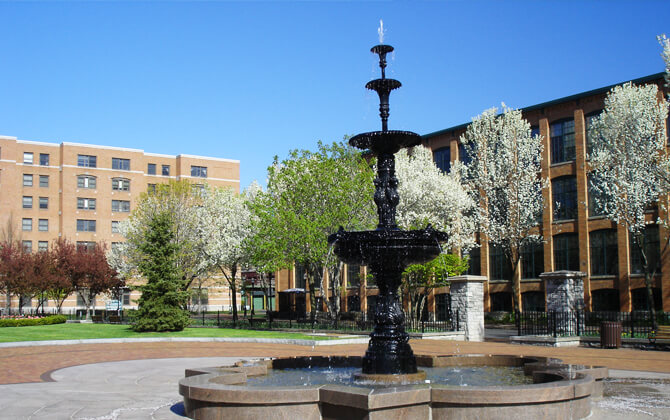
PATCO makes it easy to reach a mix of urban landmarks, neighborhood destinations, and transit hubs across Philadelphia and Camden County. For many riders, the route itself is part of the experience, especially the crossing over the Benjamin Franklin Bridge.
- 8th & Market offers access to The Gallery and connections to SEPTA Regional Rail, SEPTA Metro, and bus service.
- Franklin Square is a historic stop that was used during and after the 1976 American Bicentennial celebrations.
- Walter Rand Camden Transportation Center at Broadway links PATCO with the NJ Transit River Line and bus service.
- Haddonfield is an open-cut station shaped by local opposition to an elevated structure.
- Woodcrest, Ashland, and Lindenwold are useful park-and-ride stops, with Lindenwold also known for the PATCO shops and yard.
The line connects major parts of the region while serving stations between 15–16th & Locust and Lindenwold, so it works well both for commuting and for exploring nearby places.