The O’Hare Airport Transit System, usually called the ATS, is a free automated people mover at Chicago O’Hare International Airport. It links Terminals 1, 2, 3, and 5 with parking areas, the Multi-Modal Facility, rental cars, buses, and regional train connections. The system opened on May 6, 1993, runs 24 hours a day, and uses an elevated two-track route with five active stations.
| Key | Information |
|---|---|
| System type | Automated airport people mover for O’Hare local transport |
| Opened | May 6, 1993 |
| Route length | 4.8 km (3 miles) |
| Stations | 5 active ATS stations |
| Fare | Free; ticket price is US$0 ($0) |
| Operating hours | 24 hours a day, 7 days a week |
| Typical frequency | Every 3–5 minutes during peak hours; less frequent at other times |
| End-to-end running time | About 10 minutes from Terminal 1 to the Multi-Modal Facility |
| Main connections | CTA Blue Line, Metra O’Hare Transfer, Pace bus routes, regional coach services, parking, and rental cars |
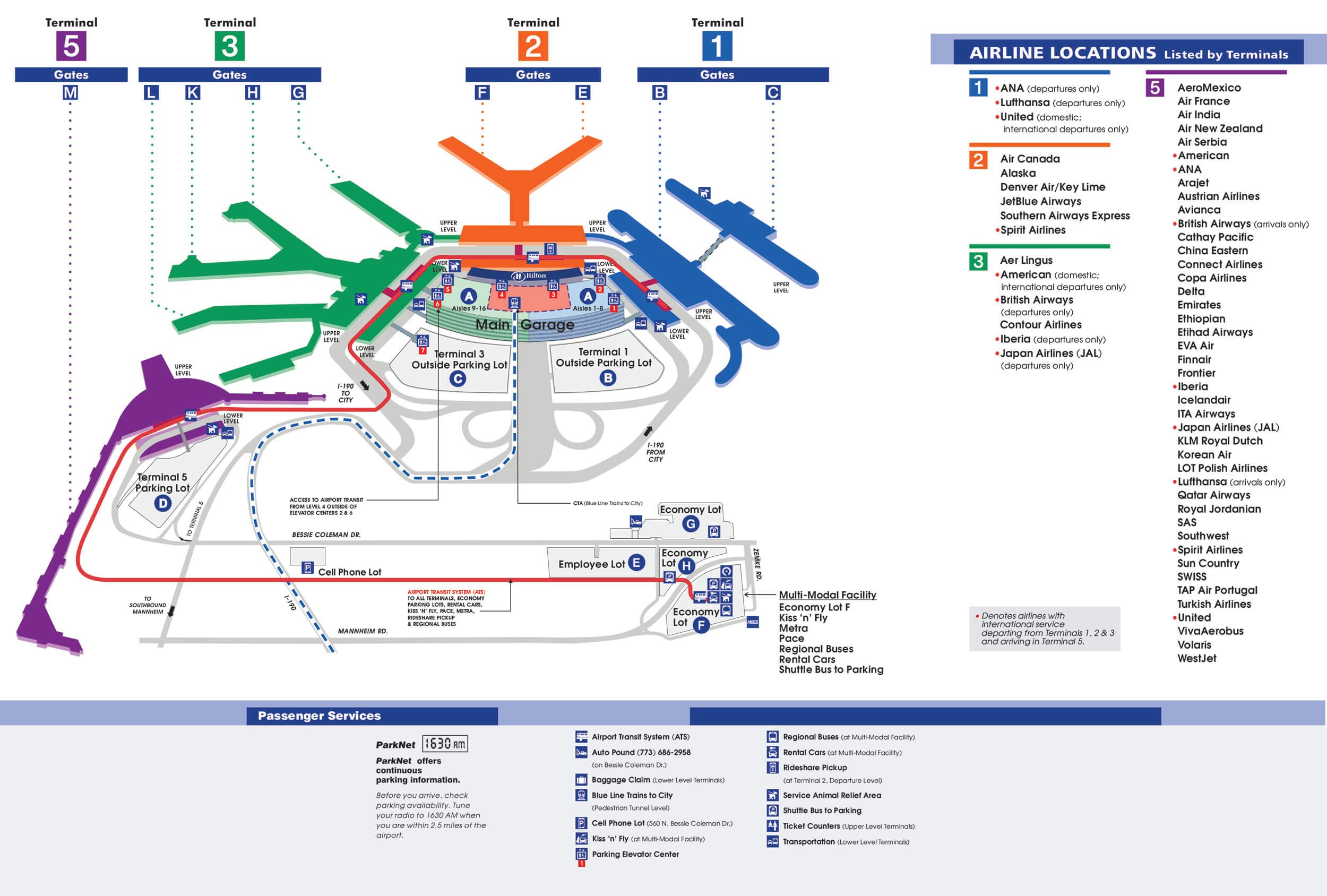
O’Hare Airport Transit System (ATS) Map
Chicago O’Hare Airport Transit System (ATS) Map showing all stations, terminal connections, and the route between Terminals 1, 2, 3, 5, and the Multi-Modal Facility. Click on the map to enlarge it or download the O’Hare ATS map in PDF format.
ATS Stations and Stops
The ATS route serves five active stations, and every train stops at all of them in both directions. For travelers using a stations map, the line begins at Terminal 1, loops through Terminals 2 and 3, continues to Terminal 5, and ends at the Multi-Modal Facility.
This stations list also explains what each stop is useful for. Parking Garage A is reachable from the three domestic terminal stations. Parking Lot B is accessed from Terminal 1, and Parking Lot C from Terminal 3. The former Remote Parking station still stands, but ATS trains no longer stop there.
| Station | Details |
|---|---|
| Terminal 1 Station | Western end of the ATS route; access to Parking Lot B, Parking Garage A, and nearby CTA Blue Line connections through the terminal area. |
| Terminal 2 Station | Central domestic terminal stop; useful for transfers among Terminals 1, 2, and 3 and access to Parking Garage A. |
| Terminal 3 Station | Domestic terminal stop with access to Parking Lot C, Parking Garage A, and terminal walkways. |
| Terminal 5 Station | Serves O’Hare’s international terminal and provides the main landside link between Terminal 5 and the domestic terminals. |
| Multi-Modal Facility Station | Eastern terminal for rental cars, Kiss ‘n’ Fly, Pace buses, regional coaches, and the Metra O’Hare Transfer connection. |
Terminal 1 Station
Terminal 1 Station is the west end of the Airport Transit System and a useful starting point for the full ATS route plan. From here, trains run around the terminal core to Terminal 2 and Terminal 3, then continue toward Terminal 5 and the Multi-Modal Facility.
The station is fully accessible and connects with Parking Lot B. Parking Garage A and the CTA Blue Line O’Hare station are also reachable from the domestic terminal area. Escalators and elevators in the domestic terminals are located near the center of each terminal, across from the ticket counters.
Terminal 2 Station
Terminal 2 Station sits on the domestic terminal loop and is served by every ATS train. It is a practical stop for passengers moving among Terminals 1, 2, and 3 or heading toward Terminal 5, parking, or the rental car facility.
Terminals 1, 2, and 3 are also connected by underground pedestrian walkways. If you are staying within the secure area between those domestic terminals, walking may be simpler than taking the ATS.
Terminal 3 Station
Terminal 3 Station is a fully accessible ATS stop on the domestic terminal loop. From here, passengers can reach Parking Garage A, the CTA Blue Line connection through the terminal area, and Parking Lot C.
The ATS is outside the secure area. If you use it for a flight connection, especially to or from Terminal 5 outside Terminal Transfer Bus hours, you may need to clear TSA security again at your next terminal.
Terminal 5 Station
Terminal 5 Station serves O’Hare’s international terminal. The ATS is the main 24-hour connection between Terminal 5 and the domestic terminals when the Terminal Transfer Bus is not operating.
From Terminal 5, the system continues toward the Multi-Modal Facility after crossing the main access road, the CTA Blue Line area, and Mannheim Road. The same route links passengers with rental cars, Pace buses, regional coach services, and the Metra O’Hare Transfer station on weekdays.
Multi-Modal Facility Station
The Multi-Modal Facility Station is the eastern end of the ATS route. The line was extended 0.61 km (0.38 miles) to reach this facility on the east side of U.S. 12–45, also known as Mannheim Road.
This station serves the consolidated rental car facility, Kiss ‘n’ Fly, Pace routes 250 and 330, the Pulse Dempster Line, regional coach services, and the Metra O’Hare Transfer station. Regional bus passengers arriving at the terminals should ride the ATS to the Multi-Modal Facility, then follow signs to the shuttle and bus boarding areas at ground level.
Fares, Tickets, and Payment
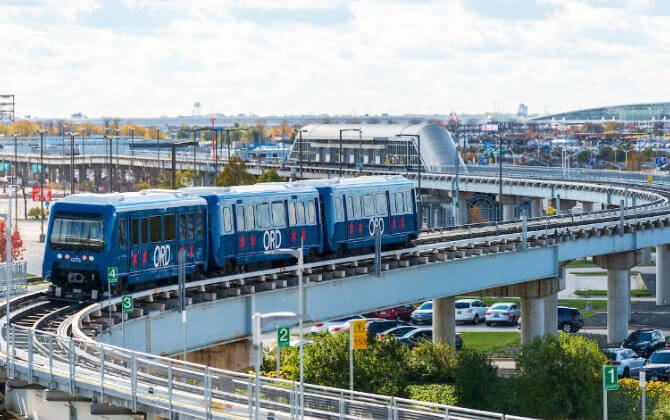
The ATS fare is free. No ticket, pass, day pass, card, fare calculator, or payment method is needed to ride between terminals, parking areas, the Multi-Modal Facility, and rental cars.
The ticket price and cost for ATS travel are US$0 ($0). Other public transport services at O’Hare, such as CTA, Metra, Pace, or regional coaches, may have their own fares and payment rules.
Is the ATS Free?
Yes. The Airport Transit System is free for passengers, airport users, and visitors moving around the O’Hare complex.
It runs 24 hours a day and connects the terminals with parking lots, bus and train connections, and the consolidated rental car facility.
Hours, Frequency, and Travel Time
The ATS operating hours are simple: trains run 24 hours a day, 7 days a week. Full round-the-clock service returned in April 2022 after the system reopened in November 2021 with a limited schedule.
For anyone checking ATS timings today, the opening hours and closing time do not change during normal operation. There is no last train because the system does not close.
| Service detail | Timings |
|---|---|
| Opening hours | 24 hours a day, 7 days a week |
| Starting time | Continuous service; no daily starting time |
| Closing time | No regular closing time |
| Last train | No scheduled last train during normal 24-hour operation |
| Peak frequency | Every 3–5 minutes |
| Off-peak frequency | Less frequent than peak service |
| End-to-end running time | About 10 minutes from Terminal 1 to the Multi-Modal Facility |
Operating Hours
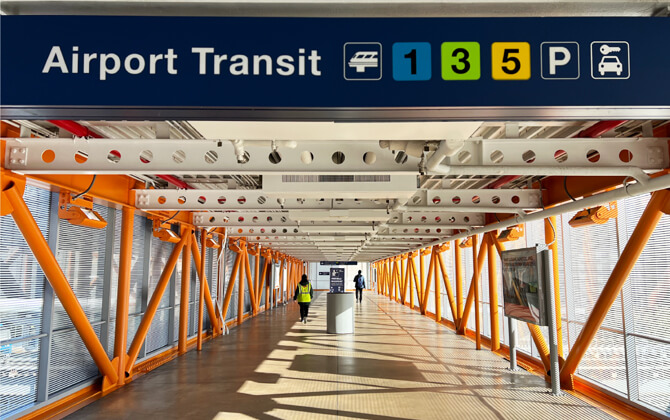
The O’Hare ATS working hours are 24/7. That makes it a reliable airport transport option for early flights, late arrivals, overnight layovers, and rental car returns.
Because the system stays open, the ATS schedule today is generally the same as any other day unless airport maintenance or construction creates a temporary service change.
Typical Train Frequency
During busy periods, ATS train frequency is typically every 3–5 minutes. At quieter times, trains run less often, so late-night passengers should allow a little extra time.
The service is designed for short airport trips rather than long-distance city transport. Most riders use it for terminal transfers, parking access, rental cars, and connections to bus or train services.
End-to-End Travel Time
The full ATS trip from Terminal 1 to the Multi-Modal Facility takes about 10 minutes. Another noted end-to-end timing is as little as nine minutes, so the ride is quick even when you cross the entire airport system.
For route timetable planning, treat the ATS as a short internal airport line with frequent service and brief station-to-station travel times.
Terminal Transfers and Flight Connections
Terminal transfers at O’Hare depend on which terminals you are using. Terminals 1, 2, and 3 are connected by secure-side pedestrian walkways, so many domestic connections do not require the ATS.
Terminal 5 is separate. For trips between Terminal 5 and the domestic terminals, passengers usually use the ATS or, during limited hours, the Terminal Transfer Bus. The ATS is landside, so if you leave the secure area to ride it, you must be screened again before your next flight.
The Terminal Transfer Bus runs every 15 minutes from 11:30 a.m. to 9:30 p.m. It serves Terminal 1 to Terminal 5 and Terminal 3 to Terminal 5 in both directions for eligible secure-side transfers.
- Use the ATS for 24-hour terminal, parking, rental car, and transport connections.
- Use the Terminal Transfer Bus for secure-side transfers involving Terminal 5 during bus operating hours.
- Walk between Terminals 1, 2, and 3 when you are already airside and signs direct you that way.
Transfers Between Terminals 1, 2, and 3
If you are connecting between Terminals 1, 2, and 3, you usually do not need to leave the secure area or ride the ATS. Follow the overhead airport signage and use the pedestrian connections.
The ATS still serves these terminals, but for a simple domestic-to-domestic connection, walking can be faster than waiting for a train.
Transfers Between Terminal 5 and Other Terminals
For transfers between Terminal 5 and Terminals 1, 2, or 3, use the ATS or the Terminal Transfer Bus. The ATS operates all day and all night, while the bus has limited timings.
If you travel between Terminal 5 and the domestic terminals between 9:30 p.m. and 11:30 a.m., you need to exit security, board the ATS, and then clear TSA screening again at the connecting terminal.
ATS vs Terminal Transfer Bus
The ATS is the airport-wide train system for terminals, parking, rental cars, and public transport connections. It is free and open 24 hours a day.
The Terminal Transfer Bus is a limited-hours airside shortcut for eligible passengers traveling between Terminal 5 and Terminal 1 or Terminal 3. It runs every 15 minutes from 11:30 a.m. to 9:30 p.m.
- ATS: best for 24/7 access, landside transfers, parking, rental cars, and local transport links.
- Terminal Transfer Bus: best for staying inside security when the bus is operating.
- Walking: best for many connections among Terminals 1, 2, and 3.
Connections to Public Transit and Regional Buses
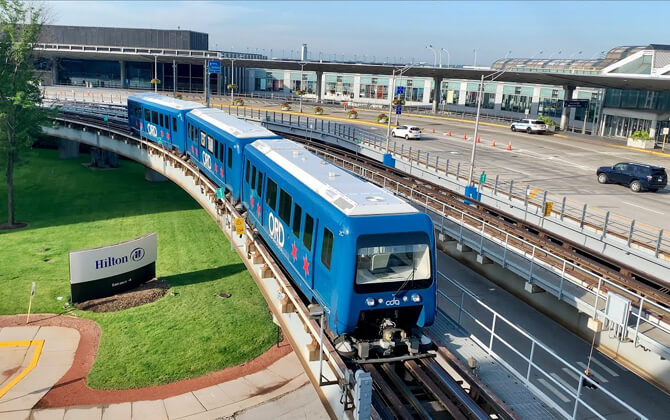
The ATS is a key part of transportation in O’Hare because it links the terminal complex with public transport, regional buses, parking, and rental cars. It connects travelers to the CTA Blue Line through the terminal area and to Pace, Metra, and coach services at the Multi-Modal Facility.
From Terminal 1 to the rental car facility and regional connections, the ride takes about 10 minutes. For passengers using city transport or regional transit after a flight, the ATS is often the first step.
CTA Blue Line
The CTA Blue Line provides 24-hour rapid transit service between Chicago-O’Hare International Airport and Forest Park via downtown Chicago.
At O’Hare, the accessible CTA station is in the lower-level concourse connected to Terminals 1, 2, and 3. If you arrive at Terminal 5, follow ATS signs and ride toward the domestic terminal area, then continue to the CTA trains.
Blue Line trains run 24 hours a day. Normal travel time from O’Hare to downtown Chicago is about 40–45 minutes.
Stations on the line include O’Hare, Rosemont, Cumberland, Harlem on the O’Hare Branch, Jefferson Park, Logan Square, Clark/Lake, UIC-Halsted, Illinois Medical District, Oak Park, Harlem on the Forest Park Branch, and Forest Park.
Metra O’Hare Transfer
The O’Hare Transfer station is on Metra’s North Central Service. It provides commuter rail access to Chicago Union Station inbound and Antioch outbound during service hours, and it is currently open on weekdays only.
To reach Metra from the terminals, ride the ATS to the Multi-Modal Facility. The ATS is free, accessible, and serves all five stations in both directions.
At the Multi-Modal Facility, passengers can also connect with Pace routes 250 and 330 and the Pulse Dempster Line.
Pace Buses and Regional Coach Services
Pace bus routes 250 and 330, along with the Pulse Dempster Line, serve the airport through the Multi-Modal Facility. The ATS is the free link between the terminals and these bus connections.
Visitors can buy short-term passes at Ventra vending machines. Pace also accepts contactless payment options and cash on board, with exact fare required for cash payments. Bags ride free, and caged pets are permitted free of charge.
Regional coach passengers should also use the ATS to reach the Multi-Modal Facility before boarding. Coach services listed for this transfer point include:
- Coach USA / Van Galder
- Lafayette Limo
- PCC / Peoria Charter Coach
- Reindeer Shuttle
Parking, Kiss ‘n’ Fly, and Rental Cars
The ATS connects O’Hare terminals with station parking areas, Kiss ‘n’ Fly, and the consolidated rental car facility at the Multi-Modal Facility. If you arrive by air and need a rental car, follow signs toward baggage claim and then to the ATS.
The Multi-Modal Facility is at 10255 W Zemke Blvd, Chicago, IL 60666. Rental car counters are inside the facility. If you arrive by car, follow airport signs to the MMF / Rental Car Facility and use the Kiss and Fly Lot.
For car returns, follow the rental car return signs to the Multi-Modal Facility and the designated return areas. After-hours returns are available at this location.
Economy Parking Access
Economy parking is the main long-stay parking option at O’Hare. Parking charges per day range from US$16 to US$30 ($16 to $30), and Economy Lot G has the lowest on-airport daily price at US$16 ($16) per day.
Economy Lot F is a covered long-term parking option on floors 4 and 5 of the Multi-Modal Facility. It includes 24 Level II electric vehicle charging stations on Level 4 in Rows G, H, I, and J, with a clearance of 8 ft 4 in (2.54 m).
Economy Lots G and H are along Bessie Coleman Drive near Mannheim and Zemke Road. Shuttle buses from Lots G and H end at the Multi-Modal Facility, where passengers board the ATS to reach the terminals.
The ATS and parking lot shuttle buses arrive every 5 to 10 minutes and operate 24 hours a day.
- Park in the appropriate economy lot and follow ATS signs.
- Use the elevator or stairs to reach the platform level.
- Board the next ATS train.
- Exit at your terminal station.
How to Use the ATS at O’Hare
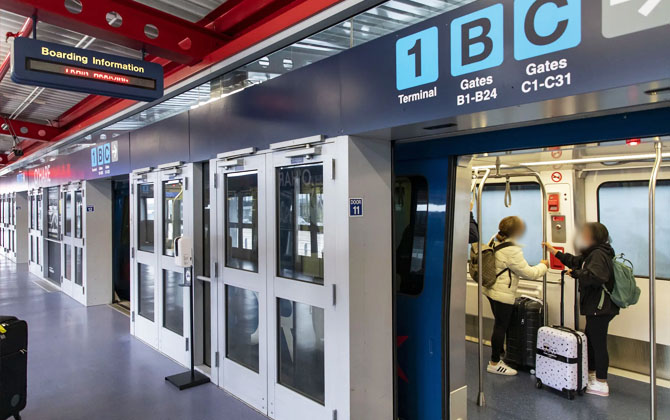
Using the ATS is straightforward. Follow airport signs marked ATS, go to the station platform, wait behind the platform screen doors, and board the next train for your terminal or the Multi-Modal Facility.
Trains are driverless and fully automated. Station stops are announced on board, and a chime sounds before doors open. The platform screen doors help keep the system safe by separating passengers from the tracks.
Every train serves all five active stations in both directions. For a simple path, train riders can use the ATS route as Terminal 1, Terminal 2, Terminal 3, Terminal 5, and Multi-Modal Facility, depending on direction and boarding point.
The ATS is sometimes described casually as an airport tram, but it is an automated people mover rather than a street tramway. Either way, it works like a short airport rail link for terminals, parking, and ground transportation.
Accessibility and Passenger Services
All ATS stations are fully accessible and provide access to the elevated tracks. The system is useful for passengers with luggage, families, travelers with mobility needs, and anyone connecting to parking or ground transportation.
Platform screen doors are used throughout the system, adding a safe barrier between passengers and the guideway. Trains run in both directions, and every train stops at all five active stations.
Passengers can use the ATS to reach Terminal 1, Terminal 2, Terminal 3, Terminal 5, parking areas, the CTA Blue Line connection, the consolidated rental car facility, Pace buses, and the Metra O’Hare Transfer station.
Tips for Tourists and Local Passengers
For tourists, the ATS is the easiest free way to move around O’Hare without booking a shuttle or paying an extra fare. For local passengers, it is also a practical link to parking, Kiss ‘n’ Fly, rental cars, and public transport.
If you are only moving between Terminals 1, 2, and 3 and you are already inside security, walking may be faster. If you are going to Terminal 5, the Multi-Modal Facility, rental cars, Pace buses, or Metra, the ATS is usually the right choice.
Allow extra time late at night, during maintenance, or when construction affects normal service. Replacement shuttle buses may be used during temporary service changes.
- Use the ATS for free transfers between terminals and airport parking areas.
- Check Terminal Transfer Bus timings if your connection involves Terminal 5.
- Expect longer waits outside peak periods.
- Follow airport signage for CTA, Metra, Pace, rental cars, and Kiss ‘n’ Fly.
Brief History and Modernization
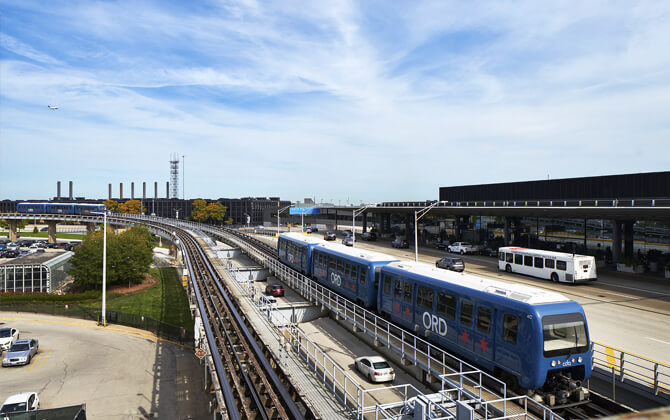
The ATS opened on May 6, 1993, after planning tied to O’Hare expansion and the need to connect the domestic terminals with the newer international terminal. Ground was broken in 1987, and the system was built to support airport growth, parking access, and smoother terminal transfers.
In 2018, the ATS entered a major modernization and expansion project as part of a larger US$800 million ($800 million) airport program. The work replaced the original 15-car fleet with 36 Bombardier Innovia APM 256 vehicles, upgraded infrastructure, and extended the line 0.61 km (0.38 miles) to the Multi-Modal Facility.
The system closed in January 2019 for construction and testing. During the closure, airport-funded shuttle buses served the destinations normally covered by the ATS. Service resumed on a limited schedule in November 2021, and full 24-hour operation returned in April 2022.
The ATS originally used French-based VAL technology and now operates Bombardier Innovia APM 256 trains. It can travel at speeds up to 80 km/h (50 mph).
Nearby Attractions
The ATS is mainly an airport transport system, but it can help travelers reach points of interest inside O’Hare during a layover. Because it connects all terminals, parking areas, and the Multi-Modal Facility, it makes it easier to move around the airport complex without extra cost.
O’Hare has public art installations and exhibitions across its terminals, including sculptures, murals, and rotating displays. The Aero Gallery in Terminal 2 is a notable stop for travelers interested in photography and art exhibits.
If time allows, passengers can also reach dining, shopping, and passenger amenities across the terminals, including the yoga room in Terminal 3. Keep your flight timing in mind, especially if you need to pass through security again after using the ATS.